Sea eagle poisoned in Northern Ireland: police appeal for info one year later!

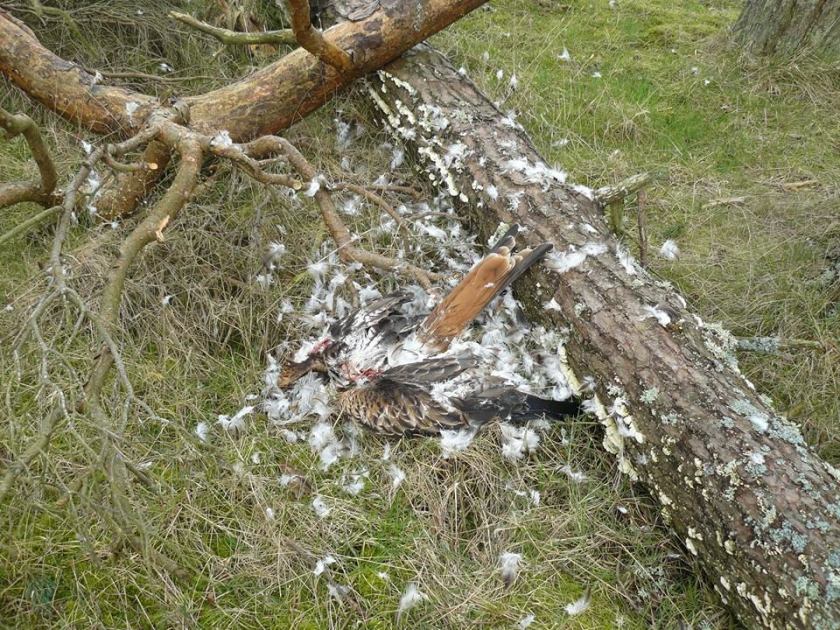
Last week, at the end of May 2014, the Police Service of Northern Ireland issued a vague press release calling for information about the discovery of a poisoned white-tailed eagle in the Armoy area of Northern Ireland. Toxicology results revealed the bird had been killed by the banned poison, Carbofuran.

The thing is, this bird was discovered in April 2013 – over a year ago – and yet this is the first time the PSNI have published anything about it.

Here’s what their press release said:

“Police are investigating the circumstances surrounding the death of a sea eagle.

During April 2013 police received a report from a member of the public regarding a dead sea eagle found within the Armoy area.

Subsequent toxicology reports confirmed Carbofuran poisoning to be the cause of death.

Carbofuran is a banned substance which is highly toxic and poses a serious risk to public health and safety.

Police are appealing to anyone with information in relation to this incident to contact them on the new non-emergency number 101″.

It’s not known if this was an adult or a juvenile bird, or whether it was from the Kerry reintroduction project in SW Ireland or whether it was a Scottish bird.

It’s also not known whether this appalling delay was due to the toxicology lab, or whether it was due to the police, or both. It’s not the first time that such chronically long delays have occurred here – see here and here for previous blogs. Whichever agency is responsible, it’s shocking that it has has taken over a year for an appeal for information.

It’s worth asking some questions about this. Let’s email the following people to ask about why it has taken so long to (a) appeal for information about this crime, and (b) warn the public in the Armoy area of Northern Ireland about the serious risk of a banned and highly toxic poison lying around in the countryside:

Environment Minister Mark H. Durkan (who incidentally has recently pledged improved action against wildlife crime – see here). His email address: doe.iemonitoring@doeni.gov.uk

Minister for Agriculture Michelle O’Neill (who is directly responsible for overseeing the process of toxicology sampling). Her email address: private.office@dardni.gov.uk

The local police office of the Armoy area: NPTBallycastle@psni.pnn.police.uk

Photo of a white-tailed eagle by Mike Watson


Head gamekeeper convicted of storing 5 banned poisons: gets conditional discharge

Derek Sanderson, a recently-retired head gamekeeper for a shooting syndicate on the Sledmere Estate in Yorkshire, was yesterday found guilty of storing five banned poisons in his house and in an unlocked outbuilding.

Those poisons were Carbofuran, Aldicarb, Mevinphos, Strychnine and Alphachloralose.

His sentence? A conditional discharge and a £15 victim surcharge!!!!!!!

The court apparently accepted that there was no causal link between the possession of these poisons and a dead buzzard found on Sledmere Estate in 2012 – confirmed as having been poisoned with Aldicarb.

Bob Elliot, Head of RSPB Investigations, has written an excellent blog about this, frankly, unbelievable case, here.

What sort of deterrent value is such a pathetic sentence?

White-tailed eagles hatch in Irish Republic again

WTE iRELAND 2013 Co Clare Allan MeeSome good news for a change….

For the second year running, white-tailed eagle chicks have hatched successfully at the Mountshannon nest in Co. Clare, as well as at a nest in west Cork in the Irish Republic.

The chick in the Mountshannon nest is the sibling of last year’s chick (see photo by Allan Mee), which was one of the first white-tailed eagles to fledge in Ireland in over 100 years, only to be shot and killed nine months later (see here).

These eagles have been reintroduced to Ireland following their extinction in the early 20th Century thanks to human persecution. Between 2007-2011, one hundred young eagles, donated by Norway, were released into Killarney National Park. The reintroduction project has been managed by the Golden Eagle Trust, who have published the following press statement about this year’s breeding success:

The first white-tailed eagle chicks of the year have been hatched in Co Clare and west Cork in recent weeks, it was announced today.

The rare birds were born in nests at Mountshannon, Co Clare and Glengarriff in west Cork, according to the Golden Eagle Trust which runs the reintroduction programme .

The chick born in Mountshannon is a sibling of a bird which was shot and killed three months ago. The deceased bird was one of two chicks born to the Mountshannon pair last year which became the first chicks to fly from a nest in Ireland in over a century. The crime is under investigation by the Garda.

The chick born in Glengarriff, the first of the year to hatch, unfortunately died at two weeks old. This was likely due to a combination of bad weather and inexperienced adults, Golden Eagle Trust project manager Dr Alan Mee said.

Nesting pairs at sites in Kerry and Galway have also laid eggs which have yet to hatch. At least half of the fourteen pairs of eagles across four counties have nested and laid eggs in recent weeks. Some pairs, including a nest in Killarney National Park, failed to breed.

These are the latest chicks in the reintroduction programme which began in 2007 with the release of 100 young Norwegian eagles in Killarney National Park .

Minister for Arts, Heritage and the Gaeltacht Jimmy Deenihandescribed it as “A very promising development after the shocking killing earlier this year. That was a dark day for this ambitious project to reintroduce these magnificent birds of prey into Ireland,” he said. “I hope these young eagles will have a long life in our skies,” he said.

The pair at Mountshannon gives the general public a chance to see some of the most spectacular birds at close quarters.

Dr Mee warned about risks of disturbance during the early stages of nesting which would be detrimental to success and could result in chicks being left unguarded. “We would caution people not to approach the nest area but instead avail of the unique opportunity to watch from nearby Mountshannon pier,” he said.

He continued: “The increase in the number of nesting pairs is encouraging and bodes well for the future of the species. White-tailed eagles can live for 25 to 30 years and generally mate for life. Ultimately the viability of the reintroduced programme depends on these chicks going on to breed themselves in Ireland. Each step brings us closer to that goal”.

The reintroduced birds came from Norway and the Norwegian Ambassador to Ireland, Roald Naess, also welcomed the news: “This is an excellent example of international cooperation on the practical level, aiming at preserving nature and biodiversity for the benefit of future generations”.

The white-tailed eagle reintroduction project is managed by the Golden Eagle Trust with the National Parks and Wildlife Service. One hundred white-tailed eagles were released in Killarney National, park between 2007 and 2011 and 29 have been recovered dead, mainly due to illegal poisoning.

The birds were historically a part of the Irish landscape before being made extinct in the early 20th century due to human persecution.

Well done to all involved in this historic conservation effort and best of luck to this year’s young pioneering birds. Let’s hope the sea eagle reintroduction project in East Scotland has equal success and that any chicks that manage to fledge here are able to survive for longer than last year’s bird, which un-mysteriously disappeared on a grouse moor in the North East Glens last month (see here).

Ross-shire Massacre: local farmers ‘have nothing to hide’

A farmer whose properties have been raided by police as part of the investigation into the Ross-shire Massacre has given an exclusive interview to the BBC (see here).

Ewan Macdonald, on whose land several of the poisoned birds were found, is claiming that he and the local farming community have nothing to hide. The report states that the police have not found anything to link Mr Macdonald to the crimes.

RK5

Mr Macdonald runs his farms in partnership with his brother, Shaun. In 2007, Shaun Macdonald was runner-up in the NFU Scotland Farming & Conservation Award, for ‘superb conservation efforts’, sponsored by the RSPB (see here).

Mr Macdonald is calling for an action group comprising landowners, police and RSPB, ‘to investigate the killings’. He suggests that there could be an innocent explanation for the deaths, such as a virus, or somebody feeding meat to the birds of prey which they do not realise has been contaminated.

Hmm. Interestingly, a number of prominent people from within the game-shooting industry have been making almost identical claims on social media in recent days.

Although the police have not yet publicly named the poison involved, it’s not that difficult to make an educated guess as to its identity, given the speed with which these birds died. An article in the Guardian last week (here) reported that a combination of poisons had been used, and also referred to “baits”. That pretty much rules out a ‘virus’ and unintentional feeding of accidentally contaminated meat then, eh?

Meanwhile, in another region of La-La Land, there are more denials about the extent of raptor persecution in Scotland. A row has broken out following Duncan Orr-Ewing’s (RSPB Scotland) comments in Holyrood magazine about persecution levels being comparable to those of the Victorian era (see earlier blog on this here).

McAdam 1In a BBC News article (here), Doug McAdam, CEO of the landowners’ organisation Scottish Land & Estates seems to have taken on the role of the headmaster: “For Mr Orr Ewing to suggest that wildlife crime is returning to Victorian levels is both irresponsible and untrue. He ought to know better“.

Then in a quite astonishing piece of spin, he goes on to say: “Official statistics in recent years have seen, overall, a downward trend in raptor persecution – even at some points demonstrating record low levels of poisoning incidents“.

Conveniently, by using the words ‘official statistics’ and ‘overall’, he has neatly side-stepped the fact that poisoning incidents doubled in 2013, and had the ‘official statistics’ included the discovery of poisoned baits, then the 36 pre-prepared Carbofuran baits found hidden on Leadhills Estate last year would have pushed the ‘official’ figure somewhat higher.

There’s also some waffle from Adam Smith of the GWCT (Scotland), who claims that “for a variety of reasons hen harriers may not be distributed right across the habitats which are suitable for them [i.e. grouse moors], but their national recovery is clear“.

What Mr Smith conveniently ‘forgot’ to mention was that the government’s own commissioned report on hen harrier conservation (published in 2011) demonstrated unequivocally that illegal persecution was the main reason this species isn’t present on large swathes of suitable habitat (i.e. grouse moors), and oh, the results from the latest national survey (conducted in 2010) show a 20% population decline (in Scotland) from the previous survey in 2004 (see here).

And finally, there’s a quote from Des Thompson of SNH. Surely as a member of the Scottish Government’s statutory conservation agency he’d be wanting to make sure that everyone knows that the damning, copious evidence was indisputable, right? Ah…..(we can’t be bothered to type it out – read the BBC article  if you’re interested in his opinion).

For any of you who’ve had a gut-full of the on-going persecution of our raptors, the game-shooting industry’s on-going denial of any involvement, and the authorities’ on-going and almost complete failure to address the situation, you might be interested in this post on Mark Avery’s blog. Hope to see many of you on or around 12th August 2014.

Raptor poisoning incidents doubled in 2013

The Partnership for Action against Wildlife Crime (PAW Scotland) has published the latest ‘official’ maps showing the distribution of reported raptor persecution incidents in Scotland during 2013.

Remember 2013? That was the government’s much heralded Year of Natural Scotland.

How disgraceful then, to see that reported incidents of raptor poisoning in 2013 doubled from the previous year. The victims this time around included a golden eagle, a red kite and four buzzards. And these were just the ones that were discovered – how many went undiscovered?

Not only did the reported poisoning incidents double, but other methods of illegal persecution were also reported, including disturbance, nest destruction, shooting and trapping, and these incidents numbered nearly three times the number of reported poisoning incidents.

It is clear, once again, that despite all the claims to the contrary, the illegal persecution of birds of prey in Scotland is still taking place with impunity. This has been vividly illustrated by the unfolding news from Ross-shire this week that at least 11 raptors have been found dead, including at least 8 red kites, all strongly suspected to be the victims of illegal poisoning. We fully expect this figure to rise…

This year, for the first time, the maps are now not just restricted to showing reported poisoning incidents; also included are the other types of persecution. This approach has to be applauded, especially as there is a real concern that the raptor killers are changing tactics in an attempt to show that the game-shooting industry is cleaning up its act (i.e. if they can keep poisoning figures low, they can point to this as an indication that persecution is dropping because they know that poisoning is the only method that is regularly mapped and monitored). Not any more, so well done to the Environment Minister for ensuring the other methods are also now ‘officially’ mapped and monitored.

However, the new and improved maps are still not showing the full picture.

For example, the recorded incidents shown on the new maps are limited to those where a dead or dying raptor has also been discovered:

The maps DO NOT show incidents where other birds/animals have been found poisoned with banned substances that have been categorised by SASA as ‘abuse’. Why not?

The maps DO NOT show incidents where an illegally-set trap has been found without an injured or dead raptor in/on it. Why not?

The maps DO NOT show the locations where satellite-tracked raptors have ‘mysteriously disappeared’ without trace. Why not?

But most significantly of all, the maps DO NOT show incidents where poisoned baits have been discovered, and have been categorised by SASA as ‘abuse’, unless a poisoned raptor was also found at the scene. Why not?

In our view, this is the most serious of all the omissions. The Scottish Government explains this away by saying that if there isn’t a dead/dying raptor at the scene then the discovery of poisoned baits can’t be classified as ‘raptor persecution’. Eh? Everybody knows that these poisons are routinely used to target birds of prey. To deliberately leave them off these poisoning maps is astonishing. In whose interest is it to exclude these incidents?

A good example of this sort of incident came last year when a massive stash of pre-prepared poisoned baits was found inside two game bags in woodland next to a grouse moor on Leadhills estate. Leadhills has a long and sorry history of poisoned baits and poisoned raptors having been found there, dating back several decades. A Leadhills gamekeeper was convicted in 2010 for er, laying out a poisoned bait on the moor. There were 36 baits in total in the 2013 stash; chopped up into bite-size pieces and sprinkled with Carbofuran. What on earth does the Government think those baits were going to be used for if not for poisoning raptors?

We think this particular stash of pre-prepared poisoned baits is the largest ever discovered in Scotland. The Leadhills baits are not included in the latest maps. Why? Because no poisoned raptors were found at the scene. Probably because the police failed to conduct any level of search when they turned up, in marked vehicles, to collect the baits.

If we, the BBC and Project Raptor had not reported on that incident, nobody would be any the wiser to it today. The police failed to issue a press release and now we find that the incident has been excluded from the ‘official’ poisoning maps. There’s now no doubt at all that the incident will also be excluded from the Scottish Government’s ‘official’ raptor persecution report that they’ll publish later this year.

‘Discovery of a massive stash of poisoned baits on a sporting estate? Where? When? Nope, we can’t find it in the ‘official’ statistics, you must be mistaken, it can’t have happened’.

Compare this approach with that used by the government/police to report on drug seizures. They regularly report on the recovery of big stashes of heroin, whether the heroin has actually found its way onto the street or not. They don’t say, ‘Oh, we can’t include that in our official stats because we didn’t find a junkie laying next to the stash”, do they? No, it all gets recorded as part of their official drug crimes statistics. What’s so different about the discovery of big stashes of banned poisons that are known to be used to illegally target birds of prey?

So, all in all then, situation normal in Scotland. Reported poisoning incidents have doubled from the previous year, other methods of killing raptors are being utilised with disturbing regularity, the game-shooting industry is still trying to spin the story into something positive (Doug McAdam is quoted in the Scotsman article as saying: ‘Good progress has been made on reducing illegal poisoning incidents’!!), the Scottish Government is still trying to spin the story into something positive (by comparing the 2013 figures with  figures from 2009 [the highest reported poisoning figures in 20 years] rather than focusing on the doubling of reported incidents from 2012 to 2013) and the ‘official’ statistics are still not showing the full scale of the problem.

See you all same place, same time, next year, when, judging by the recent Ross-shire news, once again we’ll be reporting that raptor poisoning incidents have increased over the last year. The only surprise will be by how much.

To view the ‘official’ maps on the PAW Scotland website see here.

Article in the Scotsman ‘Birds of prey spared poison – to be stamped to death’ – see here.

Article on BBC website ‘Number of birds of prey poisoned in Scotland doubles’ – see here.

Article on STV news ‘Rise in number of birds of prey illegally poisoned ‘very worrying” – see here.

Correspondence between SLE and Scot Gov re: poisoned eagle Fearnan

McAdam 2A freedom of information request has revealed some interesting correspondence between Doug McAdam, the CEO of the landowners’ organisation Scottish Land and Estates, and Paul Wheelhouse, the Scottish Environment Minister, on the subject of ‘Fearnan‘, the poisoned golden eagle found dead on a grouse moor in the Angus Glens in December 2013.

McAdam wrote to the Minister in January, setting out SLE’s “total condemnation” of the poisoning incident. He went on to say that SLE members in the area where Fearnan’s corpse was found were “perhaps more keen than anyone” that the culprit was found and prosecuted. He assured the Minister that these landowners had conducted their own enquiries and were sure that none of their staff were involved. He said that gamekeepers were “helping the police in all aspects of the investigation” (presumably this doesn’t mean giving a “no comment” response to any questions they are asked, as recommended by official SGA policy!). McAdam also emphasised how the introduction of vicarious liability had had an impact on best practice sporting management and besides, that gamekeepers love golden eagles, so much so that plans were under way to initiate ‘a golden eagle monitoring or conservation project’ in the Angus Glens.

You can read his letter here: SLE letter to Wheelhouse re Fearnan Jan 2014

Environment Minister Paul Wheelhouse, to his credit, wasn’t convinced.

In what we would call a fairly robust response, Wheelhouse told McAdam that he was going to be frank with him. He pointed out that the illegal poisoning of Fearnan was just one of “a catalogue of incidents associated with the Angus Glens area“. He went on: “I understand in fact that there has been something like a dozen incidents in this area since 2008“. [We actually know of at least 26 incidents since 2008, (36 if you go back to 2004) and we also know that several others have never been publicised: see here].

Wheelhouse continued: “In the absence of any other credible explanation, I can only conclude that, despite all our efforts, there remains an element of sporting managers and owners who continue to flout the law and defy public opinion for their own selfish ends…”.

He also pointed out that any carcasses or baits that were discovered were probably representative of “only a fraction” of those put out by the criminals (in other words, he agrees with the long-held view that what is discovered is just the tip of a very large iceberg).

He warned McAdam that if persecution didn’t stop he would be put under increasing pressure to impose further measures and he suggested that the game-shooting industry would do well to stop issuing media statements of condemnation [about persecution] that give the impression of being defensive and resentful.

You can read his letter here: Wheelhouse response to SLE Fearnan letter Feb 2014

We were quite pleased with Wheelhouse’s response – a definite baring of the teeth – but as we’ve often said, it’s his actions that count, not just words. We’re waiting to see whether he can bite.

It’s interesting that he hasn’t yet made a public comment about the discovery of those five red kites and one buzzard that was all over the news yesterday, suspected to have been poisoned. We understand the death toll has since risen but more on that later. We’ll be watching with very close interest to see whether SNH will now enforce the new enabling clause to restrict the use of General Licences on the land where these corpses were found. A conviction is not required for them to exercise this new clause; SNH must just have ‘reason to believe that wild birds have been taken or killed by such persons and/or on such land other than in accordance with the general licence’ (see here).

Case against Lloyd Webber’s gamekeeper moves to trial

The case against a gamekeeper employed on Andrew Lloyd Webber’s estate in Hampshire has moved to trial.

Mark Stevens, 42, is accused of a series of trapping offences alleged to have taken place on the Sydmonton Court Estate, Hampshire, in August and September last year. He has denied the charges.

His trial will take place in July 2014.

See here for previous blog.

Case against Stody Estate gamekeeper Allen Lambert: part 4

The case against Allen Lambert, a gamekeeper on the award-winning Stody Estate, continued in February and is now set to go to trial.

Lambert, 64, of Old Lodge House, Stody, Melton Constable in Norfolk has already pleaded guilty to storing the pesticides Mevinphos and Aldicarb, but has denied a series of further charges concerning the alleged killing and possession of 14 buzzards, 1 sparrowhawk and 1 tawny owl.

His trial will take place in May.

For previous blogs on this case see here, here and here.

Poisoned baits found on Leadhills Estate: ‘case closed’

One year ago, almost to the day, a significant haul of pre-prepared poisoned baits (36 in total) was discovered in two game bags that were hidden in woodland next to a grouse moor on Leadhills Estate. The 36 chopped up pieces of meat had been liberally sprinkled with the deadly banned poison, Carbofuran.

We blogged about this discovery in June 2013 (see here). We were highly critical of the police, who had failed to issue any press statement whatsoever, despite the proximity of the poisoned stash to a public caravan park (see photo, which we took in Feb this year). NB: This caravan park has no connection whatsoever to the Leadhills (Hopetoun) Estate.

Leadhills RPSWe were also critical of the police investigation, which included arriving on scene in marked police vehicles, thus notifying any poisoner(s) of their presence and allowing the poisoner(s) valuable time to hide any remaining evidence. We also criticised their failure to conduct a police search of the adjacent moor for any evidence of baits that had already been set out. Their failure to conduct an immediate search was particularly stupid given (a) the known history of poisoning incidents in this area and (b) the knowledge that one of the two game bags was only half full of baits.

In November 2013 we blogged about the high probability that a prosecution would not be forthcoming in this case (see here).

Today, we have just read a SASA report that confirms our suspicions. This incident is recorded as:

No suspect identified. Case now closed“.

The Untouchables get away with committing a serious wildlife crime, again….

Gamekeeper accused of pole-trapping on Lloyd Webber’s estate

It has been reported that a gamekeeper is appearing in court tomorrow to face various charges of alleged wildlife crime on Andrew Lloyd Webber’s country estate.

There is no suggestion Andrew Lloyd Webber was involved.

Mark Stevens, 42, is accused of five alleged offences. Three relate to allegations that a tawny owl was caught in a spring trap set on a pole on the Sydmonton Court Estate, Hampshire in August 2013. Two relate to allegations that spring traps were not properly set on the Sydmonton Court Estate in September 2013.

Tomorrow’s hearing will be the first in this case.

Further updates later…