More raptor persecution uncovered in the Scottish Borders

We’re still working our way through RSPB Scotland’s recently published twenty-year review (see here) and what a fascinating read it’s proving to be. We’ve already blogged about two things that caught our eye (see here and here), and now here’s the third.

On page 14 of the report, the following has been written:

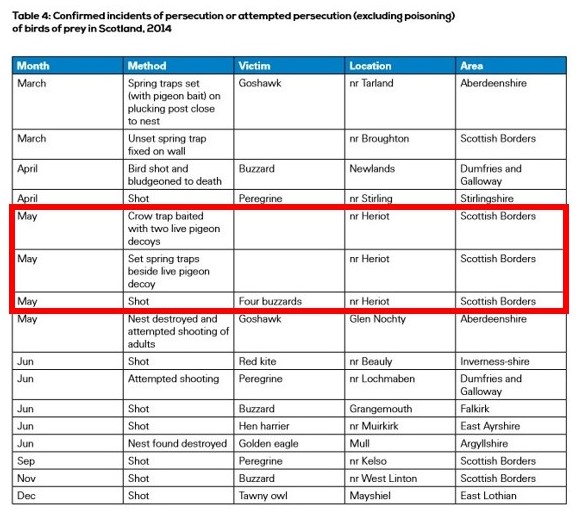
Lines 5, 6 and 7 of Table 4 describe the finding at one site, in an area intensively managed for driven grouse shooting, of a set crow trap, hidden within a small area of woodland, which was found to contain two feral pigeons indubitably being used as illegal lures to attract birds of prey. Under a tree, only a few metres away, were found the decomposed carcasses of four buzzards that had been shot, while a short distance from the crow trap a pigeon was found in a small circular cage, with four set spring traps set on the ground, hidden under moss, attached to the trap“.

Here’s a copy of Table 4, with lines 5, 6 and 7 highlighted:

Nr Heriot 2014

Also included in the report is a photograph of the pigeon inside a small cage with the four set spring traps hidden under moss:

Pigeon in trap Heriot 2014

So, according to the RSPB report, these offences were uncovered in May 2014 on a driven grouse moor in the Borders, with the location given as “nr Heriot“. Funny, we don’t remember seeing anything in the press about these crimes.

Hmm. Could these wildlife crimes be in any way related to SNH’s recent decision to serve a General Licence restriction order on parts of the Raeshaw Estate and Corsehope Estate (see here)? Both Raeshaw Estate and neighbouring Corsehope Estate can be described as being ‘nr Heriot’; indeed, the recorded property address for Raeshaw Estate is given as ‘Raeshaw House, Heriot, EH38 5YE’ (although the owner is only listed as Raeshaw Holdings Ltd., registered in the Channel Islands, natch), according to Andy Wightman’s excellent Who Owns Scotland website. And according to SNH, the General Licence restriction order on these two estates was served due to “issues about the illegal placement of traps” (see here). It’s possible that they’re connected, but it’s also possible that these crimes are unconnected with SNH’s General Licence restriction order on these two estates because Raeshaw isn’t the only grouse moor that could be described as being ‘nr Heriot’. Unfortunately, the (lack of) detail available in the public domain doesn’t allow us to be conclusive. Perhaps there’ll be some transparency once the legal arguments (see here) about the General Licence restrictions have concluded (which should happen fairly soon). Then again, perhaps there won’t.

If these crimes were not uncovered on either the Raeshaw or Corsehope Estates, we hope there’ll at least be a General Licence restriction order served on whichever grouse moor these traps were found because there’s been a clear breach of the General Licence rules – pigeons are not permitted as decoy birds in crow cage traps; set spring traps are not permitted out in the open; oh, and shooting buzzards is also illegal. There should also be a prosecution of course, but that’s highly improbable given the track record of non-prosecutions for raptor crimes uncovered in this part of the Borders.

There’s been a long history of raptor persecution “nr Heriot“, dating back to at least 2001. Here’s a list we’ve compiled of confirmed raptor persecution crimes, all listed within RSPB annual reports:

2001 May: poisoned buzzard (Carbofuran) “Heriot Dale”. No prosecution

2003 Feb: poisoned buzzard (Carbofuran) “Heriot”. No prosecution

2003 Mar: poisoned buzzard (Carbofuran) “Heriot”. No prosecution

2003 Apr: poisoned buzzard (Carbofuran) “Heriot”. No prosecution

2003 Nov: poisoned buzzard (Carbofuran) “Heriot”. No prosecution

2004 Feb: Carbofuran (possession for use) “Heriot”. No prosecution

2004 Feb: two poisoned buzzards (Carbofuran) “Heriot”. No prosecution

2004 Oct: poisoned buzzard (Carbofuran) “Heriot”. No prosecution

2005 Dec: poisoned buzzard & raven (Carbofuran) “Heriot”. No prosecution

2006 Sep: poisoned buzzard (Carbofuran) “Heriot”. No prosecution

2006 Oct: poisoned buzzard (Carbofuran) “Heriot”. No prosecution

2009 Mar: two poisoned buzzards (Carbofuran) “nr Heriot”. No prosecution

2009 Jun: poisoned red kite (Carbofuran) “nr Heriot”. No prosecution

2009 Jun: 4 x poisoned baits (2 x rabbits; 2 x pigeons) (Carbofuran) “nr Heriot”. No prosecution

2010 Nov: poisoned buzzard (Carbofuran) “nr Heriot”. No prosecution

2011 Jan: poisoned buzzard (Carbofuran) “nr Heriot” No prosecution

2013 Jun: shot + poisoned buzzard (Carbofuran) “nr Heriot”. No prosecution

2014 May: crow trap baited with two live pigeon decoys “nr Heriot”. Prosecution?

2014 May: four set spring traps beside live pigeon decoy “nr Heriot”. Prosecution?

2014 May: four shot buzzards “nr Heriot” Prosecution?

Not included in an RSPB annual report (because it happened this year): 2015 Jul: shot buzzard “found by side of road between Heriot and Innerleithen” according to media reports (see here). Prosecution?

Interestingly, also not included in the RSPB’s annual reports but reported by the Southern Reporter (here) and the Guardian (here), a police raid on Raeshaw Estate in 2004 uncovered nine dead birds of prey, including five barn owls, two buzzards, a kestrel and a tawny owl, described as being “poisoned or shot“. In addition, “a number of illegal poisons were discovered but no-one was ever prosecuted“. According to both these articles, during a further police raid on Raeshaw in 2009 ‘three injured hunting dogs were seized by the SSPCA on suspicion of involvement with badger baiting’. We don’t know whether that resulted in a prosecution.

Also not included in the above list is the sudden ‘disappearance’ of a young satellite-tagged hen harrier in October 2011. This bird had fledged from Langholm and it’s last known signal came from Raeshaw Estate. A search failed to find the body or the tag.

Fascinating stuff.

Location of shot hen harrier revealed as Cabrach

In the week before Christmas, RSPB Scotland published a 20-year review of crimes against birds of prey. We blogged about it (here) and mentioned that a few things within the report had caught our eye and that we’d come back to them. Here’s the first of those things.

Cabrach shot HH 2013

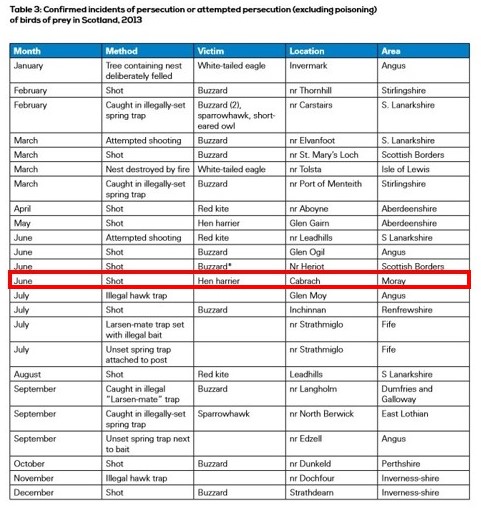
Table 3 in the report (see above) included a listing for a hen harrier that had been shot in June 2013. We knew about this crime as it had previously been listed in the Scottish Government’s 2013 Annual Wildlife Crime Report, but this was the first time that a location had been given – Cabrach, in Moray.

Cabrach is a parish which is ‘almost entirely under the aegis of the Glenfiddich and Cabrach Estate’ according to this fascinating report (here) and has been at the centre of raptor persecution investigations for a very long time. In 1998, a joint RSPB and Police investigation recorded ten persecution incidents between February and May. These included the discovery of 24 poisoned baits (ten rabbits, six pigeons, six grouse and two hares) that had been laid out on the hill. Three illegal pole traps were also found on the estate as well as an owl with legs that had been smashed in a trap. A dead peregrine was also discovered in the back of the head gamekeeper’s Land Rover – tests revealed it had been poisoned with Carbofuran. The head gamekeeper was convicted (for possession of the dead peregrine) and fined £700 (see here) but prosecutions for the other offences were not forthcoming, presumably due to the difficulty of identifying an individual culprit.

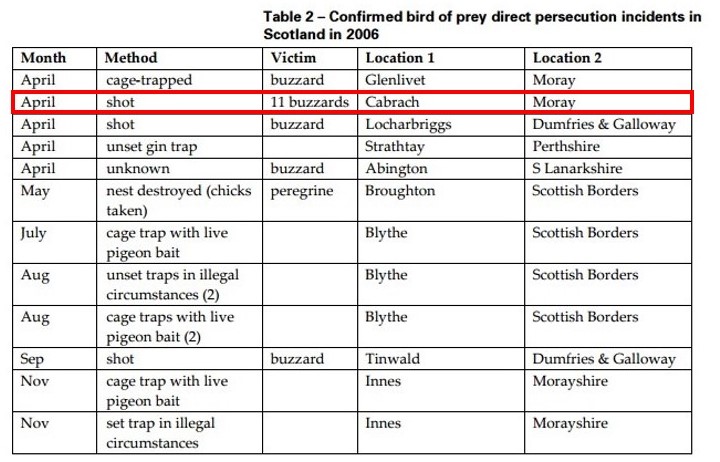
In April 2006 another gamekeeper on this estate was filmed shooting two buzzards that had been caught inside a crow cage trap. After he’d shot them he hid them inside a nearby rabbit hole. He was convicted and fined a pathetic £200 (see here). What wasn’t mentioned in court was that the corpses of another eleven shot buzzards had been retrieved during the investigation from nearby rabbit holes. Here they are listed in the RSPB’s 2006 persecution report:

Cabrach 11 shot buzzards 2006

And so what of the hen harrier shooting in June 2013? We think that this is the crime for which a 58-year old man was reported to the Fiscal in January 2014 (see here) because the hen harrier shot at Cabrach was the only listed hen harrier persecution incident in the RSPB’s data for June 2013 (see top table above).

So, if the 58-year old man was reported to the Fiscal almost two years ago, time is now running out for a prosecution – this case will become time-barred in six months time (June 2016). Let’s hope the Crown is on top of it and that there’s good enough evidence to secure a conviction. It hasn’t been reported whether the 58 year-old man has any connection to the Glenfiddich and Cabrach Estate and so at this stage it shouldn’t be assumed that he has.

New report highlights raptor persecution in Northern Ireland

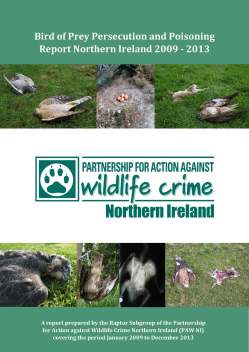
PAWNI Report 2009-2013The first ever ‘official’ report on raptor persecution in Northern Ireland has been published.

The report was prepared by the Raptor Subgroup of the Partnership for Action Against Wildlife Crime in Northern Ireland (PAWNI) – group members include the Northern Ireland Raptor Study Group (NIRSG), Police Service of Northern Ireland (PSNI), Northern Ireland Environment Agency (NIEA), Royal Society for the Protection of Birds (RSPB) and the National Wildlife Crime Unit (NWCU).

The report details confirmed raptor persecution crimes between 2009-2013, including location maps. A total of 33 raptors were confirmed to have been illegally killed during this five-year period, with buzzards, red kites and peregrines the most frequent victims but other species included golden eagle, white-tailed eagle, merlin and sparrowhawk.

The report serves a useful purpose to focus attention on the extent of raptor persecution in Northern Ireland and to encourage members of the public to report suspicious activity in their areas. It is anticipated that an annual persecution report will be published in future years.

NIRSG press release here

Read the report here

Buzzard with bait NI

Stody Estate subsidy penalty confirmed

Following on from our blog five days ago about the subsidy penalty imposed against the Stody Estate as a result of their gamekeeper’s criminal poisoning activities (see here), the Rural Payments Agency has now clarified the actual size of the penalty:

RPA Stody Estate subsidy penalty - Copy

There’s something odd about this. Converting the penalty from Euros to Sterling using a currency converter app, the subsidy penalty amounts to £184, 745.08 (although the app used by Mark Avery has calculated the conversion to be £192, 160.63). Whatevs! Whichever calculation is accurate, it’s still a huge penalty and that’s good. And it still represents the highest known subsidy penalty imposed in the UK for cross-compliance breaches related to raptor persecution offences.

However, both of these amounts are considerably less than the amount we had calculated in our earlier blog five days ago.

We had previously calculated the penalty to be £221,946.75, which was 75% of the SPS subsidy that Stody Estate had received in 2014. We got the information about the amount of subsidy the Stody Estate had received in 2014 by doing a search on CAP Payments.

When you compare our first calculation of what the penalty was (£221, 946.75), with the amount the Rural Payments Agency now say the penalty is (£184, 745.08 OR £192, 160.63), it becomes clear that around £37,000 worth of potential subsidy penalty has apparently gone missing.

So either the data on the CAP Payments website are inaccurate, or the Rural Payments Agency has miscalculated and imposed a smaller penalty than they should.

Not sure we have the appetite for going back to the RPA to ask for clarification – it’s too much like hard work for a Friday afternoon. We’re quite content just to know that the penalty has finally been imposed and that the Stody Estate has had to suffer serious financial consequences as a result of the criminal actions of their gamekeeper. Good stuff.

Stody Estate receives £221,000 subsidy penalty for mass raptor poisoning

stody buzzardsRegular blog readers will know that in October 2014, gamekeeper Allen Lambert was convicted of a series of wildlife crime offences on the Stody Estate, Norfolk, including the mass poisoning of birds of prey (10 buzzards and one sparrowhawk) which had been found dead on the estate in April 2013. He was also convicted of storing banned pesticides and other items capable of preparing poisoned baits (a ‘poisoner’s kit’) and a firearms offence (see here and here).

Lambert got off pretty lightly when he was sentenced in November 2014. Even though the judge acknowledged that Lambert’s crimes had passed the custody threshold, Lambert received a 10-week suspended sentence for poisoning 11 raptors (suspended for one year), a six-week suspended sentence for possession of firearms and dead buzzards (suspended for one year) and was ordered to pay £930 prosecution costs and an £80 victim surcharge. In our opinion (see here), this was absurdly lenient for one of England’s biggest known mass raptor poisoning incidents, and on top of that, Lambert wasn’t even sacked – it was reported that he’d been allowed to take early retirement from the Stody Estate.

Regular blog readers will also know that for the last year, we’ve turned our attention to the minted Stody Estate to try and find out whether the Rural Payments Agency had penalised the estate for breaches in cross-compliance and had removed any of their £MILLIONS of agricultural subsidies as punishment. To receive these tax-payer handouts, estates must comply with a number of measures (like don’t poison raptors) and if they don’t comply, then cross-compliance subsidies can be removed.

It’s taken a while to get any useful information about potential subsidy penalties at Stody Estate. Getting the RPA to reveal anything about this case has been like getting blood out of a stone, or the truth out of Allen Lambert. The RPA has wriggled and squirmed and done its best to avoid answering straightforward questions: see here for previous blogs about our correspondence with the RPA. However, we’re pretty much there now, although not quite there.

Our latest FoI received a response this week. We had asked the RPA (again) whether they’d now enforced a cross-compliance penalty on Stody Estate. They answered: “Yes“.

We asked what the penalty was for, exactly. They answered: “The penalty that has been applied was for a breach of farmer requirement A1, of the pre-2015 Statutory Management Requirement 1 (wild birds). The requirement reads: ‘You must not intentionally kill, injure or take any wild bird‘”.

We asked how much was the penalty applied to Stody Estate for this breach. They answered: “The financial amount has yet to be confirmed, however the penalty is 75% of the Single Payment Scheme payments made to the Estate in 2014“.

So, we now know a penalty has been imposed, but, unconvincingly, the RPA still claims it isn’t able to tell us how much that penalty is. Either they’re incompetent or unwilling to embarrass the Estate. Or maybe both.

Anyway, we’ve done a bit of digging. We’ve discovered that the Stody Estate received £295,929.01 from the Single Payment Scheme in 2014:

Stody SPS 2014 - Copy

75% of £295,929.01 is £221,946.75.

That’s a massive subsidy penalty! As far as we’re aware, this is the biggest ever civil penalty imposed for cross-compliance breaches in relation to raptor persecution crimes. Previously, the largest was £107,000 imposed on Glenogil Estate in 2008 following the discovery of 32 poisoned baits suspected of being used to target birds of prey (see here). Earlier this year, we blogged about the £66,000 subsidy penalty imposed on vicarious liability landowner Ninian Johnston Stewart, whose gamekeeper had been convicted of poisoning a buzzard (see here).

There may well have been other cases where a penalty greater than £221,946.75 has been imposed for cross-compliance breaches related to raptor persecution, but we’ve been unable to find any information. We’ve blogged previously (here) about why increased publicity is needed when these penalties are applied – the realistic threat of having thousands of pounds worth of subsidies removed from your business has got to be a far greater deterrent than the pathetically weak sanctions handed down in the criminal courts.

For this reason, over the next few months we intend to re-visit some other recent cases where a successful conviction has been secured for raptor persecution crimes and start asking some questions about whether those estates involved have also received a subsidy penalty (e.g. Kildrummy Estate, Cardross Estate for a start, and there are others).

There has previously been some discussion in the comments section of this blog about whether the new system for the Single Payment Scheme (replaced this year by the Basic Payment Scheme) would still allow for subsidy penalties for cross-compliance breaches relating to raptor persecution. Some readers thought the new system wouldn’t allow for penalties and other readers thought it would. It’s our understanding that the cross compliance rules for BPS in England still contain a Statutory Management Requirement (SMR) for Wild Birds (SMR2) stating that you must protect all wild birds, their eggs and their nests, so technically any recipient of BPS could still be fined for non-compliance with SMR2 if they were liable, vicariously or otherwise, for raptor persecution on their land.

However, the new system seems to be slightly different in Scotland where SMR2 states that you must protect all wild birds, their eggs and nests if you have land classified as a Special Protection Area. That could mean that a Scottish recipient of BPS could only be fined for breaching SMR2 if the breach took place in an SPA. If that interpretation is correct, it would exclude rather a lot of land. We’ll be seeking clarification from the Scottish Government about whether raptor persecution on non-SPA land would be considered a breach of the new SMR2.

A final word – thank you to all the blog readers who have exerted pressure on the RPA over the last year regarding the Stody Estate case; we know that a number of you have been involved. Had it not been for this sustained effort, the Stody Estate may well have escaped a penalty altogether, or perhaps been given a much smaller penalty. Well done!

Photo of some of the poisoned buzzards found at Stody Estate is by Guy Shorrock (RSPB Investigations)

Stody Estate subsidy penalties: another update

IMG_4752 (2) - CopyA year ago, gamekeeper Allen Lambert was convicted of a series of wildlife crime offences on the Stody Estate in Norfolk, including the mass poisoning of birds of prey (10 buzzards and one sparrowhawk) which had been found dead on the estate in April 2013 (see here and here).

We found out that the Stody Estate had received millions of pounds worth of agricultural subsidies (i.e. money given to them from our taxes to help them farm on the condition they look after the wildlife and wildlife habitats under their management) and we wanted to find out whether the Estate would now face a financial penalty in the form of a reduction in their subsidies for what was a very serious breach of the cross-compliance regulations.

One year later and we’re still trying to find out.

In October 2014, the Rural Payments Agency (RPA) told us they “would consider action against Stody Estate“, although one of our blog readers was told, “there is no investigation ongoing” (see here).

In December 2014, one of our blog readers contacted the RPA again to ask for an update. The RPA responded in January 2015 by saying “We are unable to provide you with any meaningful response as we do not hold any information that answers your questions” (see here).

In July 2015, we again wrote to the RPA to ask whether they had imposed a penalty on Stody Estate. We were told that as the convicted gamekeeper wasn’t the actual subsidy recipient, the RPA was trying to determine whether there was “a link” between the convicted gamekeeper and the subsidy recipient (i.e. his employer) and if so, whether the recipient (Stody Estate) could be considered liable for the actions of the gamekeeper (see here). Amazing.

As the one-year anniversary of the gamekeeper’s conviction approached, in September 2015 we wrote to the RPA again to see whether they’d now worked out “a link” between the convicted employee and his employer. Last week they responded with this:

The Rural Payments Agency (RPA) has notified the Stody Estate in Norfolk that a cross compliance breach occurred, as [sic] result of the actions of their gamekeeper. This is because the estate is vicariously liable for the actions of their employees. Under European cross compliance rules, the RPA is obliged to follow-up reports of cross compliance breaches brought to its attention. The rates of applicable reductions are explained in the scheme rules“.

So, the inefficient RPA has taken a year to decide that there was a cross compliance breach, but we still don’t know whether a financial penalty has been imposed, and if it has, what its value is.

According to the RPA’s ‘scheme rules’, cross compliance breaches can be categorised  as either ‘negligible’ or ‘intentional’, and the severity of the penalty is dependent on this.

For negligible non-compliance (falls below the standard of care expected of a competent claimant) subsidy payment is normally reduced by 3% but could range from 1-5% depending on the extent, severity, re-occurrence and permanence of the non-compliance.

For intentional non-compliance, payments will normally be reduced by 20%, but may be reduced to 15% or increased to 100% depending on the extent, severity, re-occurrence and permanence of the non-compliance.

What do you think? Is laying out banned poisons that kill 11 raptors a negligible or intentional non-compliance?

Given that we don’t know how the RPA will determine if the breaches were negligible or intentional, and given that we don’t know how much of our money was awarded to the Stody Estate in 2013 (the year the breaches occurred), although judging by the amounts they received between 2004-2012 it was probably a considerable sum (see here), it’s difficult for us to establish even a rough guesstimate of what the penalty might be, and that’s assuming that the RPA has decided a penalty is warranted.

So, we’ve written, again, to the RPA to ask whether a penalty has been imposed (and if not, why not) and if it has been imposed, how much is it?

Misleading conclusions from Scot Gov’s 2014 wildlife crime report

Wildlife Crime in Scotland 2014 reportYesterday the Scottish Government published its latest report on wildlife crime: ‘Wildlife Crime in Scotland: 2014 annual report’ (see here).

It was accompanied by a Government press release (here) with a headline statement claiming ‘ Recorded wildlife crime dropped by 20 per cent in the period 2013-2014‘. This claim has been regurgitated, without real examination, in much of the national press, which will give the public the impression that all’s going swimmingly in the fight against wildlife crime in Scotland. This couldn’t be further from the truth.

Let’s start with the report’s name. It claims to be the ‘2014 annual report’, but actually the period covered by the report is the 2013/14 financial year: April 2013 to March 2014. That means the majority of the data are from 2013 (9 months worth) – these are wildlife crimes that took place as long ago as 2.5 years and the most ‘recent’ took place 18 months ago (March 2014). Many more offences occurred during the nine months between April-Dec 2014 but they are not included in this report. Although the report itself does explain the reasons behind this odd time-frame selection, the report’s title does not, which means anyone just browsing the headline news will be given a false impression of how recent these findings are. It’s a small point, but it’s an important one.

However, there are bigger issues than just a misleading report title.

If you take the report’s data at face value (which we don’t – more on that in a second) and accept that it’s representative of all reported wildlife crime in Scotland between April 2013 and March 2014, you might also accept that the claim of a 20% reduction in recorded wildlife crime is accurate. But if you look at the data (Table 1), you’ll notice that this supposed broad reduction (i.e. reduction of recorded wildlife crimes in general) is actually almost entirely due to a large reduction in one particular area of wildlife crime: specifically, fish poaching. To then apply this reduction of a specific wildlife crime to all other types of wildlife crime in a broad sweeping statement is wholly misleading.

Our main issue with this report, as with previous reports, is the Government’s insistence on only using crime data that has been recorded by the Police. Although this report does attempt to address this problem by including separate sections on data collected by others (e.g. Scottish Badgers, SSPCA), these data are still not included in the overall analysis of wildlife crime trends because these incidents weren’t recorded on the Police national crime database. A good example of this is shown in Table 10, which details the number of wildlife cases investigated by the SSPCA. The report accepts that cases investigated solely by the SSPCA (as opposed to cases where the SSPCA has assisted the Police) are not included in the ‘official’ recorded crime data because ‘they are not recorded on the police national crime database’. So in effect, 69 cases that were investigated solely by the SSPCA during the period covered by the report are absent from the national figures. It seems bizarre that even though these data are available (of course they are, they appear in this report, albeit in a separate section!) they are still excluded from the main analysis. This blatant exclusion immediately reduces our confidence in the robustness of the ‘national’ data.

Another blatant exclusion of data is demonstrated in Table 17 in the Raptor Persecution section. This table identifies only 16 bird of prey victims from the mass poisoning in March 2014 known as the Ross-shire Massacre, excluding the other six victims that were found. The report justifies this exclusion by explaining that evidence of poisoning was not found after examinations of those six raptors. That’s fair enough, but surely we’re not expected to believe that those six victims all died of natural causes, in the same small area, and at the same time, as the 16 confirmed poisoning victims? They don’t appear in the figures because a crime couldn’t be identified, but they still died as a result of this crime and to pretend otherwise is nonsense.

An additional problem that erodes public confidence in the accuracy of the ‘national’ data is the issue of how carefully wildlife crimes are recorded. A report published earlier this year (which includes part of the period covered by this latest Government report) revealed systemic problems with the under-recording of several types of wildlife crime as well as failures by the police to undertake follow-up investigations on reports of suspected wildlife crimes (see LINK report here). If the police don’t follow up with an investigation, the incident is unlikely to be recorded as a crime. Until these issues are suitably addressed, the accuracy of ‘official’ ‘national’ wildlife crime data will inevitably be viewed with suspicion.

So, we don’t have much confidence in this report’s data and we certainly don’t agree with the Government’s claim that (overall) recorded wildlife crime has reduced by 20%, but there are some positives. It’s clear that more thought has been put in to the material contained in this year’s report and there is definitely more clarity about the sources used. That’s good progress.

There are also a couple of things in this report that we are particularly pleased to see.

First, let’s go back to Table 10 (SSPCA data). You may remember (if you have a long memory) that in March 2014, the Government opened its consultation on whether to increase the investigatory powers of the SSPCA. That consultation closed in September 2014 and, over a year later, we’re still waiting for a decision. It’s our understanding that one of the main sticking points is with Police Scotland (who, as you’ll recall, strongly objected to an increase of powers – see here). Apparently, the current sticking point is that Police Scotland are worried that they’ll be excluded from wildlife crime investigations because the SSPCA ‘refuses to work with them’. However, if you look at Table 10, you’ll notice that 50% of all wildlife cases taken by the SSPCA during the period covered by this report were undertaken in partnership with the Police. That’s 50%. Does that look like an organisation that is refusing to work with the Police? It doesn’t to us.

The second point of interest in this report appears in Table 18b. This table provides information about recorded bird of prey crimes between April 2013 and March 2014. Have a look at the 7th entry down:

Species: Hen Harrier

Police Division: Aberdeenshire and Moray

Type of Crime: Shooting

Date: June 2013.

Why is this of particular interest? Well, cast your mind back to January 2014 when we blogged about a vague Police Scotland press release that stated a man had been reported to the Crown Office ‘in relation to the death of a hen harrier’ in Aberdeenshire that took place in June 2013 (see here). So it turns out this hen harrier had been shot. Amazing that it took over two years for this information to be made public. But that’s not the most interesting bit. For this unnamed individual to be reported to the Crown for allegedly shooting this hen harrier means that the Police have some level of evidence that they think links him to the crime. If they didn’t have evidence, he wouldn’t have been reported. So, the alleged crime took place 2.4 years ago. The Crown Office was notified 1.9 years ago. What’s happening with this case? Is there going to be a prosecution? Why such a long delay for a crime that is deemed a ‘priority’ by the Scottish Government?

Environment Minister misses the point

annie-with-her-sat-tagIn August this year, over 300 blog readers emailed Environment Minister Dr Aileen McLeod in response to the news that Langholm hen harrier ‘Annie’ had been found shot dead on a Scottish grouse moor (see here). Well done to all of you who took the time to write.

The Minister issued a press statement within a few hours. The response time was impressive, the content wasn’t (see here).

Now a month later, the Minister has been responding to the individual emails that she received (well, one of her civil servants has been responding on her behalf). We’ve been sent a number of these responses and they’re all identical. Here’s what the response says:

Thank you for your letter of 11 August 2015 to the Minister for Environment, Climate Change and Land Reform, Dr Aileen McLeod. I have been asked to respond on her behalf. Please accept my apologies for the delayed response.

Let me reassure you that the Scottish Government has been and remains committed to tackling wildlife crime. Since 2007 we have built a strong and broad-based Partnership for Action against Wildlife Crime in Scotland (PAW Scotland) involving conservationists, land managers and law enforcement.

We also have a group dedicated to tackling raptor persecution – the PAW Scotland Raptor Group – which is made up of representatives from law enforcement and government agencies, RSPB, Scottish Raptor Study Groups, Scottish Land & Estates, Scottish Gamekeepers Association, British Association for Shooting and Conservation, Game & Wildlife Conservation Trust and the Cairngorms National Park Authority.

We have pursued a number of initiatives since 2007, including for example

  • the first restrictions on the use of General licences by those convicted of wildlife crimes
  • tightening up of law relating to trapping and snaring, including the introduction of training and registration requirements for operators
  • new provisions in the Wildlife and Countryside Act relating to the protection of the nests of birds such as white-tailed eagles and protection against harassment for birds such hen harrier
  • the introduction of vicarious liability provisions for offences related to wild birds

Some of these initiatives were ground-breaking in the UK and have now also been adopted by England and Wales.

There are also a number of pieces of current work which are underway, which I will take this opportunity to update you on.

Pesticides Disposal Scheme – this Scottish Government funded scheme ran from 23 February to 29 May 2015. The scheme has removed over 720kg of highly dangerous toxic chemicals from Scotland’s environment and ensured they cannot be used to poison wild birds. Details about what was removed from Scotland’s environment were published on 9 September. There remains no good reason for people to retain these substances.

Wildlife Crime Penalties Review – this review has taken a comprehensive look at whether the penalties available to the courts in wildlife crime cases are adequate and appropriate. The review has been submitted to Ministers and will be published shortly.

Further restriction of General Licences – this new procedure which has been recently introduced will see restrictions being imposed on the use of general licences over land where it is believed the wildlife crime has taken place. A number of cases have been under consideration and I expect further news to be made public imminently. SNH will publish details of imposed restrictions when it is appropriate to do so.

Law enforcement obviously has a key role to play. Since being established, Police Scotland has ensured that there is a wildlife crime liaison officer (WCLO) in each police division and has also already delivered and made significant commitment to ongoing training not only for existing WCOs, but also to other officers force wide. Police Scotland aim to bring a consistent and professional approach to wildlife crime investigations, including the use of modern forensic techniques.

The Crown Office and Procurator Fiscal Service has a dedicated Wildlife and Environmental Crime Unit with four specialist Procurators Fiscal who have developed an extensive knowledge in this area, and have now secured the first prosecution in relation to vicarious liability. There has also been the first custodial sentence for a gamekeeper found guilty of killing wild birds.

The Scottish Government has previously stated that it would be prepared to consider the licensing of shooting businesses to further regulate this sector, however it is important that we are able to assess the impact of the measures that have been recently implemented, or are still to be fully implemented, before consideration is given to the introduction of any further regulatory measures. We do not consider it is appropriate to react to every instance of criminal activity with further changes to the law. Scotland already has some of the strongest laws to deal with wildlife crime. Appropriate action by the law enforcement agencies is the correct response to wildlife crime, as with any other criminal activity.

I hope that this response demonstrates the breadth of work that is ongoing in this area.

Yours faithfully,

Karen Hunter

Wildlife Crime Policy Officer

END

As you can see, it’s full of the usual guff about ‘commitment’ and ‘partnership-working’ yada yada. But there are a couple of things that particularly interested us –

First:

We have pursued a number of initiatives since 2007, including for example

  • the first restrictions on the use of General licences by those convicted of wildlife crimes
  • tightening up of law relating to trapping and snaring, including the introduction of training and registration requirements for operators
  • new provisions in the Wildlife and Countryside Act relating to the protection of the nests of birds such as white-tailed eagles and protection against harassment for birds such hen harrier
  • the introduction of vicarious liability provisions for offences related to wild birds

Some of these initiatives were ground-breaking in the UK and have now also been adopted by England and Wales“.

Hmm. As far as we’re aware, only one of these “ground-breaking initiatives” has been adopted elsewhere, not “some of them”. The one that has been adopted is the restriction on the use of General Licences by those convicted of wildlife crimes. Although this can hardly be called a “ground-breaking initiative” when the person who is no longer permitted to use a General Licence on account of a relevant conviction can simply apply to the statutory agency (SNH or Natural England) for an individual licence to enable them to continue their trapping and killing activities as if they hadn’t been convicted at all!

The introduction of training and registration requirements for snare operators has not “also been adopted by England and Wales“. And how’s that going in Scotland, by the way? Ooops, looks like Police Scotland has cocked up big time by issuing duplicate tag numbers to 60 individuals, due to ‘an administrative error’ – see here. Brilliant.

The new provisions of the WCA relating to extra protection for white-tailed eagles and hen harriers  has not “also been adopted by England and Wales” because the enabling legislation is Scotland-specific (see here).

The introduction of vicarious liability provisions for offences related to wild birds has not “also been adopted by England and Wales“. Indeed, the Westminster Government has thus far refused to consider it as a serious option (see here and here).

Aileen McLeod MSP3The other statement in the Minister’s response that interests us greatly is this:

The Scottish Government has previously stated that it would be prepared to consider the licensing of shooting businesses to further regulate this sector, however it is important that we are able to assess the impact of the measures that have been recently implemented, or are still to be fully implemented, before consideration is given to the introduction of any further regulatory measures. We do not consider it is appropriate to react to every instance of criminal activity with further changes to the law“.

In our opinion, the last sentence indicates that the Minister has completely missed the point. Nobody is asking, or expecting, further changes to the law in response to every instance of criminal activity. That would be ludicrous. The point that we, and everyone else who sends her emails is making, is that every criminal raptor persecution incident is yet further evidence that the current measures are clearly not working!

Since the latest ‘new measures’ were first announced by former Environment Minister Paul Wheelhouse in July 2013 (see here), many of which are still to be implemented over two years later, we have seen a continuous number of reported crimes (which undoubtedly will be the very tip of a very large iceberg). Here are some of them, all detailed on this blog, and we expect there to be many more that haven’t yet made it in to the public domain:

June 2013: Shot buzzard found close to a grouse moor in the Borders, later revealed to have also been poisoned.

July 2013:  Buzzard shot in the throat in North Ayrshire.

August 2013: Red kite found shot close to a grouse moor in Leadhills.

September 2013: Poisoned buzzard found in Stirlingshire.

October 2013: Langholm hen harrier ‘Blue’ disappears.

October 2013: Half-made raptor trap discovered on a sporting estate in Angus.

December 2013: Buzzard died of ‘unnatural causes’ close to a grouse moor ‘near Tomatin’ [we now know it had been shot].

December 2013: Golden eagle ‘Fearnan’ found poisoned on Angus grouse moor.

January 2014: Man reported for hen harrier death in Aberdeenshire.

January 2014: Dead bird (species unknown) & suspected poisoned bait found in South Lanarkshire.

February 2014: Poisoned peregrine found close to a grouse moor in Leadhills.

March 2014: 22 poisoned raptors (16 red kites + 6 buzzards) found on farmland in Ross-shire.

April 2014: Man arrested for alleged attempted raptor trapping in Aberdeenshire.

April 2014: ‘Illegally-killed’ peregrine found near Stirling [we now know it had been shot].

April 2014: East Scotland sea eagle chick ‘disappears’ on Aberdeenshire grouse moor.

April 2014: Gamekeeper charged with allegedly bludgeoning & stamping on buzzard on a sporting estate in Dumfriesshire.

April 2014: Poisoned buzzard found in Fife.

May 2014: Masked gunmen caught on camera shooting at active goshawk nest in Cairngorms National Park.

June 2014: Allegations emerge of ‘coordinated hunt & shooting’ of a hen harrier on a grouse moor in Aberdeenshire last year.

June 2014: Hen harrier died on a grouse moor near Muirkirk “as result of criminal act”. We later discover it had been shot.

June 2014: Red kite found on railway line, shot in the head.

July 2014: Red kite found poisoned on a grouse moor in Stirlingshire.

September 2014: Red kite found poisoned on a grouse moor in Morayshire.

November 2014: Buzzard fatally injured after being shot & stamped on in the Borders.

December 2014: Tawny owl shot dead in East Lothian.

February 2015: Peregrine found poisoned on a grouse moor in Stirlingshire.

March 2015: Kitten found poisoned (Carbofuran) close to a grouse moor in the Borders.

March 2015: Hen Harrier ‘Annie’ found shot dead on a South Lanarkshire grouse moor.

May 2015: Red kite fatally injured after caught in illegal spring trap on a grouse moor in Stirlingshire.

July 2015: Buzzard fatally injured after found shot close to a grouse moor in the Borders.

August 2015: Buzzard shot dead in Loch Lomond & the Trossachs National Park.

August 2015: Red kite fatally injured close to a grouse moor ‘near Tomatin’ – cause of death “not due to natural causes”. [Was probably shot].

The Minister points to two recent notable successes – the vicarious liability conviction and the custodial sentence given to a raptor-killing gamekeeper. They were indeed huge results and were warmly welcomed at the time. However, they are still the exceptions to the rule and we have since seen a number of convictions this year that have resulted in the usual derisory sentences (e.g. Michael Johnston fined £400 for possession of banned poison Strychnine; Gamekeeper James O’Reilly given a 240 hours Community Payback Order for four offences including the use of a banned gin trap; Poultry farmer Michael Harrison fined £600 for shooting and stamping on a buzzard; Gamekeeper William Dick fined £2,000 for bludgeoning and stamping on a buzzard). We have only seen one vicarious liability conviction in three and half years since the new legislation was enacted.

We keep being told that ‘we need more time to assess the impact of the new measures’. Why do we? Isn’t it bleedin’ obvious that raptor persecution is continuing despite all the so-called partnership-working, new measures and deterrents? The Minister may well be irritated that her inbox gets bombarded after each raptor crime but she can expect more of the same each and every time we hear of yet another crime. And there will be more, mark our words.

She should also know that if and when she decides to make a stand with something forceful and tangible, she’ll be deluged with emails of appreciation and support.

Stody Estate subsidy penalties: an update

IMG_4752 (2) - CopyOn 1st October 2014, gamekeeper Allen Lambert from the Stody Estate in Norfolk was found guilty of poisoning 10 buzzards and one sparrowhawk, which had been found dead on the estate in April 2013. He was also convicted of storing banned pesticides & other items capable of preparing poisoned baits (a ‘poisoner’s kit’), and a firearms offence (see here and here).

On 6th November 2014, Lambert was sentenced. Even though the magistrate acknowledged that Lambert’s crimes passed the custody threshold, he only received a 10 week suspended sentence for poisoning 11 raptors (suspended for one year), a six week suspended sentence for possession of firearms and nine poisoned buzzards (suspended for one year), and was ordered to pay £930 prosecution costs and an £80 victim surcharge.

On 5th October 2014, we blogged about the millions of pounds worth of subsidies that had been awarded to Stody Estate in recent years (see here) and we encouraged blog readers to contact the Rural Payments Agency (RPA) to ask whether Stody Estate would receive a financial penalty in the form of subsidy withdrawal for being in breach of the terms & conditions of their subsidy-fest.

On 10th October 2014, the RPA responded by saying they would consider what action could be taken against Stody Estate (see here).

Then it all went quiet.

In December 2014, one of our blog readers submitted an FoI to the RPA to ask what was happening. In January 2015, the RPA responded by saying they ‘weren’t able to provide a meaningful response’ but said they would take action if it was found to be appropriate to do so (see here).

Six months on, we thought it was time for an update so an FoI was sent to the RPA to ask whether they had implemented a subsidy penalty. This is their response:

Dear XXXXX XXXXX

Thank you for your email dated 5 July 2015 regarding Stody Estate.

Cross Compliance rules only apply to recipients of Single Payment Scheme or certain Rural Development scheme payment in the year in which a cross compliance breach is found.

The person prosecuted for the offences mentioned in your e-mail is not a recipient of either of these types of payment.  Therefore before RPA can take further action, it will be necessary to determine whether there [sic] a link between this person and a subsidy recipient and, if there is, whether that recipient can be considered liable for the actions of the person who committed the breaches.

Identifying whether the person prosecuted is linked to a subsidy recipient will form a key part of our investigations.

Should you have any further queries please contact us again quoting reference number XXXXX

Regards

Helen Hunter

Customer Service Centre, Operations

END

This is all very interesting. The mass illegal poisoning of birds of prey took place on Stody Estate and a Stody Estate employee, gamekeeper Allen Lambert, was convicted of these crimes and several others. But the Rural Payments Agency is still trying to determine whether there is a link between Lambert and the Stody Estate. Eh?

It’s not very convincing is it?

Perhaps the RPA should have a read of the judge’s comments about the relationship between Lambert and his (now former) employer – see here.

Update on convicted gin trap gamekeeper James O’Reilly

A few updates on some of the questions we asked yesterday following the conviction of Scottish gamekeeper James O’Reilly (see here)….

1. We asked the Cardross Estate whether O’Reilly was still employed as a gamekeeper on their estate. They have issued the following statement:

CARDROSS ESTATE REFUTES WILDLIFE CRIME ALLEGATIONS

(Issued on behalf of Cardross Estate)

Cardross Estate today issued the following statement after the conviction and sentencing of a gamekeeper at Stirling Sheriff Court on offences under the Wildlife and Countryside Act, 1981.

Sir Archie Orr-Ewing, owner of Cardross Estate, said: “The reputation of the estate has been unjustly tarnished by the publicity around these court proceedings. The estate does not have any involvement whatsoever in the sporting management of the land in question. The area of land where these offences occurred is let on a long-term lease to a third party who has full rights and responsibilities for the management of sporting activity. The gamekeeper is employed by the third party and has never been employed by the estate.

“Having co-operated fully with the authorities during their investigation and having been asked to be a prosecution witness, I am bitterly disappointed that the Crown Office did not see fit to clarify the estate’s position in its public statement following the case.

“Cardross Estate is an estate that takes its land managcment responsibilities very seriously and is a business focused on the local community and the delivery of sustainable rural enterprise. In particular, we are committed to contributing to the tourism offering of the Loch Lomond and Trossachs National Park.”

END

According to some media outlets, O’Reilly no longer works on the Cardross Estate and some claim he no longer works in the gamekeeping industry.

2. We asked the Scottish Gamekeepers’ Association whether O’Reilly was a member of the SGA, and if so, has he now been booted out. They have issued the following statement, which seems to carefully avoid answering the question:

SGA RESPONSE

Responding to the sentencing of a former gamekeeper, who used an illegal gin trap to catch a buzzard, a spokesman for The Scottish Gamekeepers Association said: “This is the first we have heard about this case but, as an organisation, we are appalled. These actions have no place in modern gamekeeping and show ignorance of the legal requirements which are involved in being in the profession. They are an affront to all those who advocate high standards and take their responsibilities seriously and with care.”

END

Actually, O’Reilly’s criminal activities didn’t show ignorance of the legal requirements; according to the press statement issued by the Crown Office yesterday, O’Reilly had undertaken the snaring course (run by either GWCT or SGA) legally required for anyone wanting to set snares in Scotland. He’d passed the course so he wasn’t ignorant, he just chose to blatantly disregard the law.

We’re still interested in whether O’Reilly was an SGA member at the time he committed these offences. If you’re also interested, you too can email them again: info@scottishgamekeepers.co.uk

3. We asked Scottish Land & Estates whether the Cardross Estate was a member of their organisation and if so, had it now been booted out.

They haven’t yet made a public statement, although they did respond to a private email from one of our blog readers by saying that the Cardross Estate resigned from their organisation in 2012.

4. We asked Environment Minister Dr Aileen Mcleod when the Scottish Government will publish the recently completed Wildlife Crime Penalties Review, in light of the pathetic sentence given to O’Reilly for his barbaric crimes. One of her civil servants has issued an acknowledgement email, saying someone will respond soon.

On a related note, there’s an article here with further details about why the Sheriff didn’t give O’Reilly a more fitting punishment. It includes a suggestion from O’Reilly’s defence agent that the gamekeeper was ‘under pressure from above’. It’ll be interesting to see whether the Crown Office decides to go for a vicarious liability prosecution.