Even more delay in case against Morvich Estate gamekeepers

The case against three gamekeepers who are accused of committing alleged wildlife crimes on the Morvich Estate at Rogart, Sutherland in February 2012 has been adjourned for a 5th hearing.

The case against Mathew Ian Johnston, Jamie Robert Neal and William Robert Docharty was first called at Dornoch Sheriff Court on 27th November 2012 (see here), where a trial date was set for 19th March 2013, with an intermediate diet on 18th February 2013.

However, at the hearing on 18th February 2013 (here), a further hearing was set for 13th May and a possible trial date set for 9th July, pending the outcome of the hearing in May.

At the hearing on 13th May 2013 (see here), the defence asked for another adjournment to allow more time for preparation. The next hearing date was set for 25th June 2013.

At the hearing yesterday (25th June 2013)…guess what? Another hearing was set for 8th July 2013.

Scottish gamekeeper convicted for poisoning buzzard

Buzzard BellA Scottish gamekeeper has today been convicted for a number of wildlife crime offences, including the poisoning of a buzzard.

Peter Finley Bell (62) pleaded guilty to four charges at Stranraer Sheriff Court and was fined a total of £4,450.

Bell is a full-time gamekeeper and has sole responsibility for rearing pheasants and organising shooting on Glasserton and Physgill Estates which includes land on Glasserton Home Farm, Whithorn.

Bell committed the poisoning offence on 23 December 2012 at Glasserton Home Farm. He had laced the carcass of a pheasant baited with Carbofuran and set the bait in a field. A birdwatcher passing the farm saw something flapping in the field and on closer inspection found that it was a common buzzard, lying on the ground, in the last throws of life.

Subsequent forensic work showed that the buzzard had died as a result of ingesting the poisoned bait.

A search of Bell’s home address on 5 March 2013 revealed poisonous substances in his tool shed and home which are illegal to possess, namely Carbofuran, Strychnine and Aphachloralose.

Bell’s fine was broken down as follows:

£2,450 for killing the buzzard (reduced from £3,500 to reflect his guilty plea)

£1,400 for possession of Carbofuran (reduced from £2,000)

£300 for possession of Strychnine (reduced from £500)

£300 for possession of Alphachloralose (reduced from £500).

There are some interesting points about this case. First of all, the speed of the judicial process – offences committed in December 2012 and March 2013, criminal convicted by June 2013! That has to be some sort of record and it is very, very pleasing to see.

But why, if the poisoned pheasant carcass and buzzard were found in December, did it take more than two months to conduct a search of Bell’s home?

It’ll be interesting to find out if Bell is/was a member of the Scottish Gamekeepers’ Association: info@scottishgamekeepers.co.uk

It’ll also be interesting to find out if Glasserton & Physgill Estates are members of Scottish Land & Estates: info@scottishlandandestates.co.uk

UPDATE: An important question, raised by blog commentator Michael Gill: what about vicarious liability in this case? Shall we ask the Environment Minister? Email: ministerforenvironment@scotland.gsi.gov.uk

UPDATE 16.20: The SGA has issued a statement about this conviction (see here). Interestingly, they do not address the fundamental question of whether this gamekeeper is/was one of their members. The SGA is a member of PAW Scotland and serves on the PAW Scotland Raptor Persecution Priority Delivery Group. Would it be appropriate for the SGA to continue to serve in this capacity (and take credit for its PAW membership) without being transparent about whether it has a convicted poisoner amongst its membership? We think it would be highly inappropriate. Please raise these concerns with the PAW Scotland Chair – Environment Minister Paul Wheelhouse – and demand SGA transparency on this case. Email: ministerforenvironment@scotland.gsi.gov.uk

UPDATE 17.25: Scottish Land and Estates have issued a statement to say that the estate in question has been booted out of their organisation. Good news. Statement here.

UPDATE 19th June 08.30: According to a BBC article (here), this convicted gamekeeper was indeed a member of the Scottish Gamekeepers’ Association and he’s now been kicked out. Strange that the SGA excluded this information from their own statement on their own website.

Environment Minister’s response to continuing raptor persecution

On October 10th 2012, one month into his job, Environment Minister Paul Wheelhouse made the following statement in response to the huge public uproar about the death of the Deeside eagle (see here) –

The unlawful killing of any raptors has no place in today’s Scotland and we will continue to work hard to eradicate this criminal activity. We believe that the partnership approach with the Partnership for Action Against Wildlife Crime (PAW) Scotland, is bringing the reduction in bird of prey poisoning that can be seen in the statistics in recent years. However we are not complacent and if there is evidence of a switch to other methods of persecution we will take action to bear down on those methods“.

He made a further statement on 28th November 2012 following the discovery on an Aberdeenshire estate of a hen harrier that had been shot dead (see here) –

We will not tolerate the illegal persecution of protected species such as the hen harrier and, as I have said recently in relation to another shooting [presumably the shot golden eagle found critically injured on an estate in south west Scotland – see here] I am prepared to look at further measures to strengthen and assist enforcement if we continue to see this flouting of the law in respect of protected species“.

Since then a number of further persecution incidents have taken place, some of which have made it into the public domain, whereas others are still being treated as closely-guarded secrets by Police Scotland (why is that, several months after the crimes were discovered?). The ones that have been publicised include:

1. A dead buzzard at Glasserton Estate, Whithorn that was discovered in December 2012 but not reported in the media until 6 March (see here). The press release was vague but we assume this buzzard had been poisoned judging by the location of known poisoning incidents that were included in the PAW Scotland 2012 poisoning maps.

2. A dead buzzard that had been found by the side of a road in Stirlingshire in early February 2013 – later tests showed it had been shot (see here).

3. A dead buzzard that had been found near St Mary’s Loch in the Borders in early March – it had been shot (see here). Following this incident, we tweeted Paul Wheelhouse and asked him if he was ready to take the action he’d promised (see here). He replied: “I will say more when I have a full briefing but my first reaction is instinctive – I’m both disgusted and very much angered“. Seven weeks later we’re still waiting for his statement.

In early April it was reported that the shot golden eagle that had been found on a grouse moor in south west Scotland had finally succumbed to its injuries (see here). This news prompted us to encourage readers to write to Paul Wheelhouse, again, and ask him whether he was now ready to take the action he’d promised. We know that over 100 of you sent emails to him. In early May he responded. The following email is an example of one of the generic responses that were sent out by his aide:

Thank you for your letter to the Minister for Environment and Climate Change, Mr Paul Wheelhouse. I have been asked to respond.

The Minister was saddened to hear that the golden eagle in the care of the SSPCA had to be put to sleep on veterinary advice, due to underlying health conditions as it had been hoped initially that the eagle would make a full recovery. This case involves an ongoing Police and SSPCA investigation, so further comment on that incident is inappropriate.

The Minister welcomed a reduction in confirmed poisoning figures for raptors in March 2013, however he did recognise that other forms of persecution do exist and he has already committed to looking at the development of further measures to end raptor persecution if other methods of persecution prove to be on the increase. Vicarious Liability provisions which came into force in 2012 are still to be tested in court and it is critical to assess the impact of the legislation by this means.

The difficulties in prosecuting wildlife crimes are well documented. Recognising the specialist nature of the investigations required, and legislation covering such criminality, the Crown Office and Procurator Fiscal Service created specialist wildlife and environmental fiscals in 2011. Police reform has also implemented changes with regard to the structure and coordination of wildlife crime officers with a net increase in officers with relevant responsibilities. These changes combined will continue to shape improvements in wildlife crime detection, investigations and prosecutions.

Tackling wildlife crime is a priority for the Minister and he stands by previous comments that he is not prepared to allow these crimes to continue unabated, and without consequence. Partnership working via the Partnership for Action Against Wildlife Crime (PAW) Scotland, which is chaired by the Minister, is key to progress and this path will also continue to be used to deliver a reduction in wildlife crime.

Yours faithfully,

Karen Hunter

Wildlife Crime Policy Officer

It seems to us that Paul Wheelhouse is good on rhetoric but not so good on action. Very disappointing but not at all surprising. It’ll be interesting to see how he responds when he hears about the other examples of ‘continued flouting of the law’, that have happened right under his nose. He might want to have a chat with Police Scotland and ask them what they’re keeping from public view, and why……

Golden eagle population in south Scotland close to collapse

Poisoned golden eagle Borders 2007An article in the Scotsman today suggests that the recent death of the shot golden eagle (see here) signals ‘disaster’ for the species in this region.

We would agree with that, although we disagree with the figures used to support the statement.

RSPB Scotland has warned that the latest death puts the future of the species in the area at risk, with the number of breeding pairs in the south at “less than half of what it should be”, down from around ten to just three or fewer.

Actually, based on the extent of suitable habitat, the target number of breeding territories (for the species to achieve a favourable conservation status in the region) has been estimated at 17 (see the Golden Eagle Conservation Framework below).

We know of only four currently occupied territories in southern Scotland. Of these, two are occupied by single adults and two by breeding pairs. Of the two breeding pairs, only one pair has been productive in recent years.

We understand the shot golden eagle was an adult male. Was he part of the one remaining  productive breeding pair in the whole of southern Scotland? We’re hearing unconfirmed reports that only one adult has been seen this spring in the one occupied (productive) breeding territory. We’ll have to wait a while longer for this to be verified.

The article also suggests that the national golden eagle population has remained stable in recent decades, around 420-440 known breeding pairs. This is actually quite misleading. Yes, the figures suggest a stable population but what they don’t reveal is that this is a suppressed population, being held at a level well below what it should be, largely prevented from growth by illegal persecution. A conservative estimate of known or potential golden eagle territories throughout Scotland has been estimated at 716 (see the Golden Eagle Conservation Framework below).

The article includes a facile quote from Scottish Land and Estates, who seem to ignore the unfolding disaster in southern Scotland and instead talk about the work their members are doing in the north. Sure, there are some enlightened landowners helping golden eagles in the north, but the evidence suggests they are heavily outnumbered by those who are not.

It’s been five years since the Golden Eagle Conservation Framework was published. That government-funded study demonstrated that golden eagles were in favourable conservation status in only 3 of 16 regions nationwide. The report concluded that the highest national priority for the conservation and management of golden eagles in Scotland was to tackle persecution in the areas where it still persists.

Last Friday, when we reported on the death of the shot golden eagle, we encouraged readers to contact the Environment Minister to urge him to take the action he promised last year if persecution incidents continued. According to our site stats, we know that over 70 of you have now used the direct email link to send him a message. We also know that many more have contacted him without using the direct email link. If you haven’t already done so, please consider contacting him: ministerforenvironment@scotland.gsi.gov.uk. This surge of messages should let him know our strength of feeling on this issue. We’ve had enough and we expect our elected representatives to respond.

Article in the Scotsman here

Golden Eagle Conservation Framework here

Shot golden eagle finally succumbs to its injuries

The golden eagle that was found shot and critically injured on a grouse moor last autumn has finally succumbed to its injuries. The bird apparently died last week, although as far as we can tell there’s been no publicity, which seems a bit surprising given the public interest in this incident. We understand the Environment Minister Paul Wheelhouse was informed.

This eagle was discovered ‘barely alive’ last October, on a grouse moor belonging to Buccleuch Estate, close to the boundary with Leadhills Estate (see here). Its death now completes a grisly trilogy of golden eagle killings in Scotland in 2012: one poisoned, one trapped and one shot. And these are just the ones that were discovered.

It’s highly unlikely anyone will be prosecuted for killing these eagles if past incidents are anything to go by. We’ve been keeping a list of known dead or ‘missing’ eagles and any subsequent prosecutions. At last count it was 26 eagles, 6 years, 0 prosecutions (see here).

It’s now 27 eagles, 7 years, 0 prosecutions.

If you want to express your disgust to the Environment Minister and ask him when he’s going to make good on the promise he made last year to consider further measures to bring the raptor killers to justice, please email him at: ministerforenvironment@scotland.gsi.gov.uk

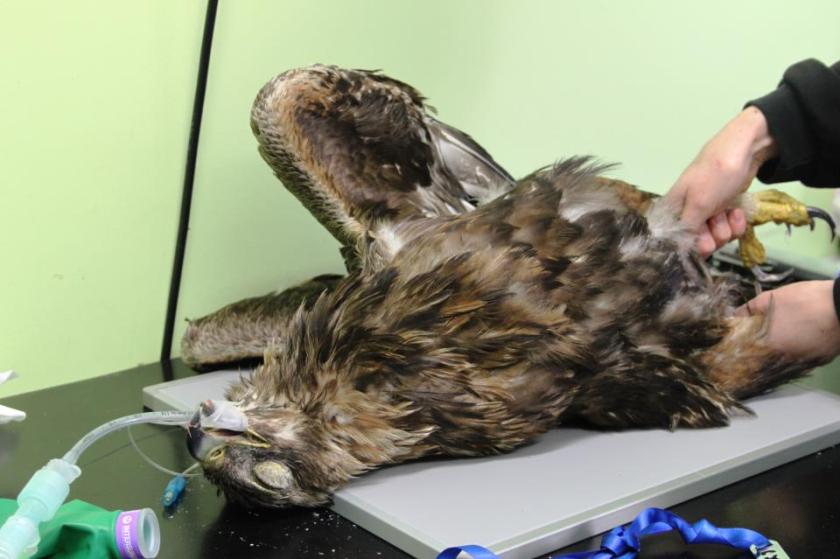
The shot golden eagle ungergoing surgery

Analysis of the SGA’s Deeside eagle report

Last month the SGA released a report into their ‘investigation’ into the death of the Deeside golden eagle (see here to read their report).

At the time we said we would comment on their report once we’d received responses to some pending Freedom of Information requests. We’re now in a position to comment.

So, the motivation for the SGA’s ‘investigation’ into the circumstances of this eagle’s death was because of what they perceived as “irregularities” in the media reports put out by the RSPB. Let’s have a look at those ‘irregularities’ in turn.

May2012 GE tayside grampianThe SGA don’t believe that the eagle was caught in an illegally-set trap because during their discussions with the estate’s staff, it was claimed they only ever use Mark 4 Fenn traps as opposed to Mark 6 Fenn traps (and of course statements made by those involved with grouse moor management should always be believed). The SGA say the Mark 4 Fenn trap is too weak to smash the legs of a golden eagle and it would be impossible for an eagle to get both feet caught inside the trap at the same time. However, if you read the RSPB’s original media statement about this incident (released 24th September 2012 – here) nowhere do they mention a Fenn trap. All they mention is a “spring type trap”, which covers a wide array of different traps, both legal and illegal, that could have caused the injuries sustained by that eagle. Indeed, independent veterinary pathology experts at the Scottish Agricultural College laboratory concluded that the two broken legs sustained by this eagle “could be consistent with an injury caused by a spring type trap”. It’s up to the reader to decide whether the statements made by the estate’s staff and the SGA are more authoritative than those of the independent veterinary pathologist experts at the SAC lab.

The SGA say they visited the precise location of the ‘alleged’ trapping on the estate. They say, “Close by, on one side, was a large multi-catch crow cage. On the other was a 7-8 foot deer fence”. This is an interesting interpretation of what “close by” means. We understand that the deer fence is actually at least 80m away from the location where the bird was static for 15 hours.

The SGA say that the eagle could have broken both its legs by crashing into the fence at a speed that could have been in excess of 50mph (according to their falconer friend). However, the post mortem report clearly states that the eagle’s injuries could be consistent with being caught in a spring type trap, not crashing into a static object at high speed. In the event of crashing into the fence with an estimated speed in excess of 50mph, you might expect injuries to the feet and to the pelvis, as a bare minimum. The post mortem report documented two broken legs as the bird’s only injuries. It’s up to the reader to decide whether the statement of an un-named falconer with an unknown level of ‘expertise’ holds more authority than the statements of the independent veterinary pathologist experts at the SAC lab.

The SGA say that after hitting the fence the eagle “would then have undoubtedly tried to regain flight. This is consistent with the GPS signals which we were shown by the RSPB, which appeared to show variations in the readings. The readings do not show that the bird was “static” for 15 hours”. It seems that the SGA have a limited understanding of how to interpret GPS sat tag signals. The variations in the readings are entirely within the +/- 18m variation quoted by the manufacturer (Microwave Telemetry). In other words, all of the signals received during the 15 hour period in question were within an 18m circle radius. To all intents and purposes the bird was “static”. It’s up to the reader to decide whether the SGA’s interpretation of the satellite data is more authoritative than those of the sat tag manufacturer or the experienced biologists tracking this eagle.

The SGA say, “The RSPB state that the eagle could no longer become airborne. We disagree, having witnessed on several occasions various bird species gaining flight with leg injuries”. But it wasn’t the RSPB who said that the eagle could no longer become airborne, it was the independent veterinary pathologists at the SAC, who said the injuries were so severe “they would prevent the bird from being able to take off”. If anyone has ever watched a golden eagle take off they will know that the bird bends its legs to push off from the ground/perch. Clearly, two broken legs would prevent this from happening. The SGA suggest that the bird could have used the “advantageous slope of the ground” to “get air below its wings”. Actually the area where this bird was static for 15 hours is relatively flat – not on the edge of a high cliff where an injured bird might be able to roll off and find a thermal uplift. So, imagine an eagle with two broken legs on the flat ground – it will be lying on its side, back or front – do you think it could get airborne? It’s up to the reader to decide whether the SGA’s explanation is more plausible than that of the independent veterinary pathologist experts at the SAC lab.

The SGA say that the eagle could have flown 15km in the dark, tried to land but crashed into the tree and fell to its final resting place underneath a tree branch. This crash would, according to them, explain the eagle feathers found between the road lay-by and the dead eagle. Unfortunately the post mortem report doesn’t show any evidence of the eagle having crashed into a dense conifer tree. It’s up to the reader to decide whether the opinion of the SGA is more authoritative than that of the independent veterinary pathologist experts at the SAC lab.

To conclude then, the SGA’s version of what happened to this eagle was that it died as a result of a terrible accident. However, they haven’t been able to provide any convincing evidence and what they propose happened is not supported by the evidence provided by the independent veterinary pathology experts.

The RSPB’s reaction to the SGA’s report included this statement:

This is a rather desperate statement from the SGA, which seemingly does more to reveal their nature as apologists for the worst types of wildlife crime, as they try to defend the indefensible. Indeed, it calls into question their very commitment to the aims and objectives of the partnership for Action Against Wildlife crime Scotland (PAWS)”.

It’s interesting (and obviously totally unrelated) to learn that in a recent meeting with the Environment Minister Paul Wheelhouse, the SGA were told very clearly that they would not be issued with licences to kill raptors for the foreseeable future due to the ongoing incidents of criminal raptor persecution. According to the police, the case of this particular eagle obviously falls within that category.  

Unfortunately we’ll probably never find out who was responsible for this eagle’s death. Had a full police search, under warrant, taken place then further supporting evidence might have been retrieved. As it stands, it appears that this supposedly ‘on-going investigation’ is as dead as the eagle.

This bird will simply join the long list of other dead or ‘missing’ eagles whose killers have never been brought to justice: 26 eagles in six years at our last count, including ‘Alma’ who was found poisoned in 2009 on, er, this estate.

Poisoning stats down, incredulity up

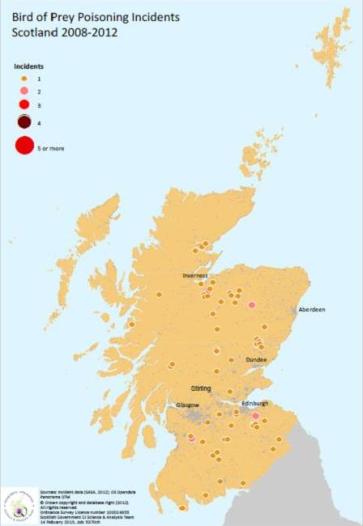
Poisoning 2008-2012The ‘official’ 2012 incidents of confirmed poisoned raptors in Scotland have just been published and show a marked decline in the number of poisoning incidents. According to the latest figures, the number of reported poisoned raptors fell from 16 in 2011 to three in 2012 (one golden eagle and two buzzards).

PAW Scotland press release here

BBC news article here

Are these figures an accurate reflection of what’s going on? We don’t think so. In fact we know they’re not. What the latest poisoning maps fail to show is the number of poisoned baits that were discovered in 2012, the number of other bird species that were poisoned in 2012, and the number of other animals that were poisoned in 2012. And obviously the maps don’t show the poisoning incidents that went undetected/unreported in 2012.

We know for certain that missing from this map is a poisoning incident recorded in the ‘Border’ region in May 2012. According to the published SASA statistics, a poisoned raven and crow were found, along with meat bait and two rabbit baits. This incident is listed as being subject to an ‘on-going police investigation’. Notably, this incident was not reported in the press. Why not? More importantly, why is this incident missing from this map? Why is the focus just on the number of confirmed poisoned raptors? Yes, the illegal poisoning of raptors is of huge concern, but it’s not just raptors that are victim to this barbaric practice. By excluding the discovery of poisoned baits and other types of poisoned species, the wider picture is not being shown. Why is that?

For example, we also know from the SASA stats that a horse and a dog were poisoned with Strychnine in January 2012, a cat was poisoned with Carbofuran and Isofenphos in March 2012, and another cat was poisoned with Carbofuran and Isofenphos in July 2012. None of these incidents appear on this map. There may well be others but the published SASA stats only go up to September 2012 – there’s the customary six-month delay in publishing more recent incidents. Obviously it’s not in the public interest to know where and when lethal poison is being laid out until many months after the event.

On a similar note, has anyone noticed the dot on the map in the Whithorn region (SW Scotland)? Could this possibly be the dead buzzard we blogged about last week (see here)? All we were told was that a man had been arrested following an investigation into a dead buzzard that had been found on the Glasserton Estate. Why didn’t the police press statement mention that the forensic tests confirmed it had been poisoned? Why are we not warned when potentially lethal poisoned baits are being placed out in areas where we might visit with our children and our pets? Why is it so difficult to tell the public what’s actually going on?

On a superficial level then, the latest figures suggest that all those people who’ve been busily poisoning our raptors for the last 100+ years have suddenly stopped. It’s highly implausible, but of course it is possible. Other possibile explanations include (a) the illegal poisoners have just got better at hiding the evidence; (b) they’ve switched to a new type of poison that isn’t currently being screened for in the SASA lab; (c) they’ve switched from poisoning as their method of choice to other methods that are less detectable, such as shooting and trapping.

Fortunately, the authorities are wise to point (c). Environment Minister Paul Wheelhouse said: “There has been real progress but we will not be complacent. I am determined to stamp out these practices once and for all and will remain vigilant to any change in approach being taken by those who seek to persecute raptors“. Of course, this statement is almost a carbon copy of statements made by previous Environment Ministers, going back several years, all of whom were ‘determined to stamp out illegal raptor persecution’ and all of whom failed. The current Minister has recently been presented with three perfect opportunities to make a stand: the dead golden eagle found on Deeside with two broken legs which is believed to have been caught in an illegal trap on an Angus grouse moor before being dumped further north away from the estate (we’ll be blogging more about this case in the next few days); the shot and critically injured golden eagle found on a grouse moor in Dumfries and Galloway; and the shot hen harrier that was found dead on another sporting estate in Grampian. It’ll be interesting to see how many more of these incidents he will tolerate before stronger sanctions are applied. Or, more to the point, how many more incidents we will allow him to tolerate.

Arrest after dead buzzard found on Glasserton Estate

Dumfries and Galloway Constabulary have arrested and bailed a 62 year old man from Whithorn in relation to a number of offences under the Wildlife and Countryside Act 1981, following an investigation into the death of a buzzard, which was discovered on the Glasserton Estate, Whithorn, in December 2012. The case has been the subject of a detailed police investigation which included a forensic examination of the dead bird.

We don’t have any further details at the moment. Thanks to the journalist at Express newspapers for passing this info on to us.

If you think gamekeepers should be held to account under a licensing scheme, please sign this e-petition: HERE

Deeside golden eagle fiasco rumbles on as SGA release their ‘report’

The shambolic investigation into the death of the Deeside golden eagle last year continues (see here, here, here, here, here, here, here for our previous blogs about this appalling case).

This morning, the Scottish Gamekeepers’ Association released a media statement and their investigatory ‘report’ into what they think happened to this eagle. It’s death was probably the result of a terrible accident, apparently. They say they only released their report because they became aware that it had been the subject of Freedom of Information requests to the Scottish Government.

At this stage, we are only posting their media statement, their ‘report’, and the RSPB’s response. We will be discussing the case as a whole, including the SGA’s conclusions, in a later blog, as we are awaiting responses from several FoI requests that potentially could be quite illuminating.

SGA media statement download: SGA RELEASE REPORT INTO EAGLE DEATH[1]

SGA investigatory report download: SGA Report, eagle death, Deeside[1]

RSPB media response:

RSPB Scotland responds to Scottish Gamekeepers Association eagle report

Responding to a statement released this morning by the Scottish Gamekeepers Association (SGA), Duncan Orr-Ewing, Head of Species and Land Management at RSPB Scotland, said:

“We reject absolutely these unprofessional assertions of the SGA in today’s press release concerning the case of the dead golden eagle found on Deeside in May 2012. Our previous media statement followed proper discussion and approval from the police, and was in full accordance with our joint working protocol. The official post mortem report concluded that the bird had suffered two broken legs due to trauma “that could be consistent with an injury caused by a spring type trap” and that the severity of these injuries “would prevent the bird from being able to take off.”

This is a rather desperate statement from the SGA, which seemingly does more to reveal their true nature as apologists for the worst types of wildlife crime, as they try to defend the indefensible. Indeed, it calls into question their very commitment to the aims and objectives of the Partnership for Action Against Wildlife Crime Scotland (PAWS).

The illegal killing of golden eagles in Scotland is still a serious conservation issue, undermining the health of their population, and bringing international shame to our country. Over the past few years there have been a number of appalling cases involving the criminal killing of golden eagles, some of which have only come to light following the use of satellite tag technology. Rather than seeking excuses, we believe that the Scottish Gamekeepers Association’s efforts would be better directed at tackling those within their sector who still encourage such outdated practices”.  

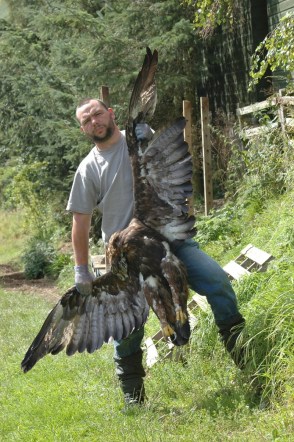
The dead golden eagle     

Northumberland gamekeeper cautioned for trap offences

Yes folks, here’s another one…

RSPB press release:

A gamekeeper from Northumberland has been cautioned by Northumbria Police after failing to attend and properly check a crow cage trap over a fifteen day period in December last year.  The trap had captured three buzzards on one occasion.

RSPB covert surveillance cameras monitored the trap belonging to a shoot in South West Northumberland and found that the trap operator had failed to attend the trap at any point during the filming. Footage showed the trap had captured three buzzards.  All three buzzards were released unharmed, two by passing members of the public and the third by the RSPB.  The video footage later showed the third buzzard had been in the cage trap for two days.

Investigations by Northumbria police, assisted by the RSPB, identified the trap operator, who during a police interview admitted to failing to check the trap properly each day and failing to release the third buzzard out of the trap. Failure to operate the trap lawfully is contrary to the Wildlife and Countryside Act 1981.

Howard Jones from RSPB investigations stated: “It is unknown how these buzzards would have fared if they had not been released.  It further highlights the issue of birds of prey being attracted to crow cage traps and the vital importance that operators responsibly manage their traps.”

PC Colin Heath of Northumbria Police who led the investigation added: “We will continue to work closely with the RSPB to promote and protect our wild birds and to deal with offenders accordingly.”

Unfortunately, we are unable to name the gamekeeper as he’s been cautioned. We also need to be cautious in naming the location, although we can say it was a family-run shoot.

The big question is, why did this keeper only get a caution? Why wasn’t he charged and prosecuted?