The eight-day trial of Scottish gamekeeper James Marsh ended at Stirling Sheriff Court last week with a verdict of ‘not proven’.
The case centred on the discovery of a Larsen trap on the Duntreath Estate on 1st April 2012. The trap, found by a walker, was situated underneath a crag and contained a Jay (in the trap’s decoy compartment) and a Tawny Owl (within the catching compartment). The Tawny Owl was reportedly close to death. The trap had an identification tag which was registered to Duntreath Estate and the walker alerted the SSPCA to the trap. It was suspected that gamekeeper Marsh was using the Jay as a lure to trap birds of prey. It is not permitted under general licence to use a Jay as a decoy within a Larsen trap. [As a point of interest, since January 1st 2014 it is now no longer permitted in Scotland to use a Jay as a decoy inside a crow cage trap either, so if you see one, you should report it immediately].
Marsh, 49, of Middle Ballewan near Blanefield, Stirling, was reported to the Procurator Fiscal by the SSPCA for a number of alleged offences including:
1. Section 5(1)(b) of The Wildlife and Countryside Act 1981 (Use of an unlawful trap);
2. Section 19 2(a)(b) Animal Health and Welfare (Scotland) Act 2006 (Causing suffering to a Tawny Owl and a Jay);
3. Section 24 3(a)(b)(c)(e) Animal Health and Welfare (Scotland) Act 2006 (Failure to ensure the welfare of a Tawny Owl and Jay);
4. Section 1(1)(a) of The Wildlife and Countryside Act 1981 (Unlawfully taking a Tawny Owl);
5. Section 1(1)(a) of The Wildlife and Countryside Act 1981 (Unlawfully taking a Jay);
6. Section 1(2)(a) of The Wildlife and Countryside Act 1981 (Unlawfully possessing a Tawny Owl);
7. Section 1(2)(a) of The Wildlife and Countryside Act 1981 (Unlawfully possessing a Jay).
In defence, Marsh admitted to having set the trap [lawfully] some weeks prior to its discovery in order to catch a Carrion Crow which he intended to use as a decoy. He argued that the trap had been moved up hill and reset in the location where it was found and despite searching he had been unable to find it. He claimed the Jay may have squeezed into the trap decoy compartment by itself and attracted the Tawny Owl which had become trapped. He was unable to explain why the Jay, having squeezed into the trap, would not have been able to get back out.
The verdict of ‘not proven’ is an interesting one. In Scottish law, there are three possible outcomes to a criminal trial. These are ‘Guilty’ [a conviction], ‘Not Guilty’ [an acquittal] and ‘Not Proven’ [an aquittal]. Wikipedia offers an explanation for the use of ‘not proven’:
“The modern perception of the ‘not proven’ verdict is an acquittal when the judge or jury does not have enough evidence to convict but is not sufficiently convinced of the accused person’s innocence to bring in a ‘not guilty’ verdict. Essentially, the judge or jury is unconvinced that the suspect is innocent, but has insufficient evidence to the contrary. In popular parlance, this verdict is sometimes jokingly referred to as ‘not guilty and don’t do it again’.
Out of the country, the ‘not proven’ verdict may be referred to as the ‘Scottish verdict’, and in Scotland itself it may be referred to colloquially as the ‘bastard verdict’, which was a term coined by Sir Walter Scott, who was sheriff in the court of Selkirk“.
Despite the ‘not proven’ verdict, well done to the SSPCA for taking on the case. It is widely recognised that this type of investigation requires specialist knowledge, especially with the continuing difficulties of proving who has set a trap (or laid out a poisoned bait, chopped down a nest tree, stamped on eggs or young birds, shot a bird etc etc) and the SSPCA and the Fiscal did well to bring this case to court.
The Tawny Owl survived and was eventually released following extensive veterinary care.
For previous blogs on this case see here and here

 Last week we blogged about what we believe to be the first prosecution under the 2011 vicarious liability legislation (see
 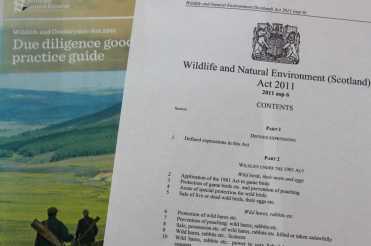 Regular blog readers will know that we’ve been interested in the first prosecution of a landowner under the vicarious liability legislation for some time now….in fact ever since the legislation was enacted as part of the WANE Act on 1st January 2012 (see
  The Scottish Parliament is taking note of the illegal killing of golden eagle Fearnan, who was found poisoned on an Angus grouse moor in December.
 The significance of this latest motion is that it’s been lodged by an MSP that doesn’t live in the region where Fearnan was killed and isn’t especially well-known for addressing raptor persecution issues – James Dornan MSP, representing Glasgow Cathcart. We view this as an important indication that the raptor persecution issue is being brought to the attention of people who may previously have been unaware.
 Raptor Persecution UK