Sentencing today for gamekeeper George Mutch, convicted raptor killer

Convicted gamekeeper George Mutch will be sentenced today at Aberdeen Sheriff Court.

Mutch, a 48-year old (now former) member of the Scottish Gamekeepers’ Association who worked on Kildrummy Estate, Aberdeenshire, was found guilty of four wildlife crimes in December, including the illegal killing of a goshawk which he trapped and then clubbed to death, and the trapping and taking of a further goshawk and a buzzard (see here).

All eyes on Sheriff McPartlin, who said in December that a custodial sentence was being considered….

Subsidy penalty for convicted vicarious liability landowner

Last month we blogged about the Scottish landowner who was the first to be convicted under the new vicarious liability legislation which came in to force on 1st January 2012.

Ninian Robert Hathorn Johnston Stewart of the Physgill & Glasserton Estates was found guilty of being vicariously liable for the actions of his gamekeeper, Peter Finley Bell, who had laid out a poisoned bait which killed a buzzard. Bell was also found to be in possession of three banned poisons (see here).

The landowner’s conviction was met with mixed feelings. Many of us were pleased to see a successful prosecution in what was a landmark case, but there was widespread disappointment in the derisory fine of just £675.

A number of blog commentators asked whether the landowner would also be hit by a Single Farm Payment penalty for cross compliance breaches. We weren’t able to answer that at the time, although we knew that the use of a banned poison to kill a protected wild bird would certainly merit a penalty.

Well, it turns out that Mr Johnston Stewart was indeed hit with a subsidy penalty. According to his defence agent (David McKie),

He [Johnston Stewart] had already been penalised substantially via a high five-figure deduction to his single farm payment“.

We don’t know what that “high five-figure deduction” was (presumably somewhere between £10,000 – £99,999), nor do we know how it was calculated, nor what percentage it was of his annual subsidy payment. Nevertheless, it’s good to hear that a penalty was imposed so well done to SGRPID (Scottish Government, Rural Payments & Inspections Directorate) for being on the ball.

Wouldn’t it be good if this sort of detail was easily available in the public domain? We’d like to know how these public subsidies are being distributed (or revoked) and it surely has a deterrent value for other landowners who might just be persuaded to take a closer look at what their gamekeepers are up to. A section on this in the Scottish Government’s annual wildlife crime report wouldn’t go amiss….

First conviction in landmark vicarious liability case

The first ever prosecution under the new vicarious liability legislation concluded today with a conviction at Stranraer Sheriff Court.

Landowner Ninian Robert Hathorn Johnston Stewart pleaded guilty to being vicariously liable for the criminal actions of Glasserton & Physgill Estates’ gamekeeper Peter Bell, who was convicted in 2013 of laying poisoned bait (Carbofuran) which killed a buzzard, and for possession of three banned pesticides (Carbofuran, Strychnine and Alphachloralose). Bell was fined a total of £4,450 (see here). On conviction, Bell was expelled from the Scottish Gamekeepers’ Association and the Glasserton & Physgill Estates were expelled from the landowners’ representative organisation, Scottish Land & Estates.

So, what was the penalty in this landmark vicarious liability conviction? A pathetic £675! We don’t know the full details of Johnston Stewart’s plea, or if there was any mitigation, but nevertheless, a £675 fine is extremely disappointing, especially when you consider that the maximum penalty for this offence is £5,000 and /or a six month prison sentence.

Will a derisory fine of £675 act as a suitable deterrent to others? No, of course not; that’s pocket change to a wealthy landowner. It’s yet another example of why there needs to be a complete overhaul of the penalties for wildlife crime and we look forward to reading Professor Poustie’s review on this issue, which is due to be submitted to the Scottish Government early next year.

What might act as a deterrent is the reputational impact of the conviction, but only if the conviction is widely publicised. We haven’t seen anything in the press, yet. Hopefully some of the journalists who follow this blog will get something out there….

So, although this is a disappointing penalty, the fact that there has been a conviction and thus a demonstration that the legislation works, is to be welcomed. Well done to the Fiscal and all those involved with bringing this case to court.

We now have information on the second vicarious liability prosecution currently going through the system and we’ll be blogging about that one in the new year.

UPDATE 19.15hrs. The following press release has been issued by the Crown Office:

copfs logoFIRST WILDLIFE VICARIOUS LIABILITY CONVICTION IN SCOTLAND

Landowner Ninian Stewart sentenced today after pleading guilty to being vicariously liable for Peter Finley Bells’ crime of poisoning and killing of a wild bird.

Ninian Robert Hathorn Johnston Stewart was convicted at Stranraer Sheriff Court on 23 December 2014 and fined a total of £675 today for four offences under Section 15A(1) and Section 18A(1) and (2) of the Wildlife and Countryside Act 1981. Section 18A(2) makes the accused guilty of the original offence and liable to be punished accordingly.

This is the first prosecution and conviction in Scotland under section 18A of the Wildlife and Countryside Act 1981. This section came into force on 1 January 2012.

Section 18A(2) created a new vicarious liability offence meaning that a person (B), who has shooting rights on or over land, or who manages or controls the exercise of such rights, can be found guilty of a relevant offence(s) committed by a person (A) while acting as the employee or agent of B.

This provision is designed to encourage landowners and employers with varying levels of responsibility in connection with shooting to be diligent and proactive in countering wildlife crime.

Stewart, the landowner of Glasserton & Physgill Estates, was convicted of being vicariously liable for the criminal actions of Glasserton gamekeeper Peter Bell on land owned by Stewart and on which he held the shooting rights.

Bell was a full time Gamekeeper in the employ of Ninian Stewart when he committed the poisoning offence on 23 December 2012 at Glasserton Home Farm. He had laced the carcass of a pheasant baited with Carbofuran and set the bait in a field. A birdwatcher passing the farm saw something flapping in the field and on closer inspection found that it was a common buzzard, lying on the ground, in the last throws of life. Subsequent forensic work showed that the buzzard had died as a result of ingesting the poisoned bait.

Under section 18A(3) it is a defence for B to show that B did not know that the offence(s) was being committed by A, and that B took all reasonable steps and exercised all due diligence to prevent the offence being committed.

In this case, while there was no indication that Mr Stewart instructed the commission of the offences or that he even knew about them being committed, there no evidence that Mr Stewart took any steps to exercise due diligence in respect of shooting on his Estate.

Sara Shaw, Procurator Fiscal, Wildlife and Environment said:

“There is a proactive responsibility placed on those who employ game keepers to run shooting estates, to ensure that is done within the parameters of the law.

“These offences were committed almost a year after the vicarious liability offence (under section 18A of the Wildlife and Countryside Act 1981) was introduced. Mr Stewart had adequate notice and time in which to take advice and put appropriate measures in place.

“Mr Stewart failed in his responsibilities and as a result stands convicted of the killing of a wild bird.

“The law specifically protects wild birds. Those who seek to poison wild birds, or continue to possess stocks of illegal poison, and those who employ or engage the services of such persons and tolerate the commission of these offences, or who do so without taking all reasonable steps and exercising all due diligence to prevent them being committed, can fully expect to be brought to account before the courts.”

ENDS

Notes to Editor

  1. Ninian Robert Hathorn Johnston Stewart (DOB 18/02/1948) of Newton Stewart pleaded guilty on 23 December 2014 at Stranraer Sheriff Court to four offences under the Wildlife and Countryside Act 1981 as below.

(001) on 23rd December 2012 on or in relation to land at Glasserton Home Farm, Whithorn, Newton Stewart, Peter Finley Bell, a person then acting as your employee or agent, did commit a relevant offence as defined by Section 18A(6)(a) of the aftermentioned Act, namely an offence under Section 1(1)(a) of the aftermentioned Act, in that he did intentionally or recklessly kill a wild bird, namely a common buzzard in that he set the carcass of a pheasant baited with poison, namely carbofuran after which said buzzard did ingest said Carbofuran and did poison said buzzard whereby you NINIAN ROBERT HATHORN JOHNSTON STEWART, being a person who has and who manages or controls the exercise of a legal right to kill or take a wild bird on or over that land, are guilty of an offence;

CONTRARY to Section 1(1)(a) and Section 18A(1) and (2) of the Wildlife and Countryside Act 1981 as amended

And it is hereby certified in terms of section 20 of the aforementioned Act that evidence sufficient in the opinion of the prosecutor to warrant proceedings came to his knowledge on 17th July 2013

Charge 1: £150 (reduced from £200)

(002) between 23rd December 2012 and 5th March 2013 both dates inclusive on or in relation to land at Physgill Cottage, Glasserton Home Farm, Whithorn, Newton Stewart, Peter Finley Bell, a person then acting as your employee or agent, did commit a relevant offence as defined by Section 18A(6)(a) of the aftermentioned Act, namely an offence under Section 15A(1) of the aftermentioned Act, in that he did have in his possession a pesticide, namely Carbofuran containing a prescribed ingredient within the terms of the Possession of Pesticides (Scotland) Order 2005/66, Article 2 and the Schedule, namely Carbofuran whereby you NINIAN ROBERT HATHORN JOHNSTON STEWART, being a person who has and who manages or controls the exercise of a legal right to kill or take a wild bird on or over that land, are guilty of an offence; CONTRARY to Section 15A(1) and Section 18A(1) and (2) of the Wildlife and Countryside Act 1981 as amended

And it is hereby certified in terms of section 20 of the aforementioned Act that evidence sufficient in the opinion of the prosecutor to warrant proceedings came to his knowledge on 17th July 2013

Charge 2: £225 (reduced from £300)

(003) on 05 March 2013 on or in relation to land at Physgill Cottage, Glasserton Home Farm, Whithorn, Newton Stewart, Peter Finley Bell, a person then acting as your employee or agent, did commit a relevant offence as defined by Section 18A(6)(a) of the aftermentioned Act, namely an offence under Section 15A(1) of the aftermentioned Act, in that he did have in his possession a pesticide, namely Strychnine containing a prescribed ingredient within the terms of the Possession of Pesticides (Scotland) Order 2005/66, Article 2 and the Schedule, namely Strychnine whereby you NINIAN ROBERT HATHORN JOHNSTON STEWART, being

a person who has and who manages or controls the exercise of a legal right to kill or take a wild bird on or over that land, are guilty of an offence;

CONTRARY to Section 15A(1) and Section 18A(1) and (2) of the Wildlife and Countryside Act 1981 as amended

And it is hereby certified in terms of section 20 of the aforementioned Act that evidence sufficient in the opinion of the prosecutor to warrant proceedings came to his knowledge on 17th July 2013

Charge 3: £75 (reduced from £100)

(004) on 05 March 2013 on or in relation to land at Physgill Cottage, Glasserton Home Farm, Whithorn, Newton Stewart, Peter Finley Bell, a person then acting as your employee or agent, did commit a relevant offence as defined by Section 18A(6)(a) of the aftermentioned Act, namely an offence under Section 15A(1) of the aftermentioned Act, in that he did have in his possession a pesticide, namely alphachloralose containing a prescribed ingredient within the terms of the Possession of Pesticides (Scotland) Order 2005/66, Article 2 and the Schedule, namely alphachloralose whereby you NINIAN ROBERT HATHORN JOHNSTON STEWART, being a person who has and who manages or controls the exercise of a legal right to kill or take a wild bird on or over that land, are guilty of an offence;

CONTRARY to Section 15A(1) and Section 18A(1) and (2) of the Wildlife and Countryside Act 1981 as amended

And it is hereby certified in terms of section 20 of the aforementioned Act that evidence sufficient in the opinion of the prosecutor to warrant proceedings came to his knowledge on 17th July 2013

Charge 4: £225 (reduced from £300)

  1. Peter Finley Bell (DOB 11/02/1951) from Whithorn, Newton Stewart was fined £4,450 on 18 June 2013 after pleading guilty to four charges contrary to the Wildlife and Countryside Act 1981: one contravention of section 1(1)(a) (killing a wild bird) and three contraventions of section 15A (possession of an illegal pesticide). He was fined £2,450 for killing the buzzard (reduced from £3,500 to reflect his plea of guilty); £1,400 for possession of Carbuforan (reduced from £2,000) and £300 on each charge for possession of Strychnine and Alphachloralose (reduced from £500 on each charge).

END

MEDIA COVERAGE

BBC news here

Galloway Gazette names Sheriff Kenneth Robb here

Scottish Land & Estates: an extraordinary statement here. Glasserton & Physgill Estates were expelled from SLE in 2013, following the conviction of gamekeeper Bell (see here). Reading SLE’s defensive response to the conviction of landowner Johnston Stewart, you have to wonder…..

Journal of the Law Society of Scotland here

Scottish Daily Mail here

UPDATE 6th January 2015: Landowner hit with a five-figure subsidy penalty (here)

Scottish gamekeeper George Mutch: guilty on all 4 counts

This is an historic day in the battle against the raptor killers.

Scottish gamekeeper George Mutch, 48, of Kildrummy Estate, Aberdeenshire, has been found guilty on all four charges, including the illegal killing of a trapped goshawk, which he clubbed to death, and the taking of two other birds, a goshawk and a buzzard.

No-one will be surprised to learn that yet another gamekeeper has been convicted of illegally killing raptors; Mutch is the 28th gamekeeper to be convicted of wildlife crime in the last three years alone (see here). The big surprise in this case has been the Sheriff’s ruling that the covert video footage, filmed by RSPB Scotland, was admissible evidence. This alone was a significant ‘win’ for those of us who have been exasperated, for years, that this type of evidence has been consistently rejected by the Crown Office, thus allowing The Untouchables to be, well, untouchable. Especially when covert video surveillance has been consistently used in England to secure convictions in similar cases.

So what prompted the change of heart? Undoubtedly, the efforts of former Environment Minister Paul Wheelhouse, who said in July 2013 that he would be urging the Crown Office to consider the use of video footage in cases against those committing wildlife crime.

According to our journalist contacts, COPFS prosecutor Tom Dysart’s performance in court was dynamite, pressing for the admissibility of the video footage and then later shredding the evidence of defence witness Hugo Straker from the GWCT. He also then shredded the evidence of Mutch, resulting in the Sheriff saying that Mutch’s evidence was ‘not credible’ and that his explanation for killing the goshawk (because it was injured) was “a convenient lie”. We never thought we’d say this but Tom Dysart apparently played a blinder. Long may it continue.

The video nasty in this case, showing Mutch trapping and then clubbing the goshawk to death, can be viewed here. WARNING – CONTAINS DISTURBING IMAGES.

Sheriff McPartlin will pass sentence in January and has already said he is considering a custodial sentence. We’ll see.

Meanwhile, the SGA has put out a fascinating press statement. It turns out that Mutch was an SGA member and apparently “his membership of the SGA has been in suspension for some time, until the outcome of the case was known. Now that it is, he will no longer be a member of the SGA“.

That’s interesting. Mutch committed his crimes in 2012, but according to the SGA’s 2013 silent auction booklet, the SGA accepted a fundraising donation from Kildrummy Estate, with George Mutch listed as the contact:

SGA Silent Auction Booklet 2013 (see Lot #17)

So not only was the SGA still accepting donations from this estate the year after the crimes were committed, but it’s also apparent that Mutch was still employed by Kildrummy Estate after he’d committed those crimes. Fascinating.

The SGA’s statement continues:

On the separate, theoretical, issue of the use of covert video evidence, it is clear to us that it should not be acceptable for individuals from one particular profession to be under surveillance in their place of work, without their knowledge, and to have their right to liberty and privacy from such encroachment, removed.

If this is to be the direction of travel, it is not right for Scottish Government to deny people whose livelihoods come under pressure due to the activity of certain species or animals, recourse to a legal solution to solve that conflict.

Currently, there are no legal or scientific means by which people can protect their investments or jobs in situations exacerbated by conflicts with species. Scottish Government has never granted anyone from the game industry a licence to protect investments, which they have the power to do, although it does grant licences routinely to other industries. This, in our view, is a barrier to justice and does nothing to prevent wildlife crime.

In a society supposedly enlightened when it comes to tackling this issue, we believe this is untenable and we will be seeking talks with Scottish Government so that this anomaly is finally closed, removing once and for all the rationale for people to commit wildlife crime.”

So, the SGA doesn’t agree with the use of covert video footage to convict those within the gamekeeping industry of wildlife crime. Why ever not? Surely, they’d be thrilled to root out those individuals who are causing so much damage to the industry’s reputation? By their reaction, you’d be forgiven for thinking that that’s not the case at all. And as Mutch was an SGA member when he committed his crimes, what does that tell us about the SGA’s ability to provide adequate training for its members? They even admit that Mutch is the 5th SGA member in three years to have been convicted!

And then they go into the usual whine about how wildlife crime would stop if only the Government would issue licences to allow the killing of protected species, (although they don’t actually mention the word ‘killing’ – instead they say “licence to protect investments”). The bottom line is, if the leisure industry of killing millions of gamebirds is reliant on the killing of protected species then that industry has had its day.

This case has taken over two years to conclude. We had thought that because the crimes were committed in 2012, before the vicarious legislation was enacted (1st Jan 2013), that there wouldn’t be a vicarious liability prosecution because we didn’t think it could be applied retrospectively. However, one of our legal friends has since advised us that there still may be a vicarious liability prosecution as long as it’s lodged within the three-year time frame from the date the offence was committed (August 2012). So potentially then, if the Crown deems it appropriate and they get it in before August 2015, we could have another vicarious liability prosecution on the cards.

For now though, let’s just enjoy the successful conviction of another raptor-killing gamekeeper, and acknowledge the work of the people who got it to this stage. Huge congratulations to the RSPB Scotland Investigations Team, the SSPCA, Police Scotland, COPFS, Sheriff McPartlin and former Environment Minister Paul Wheelhouse. Real partnership working at its best.

Media coverage:

RSPB press release and video here

BBC news here

STV news here (this one is amusing!)

Reporting Scotland here [6.25 – 8.40] (this film only available for 24 hrs)

Herald here

George Mutch trial: sheriff rules video evidence admissible

Sheriff Noel McPartlin, presiding over the trial of gamekeeper George Mutch (Kildrummy Estate, Aberdeenshire) yesterday ruled that the RSPB’s video footage is admissible.

His ruling was based on his view that the footage in question was a by-product of a legitimate survey (in to the use of crow cage traps) rather than the camera being placed with the sole intention of filming someone committing a criminal act.

This ruling doesn’t mean that covert video footage will be acceptable evidence in all criminal proceedings; each case will have to be considered based on its specific circumstances. But in this trial at least, the video evidence has been ruled lawful.

That is a big result. More often than not, this sort of evidence has not been accepted in Scotland, although it is routinely accepted in England. Credit is due to the Fiscal, Tom Dysart, and especially to former Environment Minister Paul Wheelhouse for all the political pressure he piled on to the Crown regarding the use of video evidence in wildlife crime prosecutions.

After two days of legal wrangling and following Sheriff McPartlin’s decision, Mutch’s trial got underway ‘properly’ yesterday, i.e. the evidence (video) was shown in court.

One recording filmed on August 14th 2012 showed a goshawk being caught inside a Larsen trap, which had been set inside a pheasant pen. A live Jay was being used as the decoy bird [illegally – the General Licences do not allow a Jay to be used as a decoy species in a Larsen trap]. Mutch was filmed approaching the trap the next morning at around 6am.

Prosecution expert witness David Anderson, a Conservation Manager for the Forestry Commission, was asked to tell the court what he could see in the footage, which was filmed in misty conditions. He said the man appeared to pick up an object to pin down the bird. “Then I saw the man got the bird, pulled it out and dispatched it with a stick or whatever they had in their hand”.

Another recording showed Mutch walking in to a crow cage trap (also set inside a pheasant pen) and catching a goshawk that had been caught in the trap. The bird was placed (alive) inside a white sack and removed from the cage.

Mutch has denied all the charges against him.

The trial continues at Aberdeen Sheriff Court and hopefully it’ll conclude today.

George Mutch trial: Sheriff to rule on admissibility of video evidence

The sheriff presiding over the trial of Scottish gamekeeper George Mutch is due to rule today on the admissibility of covert video footage.

Mutch is accused of several offences relating to the alleged killing or injuring of two goshawks and a buzzard that had been caught inside traps in August 2012. He has denied the charges. The evidence against him is based on covert footage collected by RSPB Scotland.

Mutch’s trial began on Monday, after months of adjournments, but so far the trial has focused on whether the evidence is admissible. The defence advocate, Mark Moir QC, has argued that the footage is inadmissible because the RSPB has an agenda against the use of crow cage traps and didn’t have the landowner’s permission to film. The prosecution (Tom Dysart from COPFS!) has argued that the evidence should be deemed admissible because the RSPB were filming as part of a research study.

Sheriff Noel McPartlin is due to rule on the question of admissibility today. Whatever his decision, it will have significant ramifications for not only this trial but also for future potential prosecutions.

News articles on this trial here and here.

First vicarious liability prosecution: part 4

Criminal proceedings continued yesterday against Mr Ninian Robert Hathorn Johnston-Stewart in the first known vicarious liability prosecution under the WANE Act 2011.

Mr Johnston-Stewart, the landowner of Glasserton & Physgill Estates, is charged with being vicariously liable for the criminal actions of Glasserton gamekeeper Peter Bell, who was convicted in 2013 of laying poisoned bait which killed a buzzard (Carbofuran), and for possession of three banned pesticides (Carbofuran, Strychnine and Alphacloralose) (see here).

Yesterday’s intermediate diet was continued, with another intermediate diet scheduled for 23rd December 2014.

Previous blogs on this case here, here and here

First vicarious liability prosecution: part 3

Criminal proceedings continued today against Ninian Robert Hathorn Johnston Stewart in the first known vicarious liability prosecution under the WANE Act 2011.

Mr Johnston Stewart, the landowner of Glasserton & Physgill Estates, is charged with being vicariously liable for the criminal actions of Glasserton gamekeeper Peter Bell, who was convicted in 2013 of laying poisoned bait which killed a buzzard (Carbofuran) and possession of three banned pesticides (Carbofuran, Strychnine and Alphacloralose) (see here).

Today’s hearing was continued for an intermediate diet on 8th December 2014.

Previous blogs on this case here and here

Interesting bedfellows

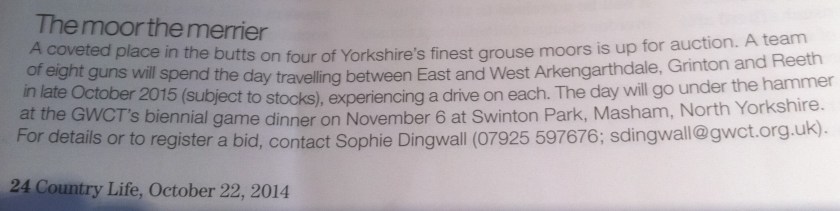
From Country Life Magazine, October 22nd 2014, page 24:

A coveted place in the butts on four of Yorkshire’s finest grouse moors is up for auction. A team of eight guns will spend the day travelling between East and West Arkengarthdale, Grinton and Reeth in late October 2015 (subject to stocks), experiencing a drive on each. The day will go under the hammer at the GWCT’s biennial game dinner on Nov 6 at Swinton Park, Masham, North Yorkshire“.

Fascinating stuff.

Swinton Park is linked with the Swinton Estate. Swinton Estate was where the shot corpse of hen harrier Bowland Betty was discovered in 2012 (see here), although that was likely just an unfortunate coincidence as there was no evidence to link her death to anybody, let alone anyone associated with the estate. According to the Countryside Alliance, she wasn’t shot at all (see here).

A different incident confirmed criminal activity by a Swinton Estate employee. Earlier this year, gamekeeper Ryan Waite was convicted of illegally setting a spring (pole) trap on Swinton Estate (see here).

What an interesting choice of venue for the GWCT to select for their prestigious event, eh?

Case against gamekeeper George Mutch: part 12

Well, well well. Today was the first day in the much-anticipated trial of Scottish gamekeeper George Mutch.

Mutch, 48, of Kildrummy Estate, Aberdeenshire, has been accused of various wildlife crimes relating to the alleged capture and subsequent killing or injuring of two goshawks and a buzzard in 2012. He has denied the charges and we’ve seen this case drag on and on and on…..

The dragging on looks set to continue….

The trial was halted today after the Sheriff (Annella Cowan) decided to stand down. Why did she decide to stand down? According to the BBC (here) it was because the defence counsel argued that as Sheriff Cowan was a member of the RSPB, she shouldn’t hear the case because the RSPB had been involved in the criminal investigation in to Mutch’s alleged activities.

Yes, seriously!

We thought a Sheriff was supposed to be considered as being ‘above bias’? The defence counsel, Mr Moir, apparently said that he wasn’t suggesting that Sheriff Cowan would be biased – so why then did he say she shouldn’t hear the case?! What a joke.

What’s an even bigger joke is that another (now retired) Sheriff, one Kevin Drummond, was never considered to be ‘unsuitable’ to hear cases against gamekeepers accused of wildlife crime, even though his hobbies apparently included shooting, and prior to becoming a Sheriff he had worked as a defence QC for……er, gamekeepers! (see here).

Fascinating, eh? You couldn’t make this stuff up.

Anyway, back to Mutch’s trial. It’s no big problem that Sheriff Cowan has decided to stand down – the case will be decided on the merit of the evidence presented against Mutch – and THAT is where our interest lies. Whether it’s Sheriff Cowan or another Sheriff who hears the case is largely irrelevant; it’s just irritating that yet another delay has been introduced to this case. Still, we can wait.

We understand the trial will re-start in December.