Police Scotland explain failure of vicarious liability in Kildrummy case

waneLast month we blogged about the failure of the Crown Office to initiate a vicarious liability prosecution in the Kildrummy case (see here).

A quick re-cap: in December 2014, Kildrummy Estate gamekeeper George Mutch was convicted of a series of wildlife crime offences that took place on Kildrummy Estate in 2012, including the trapping of a goshawk which he then beat to death with a stick (see here). In January 2015, Mutch was sentenced to four months in prison – the first gamekeeper in the UK to receive a custodial sentence for raptor persecution crimes (see here).

In September 2015, the possibility for a vicarious liability prosecution against Mutch’s employer became impossible as the case had become legally time-barred (i.e. three years had elapsed since the commission of his crimes). We wanted to find out why a vicarious liability prosecution had not been brought in this case so we asked the Crown Office for an explanation. They responded by saying that as nobody had been reported to them for consideration, they couldn’t take forward a prosecution. We speculated (here) about the reasons why nobody had been reported, and thought that it probably had something to do with the fact that Kildrummy Estate is registered as an off-shore company (in Jersey) and thus identification of the actual owner was well hidden; this situation had been expertly uncovered by Andy Wightman’s research earlier this year – see here. However, to find out if this really was the reason why nobody had been reported to the Crown Office, we really needed to hear from Police Scotland, so last month we asked them why they hadn’t reported anyone from Kildrummy Estate to the Crown Office for consideration of a vicarious liability prosecution.

Police Scotland has now responded with a cryptic masterpiece, but if you look closely at their carefully-worded reply it is actually quite revealing:

Police Scotland is committed to tackling wildlife crime whilst recognising that these investigations can often be challenging and prolonged. In 2013, a report about George Mutch was submitted to the Wildlife and Environmental Crime Unit (WECU) at the Crown Office and Procurator Fiscal Service (COPFS) alleging the unlawful taking and killing of birds of prey at Kildrummy Estate, Aberdeenshire in 2012. Following a criminal prosecution Mr Mutch was convicted and sentenced to 4 months imprisonment in January 2015.

In parallel with the investigation surrounding the activities of George Mutch, enquiries were made to establish whether any further charges could be brought in terms of Vicarious Liability legislation (Section 18A of the Wildlife & Countryside Act 1981). However, this legislation does require an offence to have been committed and therefore charges can only be formally libelled once a conviction has been confirmed. Significant international investigations were undertaken by Police Scotland but after consultation with COPFS it was established that due to insufficient evidence the additional charge of Vicarious Liability could not be libelled.

The experience of this case has, however, identified opportunities for refining future Vicarious Liability investigations, a matter currently being explored with COPFS. Please be assured that Police Scotland will continue to ensure that robust and modern investigative tactics are utilised to bring those committing wildlife crime to justice. Police Scotland’s wildlife crime commitment is additionally reflected in our membership of PAW (Partnership for Action Against Wildlife Crime) Scotland.

I hope the above information addresses the issue raised by you in your correspondence.

Yours sincerely,
Sean Scott, Detective Chief Superintendent”.
END
For the purposes of our interest, the first paragraph can be ignored. Where things start to get interesting is in paragraph two. Pay close attention to the wording:
Significant international investigations were undertaken……..it was established that due to insufficient evidence the additional charge of Vicarious Liability could not be libelled“.
International investigations” can only relate to an enquiry about either the land owner, or Mutch’s employer, or who owned the shooting rights; in other words, the individual who could be liable for a potential vicarious liability prosecution. “Insufficient evidence” implies that Police Scotland knew who was responsible for managing Mutch, but just couldn’t prove it. Why? Because the details are hidden in an off-shore holding.
It is apparent then, in the Kildrummy case, that justice has been defeated because the details of land ownership (or at least the hierarchical management structure from Mutch upwards) are concealed. This has big implications for any future vicarious liability prosecutions on estates where the land is registered as an off-shore company (a convenient ploy to escape a potential criminal prosecution) and we’re pretty sure Andy Wightman will have something to say about this in terms of his work on the Land Reform Bill currently being considered by the Scottish Parliament. (Update: Andy Wightman has blogged abut this latest development – see here).
The first line of paragraph three, (“The experience of this case has, however, identified opportunities for refining future Vicarious Liability investigations….“) is interesting and we’ll watch to see what this ‘refinement’ might entail.
As an aside, we were interested to read that Police Scotland thinks that vicarious liability charges “can only be formally libelled once a conviction has been confirmed“. That’s not actually what the legislation says. The legislation allows that the person who committed the primary offence need not be prosecuted in order for a prosecution to be brought against the person in management or control (see here). We’re a bit bemused by Police Scotland’s interpretation of this in their above statement, but, as we say, it’s a bit of a side issue in this case because even if Mutch hadn’t been convicted but an attempt was still made to undertake a vicarious liability prosecution, presumably Police Scotland would still have faced the same issue of being unable to identify the person in management or control because these details are squirreled away in an office in Jersey, apparently beyond the reach of Police Scotland.
So, even though vicarious liability has failed in the Kildrummy case, we feel it’s important to acknowledge that in this case, as far as we currently understand what went on, the failure is through no fault of Police Scotland or the Crown Office. This failure is, though, an indication that Vicarious Liability is not the panacea the Scottish Government would like us to believe it is for putting an end to raptor persecution crimes. Since vicarious liability was introduced as an option on 1st January 2012, there has still only been one single successful prosecution. In almost four years, that’s not a good return rate by anyone’s standards.

No vicarious liability prosecution for Kildrummy Estate

Last month we blogged about whether anyone from the Kildrummy Estate in Aberdeenshire would face a vicarious liability prosecution for the criminal actions of Kildrummy gamekeeper George Mutch.

Mutch, as you may recall, was convicted in December 2014 for various wildlife crimes he committed on the Kildrummy Estate in August and September 2012, including the trapping of a goshawk which he then beat to death with a stick (see here). In January 2015, Mutch was sentenced to four months in prison; a landmark custodial sentence for a raptor-killing gamekeeper (see here).

In September 2015 we noticed that time was running out for a subsequent potential vicarious liability prosecution because after three years from the date the crime was committed, the case becomes ‘time-barred’ and a prosecution is no longer possible. We decided to ask the Crown Office for information about any pending vicarious liability prosecution (see here) but to be honest, we weren’t expecting much of a response.

However, the Crown Office has surprised us by issuing the following unusually open response:

Wildlife and environmental crime is a priority for the Crown Office and Procurator Fiscal Service. Such cases are investigated and prosecuted by our specialist Wildlife and Environmental Crime Unit, WECU. A report was submitted by the police against George Mutch alleging the unlawful taking and killing of birds of prey by him at Kildrummy Estate, Aberdeenshire in dates in August and September 2012 and considered by WECU. Following further investigation, a criminal prosecution was raised. Mr Mutch pled not guilty but was convicted of the offences after trial and in January 2015 he was sentenced to four months imprisonment.

Despite further investigations including investigations which focused on establishing vicarious liability, no-one else has been reported to COPFS in relation to the events which took place in Kildrummy Estate in 2012 and accordingly, no further prosecution, including any prosecution for a vicarious liability offence, has taken place“.

FAILSo, just to be clear, a vicarious liability prosecution is not underway, and as this case has now become time-barred (because the offences were committed in Aug/Sept 2012), as we understand it there won’t be a vicarious liability prosecution for this case in the future. Massive fail.

This will be a huge disappointment to all those who have been following this particular case, and especially for those who worked so hard to secure the initial conviction of Mutch. But perhaps more importantly, this is yet further evidence that the new and much-lauded Government measures to tackle raptor persecution are simply not working as well as they should be.

So what went wrong, and what are the potential ramifications for future vicarious liability prosecutions?

Let’s go back to that statement from the Crown Office, and particularly the first part of the sentence in the last paragraph:

Despite further investigations including investigations which focused on establishing vicarious liability, no-one else has been reported to COPFS…..”

It’s clear from this that attempts were made to identify somebody for a vicarious liability prosecution. There are at least three possible explanations for what happened next:

  1. An individual was identified but they were able to show that they had exercised ‘due diligence‘ in that they had written records demonstrating that they did not know the offences were being committed AND they had taken all reasonable steps AND exercised all due diligence to prevent the offences being committed. This is possible, of course, but in this particular case is fairly implausible given that during the trial, Mutch was asked, quite pointedly by the Fiscal Tom Dysart, whether he had received training [from his employer/supervisor] for the use of his traps, to which Mutch had replied ‘No’. Given Mutch’s claim, if his employer/supervisor had subsequently claimed due diligence as a defence to a vicarious liability prosecution, the case should have been heard in court where the Fiscal could challenge the veracity of the employer’s/supervisor’s claims.
  2. Police Scotland ran out of time for their investigation. This is plausible, seeing as Mutch was only convicted in December 2014 leaving just nine months before the case became time-barred. Having said that, if this is what happened it would reflect badly on Police Scotland because they should have been thinking about, and planning for, a potential vicarious liability prosecution way back in 2012 when they were first made aware of these crimes. The legislation enabling vicarious liability prosecutions was enacted on 1st January 2012, to much public fanfare, so the police can hardly claim they didn’t know about it at the time they were initially investigating these crimes in September 2012.
  3. It was impossible for Police Scotland to identify a suspect for a potential vicarious liability prosecution due to the complexity of ownership at Kildrummy Estate. On the one hand, this seems a pretty implausible explanation. Mutch, surely, knew who employed him and who paid his wages. But on the other hand, this explanation could be highly plausible given the convoluted information about ownership of the Kildrummy Estate as revealed by Andy Wightman’s excellent investigation earlier this year – see here. If this is indeed what happened in this case, it has far-reaching implications for future vicarious liability prosecutions. All an estate owner has to do to avoid a potential prosecution is register his/her land in an offshore tax haven because then the landowner becomes untraceable. Genius. For a fascinating and detailed explanation of how these tax havens work, and how the Scottish Government has so far refused to legislate against them despite recommendations, have a read of Andy’s latest blog – here.

Given the faith that the Environment Minister has placed in the use of vicarious liability prosecutions as an effective tool to tackle illegal raptor persecution (and thus sees no need to introduce further measures), and given the failure to prosecute in this particular case, as well as the huge public interest, an explanation is required about what did (or didn’t) happen here. The Crown Office has said it didn’t prosecute because Police Scotland didn’t report anybody for a potential vicarious liability prosecution. So, the next port of call for an explanation has to be Police Scotland. They can’t use their usual get out clause of saying ‘Sorry, can’t comment, it’s a live investigation’ because this case is no longer live. It’s very much dead in the water. So will they show some transparency and accountability here? Let’s hope so.

To ask Assistant Chief Constable Malcolm Graham why nobody was reported for a vicarious liability prosecution in relation to raptor persecution crimes at Kildrummy Estate in 2012, please email: ACC.CrimeMCPP@scotland.pnn.police.uk

Kildrummy Estate: vicarious liability prosecution?

On 11th December 2014, Scottish gamekeeper (and SGA member) George Mutch was convicted of four wildlife crime offences that he’d committed on the Kildrummy Estate, Aberdeenshire in 2012 (see here).

On 12th January 2015, Mutch was given a four month custodial sentence for his crimes; the first gamekeeper to be jailed in the UK for killing raptors (see here).

Both his conviction and sentence were widely welcomed across the conservation community, not least because video evidence had been deemed admissible in this case and because the agencies involved in the investigation and prosecution had worked exceptionally hard to achieve these results.

Hopes were high that a subsequent vicarious liability prosecution would follow, especially when a journalist friend told us that Fiscal Tom Dysart had made a point of asking Mutch in court whether he’d received any training for the use of his traps, to which Mutch had replied, “No”. That response would indicate that a defence of ‘due diligence‘ wouldn’t stand up to scrutiny for anyone charged with being vicariously liable for Mutch’s crimes. All good so far, although Andy Wightman cast doubt over the feasibility of charging someone from Kildrummy Estate given the difficulty of establishing ownership there (read his blog here).

So seven months on, what’s happening now?

Well, it all gets a bit interesting around about now.  As we understand it, for offences committed under the Wildlife & Countryside Act, criminal proceedings MUST begin within three years from the date of the commission of the offence (two years in England & Wales). After three years, the case becomes ‘time-barred’ and it is no longer possible to prosecute.

Mutch was convicted of four offences, and the dates those offences were commissioned are as follows (info from COPFS press release, January 2015) –

  1. On 14 August 2012 & 15 August 2012, Mutch did intentionally or recklessly kill or take a wild bird, namely a goshawk.
  2. On 23 August 2012 and 24 August 2012, Mutch did intentionally or recklessly take a wild bird, namely a buzzard.
  3. On 28 August 2012, Mutch did intentionally or recklessly kill, injure or take a wild bird, namely a goshawk.
  4. Between 6 August 2012 – 13 September 2012, Mutch did use a trap to catch two goshawks and a buzzard.

Pay close attention to those dates. The first three offences are now time-barred (unless someone has already been charged) because it is over three years since they took place. The final offence is not quite time-barred, but will be by this Sunday (13 Sept 2015).

So, two big questions:

  1.  Has somebody from Kildrummy Estate been charged for a vicarious liability prosecution for the first three offences, and if not, why not?
  2. Is the Crown Office intending to charge someone (before Sunday) from Kildrummy Estate for a vicarious liability prosecution for the fourth offence, and if not, why not?

This case is of huge public interest and we don’t think it unreasonable to be asking questions, especially when successive Environment Ministers keep telling us that the effectiveness of Government policy against the raptor killers will be measured by the success of approaches such as vicarious liability.

If, like us, you’re curious about what’s happening with this case, you can email the Crown Office and ask them. The usual response when we ask about criminal cases is ‘As this case is on-going it would be inappropriate to comment’. It’s a handy ‘get out’ option when the authorities want to keep the public in the dark. The Crown Office could legitimately respond like this in this case, if they’ve already charged somebody. However, if they haven’t charged anybody, then the case is now time-barred and therefore cannot be said to be ‘on-going’.

Let’s see how transparent and accountable they wish to be. Emails to Helen Nisbet, Head of Wildlife & Environmental Crime Unit, Crown Office & Procurators Fiscal Office: Helen.Nisbet@copfs.gsi.gov.uk

High risk plan to boost golden eagle population in southern Scotland

Peebles August 2007There’s an article on the BBC News website today about a proposal to take golden eagle chicks from the Highlands and release them in southern Scotland in an attempt to boost the tiny, depleted population currently clinging on by its talons (BBC report here).

The timing of this news is suspicious, especially when you learn that the project hasn’t yet been formally approved and thus may or may not happen. The cynical amongst us might view it as yet another piece of spin aimed at portraying the grouse-shooting industry in a favourable light so close to the start of the Inglorious 12th, especially when you see who is involved with the project – more on that later.

There’s no doubt that the southern Scotland golden eagle population is in serious trouble, and has been for many years. We’ve blogged about this previously (here, here). On the face of it then, any attempt to increase the population to its former status should be welcome news. But…..

A basic tenet of any restocking / translocation / restoration / reinforcement / reintroduction (whatever they choose to call this project) is that there should be strong evidence that the threat(s) that caused any previous decline has been identified and removed or sufficiently reduced. This is a standard guideline issued by the IUCN and is part of the criteria used to assess whether such projects can proceed.

One of the biggest constraints on golden eagle population recovery in southern Scotland is persecution. Raptor persecution in southern Scotland has definitely not been removed, nor sufficiently reduced. In the last ten years alone there have been more than 150 confirmed persecution incidents (that figure doesn’t include the ‘probable’ or ‘possible’ cases, nor those that went undiscovered). Just three days ago we were given a sharp reminder of just how current this problem still is when it was announced that a young hen harrier had been found shot dead on a grouse moor in South Lanarkshire (see here). The 2014 SNH-commissioned report on the status of golden eagles in southern Scotland also identified several areas where persecution is an ongoing concern, including the Lowther Hills, the Lammermuirs and the Moorfoots (all driven grouse moor areas – what a surprise), and stated that persecution needed to be brought under control in those regions if golden eagles were to thrive in southern Scotland once again (see SNH report here).

Environment Minister Dr Aileen McLeod acknowledges the persecution issue and in an earlier version of the BBC article this morning she said she will “work hard” to ensure the project is a success. In the latest version of the article, this has been updated with her saying that the persecution of raptors would “not be tolerated under any circumstances“. We’re sure she has good intentions but to be frank, this is just more rhetoric. She (and her predecessors) has been unable to bring persecution under control in other parts of the golden eagle’s range (notably the driven grouse moor regions of central and eastern Scotland – see report here from 2011 and report here from 2014) so why should we think she’ll be able to bring it under control in southern Scotland without bringing in new sanctions?

Having said all that, other high risk projects of a similar nature have been very successful on the whole (think reintroduction of red kites and white-tailed eagles). It’s also abundantly clear that if we wait for the southern Scotland golden eagle population to rebound of its own accord (by natural recruitment of individuals from the more northerly populations) then we’re likely to see the demise of the southern Scotland golden eagle population within a few years. It’s a definite trade off situation.

The one big thing in the project’s favour is that, if it does go ahead, it is likely to be a high profile project. There will be plenty of public interest and, assuming the released birds will be satellite-tracked (and their movements made publicly available and not kept secret), the unlawful killing or ‘mysterious disappearance’ of any of those birds will cause public uproar. This will put a lot of pressure on landowners and their gamekeepers to behave themselves and leave those eagles alone. If they don’t, it may well be the final nail in the coffin for their industry. There have been two very high profile killings of golden eagles in southern Scotland in recent years: an adult female was poisoned in 2007 (see here) and an adult male was shot in 2012 (see here). Ironically, that shot golden eagle was found on Buccleuch Estate, one of the listed project supporters. This is also where hen harrier Annie’s corpse was found.

As well as Buccleuch Estates, another project supporter is Scottish Land and Estates. Their CEO Doug McAdam is quoted as follows in the BBC article:

Landowners value golden eagles, they are one of our most iconic birds and I think people will work hard with us to make this project a success. Often landowners are portrayed as the villain here and against golden eagles and nothing could be further from the truth“.

It’s actually very close to the truth. Yes, there are a handful of landowners who cherish having breeding golden eagles on their land (not least the landowner who provides a home for the one remaining pair in the Borders) but that handful is greatly outnumbered by the vast majority of driven grouse moor owners who employ a zero tolerance policy for golden eagles (and many other raptor species) on their ground. Why else does McAdam think there is a need for conservation intervention to rescue the southern Scotland golden eagle population? How else does McAdam explain the large number of vacant golden eagle territories on grouse moors in central and eastern Scotland? How else can McAdam explain the disproportionate number of satellite-tagged eagles that ‘vanish’ on driven grouse moors? How else does McAdam explain the disproportionate number of poisoned, shot and trapped golden eagles that are found on driven grouse moors?

Let’s hope this restoration project does go ahead and we see an increasingly viable golden eagle population in southern Scotland. We’ll be watching with interest and McAdam and his industry mates can rest assured that if any of those young eagles are illegally killed, we and others will go to town on exposing it to the public.

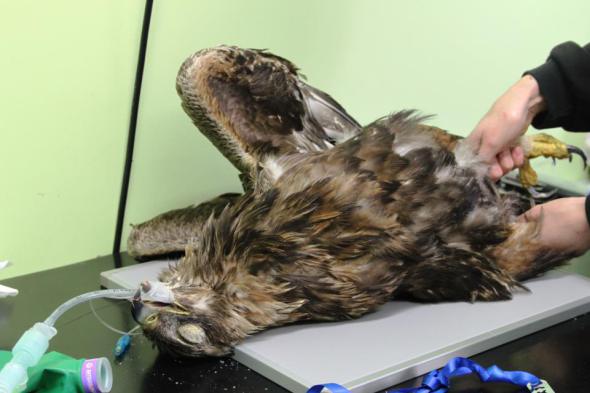
The image above is of the poisoned golden eagle found underneath her nest tree in the Borders in 2007. Nobody has ever been prosecuted for this.

The image below is of the shot golden eagle found on Buccleuch Estate in 2012. He didn’t survive. Nobody has ever been prosecuted for this.

 Wanlock Head GE Oct 2012

Henry’s tour day 27: where Bowland Betty breathed her last

Tues 12 May  Copy

Henry is visiting the Swinton Estate today – a vast area of moorland in the Yorkshire Dales that is managed for driven grouse shooting.

This is a particularly poignant visit. In July 2012, not very far from where this photo was taken, the dead body of Bowland Betty was found.

Bowland Betty was a young hen harrier from a 2011 nest in Bowland, Lancashire. She was named after Bet Lynch, the barmaid from Corrie. Bowland Betty was satellite-tracked and the public followed her movements across England and Scotland until her miserable death the following year. She’d been shot. You can read her story here.

You might also be interested in the Countryside Alliance’s view of this crime – here.

More publicity needed for wildlife crime-related subsidy withdrawals

VL subsidy removal Sunday Mail 22 March 2015 - CopyRegular blog readers will know how difficult it is to find out whether farms and shooting estates that have a proven link with wildlife crime have had any of their agricultural subsidies withdrawn as a result of their non-compliance with the subsidy regulations.

A good example is the ridiculous on-going saga of Stody Estate in Norfolk – blog readers have, for the last six months, been asking the Rural Payments Agency about any potential subsidy withdrawal, ever since their gamekeeper Allen Lambert was convicted of poisoning 11 birds of prey last October (see here for blog posts). We’re still non the wiser.

You’d think, given the potentially large sums of money involved, that the authorities would be shouting about these penalties from the rooftops. The realistic threat of having thousands of pounds of public money removed from your business is an excellent deterrent and is far greater than the typically pathetic fine imposed by the criminal justice system.

Another case in point is that of Ninian Johnston Stewart, the first landowner in Scotland to be convicted under the vicarious liability legislation. Johnston Stewart received a puny £675 fine for his crimes (see here). His gamekeeper, Peter Bell, convicted of poisoning a buzzard and having a stash of banned poisons capable of killing 10,000 birds received a £4,450 fine. Johnston Stewart’s miserable fine is hardly likely to see other landowners quaking in their tweeds.

However, in March we were able to blog about Johnston Stewart’s subsidy penalty, which amounted to almost £66,000 (see here). Now THAT’S a deterrent!

But where did we get this information from? We didn’t read about it in a Government press release. We didn’t read about it in the mainstream media. Nor did we read about it on SLE’s website.

The place we found it was in the RSPB’s Legal Eagle newsletter; an excellent publication but one of specialist interest that is probably mostly only read by those with a special interest in crimes against birds of prey.

Here it is: Legal Eagle 75 March 2015

Since then, we’re only aware of a couple of other publications that have mentioned it. One, authored by RSPB Scotland’s Head of Investigations Ian Thomson, appeared in another specialist journal, Scottish Justice Matters Vol 3(1). This can be downloaded here:

SJM Vol 3 March 2015

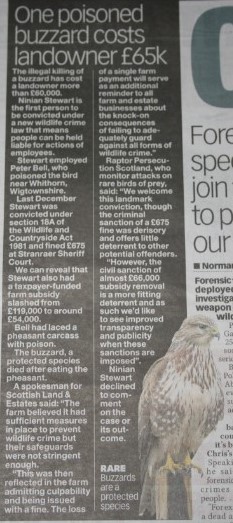
The other publication that we’re aware of was much more mainstream – the Sunday Mail (22nd March 2015) had a headline-grabbing article, ‘One poisoned buzzard costs landowner £65k’.

We were pleased to be quoted in this piece, as follows:

We welcome this landmark conviction, though the criminal sanction of a £675 fine was derisory and offers little deterrent to other potential offenders. However, the civil sanction of almost £66,000 subsidy removal is a more fitting deterrent and as such we’d like to see improved transparency and publicity when these sanctions are imposed“.

Well done to the RSPB for getting the info out there in the first place, and thanks to journalist Billy Briggs for reading this blog and taking the story to a wider audience.

Convicted vicarious liability landowner loses nearly £66,000 in subsidies

In January we blogged about the subsidy penalty given to Ninian Johnston Stewart, the first landowner to be convicted under vicarious liability legislation in Scotland after his gamekeeper laid out poisoned bait that killed a buzzard in 2012. At the time of Johnston Stewart’s conviction we knew that he’d lost some of his agricultural subsidy but we didn’t know how much. The only information in the public domain was the following quote from his defence agent, David McKie, who was discussing Johnston Stewart’s (derisory) fine of £675:

He [Johnston Stewart] had already been penalised substantially via a high five-figure deduction to his Single Farm Payment“.

The size of his subsidy penalty has now been revealed in the latest edition of the RSPB’s Investigations newsletter, Legal Eagle:

In 2012, Johnston Stewart’s business received nearly £120,000 in Single Farm Payments. Under ‘cross-compliance’ there is a requirement to comply with a number of conditions in order to receive payments. The poisoned bait and buzzard were found on land used for agriculture by the business and consequently he lost nearly £66,000 of the 2012 payment“.

That’s a good result, although you have to question why his entire 2012 subsidy (nearly £120,000) wasn’t withdrawn.

In other subsidy penalty news, regular blog readers will be aware that we’ve been trying to find out (unsuccessfully so far) whether the Stody Estate (Norfolk) has also received a subsidy penalty, following the conviction of gamekeeper Allen Lambert for poisoning 11 raptors (10 buzzards and a sparrowhawk) in 2012 and a series of other related crimes (see here, here, here, herehere and here). According to our reckoning, Stody Estate has potentially breached two Statutory Management Requirements: SMR1 (intentional killing of wild birds) and SMR9 (use of pesticides).

Thanks to the determination of one of our blog readers, here’s the latest response from the Rural Payments Agency:

12 February 2015

Ref: XXXXXX

Dear XXXXX

Re: Freedom of Information – Information Request

Thank you for your request for information dated 15 January 2015 which has been dealt with under Freedom of Information Act 2000 (FoIA).

To answer your questions:

1. Has the illegal poisoning of birds of prey carried out by an employee of the Stody Estate been reported to the RPA as a possible breach of Cross Compliance SMR1?

We can confirm that members of the public approached RPA following the media reporting of the prosecution, with several suggesting that SMR1 had been breached.

2. If the answer to the above question is yes, how many individuals have reported the potential breach to the RPA?

RPA can confirm that we have received e-mails from 20 individuals mentioning a possible breach in RPA regulations by the Stody Estate.

3. Is the RPA currently investigating a reported breach in cross-compliance at the Stody Estate relating to SMR1?

We previously answered a similar question in our response to you, reference XXXXX, and advised we do not hold any information that answers this question. RPA is obliged by European legislation to follow up these reports. We can assure you that RPA will take action, including cross compliance reductions to CAP subsidy payments, if this is found to be appropriate.

If you are not happy with the way we have handled your request, you can ask for an internal review. These requests should be submitted within two months of the date of receipt of the response to your original letter and should be addressed to: Access to Information, Rural Payments Agency, North Gate House, 21-23 Valpy Street, Reading, RG1 1AF.

Yours sincerely

Rural Payments Agency

You’d think that it would be a lot easier for members of the public to find out how their taxes have been spent, or more importantly, whether they’ve been withdrawn from those involved with criminality, wouldn’t you?

Jailing raptor-killing gamekeepers ‘not the answer’, says Robertson

Alastair Robertson Scotsman 24 Jan 2015The fall-out from the shock custodial sentence for raptor-killing gamekeeper George Mutch continues….

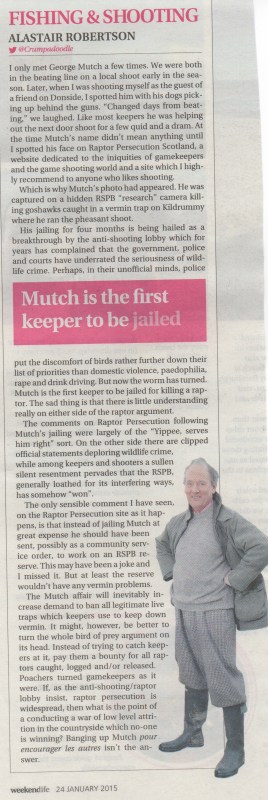
The following appeared in yesterday’s Scotsman weekend magazine (24th January 2015). It’s the regular country sports column written by Alastair Robertson, the pro-game shooting journalist who also contributes to Daily Mail, Mail on Sunday, Telegraph, The Sun, Country Life & The Field.

“I only met George Mutch a few times. We were both in the beating line on a local shoot early in the season. Later, when I was shooting myself as a guest of a friend on Donside, I spotted him with his dogs picking up behind the guns. “Changed days from beating”, we laughed. Like most keepers he was helping out on the next door shoot for a few quid and a dram. At the time Mutch’s name didn’t mean anything until I spotted his face on Raptor Persecution Scotland, a website dedicated to the iniquities of gamekeepers and the game shooting world and a site which I highly recommend to anyone who likes shooting.

Which is why Mutch’s photo had appeared. He was captured on a hidden RSPB “research” camera killing goshawks caught in a vermin trap on Kildrummy where he ran the pheasant shoot.

His jailing for four months is being hailed as a breakthrough by the anti-shooting lobby which for years has complained that the government, police and courts have underrated the seriousness of wildlife crime. Perhaps, in their unofficial minds, police put the discomfort of birds rather further down their list of priorities than domestic violence, paedophilia, rape and drink-driving. But now the worm has turned. Mutch is the first keeper to be jailed for killing a raptor. The sad thing is that there is little understanding really on either side of the raptor argument.

The comments on Raptor Persecution following Mutch’s jailing were largely of the “Yippee, serves him right” sort. On the other side there are clipped official statements deploring wildlife crime, while among keepers and shooters a sullen silent resentment pervades that the RSPB, generally loathed for its interfering ways, has somehow “won”.

The only sensible comment I have seen, on the Raptor Persecution site as it happens, is that instead of jailing Mutch at great expense he should have been sent, possibly as a community service order, to work on an RSPB reserve. This may have been a joke and I missed it. But at least the reserve wouldn’t have any vermin problems.

The Mutch affair will inevitably increase demand to ban all legitimate live traps which keepers use to keep down vermin. It might, however, be better to turn the whole bird of prey argument on its head. Instead of trying to catch keepers at it, pay them a bounty for all raptors caught, logged and/or released. Poachers turned gamekeepers as it were. If, as the anti-shooting/raptor lobby insist, raptor persecution is widespread, then what is the point of conducting a war of low level attrition in the countryside which no-one is winning? Banging up Mutch pour encourager les autres isn’t the answer”.

END

So, no real surprises. Gamekeepers and shooters apparently ‘loathe’ the RSPB for ‘interfering’ (= catching raptor-killing gamekeepers and reporting them to the police). Oh, and killing raptors doesn’t really merit a custodial sentence because it doesn’t rank as a priority crime, even though the Government and Police Scotland have both stated that tackling wildlife crime IS a priority, and even though the penalty available for EACH offence could be a £5,000 fine and/or a six month custodial sentence. Some would say Mutch got off lightly with just a four-month jail sentence.

Instead of trying to catch gamekeepers at it, Robertson’s theory is that gamekeepers should be paid a bounty for each raptor they manage not to kill. A bit like giving a bank robber a bounty for each bank he manages to walk past without robbing it. ‘Ah, well done lad, you’ve managed to go a whole day without committing a crime – here, have some tax-payer’s money in recognition of your self-control’.

Talking of Mutch, we were interested to receive a photo taken on a grouse moor in September 2014.  This was on Edinglassie Estate in Aberdeenshire. Edinglassie is an award-winning estate, receiving the GWCT’s Golden Plover Award in 2013 for their progressive & sustainable moorland management, and becoming WES-accredited (SLE’s Wildlife Estates Scotland thing). Is that George Mutch, clearing the butts after a drive? Who would employ Mutch to help out on a game shoot? (There’s no more helping out for a few quid and a dram – new rules mean that, unless in exceptional circumstances, HMRC views beaters etc as ’employees’ for tax purposes). Interesting. Although to be fair, in September he was still denying his guilt and hadn’t yet been convicted (that came in Dec). Can’t imagine an esteemed estate like Edinglassie would employ him now he’s been convicted of raptor persecution…..

Balaclava sales set to rise

Daily Mail Bloody battle of the glens (2)The angst generated by the successful use of video evidence to convict gamekeeper George Mutch continues, as does the game-shooting lobby’s pathetic attempts to discredit the RSPB….

The following excerpts are from a recent article in the Mail, written by Jonathan Brocklebank:

The camera was hidden in a pile of twigs deep inside a sporting estate whose owner had no idea that it had been infiltrated by Europe’s wildlife charity.

But then, RSPB Scotland needs no invitation or permission to launch covert surveillance ops on private land. These days, it gives its own go-aheads.

So it was that gamekeeper George Mutch, 48, came to be filmed with a juvenile goshawk he beat to death with a stick on the Kildrummy Estate, Aberdeenshire. He began a four month jail sentence this week after damning footage showed him using two traps to catch birds of prey.

His apparent motive was to protect pheasants from the raptors, thus ensuring a plentiful supply of game birds for the shooting parties whose business helps keep such estates alive. Mutch, thought to be the first person ever to be jailed in Scotland for killing a bird of prey, will win no sympathy from animal lovers.

But the court case did not simply highlight the inhumane behaviour of a lone gamekeeper who brought disgrace upon his profession. It also served as a demonstration of the now immense power of the charity whose evidence convicted him.

That power, say ever-growing numbers of critics, leaves few areas of outdoor and rural life untouched.

[There follows some predictably tedious claims made by Botham’s You Forgot The Birds campaign, whose failed complaints about the RSPB to the Charity Commission Mr Brocklebank failed to mention (see here), and how some landowners are erecting signs saying RSPB Not Welcome (see here). It then continues….]

During Mutch’s trial, Aberdeen Sheriff Court was told the RSPB routinely enters estates without asking the landowners and, once inside, staff are free to use hidden cameras to gather ‘data’.

When questioned in court, Ian Thomson, the charity’s head of investigations, explained why they needed no permission. “Because we are entering an area for scientific study, we feel we are using our access rights under the Land Reform Act”.

Is it, then, acceptable for RSPB officials to march onto a private estate and set up equipment to secretly video employees?

It seems so. A spokesman for the charity told the Mail: “In Scotland, the Land Reform Act (2003) enshrined a legal “right to roam” and this includes access for survey and research purposes, provided this is carried out responsibly”.

He said the shocking images captured on the video spoke for themselves.

Notwithstanding Mutch’s appalling actions, there is a distinct air of discomfort in the Scottish Gamekeepers’ Association (SGA) over the means by which the RSPB’s evidence was obtained.

A spokesman for the organisation said it seemed wrong for individuals “from one particular profession” to be under surveillance in their workplace without their knowledge.

He added: “Is it the case now that charities can do this rather than the police – and is this the correct thing?

They have said they used their rights of access to go on to the land to do this. Really, they should have asked the landowner out of courtesy, if anything. Although it is not sacrosanct in law to do so, I think it would rile people a lot less if there were a little bit more cooperation from organisations such as the RSPB.

These are the things that lead to the breakdown of trust. If they did things a little bit more with due respect, they would find themselves in a lot less problems”.

His words hint at both a clash of cultures and at competing interests in the schism between senior figures in the charity and the ‘tweedies’ who own and manage vast swathes of the Scottish countryside.

While Scottish Natural Heritage (SNH) routinely issues licences to farmers to control wildlife which threatens their livestock, it has never issued a licence to a gamekeeper or landowner to control any species threatening birds kept for game, which also count as livestock under the Wildlife & Countryside Act 1981. The reasons for this, gamekeepers believe, is obvious: politics.

[The rest of the article covers complaints from a gamekeeper on the Lochnell Estate in Argyll about people turning up unannounced to monitor raptor nests; how many members the RSPB has; how much income the RSPB generates; the RSPB’s involvement in the renewal energy debate; how the RSPB is seen as the ‘go to’ organisation for advice on developments; how arrogant the RSPB is; and ends with the question: Is there a time, perhaps, when a charity just becomes too big?]

ENDS

So, the SGA thinks that wildlife crime investigators should let landowners know, in advance, of their arrival on a privately-owned estate. They seem to be missing the point. The landowner can now be held criminally vicariously liable for some crimes against raptors that are carried out by their gamekeepers; what do you think is the first thing the landowner would do, if he/she was notified that wildlife crime investigators were on their way? Advanced warning would hardly be in the interest of an investigation, (or justice), would it? Besides, as was pointed out in the article, nobody has to give advanced warning to a landowner of an impending visit and as long as they act responsibly once on the land, they’re well within their rights – that’s kind of the point of the Land Reform Act.

And what’s all this guff about gamekeepers have never been issued an SNH licence to ‘control’ (kill) “any species” that is perceived as a threat to their game birds? What utter nonsense! Gamekeepers routinely use the SNH General Licences to ‘control’ (kill) corvids. Ironically, this is what Mutch was supposed to be doing when he was filmed killing a trapped goshawk and shoving two other raptors in sacks and walking off with them. Sounds to us like the SGA are trying to play the victim card, again, albeit unsuccessfully.

McAdam 1The SGA aren’t the only ones up in arms about the admissibility of the RSPB’s video footage which was used to devastatingly good effect in the Mutch trial.

Here’s what the CEO of Scottish Land & Estates (SLE), Doug McAdam, wrote in last week’s SLE e-newsletter:

There can be no doubt that the custodial sentence handed down this week to a gamekeeper convicted of wildlife crime will send a very strong message out to those who continue to break the law. The illegal killing of any bird of prey is unacceptable and anyone who engages in such activity can, rightly, expect to feel the full weight of the law.

However, this case has raised some fundamental issues regarding access rights and the law as it becomes clear that a central party to this investigation [he means the RSPB] has chosen to totally disregard Scottish Government approved guidance contained in the Scottish Outdoor Access Code regarding undertaking survey work on someone else’s land. This is a serious matter in its own right, but it also reaches well beyond matters of wildlife crime, crossing in to areas such as new development and planning work where it could have some serious implications”.

Why is this “a serious matter”? It’s no such thing (unless you happen to be CEO of an organisation that just wants to have another go at discrediting the RSPB or is concerned about what future video footage may reveal). The Scottish Outdoor Access Code is just that – it’s a code, not a statutory instrument. It has as much legal influence as the Green Cross Code. It is trumped, magnificently, by the 2003 Land Reform Act. The totally independent Sheriff in the Mutch trial (who, don’t forget, was brought in because the defence thought that the original Sheriff, as an RSPB member, might be biased – see here) deemed that, in this instance, the RSPB video footage was admissible.

That’s not to say that other video footage will be deemed admissible in other trials – it will depend entirely on the circumstances of the case. In the Mutch trial, the RSPB argued successfully that their cameras were not in place to ‘catch someone at it’ – they had been placed as part of a long-term study in to crow cage trap use. That their footage captured Mutch engaging in his disgusting crimes was just a very happy coincidence.

You have to wonder, with all this consternation from the game-shooting crowd, just what it is they’re so frightened that covert cameras might record….

Now might be a good time to buy some shares in balaclava-making companies.

George Mutch sentenced to four months in prison

Scottish gamekeeper George Mutch, convicted in December for trapping a goshawk and then battering it to death (and a few other things – see here) on the Kildrummy Estate in Aberdeenshire, has been sentenced to four months in prison for his crimes.

He was led away from the court in handcuffs and is currently en-route to a prison cell.

What an unbelievably brilliant outcome – we never thought we’d see the day. Mutch is the first gamekeeper ever to be jailed in the UK for killing raptors.

Huge congratulations to the RSPB Investigations Team, SSPCA, Police Scotland and the Crown Office, and kudos (and thanks) to Sheriff Noel McPartlin for handing out this sentence. An acknowledgement also to former Environment Minister Paul Wheelhouse, who pushed hard for the admissibility of video evidence. Had he not done so, this case would probably not have made it to court.

For anyone who missed it when he was convicted in December, here is the video nasty showing gamekeeper Mutch carrying out his crimes on the Kildrummy Estate in Aberdeenshire.

We understand there’s the potential for a vicarious liability prosecution in this case. We’ll have to wait and see whether COPFS deems there’s enough evidence to proceed. Although that may prove difficult – have a read of Andy Wightman’s blog about who owns Kildrummy Estate, here.

Media coverage:

A bizarre statement from the SGA here. Isn’t it great to see the representative organisation strongly condemning his crimes, er…

BBC news here, including statements from the Sheriff, RSPB Scotland, COPFS, SGA and SLE.

RSPB Scotland statement here

Press & Journal here

Herald here. This is an interesting one, with quotes from defence agent David McKie about Mutch’s employment status and the status of his firearms certificates.

Telegraph here, with claims that Mutch had been sent a ‘threatening letter’ following his conviction in December. The police are investigating.

Daily Mail here, with a classic quote from Superintendent George MacDonald (Police Scotland) suggesting it’s just a “small minority” of gamekeepers who are at it. What he meant, of course, is that it’s just a small minority that are actually caught.

Courier here, which is pretty much a carbon copy of the Mail’s piece.

COPFS statement here