
why is it so difficult to investigate the illegal killing of a golden eagle?

Way back in June, we blogged about a golden eagle that had been found dead in suspicious circumstances in Grampian in May (see here). Four and a half months after the dead bird was found, a press release has now been issued by the RSPB which provides the sickening details of how this eagle is believed to have been destroyed (read it here, if you’ve got a strong stomach). It is reproduced below:

CONSERVATIONISTS APPALLED BY EAGLE DEATH

RSPB Scotland has today issued an appeal and a reward for information, following the discovery of the body of a golden eagle on Deeside.

The bird, fitted with a satellite transmitter, was found on 5 May 2012, after signals sent by the transmitter indicated that the bird had not moved for several days.

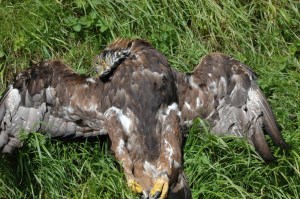
The body was found, lying face down, with its wings folded, under a tree branch, close to a lay-by on a quiet country road near Aboyne, and was seized as evidence by officers from Grampian police.

The carcass was then taken for a post mortem at the Scottish Agricultural College laboratory in Aberdeen. This concluded that the bird had suffered two broken legs due to trauma ‘that could be consistent with an injury caused by a spring type trap’ and that the severity of these injuries ‘would prevent the bird from being able to take off.’

The bird had been fitted with a transmitter by RSPB Scotland staff, in full partnership with a local landowner, a few days before it had fledged from a nest in the Monadhliath Mountains, south-east of Inverness, in July 2011.

By re-examining the satellite data, staff discovered the young bird spent its first few months in its natal area before venturing further afield. By April 2012 it was frequenting an area of upper Deeside, before moving south-west into Glenshee.

On 28 April, the bird moved eastwards into Angus. The following day, at 6am, the bird was located on a hillside overlooking Glen Esk. Over the next 15 hours, a succession of satellite tag readings, accurate to within less than 20 metres, showed that the bird did not move from this precise spot until at least 9pm that evening, after nightfall.

However, by 4am the next morning, 30 April, according to transmission data, it appeared to have travelled during the hours of darkness, some 15km north, to the location where its body was subsequently discovered some five days later. Satellite readings revealed that whilst the bird did not move from this position, it was probably alive until 4 May.

Follow-up enquires by both Tayside and Grampian Police found no further evidence as to how the eagle came to suffer its injuries, nor could it be established how the eagle came to move from Glen Esk to a position under a tree branch on Deeside overnight. However, a number of eagle down-feathers were found between the lay-by and the bird’s final resting place.

Ian Thomson, RSPB Scotland’s Head of Investigations, commented: ‘It is disgraceful that this magnificent bird was subjected to such suffering. The post mortem evidence suggests that this bird was caught in an illegally set-trap, smashing both legs. The data obtained from the satellite transmitter indicated that the eagle did not move from one spot on a hill high above Glen Esk, for over 15 hours. Then, during the night, when eagles do not readily fly, it has inexplicably moved to a new position, hidden under a tree and close to a road. Here, over the next four days, this eagle suffered a lingering death.’

Stuart Housden, RSPB Scotland Director, added: ‘Anyone who cares about our wildlife will be disgusted by what appears to be an appalling crime and the lengths taken to hide the facts from discovery. Whilst efforts to stamp out the illegal poisoning of birds of prey are perhaps beginning to yield results, this dreadful case shows that the persecution of our raptors continues through the use of traps and other means.

We call upon anyone who can provide further information about this case to contact the wildlife crime officer at either Tayside or Grampian Police without delay. Cases like this really do have a negative impact on Scotland’s reputation as a country that respects and values all its wildlife heritage. I am today offering a £1,000 reward for information that will assist a successful prosecution.’

ENDS

Yet again, as in so many other alleged persecution cases, there has been an unexplained and lengthy delay in releasing this information to the public. It should not take this long, especially for such a high-profile incident of such an appalling nature. Isn’t investigating wildlife crime a supposed ‘priority’ amongst Scottish police forces? That’s what we’re told! The reality still seems somewhat removed from that ideal, even after all this time and all these other cases with which to fine tune a response. Note that it’s the RSPB that has released this information today; not Tayside Police and not Grampian Police.

We’ve been given some interesting information about this incident. The press release states that this eagle’s satellite tag sent signals from “a hillside overlooking Glen Esk” and those data apparently suggested the eagle didn’t move from that precise spot over a 15-hour period, until it inexplicably moved, under cover of darkness, close to a layby 15 km north over the border into Grampian. Well, according to the grid reference provided by the sat tag, which may or may not be accurate because accuracy can be affected by a number of variables, this location is on Millden Estate. Millden Estate may be a familiar name to some as it was where a young sat-tagged golden eagle named ‘Alma’ was found poisoned in 2009 (see here). Nobody has ever been charged in connection with her death.

It appears the police trusted the accuracy of the sat tag data enough to pinpoint a location for an informal ‘search’ on Millden although the extent of this ‘search’ was apparently limited to the precise grid reference  from the sat tag. We understand that a search warrant was not requested to examine vehicles or the wider estate for potential evidence. Why not? It’s also worth noting that there are two other sporting estates in Glen Esk – were either of these also searched as part of this inquiry? If this eagle had been caught in an illegal spring trap in Glen Esk, as is being alluded to in the media, who’s to say on which estate the trap was located? (although that assumes the trap was un-anchored, which would be highly unusual). That’s where a wider search, especially of vehicles, might have come in useful.

So here we are again. YET ANOTHER eagle persecuted in Scotland and YET ANOTHER profoundly unsatisfactory response from those with a  statutory duty to investigate. How many more of these (e.g. see here for a long list of others) do we have to endure before we see a fundamental change in the way these offences are investigated and prosecuted?

UPDATE 25th September: If you would like to use your anger about this case in a positive way, please send an email to the new Scottish Environment Minister, Paul Wheelhouse MSP, to tell him how you feel about this disgraceful crime: ministerforenvironment@scotland.gsi.gov.uk He already knows about the incident – he tweeted about it last night: @PaulWheelhouse “Absolutely appalling – disgusted with whoever did this“. What he might not know is the strength of feeling of the rest of us.

UPDATE 26 February 2013: Deeside golden eagle fiasco rumbles on as SGA release their ‘report’ (here)
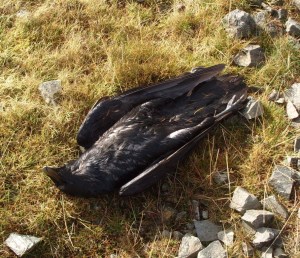
’36th buzzard found dead’ in persecution blackspot

Thanks to @EimearRooney1 for the following tweet:

36th buzzard found dead at Drumbanagher, Co. Armagh, this week. Coincidence? Unlikely. The PM will be interesting“.

Indeed.

Previous post about this area here.

UPDATE: Buzzard testing positive for Alphachloralose.

Another poisoning incident goes unpublicised

The latest list of reported poisoning incidents in Scotland, as published by SASA, reveals that yet another poisoning incident took place earlier this year and it wasn’t publicised.
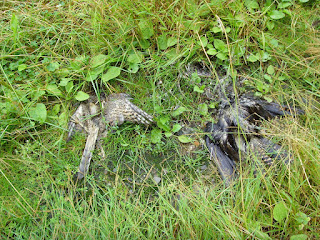
The report documents the discovery of a raven, a crow, a meat bait and two rabbit baits. The incident is categorised as ‘abuse’ and the chemical involved was the acutely toxic carbamate, Bendiocarb. This discovery was made in May and the location is given as ‘Borders’. The comments section says: “This incident is the subject of an on-going police investigation”.

So where was the publicity? What if the police hadn’t found all of the baits? What if more baits had been laid out? Where was the warning to the general public of the risks involved to them, their children and their pets if they stumbled across this poison? Isn’t there a duty of care for the authorities to warn the public about toxic poisons in their area?

There’s a fascinating document called ‘Communicating with the Public about Health Risks’, produced by Health Protection Scotland in 2008 (see here). This document spells out the importance of effective communication (with the public) about hazards that pose a risk to human health and gives very detailed guidance about how to communicate information about those risks.

There’s another useful document, called ‘Management of Public Health Incidents: Guidance on the Roles and Responsibilities of NHS-led Incident Management Teams’, produced by the Scottish Government in October 2011 (see here). This document details the statutory responsibilities for managing public health incidents and it tells us that poisons are indeed classified as a public health risk under The Public Health (Scotland) Act 2008. So who is failing in their duty to inform the public about these risks?

One of these days, somebody is going to come into contact with one of these poisoned baits and they’re either going to become seriously ill or even die. What would happen if it was revealed that the police already knew about the baits in that area/location, but hadn’t made the discovery public? There would probably be an almighty cry of public and media outrage and heads would roll. And they’d deserve to roll. This recurring situation is a scandal.

When are the interests of the public, and of wildlife, going to be put above the interests of protecting the identity of these sporting estates where illegal poisoned baits have been, and continue to be, routinely found?

Dead raptors found in suspicious circumstances in Devon

Here’s another example of fine, proactive wildlife policing from Devon WCO Josh Marshall.
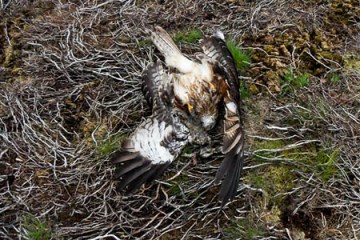
On his personal blog, which he set up specifically to raise awareness about wildlife crime in his region, Josh is reporting the discovery of a dead peregrine and a dead sparrowhawk that were found in suspicious circumstances last week. The birds were x-rayed and they hadn’t been shot, but their bodies were too decomposed to allow for any toxicology analysis.

Even though the cause of death could not be established, Josh believes that persecution had taken place due to the position of the birds.

Rather than keeping quiet and forgetting about the incident, knowing that it was going to be virtually impossible to make any more progress with the investigation, Josh chose to publicise the incident and asked people to be extra-vigilant when out walking in the area. Once again, he’s showing how suspected wildlife crimes should be handled. Well done that man.

Story on Josh’s blog here

Some not so good eagle news

We have it on very good authority that another satellite-tagged golden eagle has gone ‘missing’ in the Monadhliaths in the last couple of weeks.

Going ‘missing’ doesn’t equate to ‘being dead’ of course, but it’s really stretching the boundaries of credibility to believe that yet another disappearance is the result of yet another dysfunctional tag, especially when the area of its last known movements just happens to be one of the country’s persecution hotspots.

How many’s that since the sat-tagging began several years ago? We’ve lost count. Just looking at this year’s reports, in addition to this latest eagle, we know about this ‘missing’ satellite-tagged golden eagle (here), this ‘missing’ satellite-tagged golden eagle (here), this dead satellite-tagged golden eagle (here), and this dead satellite-tagged golden eagle found poisoned in Lochaber (here). How many don’t we know about?

N Yorks police appeal for info 3 months after kite found poisoned on moor

North Yorkshire police have taken three months to appeal for information after the discovery of a poisoned red kite on moorland.
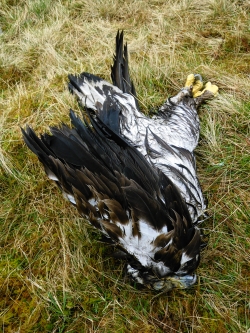
The kite was found by a raptor fieldworker on Lofthouse Moor, Nidderdale, in May 2012. Toxicology tests revealed it had been poisoned ‘by a combination of banned pesticides’. The press release doesn’t offer any further detail about which banned pesticides were used, but it also states that rodenticides were discovered during the tests. Confusingly, the police wildlife crime officer focuses on the ‘common problem’ of accidental rodenticide poisoning rather than the other common problem of deliberate poisoning using banned chemicals.

Why has it taken the police three months to make this appeal? Where’s the sense of urgency? Where’s the indication that this crime is being taken seriously? Does anybody know whether Lofthouse Moor is managed for grouse shooting?

North Yorkshire Police press release here

News article on the Grough website here

Latest poisoning figures are just a smokescreen

So, SGA Chairman Alex Hogg is “hugely encouraged” by the forthcoming 2012 poisoning statistics, due to be released by the government agency SASA in the next few days (see here for STV news story and here for SGA press release). The figures are expected to show just two confirmed raptor poisonings in the first half of 2012, a considerable drop from the figures of previous years.
Unfortunately, these figues are just a small part of the story, as many regular readers will already be aware. We’ve blogged about this before, back in March when the poisoning figures for 2011 were published (see here for our previous post). As we said then, these figures look promising on a superficial level but do they really reflect the true extent of illegal persecution?

The lower poisoning figures may well be a true indicator that fewer people are still poisoning raptors. That’s what the SGA and friends clearly think and would like the rest of us to think. However, another equally plausible explanation is that the poisoners are just getting better at hiding the evidence. We’ve always known that the published poisoning figures just show a tiny fraction of actual poisoning incidents; these poisonings usually take place in vastly remote areas where few people are around to find the evidence. The poisoned birds that have been discovered have usually been discovered by chance. More recently, they’ve been discovered because more raptors are now fitted with satellite tags so it’s easier to follow their movements and to find the locations where they die.

There is another plausible explanation, too. As we’ve also said before, poisoning is not the only method of illegally killing raptors. Perhaps the lower poisoning figures reflect a substantial shift in the methods used to persecute raptors. Are more raptors being shot at the nest? Are more raptors being shot at roost sites? Are more nests and eggs being destroyed? Are more raptors being caught in traps and being bludgeoned to death? The persecutors know very well that the government doesn’t record these types of incidents; only reported poisoning incidents are published. What better way to make it look like you’ve cleaned up your act than by reducing the poisoning but increasing the other techniques that you know will never be officially reported? (Except by the RSPB who always publish these other persecution incidents in their annual reports, but which are then dismissed as being ‘unofficial’ and ‘exaggerated’ by the game-shooting lobby).

Is it plausible that other persecution methods have now taken precedence over poisoning? Let’s look at the hen harrier situation. The UK’s hen harriers continue to spiral towards oblivion and the main cause has been identified as illegal persecution. Everyone knows it and even the government has acknowledged it. But how many hen harriers do you see listed in the annual poisoning figures? Very few indeed. Mainly because poison is rarely used to kill harriers – they’re not typically a scavenging species that depends on carrion so they’re harder to poison. But just because they don’t feature on the annual list of poisoned raptors doesn’t mean they’re not persecuted! Of course they are; the national hen harrier survey results say it all.

If anyone is still in any doubt about whether the latest poisoning figures are an accurate reflection of the extent of illegal raptor persecution, then consider this. Will the figures for Jan-June 2012 include this ‘missing’ satellite-tagged golden eagle (here), or this ‘missing’ satellite-tagged golden eagle (here), or this dead golden eagle found with substantial injuries (here), or this dead golden eagle found in what was described as ‘suspicious circumstances’ here? Or just the one confirmed poisoned golden eagle found dead in Lochaber (here)?

Yet another dead golden eagle: poisoning suspected, again

The Press and Journal is reporting the following story:
Another dead golden eagle: poisoning suspected.

Poison fears after golden eagle found dead in prime island habitat.

Police are investigating another suspicious golden eagle death- this time in one of the heartlands of the species.

The bird of prey was found at Loch Langabhat on Harris at the end of last month. Scotland’s first year round observatory to allow the public to view golden eagles opened on the island earlier this year.

It is understood that the creature was found by rangers working for the North Harris Trust, which runs the observatory.

The area has one of the highest breeding concentrations of the bird in Europe. About 20 pairs of golden eagles are resident on the island.

A police spokesman said: “We are investigating the death of a golden eagle. Its carcase has been sent for analysis to see if it had been poisoned.”

The same day as the Harris eagle was found, tests confirmed that a golden eagle found dead near Morar in Lochaber had been poisoned.

The Royal Society for the Protection of Birds Scotland said it was the third known poisoning incident in the area in 10 years. Two white tailed sea eagles were previously found poisoned.

The latest death in Lochaber was discovered in March and the results of a post mortem examination have now been released. They show banned pesticides were used.

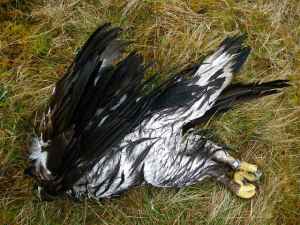
So, if this latest dead golden eagle is found to have been poisoned, it will be the third illegally-killed golden eagle reported in the last three weeks. The first one was the incident we reported on 18 June in the Tayside/Grampian region (see here), which, incidentally, still has not been the subject of a formal press release by either the police or the RSPB. The second one was reported by the RSPB and the police on 28 June and related to a poisoned golden eagle found dead in Lochaber three months earlier (see here) [This is the eagle pictured above].

It seems that ‘someone’ has leaked the story of the Harris dead eagle to the Press and Journal as there doesn’t appear to be any formal press release on any of the other news sites or the Northern Constabulary website. Well done to whoever alerted the P&J. We’ll await the SASA lab tests with interest. It’s quite possible of course that this eagle hasn’t been poisoned, although pesticide-poisoned birds generally exhibit diagnostic signs (like clenched feet and dead insects on the body) – signs with which investigators will be very familiar.

North Harris Eagle Observatory webpage here

Golden eagle poisoned in Lochaber

A golden eagle is poisoned with banned pesticides in Lochaber and the police/RSPB wait for three months before appealing for information. What’s the point? Can anyone explain the purpose of this delay? Even the Scotsman comments on it (here). Can anyone think of another type of crime where these reporting delays are common?

RSPB press release here

Please note: this dead golden eagle is not the same dead golden eagle we reported on the 18 June (see here). We’re still waiting for an official press release about that one. But anyway, that’s two known illegally-killed golden eagles reported in the space of 10 days, and we understand that at least two others have been ‘missing’ since May, according to their sat tag data. Looks like we’re going to have to update our dead eagle page (here).

What aren’t they telling us and why aren’t they telling us?

It seems blogger Alan Tilmouth was much more astute than us. Last week we blogged about Alan’s FoI to DEFRA to find out which Northumberland shoots were set to host the DEFRA buzzard ‘study’. DEFRA wrote back to Alan to ask whether he still wanted to proceed with his FoI even though the ‘study’ had now been cancelled. Alan saw this as a ‘concealment’ attempt by DEFRA – we saw it as just a delaying tactic (see here). We were wrong!

DEFRA has now written to Alan again, this time to tell him that yes, they hold the information he requested but no, they aren’t going to reveal it for ‘public safety’ reasons!!! See Alan’s blog here for their full statement.

Public safety my arse! Does anyone else smell the rancid odour of a cover up? Time to write to the Information Commissioner, Alan!

It seems DEFRA aren’t very good at responding to FoI requests, especially those relating to the game-shooting industry. Mark Avery has also been having trouble getting DEFRA to respond to his FoIs about Walshaw grouse moor (see here).

Talking of cover ups, still no official word from Tayside Police, Grampian Police or the RSPB on that dead golden eagle that we reported on Monday (see here). Hmmm…