Another poisoned raptor, another well-kept secret?

Last week we blogged about Des Thompson’s presentation at the Scottish Wildlife Crime Conference (see here). Here’s a reminder of what he had to say about Northern Constabulary and the problem of red kite persecution in northern Scotland:

So 40% of the dead, just over 100 red kites were poisoned in north of Scotland, without poisoning we should have had 300 plus birds, poisoning of red kites in the north of Scotland is attracting a lot of criticism nationally, and we now know the location of the hotspots problem areas where red kites have been found, poisoned, and we’re working closely with the police to tackle this. And I want to put on record here how grateful we are to Northern Constabulary, er, senior staff at Northern Constabulary for meeting with us to discuss the scientific issues and for taking forward the very ambitious programme of work to tackle this problem“.

So what is this “very ambitious programme of work” and why is it that Northern Constabulary appear to need persuasion to carry out what is its statutory duty to investigate wildlife crime?

If you look at the Force’s website you’ll see that they have 13 police Wildlife Crime Officers (see here) who are overseen by a Force Wildlife Crime Coordinator, Chief Inspector Matthew Reiss. The website also includes a ‘statement of intent’ in relation to tackling wildlife crime and the Force says it is committed to tackling wildlife crime (see here). Further, Chief Inspector Reiss is on record (according to Highland News) as saying Northern Constabulary treats wildlife crime “extremely seriously” (reported here after the convictions of Skibo Estate and Moy Estate employees for wildlife crime offences).

All sounds very convincing and reassuring, doesn’t it? Why is it then that Northern Constabulary has remained tight-lipped about the discovery, 15 months ago, of a poisoned red kite allegedly found on moorland at the boundary of Skibo Estate? We have been told that the satellite-tagged kite was allegedly found in February 2011. SASA documents show that only one red kite from the Highland region was tested in February 2011  and  it had been poisoned by Alphachloralose and was the subject of on ongoing police investigation (SASA ref #11020, see here).

Was there any publicity about this bird? We think we might have remembered if there had been, but we checked back to Northern Constabulary’s archived news items on their website for the month of February 2011 in case we’d missed it – but no, plenty on there about theft of handbags and damage to tractors but not a whisper about the discovery of a poisoned red kite.

Was there a police raid on the surrounding properties where this bird was allegedly found poisoned? If it was found at this location, and given that this is one of the supposed ‘hotspot’ areas for raptor poisoning (three golden eagles and a sparrowhawk found poisoned in 2010 – no convictions; a staked-out poison-laced grouse bait found in 2010 – no convictions) wouldn’t a police raid be the obvious first step in an investigation?

So is that it? No further action? If we hadn’t received a tip-off would it ever have come to light? Where was the RSPB in all of this? Did they know that one of their satellite-tagged kites had allegedly been found poisoned? If they did, why wasn’t the incident publicised? Where was SNH and PAW Scotland in all of this? Did they know that one of the satellite-tagged kites that they’d helped fund had allegedly been found poisoned? Where was their publicity? Where was the NWCU in all of this? Were they notified? Was this alleged incident the trigger for setting up the meeting with senior staff at Northern Constabulary to discuss the red kite persecution ‘science’?

This is the second time in the last few weeks that Northern Constabulary has been at the centre of allegations of secrecy and cover-up when it comes to wildlife crime (see here for earlier report on the suspected shooting and decapitation of a white-tailed eagle on Skye that went unpublicised). How many more incidents are there left to be uncovered? To be fair, Northern Constabulary does sometimes get it right, with current ongoing court cases including the alleged hare snaring at Lochindorb (here) and alleged egg theft (here), but ‘sometimes’ just isn’t good enough. Nobody’s suggesting these investigations are easy – we’ve all seen how difficult it can be to get COPFS to agree to a prosecution – but Northern Constabulary (and others) don’t help themselves when they choose not to publicise, or sometimes even investigate these alleged crimes.

How about everyone stops all the politically-motivated soundbites about commitment and very ambitious work programmes and just focuses on getting the basics right?
Egg-thief Matthew Gonshaw: warrant out for his arrest

We have been told that a warrant is out for the arrest of convicted egg-thief, Matthew Simon Gonshaw, who failed to turn up for his latest court hearing today at Inverness Sheriff Court.

This is an interesting situation. In December 2011, Gonshaw was jailed (for the fourth time) after his conviction at Thames Magistrates court for ten offences under the Wildlife & Countryside Act (relating to the theft of wild bird eggs). He was given a six month jail sentence (see here), with a likely release date of 15 March 2012 (see here).

In addition, in February 2012 Gonshaw was given a landmark ten-year ASBO (anti social behaviour order) at Stratford Magistrates court, banning him from Scotland, amongst other places, during the bird breeding season between 1 Feb – 31 Aug (see here).

Given that he had already been given a date to attend Inverness Sheriff court on other charges (again related to theft of wild bird eggs) on 8 March 2012, it is very likely that his ASBO contained an exemption allowing him to attend court in Scotland on 8 March. When the March court date came, his case was continued without plea until 5 April (see here) and was then further continued to today (see here).

Perhaps his ASBO did not contain an exemption, and that is why Gonshaw failed to appear today? But if that was the case, he should have made contact with the court to explain the situation.

His latest case at Inverness will now continue at a later date, once Gonshaw has been arrested and a new date fixed.

Anyone with information on his whereabouts is advised to call the police immediately on 999.

Egg thief Matthew Gonshaw – more delay in latest case

The latest case against convicted egg thief Matthew Gonshaw was heard at Inverness Sheriff Court on 5 April 2012 (case continued from 8 March 2012).

This case has once again been continued and will next be heard at the end of April.

For background, see previous blog here

Police, Camera, (No) Action

We’ve recently learned about the suspected shooting and decapitation of a white-tailed eagle on the Isle of Skye. Incredibly, this incident, concerning one of Scotland’s most iconic conservation species, has been a well-kept secret for almost a year!

The freshly-dead sea eagle was discovered on a Skye beach by a member of the public in late April 2011. This person is a member of the medical profession and in his opinion, the eagle had been shot by a rifle and its head had been removed with a sharp implement, probably a knife. It was also his opinion that the bird had been thrown from a cliff-top onto the beach; the rocks on the cliff-top above where the body was found are well-known sea eagle perching spots. Photographs of the shot, head-less eagle were taken and the incident was reported to the regional RSPB office and to the police (Northern Constabulary).

For a variety of reasons (and none of them sinister), the carcass was not retrieved from the beach for another two weeks. This unfortunate delay meant that the carcass was in an advanced state of decomposition. It was sent for post-mortem but this apparently proved inconclusive. We don’t know who conducted the post-mortem (the bird does not appear in the SASA reports so we assume it wasn’t tested for poisoning).

According to our sources, the police investigation was limited, at best. The dead eagle was discovered on the Easter weekend; many visitors would have been in the vicinity as this location is a popular tourist destination. A press release might have drawn potential witnesses from amongst the visitors, and also would have alerted local people to the incident. We understand that many locals were not informed, let alone asked for any potential intelligence leads.

The only public comment about this incident is a one-liner on the Skye Birds website (see here) dated 27 March 2012. Why all the secrecy? Was it deliberate, or another poorly-resourced investigation, or just incompetence? Not for the first time, questions should be asked of Northern Constabulary. It’s also surprising that the RSPB were not more vocal about this case. Sure, the RSPB doesn’t have a statutory duty to investigate wildlife crime (unlike the police), but it does have the ability and resources to publicise suspected wildlife crimes and you might have expected more from them when the suspected crime involved one of their own flagship reintroduction species.

2011 poisoning stats ‘out’ in every sense of the word

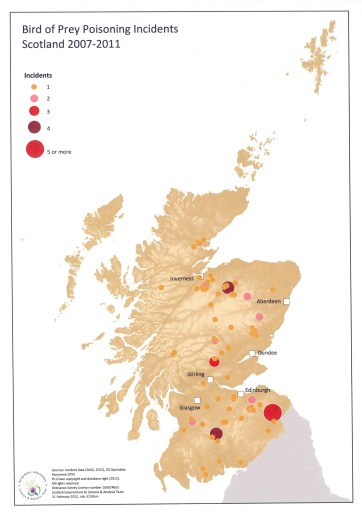
The Scottish Government has today published the 2011 poisoning map (otherwise known as Scotland’s map of shame).

The newspapers are heralding the figures as a success story, as the numbers show an apparent drop in poisoning incidents (“only [only??!] 16 raptors were killed as a result of being illegally poisoned in Scotland – 12 fewer than in 2010 and the lowest death toll since the first maps were published six years ago“, says The Scotsman). The victims included seven buzzards, four red kites, two peregrines, two sparrowhawks and a golden eagle.

On a superficial level this does look like convincing progress, but let’s scratch the surface and see what’s underneath…

The official Scottish government poisoning map only shows the places where poisoned birds were discovered. Given the remote areas involved and the fact that most of these poisoned birds were found by chance (by passing hillwalkers etc.), the official figures can in no way represent the actual number of raptors that were poisoned (but undetected) during 2011.

The figures behind the map also do not show the areas where poisoned baits (but no dead birds) were discovered during 2011. Nor do they show the other incidents of raptor persecution that were discovered during 2011, including shooting, trapping and nest destruction incidents. According to an article in today’s Guardian, it is claimed that last year’s illegal shooting, trapping and nest destruction incidents “have remained constant with previous years“. We’ll have to wait a good few months for the RSPB Birdcrime Report to see the actual figures. (Incidentally, how come the 2011 poisoning figures, as compiled by SASA, have not yet been released to the public? They’re obviously available as they were used to construct the poisoning map. So far they’ve only published data up to September 2011. Isn’t it in the public interest to release them? Why all the secrecy?).

It seems plausible that some shooting estates are doing their best to distance themselves from any sign of illegal raptor persecution, especially in light of the new law on vicarious liability. A likely example of this behaviour was an incident in the Borders in September 2011. A dog walker discovered a bag full of dead raptors by the side of the busy A68  road (see here for earlier blog on this). The police were alerted and the birds were sent to SASA for toxicology tests. The results showed that the two sparrowhawks and two buzzards had been poisoned with the banned pesticide Carbofuran. Because the dead birds had been dumped away from any shooting estate or farm, without being seen, it was virtually impossible for the police to prosecute anyone (SASA reports that the police have now closed the case due to a lack of positive leads – see here). What is the probablity that other estates up and down the country are poisoning raptors on their land and then removing the evidence as far from their location as possible?  It was pure chance that this bag of poisoned raptors was discovered. How many more are left rotting and undiscovered across the country?

But let’s suppose, just for a minute, that the latest map IS an accurate representation of all raptor poisoning incidents that took place in 2011. Should we then accept that shooting estates are cleaning up their act and they’ve all suddenly decided, after over 100 years of persecution, that raptors are actually ok and shouldn’t be killed? The only way to measure that will be to look at LONG-TERM TRENDS of poisoning incidents as well as LONG-TERM TRENDS of raptor populations. We’ve blogged about this before (see here) but it’s worth repeating some of it to show the bigger picture. The graph (adapted from the RSPB’s excellent report: The Illegal Killing of Birds of Prey in Scotland in 2010, see here) shows the long-term trend of poisoning incidents in Scotland from 1989-2010. Look carefully at the graph and you’ll see peaks and troughs in the numbers recorded. Yes, there certainly have been previous drops in the number of poisoning incidents, but then look what happened in the following years – another increase, and then another drop, then another increase etc. Before the game-shooting lobby starts its self-congratulatory back-slapping, we need to see a continuous decline in the number of recorded incidents, AND we need to see raptor populations recovering in those areas where persecution has been endemic. This will take time, but could arguably be judged in about five years’ time.
Of course we all hope that the 2011 figures are the start of a new era in raptor conservation in Scotland. As Environment Minister Stewart Stevenson has said in today’s media: “I hope this proves to be the beginning of a continuing reduction in such cases, leading to the end of this outdated, dangerous and cruel practice“. It is notable that his statement contains more than a hint of caution. That man’s no fool.

See an excellent article about the latest figures in today’s Guardian here

Article in The Scotsman here

Egg-collector Matthew Gonshaw – latest case

The latest case against five-times convicted (and four-times jailed) egg thief,  Matthew Simon Gonshaw, was heard today at Inverness Sheriff Court.

Gonshaw faces three charges which include taking or destroying wild birds’ eggs, being in possession of wild birds’ eggs, and being in possession of equipment capable of being used in the taking or destroying of wild birds’ eggs.

His case was continued without plea and the next hearing will be in April.

Gonshaw was recently served with a ten-year asbo (anti-social behaviour order) that bans him from visiting Scotland during the bird breeding season. Background info here.

Confirmed – poisoned red kite was found in September

Further to the last blog entry (here), the RSPB has now issued a press release about the poisoned red kite:

Journey’s end as red kite is found poisoned

Police are appealing for information after one of North Scotland’s most adventurous red kites was found poisoned in Ayrshire.

Shortly after fledging on the Black Isle this summer, the young bird surprised RSPB Scotland staff by immediately flying two hundred miles in just a few days.

A satellite transmitter fitted to its back, made it possible to chart the young bird’s journey down the west coast of Scotland. However, staff became concerned in September when transmissions in the Muirkirk area showed the bird had remained in the same place for several days.

It was later discovered dead close to the Muirkirk and North Lowther Hills Special Protection Area (SPA), an area of moorland that receives special legal protection because of its breeding bird of prey population.

Subsequent tests by the SASA government laboratory showed it had been poisoned by a banned pesticide.

RSPB Scotland Investigations Officer Ian Thomson said “The poisoning of this red kite is just the latest incident of bird of prey persecution in and around the SPA. Every year, breeding hen harriers and peregrines ‘disappear’ with further evidence of human interference causing nest failures. The populations of both species are declining alarmingly in this area. Only a few years ago there were 21 pairs of hen harriers in the SPA; now we are down to a mere handful”.

Enquiries by the police are continuing. Anyone with further information regarding this incident is urged to contact Strathclyde Police on 0141 532 2000, or Crimestoppers on 0800 555 111.

We understand the poisoned red kite was this one (see here).

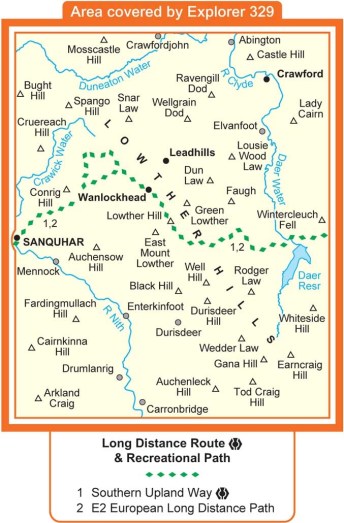
Interesting. I wonder if this is the same red kite reported in the incident in November (see here)? Although that publicity said a kite had been found in the Lowther Hills in Dumfries & Galloway, not Ayrshire. Maybe two kites have been poisoned in this area? It’s hard to tell with this level of undetailed information and delayed reporting.

The chances of catching anyone now? A big fat zero. Never mind, the way this industry continues to flout the law,  it won’t be long before mandatory estate licensing is forced upon them.

Red kite found poisoned in Ayrshire

News is coming in that a satellite-tagged red kite from Northern Scotland has been found dead in Ayrshire. Lab tests done by SASA have reportedly shown that this young bird was poisoned by an illegal pesticide. 

We are led to believe this kite was discovered in September. If this turns out to be an accurate report, questions need to be asked about the delayed reporting.

More on this when details have been confirmed…

UPDATE: this has now been confirmed (see here)

Poisoned buzzard found near poisoned bait on Glenlochy Moor

Northern Constabulary has today issued a warning to dog walkers in the Strathspey area after a distressed buzzard was found near a poisoned bait on Glenlochy Moor. The buzzard and grouse bait were found in late September in the Haughs area above Cromdale, and the bait was sent for toxicology testing. The results showed that it had been laced with the banned pesticide Aldicarb. The buzzard apparently recovered and was later released.

This is not the first time poisoned baits and birds have been discovered in this area, which is well known for its driven red grouse moors. Some previous incidents include (but are not limited to) the discovery of a poisoned buzzard and a red kite in 2005 – they had been killed by the banned pesticide Carbofuran. No charges were brought (see here). In 2008, a high-profile police raid was carried out on Glenlochy Moor after the discovery of poisoned buzzards and red kites, and poisoned baits (see here). No charges were brought. In May this year, a poisoned buzzard was discovered in the nearby area – it had been killed by Carbofuran and Aldicarb (see here). We are not aware of any charges being brought. And now this latest incident in September 2011. Hmmm. Anyone else seeing a pattern?

Northern Constabulary are to be congratulated for (a) releasing a press release to warn the general public in the area of the dangers of these lethal pesticides and (b) naming the estate where the poison was found. This is a great improvement on some of their recent responses to alleged persecution incidents in their region. However, an earlier press release would have been better, even if they just suspected that poison was present – rather than waiting for six weeks before the test results came back. West Yorkshire police managed to do it earlier this year (see here) – it should be standard practice for all police forces, unless of course they intend to launch an imminent police raid and don’t want to alert the suspects. Nevertheless, we still do applaud this action by Northern Constabulary and welcome their increased interest in illegal raptor persecution in their area. Well done.

Northern Constabulary press release here

BBC News article here

Shadow Environment Minister speaks out against illegal poisoning

The Shadow Environment Minister, Elaine Murray MSP, has spoken out against illegal poisoning following the report yesterday that a poisoned red kite and raven had been discovered in her constituency.

The following statement has appeared today on her website:

Dumfriesshire MSP Elaine Murray has hit out at the “shocking cruelty” of the poisoning of a red kite and raven in the hills near Durisdeer in Dumfries and Galloway.

The local MSP is warning of the impact on tourism in the area, as visitors to the Galloway Red Kite Trail have spent at least £21M in the region since 2004, with more than £2.6M spent by people who came specifically to see the kites.

Dumfriesshire MSP and Shadow Environment Minister Elaine Murray, who was involved in releasing some of the red kites in Dumfries and Galloway for the RSPB, said:

“This is an act of shocking cruelty that puts the very recovery of the red kite in Dumfries and Galloway at risk. Instances of poisoning like this are a double whammy because not only do they do potentially irreparable damage to our natural environment, but so much of our region’s tourism industry depends on wildlife that illegal killing of birds could have massive knock on consequences on our economy.

“This is a huge blow after the great news earlier this year that red kites have been bred in Nithsdale for the first time in 180 years. People come here to see the magnificent birds of prey in our countryside and it is selfish and barbaric to use illegal poisons to target them. The Police and RSPB Scotland have my full support in tracking down those responsible and I would urge anyone with information that could help to come forward”.

Elaine Murray MSP is no stranger to the fight against illegal raptor persecution, having played an important role during the debates on the WANE bill last year. She was also reported to have made several visits to raptor breeding sites earlier this year in the company of members from the local raptor study group.

Elaine Murray website here