Blog

National Gamekeepers’ Organisation Advice – What to do if you are raided by the police.

Whilst looking through the National Gamekeepers’ Organisation website  for information on another raptor persecution article, I came across an interesting few pages under the heading, ” What to do in the Event of a Police Search”.

In this section you can find information on police warrants, what to do while a search is in progress, what to do when arrested and/or locked up, not to answer any questions until your solicitor is present etc. With the prominent position that this advice commands, the uninitiated could be forgiven for thinking that having your home and workplace searched or being arrested and locked up is part and parcel of the work of the gamekeeper. Well, is it? Perhaps I’m being a little naive!

It also occurred to me that if an organisation that represented another profession, for example medical doctors, solicitors, teachers or indeed scrap metal merchants, distributed information on what to do when arrested you may think that something was pretty rotten at the core of that profession.

http://www.nationalgamekeepers.org.uk/media/resource_files/PoliceSearchesAdvice.pdf

Alex Hogg’s Change of Heart?

16th March 2010. The Scottish Gamekeepers’ Association (SGA) chairman Alex Hogg, has condemned the “appalling statistics” regarding the poisoning of raptors on the official SGA website. The figures he refers to were collated by Science and Advice for Scottish Agriculture (SASA) and recently published by the Partnership for Action Against Wildlife Crime (PAW) They report that a total of 27 birds of prey were found poisoned in Scotland in 2009, including 19 buzzards, four red kites one white tailed sea eagle and two golden eagles. Unfortunately the report does not “name and shame” estates, farms, individuals etc involved.

In what would appear to be a complete change of heart, Alex Hogg has stated “There is no place for raptor persecution in modern land management”.

Does this mean that Alex has seen the light and will not be pursuing his application to kill 12 buzzards on the Portmore estate where he is employed as a gamekeeper?

The SGA website also reports that Environment Minister Roseanna Cunningham has condemned the figures, saying the protection of Scotland’s wildlife has never before occupied such a prominent position politically or in terms of the law, adding “this continued persecution of our precious wildlife is simply incomprehensible.”

With Sheriff Drummond still chairing the PAW Scotland Legislation, Regulation and Guidance Sub-group after his reported admission of the low priority in which he regards raptor persecution and the pathetic, lenient sentences for these crimes it’s hard to think of a reason why these disgraceful figures should improve.

Full story:  http://www.scottishgamekeepers.co.uk/content/poisoning-incidents-condemned

National Gamekeepers Organisation makes public relations faux pas

Oh dear. Comments made by the spokesman of the National Gamekeepers Organisation (NGO) this week reveal a spectacular mis-judgement of public opinion.

Writing on the official NGO blog, spokesman Alasdair Mitchell writes in support of Sheriff Drummond’s outrageous remarks at the recent police wildlife crime conference, and suggests that the illegal persecution of raptors is no big deal, nothing more than “dissing a buzzard”. http://www.nationalgamekeepers.org.uk/blog/

And this comes in the same month that the National Gamekeepers Organisation decided to join PAW! Why bother? PAW is ‘supposedly’ about a working partnership to deal with addressing the horrors of wildlife crime, not dismissing it as an irrelevancy. Could it be that the NGO joined PAW as a public relations stunt, in light of the increasing public anger about raptor persecution and other wildlife crime? http://www.nationalgamekeepers.org.uk/news/51/

He also seems unable to cope with the concept that a woman might have achieved academic success. If ever there was evidence that gamekeepers’ views are firmly entrenched in the Victorian era, this is it! Hey Mr Mitchell, guess what – women can also vote now, too! Welcome to the 21st century! I wonder if he has such a problem with people’s hereditary titles, like for example, Lord Barnard, who is hosting this year’s NGO Golden Grouse clay shoot? I think he must do, because otherwise that would make Mr Mitchell a hypocrite.

2009 Map of shame: why not name the estates?

Raptor persecution incidents Scotland 2005-2009

As reported on this blog yesterday, the latest figures of confirmed bird of prey poisoning events in Scotland were just released and guess what? Poisoning in 2009 was at an all time high, despite the succession of statements from the Scottish government over the last 40 years that they are “determined to stamp out” wildlife crime. By anybody’s standards, the government has failed miserably, along with the judiciary, who have never given a custodial sentence to a convicted poisoner, even though they have the sentencing powers to do so. It’s pathetic.

The latest ‘map of shame’ is a pointless piece of work in its current format. What does it tell us? It tells us that raptor poisoning is widespread in Scotland. We already knew that. What it doesn’t tell us is which Estates were responsible. A carefully-worded explanation for this lack of detail goes like this:

Exact locations of incidents are not shown, in recognition of the fact that birds may travel some distance after ingesting poison. The map therefore randomises precise locations of incidents to produce a variation of around 1km. This avoids any inference being drawn from the exact point of discovery of the bird, but still allows an overview of the worst affected areas“.

Now, I’m no expert geographer, but I’m fairly certain that most Estates in Scotland are bigger than a kilometre. So if a poisoned raptor has been found on an estate where the boundary fence is greater than 1km away, we can be fairly certain that the bird has been poisoned on the estate where it was found, can’t we? And where did this arbitrary distance of 1km originate from anyway? Surely, a forensic expert would be able to calculate the distance a poisoned bird could travel based on the type, amount and toxicity of the poison used? Just look at some of the images on this blog – many dead raptors are found in very close proximity to the actual poisoned bait, sometimes even slumped over it, leaving no doubt whatsoever how and where the bird was killed. Why are these locations not published?

Leaving the dead raptors aside for one moment, why is there not a map showing the location of poisoned baits that have been found? There can be none of this hiding behind concern over an ‘incorrect inference’ for these cases – a posioned bait can’t “travel some distance” from where it was laid, so why are we not seeing the names of the Estates where these baits have been found (with the exception of Glenogil Estate in Tayside, which we all know about)? According to the latest figures released yesterday, 63 poison baits were discovered between 2005 and 2009. And these only relate to incidents involving birds of prey. A quick scan of SASA poisoning reports shows that there are plenty more poisoned baits out there in the countryside that do not get mentioned in the lastest government report. Isn’t it in the public’s interest to know where these baits have been found? I certainly wouldn’t want my children or my pets to be walking in these areas. It only takes one granule of the commonly-used (but illegal) pesticide Carbofuran to kill a human. Why should my children and pets be put at risk, just because the government is too weak and timid to stand up to the (highly rich and influential) members of the SRPBA (Scottish Rural Property & Business Association), who are allegedly behind the secrecy of poisoning locations in Scotland. Not good enough.

If you share this view and wish to express your disgust and concern, you can email the Scottish Environment Minister, Roseanna Cunningham, to let her know your thoughts: ministerforenvironment@scotland.gsi.gov.uk

shooting times magazine names the countryside’s “most wanted pests”

Game shooting’s top magazine, The Shooting Times, has published an article on the countryside’s “most wanted pests”, which speaks volumes on the true attitude of the game shooting industry to our protected wildlife.

The Shooting Times, 6th February 2006 reports,  The golden eagle, red kite, osprey, heron, peregrine falcon and buzzard stand accused with the hedgehog, otter, badger and the domestic cat of being “voracious predators” that affect the game shooting and fishing industries.

The 114-year-old title describes the animals on its list as “pricey pests” that devour pheasant, partridge, grouse, salmon, trout, hare, pigeon, woodcock, snipe, duck, goose and deer or snatch wild birds’ eggs. The losses hit the profits of estate owners and shooting and fishing syndicates.

Jim Knight, the Rural Affairs Minister, joined animal welfare groups and the Countryside Alliance in criticising the magazine for vilifying wildlife. He was shocked by the article’s emotive language. “The list includes a number of precious species that are protected by law. Readers of this article may agree that some species can be a nuisance — but this does not excuse their destruction.”

Camilla Clark, editor of Shooting Times, said: “The purpose was to assess the economic impact of predators and pests on game birds in the UK. Shooting Times would never advocate the illegal killing of a protected species.”

Rise in bird of prey poisonings in Scotland – 2009 figures just released

Depressing but wholly anticipated news today, as the raptor poisoning incidents from 2009 are released. Based on data from the government’s Science and Advice for Scottish Agriculture section (SASA), the figures show an increase on 2008 incidents.

The usual ‘map of shame’ has been trotted out, not telling us anything new at all and once again, the names of the estates involved have all been removed.

News story: http://news.bbc.co.uk/1/hi/scotland/8570464.stm

Scottish government press release: http://www.scotland.gov.uk/News/Releases/2010/03/16120046

We’ll be writing an opinion piece about this miserable news in due course, and will provide readers with information about ways you can express your disgust and concern about these relentless crimes to the people who are in a position to do something about it.

give credit where it’s due: gamekeeper saves kite on craigiehowe mains shooting estate, ross-shire

An all-too rare example of a good gamekeeper came to light in August 2009, when a red kite was rescued by keeper Bob Colyer on the Craigiehowe Mains shooting estate on the Black Isle, Ross-shire.

The recently-fledged young bird, called ‘H’, had crashed into the side of a pheasant-rearing pen and had become entangled in the netting when Bob found him. After carefully removing him, ‘H’ was given a night’s recuperation with the local SSPCA before being released the next day, with no obvious signs of injury.

Bob said: “The kite was looking very sorry for itself when I found it and didn’t seem grateful to be rescued. However, I’m delighted to have been able to help and even more pleased to hear that it has been able to take to the air once more”.

Well done Bob!

Full story: http://thescotsman.scotsman.com/birdsofprey/Unlikely-hero-saves-bird-of.5565759.jp

two peregrines poisoned on nature reserve, Aberdeenshire

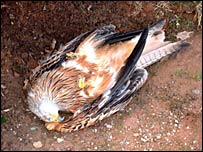
dead peregrine

Two recently-fledged peregrines were found poisoned on the Scottish Wildlife Trust’s Longhaven Reserve, Aberdeenshire, in July 2004. They were found by two climbers and tests proved they had been poisoned by eating from a pesticide-laced bait.

Police wildlife crime officer, George Sangster, said peregrines had been the victims of illegal persecution for many years, and he and his colleagues had seen “a worrying trend in the last few years in the north east of Scotland, with an increase in the persecution of peregrines”. Full story: http://news.bbc.co.uk/1/hi/scotland/3896793.stm

Six years later, not much has changed. According to a 2009 RSPB report, recent estimates suggest that 27% of nests in southeast Scotland, 24% of nests in northeast Scotland and over 10% of examined sites in Cumbria were subject to interference or killing. More info: http://www.birdguides.com/webzine/article.asp?a=1674

Environment Minister appreciates the efforts of the Scottish Gamekeepers Association

Scottish Environment Minister, Roseanna Cunningham, really showed those pesky gamekeepers that she means business when it comes to stamping out wildlife crime. In her speech at the Scottish Gamekeepers Association’s (SGA) annual general meeting on 5 March 2010, hard-hitting Roseanna gave them what for. Well actually, she didn’t.

Here is an excerpt from her speech:

Unfortunately, the illegal killing of birds of prey in Scotland remains at an unacceptably high level, as shown by the recent high profile cases such as the poisoning of the golden eagle, Alma, which was being radio-tracked by SNH. Raptor persecution is one of the UK Wildlife Crime Priorities and we are committed to tackling this.

In Scotland even one incident of deliberate, illegal poisoning would be one too many. It is shameful that some of our most iconic species continue to face illegal persecution.

We all know that the illegal killing of birds of prey is having a serious impact on the populations of iconic species such as golden eagles and hen harriers. Birds of prey are our national assets, with huge public, cultural and tourism appeal. 

However, I realise that those responsible for these illegal activities are in the minority.

I am most grateful for the efforts of the SGA who are trying to conserve birds of prey and the support that the SGA gives to the Partnership for Action Against Wildlife Crime Scotland (PAWS), in helping to defeat this type of crime.

The partnership approach taken in tackling this issue is apparent in the mix of people you see here today. We all have the same goal of defeating wildlife crime. Working together to share knowledge, resources and skills to deal with these issues is the only way to tackle this problem”.

Roseanna, it might be time to change your political advisors because they are clearly not giving you the full picture. What ‘efforts’, exactly, has the SGA made to try and conserve birds of prey? Perhaps you are referring to their long-running campaign (since 2000) to get licences to cull raptors? SGA chairman Alex Hogg even goes as far as saying if they had licences to kill raptors legally then the wildlife crime would stop ‘overnight’. http://www.independent.co.uk/environment/nature/birds-of-prey-persecution-a-special-ios-online-report-396066.html Is that an admission that if licences to kill raptors are not forthcoming then gamekeepers will continue the criminal activity of killing protected species? Wonderful! What a great effort they are making to conserve birds of prey!

Mark Osborne – another amazing coincidence

(John) Mark Osborne must be the victim of an amazing series of coincidences, according to shooting journalist James Marchington: http://jamesmarchington.blogspot.com/2009/07/poisoned-eagles-and-osborne-connection.html. What else could explain his connection to a number of shooting estates where wildlife crimes have allegedly been committed? Here’s the latest coincidence –

In 1991, Osborne apparently set up the West Wycombe Shooting Ground on the Dashwood Estate near High Wycombe, Bucks, along with Sir Edward John Francis Dashwood. The estate incorporated the Bradenham Hill Shooting Syndicate.

On 15 July 1998,  a 29 year old gamekeeper (Gamekeeper A) for the Bradenham Hill Shooting Syndicate, appeared before High Wycombe magistrates accused of an appalling litany of alleged wildlife crimes between 1996-1997. A journal found at his house documented the alleged massacre of 127 badgers, several cats and dogs, 3 owls, 2 sparrowhawks and a buzzard on the Dashwood Estate. An underkeeper on the estate told the court that Gamekeeper A had admitted killing badgers and feeding live fox cubs to his dogs. Gamekeeper A was cleared of the wildlife crime offences because of ‘insufficient evidence’ and was fined £150 with £50 costs, for keeping ammunition unsecured.

On 21 April 2005, Gamekeeper A was back in court, this time as head keeper on the Dashwood Estate. He and his co-accused, Gamekeeper B, both of West Wycombe, were charged with clubbing a buzzard to death on the Dashwood Estate on 23 February 2004. The buzzard had been caught inside a crow trap, and Gamekeeper B was videoed by RSPB undercover investigators as he clubbed the buzzard to death with a piece of wood while Gamekeeper A looked on. Both men were found guilty and fined £2,000 each, with an additional £500 costs. http://www.docstoc.com/docs/22523459/232-0574-04-05_legal-eagle-45

Eton-educated Sir Dashwood (45), chairman of the Countryside Alliance’s Campaign for Shooting, appears to have further links with Osborne. According to Companies House records, both became Directors of West Wycombe Corporate Entertainment Ltd in 1991. They were also both allegedly involved with the lease of the notorious Leadhills Estate (owned by Hopetoun Estate) in South Lanarkshire in 2003. However, in 2008, the shooting rights were put up for sale after a series of police raids in relation to alleged raptor persecution incidents. The Estate’s owner, the Marquess of Linlithgow, had apparently leased the estate to Dashwood & Osborne in 2003 on the condition that they complied with the Wildlife & Countryside Act 1981. Dashwood claimed the sale of the shooting rights was ‘entirely unconnected’ with the police raids.

http://www.guardian.co.uk/environment/2008/apr/18/wildlife.conservation