
Blog

Row escalates over SNH’s decision to authorise clam traps

The controversial clam trapEarlier in December we blogged about SNH’s decision to authorise the use of clam-type traps under the 2013 General Licences, despite the concerns of a number of organisations that these traps are likely to cause injury to non-target species, especially raptors (see here).

This story has now been picked up by the BBC (see here). According to this article, at least two organisations (SSPCA and RSPB) have called on SNH to reconsider its decision on clam traps. Judging by the comment attributed to SNH’s Licensing Manager, Ben Ross, a U-turn looks unlikely:

We will commission objective research on these traps; if the research shows they pose unacceptable risks, we will then prohibit them“.

Surely this is the wrong way around? You do the research to assess their suitability BEFORE you decide to approve their use, not afterwards!

But that’s not the end of the story. When we first blogged about SNH’s decision to approve these traps, we also raised concerns that SNH had appeared to ignore the recommendations made to them by all groups except those with an interest in game-shooting (blog article here). We asked blog readers to contact SNH and ask to see ALL the consultation responses they’d received, so that we could assess which groups’ recommendations had been accepted and which had been ignored. This was a successful tactic – in a letter to consultees yesterday, SNH wrote this:

Following our response letter to the consultation we received a number of information requests for us to publish all responses that we received to the consultation. This email is to let you know that we are legally obliged to provide this information and as such will be publishing it on our website either later today or tomorrow……..As we have received a number of requests for the information, we will make the responses available on our website“.

So well done and thank you to those of you who made the effort to send an email request to SNH. We look forward to seeing the consultation responses published on the SNH website later today.

Let’s also not forget that the written answers are due tomorrow in response to MSP Claire Baker’s parliamentary questions about the use of these clam-type traps (see here).
Sorry to disappoint you, Bert….

Ah Bert, sorry mate – try again next year?

http://blogue.centrenad.com/2012/12/19/centre-nad-reassures-montrealers-no-danger-of-being-snatched-by-a-royal-eagle/?lang=en

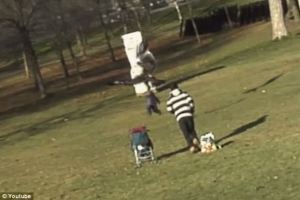
Fake video stokes anti-eagle rhetoric

article-2250416-1693BE92000005DC-649_634x423A YouTube video that purports to show a golden eagle attempting to carry off a small child in a semi-urban park in Montreal has gone viral on social media networks. Unfortunately, for the eagle-haters, the video is clearly a fake. It’s not even a golden eagle! Watch the video here.

Unsurprisingly, the Daily Mail pounced on the story, with the headline: “Kidnapper from the skies”  and described the golden eagle as “the feathered beast, one of the world’s deadliest birds of prey” (see here). They later updated their story, perhaps realising it was all an elaborate hoax.

Bert Burnett of the Scottish Gamekeepers’ Association was also on hand to offer his customary insightful analysis. Here’s what he posted on the SGA’s Facebook page:

I have no doubt that the usual idiots will brand this video as a fake but then again they probably don’t believe the holocaust took place either“.

No surprises there – last year the SGA wrote to the Scottish Government about the threat of reintroduced sea eagles eating children in Scotland (see here and here).

Another YouTube video of equal authenticity, showing a baby being carried to an eagle’s nest, can be watched here.

UPDATE ON THE HOAX VIDEO here

RSPB walks out of hen harrier ‘dialogue’

tec_logo_16271This isn’t especially new news, as it happened in the summer, but we were reminded of it today after reading something on Mark Avery’s blog – more on that later – and it does seem pertinent to blog about it now.

So, most readers will be aware of the Environment Council’s ‘Hen Harrier Dialogue’ – a process that started in 2006 that aimed to bring ‘stakeholders’ together to try and work out a way of resolving the hen harrier / grouse moor conflict in England (see here for website). Those stakeholders involved in these dialogue meetings included the usual suspects such as BASC, Countryside Alliance, Country Land and Business Association, GWCT, Moorland Association, National Gamekeepers’ Organisation, RSPB, Hawk & Owl Trust, Northern England Raptor Groups etc.

The ‘dialogue’ process has produced an awful lot of documents (and a lot of awful documents, see here) and meeting reports (see here), and a strong interest in pursuing a trial on a ‘quota system’ for hen harriers – a controversial idea spawned by Steve Redpath several years ago. In simplistic terms, this quota system would mean that grouse moor owners would ‘allow’ a certain number of breeding pairs (number yet to be established) and once a ‘ceiling’ had been reached, then they would be ‘allowed’ to remove harrier broods (non-lethally) to other parts of the UK away from grouse moors. This idea is still being discussed, although it brings with it obvious ethical and legal debates.

Hen harrier being removed from illegal trap on Moy EstateSome argue that conservation groups shouldn’t be sitting at the table with representatives from an industry that has been responsible for killing off England’s breeding hen harrier population. Others argue that the quota scheme may be the best way forward because at least there’d be some harriers, which is a better proposition than having none. Others have suggested that the quota system would never get off the ground anyway because the grouse moor owners would have to ‘allow’ a certain number of breeding hen harriers on their estates and they’ve shown themselves incapable of tolerating any.

Whatever your point of view, the bottom line is that six years on from the start of the dialogue process, and after all that talking over egg sandwiches and coffee, the English hen harrier breeding population has been reduced to one known pair. That’s it. Just the one pair. In a country that has suitable habitat to support over 300 breeding pairs.

This summer, the RSPB made a bold move and decided to walk away from the dialogue process. They said that as hen harriers have been systematically eradicated from English grouse moors then there was no longer any conflict and therefore no point in spending any more time talking about it. Instead, they intended to get on with their own plans for hen harrier recovery.

It’s not yet known what will happen to the Environment Council dialogue process now a major player has walked away. As far as we’re aware, there are still many questions about the lawfulness of the proposed trial quota scheme so it’s unclear whether attempts will still be made to push that through.

So what next for English hen harriers? After the recent sad story of the illegal shooting of Bowland Betty (see here), in addition to all the other horror stories we keep reading about from English and Scottish grouse moors (e.g. see here, here, here, herehere), is it time for a different approach? It’s obvious that the authorities can’t, or won’t deal with illegal persecution, and the grouse-shooting industry can’t, or won’t put a stop to it either. An alternative suggestion has been put forward by Mark Avery – unless things miraculously improve for breeding hen harriers in Northern England in 2013 then it will be time to start the campaign, on 12 August 2013, to end grouse shooting (see here for Mark’s blog).

Up until now we’d been supporters of the idea of estate-licensing schemes rather than an outright ban. Licensing seemed a fair and reasonable approach to regulate an industry so clearly incapable of expelling its criminal elements. But now?  The time for being reasonable has long since passed. Count us in, Mark.

For our anagram fans: Grouse moor – morgue or so

Parliamentary questions asked about SNH’s decision on clam traps

Claire Baker MSPFollowing on from earlier blog posts about SNH’s latest baffling decision to authorise the use of clam-type traps in the 2013 General Licences (see here), a well-informed MSP has now asked the following excellent parliamentary questions:

Claire Baker (Scottish Labour, Mid-Scotland and Fife), Date lodged 7/12/2012

Question S4W-11729 To ask the Scottish Government what independent testing has been carried out to evaluate the risk of injury to birds and other animals from (a) Larsen Mate and (b) Elgeeco cage traps.
 
Question S4W-11730 To ask the Scottish Government what independent testing has been carried out to evaluate the impact of (a) Larsen Mate and (b) Elgeeco cage traps on (i) protected species and (ii) species not targeted by the devices.
 
Question S4W-11731 To ask the Scottish Government what provision must be made for (a) food, (b) water and (c) shelter for (i) birds and (ii) other animals caught by a (A) Larsen Mate and (B) Elgeeco cage trap before a general licence for its use can be granted.
 
Question S4W-11732 To ask the Scottish Government what its position is on issuing general licences for untested cage traps.
 
Question S4W-11733 To ask the Scottish Government whether independent evidence establishing a need to supplement a trap with a (a) Larsen Mate and (b) Elgeeco cage trap is required before a general licence for its use can be granted.

Expected answer date: 21/12/2012

Those answers should make for interesting reading. Well done Claire Baker MSP.

Meanwhile, we’re still waiting for SNH to publish ALL the responses they received on their 2013 General Licence consultation. They told us last Thursday that they were “currently preparing the information for publication” (see here).

A well-deserved award

‘Tis the season of award-giving. Here’s one that’s truly well-deserved.

Retired former Superintendent of Grampian Police, Alan Smailes, has received a lifetime achievement award from WWF Scotland and PAW for his work against wildlife crime.

Top guy, many congratulations, and you are missed!

BBC news article here

Sea eagle ‘Irish Brian’ found dead in County Kerry

More bad news from Ireland…

One of the reintroduced Irish white-tailed eagles, known as ‘Irish Brian’ after his exploits in East Scotland last year, has been found dead in County Kerry. Apparently his body, which was found on a hillside near Glencar, was too decomposed for any conclusive tests but this is an area where three other reintroduced sea eagles were found poisoned in 2008 (see the Golden Eagle Trust’s website here for details of the sea eagle reintroduction project).

Rhian Evans, the RSPB’s East Scotland Sea Eagle Project Officer has blogged about Irish Brian here.

Purdey Awards: “celebrating greatness”?

The annual Purdey Awards for Game and Conservation were established to celebrate those who achieve most in game conservation, according to the Purdey Awards website (here). These awards are viewed as the game-shooting industry’s most prestigious, giving recognition to those ‘who do most to help our flora and fauna, by improving biodiversity and developing better land management‘.

The 2012 Purdey Award winners were recently announced. We were particularly interested in the ‘Highly Commended’ category:

Brian Kaye of Redmyre Farm Shoot of Invergowrie, near Dundee, has been highly commended for his work in creating a high quality farm shoot and for enhancing the landscape and natural environment. Mr Kaye has not only dramatically improved the habitats and biodiversity for a wide variety of game birds and plant life, but has also demonstrated how shooting goes hand in hand with conservation. The award is made in recognition of outstanding work over 20 years in establishing an exemplary shoot over 320 acres of the Sidlaw Hills“.

Surely not the same Brian Kaye who owns Redmyre Estate near Invergowrie (according to the East of Scotland Association for Wildfowling and Conservation: see here)? Nah, it couldn’t possibly be. A gamekeeper on Redmyre Estate was convicted in 2010 of shooting dead a buzzard and for possession of the banned poisons Carbofuran and Alpha-chloralose (see here, here, and especially here).

Other ‘greats’ that have been celebrated with Purdey Award wins include:

Geoff Eyre, the sporting tenant on Howden Moor (2005 Purdey Gold Award). In 2011, the gamekeeper on Howden Moor was convicted of a series of wildlife crimes (see here).

Jimmy Shuttlewood, the head gamekeeper on Snilesworth Estate (2005 Purdey Special Award).  In 2008, Shuttlewood and two other gamekeepers were convicted of a series of wildlife crimes (see here).

Lochindorb Estate (2008 Purdey Gold Award). In 2010 a dead sea eagle that had been found on the estate mysteriously disappeared just before the police arrived (see here). In 2011, the trial against two Lochindorb gamekeepers began, accused of illegally snaring mountain hares. The case against one gamekeeper was dropped earlier this year; the trial against the other gamekeeper will continue in January 2013 (see here).

Buzzard shot in Ireland

Less than two weeks after BirdWatch Ireland reported the illegal shooting of a hen harrier in  Co. Wexford (see here), they are today reporting the illegal shooting of a buzzard in County Meath.

The buzzard was found alive near the Rossnaree area but had to be euthanised due to the extent of its gunshot injuries.

The press release from BirdWatch Ireland is critical of the lack of strategy, resources and enforcement of wildlife crime in Ireland. Sound familiar?

Read their press release here

Hen harrier found shot dead on Yorkshire grouse moor

A young hen harrier has been found shot dead on a Yorkshire grouse moor. Regular blog readers will not be surprised to learn that it has taken over 5 months for an appeal for information to be made by North Yorks police.

The harrier was raised in a nest in Bowland, Lancashire in 2011. She was nick-named ‘Bowland Betty’ and was fitted with a satellite tag as part of Natural England’s so-called ‘Hen Harrier Recovery Project’. During her first year of life she was tracked through the uplands of Northern England and as far north as Caithness in northern Scotland. In June 2012 she was back in the Yorkshire Dales. Predictably, by late June her sat tag data suggested she was stationary and her dead body was found on 5 July on Thorny Grain Moor in Colsterdale in the Yorkshire Dales. Post-mortem results confirmed she had been shot.

This area is dominated by moorland managed for grouse shooting. We understand her body was found on Swinton Estate, although it is not known where she was actually shot as she could have flown for several miles before succumbing to her injuries.

RSPB and government data show the Yorkshire Dales as a hot spot for illegal raptor persecution, with at least 20 birds of prey illegally poisoned, trapped or shot between 2007-2011. This figure includes 10 poisoned red kites, 4 poisoned buzzards, 2 shot red kites, 2 shot buzzards, 1 shot kestrel and 1 trapped sparrowhawk. In addition there were at least 4 incidents of poisoned baits and a number of dogs were also poisoned.

Hen harriers have been tracked from Bowland since 1999. Wing tags were used to monitor hen harrier dispersal and survival between 1999-2002 (data from at least 42 birds). From 2002-2010, 118 hen harriers have been tracked either via radio transmitter or satellite tag. Astonishingly, Natural England have released very little detail about the results of this project, ten years on. They did produce a report in 2008 (see here) although this related to hen harriers over a broad geographic area and didn’t include specific detail about individual birds. What happened to all those birds? Where are their data? Why, when a satellite tag suggests that a harrier’s movements are suspicious (i.e. it’s been stationary on a grouse moor for several hours), do NE researchers have to seek the estate owner’s permission before they can go and search for the (presumably dead) bird? We’ve used an analogy before but it’s worth repeating – would you expect a police officer to call ahead to a suspected drug dealer to ask permission to go and search his house?

We all know only too well what will happen now. The death of this harrier will be added to the never-ending list of illegally-persecuted raptors found dead on UK grouse moors. Nobody will be prosecuted for shooting it. The public will express outrage for a few days but it’ll soon be forgotten, just like all the others that have been illegally killed before and all the others that undoubtedly will be killed in the future. The people who hold the positions of power that could bring this disgraceful practice to an end will continue to show wilful blindness and downplay the extent of the problem. The police will continue to form ‘partnerships’ with organisations who harbour the criminals responsible for this systematic killing. Nothing will change. Tune in next month to read about the latest victim. (Actually, tune in later this month….)

What can we do? The only thing we can do is to keep publicising these incidents. We can all play a part; don’t leave it to someone else. Tweet it, Facebook it, blog it, talk about it, email your MP about it. Do it.