Buzzard shot & critically injured in North York Moors National Park

Yet another bird of prey has been found shot in the North York Moors National Park and is currently ‘fighting for its life’.

The buzzard was found with shotgun injuries. Photo: North Yorkshire Police

North Yorkshire Police (Ryedale) issued the following statement on Facebook at the weekend:

We are again appealing for witnesses after this poor buzzard was found fighting for it’s life at the top of Daleside Road in Rosedale. X-rays revealed that it had been shot, but fortunately it survived the trauma and is currently receiving intensive veterinary care.

PC Jez Walmsley of the Helmsley and Kirkbymoorside safer neighbourhood team stated “This is the third buzzard in the last four months that has been shot or died in suspicious circumstances in the Rosedale area”. I would appeal to anyone who has any information about who is persecuting these magnificent birds to come forward. Please email me Jeremy.Walmsley@northyorkshire.police.co.uk’

I’m not sure about this being ‘the third shot buzzard in the last four months’ – if that’s the case then it’s in addition to two shot red kites found in the area in June 2023 (see here and here). I haven’t seen any media about two shot buzzards found in the last four months so I suspect PC Walmsley may be confusing the two shot red kites for buzzards. If that’s not the case, then five shot birds of prey have been found in this grouse moor-dominated area of the North York Moors National Park.

Either way, it’s clear that this so-called National Park, like so many others in the UK, is still not a safe haven for birds of prey.

UPDATE 11 October 2023: Buzzard shot in North York Moors National Park didn’t survive its injuries (here)

Rural businesses’ letter to Environment Minister opposing grouse moor licensing plans – some ‘interesting’ signatories

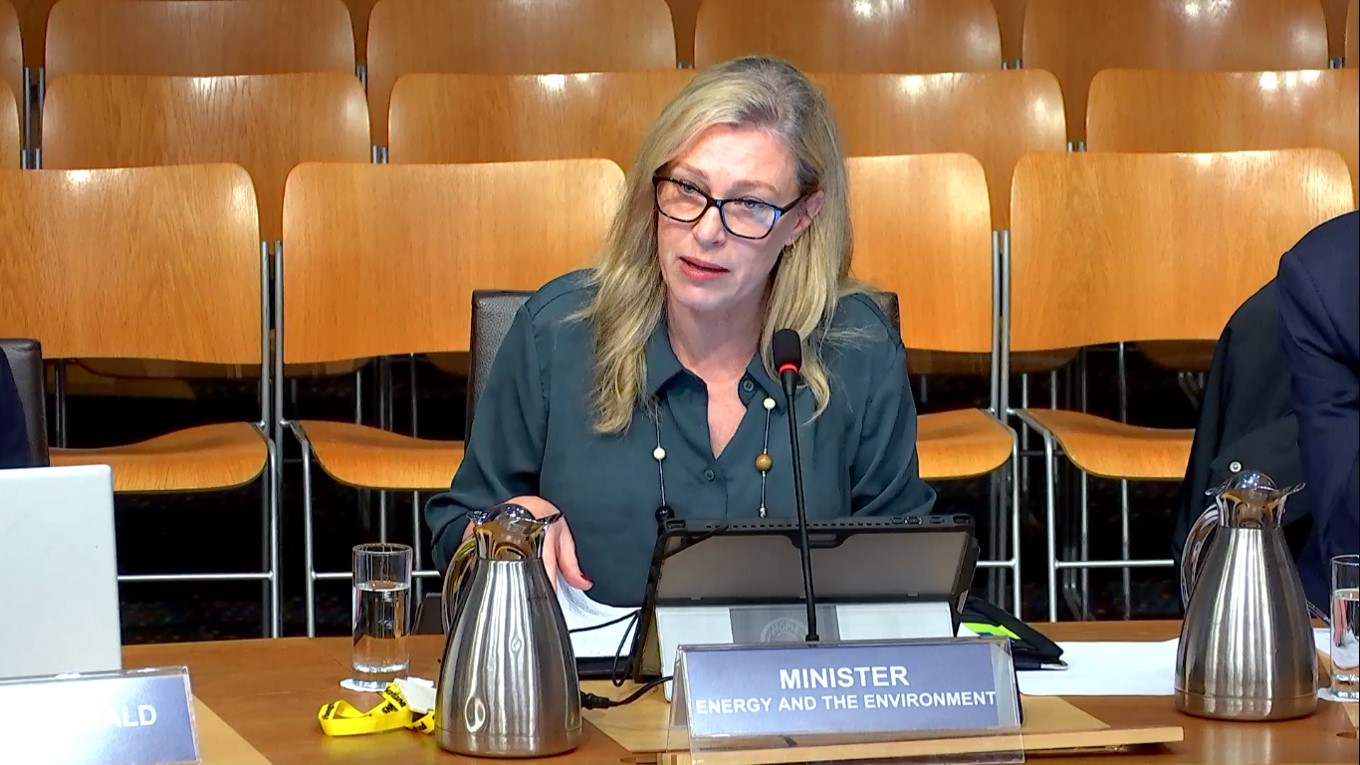
Last month the media regurgitated a press release from Scottish Land & Estates (SLE) about how ‘400 rural businesses’ had written a letter to Environment Minister Gillian Martin to voice their opposition to the Scottish Government’s plans to introduce a licensing scheme for grouse shooting, as part of the Wildlife Management and Muirburn (Scotland) Bill.

Grouse moor landscape, Cairngorms National Park. Photo: Ruth Tingay

I wrote at the time (here) how neither the letter, or its signatories, had been published and that I was keen to scrutinise it because the last time SLE pulled a publicity stunt like this (in 2010, under its former name of SRPBA), some of the 200 landowners / shooting estate owners who had written to the then Environment Minister expressing their condemnation of illegal raptor poisoning (here) had had recent raptor persecution incidents recorded on their estates and some of their employees even had criminal convictions for raptor persecution crimes (here).

So last month I submitted an FoI to the Scottish Government to ask for a copy of the latest letter and last week the letter, and its signatories, was published online as SLE had sent a copy of it to the Rural Affairs Committee who are currently scrutinising the Bill.

The letter itself offers nothing new – it is simply a repeat of the characteristically melodramatic points made by SLE during the Bill’s stage one evidence sessions, with claims that the proposed legislation “will lead to disastrous and irreversible implications for rural businesses and communities” and it makes a number of barely-veiled threats of legal action if the Bill goes ahead in its current state.

Here’s the letter and the signatories are included at the end; these are well worth a look:

There are around 80 sporting estates on the list, and although none of the estates that are currently serving General Licence restrictions for raptor persecution incidents are included, there are a few on the list who have recently served such restrictions (e.g. Edradynate Estate and Raeshaw Estate).

There are other estates listed where multiple alleged raptor persecution incidents have either occurred or been suspected but haven’t resulted in any prosecutions (e.g. Glenogil Estate, Cawdor Estate, and another one I’m not permitted to name, yet).

There are also a few sporting agents listed who I believe are linked to other estates that are either currently serving a General Licence restriction (e.g. Millden Estate) or have recently served a restriction (e.g. Leadhills Estate, which actually served two separate restrictions and yet remains a member of Scottish Land & Estates, despite SLE’s claim of having zero tolerance for raptor persecution).

The list also includes a number of businesses, some clearly legitimate but others that don’t appear to be registered at Companies House, which is interesting. To be fair they may just be sole traders so don’t have to register but how do we know they’re legitimate and not just a made-up ‘business’ for the purpose of populating this list?

I note that Rachael Hamilton MSP’s husband has signed on behalf of their business, the Buccleuch Arms – surely a conflict of interest given that Rachael serves on the Committee that is scrutinising the Bill and providing its recommendations to Parliament?

The inclusion of some other businesses just seems bizarre – for example, how will the introduction of a grouse moor licensing scheme ‘lead to disastrous and irreversible implications‘ for the Strathmore Rugby Club or Adventure Motorhome Hire?

It’s worth remembering at this point that the proposed Bill is simply a licensing scheme, not a ban on driven grouse shooting. The hysterical over-reaction of the grouse shooting industry and its mates to such a simple form of regulation is actually laughable – if the industry doesn’t think it can conform to such basic requirements, just like every other industry has to, then its practices are obviously unsustainable.

Speaking of which, I note that Scottish Land & Estates has just written another letter to Environment Minister Gillian Martin, this time signed by ‘150 land managers’ opposed to the proposed ban on snares and so-called ‘humane cable restraints’.

I’ve submitted another FoI to the Scottish Government to ask for a copy of that letter and its signatories…more on that in due course.

Minister confirms further delay on making decision whether to phase out use of toxic lead ammunition by gamebird shooters

Last month I wrote (here) about how the DEFRA Secretary of State, Therese Coffey, is preparing to make a decision about the phasing out of toxic lead ammunition by gamebird shooters; a welcome move after years and years of the Westminster Government ignoring the scientific evidence about the poisonous effects of toxic lead ammunition on wildlife, the environment and human health.

However, I also wrote how the Health & Safety Executive (HSE) was due to publish an opinion report for the Minister on 6th August 2023, along with establishing a 60-day public consultation on its findings, which HSE was legally obliged to report by 6 November 2023. But in August, HSE told stakeholders (shooters and conservation organisations) in confidence that publication had been delayed by ‘unforeseen clearance issues‘, which meant that the opinion report was no longer deliverable by 6th November 2023.

Green Party Peer Natalie Bennett read the blog piece and subsequently lodged a Parliamentary question about what, exactly, those ‘unforeseen clearance issues‘ were that were holding up the decision-making process:

On 27th September 2023, Viscount Younger of Leckie, the Parliamentary Under Secretary of State at the Department for Work & Pensions (Minister for Lords) responded with this:

So the delay was confirmed, but the Minister was unable/chose not to explain what the ‘unforeseen clearance issues‘ were and instead quite blatantly skirted around the question, which just makes me even more suspicious of what’s going on behind the scenes.

I’ve also since been told that HSE contacted the stakeholders again once this written answer had been published, to repeat the fact that ‘clearance issues‘ were the reason for the delay but didn’t elaborate about what those ‘clearance issues‘ were.

The delayed/revised delivery date has yet to be announced.

It’s worth remembering that the DEFRA Secretary of State (currently Therese Coffey) is legally required to make a decision on the phasing out of toxic lead ammunition within three months of receiving the opinion report from HSE.

‘The rules protecting UK wildlife still allow horrifying practices’ – comment piece by former UK Deputy Chief Veterinary Officer Alick Simmons

New Scientist has just published a thought-provoking opinion piece (republished below), written by Alick Simmons (the former UK Deputy Chief Veterinary Officer) on the inadequacy of UK legislation that’s supposed to protect wildlife.

It’s hard to think of a more authentic, credible voice on this subject than Alick. He’s recently authored a highly-acclaimed book, Treated Like Animals – Improving the lives of the creatures we own, eat and use (2023 Pelagic Publishing), which can be found here.

Alick’s article in New Scientist is a short summary piece but a must-read for anyone wanting to counter the unsubstantiated claims of the game shooting industry that is so desperate to cling on to its medieval practices that it thinks a quick rebrand from ‘snares’ to ‘humane cable restraints’ is going to convince policymakers that everything’s just fine as it is.

Here’s the article:

If Alick’s article resonates and you feel you want to do something practical, you might want to fill in the Scottish Government’s consultation on the use of snares (as well as increased powers for the SSPCA), which closes tomorrow (Tues 3rd October 2023).

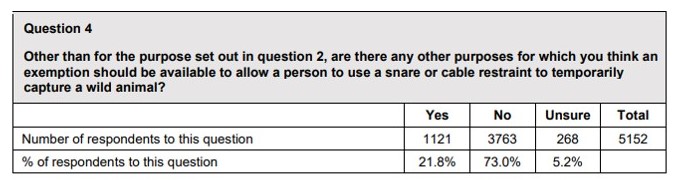
The Scottish Government is proposing to (a) prohibit the use of a snare or other type of cable restraint for the purpose of killing or trapping a wild animal; (b) prohibit the use of a snare or other type of cable restraint in any way that is likely to injure a wild animal and (c) provide Scottish SPCA inspectors who are acting under their existing powers under the 2006 Animal Welfare Act, with additional powers to search, examine and seize evidence in connection with specific offences under the Wildlife and Countryside Act 1981. This is all part of the Wildlife Management and Muirburn (Scotland) Bill which is currently making its way through Parliament.

REVIVE, the coalition for grouse moor reform, has provided a handy guide for consultation responses which you’ll find here.

Man convicted for killing pine marten on Scottish gamebird shooting estate but something odd going on here…

Earlier this week, Police Scotland issued a press statement about the conviction of two men in relation to a wildlife crime investigation on a pheasant and partridge shooting estate in Stewartry, Dumfries & Galloway.

David Excell, 54, pleaded guilty to trapping and killing a pine marten on the estate, in addition to failing to comply with the conditions of his firearms licence. He was fined £9,700 and his firearms licence has been revoked.

The Pine Marten is a protected species. Photo by Laurie Campbell

Kenneth McClune, 61, pleaded guilty to failing to comply with the conditions of his firearms licence. He was fined £840 and his firearms licence was also revoked.

At a superficial level this seems like a good result and a half-decent fine, at least for David Excell. The revocation of the firearms licences is also very welcome, although it would have been useful to know whether the two individuals also held shotgun certificates and whether those had also been revoked. (My understanding is that a shotgun certificate isn’t automatically revoked even if a firearms certificate has been – see here).

However, even though the convictions are welcome, there is something very odd about this case.

Firstly, the statement from Police Scotland was (deliberately?) vague, excluding the date the offences took place, the name of the estate where the offences took place and the occupations of the two guilty men. Is there some ‘shielding’ going on here?

Secondly, the police statement also included a gratuitous reference from the Police Wildlife Crime Officer in defence of shooting estates in general:

The actions of a few individuals do not reflect the positive steps taken by most land owners and managers to maintain and encourage wildlife in our countryside“.

Eh? Why on earth is this statement included in a press release about a man convicted of wildlife crime, and perhaps more seriously, on what qualified evidence has this claim been based?

Some would argue that the intensive and systematic (currently lawful) killing of wildlife on sporting estates (up to an estimated quarter of a million animals per year on grouse moors alone), undertaken entirely on the basis of increasing gamebird stocks for shooting, is not ‘maintaining and encouraging wildlife in our countryside‘. Some species will benefit, for sure, but other species definitely don’t. Either way, this isn’t a pronouncement that should be coming from Police Scotland.

But the oddest thing of all about this case is that I believe it is linked to this 2021 Police Scotland investigation into the alleged killing of birds of prey on an unnamed estate in Stewartry, but there’s no mention of this in the Police Scotland statement.

So either (a) I’m wrong that the allegations of raptor persecution relate to this case and there’s another, entirely separate case relating to another Stewartry estate going on; or (b) the allegations about raptor persecution do relate to this case but are being heard separately (which would be odd but not inconceivable, especially if those allegations relate only to the two other men charged in October 2021); or (c) the allegations of raptor persecution do relate to this case but have been quietly dropped.

Some clarification is needed. Watch this space.

UPDATE 16 November 2023: Charges dropped for raptor persecution offences committed on Overlaggan Estate, Dumfries & Galloway (here)

#RestoreNatureNow: protests outside DEFRA offices tomorrow (Thurs 28 Sept 2023)

Raptor Persecution UK will be represented at a public demo outside DEFRA HQ in London tomorrow (Thurs 28 Sept 2023) where many individuals and organisations will gather to tell the Government it needs to put nature at the front of policy decisions, not shoved in a bag inside a cupboard in a locked room and forgotten about.

The demo has been organised by the indefatigable Chris Packham and his team, in response to the latest State of Nature Report which has been published this evening.

The demo will be peaceful, there won’t be any glue, or paint or illegality, just lots of voices from a broad array of organisations whose members want to send a message to DEFRA and the Westminster Government that we’ve all had enough.

The demo in London will take place from 8am-2pm (details here) and there are other demos taking place in Bristol, Reading, York and Newcastle (details here).

Hope to see some of you in London. If you can’t make any of the locations, please follow on social media and help amplify the message using #RestoreNatureNow

Thanks

Awareness-raising campaign about illegal killing of birds of prey in Yorkshire & Derbyshire

Anyone who’s been following this blog for any length of time will be aware that the illegal killing of raptors takes place all over the UK, although there are some counties where crimes against birds of prey occur more frequently than in others.

In the most recent Birdcrime report (2021) published by the RSPB, the top three counties with the highest number of confirmed raptor persecution crimes that year were Norfolk (13 incidents), Dorset (12) and North Yorkshire (10). Over a ten-year period, by far the worst county for raptor-killing is North Yorkshire, which is hardly a surprise given its large size that includes vast areas managed for gamebird shooting, including in the lowlands and uplands:

So it was good to see a campaign last week by the charity Crimestoppers, focusing on the illegal killing of raptors in Yorkshire. They published a webpage (here) with information about what signs to look out for and how to report these offences, and this poster was doing the rounds on social media:

A similar awareness-raising campaign featured in Derbyshire Police’s Rural Crime Team newsletter in the summer, re-published on Derbyshire Wildlife Trust’s website (here).

In the article, the Police downplayed the significance of raptor persecution on driven grouse moors, claiming it was ‘historical’, but the information about other aspects of raptor persecution were quite relevant, especially the theft of peregrine eggs and chicks, which Derbyshire sees a fair bit of (e.g. Derbyshire Police recently charged a man with disturbance and egg theft at a peregrine site and he’s due in court next month – here).

It was amusing to see the list of partners that Derbyshire Police claim to be working with to tackle raptor persecution – I wonder how many times members of the Moorland Association and the National Gamekeepers Organisation have assisted police enquiries other than giving ‘no comment’ interviews – but it was good to see the police acknowledge the use of night vision equipment to target roosting raptors:

Most offences of shooting birds of prey involve the use of shotguns, although rifle shooting using powerful scopes or night vision aids is also used to kill perched birds at considerable distances‘.

Earlier this month, an RSPB claim that some gamekeepers were using night vision equipment to kill roosting birds of prey made the headlines (here), much to the consternation of the game-shooting industry. Derbyshire Police’s ‘partner’, the National Gamekeepers Organisation, had this to say about it:

There is no proof whatsoever that night vision has been used to target raptors; no proof that gamekeepers have been involved in any way, and indeed no proof that the birds are in fact dead. This is simply another attack by the RSPB on gamekeepers and the shooting sector more widely‘ (see here).

But then the game-shooting industry still denies that raptor persecution is even a thing, so they’re hardly going to acknowledge the more devious tactics used by the raptor-killers in their midst, are they?

Over a third of hen harriers satellite-tagged by Natural England are suspected illegally killed

Yesterday a friend sent me a link to a recent claim made by the grouse shooting industry that ‘Natural England hen harrier data reveals just 2% suffered persecution‘.

The article, published on the dodgy astro-turfing C4PMC (Campaign for Protection of Moorland Communities) website (see here for background on this murky outfit) has since been widely shared on social media by the usual suspects, in an attempt to counter my rolling list of missing/dead hen harriers in the UK since 2018 (currently reporting 110 birds but there are more to come).

The grouse shooting industry REALLY doesn’t like this rolling list, or the accompanying posters, because it lays bare their criminal activities with proven data sources (from Natural England and the RSPB) to back up each and every one of those listed ‘missing’/killed hen harriers.

My friend had never heard of C4PMC but knew the article was dodgy just from its introductory blurb, which describes me as an “animal rights activist” – he knows I’m not, and suggested I’d been labelled this way in an attempt to undermine my credibility. It’s a common tactic to create a wholly false impression of someone – the Daily Mail also tried this defamatory ploy a few years ago when it described me as an “anti-hunt extremist” and an “animal rights extremist“, presumably egged on by the loathsome Countryside Alliance, but was later forced to apologise and correct the article (see here).

Personally, I don’t read the C4PMC website ever since it published a particularly malicious ‘advent calendar of hate’ a few years ago, targeting well known conservationists, broadcasters, authors and politicians with vindictive and spiteful personal attacks, posted online every day in the run-up to Xmas during a lockdown period; so misjudged that even many of their own supporters from within the grouse-shooting industry thought they’d gone too far.

But given that my friend had drawn my attention to this latest article about hen harrier persecution being as low as 2%, I thought I’d take a look.

I’m glad I did, because it’s hilariously and hopelessly inaccurate. It’s apparent that whoever writes for C4PMC can’t count, can’t think, and can’t even copy data from a published source.

In a nutshell, C4PMC has published a list of satellite-tagged hen harriers, supposedly copied from Natural England’s public spreadsheet, showing the fates of NE’s satellite-tracked hen harriers since 2017, and has attempted to analyse those fates and present them as factual.

There are many problems with how they’ve done this (which I’ll describe below), but C4PMC’s first and most obvious mistake is to present the data from only 82 hen harriers, whereas Natural England’s spreadsheet shows the fate of 97 hen harriers. For some inexplicable reason, C4PMC has ‘forgotten’ to include 15 hen harriers (the ‘forgotten’ harriers are highlighted in blue in the document below).

Then when I started to analyse C4PMC’s ‘results’, I noticed that they’d completely changed the status of some of the birds – nine of them in fact – so for example, where Natural England has recorded a harrier as ‘Missing Fate Unknown’ in Cumbria in May 2020, C4PMC has recorded the same harrier as ‘Alive and well and living in France’ in September 2023!

C4PMC even included one harrier on its list that doesn’t actually exist in Natural England’s spreadsheet (highlighted in pink in the document below). C4PMC just made it up!

To show you the extent of C4PMC’s catalogue of ineptitude, I’ve produced a table to compare Natural England’s data with C4PMC’s misinterpretations (highlighted in red in the document below):

It’s quite obvious that any conclusion C4PMC has drawn from its inaccurate and unreliable ‘analysis’ is going to be flawed, given how many harriers they’ve left out and how many fates they’ve changed.

But it still doesn’t answer the question about how they calculated hen harrier persecution to be as low as 2%. It took me a while but then it dawned on me – to calculate the 2% figure, C4MPC has only included the two hen harriers confirmed to have been illegally killed (Free and Asta) and has totally ignored all the harriers listed by Natural England as ‘Missing Fate Unknown’ (i.e. those suspected of being/most likely have been, illegally killed).

This is a very strange approach to take but is absolutely what we’ve come to expect from the grouse shooting industry. Even Natural England acknowledges that illegal persecution is still rampant; the only ones still in denial are those within the grouse shooting industry itself (including the Chair of the Moorland Association, who last month told BBC Radio 4, “Clearly, any illegal [hen harrier] persecution is not happening” (here)). Why Natural England continues to view this industry as a ‘partner’ when that industry so blatantly ignores/denies what’s so obviously going on is beyond me, I’m afraid (although the £75,000 ‘donation’ received by NE might have something to do with it).

I’ve done a quick calculation for C4PMC, as they obviously need some/lots of help. Counting up all the harriers listed by Natural England as ‘Missing Fate Unknown’ (but excluding all those listed as likely to have been predated, or carrying failed tags, or have been found dead outside the UK), there’s a grand total of 34 hen harriers listed as ‘missing’ (in suspicious circumstances and likely to have been illegally killed in the UK), which out of 97 tagged birds amounts to a 35% persecution rate.

That’s over a third of Natural England-tagged harriers suspected to have been killed illegally, which funnily enough closely corresponds with the fates of satellite-tagged golden eagles in Scotland (here) and the fates of hen harriers satellite-tagged by the RSPB (here).

Imagine that, actual data backing up actual science.

And let’s not forget, these are the tagged birds. How many un-tagged hen harriers is the grouse shooting industry also killing?

Photo: Gerold Doble

Conference programme announced for REVIVE, the coalition for grouse moor reform

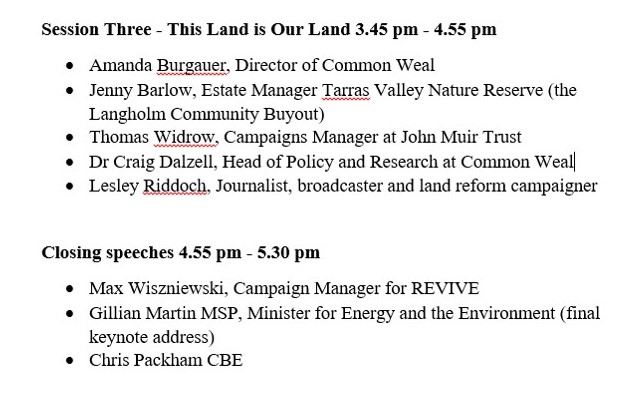
REVIVE, the coalition for grouse moor reform will be holding its annual conference at Perth Concert Hall on 12 November 2023, hosted by Chris Packham.

The full programme has now been announced, as follows:

The conference is open for anyone to attend (with concessionary rates for some) and tickets are on sale now.

Book your tickets here.

Trial date set for man charged with killing goshawk at pheasant-rearing farm

A trial date has now been set for a man accused of killing a goshawk at a pheasant-rearing farm in Wales.

Thomas Edward Jones, 38, appeared again at Welshpool Magistrates Court on 19 September 2023 where he pleaded not guilty to the shooting and killing of a goshawk at Pentre Farm in northern Powys in July 2022, where tens of thousands of pheasants are reportedly reared for the game shooting industry.

The trial will begin on 6 November 2023.

Goshawk. Photo by Mike Warburton

PLEASE NOTE: As this is a live court case comments won’t be accepted until criminal proceedings have concluded. Thanks for your understanding.

Previous blog on this case here.

UPDATE 23 November 2023: New trial date for man accused of shooting & killing goshawk at pheasant-rearing farm (here)

UPDATE 7 December 2023: Trial discontinued for man accused of killing goshawk at pheasant-rearing farm in Wales (here)