Just before Christmas a new scientific paper was published by experts from Leeds University, revealing that burning on deep peat is widespread on many Scottish grouse moors, and that, surprise surprise, land managers were ignoring the new (voluntary) Muirburn Code which suggests burning on peatland should be avoided (see here).
Muirburn on an Aberdeenshire grouse moor in 2022. Photo by RPUK blog reader
Today, one of the study’s authors, Dominick Spracklen, Professor of Biosphere-Atmosphere Interactions at the University of Leeds has written an easy-to-understand blog about the study to help the public (and I daresay politicians engaging with the Wildlife Management & Muirburn Bill) understand the importance of minimising the extent of these peatland fires.
The Scottish Government’s Wildlife Management & Muirburn (Scotland) Bill is making its way through the parliamentary process. For new readers, this is proposed new legislation to regulate grouse shooting and its associated management practices by way of licensing schemes, introduced because of the continued illegal persecution of birds of prey on many Scottish grouse moors.
Poisoned golden eagle next to a poisoned bait found on a grouse moor in Cairngorms National Park. Photo by RSPB Scotland
The Rural Affairs and Islands Committee was due to scrutinise and vote on the Stage 2 amendments tomorrow but a notice has just gone around that this has now been delayed until Wednesday 7 February 2024 (no reason for the delay was provided).
This also means that more amendments are now allowed to be lodged, up until 12 noon on Thursday 1st February 2024.
So far, the lodged amendments are predictable with no real surprises (e.g. see here for commentary on some earlier ones).
Let’s see what else gets lodged between now and 1st February and I’ll try and provide an overview shortly afterwards.
UPDATE 22.15hrs: Political shenanigans with Stage 2 of Wildlife Management Bill – back on tomorrow? (here)
The trial of prominent falconer and eagle breeder Andrew Knowles-Brown from Elvanfoot, Scotland continued at Lanark Sheriff Court last week where leading international avian vet Neil Forbes DipECZM(Avian), FRCVS was called as an expert witness for the prosecution.
This is the second trial Knowles-Brown has faced – in February 2023 he was cleared of all charges at Lanark Sheriff Court in relation to the alleged mistreatment of ten imported White-bellied sea eagles at the Scottish Eagle Centre (see here).
The current trial is separate to the first one and is concerned with alleged welfare offences relating to 90 eagles kept at Knowles-Brown’s breeding facility in Scotland. Knowles-Brown has denied all the charges.
Knowles-Brown is a prominent figure in the falconry world, having served as the Chair of the Scottish Hawk Board and Vice-Chair of the UK Hawk Board. The Hawk Board, which includes a representative from the Countryside Alliance, represents falconers, hawk-keepers and falconry clubs and provides welfare guidelines for those keeping raptors in captivity. It also engages in political lobbying (e.g. it was against the Scottish Government’s decision to afford the Mountain Hare full legal protection) and Knowles-Brown himself has provided evidence to the Scottish Parliament’s Rural Affairs Committee when it was considering its draft Protection of Wild Mammals (Scotland) Bill.
This second trial began last summer (see here) and looks set to continue for some time. The next expert witness for the prosecution is due in court on 27 February 2024.
Please note: as the case is still live, comments won’t be accepted on this blog until proceedings have concluded. Thanks for your understanding.
UPDATE 15 October 2024: Prominent falconer & eagle breeder Andrew Knowles-Brown guilty of welfare offences relating to approx 90 eagles in Scotland (here)
Essex Police are appealing for information after the discovery of an injured peregrine in the Highwood area of Chelmsford on 15th January 2024.
The wounded bird was admitted to the South Essex Wildlife Hospital and on examination is believed to have been shot.
I’ve asked for information about the peregrine’s condition and asked whether an x-ray had confirmed the bird had been shot. I’ll update this post when I hear.
Anyone with information is asked to contact Essex Police on Tel 101.
This latest raptor persecution victim is the 9th in Essex in recent years, following the shooting of a buzzard in December 2023 (here), the shooting of another buzzard in January 2023 (here), the shooting of a red kite in September 2022 (here), the shooting of another red kite in November 2021 (here), another red kite found dead in suspicious circumstances in November 2021 (here), the shooting of another three buzzards in 2020, one in Dec (here), one in September (here) and one in June (here), and the suspected shooting of a Hobby in August 2020 (here).
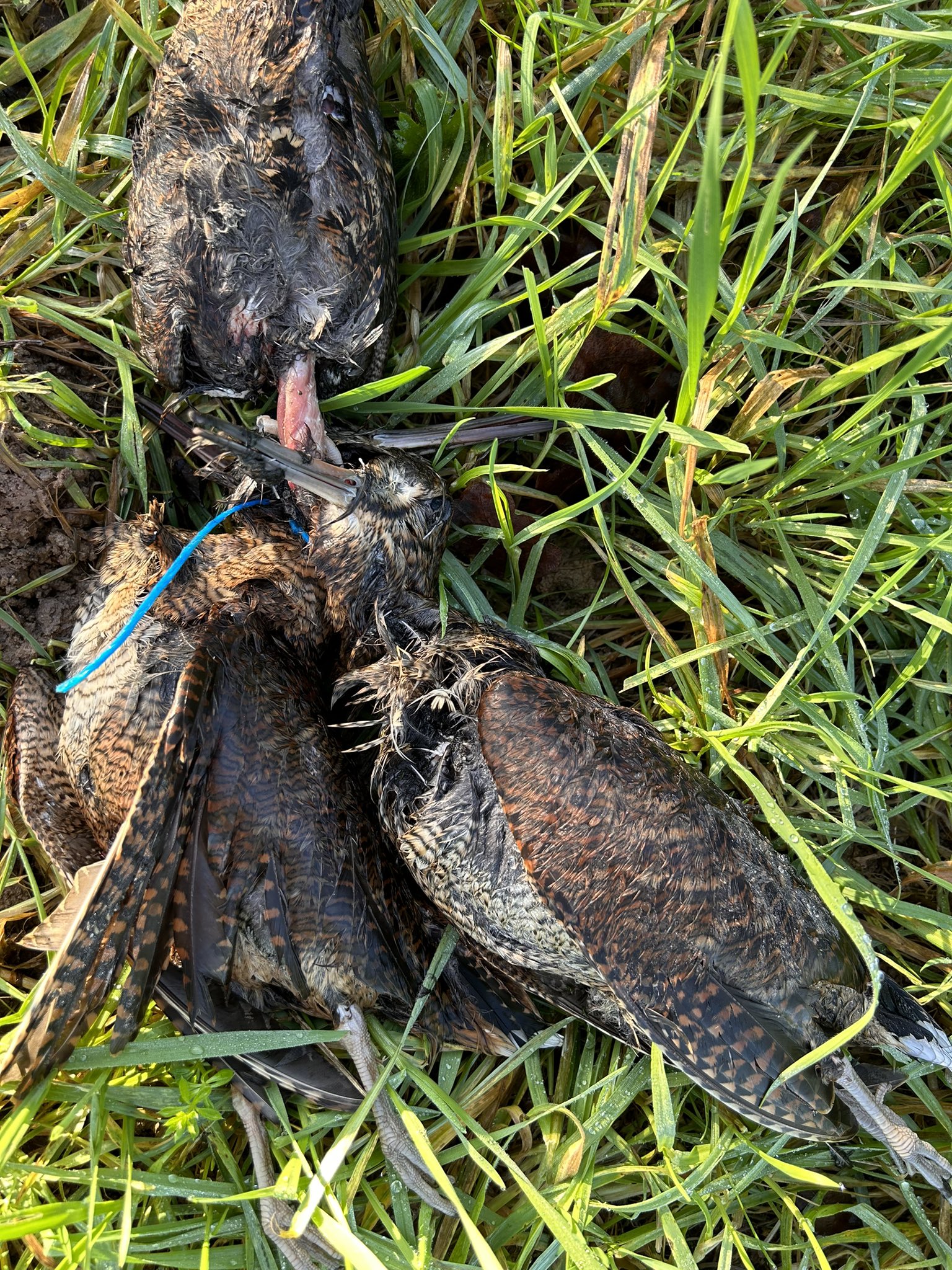
In response to yesterday’s blog where I wrote about the latest reported incident of the illegal fly-tipping of shot gamebirds (pheasants in Gloucestershire – here), blog reader Paul Bray posted the following image on Twitter:
Shot & dumped Woodcock, photo by Paul Bray
These are shot Woodcock that were found dumped in Crowton, Cheshire two weeks ago by Paul and his colleagues in the group Cheshire Against Blood Sports as they sabbed the Cheshire Forest Hunt.
Woodcock, although red listed on the UK Birds of Conservation Concern, are still classed as ‘gamebirds’ and they can be shot between 1st October (1st September in Scotland) and 31st January, although Wild Justice has been campaigning to shorten this to protect the declining resident population (see here).
It’s contemptible that introduced, non-native pheasants and red-legged partridge are shot and then dumped but to do that to Woodcock seems even more obscene.
What was the point of shooting these Woodcock if they were then going to be thrown away?
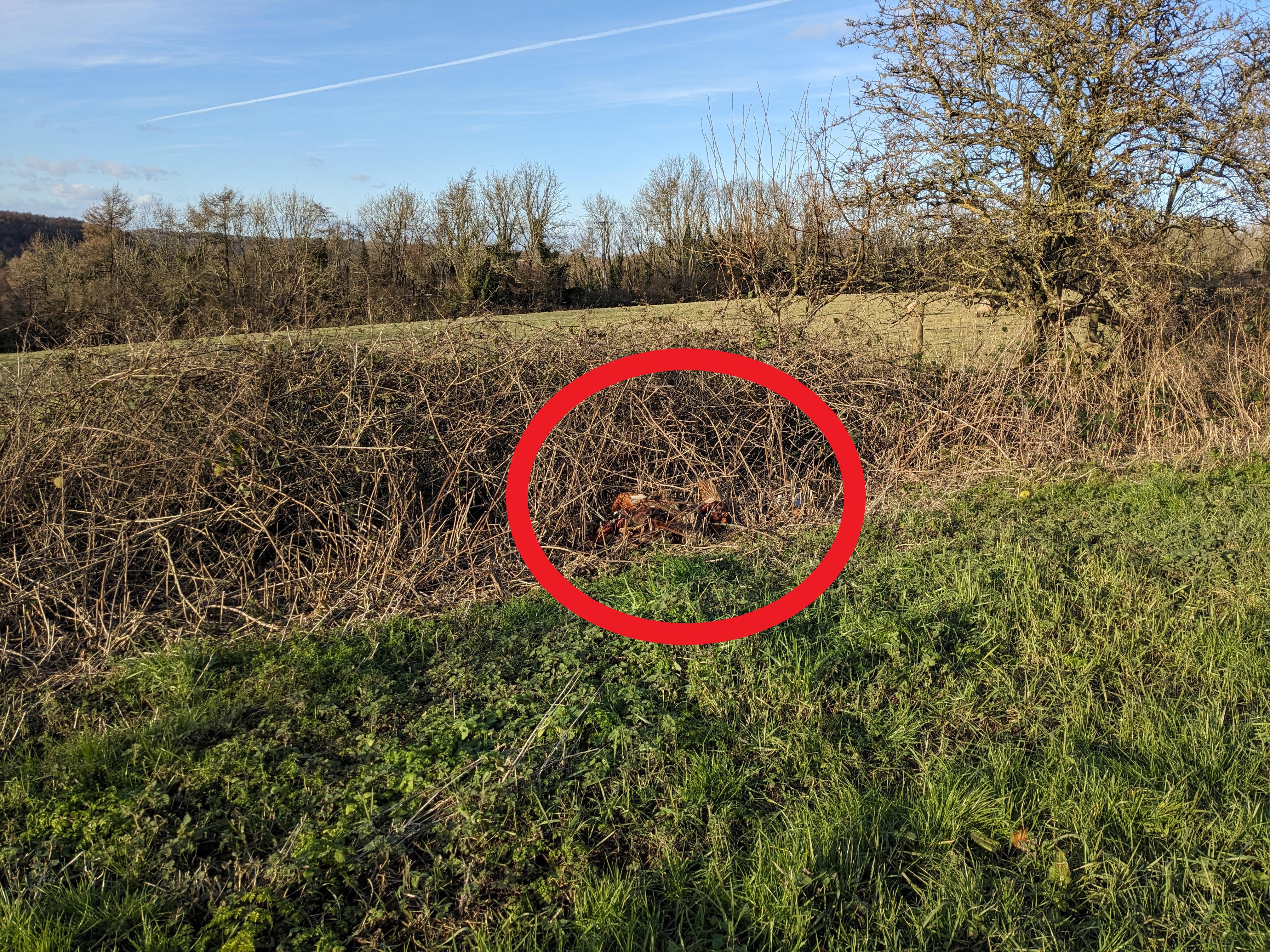
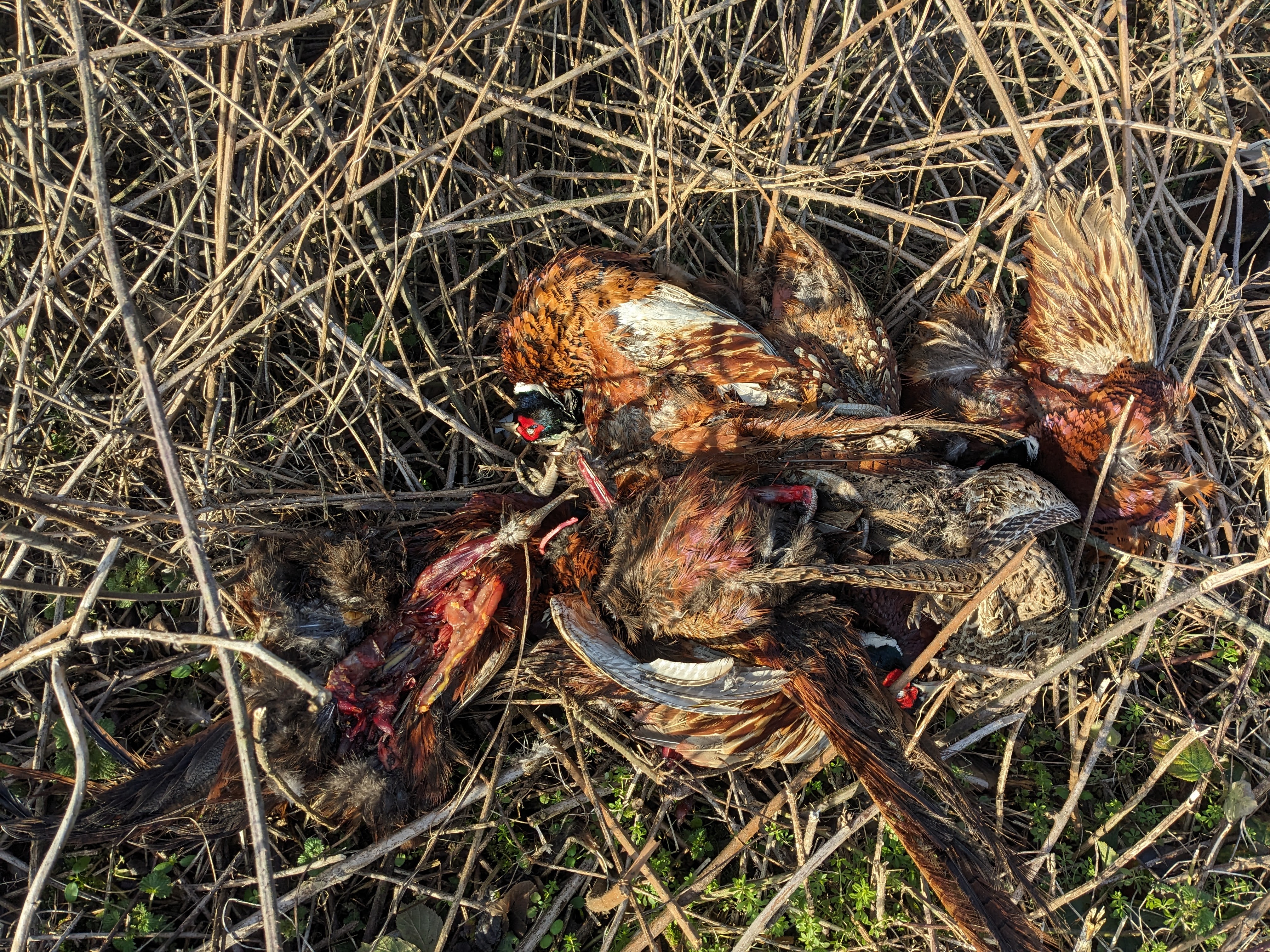
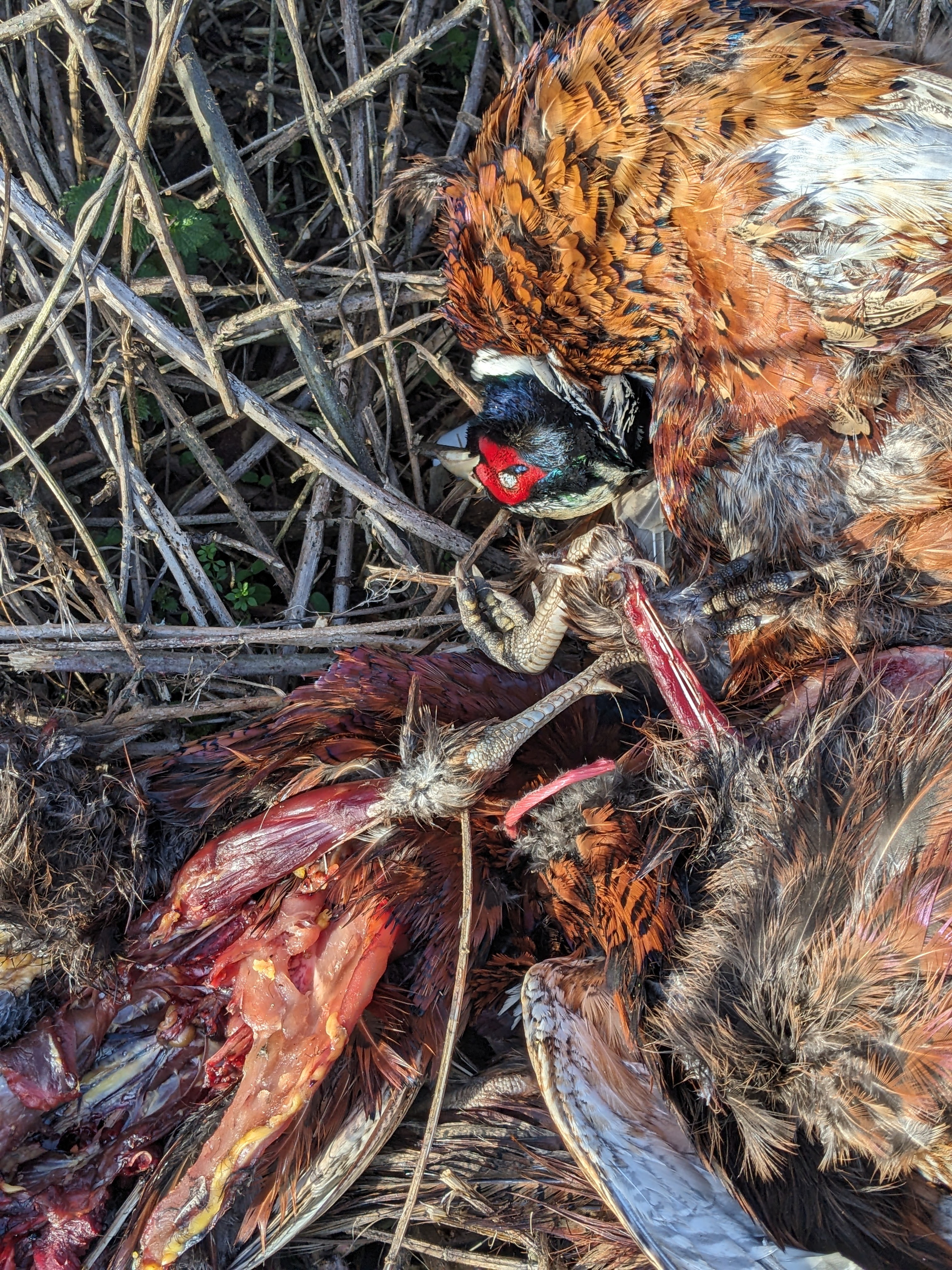
More shot pheasants have been found dumped by the side of the road, this time thrown into a hedge next to a lay-by on Old London Road, near Wotton-Under-Edge, Gloucestershire.
This latest shameful fly-tipping incident was discovered on Monday 15th January 2024 and has been reported to Stroud Council.
Thanks to the blog reading dog walker who sent in these photos:
Regular blog readers will know that this is a common and widespread illegal practice.
Previous reports include dumped birds found in Cheshire (here), Scottish borders (here), Norfolk (here), Perthshire (here), Berkshire (here), North York Moors National Park (here) and some more in North York Moors National Park (here) and even more in North Yorkshire (here), Co. Derry (here), West Yorkshire (here), and again in West Yorkshire (here), N Wales (here), mid-Wales (here), Leicestershire (here), Lincolnshire (here), Somerset (here), Derbyshire’s Peak District National Park (here), Suffolk (here), Leicestershire again (here), Somerset again (here), Liverpool (here), even more in North Wales (here) even more in Wales, again (here), in Wiltshire (here) in Angus (here), in Somerset again (here), once again in North Yorkshire (here), yet again in West Yorkshire (here), yet again in mid-Wales (here), even more in mid-Wales (here), and more in Derbyshire (here).
Ironically, I see the Countryside Alliance has been expressing its concern and ‘alarm’ over fly-tipping crimes:
‘Fly-tipping and littering must not be seen as a victimless crime: it is a scourge on our natural environment and a blight on the farms these criminals still too often target‘.
and
‘We have long campaigned on this issue and will be calling on all parties in the run up to the election to take this crime seriously’.
I look forward to seeing the Countryside Alliance draw attention to the criminal fly-tipping activities of those in the game-shooting industry.
A blog reader who works as an upland peatland specialist has written the following blog.
With the Wildlife Management and Muirburn Bill passing through the Scottish Parliament we are soon to see a tightening of the regulation around grouse shooting and burning in the Scottish uplands. This is long overdue, but welcome, nonetheless. So many have fought for so long to get to this point; but the Bill is not over the line yet, with changes possible over the coming weeks.
A recent post on this blog highlighted some of the sorts of changes that could be made by pointing to the amendments lodged by Edward Mountain MSP and one of those jumped out as important. It seems innocuous and inconsequential but the suggestion to change the definition of peat depth from 40cm to 60cm does have implications.
Why does that matter so much? It matters because the Bill is designed to offer protection to peatlands and amendments such as this would weaken that protection.
Under the terms of the Bill, an owner or occupier of land will have to apply for a licence to undertake muirburn, but they can only burn for specific reasons and these reasons are different on different types of land. Where the land is peatland, the owner or occupier may apply for a licence for the purpose of restoring the natural environment, preventing or reducing the risk of wildfires, or research. Where the land is not considered to be peatland, they can apply for a licence to burn for sporting, farming, conservation, wildfire management or research purposes. In effect, burning on peatlands is restricted; land managers will not be able to burn on peatlands for sporting or farming purposes.
Peatland burning on a driven grouse moor. Photo: Ruth Tingay
Consequently, since the Bill is structured to treat peatlands differently, the definition of what is, and what is not, a peatland, really matters. It determines where different sets of rules apply.
At present the Bill defines ‘peatland’ as “land where the soil has a layer of peat with a thickness of more than 40 centimetres” (where “peat” means soil which has an organic content of more than 60%).
In one way this definition does represent an improvement on the status quo because the current Muirburn Code refers to 50cm and the lower the threshold the larger the area that is considered to be peatland where the restricted rules apply. But, more fundamentally, these depth thresholds can have perverse consequences because they create artificial thresholds that don’t really exist. The consequence of this definition is that extensive areas of shallow peat of a depth less than 40cm will effectively be treated as ‘not peatland’, despite the fact that they are functionally part of a peatland and actually the most vulnerable areas. The IUCN Peatland Programme calls these areas the ‘lost peatlands’:
Despite these areas containing substantial carbon stores and often being vital to the wider ecology and hydrological function of connected deeper peat deposits, we, for the bureaucratic purpose of setting rules around burning, say that they are not peatlands. The result is that, under the terms of the Bill, a land manager will legitimately be able to burn on shallow peat for grouse shooting or farming purposes.
The crux of the issue is that the legislation is clearly designed to try and protect peatlands by treating them differently, but at the same time the definition of a peatland limits the benefit.
If we look again at the Edward Mountain suggestion to change the depth definition from 40cm to 60cm, the effect would be to reduce the area that is considered peatland and so reduce the area where the greater restrictions apply. Conversely it would increase the area where burning for sporting and farming purposes would be possible. This would seem to run counter to the intention of the legislation.
Arguably, the best option would be to just stop defining peatlands (for the purposes of burning) by depth and say that we shouldn’t be burning on peat/peaty soil for sporting and farming purposes (noting, of course, that burning for the purpose of nature restoration, wildfire prevention and research would still be allowed). At the time of writing there is still time for this reasonable approach to be taken forward through amendments at Stage 2 or possibly later at Stage 3, so it remains to be seen whether the rhetorical importance that our politicians give to peatlands translates into real decisions in law.
British charity Raptor Aid has launched a crowdfunder to help purchase satellite tags for Short-eared owls in the UK to help understand the movements of this enigmatic species, in partnership with the Northern England Raptor Forum (NERF).
Scientist John Calladine from the BTO has been studying this species for many years and his most recent paper, published with a number of international collaborators in the ornithological journal Ibis just last week, has revealed some remarkable and unexpected movements of satellite-tagged Short-eared owls.
The paper, ‘Remote tracking unveils intercontinental movements of nomadic Short-eared Owls (Asio flammeus) with implications for resource tracking by irruptive specialist predators‘ sits behind a paywall so if you want to read it you’ll have to subscribe to the journal, or pay to view, or you can contact one of the authors and ask for a copy.
However, there’s an excellent, non-technical article about this research on the Inside Ecology website (here) – well worth a read.
In addition to fundraising for satellite tags, Raptor Aid is also looking to continue its small grants award to raptor researchers in the UK and overseas.
For more details and to contribute to the crowdfunder, please click here.
Derbyshire man caught on camera raiding peregrine falcon nest given custodial prison sentence.
At Southern Derbyshire Magistrates Court on 15 January 2023, Christopher Wheeldonof Darley Dale, Matlock pleaded guilty to intentionally disturbing Peregrine Falcons and taking Peregrine Falcon eggs and was sentenced to 8 weeks in prison for these offences. His total sentence, including additional charges unrelated to this case is 18 weeks.
Covert footage taken by the RSPB’s Investigations Team helped secure this conviction.
The Peregrine eggs are believed to have been hatched and then laundered into the illegal falconry trade.
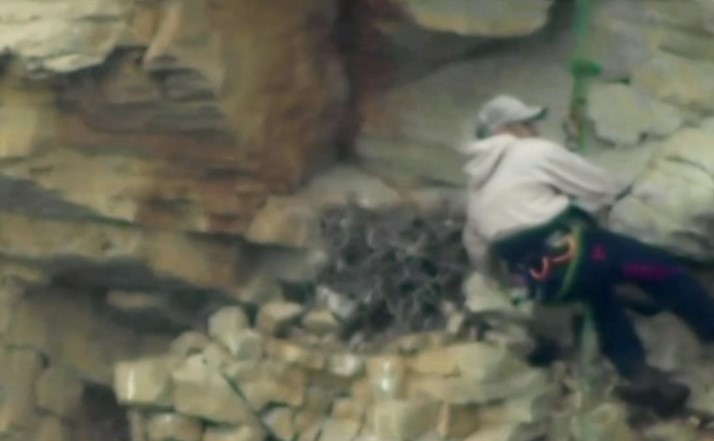
Christopher Wheeldon caught on RSPB camera stealing the peregrine eggs
In April 2023, officers from RSPB Investigations installed a surveillance camera to monitor a Peregrine Falcon nest in a limestone quarry near Bolsover, Derbyshire. The falcons were incubating a clutch of eggs when on 23 April 2023 video footage showed a rope being dropped from above, causing the parent bird to abandon the nest. The Peregrines can be heard sounding distress calls as a man abseils down to the nest and steals three eggs from the cliff-ledge nest, before climbing back to the cliff top. Derbyshire Police were alerted, and enquiries soon identified Christopher Wheeldon as the individual involved. Search warrants were executed at two addresses, resulting in the discovery of items of clothing seen in the video at Wheeldon’s address.
Sadly, no eggs or Peregrines were recovered. It is considered likely that the eggs were destined to be laundered by being artificially incubated, and when hatched, the chicks passed off as ‘legal’ captive-reared birds. Unfortunately, once in the system, and following the removal of the Government registration scheme, it is now virtually impossible to trace these wild birds. It is likely these wild Peregrines were stolen to order and are now in the overseas falconry trade, where wild British Peregrine Falcons are regarded as being of genetically superior stock and command high prices.
On Monday 15 January Wheeldon, who pleaded guilty to disturbing these protected birds and taking their eggs, received an eight-week prison sentence for these crimes and a further 10 weeks for unrelated shop-lifting charges.
District Judge Stephen Flint said on sentencing: “Even the birds are not beyond you’re thieving grasp. You may conceive these as just eggs but they are protected. This was a deplorable thing to do.”
Although Peregrine Falcons are specially protected under the Wildlife and Countryside Act 1981, these magnificent birds of prey have sadly been subjected to a diverse range of persecution over the years. Over the years the RSPB Investigations team has documented many incidents of shot and poisoned Peregrines on land managed for driven grouse shooting in the UK, including Derbyshire.
In other parts of the county, Peregrines face a different sort of persecution, with nests in quarries being targeted for their highly prized chicks and eggs, to be intended for the illegal falconry industry. Previously, in May 2020, RSPB managed to film another Peregrine nest robbery in Derbyshire but unfortunately this did not lead to a conviction in court.
This latest case highlights the ongoing demand for wild Peregrine eggs from the UK to furnish the overseas market. With the laundering of wild Peregrine Falcons fetching tens of thousands of pounds, this crime will continue to be worth the risk to some.
Without the reinstatement of full registration controls for captive bred birds this illegal activity will continue to threaten wild Peregrine populations across the UK. The RSPB Investigations Team will continue to monitor nests in Derbyshire and the wider area, and as this case shows, hope to secure more convictions in the future.
The RSPB would like to thank Derbyshire Police Rural Crime Team for their thorough investigation and diligent work which has resulted in this successful outcome, the South Peak Raptor Study Group for their continued efforts in monitoring these birds and Tarmac for their assistance throughout.
Thomas Grose, RSPB Investigations Officer: “Peregrine Falcons represent the epitome of being wild and free and it is this very characteristic that makes them such a target for criminals involved in the illegal falconry trade, earning money from the laundering and trading of these birds overseas. The theft of Peregrine eggs and chicks has been a persistent threat to these birds in Derbyshire. This case is a great example of organisations working together to bring those responsible to justice. Without dedicated volunteers and the efforts of Derbyshire Police this would have been just another failed nest. I hope this sends the message that we are watching and will continue our efforts to protect these amazing birds of prey.”
Chris Wilkinson, Derbyshire Police Rural Crime Team: “The nesting sites of these beautiful birds of prey are protected in law for a reason. Peregrines are an endangered species and groups, including the RSPB, have been working hard to ensure they are free from persecution and able thrive in Derbyshire. The efforts made by the RSPB, Derbyshire Police, NWCU and the Animal and Plant Health Agency to secure the conviction and subsequent sentence handed down by the courts, goes to show that we will go above and beyond to identify those responsible and bring them to justice.”
If you have information about anyone killing birds of prey which you wish to report anonymously, call the RSPB’s confidential Raptor Crime Hotline on 0300 999 0101.
ENDS
This is an interesting case in that the culprit received a custodial sentence for the persecution of birds of prey. As regular blog readers will know, custodial sentences are rare in this area of wildlife crime – there have been a handful, the most notorious in 2014 when a gamekeeper who was caught on camera by the RSPB trapping and killing goshawks on an Aberdeenshire shooting estate in 2012, received a four month custodial sentence (here).
There have been plenty of other convictions for raptor persecution since then, mostly gamekeepers, with many of the cases reaching/passing the custodial threshold but sentences have been consistently and disappointingly weak, typically consisting of paltry fines, community orders and/or suspended sentences.
So what made Wheeldon’s offences so different as to warrant an immediate custodial sentence?
Well, I’d argue that the fact Wheeldon didn’t have an expensive barrister to represent him, unlike many gamekeepers who appear before the courts charged with raptor persecution, was probably a crucial factor. The majority of those given a custodial sentence for raptor persecution offences have been individuals stealing eggs/chicks for the falconry trade or for private egg collections, and who haven’t had top barristers standing up for them in court.
I’d also guess that Wheeldon’s criminal history influenced the magistrate’s decision. Wheeldon, 34, previously of Lime Grove, Matlock but now of Wheatley Gardens, Two Dales, is described on the Derbyshire Livewebsite as a ‘drug-addicted tree surgeon’, and he has a bit of a record.
He reportedly lost his driving licence for ‘driving with excess drugs’ in 2021 (here) and was charged with attempted robbery of a takeaway in Matlock in January 2023 (here – I don’t know the outcome of that case). In addition, during sentencing yesterday, it emerged that Wheeldon was also convicted of five counts of shop lifting, four of which took place during the first week of January this year.
He actually received a longer sentence for the shoplifting offences (10 weeks) than he did for disturbing the peregrine nest (8 weeks) and stealing the peregrine eggs (another 8 weeks, to run concurrently). So whilst a custodial sentence is to be welcomed, it still doesn’t act as a deterrent for others who may be considering committing an offence; and an offence that is supposedly a national police wildlife crime priority, especially when this offence can theoretically attract a custodial sentence of up to six months in England.
A report on wildlife crime in the UK, published in 2021 by the United Nations Office on Drugs & Crime (UNODC) recommended improved sentencing guidelines to provide consistency on tackling wildlife crime.
Following the report’s publication, Green peer Natalie Bennett asked the UK government what plans it had to produce sentencing guidelines for raptor persecution (and other wildlife offences). DEFRA Minister Lord Benyon said the report’s recommendations “will be considered by the relevant agencies“.
No plans, then.
Nevertheless, Wheeldon’s prosecution and conviction is a good result – and especially as it was led by Derbyshire Constabulary’s Rural Crime Team, who previously have been less than impressive on some raptor persecution investigations (e.g. here, here, here). So well done to Derbyshire Police, to the RSPB’s Investigations Team and also to the Crown Prosecution Service.
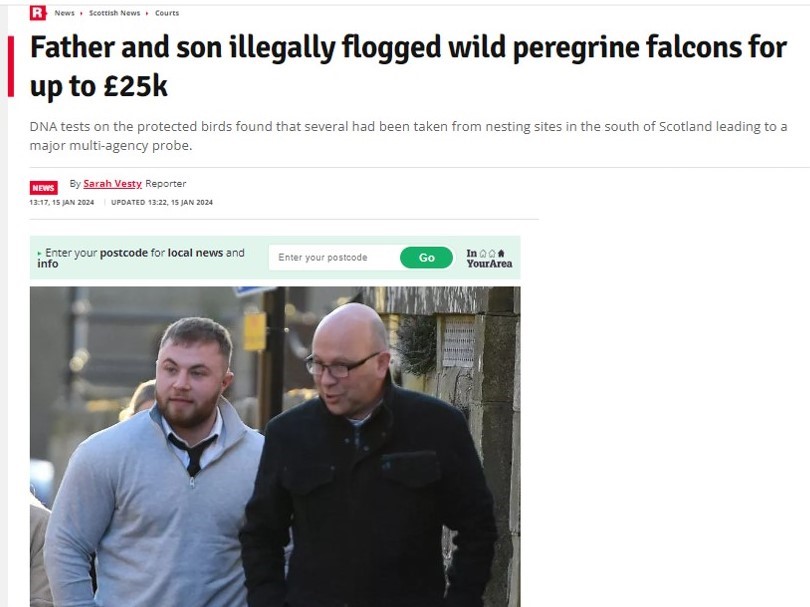
Further to this morning’s blog about sentencing being deferred for part-time gamekeeper Timothy Hall and his son, Lewis Hall, who have pleaded guilty to numerous offences relating to wild peregrines in Scotland being laundered as ‘captive bred’ peregrines to buyers in the Middle East (see here), the Daily Record has published more details about this case.
Headline from Daily Record, 15 January 2024
The article explains that the alarm was first raised by George Smith, a member of the Scottish Raptor Study Group who has monitored peregrine nest sites in the Scottish Borders for decades. He was concerned that breeding attempts were failing at sites that had previously been known to be routinely successful.
Officers from Police Scotland visited the sites with George and noticed marks that suggested someone had recently climbed to the nests.
Intelligence reports led to Timothy Hall’s home at Lamberton Holdings in Berwickshire where a large number of peregrines and eggs were found. Timothy Hall and his son Lewis claimed the young birds were captive bred but DNA evidence showed that at least seven recently-hatched chicks were not related to the captive peregrines owned by the Halls. Two chicks were later matched to an adult bird at a wild nest site and one was linked to another wild site.
Mobile phones and a drone used by the Halls was shown to have been used on 20 separate occasions to fly to known nest sites.
An analysis of bank accounts showed large sums of money being transferred from peregrine sales by Lewis Hall to a joint bank account owned by his parents. Some legitimate buyers had been duped by false paperwork procured by Lewis Hall in an attempt to pass off the young peregrines as legitimately captive bred.
Sheriff Peter Paterson reportedly told the court this morning: “These are very serious matters. I want to know what’s happened to the money. They claim they have limited assets and income.
“According to the background report for Lewis Hall, and I quote, ‘it’s clear these criminal actions have been carried out over a lengthy period of time and with great scale’. I will be informing HMRC and I’ll ask them to investigate any further charges.”
To read the full article in the Daily Record click here.





 Raptor Persecution UK