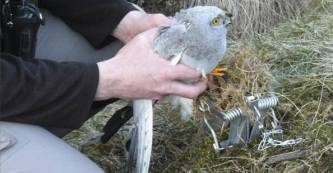
Latest SASA figures show illegal raptor poisoning continues in Scotland

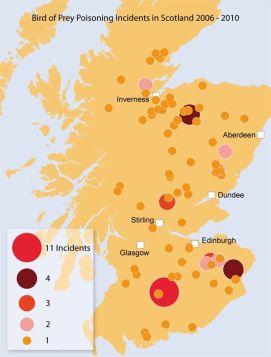
Well finally, on behalf of the Scottish Government, SASA (Science and Advice for Scottish Agriculture) has published the poisoning figures from the second quarter of 2011 (covering the period from April to June), and guess what? More raptors were illegally poisoned during this period. Seems a bit of a coincidence that these figures have been published four months late and on the very day that people were encouraged to make a Freedom of Information request to SASA to obtain the 2011 poisoning data. Nevertheless, the publication of these data is still welcome and provides us with cold hard facts about the continuing illegal poisoning of our native species.

The latest report shows that there were three confirmed ‘abuse’ incidents during this period, including:

April 2011: 1 x buzzard poisoned by Aldicarb & Carbofuran (Highland region)

May 2011: 1 x raven poisoned by Carbofuran (Dumfries & Galloway)

May 2011: 1 x red kite poisoned by Bendiocarb & Carbofuran (Highland)

All three incidents are reported to be the subject of on-going police investigations. How many of these were reported in the media at the time of the incidents? These latest figures can now be added to the figures from the first quarter (Jan – Mar 2011 – see here) to show that in the first half of this year the following  have been confirmed poisoned by illegal pesticides:

4 x buzzards; 1 x golden eagle; 2 x red kites; 2 x peregrines; 1 x raven.

And of course these are only the ones that have been discovered. And the figures do not include all the other incidents of non-poisoning persecution reported this year (e.g. shot goshawks here, shot peregrine here), nor the suspected poisoning incidents that were not included in the earlier SASA report (see here), nor the birds reported to have been poisoned since June (e.g. see here). It is clear that the widespread problem of illegal raptor persecution still exists, despite the (now apparently premature) comments from the game-shooting industry that this criminal behaviour has been eradicated. It clearly hasn’t been eradicated, but have the numbers dropped? Given the chronic delays in reporting these incidents in the media, we’ll have to wait for the next two SASA reports before that assessment can be made.

I wonder how long will we have to wait until the figures from the 3rd quarter (July – Sept) are released? If their publication is as late as this current one, we can expect to see them in four months time (February 2012). Perhaps that FoI request is still worth pursuing after all..

Latest SASA figures available for download here.

Poisoned buzzard & ravens – appeal for info comes three months later

A news item posted today on the RSPB website reveals that a buzzard and two ravens were found dead in Monmouthshire in July. Tests reveal they had been poisoned by the banned pesticide Carbofuran. Two dead pigeons were also found which had been laced with an un-named pesticide and the news report suggests these were put out as illegal poisoned bait. Last year, two dead peregrines, poisoned with Carbofuran, were found at the same site (see here).

The article reports that Gwent Police, the Welsh Government and the RSPB are appealing for information. The RSPB is reported to be offering a £1,000 reward for information leading to a conviction.

Three months after the incident? What’s the point? Why is it that media reports about wildlife crime, and particularly illegal raptor persecution incidents, are now consistently delayed for several months? What other areas of crime are reported this way? If my house was burgled in July and I waited for three months before I reported it to the police, what do you think the chances would be of catching the burglar? About the same as catching the raptor poisoners, I reckon.

Talking of delayed reports…why is it that the 2011 SASA poisoning report, which is supposed to be updated every quarter, has not been updated since March 2011? Are we to believe that raptors are no longer systematically poisoned in Scotland because none have been handed in for analysis for the last seven months? If anyone feels like doing a Freedom of Information Request, this would seem to be a good place to start (FoI on SASA website here).

News story about the poisoned buzzard & ravens on RSPB website here

Red kite persecution study wins science award

A recent study that revealed how illegal persecution is affecting the growth of a red kite population in Scotland has won a scientific research award.

The new award, the Watson Raptor Science Prize, is given for the best raptor study published in a peer-reviewed journal, and is made in honour of two exceptional raptor biologists, the late Donald Watson and his late son, Jeff Watson. Donald pioneered studies on the hen harrier and Jeff was a world authority on the ecology and conservation of the golden eagle.

The award-winning paper: Illegal killing slows population recovery of a re-introduced raptor of high conservation concern – the red kite, was published in the international journal Biological Conservation in 2010. The study, undertaken by RSPB scientists, compared the growth of two red kite populations, one in the Chilterns in southern England and one in the north of Scotland. The researchers found that after 17 years the Chilterns population numbered around 300 pairs, whereas the north of Scotland population only numbered around 50 pairs. The reason for the difference in survival rates was conclusively demonstrated to be illegal persecution.

Well done to the team of researchers, led by Dr Jennifer Smart, for scientific excellence, and especially for adding to the ever-increasing body of scientific literature that shows, unequivocally, that the illegal persecution of raptors continues to affect the conservation status of these iconic species.

BBC news article here

Scottish government’s support for grouse shooting “goes beyond words”, says Environment Minister

Here’s a fascinating insight into the Scottish Environment Minister’s views on driven grouse shooting.

In a letter addressed to the Earl of Hopetoun (Scottish Land & Estates’ Moorland Group), Environment Minister Stewart Stevenson MSP tells him: “I think it is clear that the Scottish Government’s support for this industry goes beyond words“. He goes on to comment about well-managed moorland as a valuable resource for biodiversity, the significant contribution the industry makes to the rural economy, and how hard the Scottish Government has fought to retain the use of snares for predator control.

It’s all a bit depressing until towards the end of the letter he addresses the issue of vicarious liability. It’s not clear what the Earl of Hopetoun said to Stewart Stevenson, but it seems to have been something along the lines of arguing against the introduction of vicarious liability (which is due to be enacted sometime this winter). Stevenson responds:

Turning to the issue of vicarious liability, I am afraid I do not agree that this poses a threat to the public benefits that well-managed moorlands deliver. The introduction of vicarious liability in this area is a response to a long-standing and continuing problem and reflects the wishes of a clear majority in Parliament. However, any grouse moor manager or owner who takes their staff and land management duties seriously and can show, if required, that they have carried out due dilligence in this respect, as required by the law, will not have any reason to be concerned“.

He continues: “I hope that we are beginning to see a significant reduction in crimes involving birds of prey. Any reduction in the numbers of birds that are found poisoned will be very welcome. We are however clear that the number of birds analysed by SASA is not the complete picture, and we will continue to be guided by the scientific advice from SNH on the overall population levels and distributions of birds of prey“.

Full letter available for download here: Stevenson response to Lord Hopetoun Aug 2011

Interestingly, the Earl of Hopetoun is a Director of Scottish Land and Estates and appears to be connected with the management of estate land in Lanarkshire. His profile biography on the Scottish Land and Estates website says the following:

Andrew Hopetoun is Chairman of Hopetoun Estates and Deputy Chairman of the Hopetoun House Preservation Trust. These two organizations manage Hopetoun House (home of the Hope family for over 300 years and a successful tourism, corporate and private functions business) and its related estates, mostly at Hopetoun near Edinburgh and around Leadhills in the Scottish Borders (See profile here).

This wouldn’t be the Hopetoun Estate (aka the Leadhills Estate), would it? If this information is accurate, then it’s easier to understand the Earl’s interest in vicarious liability, although it has previously been reported  that the Hopetoun family did not run the grouse moor and the shooting rights had been put up for sale (see here).

Elaine Murray MSP keeps up pressure for greater powers for SSPCA

Back in February 2011 when the Wildlife & Natural Environment (Scotland) Bill was still being debated, Peter Peacock MSP put forward an amendment that would provide greater powers for the Scottish Society for the Prevention of Cruelty to Animals (SSPCA) inspectors to investigate a wider suite of wildlife crimes (see here). The SSPCA currently has limited powers that only allows it to investigate certain types of wildlife crime (see here).

Given the concern over public spending cuts that will affect police resources, and the on-going concerns of getting police to even attend wildlife crime incidents (see here for info from SSPCA and RSPB, and info here from OneKind, page 12), Peter Peacock MSP proposed that if increased powers were given to the SSPCA, then perhaps more wildlife crimes (and especially raptor persecution incidents) might stand a better chance of being investigated more effectively.

The Environment Minister at the time (Roseanna Cunningham MSP) said that the proposed amendment raised significant issues of accountability – which seemed a fairly weak argument given that the SSPCA is already empowered to investigate some animal welfare incidents – but she did say that she thought the amendment could be considered, after public consultation, in a future Criminal Justice Bill.

Seven months later and some MSPs may have hoped/wished this proposal was long dead and buried. Not so! Enter stage right Elaine Murray MSP, who lodged the following motion in the Scottish Parliament late last week:

S4M-00932 Elaine Murray: First Dog-fighting Conviction under the Animal Health and Welfare (Scotland) Act 2006—That the Scottish Parliament congratulates the Scottish Society for the Prevention of Cruelty to Animals (SSPCA) on obtaining the first successful conviction for animal fighting under the Animal Health and Welfare (Scotland) Act 2006; notes that two brothers received jail sentences of four and six months for being involved in dog fighting involving pit bull terrier-type dogs; regrets that the perpetrators have only received a ban from keeping dogs for five years; notes that the SSPCA were able to achieve this conviction using powers conferred under the act to search and enter homes under warrant to retrieve evidence, and believes that the granting of similar powers to the SSPCA with regard to the investigation of wildlife crime should be considered.

This proposal seems to me to be a complete no-brainer. The SSPCA has been a reporting agency to the Crown for more than 100 years. They are highly effective – in 2009-2010, the SSPCA reported nearly 200 cases for prosecution to the Crown Office and Procurator Fiscal Service. Surely any sensible individual or organisation, who was committed to cracking down on wildlife crime, would support the proposal to widen the powers of these very productive and experienced investigators? Apparently the Scottish Gamekeepers Association doesn’t agree (see here on page 11).

Well done Elaine Murray MSP for keeping up the pressure – it will be interesting to see how this proposal develops over the coming months.

Estate probed in eagle poisoning investigation now up for sale

Millden Estate near Brechin, Angus has been put up for sale with a whopping £17.5 million price tag. If the estate is sold as a whole (as opposed to up to 13 Lots), it will become the most expensive Scottish country estate ever sold on the open market, according to Scotland on Sunday.

Millden Estate is well known for its grouse moors – according to the sales documents there are over 70 different lines of butts and 8 different beats to shoot on just under 20,000 acres. Tim Baynes, described as a consultant to Scottish Land and Estates and the Scottish Countryside Alliance, said Millden was a “wonderful” property, and urged the new owners to continue the “incredible” work done by its current proprietor.

Here’s what Baynes is reported to have said in the Scotland on Sunday article: “Good grouse moors don’t grow on trees, only a handful come on the market each year in the UK, and this is one of the top ones, and one of the best estates. The new owner will have to keep up their investment as moors require a lot of effort to make them productive. Well-run moors do an awful lot of good for wildlife and the community“.

Millden Estate was the place where a young golden eagle was found poisoned in July 2009. The eagle, two year old ‘Alma’ who was being satellite-tracked from her birthplace on Glenfeshie Estate, had been killed by the banned poison Carbofuran. A police search of Millden Estate failed to find any evidence and to date, nobody has been charged with any related offences (see here). The local community was outraged at the death of Alma and wrote to local estate owners, the Environment Minister and the Chairman of SNH to express their concern about the alleged use of poisoned baits in the area (see here).

Scotland on Sunday article here

Millden Estate sales brochure: Millden sales brochure 2011

Two peregrines confirmed poisoned in Cornwall

Devon & Cornwall Police, along with the RSPB, have just announced that two peregrines that were found dead on 21 July this year had been poisoned by the banned pesticide Carbofuran. The RSPB is offering a reward of £1000 for information leading to a conviction.

The two birds, a male and female, were discovered by a member of the public, having been seen alive a few hours earlier hunting along their cliffside nest in St. Just. Cornwall Police Wildlife Crime Officer, P.C. Jack Tarr said: “That these magnificent birds should be killed in this way is truly shocking. This was a pair I’d regularly enjoyed watching hunting off the coast at St. Just and I know they were popular with many other people who walked the cliffs there. We need to find out who did this and bring them to justice“.

Full story on RSPB website here

Article on BBC News here

Article in This is Devon here

Police using covert cameras to protect raptor nest sites

Well here’s some welcome news about a Scottish police force taking a proactive stance against the criminals who commit raptor persecution. According to the BBC website, Dumfries & Galloway Police have responded to recent raptor persecution incidents by installing covert cameras at some raptor nest sites in the region.

The cameras, supplied by Vemotion Interactive, are rigged to an alarm that activates an alert in the control room at Police HQ. Police Wildlife Crime Officer P.C. Jim Drysdale said: “If anyone is thinking of coming to Dumfries and Galloway to commit crimes against birds of prey, think again, you will be caught and you will be prosecuted“.

Dumfries & Galloway Police’s intent and commitment is admirable and they deserve a lot of credit for taking the lead with this initiative. If only some of the other Scottish police forces would take these crimes so seriously then our raptors would stand a much better chance of survival, at least at their nest sites. It does seem an odd time to be releasing this news story though – at the end of the breeding season! Nevertheless, we wish them well with this endeavour.

It will be interesting to see whether the covert camera footage is accepted as bona fide evidence in a court of law. Several investigations undertaken by RSPB Scotland in recent years, in which they employed covert surveillance techniques, have failed in court because lawyers argued that the covert filming was inadmissable evidence (e.g. see here). All very strange, especially when the technique is accepted as a legitimate tool in England (e.g. see here).

BBC News article here

Alive Radio (Dumfries) article here

What’s the problem with the RSPB?

I recently read a nasty little editorial in the September 2011 edition of ‘Modern Gamekeeping’ (we’ve mentioned them before – see here). Basically it was an all-out offensive on Mark Avery, the RSPB’s former Director of Conservation, who was described amongst other things as a “master manipulator“, “the man who steered the RSPB like MOSSAD for 13 years“, “a grandstander of the highest order“, and “a has-been“. What prompted this very personal attack? Avery had dared to discuss on his blog the obvious link between raptor persecution and upland game management.

After reading the editorial, I wondered whether Avery would have received the same treatment had he not had such a long association with the RSPB? It seems to me that even the merest mention of this organisation’s name causes an automatic knee-jerk reaction from the groups associated with game-shooting; the knee-jerk reaction usually being an attempt to discredit the integrity of the organisation and often in response to the latest RSPB report on raptor persecution figures.  Here are a few (of many) examples over the years:

The RSPB has been accused by the Countryside Alliance and the Scottish Gamekeepers Association of harrassing gamekeepers (see here, here and here);

The RSPB has been accused by the Scottish Gamekeepers Association of attempting to pervert the course of justice (see here);

The RSPB has been accused by James Marchington (currently Editorial Director at Blaze Publishing – home of the rag ‘Modern Gamekeeping’) of using raptor persecution to ‘drum up membership and donations’ (see here);

The RSPB has been accused by Skibo Estate Sporting Manager Dean Barr (the man later convicted of being in possession of the largest stash of banned Carbofuran on record) of planting dead raptors on his estate (see here);

The RSPB has been accused by the National Gamekeepers Organisation of waging a ‘phoney war’ about raptor persecution (see here);

The RSPB has been accused by the National Gamekeepers Organisation, Scottish Countryside Alliance, British Association for Shooting and Conservation (Scotland), Scottish Gamekeepers Association, Scottish Estates Business Group and the Scottish Rural Property and Business Alliance (now called Scottish Land and Estates) of exaggerating the statistics on raptor persecution (see here, here and here);

The RSPB has been accused by the Scottish Gamekeepers Association of receiving too much public money and ‘squandering the rich wildlife and rare species attracted to their reserves’ (see here);

The RSPB has been accused by the Shooting Times of running an ‘offensive’ advert. The ad in question was promoting a confidential hotline for gamekeepers to report wildlife crime (see here). Shooting Times claimed their readers would find the ad ‘insulting’ (see here and the RSPB’s reaction here).

Most recently, the Scottish Land and Estates organisation dismissed the RSPB’s latest report on raptor persecution by hinting that the contents weren’t ‘official’ (see here). This claim is nothing new – its widely known that some of the game-shooting groups will only recognise the annual SASA stats as being ‘official’. Of course what they fail to mention is that the SASA statistics only relate to poisoning incidents – they do not include incidents where raptors have been found trapped, shot or battered to death, as detailed in the annual RSPB reports. Convenient, eh?

So what’s the problem with the RSPB? It’s fairly obvious isn’t it? They’ve been exposing the link between criminal raptor persecution and game management for a good many years now and slowly but surely the public is beginning to take note.

More detail emerges about ‘missing’ dead sea eagle on GWCT chief’s estate

Cast your minds back to February and you may recall the story about the white-tailed eagle that was reportedly found dead in the snow by a member of the public on Logie Estate, Moray in December 2010. The Scotsman newspaper said at the time that when the police arrived ‘the next morning’ to collect the body, it had ‘disappeared’. The paper reported that the estate owner, Mr Alasdair Laing (Game & Wildlife Conservation Trust’s Scottish Committee Chairman) and his gamekeepers were questioned by the police. The police said they couldn’t do anything without the body. Mr Laing wrote to the Scotsman and said it was mis-leading for them to report that he and his keepers had been ‘questioned’ and for them to say that the sea eagle had ‘disappeared’: “Use of words such as ‘questioned’ and ‘disappeared’ imply a level of suspicion of guilt  which is unwarranted by the circumstances“, he wrote (See here for the story).

Nothing more was heard about this incident and it seemed the investigation was destined to go the same way as every other investigation there has ever been into the ‘mysterious’ deaths of eagles in Scotland – i.e. nowhere. Fast forward seven months to September 2011 and the publication of the RSPB’s report: ‘The Illegal Killing of Birds of Prey in Scotland in 2010‘ (see here). Page 16 of this excellent report shows a photograph of a dead eagle accompanied by the following text:

On 11 December 2010, a member of the public found and photographed the carcass of a white-tailed eagle, lying under a tree on a remote moorland near Lochindorb in Nairnshire. The police were notified, but when they attended the scene a few days later to recover the carcass for a post-mortem, it had disappeared. There were no tracks of scavengers in the surrounding snow, and there was not a feather remaining from the well-decomposed carcass. In fact, the only new tracks that were in the area were those of a quad bike, leading to near the finding location, and the footprints of the person who had walked over to the body, removed it, returned to the quad bike, and left the area“.

Hmm. A few things spring to mind here. First of all, when did the police attend the scene? The original article in the Scotsman said it was ‘the next morning’. The RSPB report says it was ‘a few days later’. Which report is accurate?

Secondly, now we’ve been told about the tracks in the snow, the question is, who was driving the quad bike on Logie Estate? The obvious assumption of course is that it was a gamekeeper. But if we believe Mr Laing, and why wouldn’t we, then it must have been someone else. So who else would be able to ride a quad bike, unnoticed, across the estate and back, to retrieve the dead eagle? Perhaps it was a fox. Perhaps he came out one night under the cover of darkness, jumped on the quad bike, drove it across the moorland to where the dead eagle was lying, pulled on a pair of boots and walked on his hind legs across the snow to the dead eagle, leant forward and picked up the dead eagle with his front paws, walked back to the quad bike on his hind legs, grasped the dead eagle between his teeth and drove the quad bike back, left it parked where he had found it, and skulked off into the night with his prized rotting eagle carcass.

A bit far fetched? I’d say no more so than some of the other explanations we’ve been asked to believe in recent months concerning the discovery of dead raptors on sporting estates.

Of course, the young sea eagle could have died from natural causes, although it certainly wasn’t from old age. The problem is, because the carcass was apparently removed before it could be sent for a post-mortem, we’ll never know. I’m sure people will read about the apparent chain of events and make up their own minds about what happened.