Zanussi engineers called in to help SGA stuck on spin cycle

spin2There’s an article in the Scotsman today about Scottish gamekeepers offering to help the fire service put out fires, started by, er,…well it depends on whose opinion you accept.

According to the Scottish Gamekeepers’ Association, the fires weren’t caused by gamekeepers involved in muirburning activities. Oh no, apparently they were caused by ‘camp fires getting out of control’ and ‘garden fires’.

However, last week the Scottish Fire and Rescue Service clearly thought that landowners were at least partly responsible as they issued a threat to prosecute those involved with muirburning activities in unsuitable conditions (see here). Why issue such a warning if they believed the fires were caused by careless campers and gung-ho gardeners?

Is the point of the SGA’s press release an attempt to portray a ‘caring sharing’ attitude, impressing us all by riding to the rescue as the fourth emergency service to put right the misdeeds of others? Dream on.

Later in the article the SGA accuses the RSPB of ‘scaremongering’ after they predicted the wildfires could potentially have a huge impact on golden eagle breeding success this year. This is quite an amusing accusation considering the content of the SGA’s Hogg Blog this week (see here), which includes this statement:

Many interesting subjects have been spoken about [with his chums at various meetings], not least the huge numbers of badgers, ravens and buzzards which are having a detrimental effect on our wildlife and livestock“.

Er, and the evidence for this ‘detrimental effect’ is what, exactly? And they call the RSPB the scaremongerers!

SGA chairman Hogg is further quoted in the Scotsman article talking about the golden eagle population and he implies that there’s no need for concern about its conservation status. He trots out the usual line about the population’s ‘stability’ at around 420-440 pairs but fails to acknowledge that this ‘stability’ is wholly misleading, given the accepted scientific evidence shows that the species only has favourable conservation status in 3 of 16 regions, the population is being kept suppressed by illegal persecution, and there should be a minimum of 716 pairs overall (we blogged about this the other day (here) and we’ll keep blogging about it for as long as the spin cycle lasts).

Scotsman article here
Crap sentence for Liddell: and what of his co-accused?

So, finally, three and a half years on, Inverness prison officer Keith Liddell was sentenced today for possession and trading of wild birds’ eggs.

This is the guy who was caught with 2,307 eggs, including those of a number of threatened and protected species. This is the guy who denied his guilt for three and a half years, resulting in costly legal proceedings against him (paid for by our goodselves, the taxpayers). This is the guy who only pleaded guilty to 13 charges last month, several days into his trial (see here).

This is the guy who today received just a 220-hour community service order for his crimes.

There’s been plenty of media coverage about this story today – RSPB press release (here), BBC news (here) etc etc but perhaps the most amusing is STV News, showing a video of Liddell running away from court trying to hide his face (here).

We’re all probably immune to the shock of these crap sentences now. No deterrent value whatsoever and a strong indication that the judiciary still doesn’t understand the serious and wider implications of wildlife crime. It’s the investigators and prosecutors who should have our sympathy – three and a half years of painstaking work to get this criminal convicted and he walks out of court pretty much a free man except for the few hours he’ll spend drinking tea and having a laugh or whatever it is they have to do on community service.

But Liddell’s pointless sentence isn’t the end of this sorry story. Liddell was one of three UK individuals who were charged with suspicion of trading in wild birds’ eggs, following the examination of thousands of emails that linked them with a network of alleged international traders. The second man, Andrew Seed from County Durham, was convicted of 17 charges relating to illegal smuggling and trade in birds’ eggs, in May 2010. Investigators had found more than 2,000 eggs at his house, including osprey eggs that were believed to have been stolen from a Scottish nest. His punishment was a 9 month jail sentence, suspended for two years (so effectively able to walk out of court a free man). Although his eggs were subject to a confiscation order and he was hit with costs totalling £3,607.03 (see here and here).

And what of the third man? We heard a bit about him during an earlier hearing in the Liddell case – a mansion in West Lothian was raided in 2009 where police reportedly found over 12,000 eggs (see here). According to a BBC article published shortly after the raid, police seized more than 5,000 eggs as well as egg-collecting paraphenalia. The police charged a 57-year old man with alleged wildlife crime offences and reported him to the Procurator Fiscal (see here). We understand that the Crown Office decided not to proceed with the charges against this individual. Why? Who knows, and the chances of us ever being told? Nil.

UPDATE (10 April 2013): Guy Shorrock has posted an interesting insight into this case on the RSPB’s Investigations blog here.

Golden eagle population in south Scotland close to collapse

Poisoned golden eagle Borders 2007An article in the Scotsman today suggests that the recent death of the shot golden eagle (see here) signals ‘disaster’ for the species in this region.
We would agree with that, although we disagree with the figures used to support the statement.

RSPB Scotland has warned that the latest death puts the future of the species in the area at risk, with the number of breeding pairs in the south at “less than half of what it should be”, down from around ten to just three or fewer.

Actually, based on the extent of suitable habitat, the target number of breeding territories (for the species to achieve a favourable conservation status in the region) has been estimated at 17 (see the Golden Eagle Conservation Framework below).

We know of only four currently occupied territories in southern Scotland. Of these, two are occupied by single adults and two by breeding pairs. Of the two breeding pairs, only one pair has been productive in recent years.

We understand the shot golden eagle was an adult male. Was he part of the one remaining  productive breeding pair in the whole of southern Scotland? We’re hearing unconfirmed reports that only one adult has been seen this spring in the one occupied (productive) breeding territory. We’ll have to wait a while longer for this to be verified.

The article also suggests that the national golden eagle population has remained stable in recent decades, around 420-440 known breeding pairs. This is actually quite misleading. Yes, the figures suggest a stable population but what they don’t reveal is that this is a suppressed population, being held at a level well below what it should be, largely prevented from growth by illegal persecution. A conservative estimate of known or potential golden eagle territories throughout Scotland has been estimated at 716 (see the Golden Eagle Conservation Framework below).

The article includes a facile quote from Scottish Land and Estates, who seem to ignore the unfolding disaster in southern Scotland and instead talk about the work their members are doing in the north. Sure, there are some enlightened landowners helping golden eagles in the north, but the evidence suggests they are heavily outnumbered by those who are not.

It’s been five years since the Golden Eagle Conservation Framework was published. That government-funded study demonstrated that golden eagles were in favourable conservation status in only 3 of 16 regions nationwide. The report concluded that the highest national priority for the conservation and management of golden eagles in Scotland was to tackle persecution in the areas where it still persists.

Last Friday, when we reported on the death of the shot golden eagle, we encouraged readers to contact the Environment Minister to urge him to take the action he promised last year if persecution incidents continued. According to our site stats, we know that over 70 of you have now used the direct email link to send him a message. We also know that many more have contacted him without using the direct email link. If you haven’t already done so, please consider contacting him: ministerforenvironment@scotland.gsi.gov.uk. This surge of messages should let him know our strength of feeling on this issue. We’ve had enough and we expect our elected representatives to respond.

Article in the Scotsman here

Golden Eagle Conservation Framework here

John Dodd sells Glenogil Estate

Sunday Times 7th April 2013 Glenogil saleJohn Dodd, the multi-millionaire owner of the controversial Glenogil Estate, has ‘quietly sold up’, according to an article in the Sunday Times.

The new owner is reported to be Baron Ferdinand von Baumbach, someone we know little about. Although we’re not sorry to see Dodd leave, it’s not so much who owns the estate that interests us, but rather whether (a) they intend to maintain it as a driven grouse moor and if so, (b) who will be advising on grouse moor ‘management’.

It’s been widely reported that Dodd took management advice from ‘grouse wizard’ Mark Osborne (e.g. see here) and indeed Glenogil is promoted on Osborne’s William Powell Sporting website as ‘one of the finest shooting estates in Scotland’ (see here), as well as on the William Powell Country website (here). It’s not just Osborne who rates this estate: last year The Field magazine included Glenogil in an article called ‘Britain’s 50 Great Shoots’ (see here) and in 2008 The Telegraph described it as a thriving grouse moor (see here).

However, for those of us with more of an interest in the area’s wildlife rather than with the artificially-high number of grouse that can be killed, you have to look elsewhere for information. A good place to start is the RSPB’s annual persecution reports. Below is a list of confirmed incidents recorded at Glenogil and ‘Nr Noranside’  from 2006-2010, sourced from these reports and also from Scottish Government data. Not one of these reported incidents has resulted in a criminal prosecution and Dodd has repeatedly and strenuously stated his staff are innocent. Dodd had his farming subsidy cut by £107,650 in 2008 when the Scottish Executive suspected that poisoned baits found on and near to the estate in 2006 were being used to target birds of prey (see here).

2006 March: poisoned rabbit bait (Carbofuran)

2006 April: poisoned buzzard (Alphachloralose)

2006 April: poisoned tawny owl (Alphachloralose)

2006 May: poisoned rabbit bait (Carbofuran)

2006 June: poisoned woodpigeon bait (Carbofuran)

2008 May: poisoned white-tailed eagle (Carbofuran, Isophenfos, Bendiocarb) [‘Nr Noranside’]

2008 May: poisoned buzzard (Bendiocarb) [‘Nr Noranside’]

2008 May: poisoned mountain hare bait (Carbofuran, Isophenfos, Bendiocarb) [‘Nr Noranside’]

2008 May: 32 x poisoned meat baits on fenceposts (Carbofuran, Isophenfos, Bendiocarb) [‘Nr Noranside’]

2008 Oct:  poisoned meat bait (Carbofuran) [‘Nr Noranside’]

2009 March: poisoned buzzard (Carbofuran)

2009 March: poisoned buzzard (Carbofuran)

2009 August: poisoned white-tailed eagle (Carbofuran)

2010 May: poisoned red kite (Carbofuran) [‘Nr Noranside’]

2010 September: poisoned buzzard (Chloralose)

2010 October: poisoned buzzard (Carbofuran)

2010 October: poisoned pigeon bait (Carbofuran)

2010 October: poisoned pigeon bait (Carbofuran)

John Dodd was the co-founder of Artemis Investment Management Ltd., a company that has sponsored the GWCT’s Scottish Game Fair (see here).

The Sunday Times article can be read in two parts:

Part 1 Glenogil sale Sunday Times 7 April 2013

Part 2 Glenogil sale Sunday Times 7 April 2013

Going to the Scottish Birdfair? Read this first

PrintThere’s an article today in the Sunday Herald about the RSPB’s controversial choice of venue for next month’s Scottish Birdfair. For the second year running, the RSPB has chosen to hold this event at Hopetoun House, the stately home of Lord Hopetoun whose family also owns the Leadhills (Hopetoun) Estate in South Lanarkshire, a grouse moor that has been at the centre of raptor persecution allegations for years. Sunday Herald article here.

Regular blog readers will know we’ve commented on this issue at length: see here, here, here, here, here and especially here.

In today’s article, veteran Scottish Raptor Study Group member Ronnie Graham urges potential Birdfair attendees to “make an informed decision” about going.

The following information might help. This is a list of confirmed persecution incidents listed at Leadhills/Abington between 2003-2011. This information has been sourced from the RSPB’s own annual persecution reports, in addition to Scottish Government data. The list does not include other ‘unconfirmed’ or ‘probable’ incidents, such as the discovery of skeletal raptor bodies found buried in forestry or dead raptors found shoved inside rabbit holes. Data are only available up to 2011, so any incidents that might have occured in 2012 or the first quarter of 2013 are not included. There are 41 confirmed incidents on this list; of these, only a couple have been successfully prosecuted (see here for a good example of why prosecutions fail). The list is a good example of why conviction rates should not be used to indicate the extent of criminal activity.

2003 April: hen harrier shot

2003 April: hen harrier eggs destroyed

2004 May: buzzard shot

2004 May: short-eared owl shot

2004 June: buzzard poisoned (Carbofuran)

2004 June: 4 x poisoned rabbit baits (Carbofuran)

2004 June: crow poisoned (Carbofuran)

2004 July: poisoned rabbit bait (Carbofuran)

2004 July: poisoned rabbit bait (Carbofuran)

2005 February: poisoned rabbit bait (Carbofuran)

2005 April: poisoned buzzard (Carbofuran)

2005 June: poisoned rabbit bait (Carbofuran)

2005 June: poisoned rabbit bait (Carbofuran)

2006 February: poisoned buzzard (Carbofuran)

2006 March: poisoned buzzard (Carbofuran)

2006 March: poisoned pigeon bait (Carbofuran)

2006 April: dead buzzard (persecution method unknown)

2006 May: poisoned rabbit bait (Carbofuran)

2006 May: poisoned rabbit bait (Carbofuran)

2006 May: poisoned egg baits (Carbofuran)

2006 June: poisoned buzzard (Carbofuran)

2006 June: poisoned raven (Carbofuran)

2006 June: 6 x poisoned rabbit baits (Carbofuran)

2006 June: poisoned egg bait (Carbofuran)

2006 September: 5 x poisoned buzzards (Carbofuran)

2006 September: poisoned rabbit bait (Carbofuran)

2006 September: poisoned rabbit bait (Carbofuran)

2007 March: poisoned buzzard (Carbofuran)

2007 April: poisoned red kite (Carbofuran)

2007 May: poisoned buzzard (Carbofuran)

2008 October: poisoned buzzard (Carbofuran) [listed as ‘Nr Leadhills’]

2008 October: poisoned rabbit bait (Carbofuran) [listed as ‘Nr Leadhills’]

2008 November: 3 x poisoned ravens (Carbofuran) [listed as ‘Nr Leadhills’]

2009 March: poisoned rabbit bait (Carbofuran)

2009 March: poisoned raven (Carbofuran)

2009 April: poisoned rabbit bait (Carbofuran)

2009 April: poisoned magpie (Carbofuran)

2009 April: poisoned raven (Carbofuran)

2010 October: short-eared owl shot

2011 March: illegally-set clam trap

2011 December: buzzard shot

Norfolk man arrested over ‘haul of dead birds of prey’

norfolk constabularyThis is never-ending.

Press release from Norfolk Constabulary:

“A 64-year-old man was arrested on Thursday [4 April] on suspicion of a number of wildlife offences.

It follows a police investigation that was assisted by officers from Natural England and the RSPB.

The bodies of over a dozen birds of prey were recovered from the Holt area.

The man was also arrested on suspicion of breaching pesticide regulations. The man, who is also from the Holt area, has been bailed until 22 May while further enquiries are carried out”.

It’s not clear from this press release what species of dead raptors were discovered, or how they died. The alleged pesticide breach may or may not be connected. Nevertheless, well done to Norfolk Constabulary, Natural England and the RSPB Investigations Team. Good to see this information being released at this stage. Take note, Police Scotland!

Two dead buzzards found in suspicious circumstances in North Wales

Police in North Wales are investigating the discovery of two dead buzzards found at a nature reserve at Oakenholt, on the Dee Estuary near Flint Marsh.

The birds were found by a member of the public on Friday (5th April) and police suspect foul play, saying “It is highly likely they have been shot or poisoned“. The birds have been taken for post mortems and toxicology tests.

Well done to Sgt Rob Taylor, Wildlife Crime Officer for North Wales Police, who is warning the public not to touch dead birds and to keep their dogs away from carcasses in case poison has been used. Great to see a press release appear so quickly after the discovery of the birds.

Full details available here

Shot golden eagle finally succumbs to its injuries

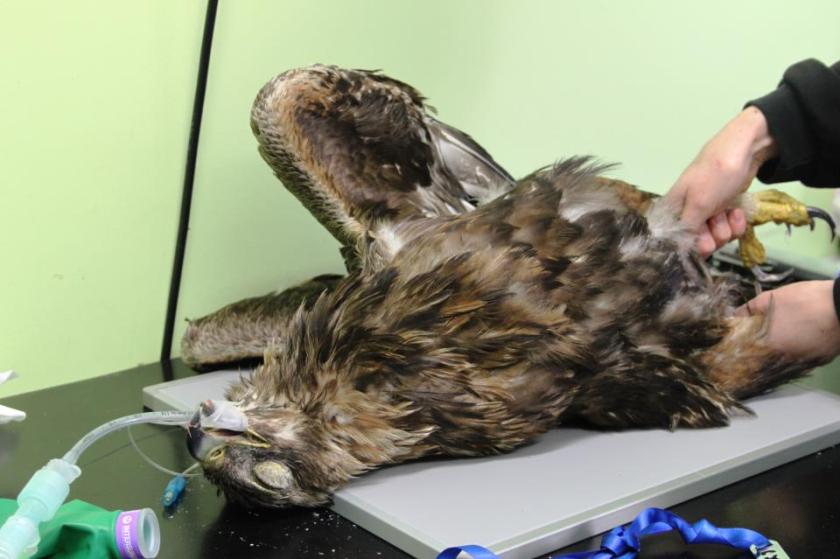
The golden eagle that was found shot and critically injured on a grouse moor last autumn has finally succumbed to its injuries. The bird apparently died last week, although as far as we can tell there’s been no publicity, which seems a bit surprising given the public interest in this incident. We understand the Environment Minister Paul Wheelhouse was informed.

This eagle was discovered ‘barely alive’ last October, on a grouse moor belonging to Buccleuch Estate, close to the boundary with Leadhills Estate (see here). Its death now completes a grisly trilogy of golden eagle killings in Scotland in 2012: one poisoned, one trapped and one shot. And these are just the ones that were discovered.

It’s highly unlikely anyone will be prosecuted for killing these eagles if past incidents are anything to go by. We’ve been keeping a list of known dead or ‘missing’ eagles and any subsequent prosecutions. At last count it was 26 eagles, 6 years, 0 prosecutions (see here).

It’s now 27 eagles, 7 years, 0 prosecutions.

If you want to express your disgust to the Environment Minister and ask him when he’s going to make good on the promise he made last year to consider further measures to bring the raptor killers to justice, please email him at: ministerforenvironment@scotland.gsi.gov.uk

The shot golden eagle ungergoing surgery

Landowners ‘blamed unfairly’ for wildfires, say, er, landowners

Scottish Land and Estates, the representative organisation of 2,500 landowners across Scotland, says landowners are being ‘blamed unfairly’ for the outbreak of wildfires that have occured across huge swathes of the Highlands this week.

According to Luke Borwick, chairman of SLE, “Some of these fires have been as a result of careless activity by recreational access takers. However, a significant number of fires have clearly been the result of irresponsible actions of other land users burning and not following the Muirburn Code“.

Amazing. The SLE statement in full here.

Meanwhile, the RSPB is deeply concerned about the effect of the fires on moorland-nesting birds, and particularly on golden eagles.

James Reynolds of the RSPB said: “It is absolutely certain that we will have lost a number of golden eagle nests. How many we don’t know but for a population that small, even the loss of one nest is serious“. Full details on BBC news here.

Marvellous. Welcome to the Year of Natural Scotland.

Environment Minister answers PQs on poisoning & vicarious liability

Claire Baker MSPClaire Baker MSP has been asking some more pertinent parliamentary questions….
Question S4W-13709: Claire Baker, Mid Scotland and Fife, Scottish Labour, Date Lodged: 14/03/2013

To ask the Scottish Government how many (a) investigations, (b) arrests and (c) convictions there have been for the offence of vicarious liability under the Wildlife and Natural Environment (Scotland) Act 2011.

Answered by Paul Wheelhouse (26/03/2013): Since the vicarious liability provisions in the Wildlife and Natural Environment (Scotland) Act 2011 came into force on 1 January 2012 there have been no arrests, prosecutions or convictions of people for vicarious liability for relevant offences. Vicarious liability is not in itself an offence, but rather a land owner or manager may be held to be vicariously liable for relevant offences as set out in Section 18, Wildlife and Countryside Act (1981). The relevant offences under the Wildlife and Countryside Act 1981 are those in:

Section 1(1), (5) or (5B)

Section 5(1) (a) or (b)

Section 15A (1)

These offences are in relation to the intentional or reckless killing, injuring of a wild bird or the damage to, or destruction of a nest or egg(s); the prohibition of certain methods of killing wild birds (e.g. by the use of traps or poisons); and the possession of certain prescribed pesticides.

Vicarious liability can be considered in relation to all relevant offences that are investigated or prosecuted. When any investigation for a relevant offence is ongoing, the possibility of an arrest or prosecution under the vicarious liability provisions will be considered.

Question S4W-13710: Claire Baker, Mid Scotland and Fife, Scottish Labour, Date Lodged: 14/03/2013

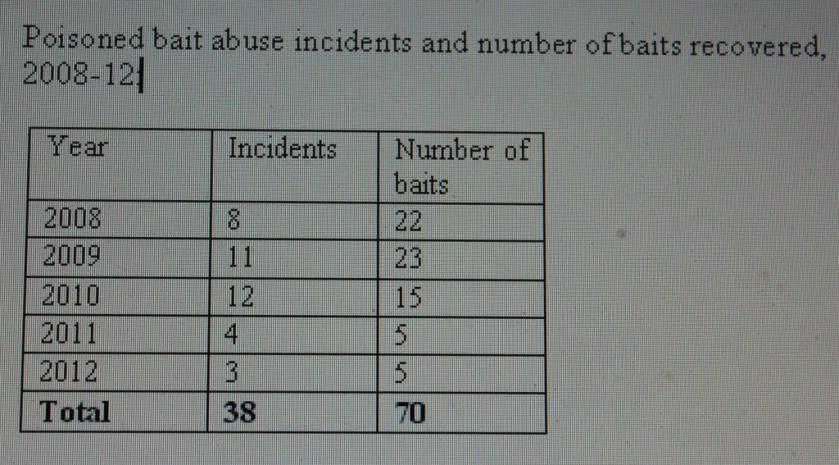
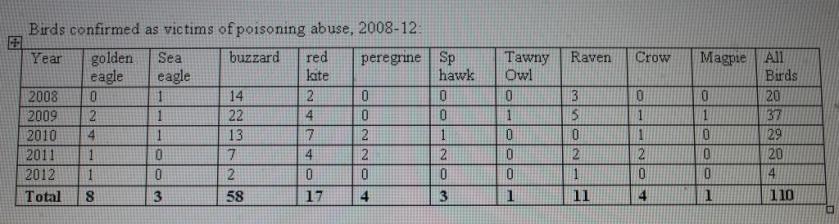
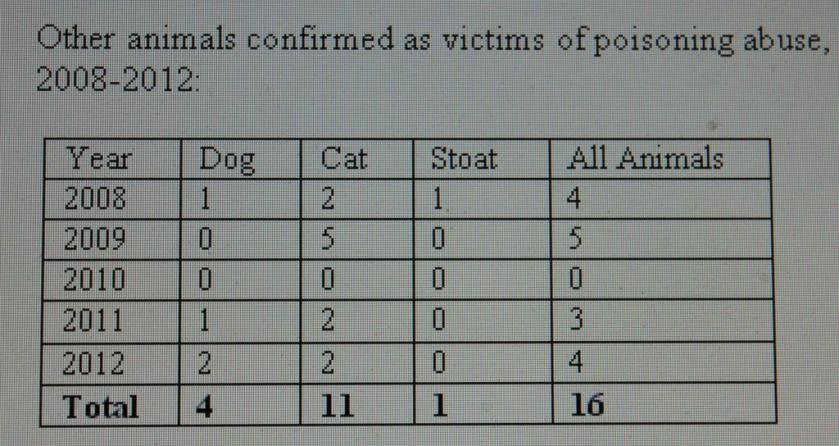
To ask the Scottish Government how many poisoned baits have been discovered and how many (a) birds and (b) other animals have been poisoned in this way since 2008, broken down by (i) year and (ii) species.

Answered by Paul Wheelhouse (27/03/2013): The available information on poisoned baits and the poisoning of birds and other animals is shown in the following table.

Science and Advice for Scottish Agriculture, collate and publish data on animal poisonings information on a quarterly and annual basis on their website.

RPS_poisoned birds 2008-12

RPS_other poisoned animals 2008-12

RPS_poison incidents & baits 2008-2012

We’re still waiting for the Environment Minister to issue a statement on his intended course of action following the reports of two buzzards, shot and killed in two separate incidents before Easter…..