
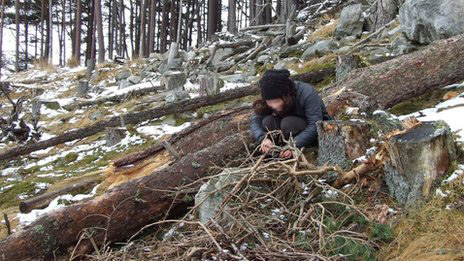
Police investigate alleged destruction of sea eagle nest on Scottish grouse moor

_68160602_tree1bc

This is just jaw-droppingly shocking.

Police Scotland are investigating the alleged destruction of a white-tailed eagle nest on Invermark Estate in the Angus Glens, according to the BBC.

RSPB Scotland claim that the nest was the first sea eagle breeding attempt in East Scotland in over a century, following the reintroduction of the species to this region over the last six years. Apparently the nest had been built up since November 2012 and the nest cup was already lined and thus primed for use. The RSPB claim they warned Invermark Estate about the presence of the nest; the BBC reports the nest tree was felled in January this year.

Here is the RSPB’s statement:

Over several months our staff had been monitoring this pair of white-tailed eagles from the East of Scotland release scheme in collaboration with local landowners. We confirm that a nest had been built, but the tree was felled. When this incident came to light, we notified the police immediately and shared all our intelligence, since all nests of white-tailed eagles are fully protected. If anyone can provide further information on this deplorable incident, they should contact Police Scotland as soon as possible. This is a current police investigation.

This is the first nesting attempt by white-tailed eagles in the east of Scotland for over a century, and is the start of what we hope will become a thriving population of white-tailed eagles in this former part of their natural range. In East Scotland, there has been a 6 year reintroduction programme since 2007 between RSPB Scotland, Scottish Natural Heritage, Forestry Commission Scotland, and the Norwegian authorities, who have helped with supply of donor birds. In east Scotland, this project has captured widespread public imagination and support, and is involving many local stakeholders. It is desperately disappointing and frustrating that what should have been a cause for celebration for all those interested in our wildlife appears instead to have become yet another statistic in the long list of crimes against Scotland’s birds of prey”.

Invermark Estate, situated at the top of Glen Esk, strongly refutes the allegations. Here is their official statement:

We take our wildlife management responsibilities very seriously and are proud of our record in this area. We have also had an excellent relationship with all relevant wildlife organisations, especially RSPB with whom we often work in partnership. The estate has also been an enthusiastic supporter of the Partnership for Action Against Wildlife Crime. We have many species on the estate including golden eagles, ospreys – as well as the sea eagles in question which are thriving on the estate. We have long been happy with the presence of all these species. Any suggestion that the estate or its employees – who are highly trained and implement extensive conservation programmes – would jeopardise or disrupt species that have made this estate their home, is disputed in the strongest possible terms”.

Invermark is part of the Dalhousie Estates. We think that Dalhousie Estates is a member of the landowners’ organisation, Scottish Land & Estates. At least it was in 2010 as the owner, Lord Dalhousie, signed the now infamous landowners’ letter to then Environment Minister Roseanna Cunningham, condemning illegal raptor persecution (see here).

Here is the official statement in response to the tree-felling allegations from Scottish Land & Estates:

Invermark Estate has an exemplary record in wildlife conservation and protection. At this stage the facts have yet to be established. There is a worrying trend in these matters that certain people take the irresponsible view that accusations can be made anonymously through the media, in the middle of police investigations, with the objective of hoping that mud sticks and an estate can be portrayed as being guilty until proven innocent. What we do know in this case is that the sea eagles are alive and well and remain on the estate where they are welcome along with many other great examples of Scottish wildlife”.

The allegations being made are astonishing. If proven, this would be the most extraordinarily brazen display of raptor persecution in Scotland in a long time. We’re used to hearing the now all-too familiar reports of the clandestine use of poison against birds of prey on some sporting estates in Scotland – a secretive & illegal practice that is easy to hide and easy to deny if challenged. But felling a tree that contains a massive nest structure, built by a large and highly conspicuous raptor that is afforded the highest possible level of legal protection in the land? That would be some display of arrogance, wouldn’t it? Unlike poisoning, you couldn’t really hide what you’d done, and the chance of there being before/after photographic evidence to prove the existence of such an historic nest would surely be quite high, especially if you knew the nest was being monitored. You’d probably only fell the tree if (a) you thought there was a very good chance you could get away with it, or (b) even if you were caught you couldn’t give a toss as you know you’d probably just get a fine of a few hundred quid, or maybe even a community service order.

Five months on and the police investigation ‘continues’, whatever that means. Draw your own conclusions. And why, yet again, have Police Scotland not mentioned this inquiry? Why are we having to rely on tip-offs given to the media to learn about these alleged crimes? (Well done BBC journalist David Miller, by the way). It’s not as though the public aren’t even interested in the East Scotland sea eagle reintroduction project for god’s sake – there has been huge public interest in the project, ever since it began in 2007, and the first nest is a long-awaited symbolic and historic event. Is it in the public interest to keep under wraps the allegation that the nest has been illegally destroyed? No, it isn’t, but it sure as hell is in the game shooting industry’s interest. Just how much influence do they have over police operations?

This alleged incident is, we think, a game-changer. In many ways, the first East Scotland sea eagle nest is a symbolic and historic event, just not in the way we had imagined it would be. According to the BBC article, Environment Minister Paul Wheelhouse has given his strongest indication yet that the introduction of new measures to tackle illegal raptor persecution is imminent. To be brutally frank, he’s going to find himself at the centre of a fucking shit-storm if he doesn’t. Sorry about the bad language but, seriously, if that’s what concerns you most about this blog entry then you really shouldn’t be here.

Please consider emailing the Environment Minister to let him know what you think about the latest allegations and to ask him when, exactly, might we see these new measures he keeps promising? Email to: ministerforenvironment@scotland.gsi.gov.uk

BBC article here.

UPDATE 21.00hrs: An article in the Scotsman (here) provides a further statement from Paul Wheelhouse:

This incident is under police investigation and I am therefore unable to comment in detail, but if reports are correct this is a shocking and brutal way to end the nesting attempts of a pair of young sea eagles. I know the Scottish public will be similarly shocked by such reports particularly as this was the first attempt by the species to nest in the east of Scotland for 100 years.

I have been clear that if we are faced with continuing incidents involving raptor persecution, whether that is poisoning, or shooting, trapping or nest destruction I would take action.

I have been made aware of this incident and others, and so have been working with officials to develop further measures which will target those who continue to flout the law and I will announce further details shortly“.

UPDATE 23.30hrs: For a limited period, watch David Miller’s tv report on Reporting Scotland here (BBC iPlayer, 11.40 mins in).
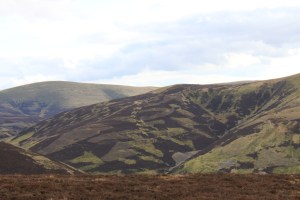
Significant haul of poisoned baits found on Leadhills Estate

leadhills estateA significant haul of pre-prepared poisoned meat baits has been found on Leadhills Estate, South Lanarkshire. And when we say significant, that’s what we mean. We’re not talking about one or two baits here; we’re talking a considerable number that, if used, would have been part of a comprehensive poisoning campaign.
The poisoned baits were discovered on 8th March 2013. Yes, that’s right, over three months ago. We’ve waited patiently for Police Scotland or NWCU or PAW Scotland to issue a press release about this, but, true to form, they’ve remained silent. During this period they even launched the 2012 poisoning maps, making much of what they called a ‘sharp fall’ in the number of poisoning incidents, even though they were well aware of what had just been uncovered at Leadhills Estate.

Because this is an on-going police investigation there is only limited detail that we’re prepared to publish at this stage. However, in due course, the full story will emerge. It’s worth keeping an eye on a forthcoming website (http://projectraptor.org.uk/) where photographs and film footage will probably appear.

This incident raises many of the usual concerns. Firstly, why has it been kept covered up? Why didn’t Police Scotland (“Keeping People Safe,” according to their website) issue a public safety warning about the discovery of these highly toxic poisoned meat baits that have the potential to kill anyone coming into contact with them? Many people, not just local residents but tourists too, visit the moors around Leadhills for recreational pursuits. Why were they not informed about the risks? That’s not ‘Keeping People Safe’ by any stretch of imagination.

Secondly, why are Police Scotland still making the same fundamental errors that they were making ten years ago in investigations of this type? They sent two marked police vehicles to collect the evidence – thus alerting the would-be poisoners that their stash had been discovered and allowing them an opportunity to hide any other incriminating evidence. This is basic stuff! Did they conduct a search of the surrounding moorland to see if any baits had already been placed? You probably can guess the answer to that.

Why didn’t they attend the scene covertly and install hidden cameras at the site where the poisoned baits were discovered? We all know that without evidence linking a specific person to the baits, a conviction would be virtually impossible to secure. So why not use cameras to film the person(s) coming to the poison storage site and either picking up the baits or replenishing the stash with new baits?

Nobody will be surprised to learn that Leadhills Estate is once again at the centre of another wildlife crime investigation; the latest in a long list dating back at least a decade. The following incidents are known, confirmed persecution incidents (data from RSPB Scotland & Scottish Government) from 2003-2011 (2012 & 2013 data not yet published). This list does not include ‘probable’ or ‘possible’ incidents such as the discovery of buried decomposing carcasses too decayed for analysis:

2003 April: hen harrier shot

2003 April: hen harrier eggs destroyed

2004 May: buzzard shot

2004 May: short-eared owl shot

2004 June: buzzard poisoned (Carbofuran)

2004 June: 4 x poisoned rabbit baits (Carbofuran)

2004 June: crow poisoned (Carbofuran)

2004 July: poisoned rabbit bait (Carbofuran)

2004 July: poisoned rabbit bait (Carbofuran)

2005 February: poisoned rabbit bait (Carbofuran)

2005 April: poisoned buzzard (Carbofuran)

2005 June: poisoned rabbit bait (Carbofuran)

2005 June: poisoned rabbit bait (Carbofuran)

2006 February: poisoned buzzard (Carbofuran)

2006 March: poisoned buzzard (Carbofuran)

2006 March: poisoned pigeon bait (Carbofuran)

2006 April: dead buzzard (persecution method unknown)

2006 May: poisoned rabbit bait (Carbofuran)

2006 May: poisoned rabbit bait (Carbofuran)

2006 May: poisoned egg baits (Carbofuran)

2006 June: poisoned buzzard (Carbofuran)

2006 June: poisoned raven (Carbofuran)

2006 June: 6 x poisoned rabbit baits (Carbofuran)

2006 June: poisoned egg bait (Carbofuran)

2006 September: 5 x poisoned buzzards (Carbofuran)

2006 September: poisoned rabbit bait (Carbofuran)

2006 September: poisoned rabbit bait (Carbofuran)

2007 March: poisoned buzzard (Carbofuran)

2007 April: poisoned red kite (Carbofuran)

2007 May: poisoned buzzard (Carbofuran)

2008 October: poisoned buzzard (Carbofuran) [listed as ‘Nr Leadhills’]

2008 October: poisoned rabbit bait (Carbofuran) [listed as ‘Nr Leadhills’]

2008 November: 3 x poisoned ravens (Carbofuran) [listed as ‘Nr Leadhills’]

2009 March: poisoned rabbit bait (Carbofuran)

2009 March: poisoned raven (Carbofuran)

2009 April: poisoned rabbit bait (Carbofuran)

2009 April: poisoned magpie (Carbofuran)

2009 April: poisoned raven (Carbofuran)

2010 October: short-eared owl shot

2011 March: illegally-set clam trap

2011 December: buzzard shot

2012 October: golden eagle shot (just over boundary with Buccleuch Estate)

The evidence is clear. Poisoning is taking place with virtually total impunity (some would say immunity) on this estate. As far as we can tell, there has only been one successful prosecution for poisoning – a gamekeeper convicted in 2010 for laying out a poisoned rabbit bait (see here).

So why is it that the poisoners, whoever they may be, can keep getting away with it?

Is Leadhills Estate (part of the Hopetoun Estates) a member of the landowners’ organisation, Scottish Land & Estates (SLE)? The Chairman of Hopetoun Estates, the Earl of Hopetoun, is a Director of SLE. If Leadhills Estate is a member, then all of SLE’s talk about condemning illegal raptor persecution and stamping it out is utter hypocrisy. The question of whether Leadhills Estate is an SLE member is one that needs to be raised by the members of the Partnership for Action Against Wildlife Crime (Scotland). SLE plays a prominent role in PAW Scotland and earns considerable kudos for that role (kudos that the organisation is not afraid to use for PR purposes). It is now high time that SLE is asked to provide some transparency about its relationship with Leadhills Estate.

We’d also like to ask Environment Minister Paul Wheelhouse what action he intends to take in light of the latest discovery of poisoned baits at Leadhills Estate? He may well try and dodge the question by saying ‘It’s an on-going police investigation so I can’t comment’. But we’re not asking him to comment on the actual investigation – what we’re asking is whether he’ll keep his earlier promises about introducing new measures to combat raptor persecution if evidence comes to light to demonstrate it is still a problem. Well Paul, here’s your filthy evidence. Now what are you going to do about it? Emails to: ministerforenvironment@scotland.gsi.gov.uk

UPDATE 18.45hrs: BBC journalist David Miller has just posted an article on this incident on the BBC News website (great to see another high profile journalist willing to discuss illegal raptor persecution). You can read his article here.

The article contains the following hilarious quotes:

From Police Scotland: “Police officers, including a wildlife crime liaison officer, were dispatched to the area the same day and following an extensive search, items were found and seized. A number of people were detained by police in connection with this inquiry, which is currently ongoing“.

Hmm, an ‘extensive search’, eh? That’s not what we’d heard!

From Scottish Land and Estates: “It would be inappropriate to comment while the facts of the matter have still to be established. As an organisation, we are actively involved in the Partnership for Action Against Wildlife Crime and our membership undertakes an enormous amount of positive work in this area“.

Er, the facts of the matter have been established. A significant haul of pre-prepared meat baits were found stashed on this estate and government scientists have confirmed the presence of Carbofuran.

Wouldn’t it be ‘inappropriate’ for SLE to remain in the government-led PAW Scotland group, and in the government-led Scottish Raptor Persecution Priority Delivery Group, if it was found that Leadhills Estate was a member of their organisation? Come on PAW Scotland members and SRPPDG members, ask them the bloody question!

From Scottish Gamekeepers’ Association: “Because this appears to be subject of a live investigation, it would not be appropriate to comment other than to reiterate that the Scottish Gamekeepers’ Association does not condone illegal poisoning“.

Perhaps they’ll consider conducting their own investigation again, just as they did with the Deeside eagle case, and let us know what really happened….my money’s on the real culprits being either badgers, buzzards, sparrowhawks, pine martens or goshawks.


Buzzard licence absurdity attracting mainstream media attention

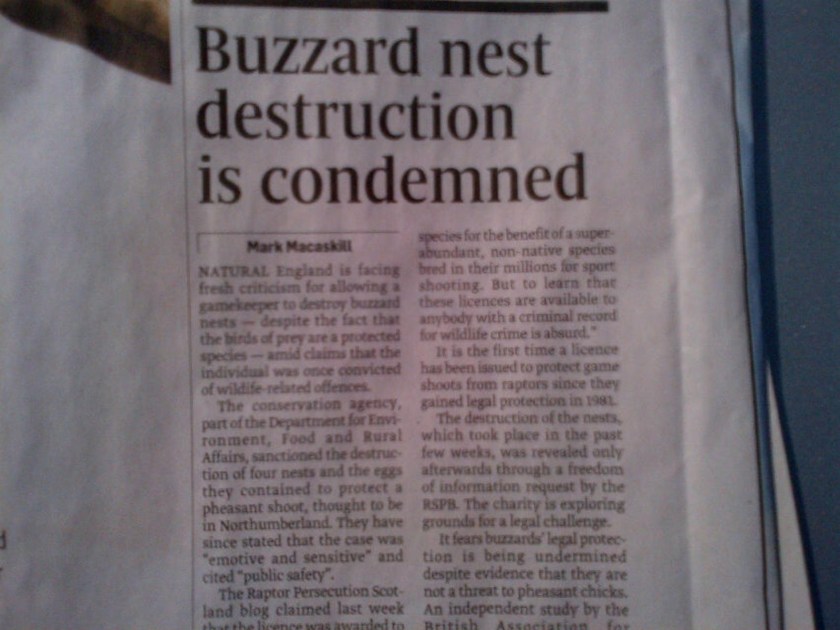
A few of our regular blog followers have previously commented about the apparent lack of interest in illegal raptor persecution by many mainstream journalists. Well here’s one (of several) bucking the trend – Mark Macaskill from the Sunday Times (Scotland), who has, over the years, written quite a few articles on the subject, including this one published today on the absurdity of Natural England seeing nothing wrong in the government’s policy of issuing licences for controlling protected species to people who might previously have been convicted of wildlife crime.

Sunday Times buzzard licence

Surely the buzzard licence applicant doesn’t have prior convictions for poison offences?

poisonLast week we mentioned that further information had emerged about the licences to control buzzards recently issued by Natural England. We said we were seeking legal advice about what information we could and couldn’t publish. That legal consultation has resulted in a decision to publish the following information.
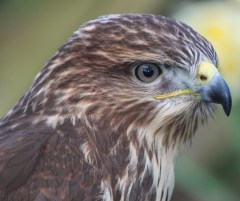
We discovered the name of the buzzard licence applicant last week. Interestingly, someone with the same name, from the same region, and working in the same industry (gamekeeping) was previously convicted for offences relating to banned poisons. It must be just another one of those freak coincidences that seem to pop up with unequal probablity within the world of gamekeeping.

According to legal advice we are at liberty to publish the name of the licence applicant under certain conditions. However, we have chosen not to identify him or to publish any detail that might lead to his subsequent identification. His identity is not important here; there is a wider issue of concern and revealing his identity would not add anything of importance to the debate. Besides, in the context of his licence application he hasn’t done anything illegal; it is not an offence to apply for a licence to control protected species.

So, his identity doesn’t interest us. What does interest us a great deal is a government policy that might enable someone with recent and relevant criminal convictions to be considered as a suitable recipient for a licence to control a protected species.

Natural England’s species licensing role is governed and authorised by DEFRA policy. Within DEFRA’s species licensing policy statement are a number of criteria that should be met by the licensing agency (in this case, Natural England) when assessing a licence application. One of them is that ‘the suitability of the applicant to carry out licensed activities’ must be assessed. That this criterion even exists indicates that DEFRA recognises that unsuitable candidates may apply for a licence and they provide an option (to the licensing agency) for refusing a licence on that basis.

So, just how is ‘the suitability of an applicant’ assessed? It seems to be a subjective test as we couldn’t find any guidelines on the subject. Would someone with recent and relevant convictions be considered a ‘suitable applicant’? What would be the justification for that?

Natural England has already confirmed that relevant past convictions are assessed during the licensing process. Last week, many of you (thank you!) wrote to Natural England to ask for clarification about whether the buzzard licence applicant had an un-spent work-related conviction at the time of his application. On Monday (June 3rd), Natural England responded by issuing a refusal notice, saying they weren’t prepared to divulge that information. In that refusal notice is the following statement:

You may find it helpful to know that it is part of Natural England’s standard procedures to ask all licence applicants for information on relevant past convictions. This information is taken into consideration in the assessment of the application. For example, this may lead to a more in-depth assessment of the application or additional monitoring of licensed actions. However the fact that a person has a previous wildlife related conviction (whether spent or not) does not automatically bar them for obtaining a licence and each licence application is judged on its merits”.

So, did Natural England consider relevant past convictions when assessing this licence application? They certainly mention previous convictions in their Technical Assessment of Application report (see the FoI documents), although the detail of those convictions has been redacted. However, there is no mention anywhere else in this assessment report about an assessment of those convictions or their relevance to this particular licence application, so either Natural England didn’t formally assess them, or they did and just redacted their assessment. There’s so much blacked out text throughout the whole document that it’s impossible to tell.

An interesting aspect in all this is the considerable weight that Natural England placed on the evidence (of supposed raptor predation of poults) provided by the applicant. Indeed, Natural England wrote the following in their technical assessment report:

Conclusions & Justification [of the application]: The quantity and quality of information and evidence provided for this case by the applicant appears to be thorough, systematic and accurate for this type of case”.

Put yourself in the shoes of a Natural England employee charged with assessing licensing applications to control protected species. Would you consider the evidence of a recently convicted criminal as being trustworthy and reliable?

One final point, and equally as interesting. The National Gamekeepers Organisation has repeatedly and publicly stated that illegal gamekeeping activity will not be tolerated within their organisation. We know from the FoI documents that the buzzard licence applicant is a member of the NGO. Last week we (and many of you, thank you) asked them to answer the following question:

Bearing in mind the NGO’s published Disciplinary Procedure, did this gamekeeper [i.e. the buzzard licence applicant] have an un-spent work-related conviction at the time of his application and has he ever been suspended or expelled as a member of the National Gamekeepers Organisation?”

They still haven’t answered.

Buzzard euthanised after caught in illegal leg-hold trap

More than nine weeks ago, a buzzard was caught in an illegal leg-hold trap. According to local sources this happened on land part-managed for gamebird shooting in central Scotland. The buzzard’s injuries were such that it had to be euthanised.

Police Scotland have still not informed the public about this incident. Why not?

It happened in March, before the Easter Bank Holiday. They’ve had almost ten weeks to inform the public. In whose interest is it to keep this incident a dirty little secret?

We’ve blogged about this a million times before. They don’t have to give away details that might compromise an investigation – all they need to say is that an illegally trapped buzzard has been discovered, it didn’t survive its injuries, and a police investigation is underway. It’s really that simple. Here’s a recent example:

Police Wildlife Crime Officers in Devon & Cornwall Police blogged on 27th May 2013 that two dead buzzards, found in suspicious circumstances, had been reported to them that day. A couple of days later they provided an update to say the birds had been retrieved and had been sent off for toxicology analysis.

Here’s another example:

On 22nd May 2013, Gwent Police appealed for information after a shot peregrine falcon had to be euthanised. The shooting had been reported to the police only two days previously, on 20th May 2013 (see here).

Here’s another example:

On 6th April 2013, Norfolk Constabulary issued a press statement to say that a man had been arrested on suspicion of a number of wildlife crime offences after the discovery of over a dozen dead birds of prey. He had been arrested just two days earlier on 4th April 2013 (see here). [Incidentally, this man’s bail expired on 22nd May and we’re waiting to hear the latest development in this case].

So you see it’s quite possible for police forces to release information in a timely manner when they want to. It’s not as though the public aren’t interested in buzzard conservation in Scotland – a recent petition urging the Scottish Government not to licence a buzzard cull has now reached over 20,000 signatures in about a week (see here and please sign it if you haven’t already done so).

 We’ll repeat the question posed earlier: in whose interest is it for Police Scotland to remain silent about this illegally-trapped buzzard?

Buzzard licensing: turning up the heat

buzzard 3Last Thursday we blogged about the buzzard licensing scandal and how new information had come to light (see here). We are still in the middle of taking legal advice on what information we can and can’t release.
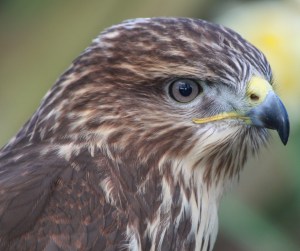
We also posed two questions; one to Natural England and one to the National Gamekeepers Organisation:

Question to the National Gamekeepers Organisation: “Bearing in mind the NGO’s published Disciplinary Procedure (see here), did this gamekeeper have an un-spent work-related conviction at the time of his application and has he ever been suspended or expelled as a member of the National Gamekeepers Organisation?”

So far, the NGO has refused to answer.

Question to Natural England: “Did this gamekeeper have an un-spent work-related conviction at the time of his application?”

Today, Natural England has issued a refusal notice, i.e. they are refusing to confirm or deny that they hold any details about convictions on the licence application.

Here is a copy of that refusal notice: 2018_response_RD_tcm6-36002

Natural England claim that the information we have asked for falls into the ‘personal information’ category as defined under the Data Protection Act 2000. As such, they consider it would be ‘unfair’ to disclose the information requested.

We disagree with them. If this individual did have a wildlife crime conviction at the time of his application, then details of that conviction would be a matter of public record, therefore it wouldn’t qualify as protected personal information.

The information we asked for was not, ‘What was the applicant’s conviction?’, it was ‘Did he have a conviction?‘ Natural England could have answered our question with a simple ‘Yes’ or ‘No’. By doing so, the disclosure of the information would not breach the individual’s privacy as the information could not be used to identify him. The question is not so much about the gamekeeper per se, but it is central to questions about Natural England’s policy on licence applications to destroy protected species and/or their nests and eggs. We believe that scrutiny of their policy is very much in the public interest.

As Natural England has issued a refusal notice, we intend to challenge it by asking for a review. We would encourage blog readers to also challenge it. If you’re not sure how to phrase it, you could always just cut and paste the following:

To: foi@naturalengland.org.uk

Dear Natural England,

Thank you for your refusal notice to prevent disclosure of whether the buzzard licence applicant had an un-spent work-related conviction at the time of his application.

I would like to request a review of your decision.

I don’t believe that the disclosure of the information I have requested meets the criteria as defined in the Data Protection Act, because a simple ‘Yes’ or ‘No’ answer would suffice. A ‘Yes’ or ‘No’ answer would not compromise the privacy (hidden identity) of the buzzard licence applicant, but it would inform a wider debate on the policy used by Natural England to issue licences to destroy protected species and/or their nests and eggs. This is clearly in the pubic interest.

I look forward to hearing from you.

And if you’re in an email-writing mood, let’s keep up the pressure on the National Gamekeepers Organisation to answer this very simple question:

To: info@nationalgamekeepers.org.uk

Dear Lindsay Waddell,

Bearing in mind the NGO’s published Disciplinary Procedure, did this gamekeeper have an un-spent work-related conviction at the time of his application and has he ever been suspended or expelled as a member of the National Gamekeepers Organisation?

Two important questions to ask about the buzzard licence applicant

buzzard 3It would appear there’s more to Buzzardgate #2 than first meets the eye.
Apart from the scandalous decision by Natural England (acting on behalf of DEFRA) to issue a licence to a gamekeeper to destroy the nests and eggs of a native species (buzzard) to protect a non-native species bred for sport shooting (pheasant) (see here for previous blog entry on this), further information has come to light.

At this stage we are unwilling to publish the information or reveal how the information can be found. We are seeking legal advice and will come back to the subject if we’re able once the legalities have been clarified.

In the meantime, we would like to ask two important questions, one of Natural England (who worked with this gamekeeper over a period of years and subsequently issued his licence), and one of the National Gamekeepers Organisation (who submitted the licence application on behalf of one of their members). We would encourage blog readers to also ask these questions as we believe they are of public interest:

1. To Janette Ward (janette.ward@naturalengland.org.uk), Director of Regulation at Natural England, who endorsed the issue of this licence:

Question: Did this gamekeeper have an un-spent work-related conviction at the time of his application?

2. To Lindsay Waddell (info@nationalgamekeepers.org.uk), Chairman of the National Gamekeepers Organisation:

Question: Bearing in mind the NGO’s published Disciplinary Procedure (see here), did this gamekeeper have an un-spent work-related conviction at the time of his application and has he ever been suspended or expelled as a member of the National Gamekeepers Organisation?

Hen harrier persecution highlighted at international art show

The plight of the UK’s hen harrier population is being brought to the attention of a whole new audience, thanks to the work of Turner Prize-winning artist, Jeremy Deller.

Deller is presenting his work in the British Pavillion for the 55th ‘Venice Biennale’, described as the art world’s most important international event.

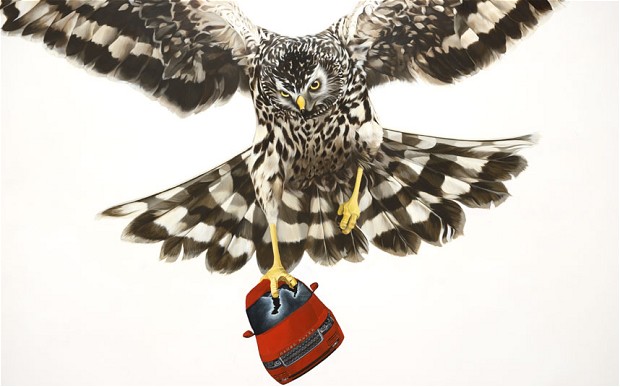
His opening piece, entitled ‘A Good Day for Cyclists’, depicts a giant hen harrier clutching a blood-red Range Rover. Deller says his piece was inspired by the alleged illegal shooting of two hen harriers on the Queen’s Sandringham Estate in 2007 – an incident for which Prince Harry was subjected to police questioning but no charges were ever brought against anybody. 

The inclusion of the Range Rover seems to serve two purposes – watch this interview with Deller here to understand his motivations. There’s also an interesting piece in the Telegraph here.

deller3_2575036b

New petition: SNH, do not licence buzzard culling in Scotland

buzzard 3Following on from the frankly outrageous situation south of the border, where it has been revealed that the UK government’s conservation agency (Natural England) has secretly issued licences, without supporting scientific evidence, to destroy native buzzards’ nests & eggs to protect superabundant foreign gamebirds reared for sport-shooting (see here), a new petition has started in Scotland to let the Scottish government’s conservation agency (Scottish Natural Heritage) know that such a move won’t be tolerated in this country.

Gamekeepers and landowners in Scotland have been lobbying the Scottish government for these licences for at least ten years. For example here is a news report from 2003. We have blogged extensively about the continuous efforts of these organisations who are seemingly hell-bent on continuing the Victorian tradition of killing predators; so far their efforts have been thwarted but for how much longer?

In January this year we blogged about a new scientific paper that discussed how buzzards are only a minor source of pheasant mortality – road traffic, for example, is far more important (see here). We also highlighted in that blog how SGA Chairman Alex Hogg admitted losing 500 pheasant poults to hypothermia last year – perhaps an infestation of buzzards blocked out the sun and caused the low temperatures that killed those young birds.

In March this year we blogged about how Environment Minister Paul Wheelhouse had recently told the SGA that licences to cull raptors would not be issued for the forseeable future due to the on-going incidents of criminal raptor persecution (see here). Since then, there have been a number of persecution incidents – some publicised by the police, some not. There’s one particularly relevant incident that happened before Easter, where, according to local sources, a buzzard was caught in what has been described as an illegal gin trap. It didn’t survive. Why haven’t Police Scotland publicised this incident? In whose interests is it to keep this crime a secret?

It’s a pretty sad state of affairs that this issue is still at the top of the agenda, in this, the so-called Year of Natural Scotland.

Please sign the petition here

You might also want to email Environment Minister Paul Wheelhouse to let him know your views on the issue of buzzard licensing in Scotland and ask him whether he’s aware of the buzzard that was caught in an illegal trap in Scotland more than eight weeks ago:  ministerforenvironment@scotland.gsi.gov.uk

Natural England issues licence to destroy buzzard eggs & nests to protect pheasants

buzzard 3An article in The Guardian has revealed that the UK’s nature conservation agency, Natural England, has licensed the secret destruction of buzzard eggs and nests to protect a pheasant shoot.

This destruction, which took place in the last few weeks, was only revealed after a Freedom of Information request was made by the RSPB. According to the article, the National Gamekeepers Organisation was ‘closely involved in winning the licences and had threatened Natural England with judicial review if they were not granted’.

Given that the buzzard (and other raptors) are native species with supposed full legal protection, the RSPB is considering its legal options.

The location of the pheasant shoot has not (yet) been revealed, as Natural England stated the case was “emotive and sensitive” and cited “public safety”. Interestingly, this is the same argument the Scottish Government recently tried to use to hide the identities of seal-shooting salmon farms in Scotland. That decision was over-ruled last month by the Scottish Freedom of Information watchdog and the Scottish Government was forced to name the locations (see here).

Article in The Guardian here.

If you want to let DEFRA Minister Richard Benyon know how you feel about this disgusting precedent, email him at: richard.benyon.mp@parliament.uk

The RSPB’s Conservation Director, Martin Harper, has posted all the FoI documents on his blog here.

UPDATE 13.00hrs: Natural England has released what it calls a ‘mythbuster’ about this controversial licence here. The header is ‘Full details of buzzard nest control licence’, only it isn’t the ‘full details’ – the majority of the data have been redacted, which means we can’t assess the scientific evidence used by NE to approve this licence. Where’s the transparency?

If you want to email Natural England and tell them what you think about their decision to licence buzzard control, contact them at: wildlife@naturalengland.org.uk

UPDATE 16.00hrs: An interesting update from the RSPB’s Martin Harper on DEFRA’s deceit here

UPDATE 18.30hrs: An excellent analysis of Natural England’s decision, written by blogger Alan Tilmouth here

UPDATE 22.00hrs: Further evidence, should you need it, that the UK’s government agency for nature conservation is sitting comfortably in the hands of the game-shooting industry – this is absolutely shocking – read it here.