
Following yesterday’s conviction and sentencing of Head Gamekeeper Racster Dingwall, 35, for conspiracy to kill a Hen Harrier on a grouse moor on the Conistone & Grassington Estate in the Yorkshire Dales National Park on 2nd October 2024, here is my commentary of the morning’s proceedings at York Magistrates’ Court.
These are comments based on notes I made during the hearing. They should not be considered a formal court record, but rather my interpretation of what happened. They are provided here to help blog readers understand how the sentence was determined.
This was supposed to be a two-day trial, after Dingwall pleaded not guilty to two charges at an earlier hearing at Skipton Magistrates’ Court in May 2025 (see here). Those two charges were:
- Possession of an article capable of being used to commit a summary offence under Section 1 to 13 or 15 to 17 of the Wildlife & Countryside Act;
- Encourage/assist in the commission of a summary offence believing it will be committed.
At a pre-trial hearing at York Magistrates’ Court in September 2025 in front of District Judge Adrian Lower, Dingwall’s barrister, the very experienced Justin Rouse KC, attempted to have the case thrown out on a technicality, arguing that the RSPB’s covert footage should not be admissible. Mr Rouse KC had been successful with this line of argument in another case against another grouse moor gamekeeper in 2017/2018 (the Bleasdale Estate case – see here).
However, in the current case Mr Rouse KC was unsuccessful and District Judge Lower ruled the Grassington footage lawful and thus admissible (here), and a two-day trial was set for 29-30 January 2026.
It became clear a few days ago that Dingwall was probably now going to change his plea to ‘guilty’ when the case was formerly listed in court documents as a ‘sentencing’ hearing. The same document listed three JPs as the presiding magistrates. However, District Judge Lower turned up in the court yesterday and sat as a single judge for this hearing.
Mr Rouse KC was not present this time, and Dingwall was represented by Tim Ryan of Warners Solicitors in Kent. Mr Ryan is another highly experienced lawyer, having represented gamekeepers in court for many years and he also provides briefing notes for the National Gamekeepers Organisation. He knows what he’s doing.
For the prosecution was Jody Beaumont (Crown Prosecution Service – CPS), as per the pre-trial hearing in September 2025.
The hearing kicked off with Dingwall being asked to provide his date of birth and address, and then his plea to the two charges (‘guilty’).
The CPS then provided District Judge Lower with a background summary of the case. He told the court that between March and September 2024, the RSPB were working on intelligence that potential offences were being committed on the Conistone & Grassington Estate. They identified a location and installed a covert camera, set to record between 1st – 19th October 2024.
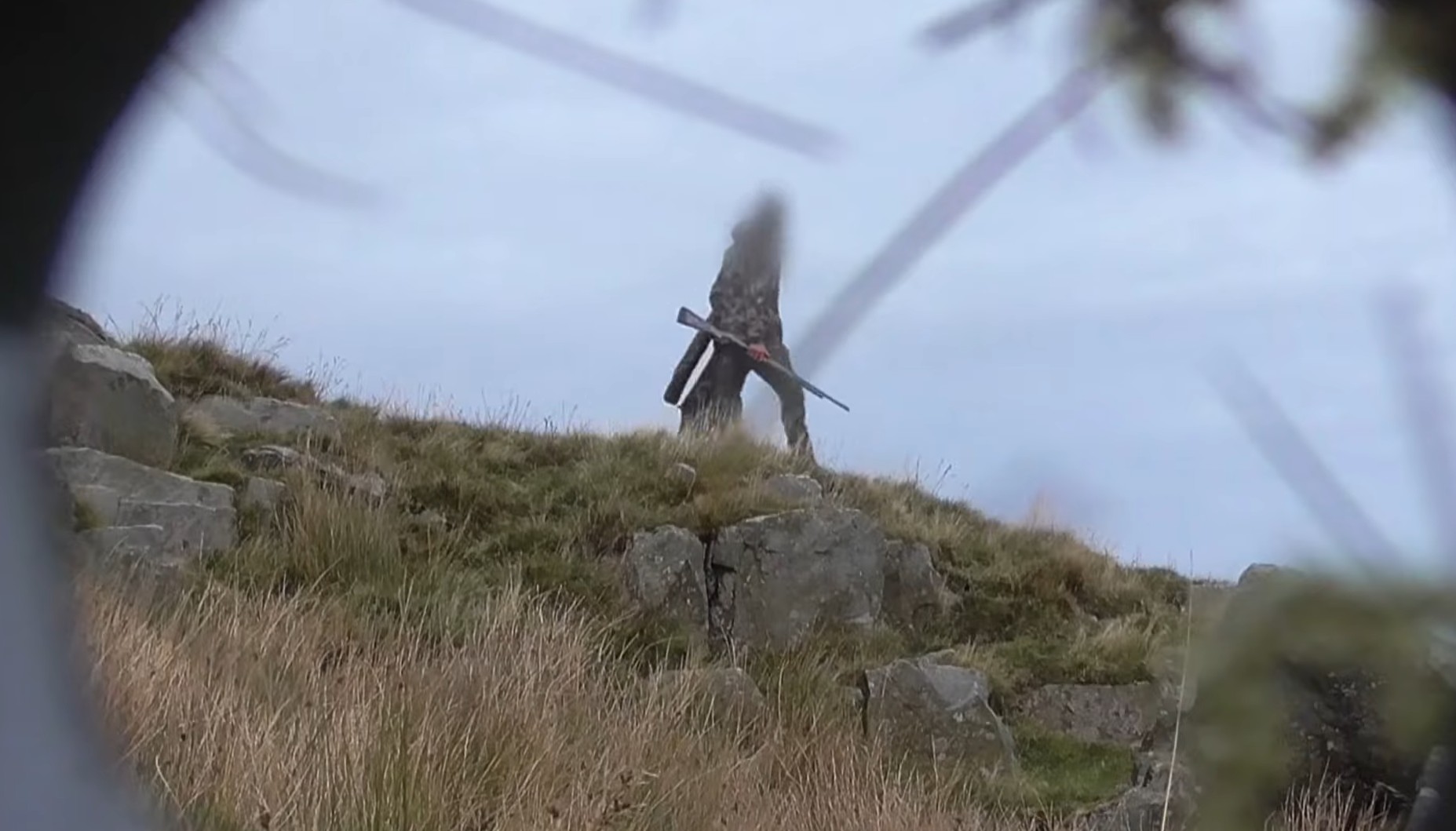
When the camera was later retrieved, the footage and audio showed the offences were recorded on 2nd October 2024. The footage showed Dingwall [and two others], dressed in camouflage carrying a semi-automatic weapon and binoculars.
The footage was passed to Channel 4 News and North Yorkshire Police in late October 2024. North Yorkshire Police interviewed Dingwall five months later (!) on 18th March 2025. [We also know that his two fellow suspects were interviewed but apparently both refused to say a word, presumably because they were concerned that voice analysis might match them with the voices recorded on the footage].
Mr Beaumont then gave some background on Dingwall. The court heard he had a prior conviction for violence in 2018 (the precise offence was not revealed) but that he had no other convictions or cautions. [For those wondering how a man with a conviction for violence was deemed suitable to hold a shotgun certificate is a question for North Yorkshire Police].
Mr Beaumont then went on to discuss sentencing guidelines, saying there weren’t any for these specific offences and suggested that the judge might use more generalised sentencing guidelines within the constraints of a magistrates’ court jurisdiction. He did not provide an impact statement or even a background summary of Hen Harrier conservation/persecution.
Mr Beaumont assessed Dingwall’s culpability as ‘high’, especially as there was an element of planning and the involvement of others was an aggravating factor, but then went on to assess the level of harm as ‘medium’ because ‘no Hen Harrier was injured or harmed as a result of Dingwall’s offending’. [Eh?? I’ll come back to this point].
District Judge Lower then said a few words in response to the prosecution’s comments. This is where things started to get really strange. He said he was putting Dingwall’s previous conviction for violence “out of my mind” because it was “dissimilar” to the current offending and “wasn’t relevant”.
He then said he had read four character references for Dingwall, provided by a Mr Gray, Mr Hewlitt, Mr “Bikey” and Mrs Sixsmith. My ears pricked up at Mr “Bikey”. I wondered whether this was Nicholas Baikie, a well known sporting agent with links to many grouse moors across the UK including the infamous Millden Estate in the Angus Glens, currently serving a three-year General Licence restriction imposed by NatureScot after multiple wildlife crime offences against birds were uncovered there.
DJ Lower said it was clear from the character references that Dingwall’s latest offending was “completely out of character“.
Then it was the turn of Tim Ryan to provide a statement of mitigation for Dingwall. Mr Ryan told the court that his client “regrets enormously” his actions, which have led to a “lost job, livelihood and reputation“. Mr Ryan claimed that Dingwall was realising that he had “no prospect of working as a gamekeeper again” and that he had “let himself down and his family“. [I don’t believe that – there are a number of examples over the years of convicted gamekeepers who have been subsequently employed on the same or on other estates – indeed some of them have even turned up at promotional events for grouse shooting held in Parliament and at least one serves on the committee of a national industry organisation].
In terms of sentencing suggestions, Mr Ryan argued that Dingwall’s guilty plea needed to be taken into account.
DJ Lower interjected at this point and said that Dingwall’s guilty plea on the opening day of the trial had been noted, and that because Dingwall had indicated his change of plea to the court prior to the trial, it had “spared the court time and spared the witnesses“, so he intended to give a “25% discount” to whatever sentence was handed down.
Mr Ryan then proposed that a Community Order would be an “appropriate starting point” for the judge to consider given the “devastating consequences on Dingwall and his family” but that a fine would be preferential because the overall effect [of a Community Order] would be “worse for his family“.
We then got to District Judge Lower’s sentencing remarks.
He repeated his comments that the court had “not had to be troubled with a trial” and that “witnesses were not called“.
He then repeated the offences to which Dingwall had pleaded guilty and launched into the most bizarre commentary about the protection of Hen Harriers. He said he understood that there was “controversy” about Hen Harrier management in terms of alleged predation on grouse. He said, “Some take the view that Hen Harriers are, to say the least, a pest, and that they have to be shot to prevent them predating Red Grouse, and this brings in to issue the management of grouse farms and those responsible for the management of farms because it’s a business, and if there aren’t any Red Grouse for others to shoot as part of a day out then there is no business“.
He continued, “Other people take the view that Hen Harriers are a protected species, and indeed they are, and should not be shot and be allowed to predate Red Grouse. I make no comment about these views”. [Eh? How on earth is this relevant?].
“What I am dealing with is on 2nd October 2024 you chose to take with you a shotgun, binoculars, audio equipment, and dress up in camouflage, in order to at least observe a Hen Harrier at a piece of land and you were in communication with others who were interested in the movements of Hen Harriers at that land, with a view to killing a Hen Harrier if it was showing any indication of preying on Red Grouse. [Er…the Harriers being targeted by Dingwall and his accomplices were coming in to an evening roost, not hunting for Red Grouse].
“That’s an offence and you should have known it was an offence and you knew full well what your responsibilities as a gamekeeper were….you may not have known all the ins and outs but you would have known something of how to respond to a Hen Harrier.
“I’ve read your character references – your behaviour is really out of character. A change in your occupation, your income – it seems rather [inaudible] for me to say, but not wrong to say, you’ll never work as a gamekeeper again as a consequence of your behaviour and this is more of a punishment than any I can impose this morning“.
There was then a brief commentary about sentencing guidelines which I didn’t catch in full so won’t try to repeat that here.
DJ Lower then spoke about culpability and agreed with the CPS’s assessment that Dingwall’s culpability was “high“, with a degree of planning with others, and that the harm caused was “medium” because, wait for it, “no Hen Harrier was shot or killed due to your behaviour“.
At this point I looked across to the packed media benches and caught the eyes of several journalists who clearly were as bemused as I was with this statement.
We’d all seen the RSPB’s footage, as shown on Channel 4 News. How anyone could watch that and believe that a Hen Harrier hadn’t been shot and killed would be beyond the comprehension of many. I’m reminded of the idiom, ‘When you hear hooves, look for horses, not zebras’.
I’ve tried to understand the rationale for DJ Lower’s statement, and struggled initially, but the following explanation is the best I came up with on my journey home from court:
Those of us who watched the footage and believed that Dingwall had shot and killed the untagged Hen Harrier based that belief on a civil burden of proof, i.e. on the balance of probability, given everything else we’d seen and heard on the RSPB’s footage, we considered it more likely than not that a Hen Harrier was shot and killed.
However, the RSPB’s footage does not meet the evidential threshold to ‘prove’, to a criminal standard of proof, i.e. beyond reasonable doubt, that a Hen Harrier was shot and killed, nor by whom, which is presumably why Dingwall was not charged with that offence.
We might not like it, and probably don’t agree with his statement, but Judge Lower had a duty to consider the criminal standard of proof in his deliberations, and not the civil burden of proof. In my opinion, though, he could/should have done a better job of explaining his statement.
If nothing else, this case provides a very good example of the high evidential threshold required to convict anyone of raptor persecution, and demonstrates why so many cases fail to result in a prosecution. Not because an offence hasn’t been committed, but because it’s really really difficult to ‘prove’ who did it.
I do think though that the footage will have opened the eyes of many members of the public about what goes on on grouse moors when gamekeepers think nobody is watching, and that awareness is crucial if we want more members of the public to start applying pressure on our political representatives to get a grip and support effective enforcement to deal with this ongoing criminality.
Anyway, back to the court room.
DJ Lower repeated his earlier comment that he was “disregarding” Dingwall’s previous conviction (for violence) because it was “dissimilar” to the current offences and “not related to killing wild birds“.
He then went through his sentencing options, musing that he had considered a custodial term “to make an example of you” and to show that “the court takes theses offences seriously” but he disregarded a custodial option because he didn’t think Dingwall would spend much time in prison.
He said he’d also considered a Community Order and what that might look like but he didn’t think it was appropriate, nor that Dingwall needed the support of the probation service.
Instead he settled on a fine, £400 for each of the two offences, plus a surcharge of £320 and prosecution costs of £400, making a total of £1,520, to be payable within 28 days. Dingwall was asked about his means to pay and he indicated that he could make the payment within the timescale.
Does this fine reflect the seriousness of Dingwall’s offending? I’d say absolutely not. I’d say it was an insult to everyone who worked so hard to bring the case to court and it’s certainly no deterrent whatsoever to anyone else thinking of killing a Hen Harrier (and there are a lot of those criminals about). The fine is just a minor inconvenience for Dingwall and once again the estate owner and/or the sporting agent goes unpunished. This really has to change.
The hearing ended with an extraordinary direction from DJ Lower. He noted how packed the court was (press, police, RSPB and general observers) and said that he didn’t think Dingwall should have to ‘meet’ any of the people who had attended the hearing so he instructed a court clerk to allow Dingwall and his solicitor to leave the court room before anyone else.
My interpretation of that direction was that Dingwall was being allowed to leave the court building by a separate entrance without having to face the wall of journalists outside. However, this message didn’t quite get through to the clerks, who ‘held’ Dingwall and Mr Ryan in a separate holding room until everyone had left the court building, and then Dingwall and Mr Ryan were escorted out to the front door of the court building, where the cameras and journalists were waiting for him.
There’s another good piece from Alex Thomson (Channel 4 News) of Dingwall’s case, here.
UPDATE 30 Jan 2026: Satellite-tagged Hen Harrier that gamekeeper Racster Dingwall chose not to shoot (to avoid unwanted attention), found poisoned three months later near another Yorkshire grouse moor (here)
 Raptor Persecution UK
Congratulations to RSPB Investigations unit for hard work and determination to shine a light yet again on those that conspire to kill wild birds of prey.This case proves yet again what we all know about the shooting industry. The sentencing judge in this case gave a lenient sentence ensuring no deterrent to others who repeat this crime often and with no come back. I dispair.
i fully understand the evidential threshold issue with regard to charging, but as sure as a character reference is relied on in court, surely all other evidence, however circumstantial, can be used at sentencing. It’s clear as day what they were discussing and had already done as well as the probable outcome for the HH, not least from the post shooting chat. I’d also be interested to know from N Yorks Police exactly why he had a previous violent conviction yet kept a shotgun licence. Very well done to the RSPB investigation team though.
One final thought, who pays for these barristers? If the estate are doing so then they have to be considered to be culpable. If I cocked up so badly at work that a crime was shown on C4 News, I’d be out on my ear immediately and left to fend for myself – unless they felt they had some responsibility
At least Channel 4 have had the guts to show this. I hope they continue to support work to advertise the fact that these crimes are happening with such regularity. I would love to see a programme entirely devoted to Raptor Persecution!
so in summary, NYP allowed a violent criminal to own a shotgun that was then used to commit a crime. If NYP had done the right thing in the first place, Dingwall wouldn’t have even been there to commit this crime. But to their credit at least they got this one over the line. Begs the question, how many other violent criminals are being licensed to own firearms, putting the public at risk?
I’m waiting for the ringing condemnation from Countryside Alliance, Moorland Association and the local MP.
As an aside his age is notable, highlights that attitudes and behaviours are not restricted to an ‘old guard’ and that they continue to permeate the gamekeeping fraternity.
This individual has also had connections to Bollihope previously.
He was a Beatkeeper on Bollihope. There’s lots of them on that estate. He was very highly regarded.
Just my thoughts on the Judges lack of understanding on this type of crime.
This is a type of activity – targeting harriers at roosts – is completely standard operating practice. It is just another part of most (I say 90%) of grousekeepers lives. It has been documented by RSPB and others for decades. It is known about by hundreds, maybe thousands of ordinary people who live in these upland areas and take an interest beyond the superficial. And by hundreds maybe thousands of birders who travel in from other areas to see birds and/or to collate sightings & data.
In the keepers working week, allocating time for this activity is just the same as allocating time say, to checking snares on stinkpits, doing the rounds of stoat trap checks on the quad, doing the grit trays, heather burning/mowing, etc. There is nothing particularly special or exotic about these “early & late” jobs – generically referred to in the trade as “sitting out”, except it has the added spice of needing a bit of Black Ops. And that these are high value targets with risks attached (satellite tags = public “pointing fingers”, as one of the voices on their radio pointed out.) The keepers that excel at this category of work and don’t succumb to any thoughts of “going soft” and leaving them alone, always produce the maximum amount of grouse. And the Agents study the bag records (statistics) constantly.
These top producing keepers gain kudos and respect among the keepers social peer group, and do well in the alpha male cock-measuring contest that is the role of being a Headkeeper on a “prestigious” estate.
This is how it is. Integral and normal “to the life”.
It is interesting to note that Dingwall had a semi automatic shotgun for which police had issued a licence. Given he had a previous conviction for violence in 2018, quite how he manged to persuade police to issue him with the license needs to be pursued. I know that semi automatic shotguns, plus semi automatic rifles generally, are viewed with great concern by police. It is unusual for them to issue licences for this type of weapon.
It would be too kind to dismiss the DJ’s comments as being those of a batty old man. He displayed a clear bias towards Dingwall which appeared to influence his unduly lenient sentence. It would be possible to appeal the sentence on the grounds it was too lenient. Quite why he should be biased remains open to speculation. Does he have links to the game shooting industry?
“It would be too kind to dismiss the DJ’s comments as being those of a batty old man. He displayed a clear bias towards Dingwall which appeared to influence his unduly lenient sentence. It would be possible to appeal the sentence on the grounds it was too lenient.”
No it won’t! There is NO provision in law to appeal any such a sentence:-(
https://www.gov.uk/ask-crown-court-sentence-review
Well done to the RSPB for their hard work and persistence in getting this to court. Pity about the paltry sentence. Also well done to Channel 4 for showing this video. Thanks to Ruth for keeping us so well informed. So the fight goes on.
The judges remarks about harriers display at the very least ignorance and dare one say it bias. It doesn’t matter a damn what some folk (erroneously) think of harriers they have been protected by law since ’54 and specially protected since the ’81 act. Sentence far to0 lenient and if Community service was inconvenient to the family of the culprit all well and good that is part of the sentence FFS. A fine in mid 4 figures would do it per offence. As to a Harrier not being harmed, that is a very rosy spectacled view of the circumstantial evidence, surely the correct evidential view is a harrier may have been harmed. Sphagnum has the right of it as to how normal and routine this criminality is on most moors. Dingwall was highly regarded as a beat keeper at Bollihope, mmm, I assume I’m not the only one reading this and thinking I know what that means ( lots of successful sitting out).
Interestingly Dingwall is now living in a village where many houses are owned by the local big shooting estate, which is believed to be managed by the same agency, makes you wonder what his new employment is to say the least.
I wonder (and genuinely don’t know) what the status is of the two other individuals on the covert video? For example there were two references to other crimes, one said he “got a brown (Buzzard) earlier on” and the other/or same man again mentioned getting a “goik” (Raven) also.
*(I appreciate that legally we can’t get into discussing about their identities.)
But put your hands up anyone who thinks these two will now have turned over a new leaf after this court case?
My hand hasn’t moved.
Maybe a bit more twitchy when they’re out & paranoid about hidden cameras, though.
Hi I have just watched the Channel 4 news clip they said he has a previous conviction for violence, do you know any more details about this? Thanks
Hi. No, as I wrote on the blog, it was mentioned in court that Dingwall had a prior conviction “for violence” in 2018 but the actual offence was not mentioned. The judge went to great lengths to explain, twice, that was “disregarding” the prior offence because it “wasn’t relevant”.
OK many thanks
Many thanks, Ruth, for your comprehensive reportage on the proceedings of the case.
Ruth, thank you for this detailed account. Pathetic fine, when are we going to see a sentence?
I still can’t get over how the judge can solemnly state – as if he knew it was an indisputable fact like night follows day – that “you (Dingwall) will never work as a gamekeeper again”.
What total shite, is he God – how can the Judge state this with such knowing authority? Who put this unfounded idea in his head so successfully, the Defence?
There are loads of keepers that carry on very happily and a couple I noticed have actually improved their careers in keepers jobs by getting promoted, going to better estates, etc. I would say the majority do just fine and dandy.
In recent years I have actually seen the grinning faces of several of these wildlife and raptor crime convicts shining out without shame on the pages of the Regional Moorland Groups on Facebook, or have seen their E-signature ‘s on open petition letters to MSP’s. I have even seen one in the House of Commons talking guff to MP’s! (and I try to get them all screenshotted for future reference when I see them)
I personally wouldn’t bet a single rusty penny against Racster Dingwall actually working again as a keeper, he has a lot of friends and a big-name for producing grouse.
But how does “zero tolerance” in words in the industry translate to real life when public interest has moved on?
Maybe somebody from the sugary powder-puff “Moorland Groups” could confirm if he has had or has not had the doors shut in his face by at least all of the Estates that are members?
Can somebody ask them about this, please? (I’m not banned on their pages, but visit them under my real name and don’t want problems with certain followers)
1.Will he ever work on any of the estates that are members of the Regional Moorland Groups? Yes or No? Surely a definite “zero tolerance” “No” would be the only answer.
2. And “work on” them to me also includes Loading and Picking-Up. So, will he ever be a visiting Loader on a shoot day on an Estate that is a member of the Regional Moorland Groups? You know, pocketing a nice fee from the Estate and also a handshake full of folded twenties/fifties from the Gun that go straight in the back pocket?
3. Will Regional Moorland Groups member keepers boycott buying gundogs from Dingwall gundog breeding business?
If the Regional Moorland Groups can’t give simple solid answers, then I would advise marking them appropriately as being worthless in tackling wildlife crime, disingenuous at best and more than likely something much worse.
This case is I sense going to be seen as defining moment when all of this is looked back on 20yrs hence.
Organisations and individuals should ask themselves moral questions and should keep the eye of history and personal integrity and conscience in mind.
What did we do? What did I say? Was this a turning point for us? For me? , etc
Good summary. The thing that stand out to me is this. If this was a case of say drug dealing, the court would not assume that the evidence and case brought, was just about the case where the police detected it. In other words, the court/judge etc, would assume that the drug dealing was part of a long-standing pattern of offending, even if the evidence before the case, involved, only a single instance. XXXXX XXXXX XXXXX XXXXX XXXXX XXXXX XXXXX XXXXX XXXXX XXXXX XXXXX XXXXX XXXXX XXXXX XXXXX XXXXX XXXXX XXXXX XXXXX XXXXX XXXXX XXXXX XXXXX XXXXX XXXXX XXXXX. They had the tactics worked out, and alluded to other raptor killing. So like a drug dealer, or anyone who committed crimes on a regular basis, it would be assumed that they did this on a regular basis. The judge’s remarks that this was out of character, were bizarre. There is nothing to indicate that this was a first attempt at killing a Hen Harrier, and considerable circumstantial evidence from the conversation, that this was an activity, that Dingwall, was well versed in. I am fed up with this contrivance, that when they get caught, this was a one off rash act, whereas the strong circumstantial evidence suggests that they have been doing this on a regular basis, for years.
Yep, exactly Steb1. I don’t believe that anybody without vested interests in shooting could seriously watch the video with an open mind and come away with anything other than the conclusion that this bunch were doing something completely routine and familiar – so familiar that getting the “bomber” and the “goik” was mentioned but wasn’t special. It’s in their words, it’s in the tones of their voices. We all recognise it – its the same conversational style we all talk in our own workplaces with colleagues during the day about our familiar work tasks. I think this is why RSPB Mark Thomas said something along the lines of “the lie is over, it’s finished”. The industry PR smoke has been blown away by this, and I don’t think that any increased amount of sugary PR can ever conceal it again.
For me personally I’ve spent a lot of comments over 6 years on here and elsewhere describing the close personal and social interactions of normal keepers doing normal keepering (for the benefit of those in a totally different social setting). A lot of apologists have said of me, “Oh that bas*td is making up his own fantasy world just to knock shooting, etc”. But now I or anyone in a similar boat to me can point to this video and this case and say to the apologist: “Off you f–k dickhead – go watch that! Then try telling me that it isn’t exactly the reality I’ve been banging on about”. 👍
” I am fed up with this contrivance, that when they get caught, this was a one off rash act, whereas the strong circumstantial evidence suggests that they have been doing this on a regular basis, for years.”
Wildlife crimes are not officially recorded (‘notifiable’ to the Home Office) by law.
The difference with drugs law is that drug offences are officially recorded: and not just recorded but also routinely debated in Parliament as a direct consequence of the records.
Therefore, without previous convictions from the individual defendant, no Judge can turn to any body of evidence for any ‘long-standing patterns’ of anything.
Just curious: if, as his lawyer says. Mr Dingwall’s career is over, will he hand in his shotgun licence?
Or will the Police act?
Good point. He might argue wants it for hobby shooting?
But I am 99% sure that was a 5-shot semi-automatic shotgun on the video. If so it is a Firearm Certificate, not Shotgun Certificate weapon.
In my experience only three categories of people use semi-automatic shotguns:
So as you say – Police licensing team could very reasonably ask “what is your reasonable cause for needing this type of weapon?”.
If he is a BASC member they have a team that would back him up/any member in any row on these lines – that is something they do care about!
Or if he access to top drawer legal advice (seemingly he does) they will help him.
Police would probs back off in either event.
Many, many, thanks for this report…
“The court heard he had a prior conviction for violence in 2018 (the precise offence was not revealed) but that he had no other convictions or cautions. [For those wondering how a man with a conviction for violence was deemed suitable to hold a shotgun certificate is a question for North Yorkshire Police].”
“North Yorkshire has the highest rate of legal gun ownership in England and Wales, with 6,588 firearm certificates issued and 3,029 weapons per 100,000 people. As a largely rural region, this data aligns with what we know about the use of firearms for farming, livestock protection, pest control, and sport shooting.
Despite high levels of ownership, North Yorkshire has relatively few weapon offences. The Office for National Statistics recorded just 472 offences in 2024/25 – the ninth lowest in the country.”
But note that wildlife crimes involving firearms are never officially recorded. So the ONS stats quoted above do not reflect reality. The reason they are not recorded is to protect the pastimes of the shooting fraternity.
So, the statement: “North Yorkshire, which holds the highest rate of licensed firearm ownership, saw only 28 recorded firearm offences, reinforcing the point that high legal ownership does not mean high misuse” is not based on fact!
It is part of a concerted effort to officially gaslight wildlife crime in the UK.
The youngest person to hold a shotgun certificate in the UK is aged seven.
Statistics on the number of people holding firearms certificates with previous convictions are as rare as hen’s teeth – all we have is an FOI request from the BBC:
“A Freedom of Information request by the BBC to the Isle of Man Constabulary revealed that nearly 40% of all registered gun and crossbow owners on the Isle of Man has a criminal record”
“Mr Beaumont then went on to discuss sentencing guidelines… He did not provide an impact statement or even a background summary of Hen Harrier conservation/persecution.”
Obviously not considered relevant nor of any interest to the CPS:-( Along with all the other official UK bodies which do not deem wildlife crime important enough to be officially recorded for any national crime statistics.
“Mr Beaumont assessed Dingwall’s culpability as ‘high’, especially as there was an element of planning and the involvement of others was an aggravating factor, but then went on to assess the level of harm as ‘medium’ because ‘no Hen Harrier was injured or harmed as a result of Dingwall’s offending’.”
Education required for Mr Beaumont – absence of proof does not mean proof of absence.
“We then got to District Judge Lower’s sentencing remarks…
He said, “Some take the view that Hen Harriers are, to say the least, a pest, and that they have to be shot to prevent them predating Red Grouse…”
“Other people take the view that Hen Harriers are a protected species, and indeed they are, and should not be shot and be allowed to predate Red Grouse. I make no comment about these views“”
Education for the District Judge – one view would be supporting illegal activities and the other would be supporting the current law.
I wonder whether District Judge Lower holds similar agnostic thoughts on (all) other UK laws?
“but not wrong to say, you’ll never work as a gamekeeper again.”
The District Judge does not know that.