
The RSPB has today issued a press release documenting the suspicious disappearance of six of its satellite-tagged Hen Harriers in 2025, as well as one that had been illegally poisoned. All seven incidents were either on, or close to, grouse moors in England.
These seven birds are in addition to the Hen Harriers that had been satellite-tagged by Natural England and had ‘disappeared’ or were illegally killed in 2025. I’ll publish the updated combined tally list later today.
Here is the RSPB’s press release:
SIX MORE RARE HEN HARRIERS VANISH ON OR NEAR GROUSE MOORS WITH ANOTHER CONFIRMED POISONED
- Seven RSPB satellite tagged Hen Harriers are suspected or confirmed to have been illegally killed in England on or near land managed for grouse shooting in 2025 – with three in just thirteen days.
- Hen Harriers are a protected, Red-listed species of high conservation concern with illegal killing widely recognised as the main cause for their vulnerable status.
- To prevent and deter these crimes and ensure the recovery of Hen Harriers in England the RSPB is urgently calling for the introduction of licensing of all gamebird shooting across the UK.
In 2025, it is suspected that a total of seven RSPB satellite-tagged Hen Harriers were illegally killed on or near grouse moors in northern England, with one Hen Harrier confirmed poisoned and six more disappearing in suspicious circumstances – all sending their final transmission on or near land managed for grouse shooting.
All incidents were quickly reported to the police and National Wildlife Crime Unit’s Hen Harrier Taskforce. Obtaining evidence of Hen Harrier killing and bringing prosecutions is extremely difficult but Police investigations continue.
To monitor Hen Harrier movements and survival, RSPB and Natural England have been tagging Hen Harrier chicks for over 15 years. These highly reliable satellite tags normally continue to transmit even when a bird dies. However, as multiple incidents have shown, many tags have suddenly and suspiciously stopped transmitting on or near grouse moors without sign of malfunction.
Evidence – including peer reviewed data, intelligence reports and forensic analysis – indicate that it is highly likely that in these circumstances the Hen Harrier’s tag has been intentionally damaged or destroyed after the bird has been illegally killed. Despite strong indication that a crime has been committed, in the absence of substantive evidence the perpetrator cannot be brought to justice.
In England, in the last 10 years (2016-2025), 72 satellite tagged Hen Harriers – monitored by the RSPB and Natural England – have suddenly and suspiciously disappeared. With 85% of these vanishing on or near land managed for grouse shooting. These incidents indicate a much wider scale of killing as only a fraction of the total Hen Harrier population is fitted with tags.
All six of the satellite tagged Hen Harriers that suddenly disappeared in 2025 sent their final transmission from hotspots – these being areas with previous bird of prey incidents in northern England, all dominated by grouse moors. Intelligence suggests that these crimes are committed in an attempt to maximise the number of grouse available to be commercially shot for profit during the grouse shooting season.
Tragically, three of the six sat-tagged Hen Harriers which disappeared in 2025 all sent their final transmissions in September – just weeks after fledging the nests and within thirteen days of each other. Recent scientific research has shown that human persecution – the main cause for Hen Harriers vulnerable status – has reduced the lifespan of this rare species, with young birds surviving on average for only four months after leaving the nest.
In addition to the six, one Hen Harrier named Ataksak, was confirmed poisoned after its body was recovered close to a grouse moor in North Yorkshire in early January 2025. Toxicological testing revealed that it had died after being exposed to a lethal pesticide mixture, known as the ‘Nidderdale Cocktail’. Since 2011 this poison has been connected to the deaths of 15 birds of prey and one dog, all in North Yorkshire.
Mark Thomas, RSPB UK Head of Investigations said: “Although the suspected persecution of six of our satellite tagged Hen Harriers in one year is extremely concerning, these birds are sadly just the latest in a long trend. Since 2010 over one hundred satellite tagged Hen Harriers are suspected to have been illegally killed in the UK, with the majority disappearing on or near land managed for grouse shooting. As satellite tagged Hen Harriers represent a small proportion of the UK’s total Hen Harrier population the true number of Hen Harriers that are being illegally killed across the uplands of the UK is likely to be significantly greater. What we’re seeing is just the tip of the iceberg“.
The RSPB has been continuously calling for the introduction of a robust licensing system for all gamebird shooting in the UK. Introduced in Scotland for grouse shooting in 2024, this proportionate, low-cost measure would only penalise those shooting estates where crimes are being committed and help ensure that this rare and vulnerable species receives the protection it so urgently needs.
James Robinson, RSPB Chief Operating Officer said: “These latest incidents paint a desperate picture for Hen Harrier recovery in England. To prevent this pattern of killing, and give this vulnerable species a realistic hope of recovery, we urgently need licensing of all gamebird shooting to be introduced in England.
“Under this proportionate legislation if a crime is suspected to have taken place, based on a civil burden of proof, the shooting estate can have their licence to shoot revoked – creating a meaningful deterrent against this type of wildlife crime. Scotland took this welcome step in 2024 when it introduced licensing for grouse shooting. We need to follow their lead and give Hen Harriers in England the safety they desperately need“.
Members of the public are urged to report any suspected incidents of bird of prey persecution by contacting the police on 101 and by submitting a report to the RSPB. This can be done via the RSPB’s online reporting form at www.rspb.org.uk/report-crimes or by calling the RSPB’s confidential Raptor Crime Hotline on 0300 999 0101. Reports via the RSPB’s reporting form and Raptor Crime Hotline can be made anonymously.
ENDS
The RSPB also provided the following additional detail as footnotes to the press release:
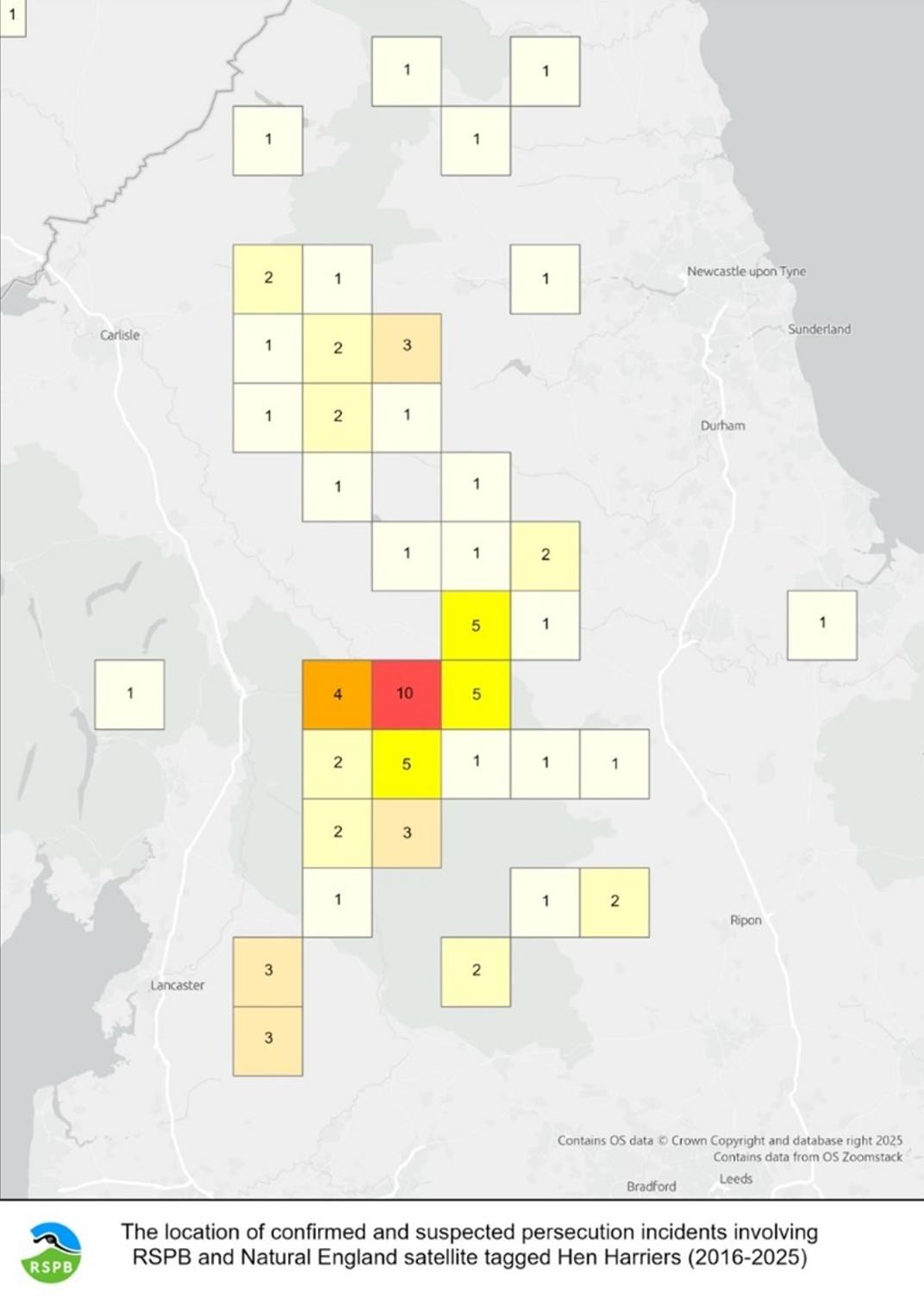
Of the 85 confirmed and suspected satellite tagged Hen Harrier persecution incidents recorded in England in the last ten years (2016-2025), 79 (93%) occurred in the area of Northern England shown in the map below.
In total, these include 35 RSPB satellite-tagged Hen Harriers and 44 Natural England satellite-tagged Hen Harriers. All were either confirmed to have been illegally killed or disappeared in suspicious circumstances.
The number in each square on the map is the total number of confirmed and suspected persecution incidents involving RSPB and Natural England satellite tagged Hen Harriers recorded in that area alone.
The RSPB also provided details of the seven tagged Hen Harriers either missing or illegally poisoned in 2025. I blogged about a number of these individuals in 2025 although the RSPB’s new commentary provides additional context. For those individual Harriers previously reported on this blog, I’ve marked them with an asterisk and provided a link to the specific blog.
- *Ataksak was found poisoned close to a grouse moor in North Yorkshire – poisoned with the Nidderdale Cocktail (January 2025). The area where Ataksak’s body was found is recognised as a bird of prey persecution hotspot. In the last ten years 25 confirmed bird of prey persecution incidents have been recorded in this area, including Ataksak. These included four Hen Harriers, 13 Red Kites and five Buzzards. A satellite tagged Hen Harrier also disappeared in this area in 2024. [Previous RPUK blog on Ataksak, here].
- *Sita disappeared on 27 February 2025. Her tag sent its final transmission from a moor south of Reeth, in the northeastern area of the Yorkshire Dales National Park. [Previous RPUK blog on Sita, here].
- *Dynamo was a six-year-old RSPB satellite tagged Hen Harrier which suspiciously disappeared whilst provisioning a nest in the Forest of Bowland in Lancashire in May 2025. He was one of four breeding male Hen Harriers that disappeared in northern England over a period of eight days – two from RSPB Geltsdale Nature Reserve in Cumbria, and a further two from the Forest of Bowland in Lancashire. All of these birds vanished whilst foraging for food away from their nest. [Previous RPUK blog on Dynamo, here].
- Wadrew was one of three chicks that successfully fledged from RSPB Geltsdale in the summer of 2025, raised with the assistance of RSPB staff and volunteers. When the male parent suddenly disappeared whilst foraging off the reserve (suspected to have been illegally killed) reserve staff and volunteers provided emergency supplementary food under licence. On 27 September 2025, just weeks after fledging, Wadrew disappeared whilst on a grouse moor near Birkdale, in the north-west of the Yorkshire Dales National Park. Based on incident data, this area – dominated by grouse moors – is the epicentre for Hen Harrier persecution in the UK. Since 2016, in this area four confirmed persecution incidents involving RSPB and Natural England satellite tagged Hen Harriers have taken place and 13 satellite tagged Hen Harriers have suspiciously disappeared (including Wadrew) – all suspected to have been persecuted (2016-2025).
- Morrigan suddenly disappeared on 30 September 2025 just three days after Wadrew’s final transmission and 17 km away, in the southern area of the North Pennines National Landscape – a notorious bird of prey persecution hotspot. In the same area in 2022, concerns were raised when irregular tag data was sent from a satellite tagged Hen Harrier named Asta. A search of the area led to the discovery of Asta’s satellite tag, found fitted to a dead Carrion Crow. The harness was intact. As a tag harness cannot be removed intact without inflicting significant harm to the bird it was clear that Asta had been illegally killed. In the last ten years 13 confirmed and suspected bird of prey persecution incidents have been recorded in this area including one confirmed incident (the sat-tagged Hen Harrier Asta) and the suspicious disappearance of 10 satellite tagged Hen Harriers, including Morrigan, between 2016 and 2025.
- Beatrix: Just 10 days before Wadrew and Morrigan disappeared, another young RSPB satellite tagged Hen Harrier, Beatrix, also vanished. Beatrix fledged from the Tarras Valley Nature Reserve in Scotland in the summer and dispersed south into the North Pennines, settling in an area dominated by grouse moor near Allendale. Her sat-tag sent its final transmission from this location on 17 September 2025. This area is another recognised persecution hotspot for Hen Harriers with four satellite tagged Hen Harriers confirmed to have been persecuted and six satellite tagged birds (including Beatrix) suspiciously disappearing in the area (2016-2025).
- *Red: In January 2025, eight months earlier, a one-year-old Scottish Hen Harrier that had also fledged from the Tarras Valley Nature Reserve, named Red, disappeared in another part of the North Pennines in County Durham. Another satellite tagged Hen Harrier, named Sia, disappeared in the same area in 2022. [Previous RPUK blog on Red, here].
The RSPB has provided a good amount of detail here, although I note that grid references have not been provided, which is disappointing.
However, the persecution hotspot map covering part of northern England is of particular interest to me. It’s striking that the RSPB has recorded ‘repeat’ incidents in certain areas, whereas Detective Inspector Mark Harrison from the National Wildlife Crime Unit (NWCU), who leads the National Hen Harrier Taskforce, is on record (several times) saying that since the Taskforce began its work in 2024, there hasn’t been a single ‘repeat’ incident in any of the Taskforce’s persecution hotspots.
This discrepancy demands more scrutiny and I’ll blog about it soon.
In the meantime, I’ll update the rolling list of missing/dead Hen Harriers since 2018…
UPDATE 21 January 2026: 147 Hen Harriers confirmed ‘missing’ or illegally killed in UK since 2018, most of them on or close to grouse moors (here).
 Raptor Persecution UK
As always sickening and very very annoying that these precious and rare specially protected birds continue to be relentlessly killed read “disappeared” on grouse moors. It is however totally unsurprising given that is is a continuing saga of murder mayhem and above all CRIME. It is all so predictable if pointless, by and large harriers make no difference to the number of grouse reared or available to go over the guns in almost all situations. That is what the science says but that flies in the face of the Victorian attitudes, prejudice and simple greed of the organised criminals who own, lease and mismanage our uplands for grouse shooting. They it seems think ( can they?) they know better and their is let’s be blunt fuck all deterrent to their criminality without some form of licence system for managing and shooting grouse. Natural England seem to have given up and are just going through the motions, RSPB are determined to make a difference but it is an uphill struggle with the criminals holding most of the cards. We need change by government but there seems little chance currently unless we start making an awful nuisance of ourselves writing to and making a lot of noise about this with our MPs. Licensing grouse moor management and grouse shooting could have been part of the animal and wildlife welfare bill currently being proposed, shout loud it at this late stage just might be.
I was surprised by the continuing use of the Nidderdale cocktail as the person I thought a key figure in this has left the area and taken a post on an estate XXXXX XXXXX. Perhaps I was wrong, time NY police and NWCU started raiding estates in the Nidderdale area, even several at once.
Shame RSPB chose, perhaps they were advised not to publish map references but even so it appears in several cases to be the same old sites and probably estates involved, Estates that often appear in publications as top grouse shooting estates. We need somehow to make them social pariahs even amongst their own kind but again with the current leadership of the grouse shooting cabal that in itself is very difficult, in part because the “good guys” are clearly a minority and a largely silent one at that. To my mind that makes them complicit. We all somehow need to change tack and make change happen but I’m currently not sure how. This has been going on ever since Hen Harriers recolonised England in the 50s and 60s, we should also note that without RSPB, United Utilities and Forestry England Hen Harriers could well have been lost from England again and more permanently. However we do it we need to stop this and its not just Hen Harriers.
Feel pretty much the same myself. One big step forward I can see is a serious ramping up of evidence gathering but this time with a tight regional focus: (1) massive scale satellite tagging of all persecuted species in one area for perhaps three to five years (big £££ needed, from where?), (2) combined with mass scale deployment of surveillance methods & raptor monitoring to provide a “mega-dossier regional case study” of e.g “northern dales” or “peak district” or “durham dales” just as examples. ie a big irrefutable document that cannot be overlooked / ignored by ministers.
But unless some billionaire grouse moor owner kindly 😂 makes a big donation akin to the costs of running his moor for a year, then the funding will be nigh on impossible to raise.
If hope the forthcoming webinar hosted by Friends of the Dales featuring DI Harrison (I tried to book onto it, but it says it’s ‘sold out’) includes Q&A (which it should), then one of the (many) questions I hope he is asked is “What has happened to the plan for North Yorkshire police covert cameras to be deployed in hotspots, whether with or without landowners knowledge or consent?” (i.e.the letters)
My own gut feeling is that they were perhaps told by their higher-ups to ditch the idea, as it seems to have not happened, or if it has been done, to have not been done with the combination of vigour, investigative intelligence and scale of effort that would get results. But it would be nice to know for sure what the story is.
If that idea has been closed off then IMHO the Harrier Taskforce might as well put a Closed sign on the door , pop their slippers on and play dominoes, as they are not armed sufficiently to compete in this war.
My understanding (which may not be complete) is that covert tactics were to be deployed if persecution incidents continued at the hotspot sites once the Taskforce had been to pay them a visit. According to the Taskforce, there haven’t been any more incidents at those hotspot sites. This claim is in direct contrast to the data just published by the RSPB.
The problem is, those hotspot locations have not been named/identified by the Taskforce, and we don’t know the extent of the geographical area to which they relate (e.g. is it an estate boundary, or is it a wider area?) so we have no way of checking the data to see whether incidents have occurred on the estate or just over the boundary. In my view, this lack of transparency casts doubt on the credibility of the Taskforce’s claim.
If you’re not able to book on, DI Harrison’s presentation will be posted on the Friends of the Dales’ YouTube channel, probably a few days after the event.
Thanks for the clarification. It will be interesting to hear from DI Harrison on this topic. Personally, I think if it is the case that they are waiting (!) until one or more satellite tagged harrier go missing in suspicious circumstances within a very short radius of a previous one, then they are either just not understanding the game or they are looking for an excuse to not get stuck in.
When they sent those letters out I dared to think this was finally the beginning of “something real” police-wise. I’m now thinking I made a mistake on that.
This toxic situation will persistant until we have a government who reforms the pathetic shambles that is serious wildlife crime investigation, prosecution and sentancing in the UK
The removal of licences is key to the whole thing. It needs to be made patantly clear that the landowner/ estate manager/shoot organiser are all to be held responsible for any unnatural deaths or disappearances of raptors.
I don’t know how low the numbers need to get before NE finally wakes up, and stops listening to ‘important people.’