
On Monday this week, former gamekeeper Thomas Munday appeared at Scarborough Magistrates’ Court where he was convicted of killing a Buzzard in March 2024 on land owned by the Hovingham Estate in North Yorkshire and was fined £1,215 (see RSPB press release here).
The case drew wide media attention, not least because it centered on disturbing footage captured on an RSPB covert camera showing Munday brutally beating to death the Buzzard that had been captured inside a Crow cage trap. The violence was appalling, and according to a piece on ITV news, even Munday’s solicitor told the court that his client had done “an incredibly cruel thing, it was a disgusting aberration“.
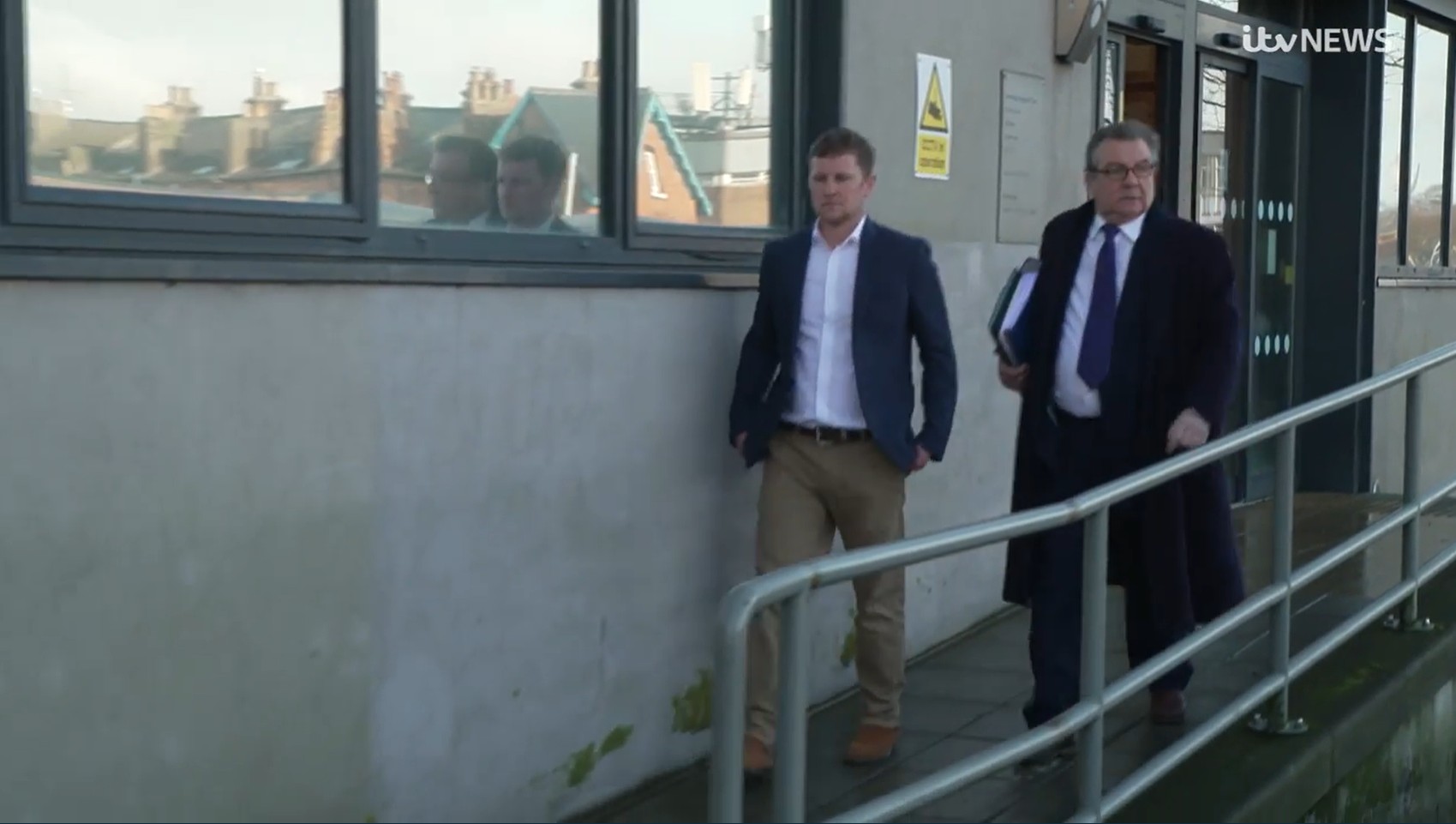
I said I’d return to this case to provide some commentary. I’m interested in three different aspects of the case: the charge against Munday, the sentence he received, and the location of the crime.
THE CHARGE
Munday was charged with intentionally killing a protected wild bird, a Buzzard. That’s an obvious offence and was clearly evidenced by the RSPB’s video footage. Munday pleaded guilty at the first available opportunity.
But to my mind there were other charges that could have been brought against Munday. For example, using a cage trap to kill or take a protected wild bird, possession of an article (the stick) capable of being used to commit an offence, and perhaps even going equipped (the ATV) to commit an offence.
However, the main additional charge I would have expected to see, based on the video footage, was that of causing unnecessary suffering to the Buzzard (Section 4 of the Animal Welfare Act 2006).
It’s beyond doubt, to me, (and apparently to Munday’s solicitor – see above) that that Buzzard suffered unnecessarily due to the two bouts of inhumane and cruel beating caused by Munday.
The courts are expected to treat animal cruelty seriously, as evidenced by the guidelines provided by the Sentencing Council – see here.
If you follow the step-by-step process outlined by the Sentencing Council, Munday’s actions could be determined as being of either High Culpability or Medium Culpability, and the harm caused (death) falls under Category 1 (the most serious level of harm caused).
Sentencing guidelines for offences determined to be High Culpability Category 1 start at two years’ custody. For Medium Culpability Category 1 offences, the starting point is 26 weeks’ custody.
I wonder why the CPS chose not to bring any charges other than that of intentionally killing a protected wild bird (the Buzzard)? Or maybe the CPS did bring other charges and there was a plea bargain? Along the lines of, ‘My client will plead guilty if the other charges are dropped’? That’s a common and legitimate feature of many criminal prosecutions but if that did happen in this case, why did the CPS accept? Was it a case of getting a quick and easy conviction in the bag and let’s move on to the next case?
This is all conjecture, of course, and until there’s better (any!) transparency about charging decisions then we’ll never know.
THE SENTENCE
Munday was fined a total of £1,215 for killing the Buzzard. This amount was broken down as follows:
£807 – fine
£323 – surcharge
£85 – costs
Some people, and I’m one of them, will consider that this level of fine does not reflect the seriousness of the offence and is at the lower end scale available to the courts. As the RSPB stated in its press release after Munday’s conviction, ‘This penalty provides little deterrent to others who may consider committing similar crimes and fails to reflect the casual and callous acts of cruelty involved‘.
I’ve seen some argue that the other consequences Munday faced (i.e. losing his firearms and shotgun certificates, losing his job, losing his home), in addition to the fine, is sufficient penalty for him. I disagree. Losing a job and home is no different to someone being made redundant, through no fault of their own, and having to relocate to find work.
According to media reports, Munday has re-trained (now a tree surgeon, apparently, so need for firearms/shotgun certs), is employed and has moved away from the house he was renting. Paying off a £1,215 fine shouldn’t be too much of a burden to him.
In addition, this case utilised forensic expertise (including examination of the bloodied stick to identify Buzzard DNA, and swabs taken from the vehicle in to which the bludgeoned Buzzard had been thrown). This work was conducted by the Wildlife DNA Forensic Unit at SASA in Scotland, paid for by the Forensic Analysis Fund (to which organisations like Wild Justice, Northern England Raptor Forum, Tayside & Fife Raptor Study Group, Devon Birds, Rare Bird Alert and many individual donors, including this blog’s readers, have contributed – see here).
One of the conditions of using the Forensic Fund for raptor persecution cases is that if the case progresses to court and costs are recoverable, an application must be made to the court to recover those costs, and any amounts recovered must be reimbursed back into the Forensic Fund to be used for other cases.
In this case, an application was made to the court to recover the costs of the forensics work but the magistrates said that a reimbursement wasn’t possible because the forensics work ‘wasn’t necessary’ to the case.
To explain – Munday committed his offence in March 2024. The RSPB passed on the video evidence to North Yorkshire Police who executed a search warrant (date unknown) at an address and retrieved several items for forensic examination. However, Munday wasn’t interviewed at that time (for reasons best known to North Yorkshire Police).
Munday was only interviewed by North Yorkshire Police in December 2025, some 21 months after the crime was committed. Had he been interviewed in 2024, Munday’s solicitor told the court that his client would have held up his hands and pleaded guilty. Hence, in the magistrates’ opinion, the forensics work wouldn’t have been needed.
THE LOCATION OF THE CRIME
If you’ve read a lot of the media reports about this case, including the RSPB’s press release and North Yorkshire Police’s press release, you might have noticed that the name of the estate where this crime took place has not been reported. It’s invariably been described as ‘near Hovingham’ and ‘near Malton’ – even the CPS charge apparently described the location as being ‘near Ripon’, which is unusual as typically the exact location is included in the charge. The exception was an article on the BBC’s website, which stated, ‘Thomas Munday was filmed killing the buzzard on land which is part of the Hovingham Estate, in North Yorkshire, in March 2024‘.
The court was told that Munday was employed by a ‘management company’ (un-named) who leased the land on an estate for a Pheasant shooting syndicate. According to an observer in court, Munday’s solicitor ‘spent a long time’ telling the court that the estate had nothing to do with the Pheasant shoot, and that as soon as the estate found out about the Buzzard being killed, it terminated the lease. Apparently he went as far as to say he hoped the press would report this sensitively. That’s bizarre – it’s almost as though the solicitor was acting for the estate.
I was intrigued by this apparent reluctance to name the estate and did some digging.
Hovingham Estate (also known as Hovingham Hall) has been in the ownership of the Worsley family for over 450 years. Sir William Worsley (6th Baronet) apparently resides there with his family. He’s big into forestry and conservation, according to Wikipedia, being the former Chairman of the National Forest Company, the former Government’s National Tree Champion, and is the current Chair of the Forestry Commission.
The estate has won awards for its woodland management, including winning a silver award in the 2023 Bede Howell Award for Excellence in Silviculture (the year before the Buzzard was beaten to death in the woods). The judges commented:
“We were impressed by the co-ordination achieved between the several estate departments. For example, the woodlands present an attractive landscape of high amenity and biodiversity character. They also host an important pheasant shoot by paying especially close attention to the character of woodland edges. The result is a profitable woodland enterprise containing excellent stands of timber. this integrates effectively with sporting and other estate priorities“.
I can see why a man of this standing would want to distance the estate from the disgusting and barbaric crime committed by gamekeeper Thomas Munday, and the estate deserves full credit for immediately terminating the shooting lease. I wish more landowners would follow this example and act so quickly and decisively when dealing with sporting agents.
But that Bede Howell awards committee statement about Hovingham Estate made me pause for thought. “They also host an important pheasant shoot….” (emphasis is mine).
If you look on the Hovingham Hall website, it includes a statement about what goes on at the estate:

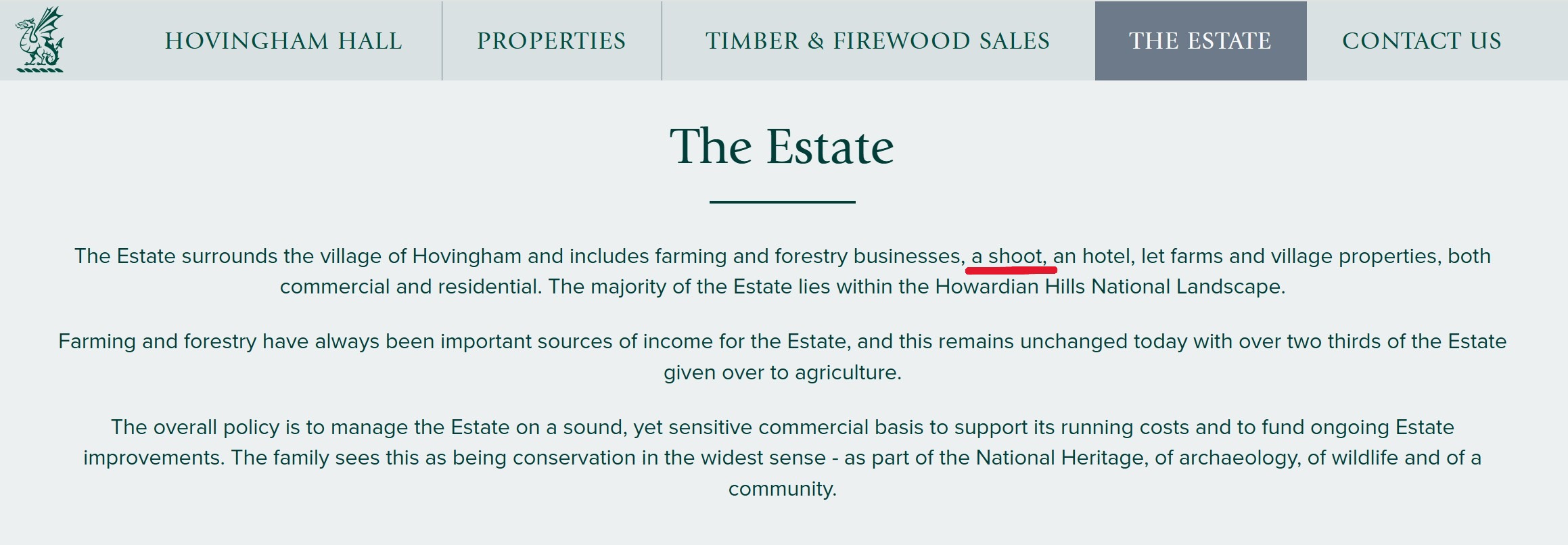
It says the estate includes ‘a shoot’, which suggests to me that the estate may be more involved in Pheasant shooting than simply renting the land to a tenant sporting agent.
However, when I looked around the rest of the website, I couldn’t see any further mention of ‘a shoot’, until I looked at the estate’s privacy policy (dated 2024).
This privacy policy lays out how the estate handles its responsibilities under the Data Protection Act and how personal information is used. There’s an interesting entry under the header ‘Shoot’, which suggests the estate is involved in the administration of the ‘shoot syndicate and Let Days’.
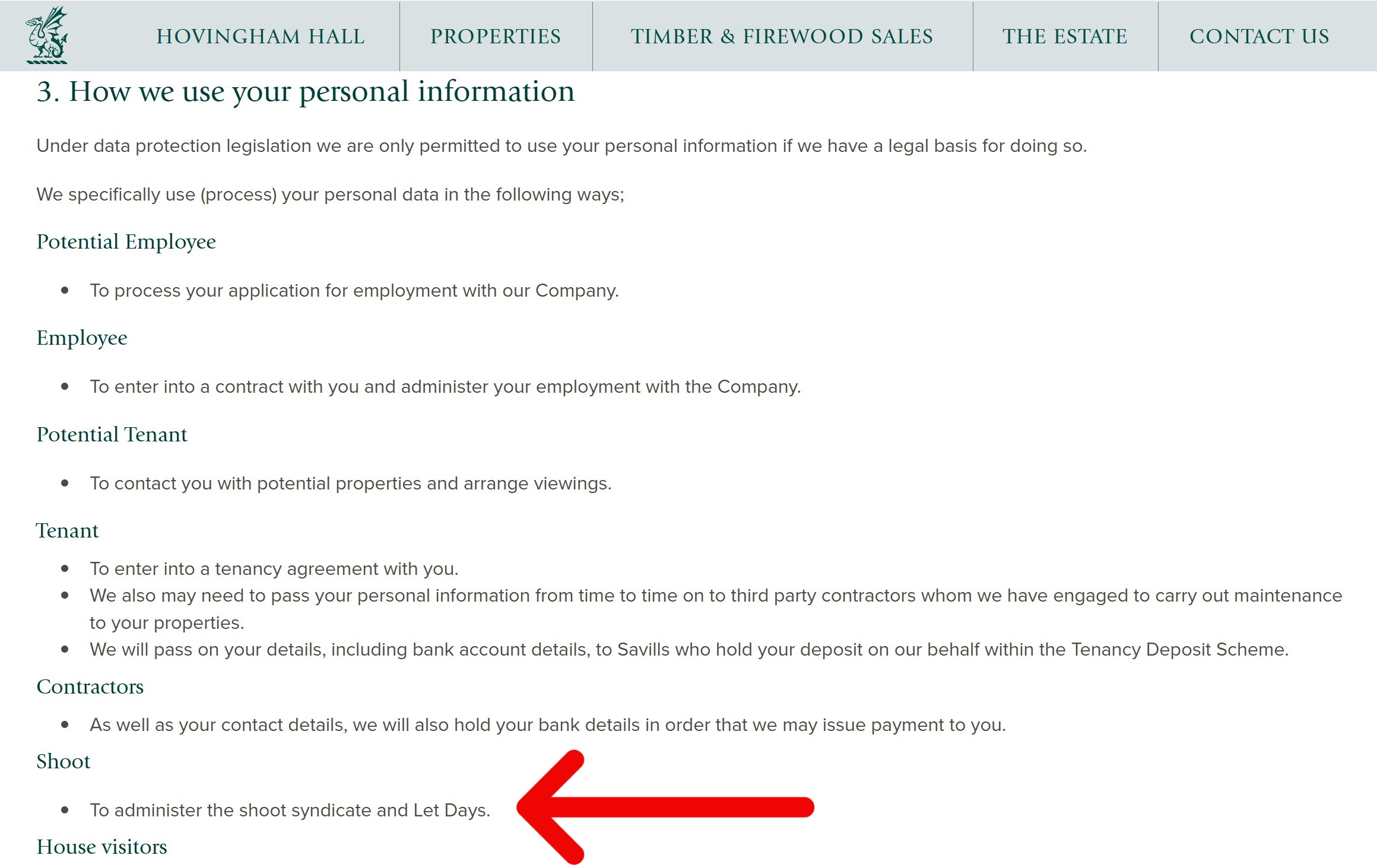
Hmm.
I decided to phone the estate and ask them about their involvement in Pheasant shooting and whether they still had a Pheasant shoot after terminating the shoot lease in 2024.
I spoke to a nice lady in the main office who gave me a prepared statement, as follows:
“Hovingham Estate is aware of an incident involving one of our tenant’s employees. We take a zero tolerance approach to issues of this kind and therefore we took immediate action to terminate the tenant’s lease. We must emphasise that none of our employees are involved in any way“.
That’s pretty clear, but didn’t answer my questions. I asked the questions again and the nice lady told me:
“I’m sorry, I’m not at liberty to comment“.
To be absolutely clear, there is no evidence to suggest that Hovingham Estate knew about the criminal activity of gamekeeper Thomas Munday, and when it did become aware, it acted responsibly and terminated the lease.
If this estate is still hosting Pheasant (or Partridge) shooting, whether leased to another tenant or managed by the estate, I hope that lessons have been learned and close attention is paid to what might be going on in those award-winning woodlands.
Kudos again to the RSPB’s Investigations Team for securing the evidence that led to this conviction.
 Raptor Persecution UK
It’s obvious estates will wriggle and evade any sort of responsibility under vicarious liability. I have seen many comments on social media from individuals and pro shooting organisations attempting to distance themselves from this incident……….it’s the same old story, they know it happens but cover it up and put up this pretence that it doesn’t happen and that they condemn it. Look at any game keeper job description and it will involve what is termed “Vermin Control” without any definition of what they include as vermin. This is a paragraph from a Game Keeper job description that was easy to find online “Control pests and predators that are a danger to chicks and eggs”
[Ed: If vicarious liability was to be applied in this case, and the landowner’s claim that Munday was not an estate employee is accepted, then it would be Munday’s employer (the sporting agent) who would be directly responsible, not the estate, although with the usual caveat that defences would be available for the sporting agent]
There is no specific vicarious liability law in England , that is only in Scotland.
WHY is it so difficult to get these so called Gamekeepers prosecuted for these acts of murder they get away with killing Raptors because they are ” protecting a non native invasive species” they should all be investigated with a view to jail time
I wonder who paid for Munday’s solicitor? Munday, the shoot tenant or Hovingham Estate?
He didn’t have to pay the costs associated with the forensic work because he would have thrown his hands up and admitted the crime without the need for the forensic work in the first place!!!
Sorry, but I smell shite on that one. And for his word to be taken at face value on the matter is surely odd???
Take note, all criminals great & small across the country…what a canny little wrinkle that it to use! i.e. to reduce the costs against you in any drug dealing or car stealing scheme, or worse – simply say “well, you shouldn’t have bothered with the forensic investigation, I would have owned up to it if you had come to me before you spent your money on it. Honest! So up yours, I’m not paying any costs connected to it “
I’m not sure whether the costs recovery for the forensics work would have been in addition to the fine imposed on Munday, or whether it was all wrapped together.
Nevertheless, the most obvious way of avoiding it happening again is for the police to interview the suspect at the earliest time, instead of waiting, inexplicably in my view, for 21 months to do it.
I agree this has a funny smell to it and some questions need to be asked to establish why it took so long for North Yorkshire Police to interview Munday, crime committed in March 2024 with hard evidence available, to an interview in December 2025. This is inexplicable and it is a known fact that the longer it is after a crime is committed, the more difficult a successful prosecution becomes. It seems that an attempt to sabotage this was made by police.
It is interesting to note that Sir William Ralph Worsley is director of 14 companies some of which have a nature of business as “other operating and letting of own or leased real estate”. I wonder whether the “management company” which employed Munday could be one of these?
https://find-and-update.company-information.service.gov.uk/officers/V5l2fZfqSWLjvJHJIEcj57gfG5o/appointments