
Three days before Xmas, DEFRA published its Animal Welfare Strategy for England, laying out the Westminster Government’s priorities and a framework for the changes it seeks to achieve by 2030.
The policy paper is wide-ranging and covers farmed livestock, companion animals and wildlife.
Two Labour manifesto pledges are included – “We will ban trail hunting and snares“, and it’s encouraging to read, “We will also conduct a review of the use of other wildlife traps“.
The strategy document can be downloaded / read here:
The key ‘actions’, of interest to me, are as follows:
- We will put an end to trail hunting and consult in early 2026 on how to deliver a ban on trail hunting.
- We will deliver on the manifesto commitment to ban the use of snare traps in England.
- We will conduct a review of other traps used to catch wildlife in England for which welfare concerns have been raised and carefully consider any recommendations for further action. (E.g. Older spring traps, mole traps and live capture traps used to catch corvids).
- We will consider how to bring forward and introduce a close season for hares.
- We will review and look to strengthen penalties for cruelty against wildlife so that they are consistent with higher levels of sentencing available for animal welfare offences against pets and livestock.
- We will improve our understanding of the welfare issues on how gamebirds are reared in the gamebird sector through issuing a call for evidence.
Whilst a timeframe for the consultation on how to implement a ban on trail hunting has been given as ‘early 2026’ (good!), no timeline has been given on when the ban on snares will be implemented.
Given the indiscriminate level of cruelty and suffering caused by snares, this ban really needs to enacted without delay. Snares have already been banned in Wales (since October 2023) and Scotland (since November 2024).
YouGov polling commissioned by the League Against Cruel Sports last year showed 71% support for a snare ban in England (the figure rose to 80% among people living in rural areas) – see here.
Last month, in response to DEFRA’s animal welfare strategy, the independent and authoritative Wild Animal Welfare Committee (WAWC) published an excellent position paper on snares – well worth a read:
I’m especially pleased to see in the animal welfare strategy for England that a review on other wildlife traps will take place (although again, no timescale is given for this), and particularly pleased to see that it includes crow cage traps.
The use and mis-use of these traps have featured heavily on the pages of this blog over the years, especially on gamebird shooting estates. Apart from the appallingly low welfare standards they afford to both decoy and trapped birds, they are also frequently used to facilitate the illegal killing of birds of prey.
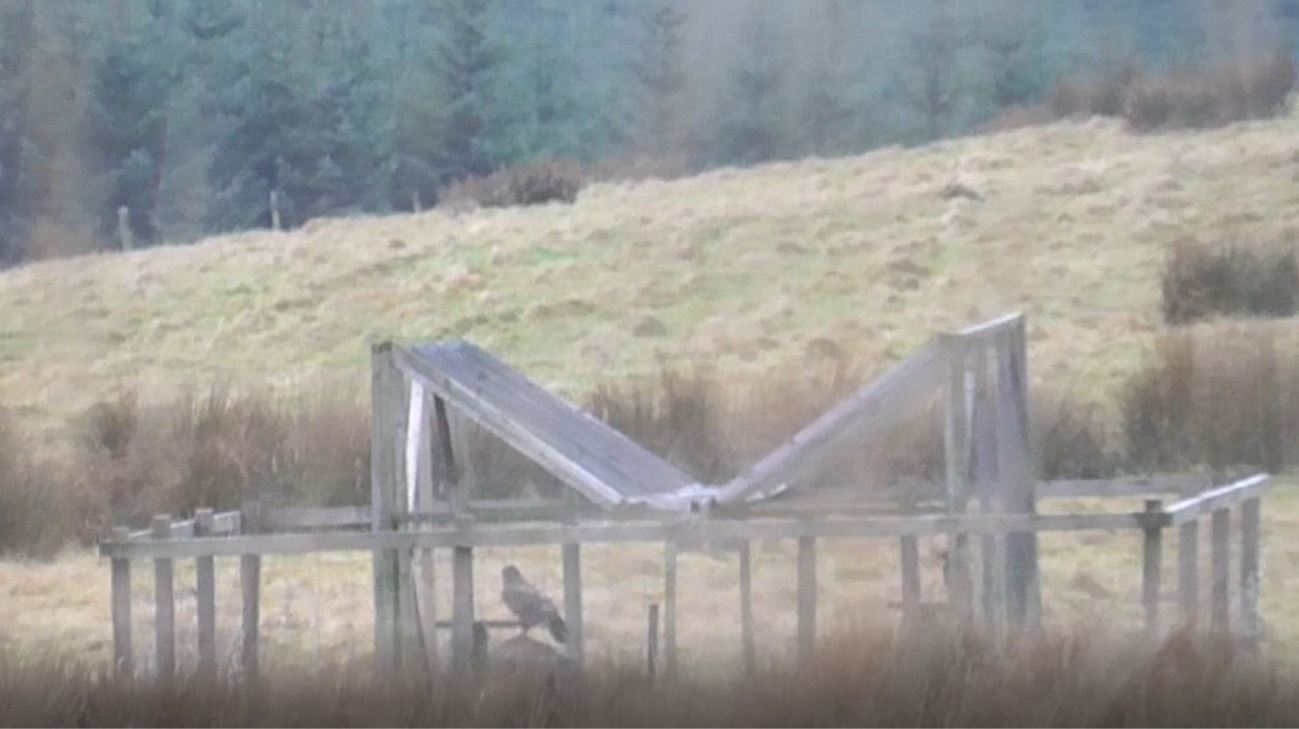
Sometimes the use of these traps for illegal persecution is targeted (i.e. by using decoys specifically to attract raptors, e.g. pigeons and doves) but it can also be non-targeted. When a raptor is caught, accidentally, inside one of these traps, by law the trap operator should release the bird, unharmed, at the earliest possible time. However, repeated evidence, usually provided by RSPB covert cameras, has shown gamekeepers taking the opportunity to kill the trapped raptor, typically by bludgeoning it to death with a big stick there and then, or in recent years, the trapped raptor has been bagged up and carried away from the location, presumably to be killed without the risk of it being filmed.
Any proposal to improve animal welfare standards is to be welcomed and I applaud the Westminster Government for acknowledging that measures are needed across the board.
There’s clearly a lot of work to do and we are fortunate to have some excellent animal welfare charities and organisations in the UK whose input will be crucial to ensure this strategy is implemented as comprehensively, robustly and quickly as possible.
 Raptor Persecution UK
What I would like to know is, who took the photo of the buzzard and then left it to its fate?
It wasn’t someone taking a photo. It’s a screengrab from a video recording, from a camera installed at the trap – the evidence would have been retrieved sometime later.
At long, long last!
if trail hunting is banned what happens to all the hounds? Who offers to re-home them? Or will they all be shot? Perhaps the government should tell us.
“if trail hunting is banned what happens to all the hounds?”
What do you think happens to the hounds now, once they can’t keep up with the hunt?
https://www.itv.com/news/2021-10-08/secret-filming-shows-hunting-hounds-being-shot-dead-at-kennels?utm_source=substack&utm_medium=email
so you suggest the hunt shoots the lot. So much for your love of animals. How about housing a pack yourself? What is your solution? If you have one. I merely asked the question to which I expect a carefully considered response not just an hysterical reaction.
the parallel is if we all were forced to become vegetarians who shoots all those farm animals.
Or perhaps the hunts should tell us? This is a potential problem of their own creation and nobody else’s. If they hadn’t used trail hunting as a smokescreen for foxhunting, this wouldn’t have become an issue in the first place.
Forgive me, but the same problem would have arisen twenty years ago when fox hunting was banned and nobody offered an answer then. It was a case of ‘ban it’ and to hell with the consequences. Even Tony Blair admitted it was not a smart move.
Exactly, so they have had twenty years to either genuinely trailhunt (and keep the packs in the same way) or to play the crafty con-games that they have played and (if they had sense) to wind down the whole charade before the trailhunting smokescreen was well and truly found out. To me, it is their responsibility entirely.
This is just typical “whataboutery” from someone who clearly supports fox hunting. The simple answer is that it is up to the hunts how they deal with it. If they decide to kill them all, that is their decision, as it currently is when they decide to shoot those they deem to be too old or too slow. It is their responsibility, just as it has been their decision to continuously exploit the loopholes in a law that Tony Blair admitted was designed to be virtually unenforceable, once he had left power, of course.
Two dishonest cliques supporting the same aim: to keep hunting with hounds.
Hi Nick,
I would suggest the very caring huntsfolk should use their resources to manage their hounds in whatever humane way they decide. My local hunts have bank account reserves and some wealthy supporters, one would hope they keep the kennel men on to look after their hounds, re-home what they can, and of course stop breeding them. With fox hunting with dogs having been illegal for so long, and trail hunting not requiring so many hounds, I’m surprised my local hunts continue to breed and kennel such large amounts of hounds.
There will be some notice period, so, if and when the trail hunting ban gets enforced, the sensible thing would be starting to re-home, stop breeding, reducing numbers now, in anticipation of the law change.
Nick, are you implying we continue trail-hunting (as a smokescreen for fox hunting) indefinitely, due to the emotive “what to do with hounds?” question?
What would your suggestion/answer to the question be?
Just when you are thinking, “What an idiot I was for voting Labour last time, as they are clearly not interested in taking action on wildlife crime/regulation of shooting, etc.” and “Who the hell do I vote for in future?” They dangle distant little carrots like this. Very strange. But still good news. Although, I trust that point 6 will be concerning itself with the whole business cycle of the farmed game shooting industry – not just on how they are reared?
Thanks spaghnum – that is how i was feeling, although Labour is finally showing some signs for animals IF i vote again – although it will get no-where it may be Greens for Animal / Environment reasons.
It was somewhat comforting & reassuring that on a previous post (about yet another persecuted raptor) in the face of bad news you said you ‘found it motivating’ as I am at a point of giving up ever seeing an end to Raptor persecution despite still being so sickened & outraged by it.
Hi Tim, glad I have given a little bit of encouragement to you & nice of you to take time to mention it! Something that struck a chord with me was a news feature (with either Frank Gardner or Alex Thomson, I can’t recall which just now) at RSPB Geltsdale. A couple of the RSPB Investigations folks were on camera talking about all the bad stuff going on around there with the Harriers, and one said “They [the other side] would love it we went away, but I’m not going anywhere…” or something similar to that. And I just remember nodding to myself and going “Aye, that’s right – and I’m not going anywhere either” which means to me personally just doing any bits & pieces perhaps maybe seemingly small, if and when I can, that’s going in the right direction – but ultimately just refusing point blank to lie down and accept the old “It’s just the way it is” fatalism re. all the killing, the bullshit and the abuse of our laws and democracy.👍
P.s. I’ve remembered that the conversation with RSPB Investigators is actually on the Guardian podcast (at about ten minutes in)
https://www.theguardian.com/science/audio/2023/aug/16/killing-the-skydancer-episode-2-the-perfect-podcast
Hello, Ruth,
I tried to reply to Nick Kester’s first comment with this, but it didn’t seem to work – have I done something wrong in any way?
bw – and many thanks again for the excellent work you do for us all.
Marian.
[Ed: Hi Marian – thanks, your comment came through but the link you provided is showing up as ‘suspicious’ so I didn’t post it. Here’s an alternative: https://www.huntsabs.org.uk/nine-foxhounds-shot-dead-in-forty-minutes/ ]
I am grateful to those who posted a ‘solution’. So when trail hunting is banned hunts should destroy all hounds, and according to some should have done it 20 years ago. Thank you for making your position clear.
Nick, please don’t put words in my mouth. My “position” is that it is a problem of their own creation and that the moral obligation is theirs to do the right thing by the hounds – and nobody else’s, and trying to using moral blackmail is just another sly tactic. If they choose to have one of the kennel hands take them around the back and shoot them (whether with a . 22LR or a legal abattoir device) then that is sadly in keeping with what they have always done when hounds aren’t needed/ not up to the task, and is (as it always has been) wholly immoral and ought to be illegal.
you shoud ban halal killing its butal.
“you shoud ban halal killing its butal.”
‘You’? I think you mean ‘We’, in the name of the UK Parliament. In which case, I agree.
Apart from the absolutely obvious “whataboutery” of your post, actually, most Halal killing is identical to all meat slaughter. Why do you call out Halal and not Kosher? Is it Islamophobia?
For the record, industrial fishing is the most brutal method of slaughter: not only are they wildlife and hugely important to other wildlife, but they are left to “drown” in fresh air. So I do hope you don’t indulge in Cod, Haddock or Hake and chips.