More detail on the ‘missing’ White-tailed Eagle in south Scotland

Further to the news yesterday (here) that three White-tailed Eagles have ‘disappeared’ in suspicious circumstances, one in England, one in Wales and one in Scotland, Police Scotland has issued a separate public appeal for information which includes a bit more detail about the Scottish case:

Police Scotland are appealing for information after a satellite-tagged white-tailed eagle disappeared in the vicinity of the Moorfoot hills.

The bird was four years old and had been translocated as a chick from Scotland to the Isle of White as part of a licenced reintroduction programme run by the Roy Dennis Foundation.

In March 2025 the bird flew back to Scotland and held a territory in the Moorfoot Hills spending most of its time in the hills between Peebles and Heriot.

In early November it expanded its range and spent the majority of its time on the lower ground to the North of the Moorfoots by Gladhouse Reservoir but after four days its satellite tag then suddenly stopped working in circumstances that give rise to suspicion.

A full search of the area where the tag last transmitted and the areas it had been frequenting has been carried out by Police Scotland Wildlife Crime officers accompanied by colleagues from the UK National Wildlife Crime Unit and a bird ecology expert however neither the bird nor the satellite tag have been recovered.

Police Constable Ali Whitby, Wildlife Crime Officer for the Lothian and Scottish Borders division said:

This is a huge iconic bird of prey that chose to fly hundreds of miles north and settle in the Moorfoot Hills. Being so big its presence was known to people working and living in the area and it thrived for 8 months; the fact it has now gone missing in suspicious circumstances is extremely disappointing.

I would urge anyone with any information that may assist to contact us.”

Anyone with any information should call 101, quoting reference number PS-20251215-1347. Alternatively, please contact Crimestoppers though 0800 555 111, where anonymity can be maintained.

ENDS

White-tailed Eagle, photo by Pete Walkden

Three satellite-tagged White-tailed Eagles disappear in suspicious circumstances in England, Wales & Scotland – two tags had been cut off

Press release from Forestry England (17 December 2025)

THREE WHITE-TAILED EAGLES DISAPPEAR IN SUSPICIOUS CIRCUMSTANCES

The public are being asked to help the police investigate the suspicious disappearance of three white-tailed eagles. The cases include a chick born in the wild earlier this year in Sussex, one of the first white-tailed eagles to fledge in England for hundreds of years.

White-tailed Eagle G842 on the nest with its sibling in Sussex prior to fledging earlier this year (Photo: Forestry England)

The missing birds are part of a project led by Forestry England and the Roy Dennis Wildlife Foundation to reintroduce this lost species to England. Their disappearance is being investigated by several police forces and the National Wildlife Crime Unit.

The return of white-tailed eagles to England is one of the country’s key conservation successes over recent years. Since 2019, 45 white- tailed eagles have been released. Several breeding pairs have formed with six chicks being born in the wild for the first time since the 1780’s. Any targeting of the birds will potentially impact the long-term success of the project.

All of the released birds are tagged with satellite trackers allowing the team to closely follow their location and movements. In September the trackers of two eagles were found dumped close to the birds’ last recorded location. Both had been cut off the birds using a sharp instrument. In the case of another eagle, its tag has stopped sending data. The last message received from the device was on 8 November and no sightings of the bird have been recorded since then.

 Tim Mackrill from the Roy Dennis Wildlife Foundation said: “We monitor the satellite data, showing the bird’s minute-by-minute movements, on a daily basis and always investigate any suspicious or unusual data. It was devastating to find the stolen and dumped tags, particularly for the chick in Sussex who fledged this summer and had only just begun its life. So many people in the area had shared the joy of seeing these birds breed again after hundreds of years and our ongoing monitoring has shown how well they were fitting into the landscape. To have that destroyed just a few months later is deeply shocking“.

Steve Egerton-Read, White-Tailed Eagle Project Officer for Forestry England, said: “We are returning this lost species to the English landscape and have had so much support from the public. These special birds are helping people connect with natural world and showing how with a little bit of help nature can thrive. We are asking the public to show this support again by encouraging anyone who has information that may help the police investigation to come forward“.

There was tremendous public support and local pride this summer when two white-tailed eagle chicks fledged from a nest in Sussex. Both were the offspring of eagles released by the project in 2020 and the first pair to successfully breed in England for over 240 years. The two chicks had spent the first few months of their lives exploring the local West Sussex area.

On 26 September, a satellite tag belonging to one of the chicks (G842) was recovered from the River Rother, near Petersfield. It had been removed from the bird using a sharp instrument. Searches in the area to try and locate the body of the bird have so far been unsuccessful.

Sussex Police are appealing for information from anyone who was in or around Harting Down and Petersfield on the evening of 20 September 2025. Any members of the public who may have seen the bird or any suspicious behaviour can contact them on 101 or 0800 555 111 quoting incident number 769.

Dyfed Powys Police are investigating a similar incident on 13 September, where a satellite tag belonging to white-tailed eagle G615 was recovered in remote moorland. The tag had been removed with a sharp instrument before being hidden in an attempt to dispose of it. Searches in the area to try and locate the body of the bird have so far been unsuccessful.

The force is interested in hearing from anyone who was at or around the Gwgia Reservoir, Tregynon between 11am and 1pm or on access land near Bryn y Fawnog between 12 noon and 3pm on 13 September. Callers should quote crime reference number 137.

In a third incident, concerns are growing for G819 after its tag, which usually transmits the data daily, has stopped working. The last transmission was sent on 8 November in the Moorfoot Hills area. Police Scotland are treating the disappearance as suspicious and asking anyone with information to contact them on 101 or 0800 555 111 quoting incident number PS-20251215-1347.

The reintroduction of white-tailed eagles is conducted under licence from Natural England, the Government’s wildlife licensing authority. White-tailed eagles are a protected species under the Wildlife and Countryside Act (1981). Disturbing, destroying or interfering with them and their nests are criminal offences.

ENDS

My commentary:

Hands up, who’s surprised?

No, me neither.

These reports are so depressingly familiar these days, we’ve pretty much come to expect them. Although there’s something particularly sickening about killing a White-tailed Eagle. It’s no lesser crime, in the eyes of the law, than killing a more common species like a Buzzard or a Sparrowhawk – the offence is the same and the available penalty is the same. But these eagles, the UK’s largest raptor, have been brought back from the brink through intensive conservation efforts by many people over many decades. Progress has been hard-won, because these birds are slow to mature (between 4-6 yrs) and when they do eventually reproduce they generally only manage to rear one or two chicks per season, on rare occasions three, and they don’t necessarily breed every year, which means that population recovery is slow. Any illegal killing, on top of natural mortality, is obviously going to hamper that reestablishment.

And there’s no doubt whatsoever that at least two of these eagles were the victims of illegal persecution, given the clear evidence that their satellite tags had been cut off and crude attempts were made to hide them. Given the area in south Scotland where the third White-tailed Eagle has vanished, a well-known persecution hotspot, it wouldn’t be a surprise to learn that that bird has also been killed illegally, most likely shot.

Kudos to the White-tailed Eagle Reintroduction team (Roy Dennis Wildlife Foundation & Forestry England) for putting out an appeal for information after three months of silence from Dyfed-Powys Police and Sussex Police.

UPDATE 18 December 2025: More detail on the ‘missing’ White-tailed Eagle in south Scotland (here)

40 shot birds dumped on road in Wisbech, Cambridgeshire

Thirty-nine geese and one pigeon have been found shot and dumped, literally on the road, in Wisbech, Cambridgeshire, according to an article in the Eastern Daily Press (EDP) posted on 10 December 2025.

The birds were found on St Paul’s Lane and many of them had blue baler twine around their necks (where the birds had been hung up) and had had their breasts cut off.

A video on the EDP website captures the reactions of members of the public, who described the incident as “barbaric”.

Screengrab from the video of the dead birds on EDP website
Screengrab of the same video, posted on Wisbech Standard website, showing a goose with its breast removed

According to the EDP article, a spokesman for King’s Lynn and West Norfolk Borough Council said: “A report of dead geese was made to the council, to which we immediately responded.

They are due to be collected today and removed to a licensed waste site that is authorised to deal with them.”

Regular blog readers will know that the dumping of shot gamebirds is a common and widespread illegal practice that has been going on for years, despite the repeated denials by the shooting industry. The disposal of animal by-products (including shot gamebirds) is supposedly regulated and the dumping of these carcasses is an offence.

Previous reports include dumped birds found in Cheshire (here), Scottish borders (here), Norfolk (here), Perthshire (here), Berkshire (here), North York Moors National Park (here) and some more in North York Moors National Park (here) and even more in North Yorkshire (here), Co. Derry (here), West Yorkshire (here), and again in West Yorkshire (here), N Wales (here), mid-Wales (here), Leicestershire (here), Lincolnshire (here), Somerset (here), Derbyshire’s Peak District National Park (here), Suffolk (here), Leicestershire again (here), Somerset again (here), Liverpool (here), even more in North Wales (here) even more in Wales, again (here), in Wiltshire (here) in Angus (here), in Somerset again (here), once again in North Yorkshire (here), yet again in West Yorkshire (here), yet again in mid-Wales (here), even more in mid-Wales (here), more in Derbyshire (here), Gloucestershire (here) more in Cheshire (here), some in Cumbria (here), some more in the Scottish Borders (here) and again in Lincolnshire (here), in Nottinghamshire (here), even more in Lincolnshire (here), even more in the Scottish Borders (here) and in Dorset (here).

The charity Hen Harrier Action launches Xmas fundraiser to buy satellite tags

The charity Hen Harrier Action has launched its annual Xmas fundraising appeal, this year with a target of £15K to purchase five satellite tags to be fitted to Hen Harrier chicks in 2026.

As you’ll know, over the last couple of decades, raptor satellite-tagging in the UK has shone a massive spotlight on the widespread scale of the illegal killing of a number of raptor species, especially Hen Harriers and Golden Eagles.

Scientists have been able to analyse the tag data and have demonstrated a clear and unequivocal link between illegal raptor persecution and grouse moor management (e.g. see here, here, here).

In Scotland this has led directly to a change in Government policy, with the recent introduction of a grouse moor licensing scheme, whereby licences for shooting Red Grouse can be suspended/revoked if evidence of raptor persecution (and some other wildlife crimes) is found on a grouse shooting estate.

It has also led to a change in tactics by some of those motivated to kill raptors, who are now apparently choosing to target un-tagged raptors because they want to avoid the media attention and scrutiny that follows the illegal killing or ‘disappearance’ of a tagged bird (e.g. see here).

But fitting a satellite tag doesn’t necessarily mean that that raptor won’t be targeted. There are plenty of examples of tagged birds still being targeted, either because those doing the killing are too stupid to understand what a tag’s data can reveal, or more likely, there are rarely any direct consequences for those who commit these crimes so there’s no incentive for them to stop.

To my mind, the main benefit of continuing to fit satellite tags to Hen Harriers, apart from the obvious research benefits of better understanding this species’ ecology and how it uses the landscape, is that it allows us to document the scale of the ongoing criminality (that would otherwise be hidden and thus would be easily deniable by the grouse shooting industry) and to use those data to put pressure on Governments to address the problem.

As in previous years, any tags purchased by Hen Harrier Action will be fitted by licensed experts from the RSPB who will also monitor and manage the data, and alert the police / Hen Harrier Taskforce if suspicious tag activity is detected.

It also means that Hen Harrier Action will publicise any suspicious disappearances / confirmed illegal killings, without compromising any police investigation, of course, but also without sitting on the data for months, sometimes years, as we’ve seen all too often with tags fitted by Natural England.

If you’re able to contribute to Hen Harrier Action’s Xmas fundraiser, please visit their fundraising site here.

Another Hen Harrier suspected illegally killed on a grouse moor, her satellite tag had been ‘removed’

Over the last few weeks I’ve blogged about a number of illegally-killed Hen Harriers whose deaths have been barely publicised by the authorities, but instead have been quietly entered onto a Government spreadsheet, months, and sometimes over a year later, with little effort to draw the public’s attention to this ongoing criminality.

Hen Harrier photo by Pete Walkden

There was Hen Harrier ‘Susie’ who was found dead with gunshot injuries on a grouse moor in the North Pennines, here; and Hen Harrier ‘254843’ who was found dead on moorland in the Northumberland National Park with shotgun damage to her satellite tag, here; and a Hen Harrier (ref # HSE 107/913) who was found poisoned on a grouse moor in North Yorkshire having ingested a lethal combination of toxic chemicals known as the ‘Nidderdale Cocktail’, so called due to the frequency it is used as a poisoned bait in the Nidderdale National Landscape, killing multiple birds of prey and even a pet dog, here.

Well, here’s another one.

This time its a young Hen Harrier named Margaret, who was fitted with a satellite tag (Tag ID 254844) by Natural England fieldworkers just prior to her fledging from a nest in Northumberland on 5 July 2024.

Natural England staff ‘lost contact’ with Margaret just three months later on 19 October 2024.

The first we knew about this was in Natural England’s intermittent spreadsheet update in December 2024 about the fate of the Hen Harriers that had been satellite-tagged using public funds. Margaret’s entry read as follows:

Lost contact 19 October 2024, Northumberland. Missing Fate Unknown, site confidential – ongoing investigation‘.

Whether that meant her tag had suddenly and inexplicably stopped transmitting, or whether the data showed an unusually long period of being static in one place, wasn’t clear.

We didn’t hear anything more until Natural England quietly updated its spreadsheet in October 2025. Margaret’s entry now reads:

Missing Fate Unknown. Suspected illegally killed. Tag found removed. Carcase not found. Grid ref NY878497‘.

So, a year after Natural England ‘lost contact’ with this Hen Harrier, we’re finally given a few more details.

This grid reference is in the North Pennines National Landscape (formerly called an AONB), a region that has long been identified as a Hen Harrier persecution hotspot (e.g. see the RSPB’s damning 2025 report, Hen Harriers in the Firing Line, here).

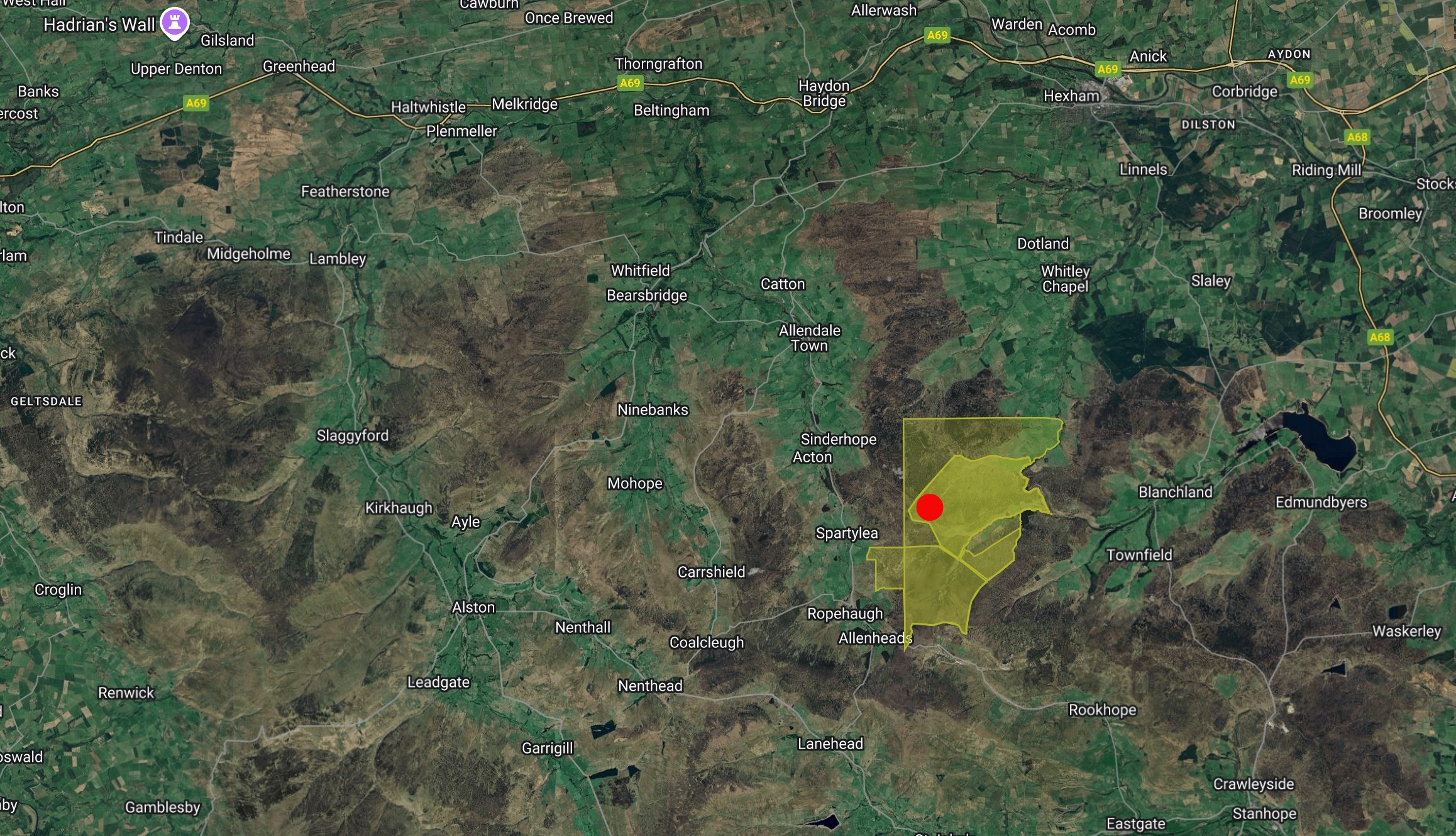
When you zoom in on this map, you’ll be unsurprised to see it is an area dominated by moorland intensively-managed for driven grouse shooting (as demonstrated by the obscene expanse of geometric strips).

According to Guy Shrubsole’s excellent website, Who Owns England?, this grid reference (approximately marked as a red dot on map below) sits on property described as part of the Allendale Settled Estates:

There’s no suggestion that anyone connected to the Allendale Estate is responsible for ‘removing’ Margaret’s satellite tag and/or killing this Hen Harrier. It’s simply a fact that her ‘removed’ satellite tag was found on a grouse moor at this location without any sign of her carcass.

I haven’t seen ANY appeal or press release from Northumbria Police about the suspected illegal killing of this Hen Harrier or the circumstances that led the police to believe her satellite tag had been ‘removed’, presumably cut, over a year ago in October 2024. Not a single word.

I haven’t seen ANY publicity from the National Wildlife Crime Unit-led Hen Harrier Taskforce. This is the specialist group set up explicitly to tackle the ongoing illegal killing of Hen Harriers in England. Not a single word.

I haven’t seen ANY publicity from the police-led national Raptor Persecution Priority Delivery Group (RPPDG), one of whose functions is apparently ‘awareness raising‘ and ‘raising the profile [of illegal raptor persecution] via media exposure‘. Not a single word.

Natural England, who used public funding to pay for the tag, public funding to pay for the fieldworkers to fit the tag to the bird, and public funding to monitor the tag’s subsequent data output, chose not to draw attention to this suspected illegal killing and instead just quietly updated its tag spreadsheet a year later, probably hoping nobody would notice.

I’ve been told by a number of sources that the decision about whether to publicise a crime lies solely with the investigating police force (in this case, Northumbria Police). I’m told that nobody else (e.g. Natural England, National Wildlife Crime Unit’s Hen Harrier Taskforce, the RPPDG) can do this until, or unless, the investigating police force agrees.

That’s understandable in the immediate period after the police have become aware of the crime. They’d want (you’d hope) to be launching an immediate investigation and wouldn’t want the suspects to be alerted because evidence could be removed/hidden before the police have turned up to do a search.

What’s utterly farcical though, is that the investigating police force can ‘sit’ on a case for months, sometimes for over a year, and do nothing, either because (a) their officers are overstretched and don’t have the resources to investigate, (b) their officers are inexperienced or even incompetent, or (c) their officers are corrupt with direct vested interests. Meanwhile, no other organisation, including a specialist police unit, is allowed to mention the suspected crime or appeal for information.

This happens again and again and again with some police forces tasked with investigating raptor persecution on private sporting estates (and some other wildlife crime offences, too, notably fox-hunting). It’s not all police forces by any means – some of them are exemplary and their wildlife crime officers routinely push the limits to try and bring offenders to justice, but some other forces simply aren’t up to the job, for any of the reasons described above.

If it is a ‘rule’ that the investigating police force has supremacy over media output, and other agencies have to sit and wait for a green light that might never come, then this needs to be challenged and changed, especially when there’s a specialist police team waiting on the sidelines ready to act but is effectively handcuffed, blindfolded and gagged. What’s the point of having a specialist team if it doesn’t have the authority to lead on an investigation?

But hang on, Natural England has ‘published’ some details about some of these incidents, albeit very quietly in a spreadsheet that most people don’t even know exists. I suspect they have a duty to do this because public funds are involved.

So why then, in those cases, can’t Natural England accompany that spreadsheet update with a blog, or a press release, or something/anything that would alert the media/public to the ongoing criminality faced by Hen Harriers?

And what’s to stop the other agencies doing likewise? Hen Harrier Margaret ‘disappeared’ and her tag was ‘removed’ over a year ago – you can’t tell me that any publicity now is going to hinder a police investigation!

And besides, I’m blogging about the case, legitimately, using information that’s in the public domain. There’s no reason whatsoever that those agencies can’t do the same.

You’ll be unsurprised to know that Margaret isn’t the last Hen Harrier I’ll be writing about that has ‘disappeared’ in suspicious circumstances in recent months.

I’m also aware that I haven’t recently updated the running ‘death list‘ of missing/dead Hen Harriers…I plan to do this soon, because the tally is racking up, but may not get to it quickly as there’s a lot going on right now.

Alleged killing of Red Kites in Cairngorms National Park – trial of two gamekeepers adjourned as Sheriff recuses himself due to RSPB membership

Following on from this morning’s blog about the start of a two-day trial at Aberdeen Sheriff Court today for two gamekeepers accused of alleged offences relating to the illegal killing of Red Kites in the Cairngorms National Park earlier this year (here), it barely got going before being adjourned until next year.

Red Kite. Photo by Pete Walkden

The Sheriff made a declaration of being a monthly subscriber to the RSPB, which resulted in the two defence KCs (King’s Counsel) lodging a motion that the Sheriff should consider recusing himself because the ‘public might perceive some bias’.

After giving the motion some consideration, the Sheriff agreed to stand down because this case involves RSPB staff members as witnesses for the prosecution.

Unfortunately, no other Sheriff was available immediately to hear the case, so it has been adjourned.

We’ve seen this before, in the trial against another Aberdeenshire gamekeeper back in 2012, where the presiding Sheriff was a member of the RSPB and the defence counsel suggested she should stand down, which she did (see here).

It’s frustrating, and a colossally inefficient use of public money, (and presumably adds extra cost for the defence – KCs don’t come cheap) but inefficiency seems to be a hallmark of the judiciary and it is what it is.

The important issue is that the case is decided on the strength of the evidence, not the perceived bias of a presiding Sheriff.

The case will return to the court in April 2026, this time listed as a four-day trial.

NB: Comments are turned off as legal proceedings are still live.

Two Scottish gamekeepers on trial today in relation to alleged killing of Red Kites in Cairngorms National Park

A trial is underway today at Aberdeen Sheriff Court where two gamekeepers are accused of alleged offences in relation to the illegal killing of Red Kites in the Cairngorms National Park earlier this year.

Red Kite. Photo by Ronnie Gilbert

A Head gamekeeper and an assistant gamekeeper were charged in May 2025 ‘in connection with wildlife offences following enquiries into the death of red kites in the Strathdon area of Aberdeenshire in February, 2025′ (see here).

This is believed to be related to the discovery of a shot Red Kite in the Glenbuchat area of Strathdon between 3rd and 4th February 2025 (see here).

The trial has been scheduled for two days.

NB: Comments turned off as legal proceedings are live.

UPDATE 18.20hrs: Alleged killing of Red Kites in Cairngorms National Park – trial of two gamekeepers adjourned as Sheriff recuses himself due to RSPB membership (here)

Peregrine found with shotgun injuries in Peak District National Park

Derbyshire Police Rural Crime Team posted the following on Facebook on 3 December 2025:

WILDLIFE CRIME AWARENESS – INJURED PEREGRINE

Between 01/09/25 – 08/09/25, we received a report from the Youlgrave [Youlgreave] area that a peregrine falcon had been sadly shot.

After x-rays it showed that the incident caused the bird’s wing to shatter.

X-ray provided by Derbyshire Police Rural Crime Team. Annotated by RPUK

Thankfully, this story doesn’t end in tragedy — the peregrine is alive and currently undergoing rehabilitation.

This post is a reminder that peregrines are legally protected, and it is a criminal offence to intentionally injure or kill them under the Wildlife and Countryside Act 1981.

If you witness wildlife crime or anything suspicious:

Report via 101 or 999

Or report online https://orlo.uk/reportacrime_C7Dn3

If you have any information relating to this incident, please quote 25*580157

Together, we can protect our wildlife

ENDS

It’s not known where or when this Peregrine was shot, but given the extent of its injuries it’s unlikely to have been able to fly far from that location.

I don’t know why it’s taken Derbyshire Constabulary three months to appeal for information on a supposed priority wildlife crime.

Attempt to downlist conservation status of Peregrine Falcons (to allow international trade) is thwarted at CITES conference

To the relief of many raptor conservationists, a proposal to downlist the Peregrine Falcon from Appendix 1 to Appendix II of CITES (Convention on International Trade in Endangered Species), which would allow the capture and trade of wild Peregrines) has been thwarted at the 20th Conference of the Parties on CITES (CoP20), currently taking place in Uzbekistan.

Young Peregrines in the wild, not related to this case (Photo by Ruth Tingay, taken under licence)

Peregrines have been listed as an endangered species on CITES Appendix 1 since 1975, prohibiting international trade of this species, following the catastrophic effect of pesticides on Peregrine populations globally.

Since then, many populations have ‘recovered’ after significant conservation effort over many decades, although recent declines of ‘recovered’ populations are reported in a number of countries, and the species’ status is still poorly understood in many other countries.

Canada and the USA proposed downlisting the Peregrine from Appendix to 1 to Appendix II to allow capture of wild Peregrines and international trade to meet demands for falconry. Here’s a copy of the proposal to the CITES Conference of Parties:

However, a large number of raptor biologists and conservationists from around the world, many of them specialising in Peregrine research, opposed the proposal and warned of the high risk to some populations.

This excellent paper published recently in the scientific journal Animal Conservation explains those concerns:

A vote on the downlisting proposal took place at the CITES Conference yesterday (3 Dec 2025) and did not receive sufficient support to pass and the proposal was rejected.

Here is a note of what happened, published by the International Institute for Sustainable Development (IISD) in its Earth Negotiations Bulletin as part of its daily CITES Conference reporting:

This is good news for Peregrines globally, but I haven’t seen, nor do I understand, the UK’s rationale for supporting the proposal. If any blog readers have information about that, it’d be interesting to read.

Even if the proposal had been agreed at an international scale, national governments would still retain responsibility for regulating ‘wild take’ in their own countries.

You may remember in March this year, Defra endorsed Natural England’s recommendations for a presumption AGAINST the issuing of licences for taking wild birds of prey for falconry (see here).

The theft of wild Peregrines in the UK for trade continues to be a problem. Recent prosecutions include the conviction of two men found guilty of laundering wild Peregrines stolen from nest sites across south Scotland (see here) and an ongoing prosecution of a man in Worcestershire accused of 21 charges relating to the possession and trade of wild Peregrines (here).

More detail on Natural England’s decision to close Hen Harrier Southern Reintroduction Project

Back in September, Natural England announced its decision to end its controversial plan to ‘reintroduce’ Hen Harriers to southern England (see here).

The decision was widely welcomed by conservationists, who had long argued that Hen Harriers don’t need to be ‘reintroduced’ to southern England, or anywhere else in the UK for that matter. They are perfectly capable of breeding in the wild and recolonising their former range, over a relatively short space of time, IF, and only IF, their survival isn’t curtailed by grouse moor gamekeepers shooting, trapping and poisoning them, pulling off their heads and legs, or stamping on their eggs and chicks.

I’ve blogged about this unhinged ‘reintroduction’ plan for years – see here for a series of links to relevant blogs (scroll to end to find the links).

Hen Harrier photo by Pete Walkden

Whilst Natural England’s decision to close the farce was welcome, the reasons behind it were quite vague:

Following a thorough review, it has become clear that Natural England is no longer in a position to provide the long-term funding and resource needed to continue delivering the Hen Harrier Southern Reintroduction project, despite the progress to date. The difficult decision has therefore been made to conclude this project‘.  

I submitted an Freedom of Information request to Natural England on 16 September 2025, asking for further detail.

On 13 October 2025 Natural England refused my request, saying it was ‘manifestly unreasonable’ because the cost of providing the information requested would exceed the ‘appropriate limit’ as laid out in the regulations.

Here’s a copy of NE’s response:

Hilariously, Natural England’s response included this line:

While Natural England supports openness and transparency, we also have a duty to ensure the effective and responsible use of public funds‘.

I’ll come back to that later in this blog.

Even though NE refused my request, it was still under obligation to assist with my enquiry,, within its cost limitations, so NE gave me two options:

  1. That it would provide a summary of the rationale for the Hen Harrier Southern Reintroduction Project closure, or
  2. That it would provide redacted documentation and a meeting schedule outlining key discussion topics.

I chose option 1, and on 10 November 2025 Natural England provided me with this summary document:

This document reveals that two of the wild-disabled captive-held Hen Harriers, brought over from Europe to form the core breeding programme, have since died (cause of death is not given), leaving just four breeding pairs in captivity. In 2025, those birds failed to breed successfully for the third consecutive year.

In addition to this, funding cuts to Natural England, and a demand for increased payment from the International Centre for Birds of Prey (ICBP) to manage the unsuccessful captive breeding programme, meant the project became unviable.

The document states, ‘Natural England has spent heavily on outsourcing breeding to ICBP, with the agreement ending in March 2026‘ [with an additional two-year extension granted].

So what does ‘spent heavily‘ actually mean? How much public funding has Natural England/Defra actually wasted on this pointless project?

Well, according to a Parliamentary response to a written question from Tory MP Kevin Hollinrake in November 2025, NE/Defra is said to have spent a whopping £572,272.

Over half a million pound’s worth of public funding, with nothing to show for it? Good grief.

But take a close look at that parliamentary response from Defra Under-Secretary Mary Creagh MP. It states this funding was spent between March 2021 and October 2025.

So what about the money spent prior to March 2021? Why hasn’t that been factored in?

We know that planning and preparation for this project began as early as 2016 (see here), and has included numerous trips to France & Spain by the project team, trying to persuade the Europeans that sending Hen Harriers to the persecution-infested UK is a good idea, and even included paying for satellite-tags for Harriers in Spain in an attempt to curry favour with the Spanish authorities (see here).

That won’t have been cheap!

How much, in total, has this useless project cost us? And how does Natural England justify spending so much of our money given its “duty to ensure the effective and responsible use of public funds“?

Meanwhile, further north, Hen Harriers continue to be killed illegally on driven grouse moors. Natural England says it has spent £80,800 on the ludicrous Hen Harrier brood meddling trial (the project itself will have cost a great deal more than this but the cost of satellite-tags and doing the actual brood meddling is believed to have been privately funded by grouse moor owners).

Mary Creagh says that a total of 15 Hen Harrier nests were brood meddled, resulting in 58 Hen Harrier chicks subsequently released. She seems to have forgotten to mention that over half of those released birds (at least 31 of the 58) later ‘disappeared’ in suspicious circumstances and/or were illegally killed.

Value for money and public benefit? Not in my book.