Massive decline in Cairngorms National Park Peregrine population linked to intensive grouse moor management

Press release from Cairngorms National Park Authority (24 November 2025)

PEREGRINE NUMBERS IN DECLINE IN CAIRNGORMS NATIONAL PARK

The last UK-wide survey of peregrines took place in 2014 and covered Scotland as a whole, showing a 9% decline in numbers across the country. The Scottish Raptor Monitoring Scheme also found some evidence of a decline from 2009-18; however, no survey was undertaken to assess peregrine populations specifically within the National Park during that time.  

In 2024 the Cairngorms National Park Authority collaborated with three of the regional branches of the Scottish Raptor Study Group: Highland, North East of Scotland and Tayside and Fife, to carry out a survey to establish how many peregrine sites within the National Park were occupied and assess their breeding success.   

Peregrine photo by Pete Walkden

Raptor Study Groups have records going back to the 1960s of sites where peregrines have bred within the Cairngorms National Park and these were used as the basis for the survey. The study shows that the estimated number of peregrine pairs in the breeding season within the National Park has declined by 56% since 2002, with less than half of territorial pairs successfully fledging young in 2024. 

Contributing factors are likely to include upland land management practices, decreased prey availability for peregrines, wildlife crime and, more recently, outbreaks of Avian Flu.  

It is a complex picture, and more research is needed to understand the key factors and gain a better understand of upland raptor population dynamics – including interspecific competition (ie competition for resources between individuals of different species) and the influence of prey availability. It will require action from the Park Authority working with a range of partners, including the Raptor Study Groups, NGOs and estates on the ground, as well as NatureScot and other public bodies, to explore what can be done to try and turn the tide for peregrine and all raptors in the National Park.  

Dr Sarah Henshall, Head of Conservation at the Cairngorms National Park Authority, said: “This is the first time we have been able to get a clear view of peregrine falcon numbers in the National Park and it paints a bleak picture. We will be working closely with Raptor Study Groups, estates and other experts to explore a range of options such as the installation of nest cameras to help us understand bird behaviour, DNA work to support wildlife crime prevention initiatives and GPS tagging to get information on bird movements and survival

Our ongoing conservation work, from ecological restoration to increasing the sustainability of moorland management, aims to benefit habitats for peregrine and other key upland species. This survey further highlights the importance of this work and strengthens our resolve to help this iconic bird thrive.” 

ENDS

The report can be read / downloaded here:

My commentary:

The continued decline of Peregrines in the Cairngorms National Park comes as no surprise whatsoever, and its link to intensively-managed driven grouse moors even less so.

The illegal persecution of Peregrines on driven grouse moors is an issue that has been documented repeatedly in scientific papers since the early 1990s, nationally (e.g. see here) and regionally (e.g. see here for research from northern England). A particularly illuminating paper published in 2015 reported specifically on the decline of breeding Peregrines on grouse moors in North-East Scotland, including those on the eastern side of the Cairngorms National Park (here).

This latest report from the Cairngorms National Park Authority, based on fieldwork undertaken by the Scottish Raptor Study Group, is a welcome addition to the literature and will help inform the new requirement (under the Wildlife Management & Muirburn Act 2024) to monitor and report every five years on the status of a number of raptor species (Peregrine, Golden Eagle, Hen Harrier & Merlin) on grouse moors in Scotland as a measure of how well / badly the legislation is working.

The report’s findings are cautious, citing a number of factors that could be potential drivers influencing the recent decline (e.g. Bird Flu, interspecific competition etc) but these cannot, and do not, account for the long-term decline of Peregrines in the uplands, either within the Cairngorms National Park or in other upland areas. I’m pleased to see the report acknowledge this.

Let’s not kid ourselves. The Cairngorms National Park Authority has known for some time that illegal raptor persecution is a huge issue within the Park boundary – check out what the CNPA was proposing in 2013 to tackle the problem (see here) – unsurprisingly, it didn’t work.

The latest report includes an analysis of the relationship between Peregrine breeding site occupancy and the intensity of grouse moor management (ranging from ‘low’ to ‘high’ management intensity and everything in between).

The results speak for themselves:

Hen Harrier found dead in Northumberland National Park with shotgun damage to satellite tag

This is a blog about one of those dead Hen Harriers for whom we’ve been waiting over a year for Natural England to confirm the cause of death.

A Hen Harrier (photo by Pete Walkden)

The young Hen Harrier in question (Tag ID: 254843) was fitted with a satellite tag when she was a nestling in Northumberland on 5 July 2024.

In Natural England’s HH spreadsheet that was updated in August 2024, her status was given as follows:

Date of last contact: 29 July 2024

Location of last contact: Northumberland

OS reference: Recovered awaiting PM

Status: Dead

There were no further details provided until 14 months later, when Natural England quietly updated its spreadsheet in October 2025. This bird’s status was now given as follows:

Date of last contact: 29 July 2024

Location of last contact: Northumberland

OS reference: NY824937

Status: Dead

Notes on Loss: The recovered carcass was not suitable for any PM owing to level of decomposition

The grid reference places the last location in an upland area of Northumberland National Park, to the north east of Kielder Water. This area of moorland is not known to be a raptor persecution hotspot – indeed it’s one of the few strongholds for Hen Harrier breeding attempts in England – and there was nothing in Natural England’s spreadsheet notes to suggest she had been killed illegally. So we’re led to conclude it was a probable natural death.

Last known location of Hen Harrier 254843 according to Natural England info

But hang on a minute.

I’ve recently found a fascinating blog posted within the depths of the National Wildlife Crime Unit’s (NWCU) website that tells a very different story. It was published on 10 October 2025 and is entitled, ‘Cracking the Case: How Experts Uncovered the Truth Behind a Hen Harrier’s Mysterious Death‘.

The original blog can be read here, and I’ve copied it here incase the link is broken in the future:

When a young female hen harrier known as 254843 took her first flights over the moorlands of Otterburn, Northumbria, in July 2024, she became part of a vital conservation effort. Fitted with a satellite tag by Natural England (NE), this small device would help scientists track her journey, monitor her wellbeing, and contribute to the protection of one of the UK’s most threatened birds of prey.

But just weeks later, her signal stopped. What initially appeared to be a tragic but natural loss of a young bird soon revealed something far more sinister and set in motion a remarkable multi-agency investigation into suspected wildlife crime.

When NE staff noticed that 254843’s satellite tag had stopped transmitting, they followed established procedures to locate her. The bird’s remains were found roughly 1.2 kilometres from her nest close to where she had been learning to hunt under her parents’ watchful eyes. At first, the team suspected natural predation.

The remains of HH 254843 (photo Natural England)
HH 254843 with damaged tag (photo Natural England)

However, during recovery, one small detail caught their attention — a small, round dent and hole in the satellite tag. It was an anomaly that couldn’t be ignored.

This discovery triggered the involvement of the UK National Wildlife Crime Unit (NWCU) and the Harrier Task Force (HTF). Working closely with Natural England, the Northumbria Police Rural Crime Team, and scientific experts, they began piecing together what had really happened.

The first step was to send the remains and the tag to the Zoological Society of London (ZSL) for a detailed postmortem. Due to the bird’s advanced decomposition, the pathologists couldn’t confirm a cause of death, but their findings were enough to justify further forensic testing.

Radiograph of the carcass of HH 254843 and her satellite tag (photo by ZSL)

From there, the investigation moved to Nottingham Trent University (NTU), where specialists used CT scanning and chemical analysis to examine the damaged tag. Their results revealed elevated levels of lead around the hole a crucial clue pointing toward a lead-based projectile.

Finally, the tag was analysed by a ballistics expert from the Scottish Police Authority (SPA). The verdict: the damage was consistent with being struck by a shotgun pellet, likely from a birdshot cartridge fired from below the flying bird. Tests confirmed traces of lead, and the impact trajectory supported the theory of a shotgun discharge at an estimated distance of up to 30 metres.

The conclusion was clear. This was no accident of nature. It was a deliberate act of wildlife crime.

Shotgun damage to HH 254843’s satellite tag (photo by Scottish Police Authority)

Thanks to the combined expertise of scientists, conservationists, and law enforcement, the incident has been officially recorded as criminal damage. Each satellite tag costs around £2,800, not including the significant resources dedicated to fitting and monitoring them but the real loss is far greater, representing another blow to hen harrier conservation efforts.

The investigation also led to important lessons for future responses. New procedures now ensure that if anything suspicious is discovered during a bird recovery — no matter how small — the process halts immediately, and police take over to conduct a forensic recovery. This prevents potential evidence from being lost and strengthens the chance of bringing perpetrators to justice.

This case demonstrates the high level of skill, coordination, and dedication required to detect and investigate wildlife crime. From the precision of CT imaging and chemical testing to the meticulous work of forensic ballistics experts and the vigilance of conservation field teams every partner plays a crucial role.

It also serves as a reminder that wildlife crime is not victimless. Each illegal act damages not only individual animals but also the broader ecosystem and the tireless efforts of those working to protect it.

The public can play their part too. If you have any information about this incident or any suspected wildlife crime please report it.

Every report helps protect the wild places and species that make our countryside unique and ensures that those who threaten them are held accountable.

ENDS

It’s clear from the NWCU blog the extent of the effort, by multiple partners, to determine what happened here, and I applaud them for it.

I’m less impressed that this information hasn’t been given the media attention it deserves, nor that a link to the NWCU blog hasn’t been added to Natural England’s spreadsheet entry about the circumstances surrounding this Hen Harrier’s death. It really isn’t difficult.

I’m also interested that the NWCU blog states, “…the incident has been officially recorded as criminal damage“. This is presumably in reference to the shotgun damage caused to the satellite tag.

I wonder, though, how the death of Hen Harrier 254843 has been officially recorded…’Unknown’? ‘Suspicious’? ‘Illegally killed’?

The blog says, “The conclusion was clear. This was no accident of nature. It was a deliberate act of wildlife crime”. So why doesn’t Natural England’s spreadsheet reflect this?

Pre-trial hearing for ex-gamekeeper accused of shotgun murder of former colleague

There was a virtual pre-trial hearing at Glasgow High Court yesterday in the case against David Campbell, the former Head Gamekeeper of Edradynate Estate in Perthshire, who is accused of murdering a former colleague, Brian Low, whilst Mr Low was walking his dog on Leafy Lane, near the Pitilie Track close to Aberfeldy in February 2024 (see here for background).

The pre-trial hearing, before Lord Cubie, heard that one of the prosecution witnesses, Michael Campbell (no relation, and believed to be the owner of Edradynate Estate) has since died, but the case continues.

Both the accused and victim were formerly employed on Edradynate Estate, Perthshire. Photo by Ruth Tingay

David Campbell, now 76, is alleged to have discharged a shotgun at 65-year-old retired groundsman Brian Low, leaving him so severely hurt he died at the scene. It is alleged that Campbell did this after disabling CCTV cameras at Tigh Na Caorann, Crieff Road, Aberfeldy, in an “attempt to conceal” his whereabouts.

Campbell faces a separate charge of attempting to defeat the ends of justice following Mr Low’s alleged murder. It is alleged between 16 February and 24 May 2024 he disposed of an Walther RM8 Rotex airgun – for which he allegedly did not have a certificate – at an unknown location.

He is further said to have got rid of the shotgun and a gun bag, also at a spot unknown to prosecutors.

Campbell is also accused of going to Crighton’s Cycles, Blairgowrie, and having two replacement tyres fitted on an electric bicycle, which prosecutors believe was used by him in the commission of the murder.

It is also alleged that Campbell disposed of a box, cartridge bag and bicycle tyres at Aberfeldy Recycling Centre.

Campbell further faces five breach of the peace allegations dating back to the mid-90s.

It is alleged some time in July 1995, he threatened a man called Alan Stewart and placed him in a state of fear and alarm.

Prosecutors further allege that on a date between 1 March and 31 May 1997, Campbell conducted himself in a disorderly manner at the Edradynate Estate, Aberfeldy and threatened to shoot worker Gregor Forrest.

Campbell has also been accused of threatening to shoot another man, Richard Wright, also at Edradynate Estate between 1 June and 31 August 1999.

It is further alleged that between 1 June and 30 September 2011, Campbell threatened to shoot a fourth man, Maksymillan Konchanski, at The Square, Aberfeldy.

And he is also accused of threatening to shoot a woman’s dog at Ardlach House, Aberfeldy, sometime between 1 June and 30 September 2012.

Campbell has previously pleaded not guilty to all charges and his defence advocate, Tony Lenehan KC, has lodged a special defence of alibi in connection with the murder charge.

Campbell remains on remand and his trial date has been set to begin on 2 February 2026 at Glasgow High Court before judge Lord Scott and is expected to last for three weeks.

PLEASE NOTE: As this case is live, comments are turned off until proceedings conclude.

[Information sourced from various news reports]

Man arrested after five Red Kites found poisoned in Essex

Statement from Essex Police posted on social media, 21 November 2025:

An Aveley man has been arrested after five red kites were found dead in a field in Orsett.

Our Rural Engagement Team is investigating because killing or harming birds of prey is a criminal offence.

PC Luke Jones says: “Red kites, along with all birds of prey, are protected under the Wildlife & Countryside Act 1981.

Tests have shown that they were poisoned. The poisons used are deadly not only to wildlife but also to humans.

Anyone who finds a dead bird of prey or suspects illegal activity should report the information to police via our website.

But please take care not to touch them“.

The man has been released under investigation and our inquiries continue.

ENDS

There’s no further information available, such as when the Red Kites were found or the poison(s) used.

Red Kite. Photo by Ronnie Gilbert

New report on gamebird releases in Cairngorms National Park doesn’t tell even half the story

In spring 2025, news emerged that the GWCT (Game & Wildlife Conservation Trust) was going to be conducting a pilot study to look at the number of non-native gamebirds (Pheasants & Red-legged Partridges) being released into the Cairngorms National Park (see here).

Unhealthy-looking Pheasant poults being transported to a release site. Photo by Ruth Tingay

This research represents the first step of a commitment made by the Cairngorms National Park Authority in its 2022-2027 Partnership Plan to assess the impact of these non-native species on habitats and native wildlife (see here for an hilarious video of a 2021 Park Board meeting where certain members tried to block the idea).

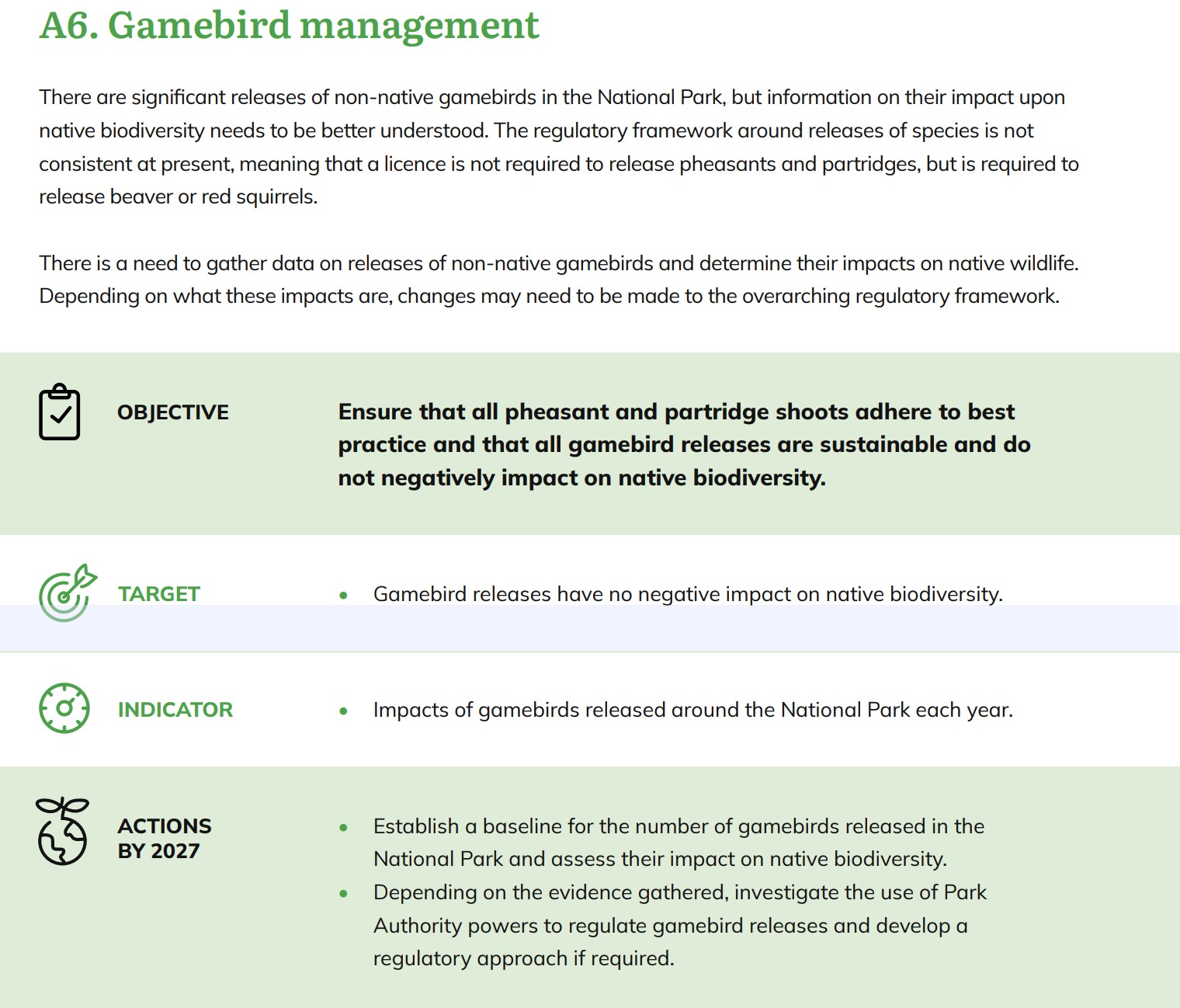
Here’s the relevant information page from the CNP’s current Partnership Plan:

The GWCT’s report was published in August 2025 but to be perfectly honest, it’s somewhat underwhelming (report available for downloading at foot of this blog).

The most significant limitation, in my view, is that the report only includes data from ten of at least 22 sporting estates known to be rearing and releasing gamebirds for shooting within the Park’s boundary. That’s only 45%, not even half of the estates involved in gamebird releases, and there is no indication of how representative those ten estates are.

That’s not a criticism of the study’s authors – they are upfront about this significant constraint and they had tried to include information from the 22 estates that they had been told were rearing and releasing gamebirds within the Park, but three shoots were in the process of changing management so were unable to answer questions, two shoots were ‘too busy’ at the time the interviews were scheduled, and seven shoots refused to participate.

I do have a criticism of the study design. To identify the estates rearing and releasing gamebirds in the CNP, the authors used their existing contacts as well as a ‘snowball sampling’ strategy, where participants suggest other potential participants. However, since 2006 it has been compulsory to register with the Animal Plant & Health Agency’s (APHA) Poultry Register when more than 50 gamebirds are released. It is entirely feasible to submit FoIs to APHA to access those data based on postcodes or council areas, just as Guy Shrubsole did in England. I wonder why the GWCT didn’t use this approach? Perhaps they suspected that compliance with the Register might be low and they didn’t want to draw attention to it?

Going forward, as more work is most definitely needed, researchers can access the Government’s Scottish Kept Bird Register, which replaced the Poulty Register in Scotland in 2024 and also requires mandatory reporting. There’s no reason that staff at the Cairngorms National Park Authority, or indeed anybody reading this blog, couldn’t request data covering the National Park.

Due to the limited number of estates available/willing to participate in the study, the authors relied on data from the National Gamebag Census (a voluntary reporting scheme used by some shoots to record the number of birds killed during a shoot season) to compare the number of gamebirds they’d been told were being released on ten shoots in the CNP with release densities in the wider Scottish countryside and also in England.

One of the study’s headline claims was that across ‘all’ shoots in the CNP (meaning just the ten participating estates), the total number of birds released in seasons 2022/3, 2023/4 and 2024/5 were 50,900, 61,200 and 49,800 Pheasants and 8,000, 36,000 and 29,240 Red-legged Partridges. The report states that the release densities “are lower than those reported from Scotland as a whole“.

The problem with this headline claim is that the results will be, and have already been, either genuinely misunderstood or deliberately misrepresented, without reference to the pretty big constraints in data sampling as discussed above.

I heard an MSP reference this report several times during a Parliamentary debate earlier this week (more on that shortly because it was really interesting) and it was inferred that the report’s findings related to gamebird releases in the whole of the Cairngorms National Park, not just the small number of estates that actually participated in the study, representing less than half of the known shoots and whose representative value is unknown.

I would like to see the briefing notes given to that MSP by the gamebird shooting industry to see whether they have deliberately misrepresented the study’s findings or whether the MSP has just genuinely failed to grasp the details. I will return to this topic.

Of wider importance, the question now is, what will the Cairngorms National Park Authority do with the findings of this report it commissioned?

One of the ‘Actions by 2027’ outlined in the Park’s 2022-2027 Partnership Plan is to ‘Establish a baseline for the number of gamebirds released in the National Park and assess their impact on native biodiversity‘.

Given that it’s now the end of 2025 and it’s still not known how many non-native gamebirds are released within the National Park boundary, let alone what their impact may be on native species, I’d say meeting this deadline looks unlikely.

You can read /download the GWCT report here:

Satellite-tagged Hen Harrier ‘Circe’ disappears in suspicious circumstances in Moorfoot Hills, south Scotland

Press release from Hen Harrier Action (20th November 2025)

HEN HARRIER ACTION APPEALS FOR INFORMATION AS ANOTHER RARE HEN HARRIER SUSPECTED TO HAVE BEEN ILLEGALLY KILLED IN SCOTLAND

  • A satellite tagged Hen Harrier, ‘Circe’, suddenly disappeared in the Moorfoot Hills, south of Edinburgh
  • As numerous recent incidents have shown, satellite tagged Hen Harriers that disappear in suspicious circumstances are highly likely to have been illegally killed
  • Hen Harrier Action are appealing for information which could help with the investigation

Thanks to donations from supporters in 2025, Hen Harrier Action funded the purchase of four satellite tags to monitor the movements of Hen Harriers in the UK.

One of the tags was fitted by RSPB staff to a juvenile female Hen Harrier named Circe before she fledged from her nest on Tarras Valley Nature Reserve – a community-led rewilding project in Langholm, Dumfries and Galloway.

Hen Harrier ‘Circe’ being fitted with a satellite tag in 2025

In the days leading up to her disappearance Circe ranged across the Moorfoot Hills, south of Edinburgh. Her tag data shows that the tag was regularly transmitting but then sudden stopped with no sign of tag malfunction. The disappearance was reported to the National Wildlife Crime Unit and the area was searched but no body or tag has been found. Sudden stops without the tag being found are a huge concern, often indicating that the bird has been illegally killed.

Circe’s last transmission was on Tuesday 14th October at 2.07pm, not far from the well-known standing stones at Greenfieldknowe and the hiking trails around Whiteside Edge and Loncote Hill. She was less than four months old.

Though a legally protected species, Hen Harriers are one of the UK’s scarcest and most persecuted birds of prey in the UK. Dozens are satellite tagged each year to monitor their movements and wellbeing with the support of charities like the RSPB and local raptor groups. But despite being heavily protected in law for decades, many go missing each year due to suspected and confirmed illegal killing. In an effort to locate the body of Circe the charity has issued an appeal for information.

Hen Harrier Action trustee Adrian Rowe said “We are devastated by the loss. Circe was a healthy, thriving Hen Harrier and we had high hopes that she would go on to find a mate and raise a family. We know that the area is a popular walking route, and we are appealing for anyone who might have seen anything suspicious that Tuesday afternoon, or come across a dead bird of prey in the area, to get in touch.

If you have information that could help, please call the RSPB’s Raptor Crime Hotline on 0300 999 0101, or the Wildlife Crime team at Police Scotland on 101.

ENDS

Well done to Hen Harrier Action for issuing a press release.

Hen Harrier Action has published the coordinates of Circe’s tag’s last known transmission, which according to Andy Wightman’s excellent website, Who Owns Scotland, appears to have come from the Portmore Estate, although no detail is provided about the tag’s transmission cycle or the accuracy of the final fix.

Red line = boundary of Portmore Estate. Orange X indicates last known transmission from Circe’s satellite tag.

There is no suggestion that Circe was killed on the Portmore Estate. I’m not aware of any previously reported illegal persecution incidents on this estate.

However, the wider Moorfoot Hills area is well-known as a hotbed of illegal raptor persecution, with many confirmed incidents of poisoning, shooting, illegal traps and ‘disappearing’ satellite-tagged raptors over the last 20 years.

Indeed, the Moorfoot Hills is where Golden Eagle ‘Merrick‘ was killed over two years ago, whilst she was asleep in a tree. Police Scotland believe she was shot and then her corpse was removed and her satellite tag destroyed in an attempt to hide the evidence.

A long-overdue decision is expected from NatureScot about whether a General Licence restriction will be imposed in relation to that appalling crime.

Other ‘missing’ satellite-tagged raptors in south Scotland at the moment include two Golden Eagles that vanished at the end of August (see here).

New independent report reveals locations of poisoned raptors in northern England, 2015-2023 – information that has been suppressed by government

Press release from independent group, Wildlife Poisoning Research UK, 15th November 2025.

WHERE THE POISONED BODIES WERE FOUND!

Many people probably imagine that the use of poisons to kill protected wildlife is something out of the pre-Victorian era, like cock fighting and bull baiting.  However, this senseless and cruel slaughter is still happening in Britain, with many mammals and birds of prey suffering horrific and agonising deaths, even though this practice has been banned since 1911.

It is a crime which not only kills wildlife, but also kills much loved family pets and can even kill people.  This is a wildlife crime that frequently occurs on remote and private land where the chance of detection is very low and most victims are never found.  Those cases which are reported and then investigated must be considered to be a very small tip of a very large ‘iceberg’ of sickening rural felonies.

An illegally poisoned Red Kite (photo via WPRUK)

In 2017, in an attempt to combat this wildlife crime, the UK Government initiated a project to map incidents of illegal bird poisonings.  This provided information to the public and other interested parties as to where these crimes were taking place and it was intended that these maps would be updated annually to “provide an invaluable intelligence tool to help fight crimes against birds of prey” (Defra press release 2017).

It now appears that these wildlife poison crime maps have not been updated and there is very little governmental action informing the public that these crimes are still occurring and wildlife is still being deliberately poisoned.

Wildlife Poisoning Research UK (WPRUK) works to place information about the environmental impact of pesticides, biocides and other toxic chemicals into the public domain so that the general public and the media have a better understanding of this situation.  Data on cases of deliberate poisoning of birds has been obtained using Freedom of Information requests.  This has enabled WPRUK to produce maps showing where these poisoned birds have been found.  This is information which the Government, for whatever reason, has now apparently declined to put into the public domain.

WPRUK has now released a report pinpointing where the poisoned birds have been found in Northern England.  Future maps will cover other parts of the UK.

Between 2015 to 2023, the bodies of 73 legally protected birds, mostly birds of prey, were found in Northern England.  These birds had been illegally and deliberately killed using poisons; 31 birds being Schedule 1 Wildlife and Countryside Act (1981) species, which have the highest level of protection.  Due to the very small chance of poisoned birds being found, the real numbers of birds being killed by this criminal activity is likely to be far higher.  To date, no one has been convicted for killing any of these 73 birds.

There were two areas in Northern England where particularly high numbers of poisoned birds were found.  These were Nidderdale in North Yorkshire and the Glapwell area in Derbyshire.

Releasing the report, Dr Ed Blane from WPRUK said: “The fact that 114 years after this sickening practice was banned, individuals are still poisoning our wildlife is deeply disturbing.  People visit the countryside to enjoy nature and they will be truly alarmed to learn that poison is still being used to kill wildlife.”

If this continues it might severely impact on plans to re-introduce white tailed eagles to Northern England.  In the Southern England eagle project, at least 2 birds have been killed by poison.

A comment from Steve Downing Chairman Northern England Raptor Forum:

We proudly, and rightly, identify ourselves as a nation of nature lovers.  Every year tens of thousands of tourists, both domestic and foreign, visit the historic and beautiful countryside throughout the North of England to enjoy the scenery and stunning birds of prey that it supports.  Collectively they spend £millions supporting our rural communities.  What the visitors don’t see is the underbelly of criminality in the countryside where the barbaric practice of deliberately poisoning raptors persists today, as highlighted by the bodies found in Nidderdale, North Yorkshire and around Glapwell in Derbyshire.  Thanks to Ed, a spotlight is being shone on this shocking pernicious activity raising public awareness of the danger presented by these lethal poisons, both to themselves and local birds of prey.

Bob Elliot CEO of Wild Justice said:

Illegal wildlife poisoning hasn’t faded into history; it’s still being carried out in the shadows with very little oversight.  These findings show that wildlife species are still being killed with impunity, and the public is being kept in the dark about the scale of it.  Without transparency, enforcement and the political will to confront those responsible, this criminal abuse of our countryside will continue unchecked.

ENDS

The report can be read / downloaded here:

Worcestershire man faces 21 charges in relation to possessing & trading wild Peregrines

A 57-year old man appeared at Worcester Magistrates’ Court on 11 November 2025 accused of 21 offences relating to the keeping and trading of wild Peregrines, alleged to have taken place between 2018 and 2022.

Young Peregrines in the wild, not related to this case (Photo by Ruth Tingay, taken under licence)

Ross Loader, of California Lane, Welland, Malvern is accused of 11 counts of having in his possession or control live wild birds (Peregrines) and eight charges of keeping / possessing / controlling unregistered Schedule 4 birds (Peregrines) contrary to the Wildlife and Countryside Act 1981.

It is further alleged that Loader sold a Peregrine and also knowingly or recklessly made a false declaration, namely claiming the Peregrines were captive bred birds, in order to obtain a certificate.

Loader has not entered a plea to any of the 21 charges. He is expected to do so at the next court appearance on 9 December 2025.

Court details from Worcester News.

NB: Comments are turned off as criminal proceedings are live.

Sparrowhawk shot in Towcester – Northants Police appeals for information

Press release from Northants Police (14 November 2025)

BIRD OF PREY KILLED IN TOWCESTER

Police officers from the Rural Crime Team are appealing for witnesses after a bird of prey was found dead in Towcester.

The Force were contacted by the RSPB following a report from a member of the public that a Sparrowhawk had been found dead in Redcar Road.

Following enquiries, it is believed the protected bird had been shot by a type of rifle sometime between 8am on Thursday, November 6 and 11.30am on Friday, November 7.

Sparrowhawk (photo by Ronnie Gilbert)

PC Emerson Knights of the Rural Crime Team said: “Sparrowhawks are protected under the Wildlife and Countryside Act 1981, and it is an offence to intentionally or recklessly kill or injure them.

We believe this Sparrowhawk was fatally injured after being shot with either a high-powered air rifle or small calibre rifle and would like to hear from anyone who may be able to identify the person responsible for the bird’s death.”

Witnesses or anyone with information are asked to call Northamptonshire Police on 101 or alternatively contact Crimestoppers on 0800 555 111.

ENDS

Scottish Minister Jim Fairlie provides rationale behind proposed amendment to close loophole on grouse shoot licence

Earlier this month, the Scottish Government announced its commitment to closing the loophole on the grouse moor licences that were sabotaged last year by the powerful grouse shooting lobby.

If you recall, grouse moor licensing was introduced as part of the Wildlife Management & Muirburn (Scotland) Act 2024, as a result of the continued illegal killing of birds of prey on grouse moors and the associated difficulties of identifying an individual suspect and prosecuting them.

The idea was that a licence to shoot Red Grouse could be amended / withdrawn / revoked by NatureScot if evidence showed that illegal raptor persecution had taken place (importantly, based on the civil burden of proof, i.e. balance of probability, rather than the criminal burden of proof, i.e. beyond reasonable doubt). It was expected that the licence would cover an estate’s entire landholding, not just the areas where Red Grouse are shot, because raptor persecution crimes often take place beyond the boundary of the moor (e.g. in woodland).

However, in November last year, the licences were significantly weakened after legal threats from the grouse shooting industry. Instead of now covering an entire estate, it was announced that the licence holder could decide on the extent of the area the licence covered, specifically the area where Red Grouse are ‘taken or killed’.

Effectively, this could mean simply drawing an arbitrary line around their grouse butts, denoting the reach of a shotgun pellet, and argue that THAT is the area where they take/kill grouse and thus that should be the extent of the licensable area:

Photo of a line of grouse-shooting butts by Richard Cross, annotated by RPUK

There has been a year of prolonged campaigning to get this loophole closed, mostly behind-the-scenes and led by Green MSP Mark Ruskell and RSPB Scotland – they deserve our gratitude because without their efforts, this loophole would have been left wide open.

When Minister Fairlie announced his intention to close the loophole, by introducing a proposed amendment to the Natural Environmental (Scotland) Bill which is currently making its way through Parliament, the precise details of his amendment were not known so although his announcement was welcomed, there was still some skepticism about whether the amendment would be fit for purpose.

The proposed amendment has now been published and Minister Fairlie has written a detailed explanation.

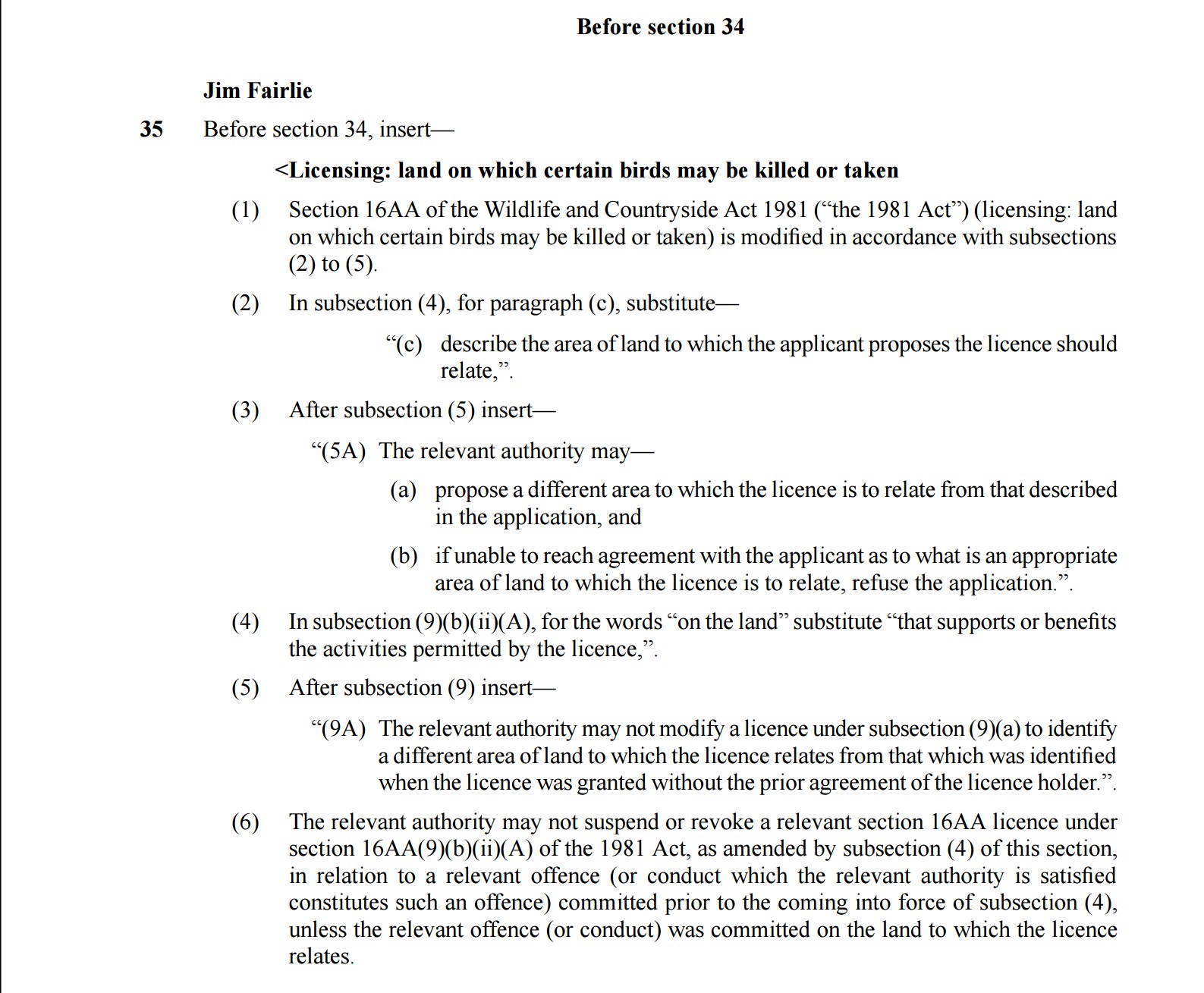
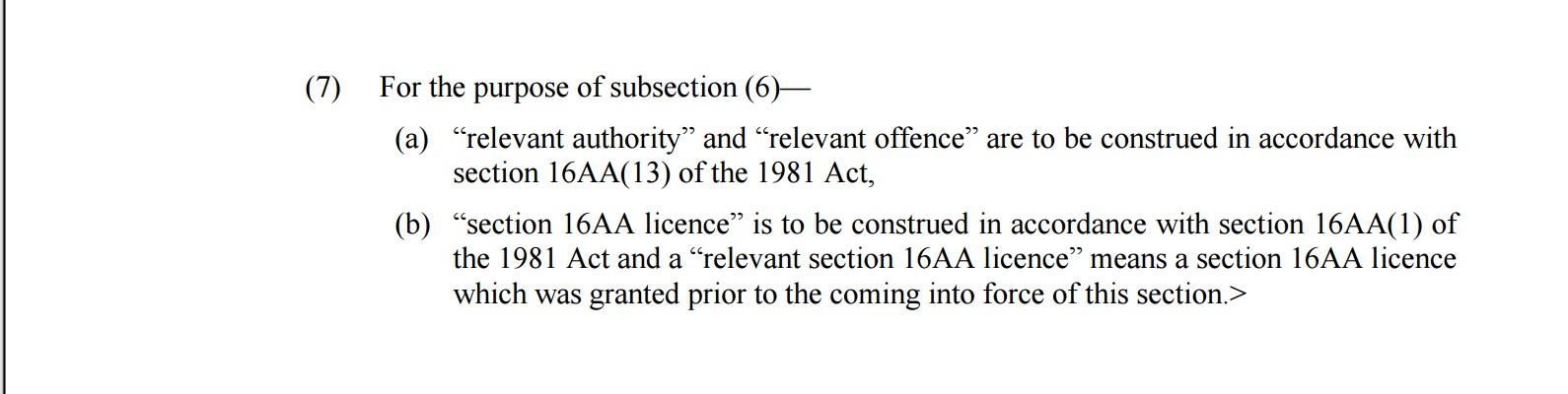
First, here’s the proposed amendment, which was lodged on 7 November 2025:

On first appearances, this looks to be pretty robust. Although it still offers room for ‘negotiation’ between the licensing authority (NatureScot) and the licence applicant about the extent of the licensable area, it is clear that if agreement is not reached, then NatureScot has the authority to refuse the licence application altogether.

That’s good, assuming that NatureScot will stand up to the powerful land-owning lobby. That’s by no means assured though, so we might expect that NatureScot’s decision-making process is laid out in writing so it is transparent for all those interested and fair to all licence applicants, in the same way that NatureScot has published the decision-making process it uses when assessing whether to impose a General Licence restriction on estates where there is evidence to support a suspicion of wildlife crime taking place.

Minister Fairlie’s amendment also removes the controversial issue of a reduced licensed area, rather than the licence applying to an estate’s entire landholding, as believed to be intended by Parliament when the Wildlife Management & Muirburn Act was passed. So instead of limiting the licensable area to only being applicable “on the land” [where Red Grouse are taken or killed], the amendment suggests that the licence could be withdrawn/revoked if a relevant offence takes place anywhere on the landholding “that supports or benefits the activities permitted by the licence“, i.e. grouse shooting.

It looks like this amendment will also bring back all the relevant offences that could result in a licence suspension/revocation, which were removed when NatureScot made changes to the licence in November last year (see here). This means that offences under the Protection of Badgers Act 1992, Wild Mammals (Protection) Act 1996, Conservation (Natural Habitats etc) Regulations 1994, Animal Health & Welfare (Scotland) Act 2006, Hunting with Dogs (Scotland) Act 2023), would all come back in to play. Excellent.

After notifying the Scottish Parliament’s Rural Affairs & Islands Committee (the committee scrutinising the Natural Environment Bill) of his intention to bring an amendment to close the grouse shoot licence loophole, Minister Fairlie was asked by the Committee Convenor to explain his rationale for his proposed amendment.

Minister Fairlie’s explanation is clear and well worth a read:

Amendments to the Natural Environment Bill stage 2 will be debated in Parliament next Wednesday (19 November 2025).