
Press release from National Trust (18 August 2025)
LATEST HEN HARRIER FLEDGLINGS RECEIVE PROTECTIVE SATELLITE TAGS IN THE PEAK DISTRICT
- Two hen harrier chicks from a nest found on National Trust land, raised by the adult birds featured on Springwatch, have been tagged to protect them from persecution.
- The RSPB tagged the chicks thanks to support from the National Trust and the Peak District National Park, and with the help of the Peak District Raptor Study Group.
- Satellite tagging provides a valuable insight into the preferences and behaviour of these birds, as well as building vital evidence to enable their protection.
- Hen harriers are one of the UK’s most persecuted birds.
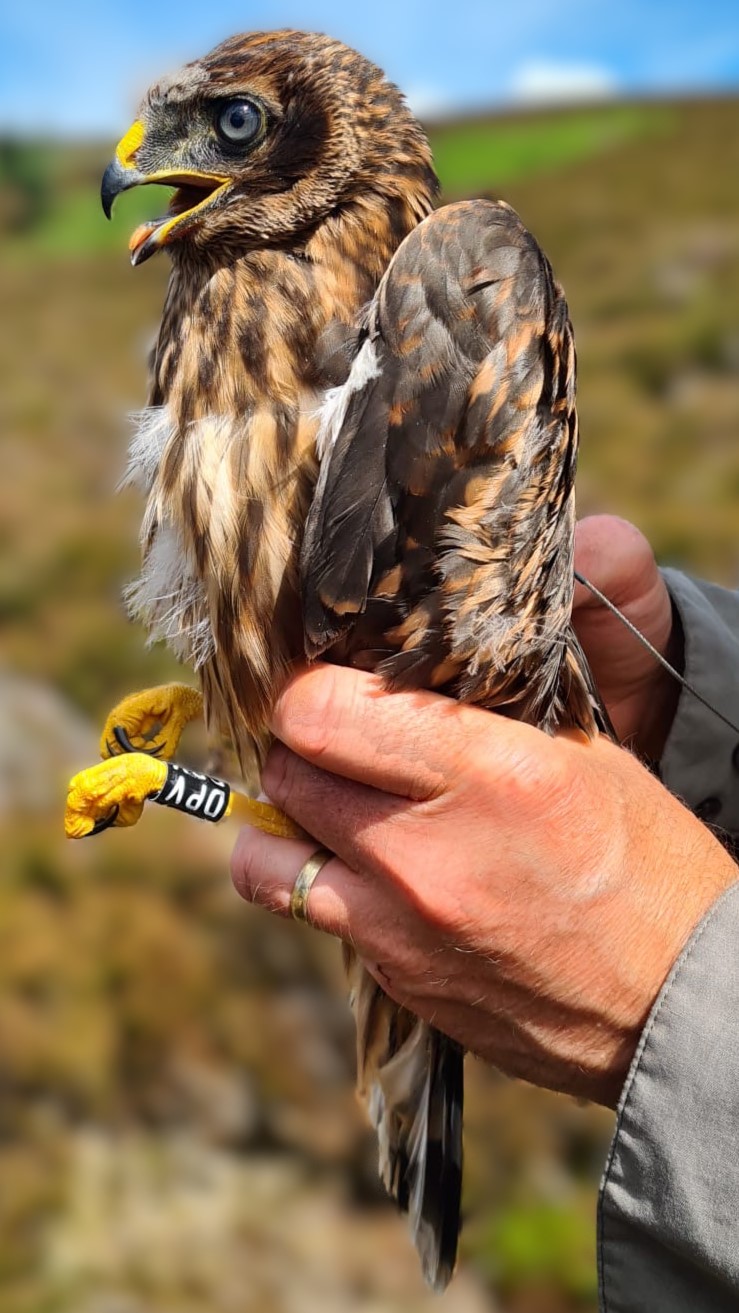
Two hen harrier chicks, hatched from a nest on moorland in the care of the National Trust in the Peak District, have been fitted with satellite tags by the RSPB to protect them from persecution1.
At the same time as providing location data, the satellite tags will provide vital information about the behaviour of this threatened species and an insight into roosting, breeding and foraging sites. The tried and tested method also helps to gather evidence in the fight against criminal activity. Each year in England, around 30 chicks are fitted with these tags.
Specially trained officers from the RSPB fitted the tags, thanks to funding from the National Trust and the Peak District National Park. The organisations are working together along with the Peak District Raptor Study Group to give birds of prey like Hen Harriers the best chance of survival in the area.
The chicks tagged were part of a brood of three chicks from the same nest who have now successfully fledged. They are the offspring of the adult birds which featured on the BBC’s Springwatch earlier this year, spectacularly passing food mid-air.

The news of the successful nest has been met with cautious celebration by the conservation partners involved, as the presence of nests and fledging chicks shows efforts to create the right habitats for the birds are taking effect2. However, there is still much to do to protect this important bird of prey from the threats it faces from habitat loss and persecution.
This is the eighth nest attempt to have been recorded over the past five years in the Peak District. Last year there were only 34 nests in the UK compared to 49 in 2022. There are only around 30-40 breeding pairs of hen harriers in England.
Craig Best, General Manager in the Peak District at the National Trust said:
“We have been working hard with our partners to create ideal habitats to attract red-listed birds and provide good homes for them when they move to moorland landscapes over the spring and summer. A significant amount of time and investment is made to do this. These birds need moorland where you find a variety of plants and animals. We’re restoring peatland and ensuring wetlands and grasslands can host a good mix of species which means these habitats become a good place for small birds and voles too, which are a vital food for hen harriers and their young.
“It is wonderful to see successful nests on the land in our care because it is a good indicator that our work is providing them with the conditions they need. However, we need to be cautious and vigilant because despite being legally protected, persecution is still one of the biggest threats to these special birds of prey in the Peak District and across the UK.
“This is harder to address, but we’re taking action to combat these illegal practices. We’re working closely with our partners in the Police, Statutory Agencies, the Raptor Monitoring Group and the RSPB. One way we do this is by supporting tagging the birds and tracking their movements.
“I am delighted that we have been able to give these two chicks this extra protection, and that the data they provide will provide evidence to tackle illegal activity as well as support our conservation efforts.”
Mark Thomas, Head of Investigations at the RSPB said:
“Satellite-tagging of Hen Harriers has been a game changer; it tells us what habitats the birds are using and informs us of the place and reason for any mortality. For a persecuted species this is vital, to inform police investigations, to document associated land uses and to lobby for policy outcomes that aim to provide a better future. The RSPB believes that is through the licensing of grouse shooting, a pragmatic solution to tackle the record high levels of illegal killing in the last five years.”
For example, a recent successful tracking of another hen harrier, fitted with a satellite tag by Natural England on National Trust land in 2022, also returned to the Peak District earlier this year. The tracking data shows the extensive flight-path of the bird, which travels down to Cornwall during the winter months, before returning to the Peak District each summer, flying approximately over 550 miles between wintering sites and breeding grounds and choosing to spend time in the moorland habitat, not far from where it fledged, after stopping off in Wales along the way.
Phil Mulligan, Chief Executive Officer at the Peak District National Park said:
“It is vital for our ecosystems and the health of the landscape in the Peak District National Park that we do all that we can to welcome and protect these stunning birds of prey. I look forward to the day when there is a healthy population of hen harriers here. It is great to hear that hen harriers which started their life in the Peak District will help us gather important data to improve the chances of the species in the future.”
Editor’s notes:
- Despite having the highest level of protection under UK law and a designated species of high conservation concern, Hen Harriers are being illegally killed in the UK.
In the last five years, the number of confirmed and suspected Hen Harrier persecution incidents has increased with 102 recorded between 2020 and 2024. 89% of these incidents took place in northern England. 2023 was notably the worst year on record with 34 Hen Harriers confirmed to have been killed or disappearing under suspicious circumstances. The impact of these crimes is most evident in England with numbers recorded in 2024 representing only one tenth of the upper estimate of potential breeding pairs for England (323-340 pairs) as outlined by the Joint Nature Conservation Committee Report in 2011. Information taken from Hen Harriers in the Firing Line – RSPB report 2025.
2. Work undertaken by the National Trust includes cutting heather to allow a more diverse range of moorland plants such as sphagnum moss, bilberry and cottongrass to grow, which helps attract the different insects and small mammals which the birds rely upon for food. The charity is also working closely with tenants to ensure their land management practices support the vision for more birds of prey in the area.
ENDS
UPDATE 20 August 2025: Hen Harrier persecution “is very much linked to grouse shooting” – Craig Best, National Trust General Manager, Peak District (here)
 Raptor Persecution UK
On my group we have a file called ‘Raptor/Animal Persecution Reports ‘ but this post and the previous one I cant put there can I – both are good news so will end up in another file . Thank you Ruth so much for good news , if only every blog was the same but !!!!
Interested to know why only 2 of the 3 fledglings were tagged, is this due to costs?
It could be costs, but it could also be the size of the third nestling. There are very strict regulations about the weight they’re allowed to carry and a small male may not have met the threshold needed for a tag.
Thank you, I do think that the tags used on eagles look rather large, is there any way they could use a chip instead? This would also mean, in the event of a bird being killed, the chip would keep transmitting
The tags used on Golden Eagles in Scotland are all below the 3% threshold of body weight, to comply with the licence.
Microchips don’t transmit a tracking signal, they are passive.
Satellite tags continue to transmit if the bird has been killed, until the battery charge is depleted. The length of time that takes depends on the condition of the battery, obviously, and can vary enormously. If the eagle has been killed illegally (shot, poisoned, trapped etc), the person who killed the eagle often destroys the tag to prevent it from transmitting. We’ve seen the lengths that these eagle killers will go to to hide the evidence of their crimes e.g:
https://raptorpersecutionuk.org/2020/09/25/missing-eagles-satellite-tag-found-cut-wrapped-in-lead-dumped-in-river-at-strathbraan/
Gorgeous news for once Well done national trust onwards and upwards.