Press release from Defra: Toxic lead ammunition banned to protect Britain’s countryside

Press release from Defra (10 July 2025):

TOXIC LEAD AMMUNITION BANNED TO PROTECT BRITAIN’S COUNTRYSIDE

  • New ban on use of lead in ammunition to protect iconic wildlife and clean up the nation’s waterways
  • Restrictions will help prevent release of an estimated 7,000 tonnes of lead into the environment each year
  • Aim to legislate the ban by summer 2026, with three-year transition period to give shooting and hunting sectors time to shift to more environmentally friendly alternatives

Red kites and white-tailed eagles will receive greater protection thanks to new restrictions on the use of lead in ammunition, Environment Minister Emma Hardy announced today.

To protect iconic British wildlife and clean up the nation’s waterways, new measures will ban shot containing more than 1% lead and bullets with a lead content of more than 3%. Beyond limited exemptions, these types of ammunition will no longer be sold to the public.

Spent shotgun cartridge. Photo by Ruth Tingay

The ban will prevent the release of an estimated 7,000 tonnes of the toxic metal into fields, forests and wetlands each year. Up to 100,000 wildfowl, including ducks, swans and waders, die from lead poisoning annually, with birds often confusing the scattered shot for grit and consuming it.

Evidence from the Health and Safety Executive shows lead poses a risk to at least 1 million birds over the coming decades if usage continues at its current rate, while around 40,000 birds of prey such as red kites and white-tailed eagles are at risk from ingesting lead through carrion.

Introducing restrictions will also stop lead from contaminating soil and leaching into rivers when guns are discharged and spread the harmful metal, ensuring ecosystems thrive for both wildlife and people alike.

Environment Minister Emma Hardy said:

Britain is a proud nation of nature lovers, but our rivers are heavily polluted, and majestic birds are declining at an alarming rate.

This new ban on lead in ammunition for most uses will help reverse this – rejuvenating pride in our countryside by protecting precious birdlife and cleaning up rivers.

Non-lead alternatives are readily available, and we’ll continue to work closely with the shooting sector throughout this transition.” 

Following extensive public engagement, a three-year transition period will support the shooting and hunting sectors to shift to more environmentally friendly alternatives. There will also be a two-year period for outdoor shooting ranges where lead is used to implement measures that prevent pollution from entering the environment.

Alternatives to lead shot have become more efficient and widely available in recent years, with steel and tungsten-based shot being two popular options. The government will continue to engage with the shooting industry to support the transition to alternative ammunition types.

In December 2024, the Health and Safety Executive published their Final Opinion proposing restrictions on the supply and outdoor uses of lead in ammunition – and the Government has now taken action to reduce toxic substances from entering the environment.

As part of the restrictions, there will be exemptions in place for the military, police, elite athletes, outdoor target shooting ranges with risk management measures in place, museum collections and other minor uses. Small calibre bullets for live quarry shooting – the outdoor shooting of live animals – and airguns are not in scope of the restriction.

 ENDS

This announcement has been a long, long time coming. Way too long, as various previous governments have been more interested in appeasing the selfish, idiotic game shooting industry instead of acting on reams of scientific evidence, produced over many decades, and doing the right thing for the environment, wildlife and human health.

Well done to Defra Ministers Reed and Hardy, as well as their counterparts in the devolved nations. This is an historic decision and is very welcome indeed.

I could quibble about the long lead-in time – the press release says there’ll be a three-year transition period but actually it’ll be at least four years before the ban becomes real, given that it’ll take at least a year for the new legislation to arrive and the 3-year transition will begin from then. But in the big scheme of things, this seems trivial. The decision to ban toxic lead ammunition will be one of those that future generations look back upon in 25, 50, 75 years time and wonder why the hell it took so long to implement what has been blindingly obvious for decades.

The game shooting industry will be furious. They’ve resisted this move for such a long time, denying the scientific evidence and maintaining there’s no issue here (gosh, sound familiar?!).

That was until February 2020.

After seeing the writing on the wall in parts of the US and Europe where more progressive, enlightened Governments had made huge strides to get rid of toxic lead ammunition, nine of the UK’s shooting organisations, including the National Gamekeepers Organisation, suddenly made a massive U-turn and announced they were introducing a ‘five year voluntary transition away from toxic lead shot’, presumably to deter legislation – the industry hates being forced to do anything because it goes against its ingrained sense of entitlement.

Notably, the dinosaurs at the Scottish Gamekeepers Association refused to sign up to a voluntary transition because they didn’t think there was sufficient evidence to support a move away from the use of toxic lead ammunition (yes, really).

To be fair, some shooting organisations, particularly BASC, made genuine efforts to encourage members to undertake the transition, but many of their members simply refused and a lot of them ditched their membership and wrote angry letters to the shooting press.

BASC tried to save face (and its falling membership) by slurring the scientific credentials of a research team from the University of Cambridge that was monitoring the (non)effectiveness of the five-year transition away from the use of toxic lead ammunition (see here). It wasn’t a good look.

Scientific results published earlier this year demonstrated that the industry’s voluntary five-year transition had failed spectacularly (see here), although the industry hilariously pretended to have made ‘significant progress’ (see here).

Now they’ve got another four years, in addition to the five they’ve already had, to drag themselves into the 21st century.

Will they do it? There’ll be some change, I’m sure, but I’m also sure that there’ll be high levels of non-compliance. Scientific evidence has shown that even though there is already legislation banning the use of toxic lead ammunition in some sensitive environments, non-compliance remains high in England (here and here) and in Scotland (here).

Monitoring and robust enforcement will be key, as ever.

There are many, many people who have worked hard for today’s decision, some of them dedicating their whole careers to this issue. We owe them all a debt of gratitude.

Defra refuses funding for another futile ‘dialogue’ process to address ongoing killing of Hen Harriers on grouse moors

Back in March 2025 I blogged about the prospect of another futile ‘dialogue’ process between gamebird shooters and conservationists, purportedly to find a ‘solution’ to the ongoing illegal killing of hen harriers on grouse moors (see here).

There’s nothing novel about this approach. Those with long memories will recall the utterly pointless six year ‘Hen Harrier Dialogue’, facilitated by the Environment Council between 2006-2013, where grouse shooting industry representatives sat around a table pretending to have ‘constructive dialogue’ with conservationists. Whilst that was going on, the English Hen Harrier population was decimated to a single breeding pair.

This Hen Harrier had to be euthanised after its leg was almost severed in an illegally-set trap on a driven grouse moor. Photo: Ruth Tingay

That dialogue process achieved absolutely nothing for Hen Harrier conservation, but everything for the grouse shooting industry, who were able to masquerade as partners and claim to be working hard to address the illegal killing, thus delaying any hint of enforcement action from Defra.

The process eventually collapsed after three conservation organisations realised they’d been had and left, one by one (RSPB here, Northern England Raptor Forum here, Hawk & Owl Trust here).

This absurd charade has been repeated since with other pseudo ‘partnerships’, established over the years with good intentions to tackle raptor persecution but ultimately collapsing when the projects failed to meet any of the set targets (e.g. Peak District Bird of Prey Initiative here and here; and the Yorkshire Dales/Nidderdale Bird of Prey Partnership here and here).

It should be obvious but apparently it isn’t, that partnerships will only be successful if ALL participants share the same objectives. In the case of the conservation of the UK’s birds of prey, it’s clear that one side wants to protect raptors and the other side wants to kill them (either legally or illegally) because they’re perceived as a threat to their gamebird stocks.

The latest proposal for a ‘Hen Harrier Dialogue’ came at the beginning of this year from the Hen Harrier Taskforce, a police-led ‘partnership’ established to tackle the ongoing illegal killing of Hen Harriers on grouse moors. The ‘partners’ include the National Wildlife Crime Unit (NWCU), RSPB, Country Land & Business Association (CLA), BASC, National Gamekeepers Organisation, wildlife trusts (not sure which ones) and the National Parks.

Although from my FoI requests, it’s now become apparent that not all the partners supported the proposal.

Here’s a copy of the funding bid from the Hen Harrier Taskforce, sent to Defra via Natural England on 10 Feb 2025. They were asking for £400,000 for a three-year ‘dialogue’ process:

The RSPB, obviously mindful of the colossal amount of time and money its wasted on similar exercises, was not supportive, for the following reasons:

Fortunately, Defra was not supportive either and has turned down the funding bid.

Intensive grouse moor management ahead of muirburn licensing in Scotland

A couple of weeks ago I blogged about the Scottish Government’s and NatureScot’s decision to delay the introduction of muirburn licensing, which was due to begin on 15 September 2025 but now won’t start until 1 January 2026 thanks to lobbying by the grouse shooting industry (see here).

I wrote that as a result of this delay, we can expect to see an increase in the intensification of muirburn between 1 October – 31 December 2025 as grouse moor managers take full advantage of the opportunity to burn on deep peat until restrictions begin.

Intensification of grouse moor management looks like it’s already begun on some grouse moors.

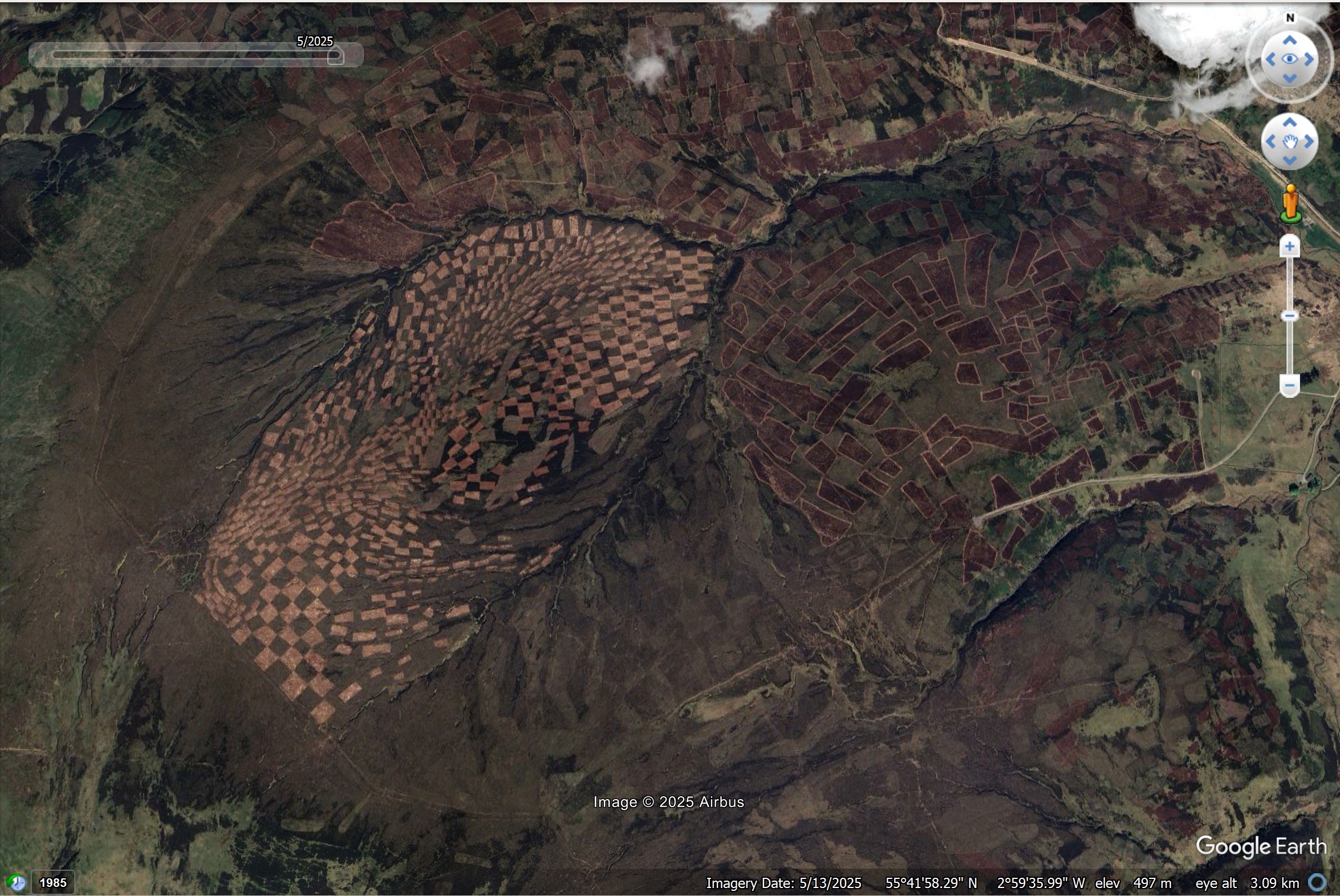
Have a look at this satellite imagery from part of the moorland on the Raeshaw Estate in the Scottish Borders (image captured 13 May 2025, after the close of the 2024/25 muirburn season).

Look at the state of this!

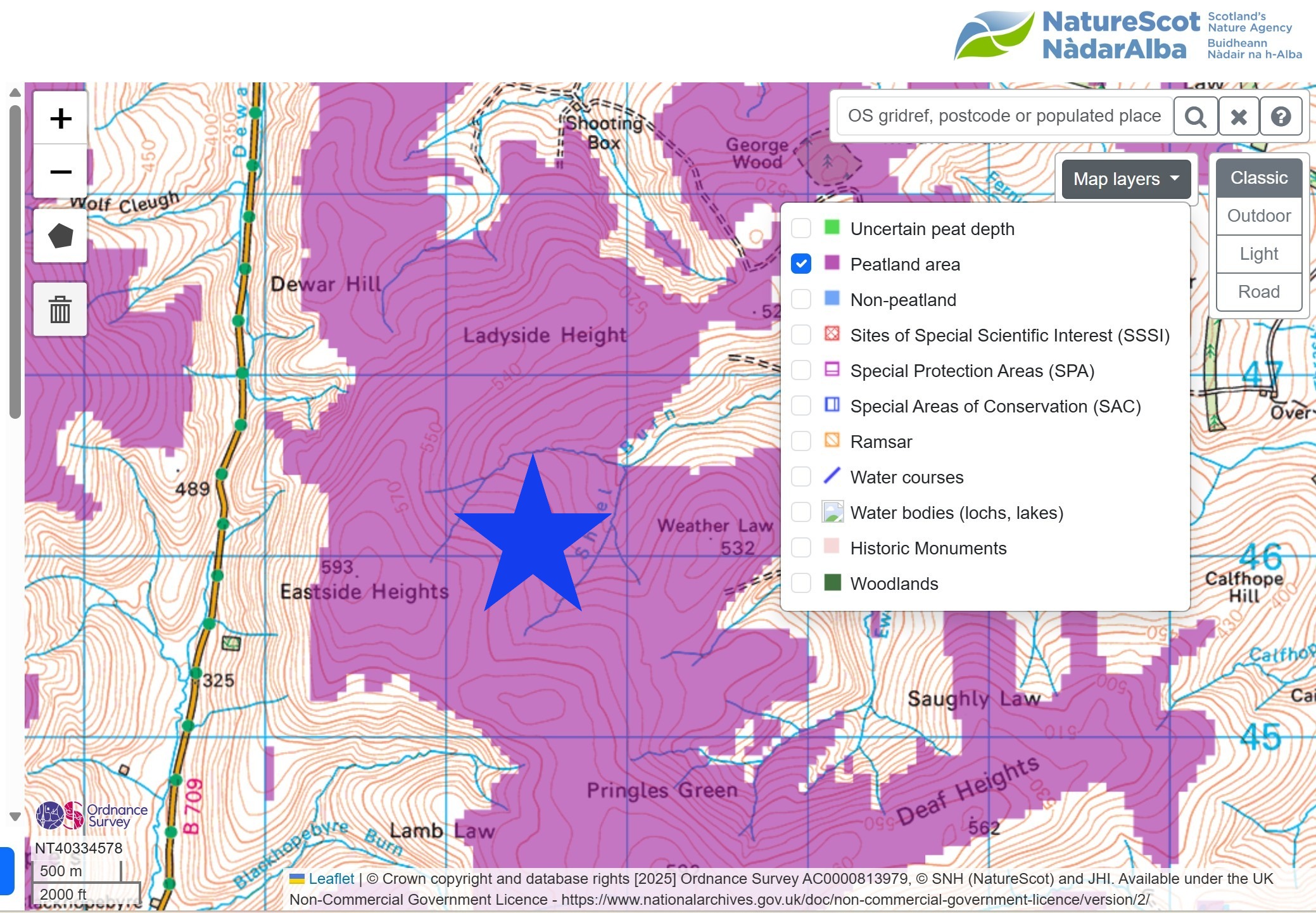
According to the peat depth map that NatureScot has provided to help grouse moor managers determine peat depth for licensing purposes, this area is bang in the middle of an area defined in Scottish legislation as ‘deep peat’ (peat depth of 40cm+).

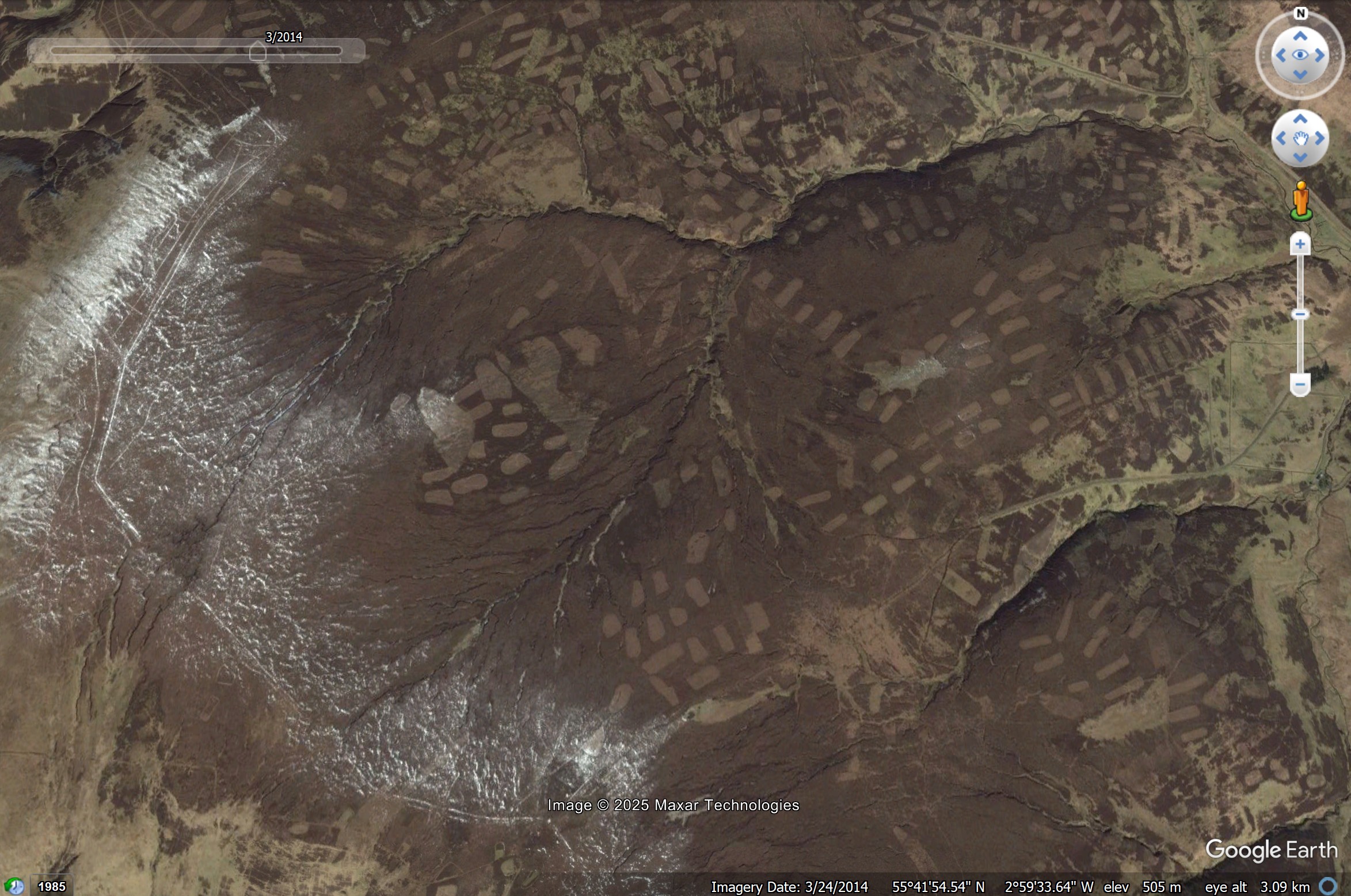
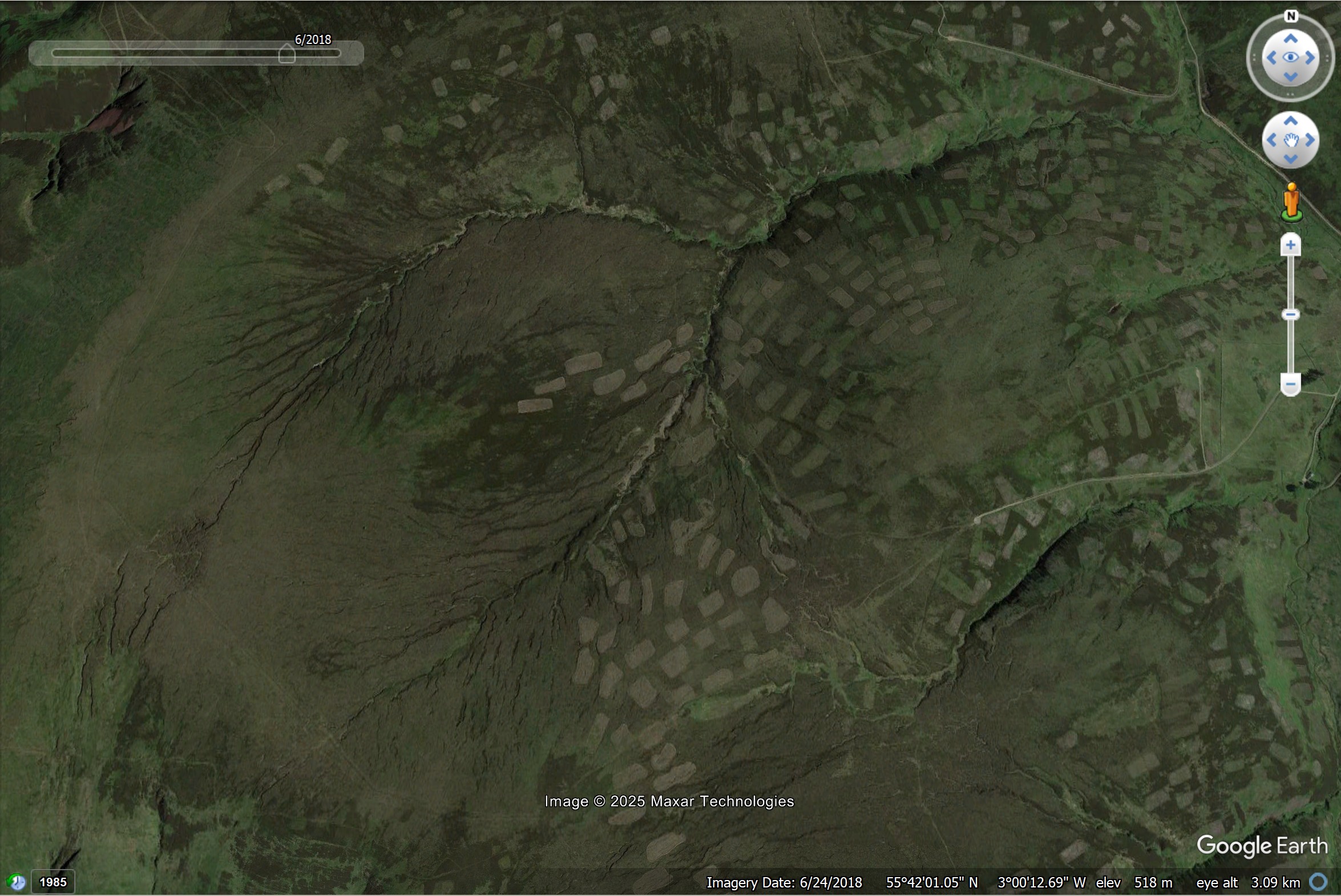
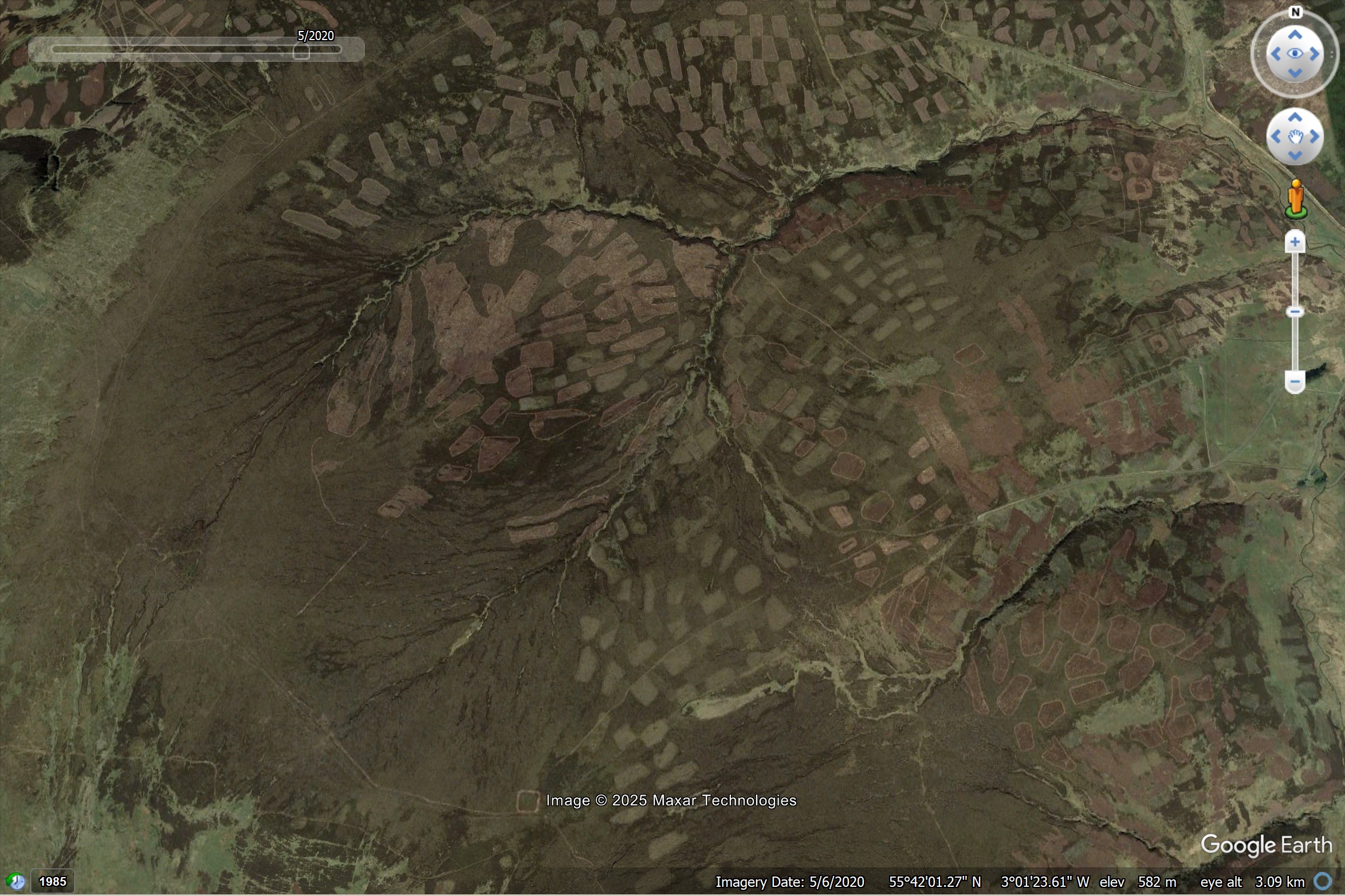
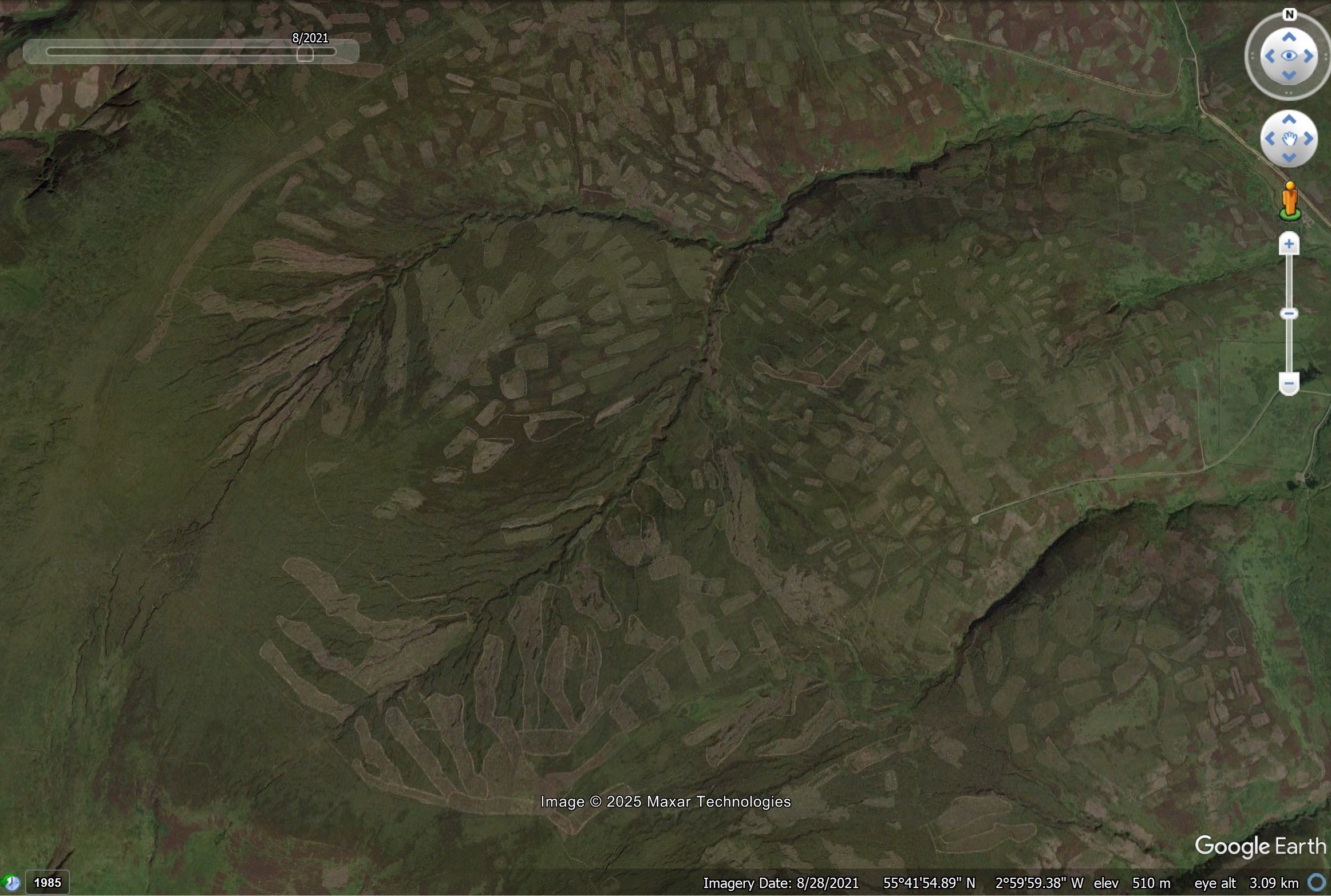
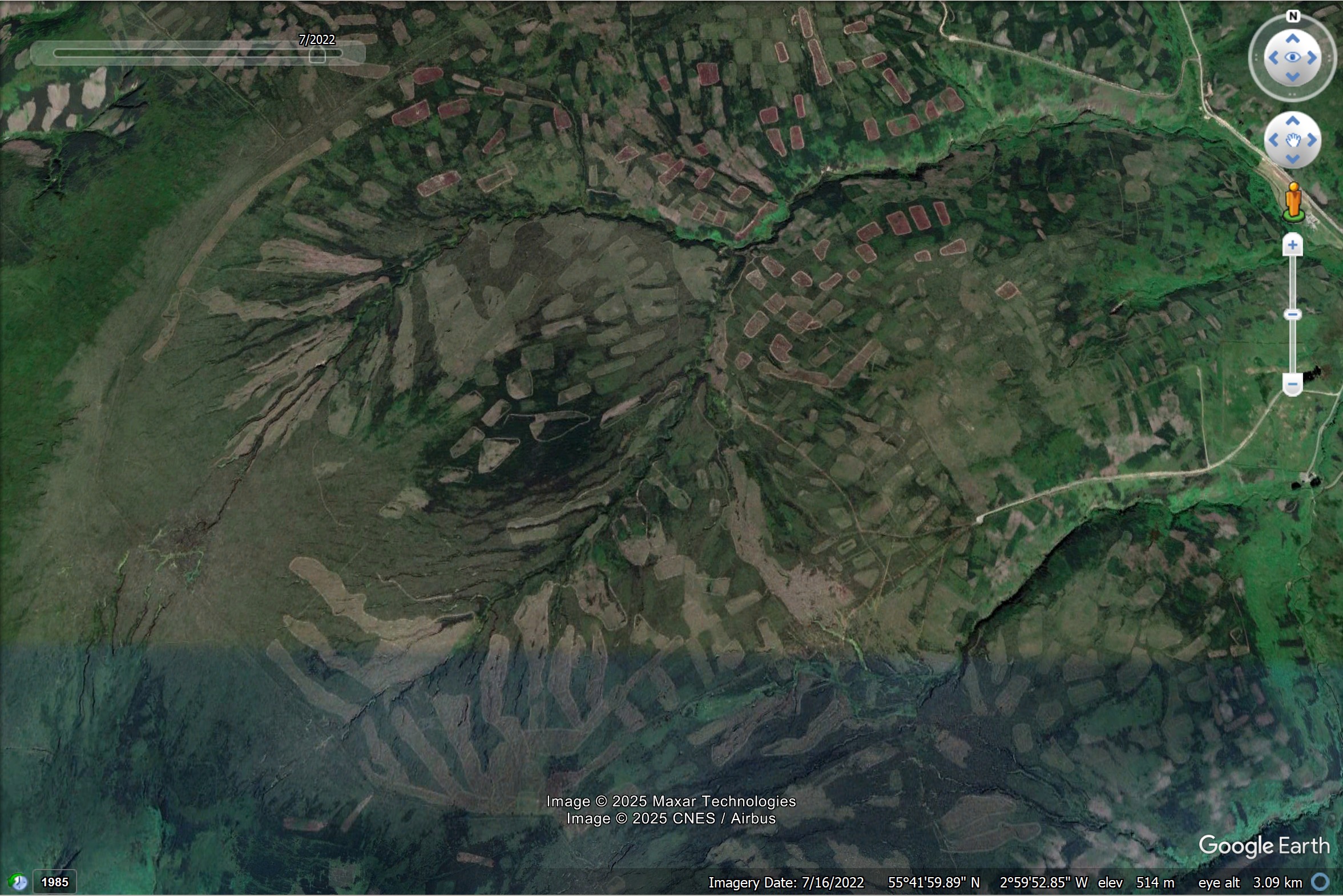
Using the timelapse function on Google Earth, it’s possible to look back at the ‘management’ of this area over the years:

Imagery date: 1 January 2007
Imagery date: 24 March 2014
Imagery date: 24 June 2018
Imagery date: 6 May 2020
Imagery date: 28 August 2021
Imagery date: 16 July 2022
Imagery date: 13 May 2025

Given the driven grouse shooting industry’s general rejection of cutting instead of burning (they claim it’s labour intensive, logistically difficult and doesn’t get rid of the ‘fuel load’ because it’s just dropped where it’s been cut), I’m guessing that this is muirburn. But it’s hard to differentiate between muirburn and cutting from satellite imagery so it really needs ground-truthing to know for sure. If any blog readers fancy a walk over to ‘The Sole’ on Raeshaw Estate to check, I’d be interested in seeing photographs.

But whether it’s cutting or burning, there’s no denying the intensification of grouse moor management here.

Estate ownership questions raised after two men charged in relation to alleged illegal killing of Red Kites in Cairngorms National Park

On 2 May 2025, Police Scotland issued a press statement about how two men had been charged in relation to the illegal killing of Red Kites in the grouse moor-dominated Strathdon area of the Cairngorms National Park in February 2025 (see here).

This general area on the NE side of the Cairngorms National Park has long been identified as a raptor persecution hotspot with several confirmed and alleged offences recorded in the area over a number of years.

The Police said the men would be reported to the Procurator Fiscal but since then there haven’t been any further updates.

NB: As two men have been charged, criminal proceedings are live so any comments about that case will not be published on this blog until proceedings have ended.

Shortly after the police issued that statement, land reform campaigner Andy Wightman published a fascinating blog about the lengths he has gone to to determine who might be the beneficial owner of North Glenbuchat Estate, one of a number of prominent sporting estates in the area – see here.

Photo by Ruth Tingay

Andy writes that he has submitted a report to Police Scotland about the estate owner’s (North Glen Estates Ltd, registered in the Turks and Caicos Islands) alleged failure to register its beneficial owner as required by recent land reform legislation in Scotland.

Andy published an update to his first blog on 13 May 2025 where he outlines how he was waiting for an interview with a Police Scotland officer about his findings (see here).

Andy’s second blog also provides commentary about someone else’s attempt to lodge a complaint about the alleged failure of another company to register the name of the beneficial owner of Craiganour Estate (see blog here).

All three blogs illustrate the ongoing complications of finding out who owns private estates in Scotland. This is of interest to RPUK readers due to the possibility of holding estate owners vicariously liable if certain wildlife crimes, but particularly raptor persecution offences, are proven to have taken place on an estate.

One investigation into alleged vicarious liability for raptor persecution has already been dropped in Scotland after the conviction of a gamekeeper on Kildrummy Estate in NE Scotland in 2014. The authorities tried to identify the owner but failed (see here). NB: The ownership of Kildrummy Estate has since changed hands and gamebird shooting is no longer permitted..

Since the 2014 Kildrummy case the rules around registering ownership have changed in Scotland and technically it should no longer be possible for beneficial owners to hide their identity behind overseas shell companies.

Andy’s work suggests otherwise.

DEFRA withdraws licence for release of gamebirds on Special Protection Areas due to high risk of avian flu – BASC starts legal challenge

In 2020, Wild Justice won a significant legal challenge against Defra, forcing it to introduce a licensing scheme for the release of gamebirds (Pheasants & Red-legged Partridges) on or near Natura 2000 sites (see here).

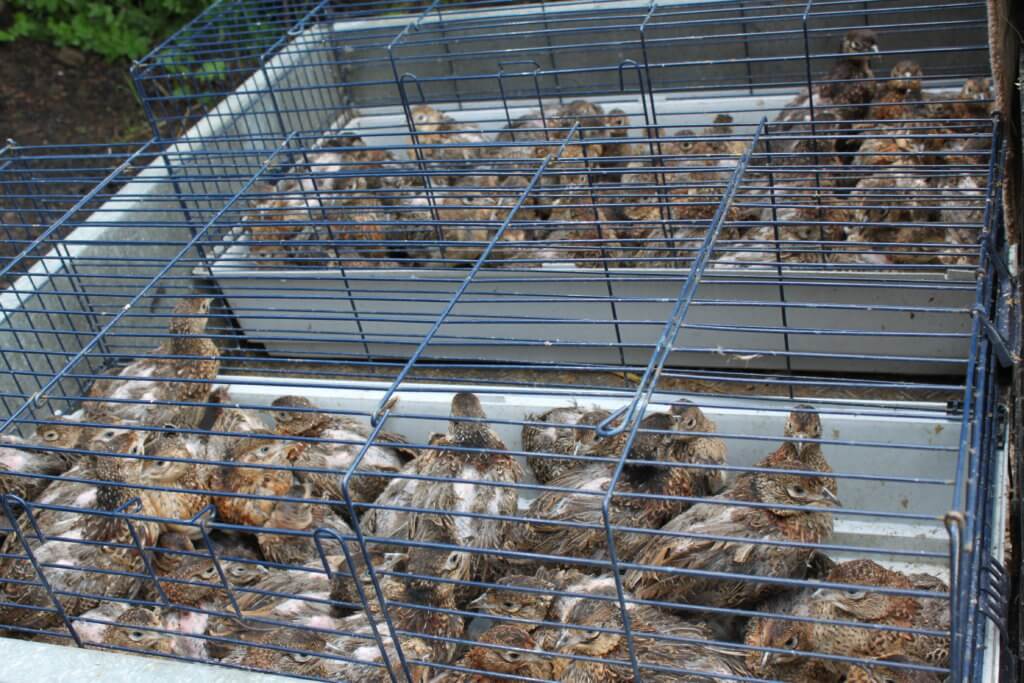
Captive-bred non-native Pheasant poults, in pretty poor condition, being transported for release in the UK countryside. Photo by Ruth Tingay

In March this year, Defra announced that it would not be issuing General Licence 45 (GL45 – the licence under which restricted numbers of gamebirds can be released on or within 500m of Special Protection Areas) in 2025 because:

It is currently not possible to rule out the risk of highly pathogenic avian influenza (HPAI) (which is currently very high) spreading to the bird features present on SPAs”.

That was a very sensible, precautionary decision by Defra. Protecting internationally significant bird populations is of far greater national importance than the unsustainable release of ~60 million non-native Pheasants and Red-legged Partridges by those who want to get their kicks from shooting them.

Natural England (now responsible for individual licences) went further, and on 14 April 2025 it advised the gamebird shooting industry that although they could still apply for individual licences for 2025 gamebird releases on or close to SPAs, some licences would only be permitted with a delayed release date for the poults, whereas licences for many other SPAs would be unlikely to be issued at all:

Natural England told the shooting industry that applications for individual licences could be made from 22 April 2025 and that NE aimed to determine applications within 15 working days.

Again, setting aside the absurdity of the statutory nature advisor giving permission to release millions of non-native gamebirds in to the countryside, NE’s advice to the shooting industry about limitations to individual licences was all very sensible in light of the heightened Avian Flu risk, and it gave the shooting industry plenty of time to adjust its plans for the 2025/26 shooting season.

Predictably, the shooting industry went into meltdown, with BASC claiming on 15 April 2025:

The approach taken by Natural England risks jobs and will have a huge impact on rural economies, not to mention the conservation benefits that sustainable shooting delivers for species and habitats.

These new restrictions risk bringing large parts of the countryside to a standstill. While we recognise the need to manage the risk of avian influenza, the damage to the countryside could be irreparable. The government should commit to revisiting licensing decisions as the risk of AI dissipates“.

Two months later on 13 June 2025, BASC announced it had started legal proceedings against Defra’s decision not to issue GL45 for the 2025/26 shooting season.

BASC has submitted a Pre-Action Protocol (PAP) letter, apparently on the basis that “Defra has still not provided the formal reason behind it or published a detailed decision-making document“.

The timing of BASC’s PAP letter appears to be just within the three-month time limit for bringing judicial review proceedings, but it’s not clear to me what the specific legal basis of the claim is, nor the remedy BASC is seeking. It looks more like a grandstanding exercise to appease BASC members, but I guess time will tell.

Meanwhile, back in the real world, it turns out that Defra’s precautionary decision not to issue GL45 this year due to the high risk of avian influenza was absolutely spot on.

Since 11 June 2025, there have been five outbreaks of Highly Pathogenic Avian Influenza (H5N1) and protection zones have been established at all five premises, including one which is believed to be a commercial gamebird rearing facility.

The five current outbreaks are as follows:

11 June 2025 – near Ravensthorpe, Kirklees, West Yorkshire. Centred on grid ref: SE2206919016.

17 June 2025 – near Stanhope, Bishop Auckland, County Durham. Centred on grid ref: NZ0336936829.

20 June 2025 – near Linton-on-Ouse, Wetherby & Easingwold, North Yorkshire. Centred on grid ref: SE5024159461.

24 June 2025 – near Glyn Ceirlog, Wrexham. Centred on grid ref: SJ1591333699.

24 June 2025 – near Haverfordwest, Pembrokeshire. Centred on grid ref: SM8938621496.

Avian Influenza isn’t going away, and it’s not even peak season for outbreaks of this highly contagious notifiable disease (typically autumn/winter). As little faith as I have in Defra, I can’t see Ministers making a U-turn on its decision to withdraw GL45 this year, legal challenge or not.

UPDATE 31 July 2025: Four more Bird Flu outbreaks confirmed, including on a Pheasant shoot – yet selfish BASC starts another legal challenge against Govt restrictions on gamebird releases (here).

Northern Ireland Minister commits to taking action on illegal poisoning of birds of prey

Some very good news from Northern Ireland.

Andrew Muir MLA, Minister of Agriculture, Environment and Rural Affairs made the following statement in the Northern Ireland Assembly this week:

The killing of birds of prey, whether deliberately or through improper use of pesticides or other poisons, is deplorable, it’s a crime, and it diminishes our biodiversity.

I recently met with the Northern Ireland Raptor Study Group, RSPB and Ulster Wildlife last week to discuss this issue and I recognise the need to address bird of prey persecution in Northern Ireland and am determined to take more action to help stamp out this repugnant activity.

My department is exploring ways to strengthen the enforcement and sanctions for the current plant protection product [PPP, also known as pesticides] legislation relating to storage and use of unauthorised plant protection products.

A new working group will also be established to pull together relevant stakeholders and fully consider a potential road map and requirements for any new secondary legislation to prohibit the possession of dangerous pesticides in Northern Ireland in the next Assembly mandate“.

Wow! 14 years of can-kicking by DAERA (Dept of Agriculture, Environment & Rural Affairs) seems to have finally been brought to an end by this decisive commitment to take action from Minister Muir.

Without doubt, this is a direct result of evidence-collecting and campaigning by the Northern Ireland Raptor Study Group (NIRSG), led by the wonderful Dr Eimear Rooney & Dr Marc Ruddock.

Following the discovery in May 2023 of two illegally poisoned White-tailed Eagles at Glenwherry, Northern Ireland’s only driven grouse moor, the NIRSG began a petition calling for Ministers to add a list of proscribed poisons to section 15B of the Wildlife (Northern Ireland) Order 1985, which has been missing from the legislation since it was last updated in 2011.

That petition attracted over 50,000 signatures (including many RPUK blog readers – thank you) and was handed in by the NIRSG to Minister Muir at Stormont last month, with support from the RSPB and Ulster Wildlife.

A week later, the Police Service of Northern Ireland revealed that a Red Kite had been found illegally poisoned in a raptor persecution hotspot in County Down (here).

Minister Muir’s recognition of this long-standing and ongoing issue, and his pledge to actually do something about it, is very welcome news and is in stark contrast to Defra’s pathetic filibustering on the same issue in England.

Huge congratulations to the Northern Ireland Raptor Study Group and their partners – this is a big win.

RSPB response to Westminster Hall debate on banning driven grouse shooting

The RSPB did a fair bit of lobbying and campaigning on the back of the recent Wild Justice petition calling for a ban on driven grouse shooting.

Although agreeing with Wild Justice on the various problems associated with driven grouse moor management, the RSPB’s position was not to support a ban, but rather to push for a licensing scheme.

Calling for a licensing scheme has been RSPB policy since October 2020, after a period of internal review (see here).

It was good to see a couple of RSPB staff members attend the Westminster Hall debate last Monday, and on Friday it published the following statement (available on the RSPB website here but reproduced below because annoyingly, links to material on the RSPB website tend to break quite often).

On Monday 30 June Parliament debated the future of driven grouse shooting in England, and with it the future of vast swathes of our iconic upland landscapes. The debate was triggered by the petition launched by the campaign group Wild Justice, which was signed by over 104,000 people and called for a ban on driven grouse shooting. 

Our position on shooting

The RSPB is neutral on the ethics of shooting, and concerned only with preventing the harm caused to wildlife through the management of some grouse shoots. This is why, while we support efforts that bring this important issue into the spotlight, our focus has long been on achieving a system of licensing for grouse shooting. We believe this, rather than an outright ban, is the most pragmatic way to secure a positive outcome for nature.  

Licensing would raise environmental standards across the shooting industry and allow responsible shoots to continue to operate, while providing an effective deterrent for those who do harm, or worse, break the law.     

Our concerns

We share the concerns of Wild Justice and all who signed the petition about the damaging and often illegal activities associated with the intensive management of land for grouse shooting: 

  • Our latest report ‘Hen Harriers in the firing line’  highlights that there have been 102 confirmed cases of Hen Harrier persecution in the UK in the last five years, and these confirmed cases are just the tip of the iceberg when it comes to the true scale of this criminal activity, as many incidents happen in remote locations and go unreported. The report highlights that the average life expectancy of a young Hen Harrier in the UK is just 121 days, and that a Hen Harrier is 10 times more likely to die or disappear when on grouse moors.  Despite this, there has not been a single conviction for Hen Harrier persecution in England. 
  • More broadly, our latest Birdcrime report reveals that, between 2009-2023, there were 1,529 confirmed bird of prey persecution incidents in the UK involving 1,344 individual birds of prey, including Peregrines, Buzzards and Red Kites, as well as rare and recovering Hen Harriers and White-tailed Eagles. The majority of raptor persecution incidents are associated with land managed for gamebirds, and of all individuals convicted of bird of prey persecution-related offences between 2009 and 2023, 75% were connected to the gamebird shooting industry.   
  • Grouse shooting estates often use burning of peatland vegetation as a land management technique intended to encourage the growth of young heather shoots on which Red Grouse feed. This practice damages the UK’s globally rare peatlands, contributing to climate change by degrading these natural carbon sinks, increasing air pollution and associated health risks, and increasing the risks of flooding for nearby communities.  
  • Research has highlighted the scale of the use of lead shot used in the grouse shooting industry. In 2024/25, 100% of the grouse purchased from UK food retailers, and from which shot could be recovered, had been killed with lead. This is toxic to both wildlife (including birds of prey) and to humans. 
  • And then there are other impacts including the largely unregulated use of veterinary medicines, and the damage caused by the construction of hill tracks and other infrastructure for shoots. 

The Westminster debate

While there were some who spoke persuasively during the debate about the need for a robust regulatory framework if grouse shooting is to have a future, many spoke out against the calls for a ban. A wide range of arguments were given, from the socio-economic and cultural value of grouse shooting through to the often beneficial effects of legal predator control for some species of wading birds – most notably Curlews. 

Importantly, however, although the concerns raised are arguments against a ban – none of them are arguments against licensing.

Almost all of those who spoke were unanimous in their outright and unequivocal condemnation of the illegal killing of birds of prey.  But disappointingly few had suggestions for how this can be meaningfully addressed.

In summing up, Defra Minister Daniel Zeichner repeated the UK Government’s previous statements that they have no plans to ban grouse shooting, but acknowledged the strong opinions on both sides of the debate, and said that the Government would keep options under close review.

Licensing is urgently needed

Based on the growing body of evidence of the unacceptable and often illegal activities associated with grouse shooting, we believe grouse shoots should be licensed in England. Without change, there can be no sustainable future for our uplands. 

Licensing has already been introduced in Scotland, and, as pro-shooting and anti-ban MP John Lamont stated during the debate, “that system has its flaws, but works adequately in other respects”. 

We’re now calling on the UK Government to take swift action to introduce the licensing of grouse shooting in England, building on, and learning from the experience in Scotland.   

Our Hen Harriers and other wildlife can’t wait. Those who operate responsible shoots would have nothing to fear, and much to gain, from a system that would make the unanimous calls for effective action on the illegal persecution of birds of prey a reality. 

ENDS

I mentioned above that calling for a licensing scheme for driven grouse shooting has been the RSPB’s policy since October 2020 after the organisation undertook a comprehensive review of the evidence.

That policy was announced at the AGM in October 2020, and included the following statement:

Our focus is not on “walked up” grouse shooting, but we will re-double our efforts to secure effective licensing for “driven” grouse shooting, and we will learn from the developments anticipated soon on this issue in Scotland.  We will provide an annual assessment of progress and review our position within five years.  Failure to deliver effective reform will result in the RSPB calling for a ban on driven grouse shooting‘. [Emphasis is mine].

The findings of that five-year policy review are due to be announced in three month’s time at the RSPB’s October 2025 AGM.

It’ll be really interesting to hear what the RSPB says about the findings of it’s five-year review. I’d guess, given the RSPB’s response to the Westminster debate, that it will be sticking to its policy of calling for a licensing scheme rather than a ban, but if so, how will it justify that ‘effective reform‘ has been delivered since 2020? I don’t even know what measures it will use to assess ‘effective reform‘ but from what I’ve seen in the last five years, there hasn’t been a single bit of it.

Indeed, if you watch this (very good) RSPB video about the problems with driven grouse moor management in the Peak District National Park, which the RSPB published in January 2025, it’s quite clear that the RSPB recognises that ‘effective reform‘ has most definitely not been delivered:

Pro-grouse shooting Labour MP Sam Rushworth received £10,000 donation from local grouse moor gamekeeper group

Perhaps the most surprising pro-grouse shooting voice at Monday’s Westminster Hall debate on driven grouse shooting was Sam Rushworth, the Labour MP for Bishop Auckland.

Wild Justice described Rushworth’s arguments in the debate as being ‘less coherent’ than his Labour colleague’s (Olivia Blake MP):

Mr Rushworth’s arguments were less coherent, stating firmly his dedication to animal welfare and his stance against fox hunting, whilst also defending an industry known for its illegal persecution of birds of prey and its legal, yet unethical, killing of wildlife such as the routine killing of foxes, referred to by the industry as ‘vermin’‘. 

Here’s what I wrote earlier today about Rushworth’s contribution to the debate:

Sam Rushworth MP (Labour, Bishop Auckland), whose constituency includes some notorious grouse moors in the North Pennines, which is another well-known raptor persecution hotspot, spoke about attending a recent ‘Lets Learn Moor’ event with primary-age schoolchildren. He also mentioned being “disgusted by the criminality that sometimes occurs on the moorland“. I wonder if he realises that these events, funded by BASC, are facilitated by the Regional Moorland Groups, many of whose members have been under police investigation into suspected and confirmed raptor persecution crimes? Awkward’.

It was all a bit odd.

But now things have become a whole lot clearer.

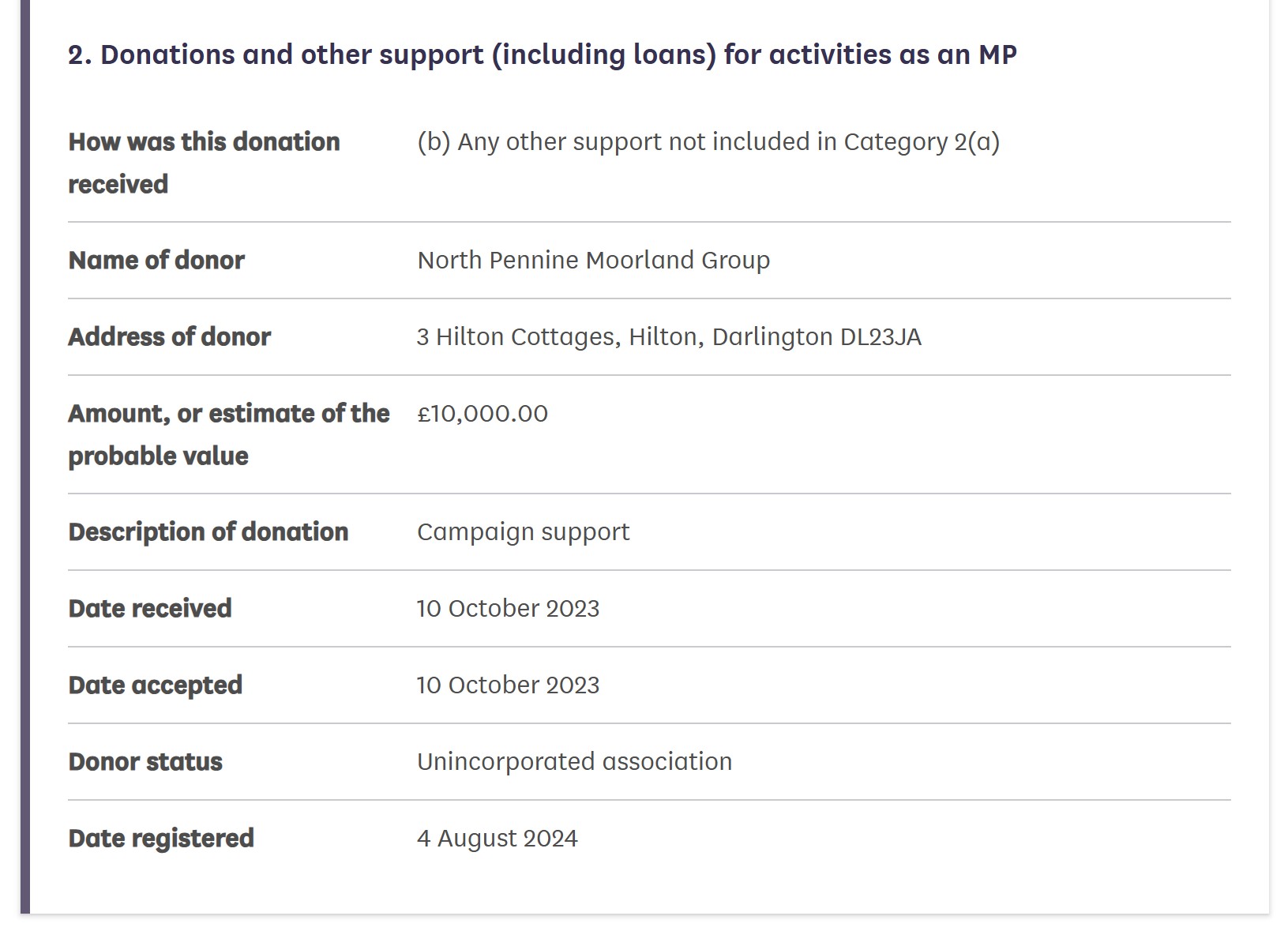
Here’s an excerpt from Rushworth’s list of Registered Interests on the Parliamentary website:

Well, well, well. Rushworth’s pro-shooting stance no longer looks surprising, does it?

This entry reveals that Rushworth received a £10,000 donation from the North Pennine Moorland Group in October 2023, for ‘campaign support’. Imagine that!

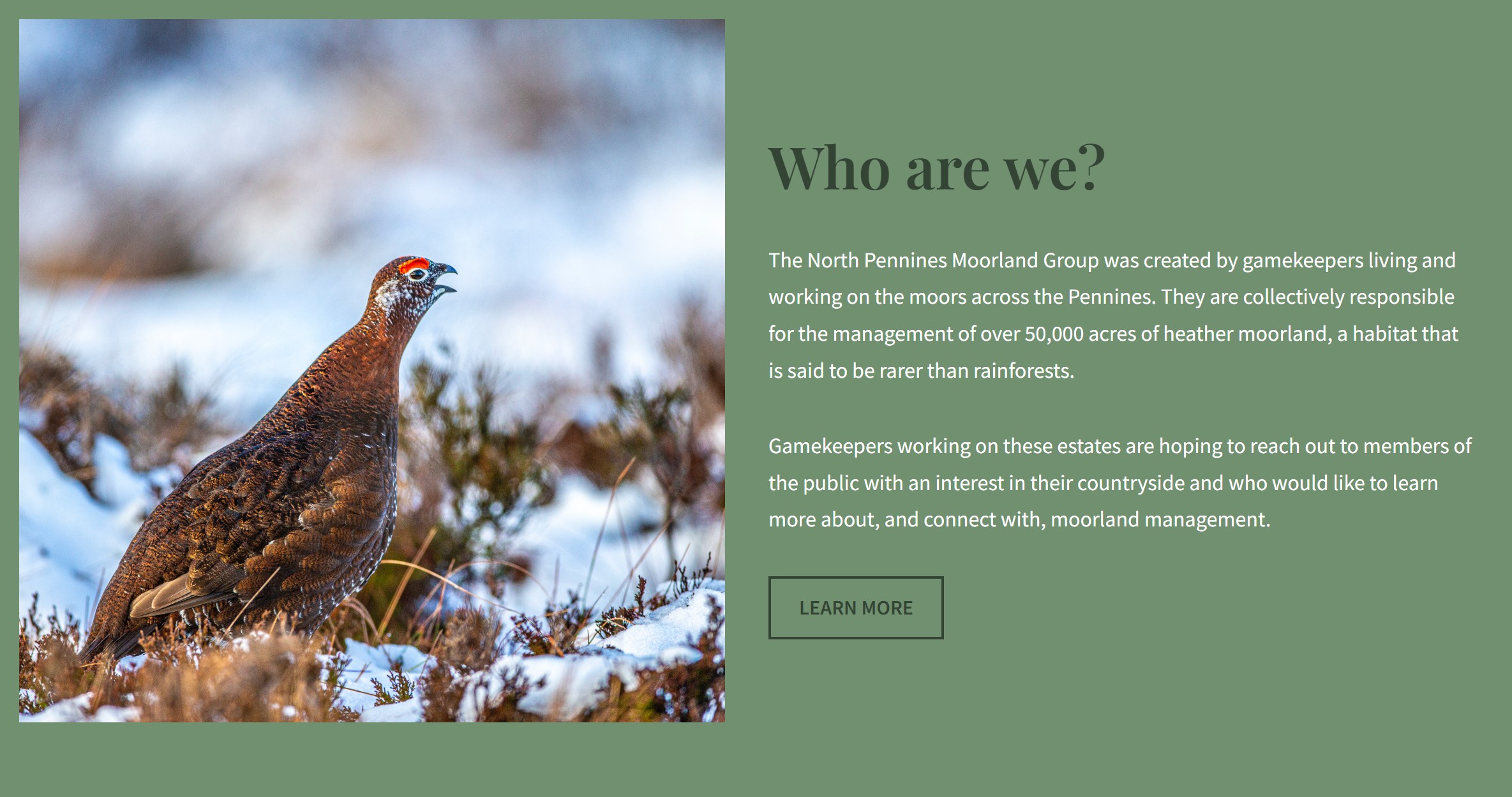
For those who might not know who the North Pennine Moorland Group is, it’s basically one of a large number of regional grouse moor groups that sprang up across England and Scotland several years ago, presenting themselves as ‘grassroots community groups’, purporting to represent ‘downtrodden country folk’ who were being unfairly attacked by some nasty people from the cities who didn’t understand country ways.

In reality, these groups appear to be part of a well-funded and co-ordinated astroturfing campaign for the driven grouse shooting industry, closely associated with the vile and abusive Campaign for the Protection of Moorland Communities (C4PMC) website, which specialises in publishing personal attacks and smears on anyone who dares to raise questions about the environmental unsustainability and criminality associated with driven grouse moor management. Indeed, the Chair of the North Pennines Moorland Group was listed as being one of ‘Our People’ when C4PMC lurched on to the scene in 2020 (see here).

Funny, I don’t recall hearing Rushworth making a declaration of interest about this £10,000 donation prior to his speech in the debate. As I understand it, ‘politicians must declare relevant interests that could be perceived as influencing their views or actions. This includes financial interests, gifts, hospitality, and any other interests that might create a perception of bias‘.

Perhaps, as this £10,000 donation was received in October 2023, prior to Rushworth’s election in July 2024, it doesn’t count as something he needed to declare before his speech? But then the donation is included on his official Registered Interests page on the parliamentary website so it does appear to be something he should have declared in the debate. Perhaps it was just an oversight and he’ll no doubt be grateful for the clarification here.

The donation raises a lot of questions.

The timing of it is interesting, as it was made around the same time as a £10,000 donation was made to the then Conservative MP for Hexham, Northumberland, Guy Opperman, by a company called GMS Partnership Ltd, whose sole director just happened to be one Andrew Gilruth, the Chief Executive of the Moorland Association, the lobby group for England’s grouse moor owners (see here) and prior to that he was Chair of the Regional Moorland Groups.

Opperman lost his seat in the July 2024 election.

Were these two £10,000 donations linked in any way? Are we uncovering a wider strategy of ‘donations’ from the grouse shooting industry, given to MPs in grouse moor dominated constituencies? I don’t know, I’m just speculating, but I think it’d be worth investigating the Registered Interests of other MPs in northern England, just to see if there’s a pattern.

It also raises the question of who is funding the regional moorland groups? Or are we supposed to believe that the gamekeepers in the North Pennines Moorland Group have been saving up their tips in a jam jar to then happily hand them over to support a prospective MP’s election campaign?

There have been rumours circulating for several months about who might be the actual financial backer(s) of these moorland groups, and I also have my own suspicions, but a bit more work is needed to be certain.

Meanwhile, if any of Rushworth’s constituents reading this are minded to make a formal complaint to the Independent Parliamentary Standards Authority about Rushworth’s failure to declare an interest during the driven grouse shooting debate (alleged breach of Code D (6) of the House of Commons Code of Conduct for Members of Parliament), you can find out how to do it here.

Many thanks to the blog reader who provided the tip off.

Some thoughts about Monday’s Westminster Hall debate on driven grouse shooting

The debate on banning driven grouse shooting took place at Westminster Hall on Monday 30 June 2025, as a result of Wild Justice’s petition passing 100,000 signatures.

Wild Justice shared its views on the debate in its newsletter this morning, as follows:

On Monday afternoon, and in a 34-degree heatwave, Wild Justice headed to the Houses of Parliament to watch our petition be debated by backbenchers in Westminster Hall. This is the third time in nine years that a petition on this subject has met the criteria for a debate (100,000 signatures) but the first time under a Labour government. A massive thank you to everyone who helped it past the threshold (again).

Following Labour’s woeful response to our petition when it reached 10,000 signatures – in which they stated, ‘The Government has no plans to ban driven grouse shooting’ (see our blog here) – we didn’t have high hopes for a particularly reasoned or informed debate. 

Only two Labour MPs turned up to contribute on Monday – the brilliant Olivia Blake MP (Sheffield Hallam), and Sam Rushworth MP (Bishop Auckland). [Ed: actually there was a third Labour MP, Joe Morris from the Hexham constituency, who didn’t make a speech but did make one intervention to ask about introducing vicarious liability for landowners as in Scotland].

As usual, Olivia – whose constituency yielded the highest number of signatures on our petition, and whose residents have to live alongside the polluting smoke and flooding caused by driven grouse moors – was brilliant. As the standalone backer of our petition in the debate, she clearly and firmly articulated her support, highlighting the subjects of air pollution, environmental degradation and criminal activity. 

An amusingly dry comment was her suggestion to those employed, often on very low wages, by the industry charging up to £7,000 for a day’s grouse shooting; “If I were a beater, I might be unionising to take more of that profit home to my family.”

Mr Rushworth’s arguments were less coherent, stating firmly his dedication to animal welfare and his stance against fox hunting, whilst also defending an industry known for its illegal persecution of birds of prey and its legal, yet unethical, killing of wildlife such as the routine killing of foxes, referred to by the industry as ‘vermin’. 

Why did so few Labour MPs – and not a single Green MP – turn up to the debate? Is this subject deemed by them to be in the ‘too difficult’ category? Are Labour perhaps wary of upsetting other ‘countryside’ groups after the reprisals over their unpopular ‘family farm tax’ proposals? Or do they simply not care about the widespread criminality and environmental damage associated with driven grouse shooting? 

We know lots of you contacted your MPs over the last few weeks and asked them to attend the debate on Monday – so they can’t argue that they were unaware of the issues or of the debate. It would be interesting to hear how they account for their absence if any of you decide to challenge them on it. 

Ban Driven Grouse Shooting – a game of BINGO

Although there was an almost empty house to defend our petition, we did enjoy a full house of grouse shooting BINGO. When challenged on its bad practices and poor track record, the driven grouse shooting industry has a few well-rehearsed and worn-out lines it peddles on repeat. Watching the debate on Monday we enjoyed crossing off the usual list of cliches, tropes and outright lies.

Some of our highlights included:

Claims that the driven grouse shooting industry has a ‘zero tolerance for raptor persecution’.  Last week the RSPB published new figures which showed 102 Hen Harriers have been confirmed or are suspected to have been illegally killed between 2020 – 2024, mostly from areas managed for driven grouse shooting in northern England. 

By the way, Greg Smith MP gets the star bonus prize for the most absurd statement which made us laugh out loud during the debate: ‘Gamekeepers are not the enemy of the hen harrier; they are its strongest ally in the uplands’. Mr Smith (a self-declared member of the Countryside Alliance & BASC) can look forward to a fruitful career on the panto circuit when his parliamentary career is over.

The UK has 75% of the world’s heather moorland, which is ‘rarer than rainforest’’. Upland heather moorland is an artificial, man-made habitat created by management techniques including burning vegetation on vast areas of peatland, causing air pollution and increasing carbon emissions. The ‘75%’ myth is also totally inaccurate and was debunked six years ago in this excellent blog by Professor Steve Carver of Leeds University. 

Managed grouse moorland also provides a defence against tick-borne diseases’. This desperate claim came from Shadow Defra Minister Robbie Moore MP, and its irony wasn’t lost on us. A recent scientific study suggests that ticks found in woodlands where lots of Pheasants are released are two and a half times more likely to carry Lyme disease bacteria than ticks found in woodlands where no Pheasants are released (see here). Perhaps the ‘guardians of the countryside’ should consider stopping the annual release of 50 million non-native Pheasants if they’re so concerned about the prevalence of tick-borne diseases.

Daniel Zeichner, Defra Minister for Food Security and Rural Affairs, rounded off the ‘debate’ by providing the Government’s position on our petition. He repeated Labour’s earlier stance about having no plans to ban driven grouse shooting but this time adding, “we keep options under close review”. Not close enough, obviously.

He did acknowledge the cast-iron link between driven grouse shooting and the illegal persecution of birds of prey but then feebly muttered, “There are strong penalties in place for offences committed against birds of prey and other wildlife, and anyone found guilty of such offences should feel the full force of the law. Penalties can include an unlimited fine and/or a six-month custodial sentence” (emphasis is ours).

These statements are routinely trotted out by Defra in an attempt to gaslight the public into thinking there’s no need to worry about illegal raptor persecution because measures are in place to tackle it. The very reason that raptor persecution continues on driven grouse moors is because the criminals there know that (a) there is only a miniscule chance of being caught, and (b) even if they are caught, the punishment is of little consequence. The one, and only, custodial sentence ever given to a gamekeeper for committing raptor persecution offences was a case in Scotland in 2014, when a gamekeeper was filmed by the RSPB trapping a Goshawk and clubbing it to death with a stick, amongst other offences. He was given a four-month custodial sentence. Every other gamekeeper convicted since then has received either a small fine (probably covered by his employer) and/or a short community service order.

There’s no effective deterrent and Labour’s trite regurgitation of the words ‘should’ and ‘can’ demonstrates its appalling unwillingness to stop this brazen criminality. That is unforgiveable.

There was one spark of credibility in the Minister’s closing speech, and that was his referral to the Government’s recent public consultation on proposals to extend the Heather and Grass etc. Burning (England) Regulations 2021, including a change to the definition of deep peat from 40cm depth to 30cm depth, which would effectively ban the burning of heather on many driven grouse moors across northern England. It was evident from the speeches made by the Conservatives in the debate that this issue is of HUGE concern to them and their grouse-shooting mates. We look forward to hearing the Government’s announcement on those proposals in the near future.

John Lamont MP (Berwickshire, Roxburgh and Selkirk) first introduced and then concluded the debate, saying in reference to the petition’s 104,000 signatories, “I suspect those people will be a little surprised by the lack of balance in this debate.”

Was Wild Justice surprised at this lack of balance? No, not at all. But motivated? Absolutely. We will of course not be giving up when it comes to the fight to end this environmentally damaging and unjust so-called ‘sport’, mired in wildlife crime and savage animal cruelty.

Onwards and upwards!

ENDS

I must confess that I pretty much zoned out during the ‘debate’, such was the predictability of the propaganda/speeches from the pro-grouse shooting MPs. I was mostly interested in what DEFRA Minister Daniel Zeichner would have to say at the end of the debate. Whilst waiting for him to speak, though, my ears did prick up at the specific mention of some infamous grouse moor areas.

We had Kevin Hollinrake MP (Conservative, Thirsk & Malton) say this:

I have beautiful moorland, including in Hawnby, Bransdale, Farndale, Snilesworth and Bilsdale—I am very proud of those areas and have visited a number of times“.

All of these locations have featured on this blog over the years: Hawnby, Bransdale, Farndale, Snilesworth and Bilsdale.

The grouse moors of the North York Moors National Park have long been identified as a raptor persecution hotspot, and North Yorkshire as a whole is repeatedly recognised as the worst county in the UK for reported raptor persecution crimes. Not much to be proud of there, Mr Hollinrake.

Sam Rushworth MP (Labour, Bishop Auckland), whose constituency includes some notorious grouse moors in the North Pennines, which is another well-known raptor persecution hotspot, spoke about attending a recent ‘Lets Learn Moor’ event with primary-age schoolchildren. He also mentioned being “disgusted by the criminality that sometimes occurs on the moorland“. I wonder if he realises that these events, funded by BASC, are facilitated by the Regional Moorland Groups, many of whose members have been under police investigation into suspected and confirmed raptor persecution crimes? Awkward. [Ed: Update 3 July 2025 – Pro-grouse shooting Labour MP Sam Rushworth received £10,000 donation from local grouse moor gamekeeper group – here].

And then there was Jim Shannon MP (DUP, Strangford, NI), a fully-signed up member of the Countryside Alliance, BASC and the Ulster Farmers Union, who treated us to this:

I want to mention the Glenwherry shoot, which is the only grouse shoot in Northern Ireland. It is sponsored by BASC and the landowner. It is a success, but why is that? To start with, Glenwherry had no more than about 10 grouse, but it built that up. As others have said, the magpies, the crows, the greybacks, the foxes and the rats —all the predators—were controlled. It was gamekeepered, and the heath and moorland was burnt in a controlled burning, so that it could regenerate and produce the heather for the young birds and the grouse. Today, that is a successful grouse shoot. Why is it successful? Because grouse shooters know how to do it. They know how to deliver a successful grouse shoot. The lapwings and curlews also gathered momentum as a result. They have a place to breed every year because of the efforts of the gamekeeper and the landowner—the efforts of those who put money into the grouse shooting to make it a success“.

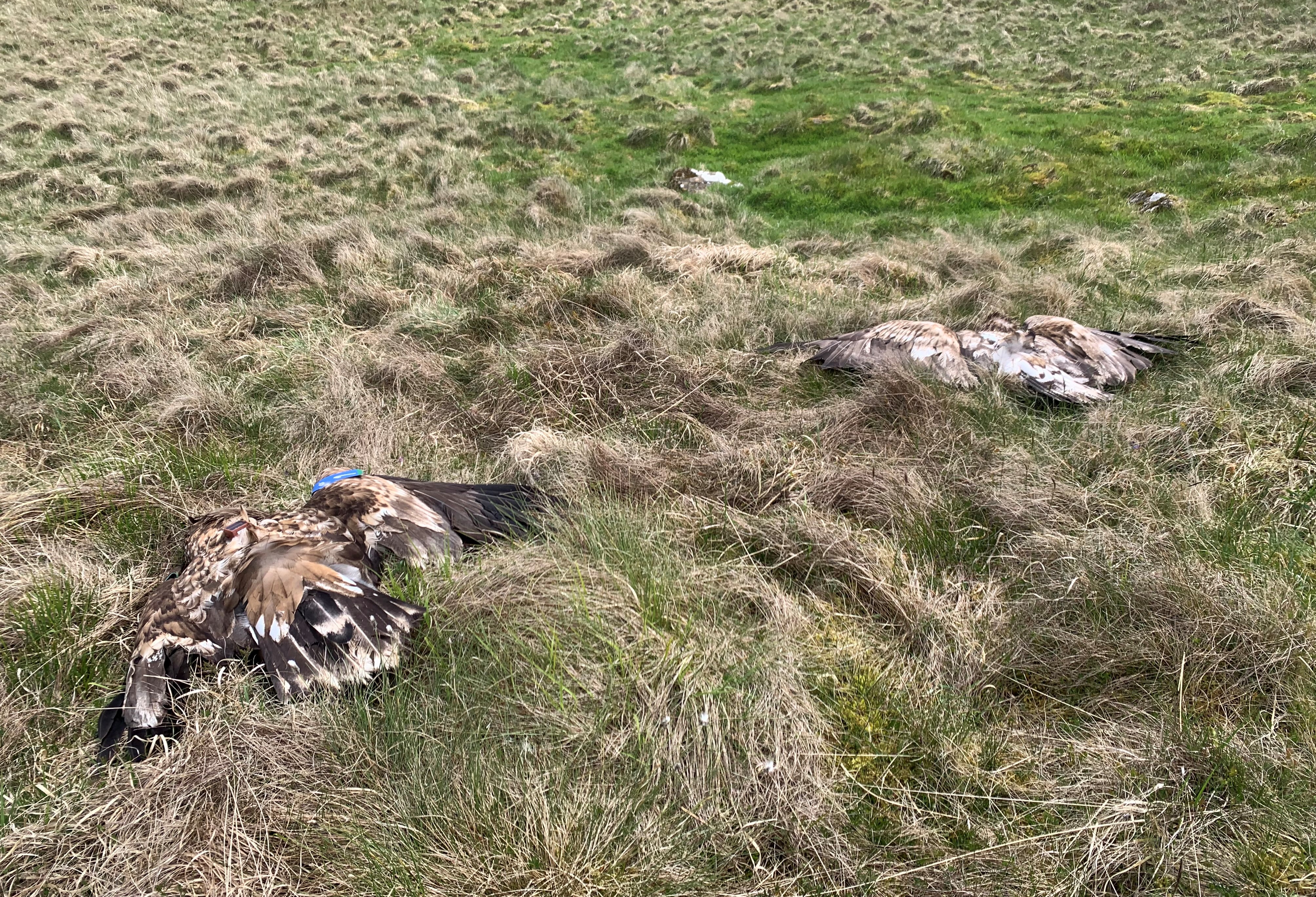
Would that be the same Glenwherry grouse moor shoot where two illegally poisoned White-tailed Eagles were found dead, side by side, in May 2023? Strange that Mr Shannon forgot to mention them.

Two illegally poisoned White-tailed Eagles found dead on Glenwherry, Northern Ireland’s only driven grouse moor. Photo by Northern Ireland Raptor Study Group.

Hen Harriers were mentioned throughout the debate but it was Minister Zeichner’s reference to the Hen Harrier Taskforce, “…which is using technology such as drones and strategic partnerships to detect, deter and disrupt offenders and is targeting hotspot areas and suspected hen harrier persecution” that caught my attention.

Zeichner claimed that, “Early signs suggest that it is having a positive impact“.

Really? That’s not my understanding. The HH Taskforce has been withholding details of multiple suspected and confirmed Hen Harrier persecution incidents over the last year. There are probably legitimate reasons to withhold information about the most recent cases as the police investigations are active but some of the other cases date back many months, some of them from over a year ago. It is simply not credible to argue that making an announcement about those cases will affect an investigation at this stage. I suspect there are other, political reasons for withholding those cases from the public and I’ll set out my reasoning in future blogs – there’s too much to include here.

For those who want to watch the recording of the Ban Driven Grouse Shooting debate you can find it here.

For those who want to read/download the debate transcript, it’s here:

UPDATE 3 July 2025: Pro-grouse shooting Labour MP Sam Rushworth received £10,000 donation from local grouse moor gamekeeper group (here).

UPDATE 5 July 2025: RSPB response to Westminster Hall debate on banning driven grouse shooting (here)