OPERATION EASTER – 28 years of stopping egg thieves

Press release from National Wildlife Crime Unit (NWCU)

The national enforcement campaign to protect our nesting wild birds is underway for 2025.

The taking of wild bird eggs is a serious crime which threatens bird populations across the UK and internationally.  However, this activity remains an illicit hobby for some determined individuals. Whole clutches of eggs can be taken from some of the UK’s rarest birds and stored in secret collections.

In 2024, Operation PULKA dismantled a transnational egg trading network and highlighted the harm caused by this illegal activity.  In the region of 20,000 eggs were seized in coordinated warrants from nominals throughout the UK.  High value collections were also seized in Australia and Norway. 

Police forces and partner agencies will be working hard this nesting season to protect wild birds from criminals.  Information from the public is a vital part of identifying suspicious activity and catching criminals.  

Detective Inspector Mark Harrison from the UK NWCU said: 

“At this time of year one of my favourite things to do, is stand outside in the morning with a brew and listen to the birds singing as the breeding season gets underway. 

But for some people this is when they are plotting, planning, visiting areas and checking for nests, getting their cameras, drones and climbing equipment ready. They may have to prepare a hide in their vehicle or check incubators are working correctly. For them this is a busy time of year.  Their interest in birds is far removed from mine.

At the end of 2024 my team led Operation Pulka and worked with police forces across the UK to execute warrants at numerous addresses during which thousands of bird’s eggs were seized. This highlighted that egg collecting is still a threat to our wildlife.

Add to this the threats to birds at this time of year from criminals wanting to take wild birds and launder them into the pet and falconry trades, criminals who want to kill certain birds due to some conflict with their hobby or business. Even overly keen bird photographers can disturb nesting birds and commit offences.

Operation EASTER is one of the NWCUs longest standing operations for the protection of wild birds at this crucial time of year. We will help to co-ordinate the policing response, ensuring dedicated Police Wildlife Crime Officers receive up to date intelligence, operational support and access to specialist investigators from the NWCU. With the help of our partners and the public we can make a difference.

We need the public and people who spend time out and about in our countryside to be our eyes and ears. To be aware of this criminality and to take the time to report anything suspicious or any information about this criminal activity to the police”.

If you have any information on egg and chick thieves, or those who disturb rare nesting birds without a licence, you should contact your local police by dialing 101 – ask to speak to a wildlife crime officer if possible. Get a description/photo and vehicle registration if safe to do so. Nesting will be in full swing in April so please contact the police if you see anyone acting suspiciously around nesting birds.

Information can also be passed in confidence to Crimestoppers via 0800 555 111.

ENDS

Gamekeeper from a Yorkshire Dales grouse moor charged in relation to alleged shooting of hen harrier (as featured on Channel 4 News in October)

In October last year, Channel 4 News featured incredible footage secretly filmed by the RSPB’s investigations team of three gamekeepers plotting to kill, and then allegedly killing, a hen harrier on an unnamed grouse moor in the north of England (see here).

If you missed the piece on Channel 4 News you can watch it here:

The audio quality on the footage was remarkable, allowing viewers to listen to the three gamekeepers discussing what not to shoot (a hen harrier with a satellite tag) and what to shoot (an untagged hen harrier, whose death would not be revealed to the wider world, or so they thought).

They were also heard discussing what else they’d apparently casually shot that afternoon – a buzzard and a raven, both protected species.

An untagged hen harrier. Photo by Pete Walkden

According to one of my media sources, a gamekeeper has now been charged in relation to this incident for an alleged offence under the Serious Crime Act 2007.

At this stage I’m not publishing the name of the accused, or the name of the grouse moor where the footage was captured, although I understand this information is widely known within the Yorkshire Dales National Park.

The accused is due in court for a first appearance next month.

NB: As an individual has now been charged, comments are disabled on this blog until criminal proceedings have ended to avoid prejudicing the case.

Natural England / DEFRA turns down licence application for hen harrier brood meddling in 2025

Some excellent news, for a change!

Natural England / DEFRA have turned down a licence application for hen harrier brood meddling in the 2025 breeding season, following the recent closure of the seven-year hen harrier brood meddling ‘trial’.

For new blog readers, the hen harrier brood meddling trial was a conservation sham sanctioned by DEFRA as part of its ludicrous ‘Hen Harrier Action Plan‘ and carried out by Natural England between 2018 – 2024, in cahoots with the grouse shooting industry, the very industry responsible for the species’ catastrophic decline in England. In general terms, the plan involved the removal of hen harrier chicks from grouse moors, they were reared in captivity, then released back into the uplands just in time for the start of the grouse-shooting season where many were illegally killed. It was plainly bonkers. For more background see here and here.

Male hen harrier. Photo by Pete Walkden

In autumn last year, the Moorland Association (grouse moor owners’ lobby group in England) lodged a licence application with Natural England, seeking to continue hen harrier brood meddling in 2025 albeit with some significant changes from the ‘trial’ conditions.

Those proposed changes included removing the requirement to satellite tag brood meddled hen harriers, presumably because the data from current satellite-tagged hen harriers have been so very effective at revealing the devastating extent of ongoing hen harrier persecution (e.g. see here and here). 

The other main change was that the Moorland Association wanted “a single release site” [for brood meddled hen harriers], “irrespective of the location from where they’d been removed from their nests”, presumably to get around the problem of there not being sufficient receptor sites willing to take the brood meddled harriers. I understand that the proposed single release site would have been of great interest to readers of this blog!

In March this year, Natural England announced the end of the hen harrier brood meddling trial but said it had not yet made a decision on whether to roll out brood meddling more widely (see here).

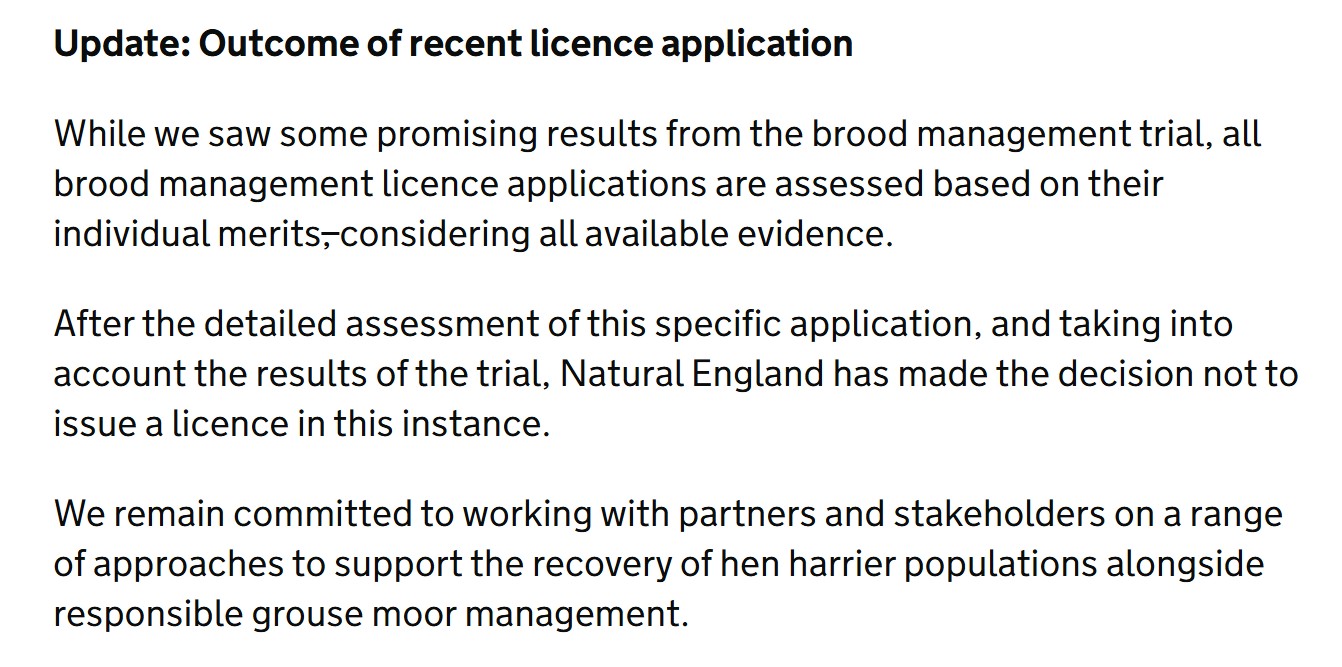
Today, Natural England has updated its hen harrier brood meddling blog with the following statement:

NE hasn’t provided any more detail about how it came to this very welcome decision but I have submitted an FoI and will publish NE’s response when it arrives.

Meanwhile, the Moorland Association has issued its own version of events about why its licence application was refused. I take everything the MA says with a dumper-truck-full of salt, given the reputation of its CEO for distorting and manipulating facts (e.g. see here and here).

According to this statement, the Moorland Association’s refusal to satellite tag brood meddled hen harriers was a factor in NE’s decision-making process. The Moorland Association says this:

We proposed using high visibility leg tags because we have serious concerns about using satellite tags – particularly the added cost and complexity. We also have concerns about how satellite tracking data is [sic] being used to damage trust and increased [sic] tension“.

Er, nope. Satellite tag data are being used to demonstrate the ongoing and widespread criminal killing of hen harriers in and around many driven grouse moors. It’s the illegal killing (undertaken by gamekeepers on grouse moors) that’s damaging trust and increasing tension, not the use of satellite tag data!

At least 134 hen harriers ‘disappeared’/were illegally killed during the brood meddling trial, mostly on or close to grouse moors, and they’re just the ones we know about.

Incidentally, there’s news about a recent, very high profile case, coming shortly…

Meanwhile, I’m raising a glass to the end of hen harrier brood meddling (for this year, at least). It should never have started in the first place. Well done to all those who have campaigned so hard against it over the last seven years and shame on the individuals and organisations who facilitated this conservation sham.

Wild Justice’s petition calling for a ban on driven grouse shooting is nearing its 100,000-signature goal. It currently stands at 91,439. If you’d like to help it over the line, for the sake of future generations of hen harriers, please click here.

“Something is very wrong at the heart of NatureScot” – opinion piece by farmer & conservationist Tom Bowser

A couple of weeks ago I published a press statement from Scottish charity Trees for Life about NatureScot’s ‘mystifying lack of backbone’ in relation to a delayed licensing decision on the release of beavers in Glen Affric.

I also mentioned concerns about NatureScot’s recent decisions and behaviour in recent months relating to grouse moor licensing and the monitoring of Schedule 1 raptor species.

Criticism of NatureScot continues, this time with an opinion piece by farmer and conservationist Tom Bowser from the excellent Argaty, a rewilding estate in Doune, Perthshire, which was published in The National yesterday.

It’s reproduced below.

SOMETIMES I wonder what sort of democracy Scotland really is.

We have a government policy designed to grow our small beaver population by translocating these biodiversity-boosting animals to new parts of the country. Repeated surveys show that most Scots wish this to happen. We have the world’s most thorough official guidance, leading applicants through how to attempt such wildlife relocations.

Yet when Forestry and Land Scotland and Trees for Life followed this guidance, conducting a gold-standard two-year consultation on proposals to relocate beavers to Glen Affric, the national nature agency, NatureScot, stalled on granting a licence, citing concern among the local community.

Yet two-thirds of the Glen Affric community supported the proposals, and NatureScot itself had previously called the consultations “exemplary”. What is going on?

Since submitting their plans, the applicants have already been made to wait three long months to hear from NatureScot. Now they face a whole summer in the wilderness as the agency demands further consultation. But with community support already demonstrated after two years of engagement, what else can there possibly be to consult on?

NatureScot’s decision is stranger still given that Strathglass, where the proposal’s opponents reside, already has an established beaver population. If this application is too controversial to proceed, what hope have we of assisting the spread of beavers and allowing them to help us fight biodiversity loss and climate breakdown?

Something is very wrong at the heart of NatureScot. This is but the latest in a string of examples where it has acted against the interests of wildlife and communities.

Reaction to its controversial Glen Affric indecision has been brutal. The BBC, Herald and Scotsman wrote stories of “beaver betrayal”. Wild Justice’s Ruth Tingay detailed NatureScot’s “glaring disregard” for conservationists and “pandering” to landowners.

Springwatch presenter Iolo Williams summed the mood up: “NatureScot = not fit for purpose”.

They are right to be angry. Scotland is one of the world’s most nature-depleted countries, ranking 212th of 240 surveyed for intactness of biodiversity. Where is the leadership from those charged with restoring nature?

Let’s return to beavers. Their deadwood-filled wetlands are scientifically proven to boost biodiversity. Their dams store water in times of deluge and drought. The environmental crisis is the greatest threat humankind faces. Scotland’s nature agency ought to be encouraging the spread of beavers. Right?

Unfortunately, the opposite seems true. Every beaver translocation applicant has faced bureaucratic burdens and legislative inconsistency. I know this because I’ve been through it.

Despite having beavers living in the wild just five miles away, it took me many months to obtain a licence to translocate other families to my farm, Argaty. Time and time again I was told that our proposal to move these much-needed animals from areas where they were destined to be shot was “novel and contentious”. At that time, NatureScot was dispensing licences in less than 24 hours to farmers wishing to kill beavers.

As if stalling other applicants wasn’t bad enough, NatureScot refuses to even consider relocating beavers to any of its own, highly suitable National Nature Reserves. That it won’t jump its own bureaucratic hurdles tells you all you need to know about NatureScot and its nightmarish processes. This is not a nature agency Scots can be proud of; it is one we should be embarrassed by.

Why the lack of interest in helping Scotland’s beavers?

Part of the answer lies at the political level. By changing Inheritance Tax rules, the UK Government has alienated the farming community. Seeing the opportunity to win rural votes ahead of an election year, John Swinney seems hell-bent on throwing the farmers every bone he can. Even if that means throwing biodiversity under the bus.

We’ve seen a refusal to countenance lynx reintroduction, a commitment to maintain basic subsidy payments to farmers (paying them per farmable acre owned, rather than properly rewarding environmentally sensitive food production). The list goes on.

Is the stalling of beaver translocations another SNP gift to National Farmers’ Union lobbyists?

Much of the blame surely lies with Holyrood. NatureScot lives in fear of its SNP paymasters, who have cut the agency’s funding by 40% in the last decade. It’s a brave civil servant who defies the politicians, angers the farmers and brings further cuts.

But NatureScot is not exempt from criticism. For years they handed out beaver cull licences as though they were sweeties. The annual slaughter of one in 10 of these animals only came to an end when Trees for Life took NatureScot to judicial review and shamed it into change.

NatureScot’s cowardice over the Glen Affric beaver proposal may have triggered conservationists’ anger, but this storm has been brewing for years. NatureScot is riven with problems. Grouse shooting industry lobbyists have infiltrated its boardroom; traditional “kill everything” attitudes dominate its directorship.

There are good people within the agency, but they are too few and the enemies within are too many. As an organisation, it does not know whether it exists to stand up for nature or to simply serve the whims of its masters.

In 2021, when Trees for Life had proved the illegality of NatureScot’s beaver cull policy, celebrated Scottish writer Jim Crumley called for a “new nature-first agency”. Perhaps it’s time to make the idea a reality.

As climate breakdown and biodiversity loss ravage Scotland, we need an agency properly funded by, but independent from, government. One that is led by evidence and is willing to speak truth to power.

We need an agency willing to champion co-existence with wildlife, brave enough to overcome resistance to vital change, humane enough to support everyone through that difficult process. The only people in this agency’s boardroom and upper echelons would be those with a proven record of defending nature. This is the agency Scotland needs.

The politicians we require are those willing to make that change. If John Swinney and his heir apparent, Kate Forbes, think that the opponents of nature restoration are the only rural voters he needs to win over, he has made a grave mistake.

Tom Bowser is the owner of Argaty, a working farm based on the Braes of Doune in central Scotland, which aims to produce food in an environmentally sensitive manner and to make a home for nature. Tom is author of A Sky Full Of Kites: A Rewilding Story and the forthcoming Waters Of Life: Fighting For Scotland’s Beavers.

ENDS

Tom’s latest book is due out 1st May 2025. It is available for pre-order from the publisher here.

Peregrine eggs smashed at St Albans Cathedral as person seen walking over them on livestream camera

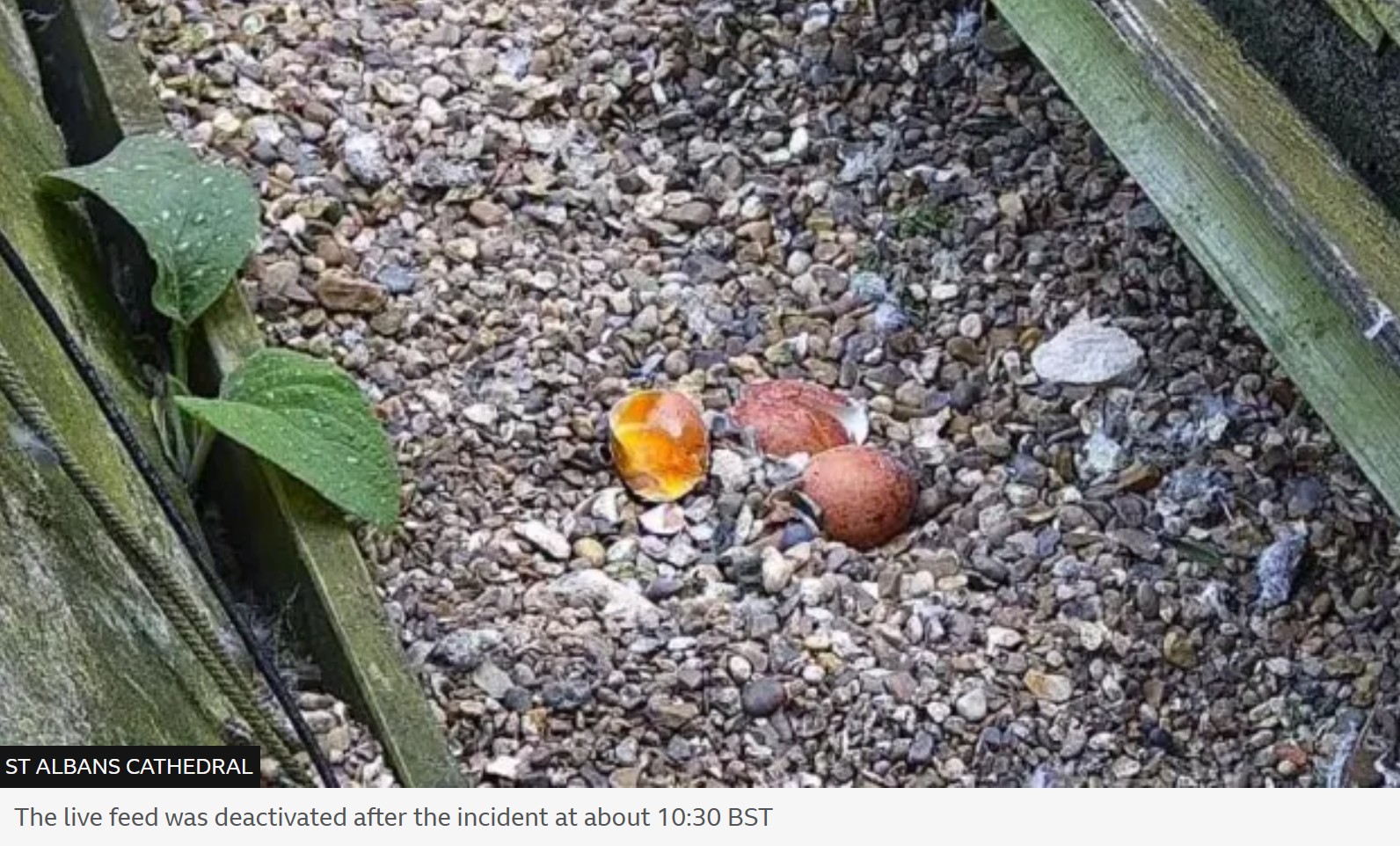
An individual is ‘helping police with their inquiries‘ after a person was seen on livestream camera deliberately walking over three Peregrine falcon eggs laid by the resident breeding pair at St Albans Cathedral in Hertfordshire yesterday.

The livestream feed, run in partnership by St Albans Cathedral and Herts and Middlesex Wildlife Trust, has been taken off air.

A livestream viewer said:

The female bird was sitting on the eggs and all of a sudden there was a noise that spooked her, it sounded like a door opening.

Then I saw a man’s leg enter in front of the camera. He stood there for 30 or 40 seconds before literally walking across – he didn’t stamp but he stepped on the eggs and just kept walking“.

More details on BBC News website here.

UPDATE 5 May 2025: ‘Investigation still ongoing’ into person seen trampling Peregrine eggs at St Albans Cathedral (here).

Thousands of gamebirds culled at breeding facility in N Yorkshire after bird flu outbreak

The number of outbreaks of Highly Pathogenic Avian Influenza is showing no sign of slowing down, with the latest flurry of cases reported in Yorkshire and County Durham.

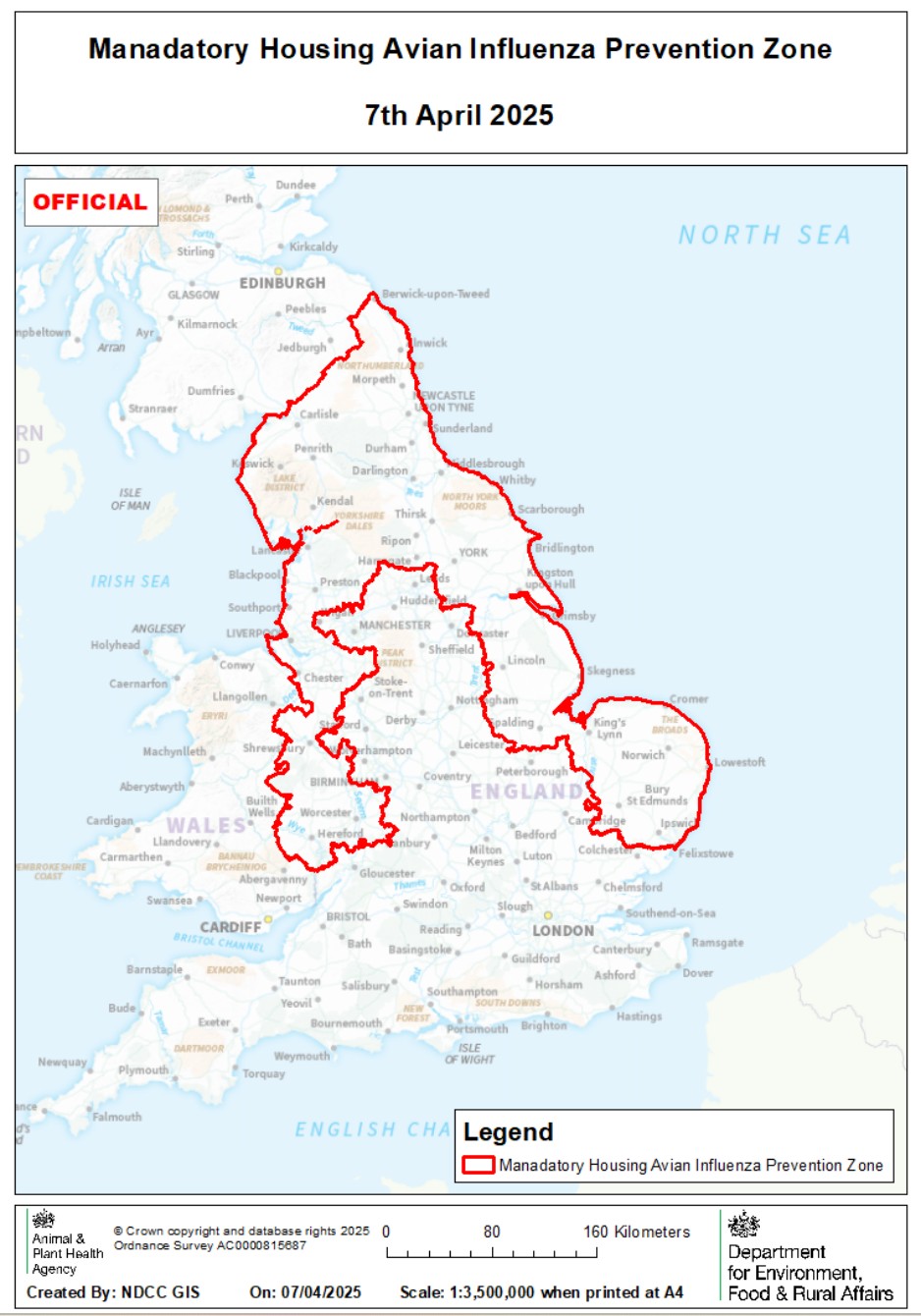
So much so that from today (7th April 2025), the regional Avian Influenza Prevention Zone (AIPZ) mandating enhanced biosecurity and housing for kept birds currently in force across Cheshire, City of Kingston Upon Hull, East Riding of Yorkshire, Herefordshire, Lancashire, Lincolnshire, Merseyside, Norfolk, North Yorkshire, Shropshire, Suffolk, Worcestershire and York has now been extended to cover the following counties:

Cumbria, County Durham, Northumberland, Tyneside.

One of the recent outbreaks reported in North Yorkshire caught my eye. Here’s the report of a case on 30 March 2025:

Highly Pathogenic Avian Influenza (HPAI) H5N1 was confirmed in commercial poultry and other captive birds at a premises near Pickering, Thirsk & Malton, North Yorkshire (AIV 2025/37).

A 3km protection zone and 10km surveillance zone have been declared around the premises. All affected birds on the premises will be humanely culled‘.

The grid reference given for the centre of the protection zone (i.e. the location of the H5N1 outbreak at the centre of the blue circle) is given as: SE7592387464.

This appears to be Westfield Farms, Cropton Lane, Pickering, just on the border of the North York Moors National Park.

Sound familiar?

In 2015 the owner of Westfield Farms, where pheasants, red-legged partridges and ducks are bred and reared to be sold for gamebird shooting was convicted of permitting the use of a pole trap at his game farm after the RSPB filmed him driving past and appearing to look in the direction of a pole trap set above a rearing pen.

Pole traps have been banned since 1904. It’s a barbaric way to kill any animal and causes horrendous suffering and distress, often over a period of many hours. A spring trap is placed on a post where a bird of prey is likely to perch. When the bird lands on the ‘plate’, the trap springs shut on the bird’s legs. When the bird tries to fly off, it ends up dangling upside down because the trap is attached to the post by a chain to prevent it from being carried away. The bird remains dangling, often with severe injuries, until its ultimate demise.

The game farm owner had denied any knowledge of the pole trap but after viewing the RSPB’s footage, magistrates said it was “inconceivable” that he wouldn’t have seen it. In addition to his conviction for permitting the use of a trap, two of his staff were cautioned by police after a total of five set pole traps were found at the game farm (see here).

North Yorkshire Police collecting one of five illegally-set pole traps at Westfield Farm. Photo: RSPB

However, the game farm owner’s conviction was quashed on appeal later that year after judges at York Crown Court declared that “the prosecution had failed to prove its case” (i.e. that the game farm owner had seen the illegal trap) – see here.

Sign at Cropton last week (supplied by RPUK blog reader). Spot the pheasant!

Pilot study to examine impact of releasing non-native gamebirds in Cairngorms National Park

A pilot study to examine the impacts of releasing non-native gamebirds (pheasants & red-legged partridges) into the Cairngorms National Park is due to begin this spring, according to an article published by The Ferret.

Captive-bred non-native pheasants in pretty poor condition being transported for release into the UK countryside. Photo by Ruth Tingay

The pilot study looks to be the start of a wider and long-overdue assessment of the impact of these releases across Scotland, based on FoI documents from NatureScot compiled by journalists at The Ferret (well worth reading those documents, here).

The Ferret suggests that the Game & Wildlife Conservation Trust (GWCT) will be undertaking the study. This is a charity that relies heavily upon funding from the gamebird shooting industry. Talk about marking your own homework!

A GWCT spokesperson is quoted in The Ferret article:

The pilot project to begin looking at the numbers of gamebirds released within the Cairngorms National Park has not yet taken place, but is due to start this spring once the plan for it has been finalised“.

I’ll be looking forward to seeing the GWCT’s proposed methods and justification for undertaking a pilot study in the spring – a time of year when gamebird numbers will be at their lowest after the end of the winter and the end of the shooting season, instead of planning to do it in the autumn when these birds are released in their millions and thus at their most abundant / causing the most damage.

There’s also a hilarious quote from NatureScot:

Currently, there is little evidence to show that gamebirds are causing damage to protected areas in Scotland, but we will continue to monitor the situation closely“.

‘We will continue to monitor the situation closely’ can be translated as, ‘We’ve ignored this issue for years so of course we don’t have any evidence of damage, because we haven’t been looking!’.

The issue of releasing non-native gamebirds into the Cairngorms National Park has been the subject of a number of blogs on the excellent ParkswatchScotland website over the years (e.g. here in 2017 and here in 2020). Nick Kempe, the blog’s author, has repeatedly questioned why this issue hasn’t featured in the Cairngorms National Park’s Management Plans.

It was, finally, included in the latest Management Plan (2022-2027) despite objections from some members of the Park Authority’s Board in 2021 who just happened to have strong links to the game-shooting industry (see here – and if you’ve got the time it’s worth watching the video of that Board Meeting).

Here’s what the current CNP Management Plan says about gamebird management:

The Management Plan points out:

The regulatory framework around releases of species is not consistent at present, meaning that a licence is not required to release pheasants and partridges, but is required to release beavers and red squirrels‘.

Isn’t it about time this inequity between the release of millions of non-native gamebirds and the restoration of a few native species was addressed?

UPDATE 21 November 2025: New report on gamebird releases in Cairngorms National Park doesn’t tell even half the story (here)

Private Eye pulls Wild Justice adverts, causing ‘Streisand Effect’

A couple of weeks ago conservation campaign group Wild Justice put a full page advert in Private Eye, the UK’s number one best-selling news and current affairs magazine, to draw readers’ attention to the absurd release of over 50 million non-native pheasants into the countryside every year, for shooting.

It was the first of three planned adverts and this one caused quite a reaction, with many people commenting how surprised they were to learn that pheasants were non-native to the UK, let alone that 50 million of them are released into the countryside every year for so-called ‘sport shooting’. The advert also prompted conversations in Whitehall, according to sources.

The gamebird shooting industry wasn’t impressed with this level of awareness-raising amongst the general public and politicians – no surprise really given that they’ve been hoodwinking everyone for decades about how ‘sustainable’ gamebird-shooting is supposed to be.

Imagine Wild Justice’s surprise then when Private Eye got in touch to say it was pulling the other two adverts and didn’t provide any explanation for that decision. You can draw your own conclusions.

Amusingly, since Wild Justice announced the news this morning, Private Eye’s censorship has caused somewhat of a Streisand Effect and many people are now asking to see the other two adverts that Private Eye has refused to publish.

Wild Justice has placed the two remaining ads with another publication and they should be out in the next few weeks. It’s probably best not to name the publication in advance to avoid the possibility of it being nobbled!

For those who wish to support Wild Justice you can sign up for their free newsletter here.

For those who want to see a ban on driven grouse shooting, (not the same as pheasant shooting but just as absurd, for different reasons, and just as mired in wildlife crime) you can sign the Wild Justice petition here (it currently stands at 84,000 signatures and needs 100,00- signatures to trigger a Westminster debate). The petition closes on 22 May 2025.

It would be deliciously sweet if the petition attracted more support as a result of Wild Justice being censored!

UPDATE 27 April 2025: Private Eye ‘explains’ (sort of) its reasons for pulling Wild Justice adverts (here)

Police investigation launched after two ravens found poisoned in Newry

The Police Service of Northern Ireland (PSNI) has issued a press release following confirmation that two ravens found dead in December 2024 had been poisoned.

PSNI press release (3 April 2025):

INVESTIGATION AFTER TWO RAVENS CONFIRMED TO HAVE BEEN FATALLY POISONED

Police in Newry have commenced an investigation after two ravens were confirmed to have been fatally poisoned in Poyntzpass.

Testing determined that the birds, which were found in a field in the Drumbanagher Wall area in December, had consumed high levels of the rodenticide Chloralose, and Bendiocarb, an insecticide and concluded this was likely an abuse case, potentially causing their deaths.

Raven photo by Pete Walkden

Superintendent Johnston McDowell, the Police Service lead for Wildlife Crime and Animal Welfare, said: “These birds should have been safe in the wild and yet someone has sought to intentionally poison them. This is not the first time we have had reports of this nature in the area and it saddens me that our incredible wildlife and birds are being killed. They are a beautiful asset to our countryside that we should work to protect.

It’s important that anyone who comes across dead birds, which they believe to have been poisoned, shot, illegally trapped or even taken to sell, that they report their find to PSNI immediately and do not handle them. The poisons being used are deadly not only to birds and wildlife but also to humans and chances should never be taken when potentially dealing with such chemicals.”

The Health and Safety Executive NI, one of the enforcing authorities responsible for Biocidal Product Regulations in Northern Ireland, said: “Where duty-holders are found to have incorrectly used or have misused biocidal products or continue to use or store biocidal products that have been withdrawn from the market, HSENI will take appropriate enforcement action to achieve compliance. This highlights the importance of responsible use of all chemicals including biocidal products.” 

A spokesperson for the Department of Agriculture, Environment and Rural Affairs said: “Illegal poisoning of birds and wildlife is completely reprehensible. It is an offence to supply, store (be in possession of) and use a Plant Protection Product (PPP, or Pesticide), that has been banned or withdrawn. Further it is an offence to use an authorised PPP in contravention of the conditions and the specific restrictions established by the authorisation and specified on the product label. The penalty, if convicted on summary conviction, is a fine not exceeding the statutory maximum or on conviction on indictment, to an unlimited fine.”

Superintendent McDowell added: “Along with our partners we will continue to investigate these crimes and seek to prevent further instances whilst bringing offenders to justice.

Please report wildlife crime by calling 101. A report can also be made online via http://www.psni.police.uk/makeareport/ or you can also contact Crimestoppers anonymously on 0800 555 111 or online at http://crimestoppers-uk.org/

If you have any information on this particular incident please quote incident number 723 13/12/25.

ENDS

This isn’t the first time poisoned ravens have been found in Newry. In October 2024 wildlife crime officers ‘visited an estate in Newry to talk to residents and employees about the confirmed poisoning of ravens on two separate occasions‘ (see here, although there are no details about when those two poisoning crimes took place).

It would help if the Department for Agriculture, Environment & Rural Affairs (DAERA) would get on with updating and implementing stronger pesticide legislation in Northern Ireland. It’s not difficult -they just have to write a list of the banned chemicals and add it to the Wildlife (Northern Ireland) Order 1985, as amended. This simple measure is widely supported by over 50,000 people who signed the Northern Ireland Raptor Study Group’s recent petition calling for this action.

UPDATE 25 June 2025: Police launch investigation after Red Kite killed in poisoning hotspot (here)

“NatureScot’s mystifying lack of backbone” – Beavers, grouse moor licensing & raptor monitoring

Scottish charity Trees for Life has issued a damning press release about “NatureScot’s mystifying lack of backbone” in relation to a delayed licensing decision on the release of beavers in Glen Affric.

I’ll come to that press release in a second, but it reflects a wider and growing anger amongst conservationists towards NatureScot, and particularly its Wildlife Management department, for some utterly stupid and ill-thought out decisions made in recent months relating to grouse moor licensing and the monitoring of Schedule 1 raptor species.

It’s not just the decisions that have been made, but it’s more about how they were made, with appalling levels of communication, shrouded in secrecy and in some cases, blatant lies have been told. There has been a glaring display of disregard for the views of those in the conservation sector and an overt demonstration of pandering to the demands of landowners, particularly those who own game-shooting estates.

We saw an example of that last autumn/winter when NatureScot made amendments to the grouse moor licences after coming under pressure from the grouse shooting industry. NatureScot didn’t consult with any other stakeholders and instead held secret talks and meetings that resulted in a significantly weakened licence and a massive, gaping loophole that makes enforcement measures for raptor persecution (and other wildlife) crimes on grouse moors pretty much unenforceable (see here). The Scottish Government has acknowledged there are issues and efforts to rectify that mess are ongoing.

There’s also been another NatureScot fiasco running in the background over the last five months relating to licences issued to raptor fieldworkers to monitor Schedule 1 species. I won’t write about that here because it deserves a separate blog or two, which I’ll write soon, but be under no illusion about the levels of anger from a number of conservation organisations about how NatureScot has behaved during the process. There will undoubtedly be repercussions.

And now there’s the beaver licensing fiasco at Glen Affric, with NatureScot being accused by conservationists of “great beaver betrayal” and concerns that some within NatureScot have “succumbed to pressure from outside forces“.

NatureScot’s reputation reached rock bottom in 2018 when it issued a licence to a bunch of predator-hating landowners and gamekeepers to kill ravens in Strathbraan in a five-year experiment, “just to see what happens” (here). That licence was pulled after a successful legal challenge from the Scottish Raptor Study Group resulted in NatureScot’s own scientific advisory committee stating that the scientific rigour of the licence was “completely inadequate” (here).

Since then, relationships between conservationists and NatureScot had improved significantly in recent years, with efforts made by both parties to rebuild trust. It was going well, up until last summer, when it became apparent that someone at NatureScot, or perhaps a couple of them, were clearly making decisions without the ‘openness and transparency” that NatureScot laughingly claims to uphold.

Expect to read more about the fall out, and ramifications, in coming weeks.

Meanwhile, here’s the press release from Trees for Life, issued yesterday:

NATURESCOT ACCUSED OF ‘GREAT BEAVER BETRAYAL’

‘Mystifying’ decision by Scotland’s nature agency comes despite huge public support for return of native species and ‘exemplary’ local consultations

Scottish government agency NatureScot has unexpectedly delayed its decision to grant a licence application for the historic official release of beavers in Glen Affric citing ‘concern among the local community and its representatives’ as a reason for its controversial delay. 

Another government agency, Forestry and Land Scotland, submitted a licence application in December, following two years and three phases of extensive local consultation which resulted in two thirds of people involved supporting the release of beavers in the glen. 

Steve Micklewright, CEO of Trees for Life said, “This is an astonishing move by NatureScot. After two years of exhaustive consultations that far exceeded the requirements set out by NatureScot and that they have described as exemplary, one has to ask, what more is there to consult on?

Beavers create wetlands that benefit other wildlife, soak up carbon dioxide, purify water and reduce flooding. They can also bring economic benefits to communities through eco-tourism. 

NatureScot’s mystifying lack of backbone in the face of the nature and climate emergencies betrays so many people in the community who have engaged with this process in good faith and want the hope and renewal beavers would bring,” said Steve Micklewright.

The agency’s indecision also flies in the face of a Scottish Government directive to its public agencies to return beavers to suitable new areas of the country, and polls showing three-quarters of Scots want to see public bodies delivering on that. Scotland can’t afford its national nature agency to be failing to deliver on its remit on biodiversity in this way. NatureScot needs to be worthy of its name.

Very senior NatureScot managers were endorsing our gold standard approach to public consultation even after the licence application was submitted, so the fear is agency bosses have succumbed to pressure from outside forces. NatureScot should do the right thing and provide full, transparent answers to explain its inconsistent behaviour.”

ENDS

Notes to Editors

In a recent opinion poll conducted for the Scottish Rewilding Alliance, 73% of respondents said Scotland’s public bodies should identify more sites on their land for beavers.

Scotland’s Beaver Strategy, published by NatureScot in 2022, aims to ensure communities are supported to maximise the benefits of beavers, with negative impacts minimised, and to actively expand the beaver population into appropriate areas.

Trees for Life and FLS have been working in partnership for over two years on the Glen Affric proposal, which would have been the first official release of beavers to the northwest Highlands, four centuries since the native species was driven to extinction.

The rigorous consultations have significantly exceeded the requirements of Scotland’s National Beaver Strategy. This includes three rounds of extensive public engagement, resulting in two-thirds (67%) community support as long as conditions are met, and Trees for Life’s appointment of a dedicated Beaver Management Officer from the local area.

UPDATE 14 April 2025: “Something is very wrong at the heart of NatureScot” – opinion piece by farmer & conservationist Tom Bowser (here)