Press release from Police Scotland (28 February 2025):
APPEAL FOR INFORMATION AFTER BIRD OF PREY SHOT NEAR STRATHDON
Officers are appealing for information after a bird of prey was shot near Strathdon.
On Wednesday, 26 February 2025, we received a report of a red kite having being shot sometime between Monday, 3 and Tuesday, 4 February in the Glenbuchat area of Strathdon after being found by a member of the public.
The bird was recovered with the assistance of the Royal Society for the Protection of Birds (RSPB) where the cause of death was not apparent at that time. Following further investigations, it has been established that the bird had been shot and police were contacted.
Detective Constable Danny Crilley of the Wildlife Crime Unit said: “Red kites are protected under the Wildlife and Countryside Act and it is illegal to kill any protected species.
“Enquiries are ongoing and we are working with our partner agencies to establish the full circumstances of this incident.
“I would appeal to anyone with any information that may assist our investigation to contact us. Your information could be vital in in establishing what has happened. If you were in the Glenbuchat area on Monday, 3 or Tuesday, 4 February, and saw anything suspicious or have any information about shooting activity in the area, please contact us.
“Anyone with information is asked to contact Police Scotland on 101, quoting incident number 0846 of Thursday, 27 February. Alternatively, you can contact Crimestoppers on 0800 555 111 where information can be given anonymously.”
ENDS
First of all, well done to Police Scotland for issuing a speedy appeal for information, just two days after being notified about this shot red kite.
It’s not clear from the press release whether this shot raptor was found on or next to a grouse moor. However, the ‘Glenbuchat area of Strathdon’ is certainly in close proximity to land managed for driven grouse shooting.
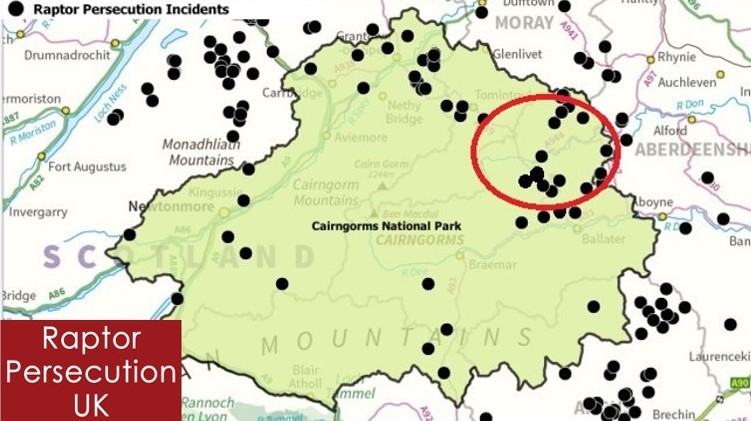
The Strathdon area of the Cairngorms National Park has long been recognised as a raptor persecution hotspot, as this map demonstrates:
This is a map I published in 2020 following the discovery of a poisoned White-tailed eagle on an unnamed grouse moor in the area (here).
The black dots on the map represent raptor persecution incidents recorded between 2005-2020, based on data from the RSPB, the golden eagle satellite tag review, and other data in the public domain. The Strathdon area is circled.
Those incidents in Strathdon include a poisoned raven (2006), a poisoned common gull (2006), multiple poisoned baits (2006), a shot buzzard (2009), a poisoned golden eagle (2011), a poisoned buzzard (2011), poisoned bait (2011), a shot short-eared owl (2011), two satellite-tagged golden eagles ‘disappearing’ (2011), another satellite-tagged golden eagle ‘disappearing’ (2013), a satellite-tagged white-tailed eagle ‘disappearing’ (2014), a goshawk nest shot out by masked men (2014), a shot goshawk (2016), another satellite-tagged golden eagle ‘disappearing’ (2017), a satellite-tagged hen harrier ‘disappearing’ (2018), another satellite-tagged hen harrier ‘disappearing’ (2019), and another satellite-tagged hen harrier ‘disappearing’ (2020).
Nobody was prosecuted in any of these cases.
The Strathdon area was also identified as a golden eagle persecution hotspot in the Scottish Government-commissioned scientific report, Analyses of the fates of satellite-tracked golden eagles in Scotland, published in 2017 and eventually leading to the introduction of the grouse moor licensing scheme in 2024:
It would be interesting to know whether this shot red kite was found on or next to a grouse moor and if it was, whether an associated grouse moor licence will be revoked as a consequence, which was the clear intention of the Scottish Parliament when it voted through the Wildlife Management & Muirburn (Scotland) Act 2024 almost a year ago last March.
My guess is that it won’t lead to a licence revocation, even if the red kite was found on or close to a grouse moor, because it will be virtually impossible to connect its death to the management of the grouse moor (as the new, shambolic and unenforceable licence condition now specifies).
Just like the shot osprey found in the Angus Glens on the opening day of the grouse-shooting season in August 2024 (here) and the shot peregrine, also found in the Angus Glens, in September 2024 (here), there won’t be any consequences for those responsible.
The raptor killers are still at, and they’re still getting away with their crimes.
For those who think the grouse moor licensing scheme is failing, and that the Scottish Government hasn’t shown any signs of intending to fix it even though it acknowledges there are issues (e.g. see here), there’s an alternative option – and that is to ban driven grouse shooting.
Wild Justice currently has a live petition calling for such a ban. It’s been supported by 67,432 members of the public so far but needs 100,000 signatures to trigger a Parliamentary debate. Please sign here to support it.
UPDATE 1st March 2025: Cairngorms National Park Authority condemns latest shooting of red kite (here)
UPDATE 2 May 2025: Two men charged in relation to illegal killing of Red Kites in Cairngorms National Park (here)
UPDATE 9 December 2025: Two Scottish gamekeepers on trial today in relation to alleged killing of Red Kites in Cairngorms National Park (here)
UPDATE 9 December 2025: Alleged killing of Red Kites in Cairngorms National Park – trial of two gamekeepers adjourned as Sheriff recuses himself due to RSPB membership (here)
The Scottish Greens MSP Mark Ruskell is the latest politician to lodge parliamentary questions about the grouse moor licensing shambles in Scotland.
As a recap, regular blog readers will know that NatureScot made a sudden and controversial decision last autumn to change its approach and amend the brand new grouse moor licences that had been issued to sporting estates in Scotland under the new Wildlife Management & Muirburn (Scotland) Act 2024.
The changes made by NatureScot significantly weakened the licence by changing the extent of the licensable area from covering an entire estate to just the parts of the estate where red grouse are ‘taken or killed’, which on a driven grouse moor could effectively just mean a small area around a line of grouse butts. The licence was further weakened by NatureScot reducing the number of offences outside the licensable area that could trigger a licence revocation.
Photo of a line of grouse-shooting butts by Richard Cross, annotated by RPUK
Freedom of Information responses later revealed that NatureScot had capitulated on grouse moor licensing after receiving legal threats from the grouse shooting industry. Secret and extensive negotiations then took place between NatureScot and a number of grouse shooting organisations, excluding all other stakeholders. NatureScot refused to release the legal advice it had received and on which it had apparently based its changes to the licence.
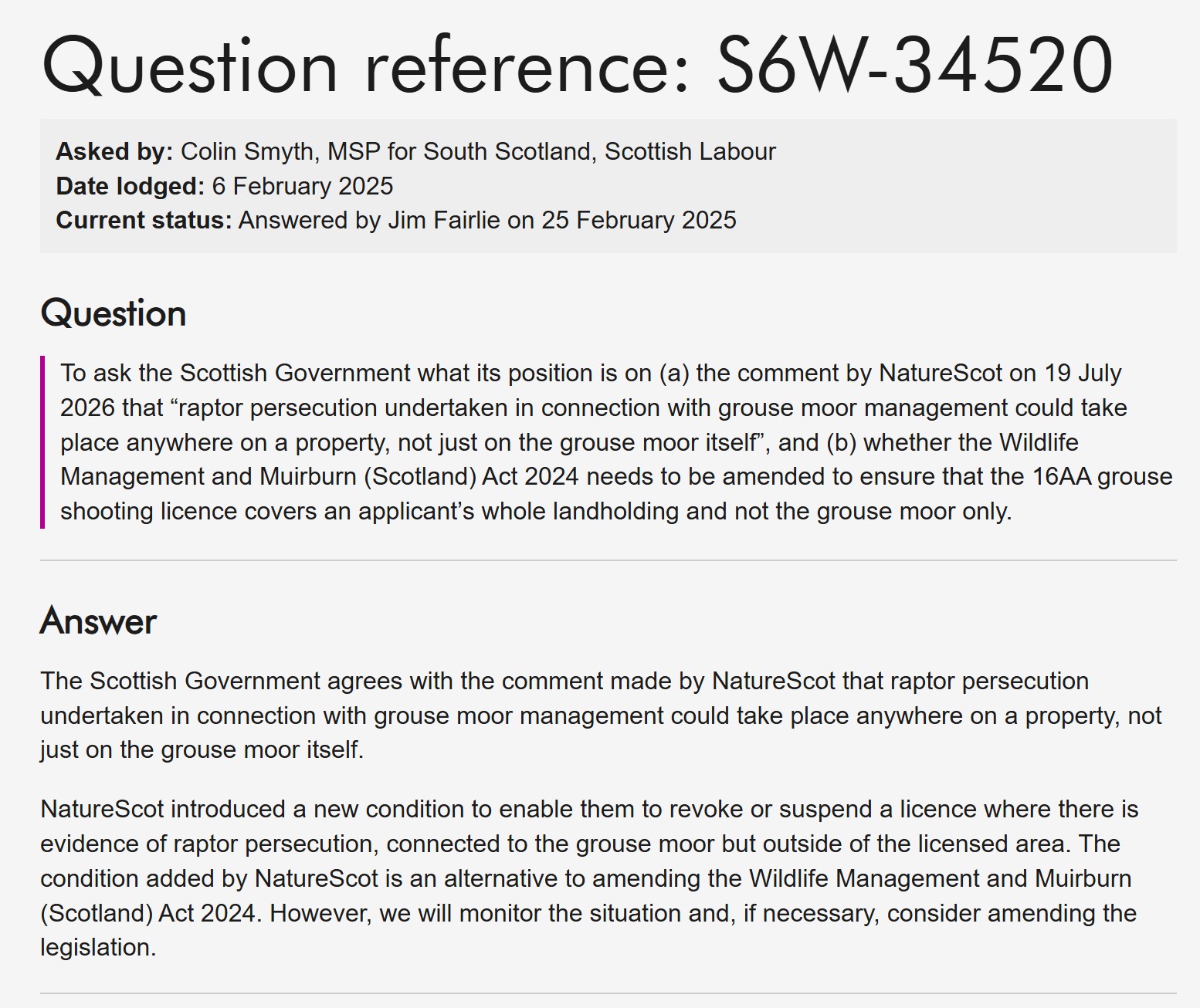
A couple of days ago, Minister Jim Fairlie responded to a series of parliamentary questions on this subject, lodged by Colin Smyth MSP (Scottish Labour). The Minister readily acknowledged there were issues with the changes that had been made to the grouse moor licences, but it was quite clear that he didn’t have any immediate plans to address the significant weakening of the licences (see here for his responses).
Now Mark Ruskell MSP from the Scottish Greens has lodged four more parliamentary questions about NatureScot’s behaviour and decision-making:
S6W-34987 Mark Ruskell: To ask the Scottish Government for what reason NatureScot reportedly did not invite each of the groups involved in the development of the Grouse Code of Practice to (a) meetings and (a) engage in consultation with it to discuss grouse licence conditions.
S6W-34988 Mark Ruskell: To ask the Scottish Government how many (a) meetings and (b) other discussions NatureScot and Scottish Land and Estates have held to discuss (i) the legal opinions regarding the wording of the Wildlife Management and Muirburn (Scotland) Act 2024 and (ii) what land should be included in a 16AA licence to shoot grouse.
S6W-34989 Mark Ruskell: To ask the Scottish Government whether NatureScot will release the notes of (a) meetings and (b) any other discussions it has had with Scottish Land and Estates to discuss grouse shoot licensing.
S6W-34990 Mark Ruskell: To ask the Scottish Government what (a) meetings and (b) other discussions took place between ministers and/or its officials with NatureScot in advance of the agency introducing new guidance related to “area of land” and new conditions to 16AA licences; whether these changes were approved and, if so, (i) by whom and (ii) when.
These questions were lodged on 18 February 2025. Responses are due by 4 March 2025.
Natural England’s review of its controversial Hen Harrier Brood Meddling trial is ‘being prepared for publication‘, according to a Freedom of Information request.
For new blog readers, the hen harrier brood meddling trial was a conservation sham sanctioned by DEFRA as part of its ludicrous ‘Hen Harrier Action Plan‘ and carried out by Natural England between 2018 – 2024, in cahoots with the very industry responsible for the species’ catastrophic decline in England.
In general terms, the plan involved the removal of hen harrier chicks from grouse moors, they were reared in captivity, then released back into the uplands just in time for the start of the grouse-shooting season where many were illegally killed. It was plainly bonkers. For more background see here and here.
Hen harrier photo by Laurie Campbell
In September 2024, Natural England announced on its blog that it was ‘currently reviewing and analysing the data gathered under the trial, a process which will be concluded later this year‘:
I have speculated previously that this relatively speedy review was probably triggered by an apparent application by the Moorland Association for a licence to continue Hen Harrier brood meddling as part of what it laughingly calls a ‘conservation licence’ (see here).
As I understand it, in September 2024 the Moorland Association (grouse moor owners’ lobby group in England) applied to Natural England for a brood meddling licence and it included the following condition requests:
That there should be a single release site [for the brood meddled HHs] irrespective of the location from where they’d been removed from their nests; and
That the requirement for the brood meddled HHs to be satellite-tagged should be dropped.
The first proposed condition is presumably designed to get around the problem of there not being sufficient receptor sites willing to take the brood meddled harriers (just a handful of estates agreed to receive brood meddled hen harriers during the trial period). I’m also led to understand that the proposed single release site is, shall we say, a location of great interest to this blog.
The second proposed condition, that any brood meddled hen harriers should not be satellite-tagged, is presumably because the data from current satellite-tagged hen harriers have been so very effective at revealing the devastating extent of ongoing hen harrier persecution on grouse moors (e.g. see here and here).
We also know that gamekeepers on grouse moors are now selectively choosing to kill hen harriers that are NOT satellite-tagged because there’s less chance of their crimes being detected (e.g. see here).
The deadline for Natural England to respond to the Moorland Association’s licence application must be fast approaching, hence Natural England’s relatively speedy brood meddling review.
Given that Natural England had said in September 2024 that its brood meddling review would be ‘concluded later this year‘, I submitted an FoI request on 2nd January 2025 to find out whether the review had been completed.
Natural England’s response was dated 28 January 2025, so a month on, the publication of this review must now be imminent.
Will Natural England conclude that the hen harrier brood meddling trial was ‘aremarkable success story‘ as the Moorland Association ridiculously claimed? Remember, the trial was set up to test two specific objectives:
The practicalities of brood management: can [hen harrier] eggs or chicks be taken from the wild and raised in captivity, can those chicks be released back in to the wild and the implications for their subsequent behaviour and survival;
Changes in societal attitudes by those involved in upland land management to the presence of hen harriers on grouse moors with a brood management scheme in place.
It’s quite clear that objective 1 has been answered by the trial – although chicks rather than eggs were brood meddled due to concerns about transporting the eggs from the nests over rough terrain, but that’s no big deal in terms of assessing the viability of the objective.
But what about objective 2? It’s abundantly clear that apart from the handful of estates involved in the brood meddling trial (whether they be ‘donor’ or ‘receptor’ sites), that a high level of illegal hen harrier persecution has continued amongst the wider grouse moor industry (at least 134 hen harriers reported as ‘missing’/illegally killed since the trial began in 2018, including at least 30 brood meddled hen harriers).
Indeed, the illegal killing is still on such a scale that the police have had to set up a new Hen Harrier Taskforce, designed to use techniques usually seen when dealing with serious and organised crime, to address the ongoing criminality.
*n/a – no hen harriers were brood meddled in 2018. **Post mortem reports on a further six hen harriers found dead in 2024 are awaited.
Many of us will be taking a very close look at Natural England’s review of brood meddling whenever it’s published. Watch this space.
Press release from Wild Justice (26 February 2025)
WILD JUSTICE APPOINTS FIRST CHIEF EXECUTIVE
Conservation campaign group Wild Justice has appointed Bob Elliot as its first Chief Executive.
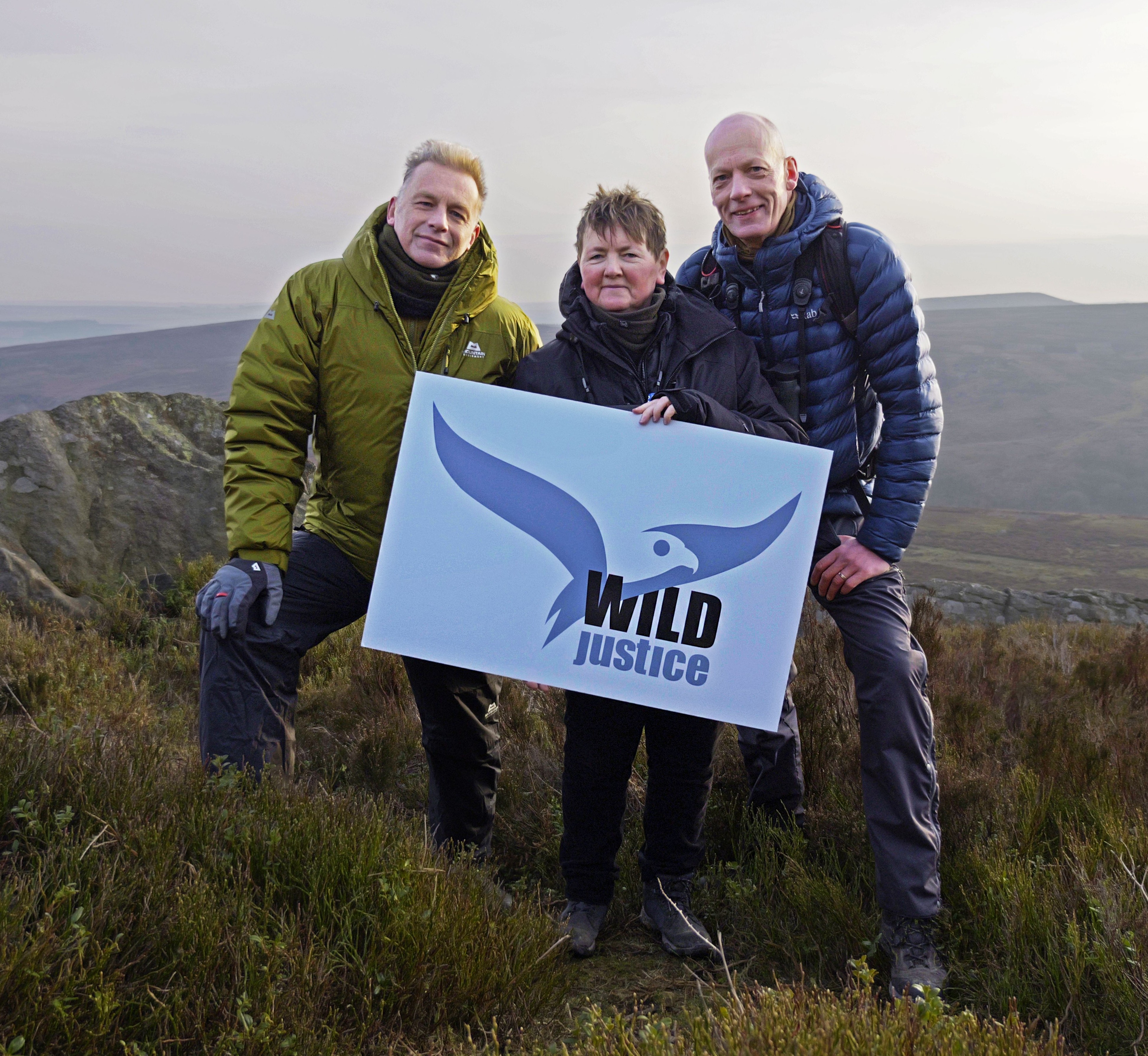
Wild Justice co-directors Chris Packham & Ruth Tingay with new CEO Bob Elliot. Photo by Fabian Harrison
Bob has worked in the nature conservation and animal welfare sector for over 30 years and will be joining from the Scotland-based charity OneKind where he has worked as CEO for the last seven years. Prior to that, Bob worked as Head of Investigations at the RSPB for over 10 years as well as other roles with The National Trust for Scotland and The Loch Lomond & The Trossachs National Park.
Commenting on his appointment, Bob said:
“I’m absolutely delighted to be joining Wild Justice and to help play a part in protecting and restoring wildlife. This team’s dedication to legal challenges and campaigning to hold governments accountable and strengthen environmental protections aligns perfectly with my passion for conservation.
“With my background in nature conservation, wildlife crime investigations, and animal welfare policy and campaigning, I’m excited to work alongside a team that’s truly making a difference. I look forward to helping drive change, inspiring public involvement, and fighting for a better future for nature”.
Wild Justice co-director Ruth Tingay said:
“I’m delighted we’ve been able to appoint such a high calibre individual. I’ve known and worked with Bob for many years, collaborating most recently on REVIVE, the coalition for grouse moor reform in Scotland. Along with his personal qualities, Bob brings a wealth of experience and understanding of the issues in which Wild Justice is interested, and his proven leadership, strategic and management capabilities will strengthen both our operational and campaigning aspirations”.
Wild Justice co-director Chris Packham said:
“Wild Justice doesn’t nibble – it bites, it doesn’t snivel in the car park – it bangs on the door, it doesn’t shy away from a fight – it throws the first punch. Wild Justice picks its fights based on legality and morality, not because it can win, but because it doesn’t care about what it takes to do the right thing for wildlife in the UK.
“To find someone to step into the ring vacated by the indefatigable Mark Avery should have been hard but in Bob Elliot we have all the determination, vim, vigour and vision we need to battle on. His longstanding knowledge and experience in the game of real conservation and animal welfare represent significant assets which we will all put to use on the front line of the war on nature. It’s great to have Bob on the job!”.
Wild Justice co-director Mark Avery said:
“The appointment of a first CEO is a big step for any small organisation. We’re lucky to have persuaded Bob to join us. I am sure he’ll be great in this role”.
Bob will be joining Wild Justice later this spring.
The Scottish Government’s Minister for Agriculture & Connectivity, Jim Fairlie MSP, has responded to a series of parliamentary questions lodged earlier this month by Colin Smyth MSP (Scottish Labour) on the grouse moor licensing shambles in Scotland.
As a recap, regular blog readers will know that NatureScot made a sudden and controversial decision last autumn to change its approach and amend the brand new grouse moor licences that had been issued to sporting estates in Scotland under the new Wildlife Management & Muirburn (Scotland) Act 2024.
The changes made by NatureScot significantly weakened the licence by changing the extent of the licensable area from covering an entire estate to just the parts of the estate where red grouse are ‘taken or killed’, which on a driven grouse moor could effectively just mean a small area around a line of grouse butts. The licence was further weakened by NatureScot reducing the number of offences outside the licensable area that could trigger a licence revocation.
Photo of a line of grouse-shooting butts by Richard Cross, annotated by RPUK
Freedom of Information responses later revealed that NatureScot had capitulated on grouse moor licensing after receiving legal threats from the grouse shooting industry. Secret and extensive negotiations then took place between NatureScot and a number of grouse shooting organisations, excluding all other stakeholders. NatureScot refused to release the legal advice it had received and on which it had apparently based its changes to the licence.
Here are the answers given by Minister Fairlie yesterday to Colin Smyth’s four parliamentary questions about this fiasco:
This is an interesting response about NatureScot’s continued refusal to release the legal advice it received about making changes to the grouse moor licences.
For interest, I have recently submitted a request for an Internal Review of NatureScot’s FoI response in December, where it refused to release the legal advice it had received. I don’t believe NatureScot’s decision was lawful so I’m seeking further clarification on its decision making. Depending on NatureScot’s response to the Internal Review request, I may escalate this to the Information Commissioner if my suspicions of unlawful behaviour are founded.
The second paragraph of the Minister’s response ignores totally the criticisms about NatureScot’s new licence condition. I.e. that (a) it is practically unenforceable, and (b) that it reduces the number of offences outside the licensable area that could trigger a licence revocation.
The Minister’s last sentence, “We are considering whether any further steps need to be taken to address this issue” is a simple non-committal to doing anything about the flawed new condition.
It reflects poorly on the Scottish Government but if the Government isn’t intending to address the issue itself, then there are other routes that other, more engaged politicians can take to address it. More on that to come.
Hmm. I’m not sure that Colin’s question was referring to NatureScot seeking approval from Police Scotland, but rather approval from the Scottish Government, although the wording of the parliamentary question isn’t as clear as perhaps it could have been.
Either way, it is my understanding that Police Scotland did not support the proposed new licence condition because it recognised that it was practically unenforceable. NatureScot appears to have ignored this expert advice.
It’s good that the Minister openly admits that raptor persecution can take place anywhere on a property and not just on the actual grouse moor.
However, the repeated statement about NatureScot’s new (and flawed and unenforceable) licence condition is pointless. Again, it reflects poorly on the Scottish Government but if the Government isn’t intending to address the issue itself, then there are other routes that other, more engaged politicians can take to address it. More on that to come.
Some more parliamentary questions have now been lodged to dig further in to NatureScot’s behaviour and decision-making in relation to the changes it made to the new grouse moor licences. I’ll blog shortly.
UPDATE 28 February 2025: More Parliamentary questions on grouse moor licensing shambles in Scotland (here)
For anyone who still wants to pretend that the grouse shooting industry isn’t responsible for the systematic extermination of hen harriers on grouse moors across the UK, here’s the latest catalogue of crime that suggests otherwise.
This male hen harrier died in 2019 after his leg was almost severed in an illegally set trap that had been placed next to his nest on a Scottish grouse moor (see here). Photo by Ruth Tingay
This is the blog I now publish after every reported killing or suspicious disappearance.
“They disappear in the same way political dissidents in authoritarian dictatorships have disappeared” (Stephen Barlow, 22 January 2021).
Today the list has been updated to include the most recently reported victim, ‘Red’, who hatched on the Tarras Valley Nature Reserve in 2024 and ‘disappeared’ on a grouse moor in the North Pennines in January 2025 (here).
I’ve been compiling this list only since 2018 because that is the year that the grouse shooting industry ‘leaders’ would have us believe that the criminal persecution of hen harriers had stopped and that these birds were being welcomed back on to the UK’s grouse moors (see here).
This assertion was made shortly before the publication of a devastating new scientific paper that demonstrated that 72% of satellite-tagged hen harriers were confirmed or considered likely to have been illegally killed, and this was ten times more likely to occur over areas of land managed for grouse shooting relative to other land uses (see here). A further scientific paper published in 2023 by scientists at the RSPB, utilising even more recent data, echoed these results – see here.
2018 was also the year that Natural England issued a licence to begin a hen harrier brood meddling trial on grouse moors in northern England. For new blog readers, hen harrier brood meddling was a conservation sham sanctioned by DEFRA as part of its ludicrous ‘Hen Harrier Action Plan‘ and carried out by Natural England (NE), in cahoots with the very industry responsible for the species’ catastrophic decline in England. For more background see here and for a critical evaluation of the trial after 5 years see this report by Wild Justice. In 2024 the brood meddling trial appeared to collapse for reasons which are not yet clear (see here) and the licence for the so-called ‘scientific trial’ expired. Natural England is currently undertaking a review of the ‘trial’ and a report is expected soon.
Brood meddling has been described as a sort of ‘gentleman’s agreement’ by commentator Stephen Welch:
“I don’t get it, I thought the idea of that scheme was some kind of trade off – a gentleman’s agreement that the birds would be left in peace if they were moved from grouse moors at a certain density. It seems that one party is not keeping their side of the bargain“.
With at least 134 hen harriers gone since 2018, and 30 of those being brood meddled birds, there is no question that the grouse shooting industry is simply taking the piss. Meanwhile, Natural England pretends that ‘partnership working’ is the way to go and consecutive DEFRA Ministers have remained silent.
*n/a – no hen harriers were brood meddled in 2018. **Post mortem reports on a further six hen harriers found dead in 2024 are awaited.
‘Partnership working’ according to Natural England appears to include authorising the removal of hen harrier chicks from a grouse moor already under investigation by the police for suspected raptor persecution (here) and accepting a £75k ‘donation’ from representatives of the grouse shooting industry that prevents Natural England from criticising them or the sham brood meddling trial (see here). This is in addition to a £10k ‘donation’ that Natural England accepted, under the same terms, in 2021 (here).
Thankfully, the Scottish Government finally decided to act by introducing a grouse moor licensing scheme under the Wildlife Management & Muirburn (Scotland) Act 2024. The intention behind this new legislation is that grouse shooting estates could have their licences suspended/revoked if, on the balance of probability, it is shown that any raptor persecution crimes (& some other associated offences) are linked with grouse moor management on that estate. There, are, however, ongoing issues with the licence as it’s been significantly watered-down after an intervention from the grouse shooting industry (see here). Work is underway to address this.
In England a new Hen Harrier Taskforce was established in 2024, led by the National Wildlife Crime Unit, to use innovative techniques to target hen harrier persecution hotspots (locations where hen harriers repeatedly ‘disappear’ or are found illegally killed). It’s too early to judge the Taskforce’s success and it’s been met with resistance from the Moorland Association, the grouse moor owners’ lobby group (here) and so far, illegal persecution continues.
So here’s the latest gruesome list of ‘missing’/illegally killed hen harriers since 2018. Note that the majority of these birds (but not all) were fitted with satellite tags. How many more [untagged] harriers have been killed? We now have evidence that gamekeepers are specifically targeting untagged hen harriers, precisely to avoid detection (see here for brilliant exposure by Channel 4 News).
February 2018: Hen harrier Saorsa ‘disappeared’ in the Angus Glens in Scotland (here). The Scottish Gamekeepers Association later published wholly inaccurate information claiming the bird had been re-sighted. The RSPB dismissed this as “completely false” (here).
5 February 2018: Hen harrier Marc ‘disappeared’ on a grouse moor in Durham (here).
9 February 2018: Hen harrier Aalin ‘disappeared’ on a grouse moor in Wales (here).
March 2018: Hen harrier Blue ‘disappeared’ in the Lake District National Park (here).
March 2018: Hen harrier Finn ‘disappeared’ near Moffat in Scotland (here).
18 April 2018: Hen harrier Lia ‘disappeared’ in Wales and her corpse was retrieved in a field in May 2018. Cause of death was unconfirmed but police treating death as suspicious (here).
8 August 2018: Hen harrier Hilma ‘disappeared’ on a grouse moor in Northumberland (here).
16 August 2018: Hen harrier Athena ‘disappeared’ on a grouse moor in Scotland (here).
26 August 2018: Hen Harrier Octavia ‘disappeared’ on a grouse moor in the Peak District National Park (here).
29 August 2018: Hen harrier Margot ‘disappeared’ on a grouse moor in Scotland (here).
29 August 2018: Hen Harrier Heulwen ‘disappeared’ on a grouse moor in Wales (here).
3 September 2018: Hen harrier Stelmaria ‘disappeared’ on a grouse moor in Scotland (here).
24 September 2018: Hen harrier Heather ‘disappeared’ on a grouse moor in Scotland (here).
2 October 2018: Hen harrier Mabel ‘disappeared’ on a grouse moor on the edge of the Yorkshire Dales National Park (here).
3 October 2018: Hen Harrier Thor ‘disappeared’ next to a grouse moor in Bowland, Lanacashire (here).
23 October 2018: Hen harrier Tom ‘disappeared’ in South Wales (here).
26 October 2018: Hen harrier Arthur ‘disappeared’ on a grouse moor in the North York Moors National Park (here).
1 November 2018: Hen harrier Barney ‘disappeared’ on Bodmin Moor (here).
10 November 2018: Hen harrier Rannoch ‘disappeared’ on a grouse moor in Scotland (here). Her corpse was found nearby in May 2019 – she’d been killed in an illegally-set spring trap (here).
14 November 2018: Hen harrier River ‘disappeared’ on a grouse moor in the Nidderdale AONB (here). Her corpse was found nearby in April 2019 – she’d been illegally shot (here).
16 January 2019: Hen harrier Vulcan ‘disappeared’ in Wiltshire close to Natural England’s proposed reintroduction site (here).
28 January 2019: Hen harrier DeeCee ‘disappeared’ in Glen Esk, a grouse moor area of the Angus Glens (see here).
7 February 2019: Hen harrier Skylar ‘disappeared’ next to a grouse moor in South Lanarkshire (here).
22 April 2019: Hen harrier Marci ‘disappeared’ on a grouse moor in the Cairngorms National Park (here).
26 April 2019: Hen harrier Rain ‘disappeared’ on a grouse moor in Nairnshire (here).
11 May 2019: An untagged male hen harrier was caught in an illegally-set trap next to his nest on a grouse moor in South Lanarkshire. He didn’t survive (here).
7 June 2019: An untagged hen harrier was found dead on a grouse moor in Scotland. A post mortem stated the bird had died as a result of ‘penetrating trauma’ injuries and that this bird had previously been shot (here).
5 September 2019: Wildland Hen Harrier 1 ‘disappeared’ on a grouse moor nr Dalnaspidal on the edge of the Cairngorms National Park (here).
11 September 2019: Hen harrier Romario ‘disappeared’ on a grouse moor in the Cairngorms National Park (here).
14 September 2019: Hen harrier (Brood meddled in 2019, #183704) ‘disappeared’ in the North Pennines (here).
23 September 2019: Hen harrier (Brood meddled in 2019, #55149) ‘disappeared’ in North Pennines (here).
24 September 2019: Wildland Hen Harrier 2 ‘disappeared’ on a grouse moor at Invercauld in the Cairngorms National Park (here).
24 September 2019: Hen harrier Bronwyn ‘disappeared’ near a grouse moor in North Wales (here).
10 October 2019: Hen harrier Ada ‘disappeared’ on a grouse moor in the North Pennines AONB (here).
12 October 2019: Hen harrier Thistle ‘disappeared’ on a grouse moor in Sutherland (here).
18 October 2019: Member of the public reports the witnessed shooting of an untagged male hen harrier on White Syke Hill in North Yorkshire (here).
November 2019: Hen harrier Mary found illegally poisoned on a pheasant shoot in Ireland (here).
November 2019: Hen harrier Artemis ‘disappeared’ near Long Formacus in south Scotland (RSPB pers comm).
14 December 2019: Hen harrier Oscar ‘disappeared’ in Eskdalemuir, south Scotland (here).
December 2019: Hen harrier Ingmar ‘disappeared’ in the Strathbraan grouse moor area of Perthshire (RSPB pers comm).
27 January 2020: Members of the public report the witnessed shooting of a male hen harrier on Threshfield Moor in the Yorkshire Dales National Park (here).
23 March 2020: Hen harrier Rosie ‘disappeared’ at an undisclosed roost site in Northumberland (here).
1 April 2020: Hen harrier (Brood meddled in 2019, #183703) ‘disappeared’ in unnamed location, tag intermittent (here).
5 April 2020: Hen harrier Hoolie ‘disappeared’ on a grouse moor in the Cairngorms National Park (here)
8 April 2020: Hen harrier Marlin ‘disappeared’ on a grouse moor in the Cairngorms National Park (here).
19 May 2020: Hen harrier Fingal ‘disappeared’ on a grouse moor in the Lowther Hills, Scotland (here).
21 May 2020: Hen harrier (Brood meddled in 2019, #183701) ‘disappeared’ on a grouse moor in Cumbria shortly after returning from wintering in France (here).
27 May 2020: Hen harrier Silver ‘disappeared’ on a grouse moor on Leadhills Estate, Scotland (here).
2020: day/month unknown: Unnamed male hen harrier breeding on RSPB Geltsdale Reserve, Cumbria ‘disappeared’ while away hunting (here).
9 July 2020: Unnamed female hen harrier (#201118) ‘disappeared’ from an undisclosed site in Northumberland (here).
25 July 2020: Hen harrier Harriet ‘disappeared’ on a grouse moor in the Yorkshire Dales National Park (here).
14 August 2020: Hen harrier Solo ‘disappeared’ in confidential nest area in Lancashire (here).
7 September 2020: Hen harrier Dryad ‘disappeared’ on a grouse moor in the Yorkshire Dales National Park (here).
16 September 2020: Hen harrier Fortune ‘disappeared’ from an undisclosed roost site in Northumberland (here).
19 September 2020: Hen harrier Harold ‘disappeared’ on a grouse moor in the Yorkshire Dales National Park (here).
20 September 2020: Hen harrier (Brood meddled in 2020, #55152) ‘disappeared’ next to a grouse moor in North Yorkshire (here).
24 February 2021: Hen harrier Tarras ‘disappeared’ next to a grouse moor in Northumberland (here)
12th April 2021: Hen harrier Yarrow ‘disappeared’ near Stockton, County Durham (here).
18 May 2021: Adult male hen harrier ‘disappeared’ from its breeding attempt on RSPB Geltsdale Reserve, Cumbria whilst away hunting (here).
18 May 2021: Another adult male hen harrier ‘disappeared’ from its breeding attempt on RSPB Geltsdale Reserve, Cumbria whilst away hunting (here).
24 July 2021: Hen harrier Asta ‘disappeared’ at a ‘confidential site’ in the North Pennines (here). We learned 18 months later that her wings had been ripped off so her tag could be fitted to a crow in an attempt to cover up her death (here).
14th August 2021: Hen harrier Josephine ‘disappeared’ at a ‘confidential site’ in Northumberland (here).
17 September 2021: Hen harrier Reiver ‘disappeared’ in a grouse moor dominated region of Northumberland (here)
24 September 2021: Hen harrier (Brood meddled in 2021, R2-F-1-21) ‘disappeared’ in Northumberland (here).
15 November 2021: Hen harrier (brood meddled in 2020, #R2-F1-20) ‘disappeared’ at the edge of a grouse moor on Arkengarthdale Estate in the Yorkshire Dales National Park (here).
19 November 2021: Hen harrier Val ‘disappeared’ in the Lake District National Park in Cumbria (here).
19 November 2021: Hen harrier Percy ‘disappeared’ in Lothian, Scotland (here).
12 December 2021: Hen harrier Jasmine ‘disappeared’ on a grouse moor (High Rigg Moor on the Middlesmoor Estate) in the Nidderdale AONB in North Yorkshire (here).
9 January 2022: Hen harrier Ethel ‘disappeared’ in Northumberland (here).
26 January 2022: Hen harrier Amelia ‘disappeared’ in Bowland (here).
10 February 2022: An unnamed satellite-tagged hen harrier ‘disappeared’ in a grouse moor dominated area of the Peak District National Park (here). One year later it was revealed that the satellite tag/harness of this young male called ‘Anu’ had been deliberately cut off (see here).
12 April 2022: Hen harrier ‘Free’ (Tag ID 201121) ‘disappeared’ at a ‘confidential site’ in Cumbria (here). It later emerged he hadn’t disappeared, but his mutilated corpse was found on moorland in the Yorkshire Dales National Park. A post mortem revealed the cause of death was having his head twisted and pulled off. One leg had also been torn off whilst he was still alive (here).
April 2022: Hen harrier ‘Pegasus’ (tagged by the RSPB) ‘disappeared’ on a grouse moor at Birkdale in the Yorkshire Dales National Park (here).
May 2022: A male breeding hen harrier ‘disappeared’ from a National Trust-owned grouse moor in the Peak District National Park (here).
May 2022: Another breeding male hen harrier ‘disappeared’ from a National Trust-owned grouse moor in the Peak District National Park (here).
14 May 2022: Hen harrier ‘Harvey’ (Tag ID 213844) ‘disappeared’ from a ‘confidential site’ in the North Pennines (here).
20 June 2022: Hen harrier chick #1 stamped to death in nest on a grouse moor in the Yorkshire Dales National Park (here).
20 June 2022: Hen harrier chick #2 stamped to death in nest on a grouse moor in the Yorkshire Dales National Park (here).
20 June 2022: Hen harrier chick #3 stamped to death in nest on a grouse moor in the Yorkshire Dales National Park (here).
20 June 2022: Hen harrier chick #4 stamped to death in nest on a grouse moor in the Yorkshire Dales National Park (here).
17 August 2022: Hen harrier (brood meddled in 2022, #R1-M1-22) ‘disappeared’ on moorland in the Yorkshire Dales National Park (here).
September 2022: Hen harrier ‘Sullis’ (tagged by the RSPB) ‘disappeared’ on a grouse moor in Cumbria (here).
5 October 2022: Hen harrier (brood meddled in 2022, #R3-M2-22) ‘disappeared’ on moorland in the Yorkshire Dales National Park (here).
10 October 2022: Hen harrier ‘Sia’ ‘disappeared’ near Hamsterley Forest in the North Pennines (here).
October 2022: Hen harrier (brood meddled in 2021, #R1-F1-21) ‘disappeared’ in the North Sea off the North York Moors National Park (here).
1 December 2022: Hen harrier male (brood meddled in 2021, #R1-M1-21) ‘disappeared’ on moorland in the Yorkshire Dales National Park (here).
7 December 2022: Hen harrier female (brood meddled in 2020, #R2-F2-20) ‘disappeared’ from winter roost (same as #R3-F1-22) on moorland in North Pennines AONB (here). Later found dead with 3 shotgun pellets in corpse.
14 December 2022: Hen harrier female (brood meddled in 2022, #R3-F1-22) ‘disappeared’ from winter roost (same as #R2-F2-20) on moorland in the North Pennines AONB (here). Later found dead with two shotgun pellets in corpse.
15 December 2022: Hen harrier female (brood meddled in 2022, #R2-F1-22) ‘disappeared’ on moorland in the Yorkshire Dales National Park (here).
30 March 2023: Hen harrier female (brood meddled in 2022, #R1-F3-22) ‘disappeared’ in Yorkshire (here). Notes from NE Sept 2023 spreadsheet update: “Final transmission location temporarily withheld at police request“.
1 April 2023: Hen harrier male (brood meddled in 2022, #R2-M1-22) ‘disappeared’ in Yorkshire (here). Notes from NE Sept 2023 spreadsheet update: “Final transmission location temporarily withheld at police request“.
April 2023: Hen harrier ‘Lagertha’ (tagged by RSPB) ‘disappeared’ in North Yorkshire (here).
April 2023: Hen harrier ‘Nicola’ (Tag ID 234078) ”disappeared’ in North Yorkshire (here).
April 2023: Untagged male hen harrier ‘disappeared’ from an active nest on RSPB Geltsdale Reserve in Cumbria (here).
April 2023: Another untagged male hen harrier ‘disappeared’ from an active nest on RSPB Geltsdale Reserve in Cumbria (here).
April 2023: Untagged male hen harrier ‘disappeared’ from an active nest in Durham (here).
4/5 May 2023: Satellite-tagged male hen harrier called ‘Rush’ ‘disappeared’ from a grouse moor in Bowland AONB in Lancashire (here).
9/10 May 2023: Hen harrier male called ‘Dagda’, tagged by the RSPB in Lancashire in June 2022 and who was breeding on the RSPB’s Geltsdale Reserve in 2023 until he ‘vanished’, only to be found dead on the neighbouring Knarsdale grouse moor in May 2023 – a post mortem revealed he had been shot (here).
17 May 2023: Satellite-tagged hen harrier called ‘Wayland’ ‘disappeared’ in the Clapham area of North Yorkshire, just north of the Bowland AONB (here).
31 May 2023: Hen harrier male (brood meddled in 2022, tag #213932, name: R2-M3-22) ‘disappeared’ in Northumberland (grid ref: NY765687) (here).
11 June 2023: Hen harrier male (brood meddled in 2021, tag #213922, name: R2-M1-21) ‘disappeared’ at a confidential site in the Yorkshire Dales National Park. Notes from the NE spreadsheet: “Final transmission location temporarily withheld at police request“ (here).
12 June 2023: Hen harrier male (brood meddled in 2020, tag #203004, name: R1-M2-20) ‘disappeared’ on a grouse moor in Co. Durham (grid ref: NY976322) (here).
6 July 2023: Satellite-tagged female hen harrier named ‘Rubi’ (tag #201124a) ‘disappeared’ on a grouse moor in Co. Durham (grid ref: NY911151) (here).
23 July 2023: Hen harrier female (brood meddled in 2023, tag #55154a, name: R1-F1-23) ‘disappeared’ on a grouse moor in Co. Durham (close to where ‘Rubi’ vanished), grid ref: NY910126 (here).
29 July 2023: Hen harrier female (brood meddled in 2020, tag #55144, name: R2-F2-20) ‘disappeared’ at a confidential site in the North Pennines. Notes from the NE spreadsheet: “Dead. Recovered – awaiting PM results. Final transmission location temporarily withheld at police request“ (here).
9 August 2023: Satellite-tagged hen harrier called ‘Martha’ ‘disappeared’ on a grouse moor (Westburnhope Moor) near Hexham in the North Pennines (here).
11 August 2023: Satellite-tagged hen harrier called ‘Selena’ ‘disappeared’ on a grouse moor (Mossdale Moor) in the Yorkshire Dales National Park (here).
11 August 2023: Hen harrier female (brood meddled in 2023, tag #201118a, name: R3-F1-23) ‘disappeared’ in Co. Durham (grid ref: NZ072136) (here).
15 August 2023: Satellite-tagged hen harrier called ‘Hepit’ ‘disappeared’ on a grouse moor (Birkdale Common) near Kirkby Stephen in the Yorkshire Dales National Park (here).
24 August 2023: Hen harrier female (brood meddled in 2023, tag #55155a, name: R1-F2-23) ‘disappeared’ at a confidential site in Northumberland. Notes from the NE spreadsheet: “Final transmission location temporarily withheld at police request“ (here).
August-Sept 2023: Satellite-tagged hen harrier called ‘Harmonia’ ‘disappeared’ in the Yorkshire Dales National Park (here).
September 2023: Hen harrier female ‘Saranyu’, tagged by the RSPB in Cumbria in June 2023, ‘disappeared’ in Durham in September 2023 (no further details available yet – just outline info provided in 2022 Birdcrime report) (here).
September 2023: Hen harrier female ‘Inger’, a female tagged by the RSPB in Perthshire in July 2022, ‘disappeared’ on a grouse moor in the Angus Glens in September 2023 (here).
15 September 2023: Hen harrier male called ‘Rhys’, tagged in Cumbria on 1st August 2023, ‘disappeared’ on a grouse moor in the Yorkshire Dales National Park. Grid ref: SD798896 (here).
24 September 2023: Hen harrier female (brood meddled in 2023, name: ‘R2-F2-23’) ‘disappeared’ in the North Pennines, grid ref: NY888062 (here).
25 September 2023: Hen harrier female (brood meddled in 2022, name: ‘R1-F4-22’) ‘disappeared’ on a grouse moor in the Yorkshire Dales National Park, grid ref: SE077699 (here).
26 September 2023: Hen harrier female called ‘Hope’, tagged in Cumbria on 21 July 2023, ‘disappeared’ next to a grouse moor in the Yorkshire Dales National Park, grid ref: SD801926 (here).
4 October 2023: Hen harrier male (brood meddled in 2020, name: ‘R1-M3-20’) ‘disappeared’ in Co Durham, grid ref: NY935192 (here).
4 October 2023: Hen harrier female (brood meddled in 2023, name: ‘R4-F1-23’) ‘disappeared’ on a grouse moor in the Yorkshire Dales National Park, grid ref: SE003981 (here).
14 October 2023: Hen harrier male called ‘Cillian’, tagged in Cumbria on 1 August 2023, ‘disappeared’ in south west Scotland, grid ref: NY051946 (here).
15 November 2023: Hen harrier female called ‘Hazel’, tagged in Cumbria on 21 July 2023, ‘disappeared’ on the Isle of Man, grid ref: SC251803 (here).
27 November 2023: Hen harrier female called ‘Gill’, tagged in Northumberland on 10 July 2023, ‘disappeared’ at a confidential location in Teeside (here).
12 February 2024: Hen harrier female called ‘Susie’, Tag ID 201122, found dead at a confidential location in Northumberland and the subject of an ongoing police investigation (here).
15 February 2024: Hen harrier female called ‘Shalimar’, tagged on the National Trust for Scotland’s Mar Lodge estate in 2023, ‘disappeared’ in suspicious circumstances on a grouse moor in the notorious Angus Glens (here).
7 March 2024: Hen harrier male (brood meddled in 2023, name R2-M1-23) found dead in Devon. According to an FoI response from Natural England in June 2024 this death is the subject of an ongoing police investigation (here).
24 April 2024: Hen harrier male called ‘Ken’, Tag ID 213849a, ‘disappeared’ in suspicious circumstances close to a grouse moor in Bowland, grid ref SD 684601 (here).
17 May 2024: Hen harrier male (brood meddled in 2023, name R2-M2-23) ‘disappeared’ in suspicious circumstances next to Middlesmoor grouse moor in Nidderdale, grid ref SE043754 (here).
25 June 2024: Hen harrier female (brood meddled in 2023, name R2-F1-23) ‘disappeared’ in suspicious circumstances on a grouse moor in Yorkshire Dales National Park, grid ref NY985082 (here).
July 2024: Hen harrier female named ‘Helius’ satellite tagged by the RSPB ‘disappeared’ in suspicious circumstances in Bowland (here).
October 2024: An un-tagged hen harrier was shot on a grouse moor by one of three gamekeepers being secretly filmed by the RSPB (here).
1 October 2024: Hen harrier female named ‘Dreich’, Tag ID: 254842, ‘disappeared’ in Lanarkshire. Listed by NE as ‘Missing Fate Unknown, site confidential – ongoing investigation‘ (here).
15 October 2024: Hen harrier male named ‘Baldur’, Tag ID: 240291, ‘disappeared’ in Northumberland. Listed by NE as ‘Missing Fate Unknown, site confidential – ongoing investigation‘ (here).
19 October 2024: Hen harrier female named ‘Margaret’, Tag ID: 254844, ‘disappeared’ in Northumberland. Listed by NE as ‘Missing Fate Unknown, site confidential – ongoing investigation‘ (here).
15 January 2025: Hen harrier female named ‘Red’, hatched on the Tarras Valley Nature Reserve in 2024, ‘disappeared’ on a grouse moor in County Durham in the North Pennines, in the same area another tagged hen harrier (Sia) vanished in 2022 (here).
To be continued…….
Not one of these 134 incidents has resulted in an arrest, let alone a prosecution. I had thought that when we reached 30 dead/missing hen harriers then the authorities might pretend to be interested and at least say a few words about this national scandal. We’ve now reached ONE HUNDRED AND THIRTY FOUR hen harriers, and still Govt ministers remain silent on the illegal persecution issue. They appear not to give a monkey’s. And yes, there are other things going on in the world, as always. That is not reason enough to ignore this blatant, brazen and systematic destruction of a supposedly protected species, being undertaken to satisfy the greed and bloodlust of a minority of society.
And let’s not forget the response from the (now former) Moorland Association Chair (and owner of Swinton Estate) Mark Cunliffe-Lister, who told BBC Radio 4 in August 2023 that, “Clearly any illegal [hen harrier] persecution is nothappening” (here), in the year when a record 33 hen harriers had been confirmed ‘missing’ and/or illegally killed.
Nor should we forget the response from the Game and Wildlife Conservation Trust’s (GWCT) Director of Policy Dr Alistair Leake who wrote a letter to the Guardian newspaper in November 2023 stating that the hen harrier brood management [meddling] scheme “is surely a shining example of human / wildlife conflict resolution that would be the envy of other countries trying to find similar solutions“ (I kid you not – here).
Wild Justice has launched another petition calling for a ban on driven grouse shooting. This latest petition is intended to gauge the view of the new Labour Government, as previous petitions were all lodged under the Conservative Government with its well-documented vested interests. Labour issued an appallingly pathetic interim response to the petition in January 2025, via DEFRA, which indicated it had no intention of banning driven grouse shooting (see here).
The petition is live until 22 May 2025 and needs 100,000 signatures to qualify for a debate in Westminster Hall. It’s currently on 65,000 signatures. If you haven’t yet signed it, it’s here.
UPDATE 14 April 2025: Natural England / DEFRA turns down licence application for hen harrier brood meddling in 2025 (here)
In an ‘exclusive’ in today’s Scottish Daily Express (because no-one else would think this newsworthy), the Scottish Tories demonstrate the most pathetic, but hilarious, example of manufactured outrage for the purpose of political smearing that I’ve seen for a while.
Their target is REVIVE, the coalition for grouse moor reform. REVIVE hosted its annual conference in Perth last November, which was recorded and you can watch the event here.
During one of the panel sessions on land reform, a member of the audience asked the following question:
“How do we make sure that taxes are paid on land, what about the Royal Family? What about the land that they own? I’ve heard many times that the Royal Family seem to evade being treated in employment issues the same as anyone else in this country“.
Another audience member then shouted out, “Off with their heads!“, resulting in clapping and laughing.
Yes, that’s right folks, clapping and laughing. These were clearly dangerous radical extremists that need reporting to the Prevent programme.
According to Scottish Conservative MSP Annie Wells, who was quoted in the Scottish Daily Express:
“Scots will be appalled at the sickening remark that was made about the Royal Family at REVIVE’s conference.
“While it’s no secret that a number of Labour MSPs hold anti-monarchist views, even they will surely agree that these comments were completely beyond the pale.
“People across Scotland admire the Royal Family and all that they do for our country. Anas Sarwar should do the right thing and cancel this controversial group’s fringe event at his party’s conference“. [She’s referring to REVIVE’s fringe event on land reform at the Scottish Labour conference this weekend].
Here’s the headline:
And here’s the link to read the full article, just in case you think this story is so ridiculous that I must have made it up as some kind of spoof.
REVIVE responded to the Tories’ attempts to cancel it with the following statement:
“We are pleased that the Scottish Conservative Party watched The Big Land Question conference. By doing so they saw around seven hundred people engage with five hours of debates and talks about why land reform in Scotland matters. Faux outrage at stray audience comments does no one any favours on a topic of such importance“.
I’ve got another few ‘sickening’ quotes at which Annie Wells and her sycophantic Tory royalists can feign offence:
‘Awa an bile yer heid‘ (Scottish). Go away and boil your head (English). Translation: Go away and stop your nonsense.
‘Yer bum’s oot the windae‘ (Scottish). Your bum is out the window (English). Translation: You’re literally talking rubbish.
*Disclaimer – it should be blindingly obvious to any sane, rational reader but for the avoidance of doubt, these are not literal suggestions that Annie Wells should ‘boil her head’ or that her ‘bum is out the window’.
SATTELITE-TAGGED HEN HARRIER DISAPPEARS IN SUSPICIOUS CIRCUMSTANCES
The rare bird was being monitored by the RSPB and the sudden failure of the bird’s tag is being treated as suspicious
Hen Harriers are on the red list of conservation concern, with illegal killing the key factor limiting their recovery.
The RSPB is pressing Westminster to introduce licensing in England for all gamebird shooting, to afford birds of prey greater protection
Durham Police and the RSPB are appealing for information after a protected Hen Harrier disappeared in suspicious circumstances in County Durham in January.
The young female bird hatched on a Scottish nest in 2024 and was named Red by local schoolchildren. Whilst still a chick, Red was fitted with a satellite tag in 2024 as part of an RSPB programme to gather more information about this rare and persecuted species. The tags, fitted when the birds are still in the nest, are worn like tiny rucksacks and continue to transmit even after a bird dies.
Hen harrier ‘Red’ hatched on the Tarras Valley Nature Reserve in 2024
After fledging her nest, Red flew into England and spent the winter in the North Pennines. On 15 January, her tag showed her to be roosting on a grouse moor near Hamsterley Forest. After this, the daily transmissions unexpectedly ceased.
Durham Police carried out a search of the area but found no sign of the bird or the tag.
Another Hen Harrier, Sia, disappeared in similarly suspicious circumstances nearby in 2022 [Ed: see here]. Her tag had also been functioning normally until that point.
The RSPB is urging the government to introduce a licensing scheme for grouse and gamebird shooting, as is now law in Scotland. If criminal activity – such as raptor persecution – is detected on an estate, then this licence can be removed.
Hen Harriers are rare breeding birds and fully protected by law. They are known for their acrobatic ‘skydancing’ courtship display which they perform above upland moors in spring. There were just 25 successful Hen Harrier nests in England 2024, despite a previous independent government report finding that there is enough habitat and food to support over 300 pairs. Illegal killing continues to be the main factor limiting the recovery of the UK Hen Harrier population.
A scientific study published in the journal Biological Conservation found that survival rates of Hen Harriers were ‘unusually low’, and illegal killing was identified as a major cause. And previously, a 2019 Government study concluded that Hen Harriers suffer elevated levels of mortality on grouse moors, most likely as a result of illegal killing. The RSPB’s Birdcrime report also found that 75% of all individuals convicted of bird of prey persecution-related offences from 2009 to 2023 were connected to the gamebird shooting industry.
Howard Jones, RSPB Senior Investigations Officer, said:
“The disappearance of Red is a huge blow for a struggling species where every bird counts. Should a tagged bird die, its tag would continue transmitting, allowing us to recover the body. This was not the case, which strongly suggests human interference.
“This latest incident follows a clear pattern of Hen Harriers disappearing on driven grouse moors. It’s overwhelmingly clear that action must be taken to protect these birds in these landscapes. Licensing of driven grouse shooting estates must be implemented to ensure all estates are operating within the law, and to protect birds like Hen Harriers from persistent persecution“.
If you have information about anyone killing birds of prey which you wish to report anonymously, call the RSPB’s confidential Raptor Crime Hotline on 0300 999 0101.
ENDS
So here we are again. Yet another hen harrier ‘vanishes’ on yet another grouse moor. The name of the grouse moor hasn’t been made public but we know that Hen Harrier ‘Red’ disappeared in the same area where another young hen harrier, called ‘Sia’, also disappeared in suspicious circumstances in 2022.
The hen harrier killers couldn’t even get through the first month of a new year without committing yet another offence.
Why does it keep happening? Simple. Nobody has been caught or prosecuted in any of the (now) 134 cases we know about in recent years, and the chances of anyone being caught or prosecuted are virtually none existent, so there is absolutely no deterrent whatsoever to stop this happening again and again and again.
We know that Natural England is currently undertaking a review of the ludicrous Hen Harrier Brood Meddling ‘trial’ which ran from 2018 – 2024 (see here) and was supposed to bring an end to the routine, systematic slaughter of these birds. My understanding is that this review is being done relatively quickly because representatives of the grouse shooting industry have apparently applied for another brood meddling licence for 2025, laughingly termed a ‘conservation’ licence, and I’ll be writing about that soon.
Meanwhile, the RSPB says it is urging the Government to introduce a licensing scheme for grouse shooting in England, along the same lines as the new scheme in Scotland. They’re wasting their time – the legislation in Scotland has already been sabotaged by the grouse shooting industry resulting in a severely weakened licensing system that is virtually unenforceable.
Instead, Wild Justice has launched a petition calling for a ban on driven grouse shooting as the only viable option on the table. The petition is live until 22 May 2025 and needs 100,000 signatures to qualify for a debate in Westminster Hall. It’s currently on 64,000 signatures. If you haven’t yet signed it, it’s here.
I’ll shortly be updating the hen harrier death list, which now stands at 134 hen harriers confirmed ‘missing’ or illegally killed in the UK since 2018, mostly on or close to grouse moors. If the additional six dead hen harriers currently still awaiting post mortems turn out to have been illegally killed, the death list will stand at 140 hen harriers.
UPDATE 22 February 2025: 134 hen harriers confirmed ‘missing’ or illegally killed in UK since 2018, most of them on or close to grouse moors (here)
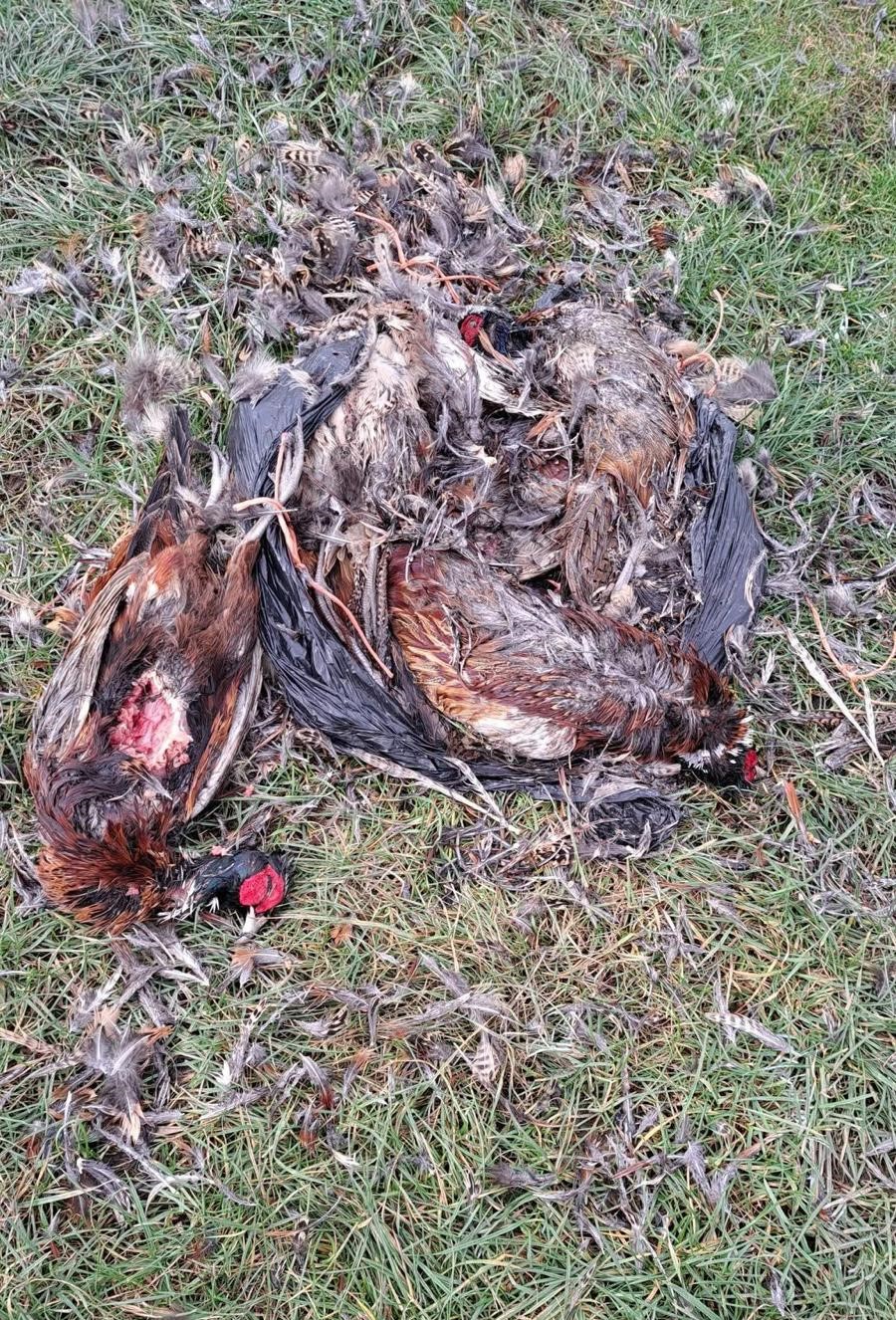
Hot on the heels of my recent blog about the discovery of shot & dumped pheasants and geese in Nottinghamshire (here), another fly-tipping incident has been reported, this time involving the dumping of four shot pheasants inside a black plastic bag in Lincolnshire.
These were discovered on 16 Feb 2025 by a member of the public at the edge of farmland in Bourne, Lincolnshire. The finder said the bag had split open and she’d observed red kites feeding on the carcasses, evidenced by the amount of plucked feathers next to the bag. What’s the betting these pheasants were shot with toxic lead ammunition, now slowly poisoning the native wildlife? If the lead poisoning doesn’t get them, the Avian Influenza probably will.
The orange baler twine shown in the photograph is indicative that these pheasants had been killed on a nearby shoot (gamebirds are often tied together in a brace with baler twine and hung up to allow the air to get to them). It’s likely these four birds were given to a shoot participant to take home and he/she decided to dump them instead because they’d already served their purpose as live targets shot for entertainment.
Regular blog readers will know that the dumping of shot gamebirds is a common and widespread illegal practice that has been going on for years, despite the repeated denials by the shooting industry. Who else do they think is doing this if not the people involved in gamebird shooting?! The disposal of animal by-products (including shot gamebirds) is regulated and the dumping of these carcasses is an offence.
Previous reports include dumped birds found in Cheshire (here), Scottish borders (here), Norfolk (here), Perthshire (here), Berkshire (here), North York Moors National Park (here) and some more in North York Moors National Park (here) and even more in North Yorkshire (here), Co. Derry (here), West Yorkshire (here), and again in West Yorkshire (here), N Wales (here), mid-Wales (here), Leicestershire (here), Lincolnshire (here), Somerset (here), Derbyshire’s Peak District National Park (here), Suffolk (here), Leicestershire again (here), Somerset again (here), Liverpool (here), even more in North Wales (here) even more in Wales, again (here), in Wiltshire (here) in Angus (here), in Somerset again (here), once again in North Yorkshire (here), yet again in West Yorkshire (here), yet again in mid-Wales (here), even more in mid-Wales (here), more in Derbyshire (here), Gloucestershire (here) more in Cheshire (here), some in Cumbria (here), some more in the Scottish Borders (here) and again in Lincolnshire (here) and in Nottinghamshire (here).
Unless someone was seen dumping these shot gamebirds there’s no way of knowing who did it or from which gamebird shoot they originated. There’s no requirement for shoot managers to fit identifying markers to their livestock, which would make them traceable, because gamebird ‘livestock’ absurdly changes legal status to ‘wildlife’ as soon as the birds are released from the rearing pens for shooting (see Wild Justice’s blog on Schrodinger’s Pheasant for details).
Obviously, it’s irresponsible (and illegal) to dump shot gamebirds at any time but especially so when the UK Government (and Scottish Government and now also the Welsh Government) has declared a nationwide Avian Influenza Prevention Zone (AIPZ) due to the heightened risk of the spread of highly pathogenic Avian Influenza (Bird Flu) amongst captive and wild birds.
These declarations make it a legal requirement for all bird keepers to follow strict and enhanced biosecurity measures to help protect their flocks from the threat of Avian Influenza. In some areas, the risk is considered so severe that mandatory housing measures have also been declared.
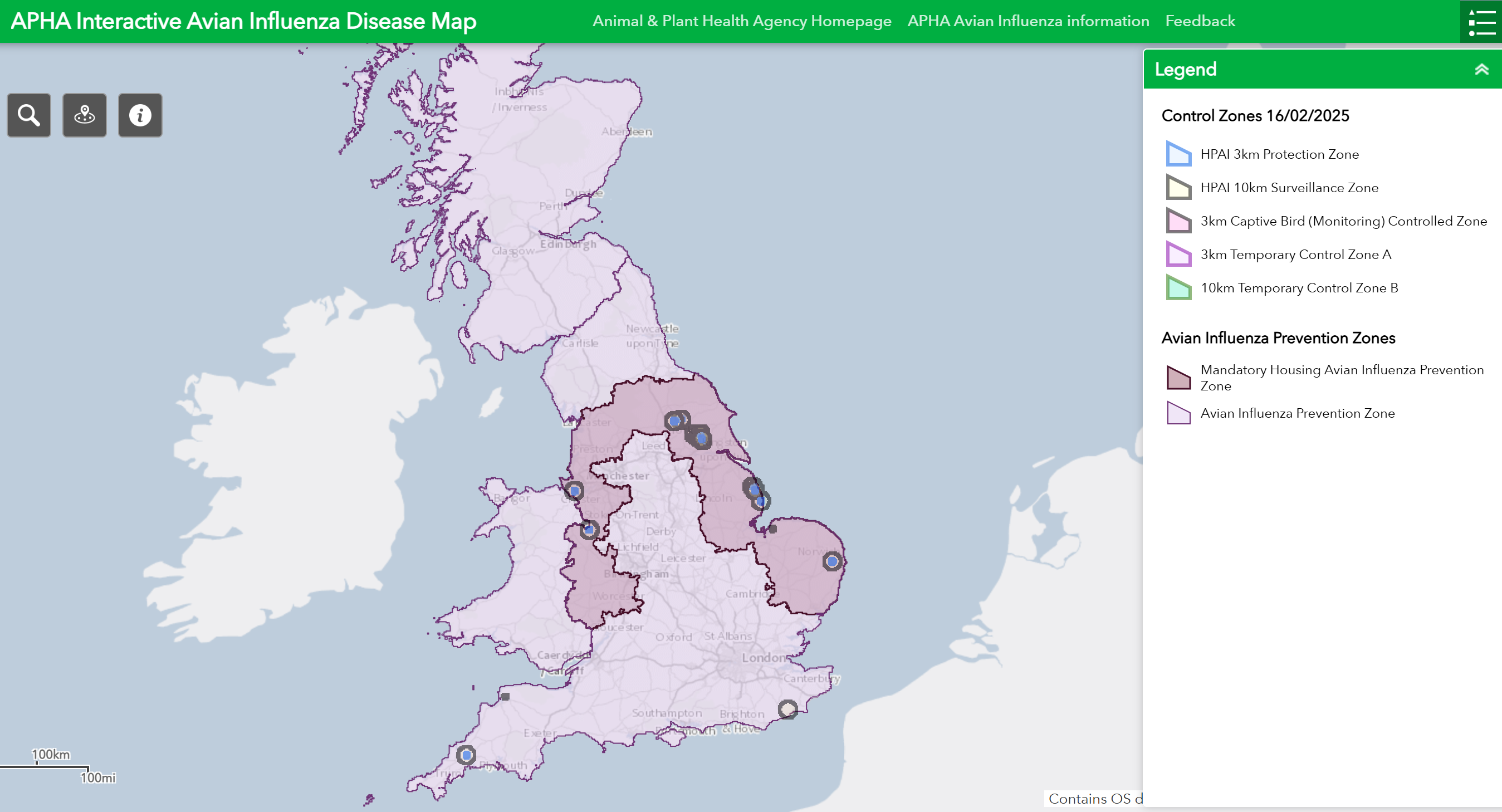
The Mandatory Housing Avian Influenza Prevention Zone was previously declared in the East Riding of Yorkshire, City of Kingston Upon Hull, Lincolnshire, Norfolk, Suffolk, Shropshire, York and North Yorkshire. However, as of 16 February 2025, this has now been extended to cover Herefordshire, Worcestershire, Cheshire, Merseyside and Lancashire, as shown on this map:
The latest dumped pheasants found inside a black sack were discarded in Bourne, Lincolnshire, which also happens to be inside the regional Mandatory Housing Avian Influenza Prevention Zone.
I can’t imagine that the farmers in this area, who are having to implement the very highest levels of biosecurity measures and cover the financial strain of all that entails, will be impressed with the thoughtless, feckless and unaccountable actions of the gamebird shooting industry who yet again do what they like, when they like and to hell with the consequences because there aren’t any.
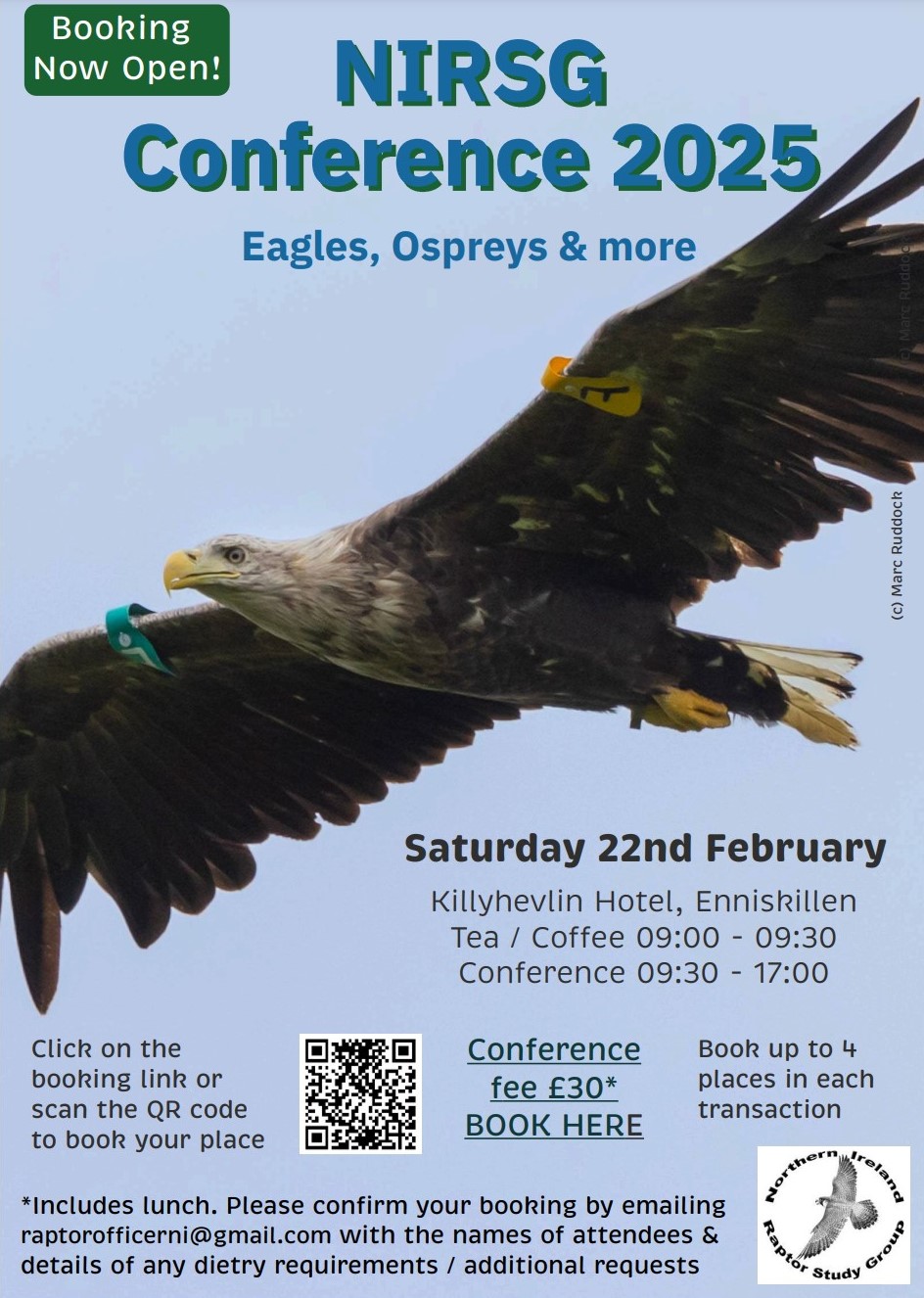
Booking is open for The Northern Ireland Raptor Study Group (NIRSG) conference taking place this Saturday (22 February 2025) at the Killyhevlin Hotel, Enniskillen.
The conference is open to everyone – you don’t need to be a member of the NIRSG to attend. To find out more information and details of how to book, please visit the NIRSG website (here).
You’ll see that Phase 2 of the NIRSG’s campaign to ban dangerous, raptor-killing pesticides will be launched on Saturday morning. I wrote about this campaign a few days ago (see here) and wanted to drum up support to help the petition reach 50,000 signatures before this coming Saturday (it had been stubbornly stuck at 46, 206 signatures for a while).
This petition/campaign was initiated after the discovery of two young white-tailed eagles that were found dead on Northern Ireland’s only driven grouse moor in 2023 – they’d both been illegally poisoned by the toxic pesticide Bendiocarb.
Many, many thanks to the approx 1,500 of you who have signed in the last few days – the current total is 47, 761 signatures. We need a couple more thousand people to pledge their support to reach the target.
Can you help? You don’t need to be a resident of Northern Ireland to sign – the petition is open to anyone, anywhere, who cares about the illegal use of these dangerous poisons to kill birds of prey (and any other wildlife that comes into contact with indiscriminately placed poisonous baits).
If you’d like to sign and/or share the petition with others, please click HERE.








 Raptor Persecution UK