133 hen harriers confirmed ‘missing’ or illegally killed in UK since 2018, most of them on or close to grouse moors

For anyone who still wants to pretend that the grouse shooting industry isn’t responsible for the systematic extermination of hen harriers on grouse moors across the UK, here’s the latest catalogue of crime that suggests otherwise.

This male hen harrier died in 2019 after his leg was almost severed in an illegally set trap that had been placed next to his nest on a Scottish grouse moor (see here). Photo by Ruth Tingay

This is the blog I now publish after every reported killing or suspicious disappearance.

They disappear in the same way political dissidents in authoritarian dictatorships have disappeared” (Stephen Barlow, 22 January 2021).

Today the list has been updated to include the most recently reported victims, three more satellite-tagged hen harriers that ‘disappeared’ in Lanarkshire and Northumberland during October 2024 (here).

I’ve been compiling this list only since 2018 because that is the year that the grouse shooting industry ‘leaders’ would have us believe that the criminal persecution of hen harriers had stopped and that these birds were being welcomed back on to the UK’s grouse moors (see here).

This assertion was made shortly before the publication of a devastating new scientific paper that demonstrated that 72% of satellite-tagged hen harriers were confirmed or considered likely to have been illegally killed, and this was ten times more likely to occur over areas of land managed for grouse shooting relative to other land uses (see here). A further scientific paper published in 2023 by scientists at the RSPB, utilising even more recent data, echoed these results – see here.

2018 was also the year that Natural England issued a licence to begin a hen harrier brood meddling trial on grouse moors in northern England. For new blog readers, hen harrier brood meddling was a conservation sham sanctioned by DEFRA as part of its ludicrous ‘Hen Harrier Action Plan‘ and carried out by Natural England (NE), in cahoots with the very industry responsible for the species’ catastrophic decline in England. For more background see here and for a critical evaluation of the trial after 5 years see this report by Wild Justice. In 2024 the brood meddling trial appeared to collapse for reasons which are not yet clear (see here) and the licence for the so-called ‘scientific trial’ expired. Natural England is currently undertaking a review of the ‘trial’ and a report is expected soon.

Brood meddling has been described as a sort of ‘gentleman’s agreement’ by commentator Stephen Welch:

I don’t get it, I thought the idea of that scheme was some kind of trade off – a gentleman’s agreement that the birds would be left in peace if they were moved from grouse moors at a certain density. It seems that one party is not keeping their side of the bargain“.

With at least 133 hen harriers gone since 2018, and 30 of those being brood meddled birds, there is no question that the grouse shooting industry is simply taking the piss. Meanwhile, Natural England pretends that ‘partnership working’ is the way to go and consecutive DEFRA Ministers have remained silent.
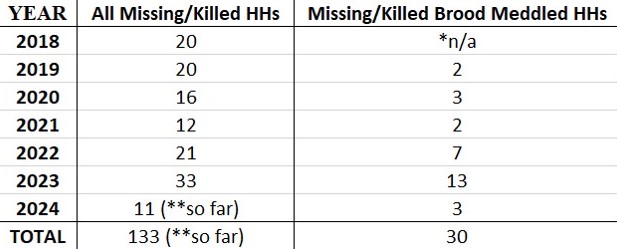
*n/a – no hen harriers were brood meddled in 2018. **Post mortem reports on a further six hen harriers found dead in 2024 are awaited.

‘Partnership working’ according to Natural England appears to include authorising the removal of hen harrier chicks from a grouse moor already under investigation by the police for suspected raptor persecution (here) and accepting a £75k ‘donation’ from representatives of the grouse shooting industry that prevents Natural England from criticising them or the sham brood meddling trial (see here). This is in addition to a £10k ‘donation’ that Natural England accepted, under the same terms, in 2021 (here).

Thankfully, the Scottish Government finally decided to act by introducing a grouse moor licensing scheme under the Wildlife Management & Muirburn (Scotland) Act 2024. The intention behind this new legislation is that grouse shooting estates could have their licences suspended/revoked if, on the balance of probability, it is shown that any raptor persecution crimes (& some other associated offences) are linked with grouse moor management on that estate. There, are, however, ongoing issues with the licence as it’s been significantly watered-down after an intervention from the grouse shooting industry (see here). Work is underway to address this.

In England a new Hen Harrier Taskforce was established in 2024, led by the National Wildlife Crime Unit, to use innovative techniques to target hen harrier persecution hotspots (locations where hen harriers repeatedly ‘disappear’ or are found illegally killed). It’s too early to judge the Taskforce’s success and it’s been met with resistance from the Moorland Association, the grouse moor owners’ lobby group (here) and so far, illegal persecution continues.

So here’s the latest gruesome list of ‘missing’/illegally killed hen harriers since 2018. Note that the majority of these birds (but not all) were fitted with satellite tags. How many more [untagged] harriers have been killed? We now have evidence that gamekeepers are specifically targeting untagged hen harriers, precisely to avoid detection (see here).

February 2018: Hen harrier Saorsa ‘disappeared’ in the Angus Glens in Scotland (here). The Scottish Gamekeepers Association later published wholly inaccurate information claiming the bird had been re-sighted. The RSPB dismissed this as “completely false” (here).

5 February 2018: Hen harrier Marc ‘disappeared’ on a grouse moor in Durham (here).

9 February 2018: Hen harrier Aalin ‘disappeared’ on a grouse moor in Wales (here).

March 2018: Hen harrier Blue ‘disappeared’ in the Lake District National Park (here).

March 2018: Hen harrier Finn ‘disappeared’ near Moffat in Scotland (here).

18 April 2018: Hen harrier Lia ‘disappeared’ in Wales and her corpse was retrieved in a field in May 2018. Cause of death was unconfirmed but police treating death as suspicious (here).

8 August 2018: Hen harrier Hilma ‘disappeared’ on a grouse moor in Northumberland (here).

16 August 2018: Hen harrier Athena ‘disappeared’ on a grouse moor in Scotland (here).

26 August 2018: Hen Harrier Octavia ‘disappeared’ on a grouse moor in the Peak District National Park (here).

29 August 2018: Hen harrier Margot ‘disappeared’ on a grouse moor in Scotland (here).

29 August 2018: Hen Harrier Heulwen ‘disappeared’ on a grouse moor in Wales (here).

3 September 2018: Hen harrier Stelmaria ‘disappeared’ on a grouse moor in Scotland (here).

24 September 2018: Hen harrier Heather ‘disappeared’ on a grouse moor in Scotland (here).

2 October 2018: Hen harrier Mabel ‘disappeared’ on a grouse moor on the edge of the Yorkshire Dales National Park (here).

3 October 2018: Hen Harrier Thor ‘disappeared’ next to a grouse moor in Bowland, Lanacashire (here).

23 October 2018: Hen harrier Tom ‘disappeared’ in South Wales (here).

26 October 2018: Hen harrier Arthur ‘disappeared’ on a grouse moor in the North York Moors National Park (here).

1 November 2018: Hen harrier Barney ‘disappeared’ on Bodmin Moor (here).

10 November 2018: Hen harrier Rannoch ‘disappeared’ on a grouse moor in Scotland (here). Her corpse was found nearby in May 2019 – she’d been killed in an illegally-set spring trap (here).

14 November 2018: Hen harrier River ‘disappeared’ on a grouse moor in the Nidderdale AONB (here). Her corpse was found nearby in April 2019 – she’d been illegally shot (here).

16 January 2019: Hen harrier Vulcan ‘disappeared’ in Wiltshire close to Natural England’s proposed reintroduction site (here).

28 January 2019: Hen harrier DeeCee ‘disappeared’ in Glen Esk, a grouse moor area of the Angus Glens (see here).

7 February 2019: Hen harrier Skylar ‘disappeared’ next to a grouse moor in South Lanarkshire (here).

22 April 2019: Hen harrier Marci ‘disappeared’ on a grouse moor in the Cairngorms National Park (here).

26 April 2019: Hen harrier Rain ‘disappeared’ on a grouse moor in Nairnshire (here).

11 May 2019: An untagged male hen harrier was caught in an illegally-set trap next to his nest on a grouse moor in South Lanarkshire. He didn’t survive (here).

7 June 2019: An untagged hen harrier was found dead on a grouse moor in Scotland. A post mortem stated the bird had died as a result of ‘penetrating trauma’ injuries and that this bird had previously been shot (here).

5 September 2019: Wildland Hen Harrier 1 ‘disappeared’ on a grouse moor nr Dalnaspidal on the edge of the Cairngorms National Park (here).

11 September 2019: Hen harrier Romario ‘disappeared’ on a grouse moor in the Cairngorms National Park (here).

14 September 2019: Hen harrier (Brood meddled in 2019, #183704) ‘disappeared’ in the North Pennines (here).

23 September 2019: Hen harrier (Brood meddled in 2019, #55149) ‘disappeared’ in North Pennines (here).

24 September 2019: Wildland Hen Harrier 2 ‘disappeared’ on a grouse moor at Invercauld in the Cairngorms National Park (here).

24 September 2019: Hen harrier Bronwyn ‘disappeared’ near a grouse moor in North Wales (here).

10 October 2019: Hen harrier Ada ‘disappeared’ on a grouse moor in the North Pennines AONB (here).

12 October 2019: Hen harrier Thistle ‘disappeared’ on a grouse moor in Sutherland (here).

18 October 2019: Member of the public reports the witnessed shooting of an untagged male hen harrier on White Syke Hill in North Yorkshire (here).

November 2019: Hen harrier Mary found illegally poisoned on a pheasant shoot in Ireland (here).

November 2019: Hen harrier Artemis ‘disappeared’ near Long Formacus in south Scotland (RSPB pers comm).

14 December 2019: Hen harrier Oscar ‘disappeared’ in Eskdalemuir, south Scotland (here).

December 2019: Hen harrier Ingmar ‘disappeared’ in the Strathbraan grouse moor area of Perthshire (RSPB pers comm).

27 January 2020: Members of the public report the witnessed shooting of a male hen harrier on Threshfield Moor in the Yorkshire Dales National Park (here).

23 March 2020: Hen harrier Rosie ‘disappeared’ at an undisclosed roost site in Northumberland (here).

1 April 2020: Hen harrier (Brood meddled in 2019, #183703) ‘disappeared’ in unnamed location, tag intermittent (here).

5 April 2020: Hen harrier Hoolie ‘disappeared’ on a grouse moor in the Cairngorms National Park (here)

8 April 2020: Hen harrier Marlin ‘disappeared’ on a grouse moor in the Cairngorms National Park (here).

19 May 2020: Hen harrier Fingal ‘disappeared’ on a grouse moor in the Lowther Hills, Scotland (here).

21 May 2020: Hen harrier (Brood meddled in 2019, #183701) ‘disappeared’ on a grouse moor in Cumbria shortly after returning from wintering in France (here).

27 May 2020: Hen harrier Silver ‘disappeared’ on a grouse moor on Leadhills Estate, Scotland (here).

2020: day/month unknown: Unnamed male hen harrier breeding on RSPB Geltsdale Reserve, Cumbria ‘disappeared’ while away hunting (here).

9 July 2020: Unnamed female hen harrier (#201118) ‘disappeared’ from an undisclosed site in Northumberland (here).

25 July 2020: Hen harrier Harriet ‘disappeared’ on a grouse moor in the Yorkshire Dales National Park (here).

14 August 2020: Hen harrier Solo ‘disappeared’ in confidential nest area in Lancashire (here).

7 September 2020: Hen harrier Dryad ‘disappeared’ on a grouse moor in the Yorkshire Dales National Park (here).

16 September 2020: Hen harrier Fortune ‘disappeared’ from an undisclosed roost site in Northumberland (here).

19 September 2020: Hen harrier Harold ‘disappeared’ on a grouse moor in the Yorkshire Dales National Park (here).

20 September 2020: Hen harrier (Brood meddled in 2020, #55152) ‘disappeared’ next to a grouse moor in North Yorkshire (here).

24 February 2021: Hen harrier Tarras ‘disappeared’ next to a grouse moor in Northumberland (here)

12th April 2021: Hen harrier Yarrow ‘disappeared’ near Stockton, County Durham (here).

18 May 2021: Adult male hen harrier ‘disappeared’ from its breeding attempt on RSPB Geltsdale Reserve, Cumbria whilst away hunting (here).

18 May 2021: Another adult male hen harrier ‘disappeared’ from its breeding attempt on RSPB Geltsdale Reserve, Cumbria whilst away hunting (here).

24 July 2021: Hen harrier Asta ‘disappeared’ at a ‘confidential site’ in the North Pennines (here). We learned 18 months later that her wings had been ripped off so her tag could be fitted to a crow in an attempt to cover up her death (here).

14th August 2021: Hen harrier Josephine ‘disappeared’ at a ‘confidential site’ in Northumberland (here).

17 September 2021: Hen harrier Reiver ‘disappeared’ in a grouse moor dominated region of Northumberland (here)

24 September 2021: Hen harrier (Brood meddled in 2021, R2-F-1-21) ‘disappeared’ in Northumberland (here).

15 November 2021: Hen harrier (brood meddled in 2020, #R2-F1-20) ‘disappeared’ at the edge of a grouse moor on Arkengarthdale Estate in the Yorkshire Dales National Park (here).

19 November 2021: Hen harrier Val ‘disappeared’ in the Lake District National Park in Cumbria (here).

19 November 2021: Hen harrier Percy ‘disappeared’ in Lothian, Scotland (here).

12 December 2021: Hen harrier Jasmine ‘disappeared’ on a grouse moor (High Rigg Moor on the Middlesmoor Estate) in the Nidderdale AONB in North Yorkshire (here).

9 January 2022: Hen harrier Ethel ‘disappeared’ in Northumberland (here).

26 January 2022: Hen harrier Amelia ‘disappeared’ in Bowland (here).

10 February 2022: An unnamed satellite-tagged hen harrier ‘disappeared’ in a grouse moor dominated area of the Peak District National Park (here). One year later it was revealed that the satellite tag/harness of this young male called ‘Anu’ had been deliberately cut off (see here).

12 April 2022: Hen harrier ‘Free’ (Tag ID 201121) ‘disappeared’ at a ‘confidential site’ in Cumbria (here). It later emerged he hadn’t disappeared, but his mutilated corpse was found on moorland in the Yorkshire Dales National Park. A post mortem revealed the cause of death was having his head twisted and pulled off. One leg had also been torn off whilst he was still alive (here).

April 2022: Hen harrier ‘Pegasus’ (tagged by the RSPB) ‘disappeared’ on a grouse moor at Birkdale in the Yorkshire Dales National Park (here).

May 2022: A male breeding hen harrier ‘disappeared’ from a National Trust-owned grouse moor in the Peak District National Park (here).

May 2022: Another breeding male hen harrier ‘disappeared’ from a National Trust-owned grouse moor in the Peak District National Park (here).

14 May 2022: Hen harrier ‘Harvey’ (Tag ID 213844) ‘disappeared’ from a ‘confidential site’ in the North Pennines (here).

20 June 2022: Hen harrier chick #1 stamped to death in nest on a grouse moor in the Yorkshire Dales National Park (here).

20 June 2022: Hen harrier chick #2 stamped to death in nest on a grouse moor in the Yorkshire Dales National Park (here).

20 June 2022: Hen harrier chick #3 stamped to death in nest on a grouse moor in the Yorkshire Dales National Park (here).

20 June 2022: Hen harrier chick #4 stamped to death in nest on a grouse moor in the Yorkshire Dales National Park (here).

17 August 2022: Hen harrier (brood meddled in 2022, #R1-M1-22) ‘disappeared’ on moorland in the Yorkshire Dales National Park (here).

September 2022: Hen harrier ‘Sullis’ (tagged by the RSPB) ‘disappeared’ on a grouse moor in Cumbria (here).

5 October 2022: Hen harrier (brood meddled in 2022, #R3-M2-22) ‘disappeared’ on moorland in the Yorkshire Dales National Park (here).

10 October 2022: Hen harrier ‘Sia’ ‘disappeared’ near Hamsterley Forest in the North Pennines (here).

October 2022: Hen harrier (brood meddled in 2021, #R1-F1-21) ‘disappeared’ in the North Sea off the North York Moors National Park (here).

1 December 2022: Hen harrier male (brood meddled in 2021, #R1-M1-21) ‘disappeared’ on moorland in the Yorkshire Dales National Park (here).

7 December 2022: Hen harrier female (brood meddled in 2020, #R2-F2-20) ‘disappeared’ from winter roost (same as #R3-F1-22) on moorland in North Pennines AONB (here). Later found dead with 3 shotgun pellets in corpse.

14 December 2022: Hen harrier female (brood meddled in 2022, #R3-F1-22) ‘disappeared’ from winter roost (same as #R2-F2-20) on moorland in the North Pennines AONB (here). Later found dead with two shotgun pellets in corpse.

15 December 2022: Hen harrier female (brood meddled in 2022, #R2-F1-22) ‘disappeared’ on moorland in the Yorkshire Dales National Park (here).

30 March 2023: Hen harrier female (brood meddled in 2022, #R1-F3-22) ‘disappeared’ in Yorkshire (here). Notes from NE Sept 2023 spreadsheet update: “Final transmission location temporarily withheld at police request“.

1 April 2023: Hen harrier male (brood meddled in 2022, #R2-M1-22) ‘disappeared’ in Yorkshire (here). Notes from NE Sept 2023 spreadsheet update: “Final transmission location temporarily withheld at police request“.

April 2023: Hen harrier ‘Lagertha’ (tagged by RSPB) ‘disappeared’ in North Yorkshire (here).

April 2023: Hen harrier ‘Nicola’ (Tag ID 234078) ”disappeared’ in North Yorkshire (here).

April 2023: Untagged male hen harrier ‘disappeared’ from an active nest on RSPB Geltsdale Reserve in Cumbria (here).

April 2023: Another untagged male hen harrier ‘disappeared’ from an active nest on RSPB Geltsdale Reserve in Cumbria (here).

April 2023: Untagged male hen harrier ‘disappeared’ from an active nest in Durham (here).

4/5 May 2023: Satellite-tagged male hen harrier called ‘Rush’ ‘disappeared’ from a grouse moor in Bowland AONB in Lancashire (here).

9/10 May 2023: Hen harrier male called ‘Dagda’, tagged by the RSPB in Lancashire in June 2022 and who was breeding on the RSPB’s Geltsdale Reserve in 2023 until he ‘vanished’, only to be found dead on the neighbouring Knarsdale grouse moor in May 2023 – a post mortem revealed he had been shot (here).

17 May 2023: Satellite-tagged hen harrier called ‘Wayland’ ‘disappeared’ in the Clapham area of North Yorkshire, just north of the Bowland AONB (here).

31 May 2023: Hen harrier male (brood meddled in 2022, tag #213932, name: R2-M3-22) ‘disappeared’ in Northumberland (grid ref: NY765687) (here).

11 June 2023: Hen harrier male (brood meddled in 2021, tag #213922, name: R2-M1-21) ‘disappeared’ at a confidential site in the Yorkshire Dales National Park. Notes from the NE spreadsheet: “Final transmission location temporarily withheld at police request“ (here).

12 June 2023: Hen harrier male (brood meddled in 2020, tag #203004, name: R1-M2-20) ‘disappeared’ on a grouse moor in Co. Durham (grid ref: NY976322) (here).

6 July 2023: Satellite-tagged female hen harrier named ‘Rubi’ (tag #201124a) ‘disappeared’ on a grouse moor in Co. Durham (grid ref: NY911151) (here).

23 July 2023: Hen harrier female (brood meddled in 2023, tag #55154a, name: R1-F1-23) ‘disappeared’ on a grouse moor in Co. Durham (close to where ‘Rubi’ vanished), grid ref: NY910126 (here).

29 July 2023: Hen harrier female (brood meddled in 2020, tag #55144, name: R2-F2-20) ‘disappeared’ at a confidential site in the North Pennines. Notes from the NE spreadsheet: “Dead. Recovered – awaiting PM results. Final transmission location temporarily withheld at police request“ (here).

9 August 2023: Satellite-tagged hen harrier called ‘Martha’ ‘disappeared’ on a grouse moor (Westburnhope Moor) near Hexham in the North Pennines (here).

11 August 2023: Satellite-tagged hen harrier called ‘Selena’ ‘disappeared’ on a grouse moor (Mossdale Moor) in the Yorkshire Dales National Park (here).

11 August 2023: Hen harrier female (brood meddled in 2023, tag #201118a, name: R3-F1-23) ‘disappeared’ in Co. Durham (grid ref: NZ072136) (here).

15 August 2023: Satellite-tagged hen harrier called ‘Hepit’ ‘disappeared’ on a grouse moor (Birkdale Common) near Kirkby Stephen in the Yorkshire Dales National Park (here).

24 August 2023: Hen harrier female (brood meddled in 2023, tag #55155a, name: R1-F2-23) ‘disappeared’ at a confidential site in Northumberland. Notes from the NE spreadsheet: “Final transmission location temporarily withheld at police request“ (here).

August-Sept 2023: Satellite-tagged hen harrier called ‘Harmonia’ ‘disappeared’ in the Yorkshire Dales National Park (here).

September 2023: Hen harrier female ‘Saranyu’, tagged by the RSPB in Cumbria in June 2023, ‘disappeared’ in Durham in September 2023 (no further details available yet – just outline info provided in 2022 Birdcrime report) (here).

September 2023: Hen harrier female ‘Inger’, a female tagged by the RSPB in Perthshire in July 2022, ‘disappeared’ on a grouse moor in the Angus Glens in September 2023 (here).

15 September 2023: Hen harrier male called ‘Rhys’, tagged in Cumbria on 1st August 2023, ‘disappeared’ on a grouse moor in the Yorkshire Dales National Park. Grid ref: SD798896 (here).

24 September 2023: Hen harrier female (brood meddled in 2023, name: ‘R2-F2-23’) ‘disappeared’ in the North Pennines, grid ref: NY888062 (here).

25 September 2023: Hen harrier female (brood meddled in 2022, name: ‘R1-F4-22’) ‘disappeared’ on a grouse moor in the Yorkshire Dales National Park, grid ref: SE077699 (here).

26 September 2023: Hen harrier female called ‘Hope’, tagged in Cumbria on 21 July 2023, ‘disappeared’ next to a grouse moor in the Yorkshire Dales National Park, grid ref: SD801926 (here).

4 October 2023: Hen harrier male (brood meddled in 2020, name: ‘R1-M3-20’) ‘disappeared’ in Co Durham, grid ref: NY935192 (here).

4 October 2023: Hen harrier female (brood meddled in 2023, name: ‘R4-F1-23’) ‘disappeared’ on a grouse moor in the Yorkshire Dales National Park, grid ref: SE003981 (here).

14 October 2023: Hen harrier male called ‘Cillian’, tagged in Cumbria on 1 August 2023, ‘disappeared’ in south west Scotland, grid ref: NY051946 (here).

15 November 2023: Hen harrier female called ‘Hazel’, tagged in Cumbria on 21 July 2023, ‘disappeared’ on the Isle of Man, grid ref: SC251803 (here).

27 November 2023: Hen harrier female called ‘Gill’, tagged in Northumberland on 10 July 2023, ‘disappeared’ at a confidential location in Teeside (here).

12 February 2024: Hen harrier female called ‘Susie’, Tag ID 201122, found dead at a confidential location in Northumberland and the subject of an ongoing police investigation (here).

15 February 2024: Hen harrier female called ‘Shalimar’, tagged on the National Trust for Scotland’s Mar Lodge estate in 2023, ‘disappeared’ in suspicious circumstances on a grouse moor in the notorious Angus Glens (here).

7 March 2024: Hen harrier male (brood meddled in 2023, name R2-M1-23) found dead in Devon. According to an FoI response from Natural England in June 2024 this death is the subject of an ongoing police investigation (here).

24 April 2024: Hen harrier male called ‘Ken’, Tag ID 213849a, ‘disappeared’ in suspicious circumstances close to a grouse moor in Bowland, grid ref SD 684601 (here).

17 May 2024: Hen harrier male (brood meddled in 2023, name R2-M2-23) ‘disappeared’ in suspicious circumstances next to Middlesmoor grouse moor in Nidderdale, grid ref SE043754 (here).

25 June 2024: Hen harrier female (brood meddled in 2023, name R2-F1-23) ‘disappeared’ in suspicious circumstances on a grouse moor in Yorkshire Dales National Park, grid ref NY985082 (here).

July 2024: Hen harrier female named ‘Helius’ satellite tagged by the RSPB ‘disappeared’ in suspicious circumstances in Bowland (here).

October 2024: An un-tagged hen harrier was shot on a grouse moor by one of three gamekeepers being secretly filmed by the RSPB (here).

1 October 2024: Hen harrier female named ‘Dreich’, Tag ID: 254842, ‘disappeared’ in Lanarkshire. Listed by NE as ‘Missing Fate Unknown, site confidential – ongoing investigation‘ (here).

15 October 2024: Hen harrier male named ‘Baldur’, Tag ID: 240291, ‘disappeared’ in Northumberland. Listed by NE as ‘Missing Fate Unknown, site confidential – ongoing investigation‘ (here).

19 October 2024: Hen harrier female named ‘Margaret’, Tag ID: 254844, ‘disappeared’ in Northumberland. Listed by NE as ‘Missing Fate Unknown, site confidential – ongoing investigation‘ (here).

    To be continued…….

    Not one of these 133 incidents has resulted in an arrest, let alone a prosecution. I had thought that when we reached 30 dead/missing hen harriers then the authorities might pretend to be interested and at least say a few words about this national scandal. We’ve now reached ONE HUNDRED AND THIRTY THREE hen harriers, and still Govt ministers remain silent on the illegal persecution issue. They appear not to give a monkey’s. And yes, there are other things going on in the world, as always. That is not reason enough to ignore this blatant, brazen and systematic destruction of a supposedly protected species, being undertaken to satisfy the greed and bloodlust of a minority of society.

    And let’s not forget the response from the (now former) Moorland Association Chair (and owner of Swinton Estate) Mark Cunliffe-Lister, who told BBC Radio 4 in August 2023 that, “Clearly any illegal [hen harrier] persecution is not happening” (here), in the year when a record 33 hen harriers had been confirmed ‘missing’ and/or illegally killed.

    Nor should we forget the response from the Game and Wildlife Conservation Trust’s (GWCT) Director of Policy Dr Alistair Leake who wrote a letter to the Guardian newspaper in November 2023 stating that the hen harrier brood management [meddling] scheme “is surely a shining example of human / wildlife conflict resolution that would be the envy of other countries trying to find similar solutions“ (I kid you not – here).

    Wild Justice has launched another petition calling for a ban on driven grouse shooting. This latest petition is intended to gauge the view of the new Labour Government, as previous petitions were all lodged under the Conservative Government with its well-documented vested interests. Labour issued an appalling pathetic interim response to the petition in January 2025, via DEFRA, which indicated it had no intention of banning driven grouse shooting (see here).

    The petition is live until 22 May 2025 and needs 100,000 signatures to qualify for a debate in Westminster Hall. It’s currently on 53,000 signatures. If you haven’t yet signed it, it’s here.
    Three more satellite-tagged hen harriers have gone ‘missing’ & two more found dead, awaiting post mortem

    Natural England has just published its latest update on the fates of the satellite-tracked hen harriers it has tagged and subsequently been tracking. This latest update (dated Dec 2024) shows that since its last update (Aug 2024 but actually published in Sept 2024), three more hen harriers have gone ‘missing’ and two more have been found dead and are awaiting post-mortem.

    Once again, I haven’t seen any press releases or appeals for information about any of these incidents, either from Natural England or the police.

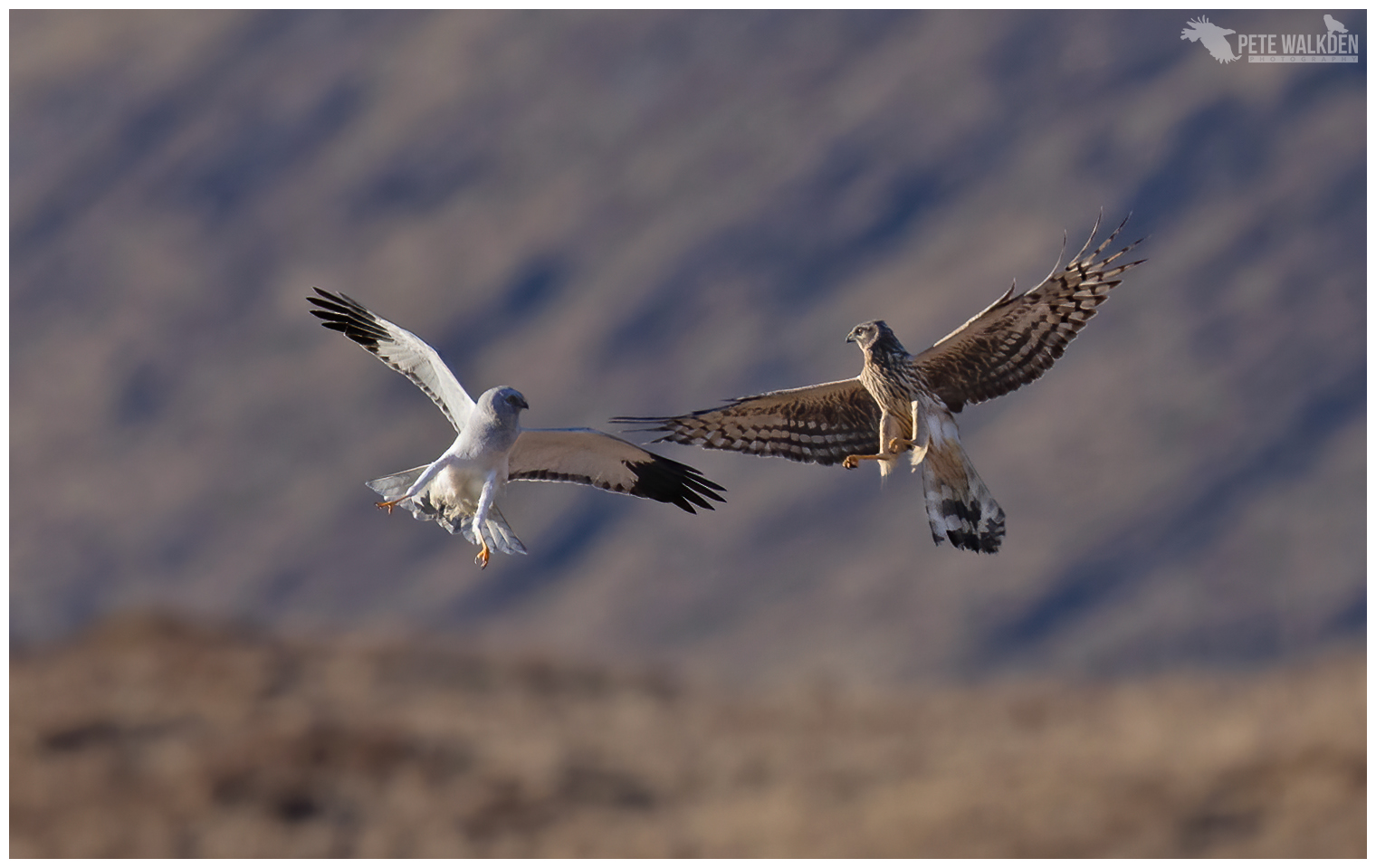
    Sky-dancing hen harriers. Photo by Pete Walkden

    Here are the details of the latest hen harriers listed as ‘missing’:

    1. Female hen harrier named ‘Dreich’, Tag ID: 254842, last known transmission date 1 October 2024 in Lanarkshire. Listed by NE as ‘Missing Fate Unknown, site confidential – ongoing investigation‘.
    2. Male hen harrier named ‘Baldur’, Tag ID: 240291, last known transmission date 15 October 2024 in Northumberland. Listed by NE as ‘Missing Fate Unknown, site confidential – ongoing investigation‘.
    3. Female hen harrier named ‘Margaret’, Tag ID: 254844, last known transmission date 19 October 2024 in Northumberland. Listed by NE as ‘Missing Fate Unknown, site confidential – ongoing investigation‘.

    I’ll be adding these three birds to my long-running tally of hen harriers that are known to have been illegally killed and/or have ‘disappeared’ in suspicious circumstances since 2018.

    Here are the details of the latest hen harriers listed by NE as found dead and awaiting post mortem:

    1. Male hen harrier named ‘Chance’, Tag ID: 254840, last known transmission date 8 August 2024 in Cumbria. Listed by NE as ‘Recovered awaiting PM‘.
    2. Female hen harrier named ‘Sofia’, Tag ID: 34346, last known transmission date 3 October 2024 in Northumberland. Listed by NE as ‘Recovered awaiting PM‘.

    I won’t add these two birds to my tally of missing/illegally killed hen harriers just yet because the circumstances of their deaths have not yet been published. They join the other four dead hen harriers whose corpses were found earlier in 2024 (see here) but whose causes of death have not yet been published. They are:

    1. Female hen harrier named ‘Susie’, Tag ID: 201122. Last known transmission 12 February 2024, Northumberland. Found dead. Site confidential. In NE’s April 2024 update, Susie was listed as, ‘recovered, awaiting post mortem‘. Now her listing says, ‘Ongoing police investigation, final transmission location temporarily withheld at police request‘. You might remember ‘Susie’ – she’s the hen harrier whose chicks were brutally stamped on and crushed to death in their nest on a grouse moor in Whernside in the Yorkshire Dales National Park, in June 2022 (here).
    2. Female hen harrier named ‘Edna’, Tag ID: 161143a. Last known transmission 7 June 2024, Northumberland. Listed by NE as ‘Recovered, awaiting post mortem‘.
    3. Female hen harrier, Tag ID: 254843. Last known transmission 29 July 2024, Northumberland. Listed by NE as ‘Recovered, awaiting post mortem‘.
    4. Male hen harrier, Tag ID: 254839. Last known transmission 5 August 2024, Northumberland. Listed by NE as ‘Recovered, awaiting post mortem‘.

    I won’t be holding my breath waiting for NE to publish the post mortem results and inform us whether any of these additional six hen harriers died of natural causes or were the victims of illegal persecution. As we saw in December 2024 (here), it took NE 18 and 20 months respectively to reveal that two brood meddled hen harriers that had been previously listed as ‘Missing Fate Unknown’ had actually been found dead, their corpses containing two and three shotgun pellets respectively.

    I’ll be writing more about hen harrier brood meddling shortly, but first it’s time to update the death list, which now stands at 133 hen harriers confirmed ‘missing’ or illegally killed in the UK since 2018, mostly on or close to grouse moors. If the six dead hen harriers currently still awaiting post mortems turn out to have been illegally killed, the death list will stand at 139 hen harriers.

    If you’re sick to the back teeth of watching the death list expand, and the grouse moor owners and gamekeepers continue to escape prosecution for their crimes, please sign Wild Justice’s latest petition calling for a ban on driven grouse shooting. The petition runs until 22 May 2024 and currently stands at 53,000 signatures. If it reaches 100,000 signatures it will be considered for a debate in Westminster Hall. Please sign the petition HERE and then share it! Thank you.

    Shot pheasants dumped in Lincolnshire during heightened risk of Avian Influenza

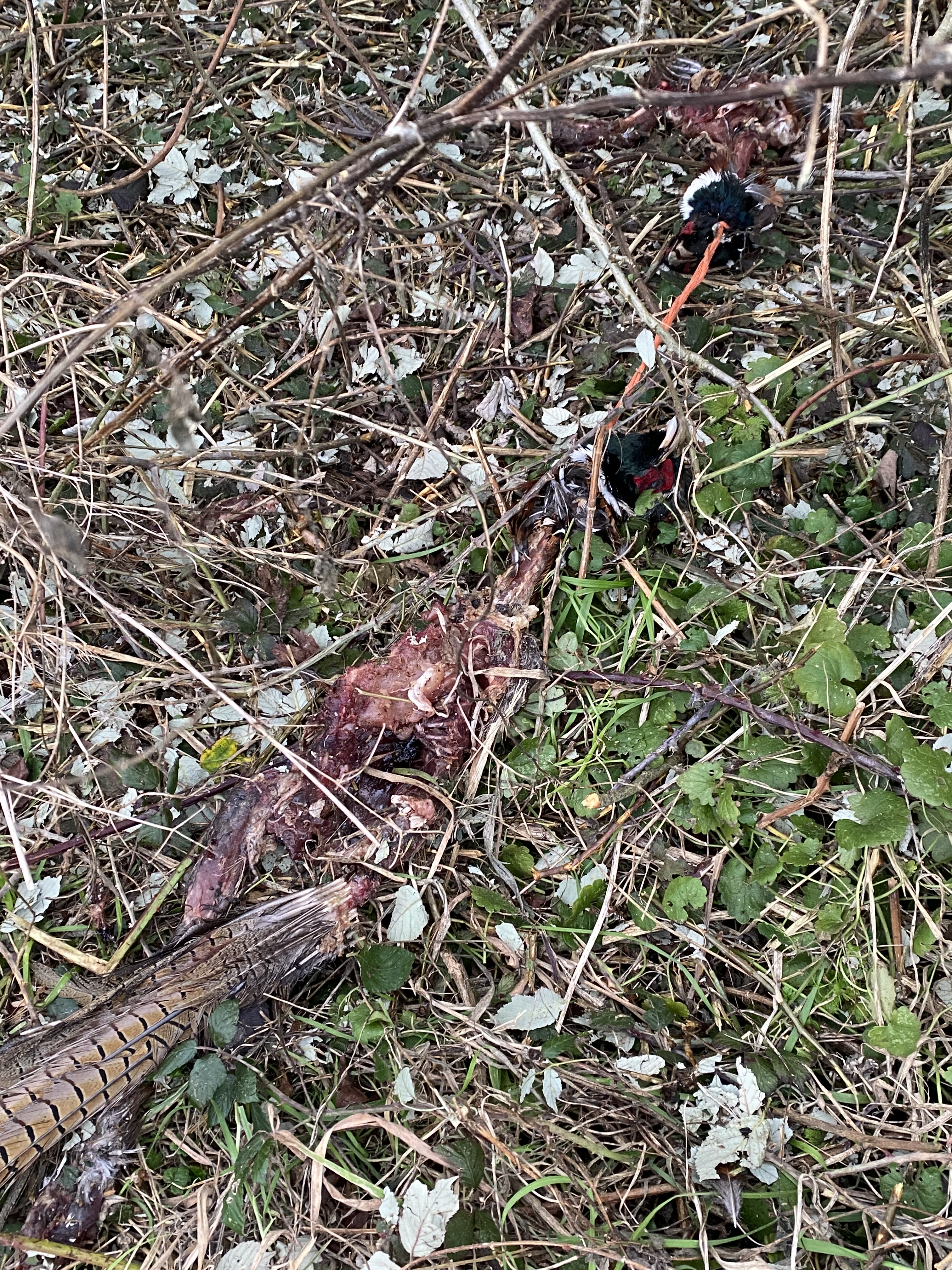
    A blog reader has sent in this photograph of shot pheasants that had been dumped by a roadside in Lincolnshire.

    Regular blog readers will know that this is a common and widespread illegal practice that has been going on for years. The disposal of animal by-products (including shot gamebirds) is regulated and the dumping of these carcasses is an offence.

    Previous reports include dumped birds found in Cheshire (here), Scottish borders (here), Norfolk (here), Perthshire (here), Berkshire (here), North York Moors National Park (here) and some more in North York Moors National Park (here) and even more in North Yorkshire (here), Co. Derry (here), West Yorkshire (here), and again in West Yorkshire (here), N Wales (here), mid-Wales (here), Leicestershire (here), Lincolnshire (here), Somerset (here), Derbyshire’s Peak District National Park (here), Suffolk (here), Leicestershire again (here), Somerset again (here), Liverpool (here), even more in North Wales (here) even more in Wales, again (here), in Wiltshire (here) in Angus (here), in Somerset again (here), once again in North Yorkshire (here), yet again in West Yorkshire (here), yet again in mid-Wales (here), even more in mid-Wales (here), more in Derbyshire (here), Gloucestershire (here) more in Cheshire (here), some in Cumbria (here) and some more in the Scottish Borders (here).

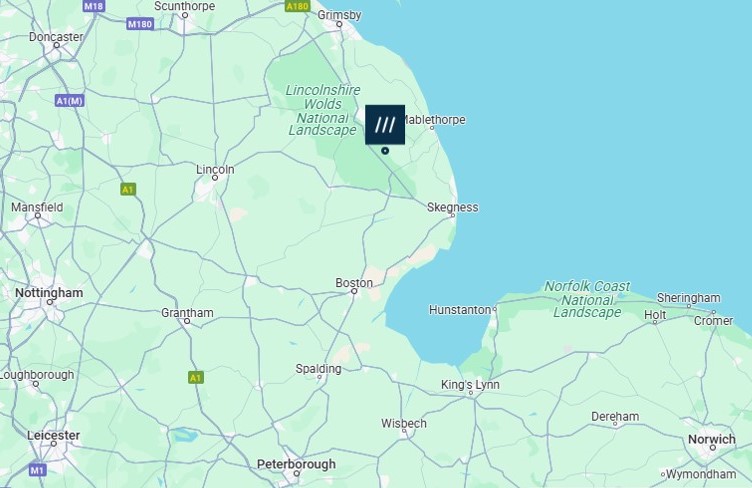
    The latest example was found on 22 January 2025 on Long Hedge Lane, Lincolnshire, on the edge of the Lincolnshire Wolds National Landscape (previously known as the Lincolnshire Wolds Area of Outstanding Natural Beauty, AONB). Shot and dumped pheasants were also found in the area in 2019 (here).

    The blog reader found these two birds tied together with baler twine which is indicative that they’d been killed on a nearby shoot (gamebirds are often tied together in a brace with baler twine and hung up to allow the air to get to them). It’s likely this particular brace was given to a shoot participant to take home and he/she decided to dump them instead. The carcasses have been well eaten, presumably by scavengers but still look relatively fresh, definitely this season’s birds.

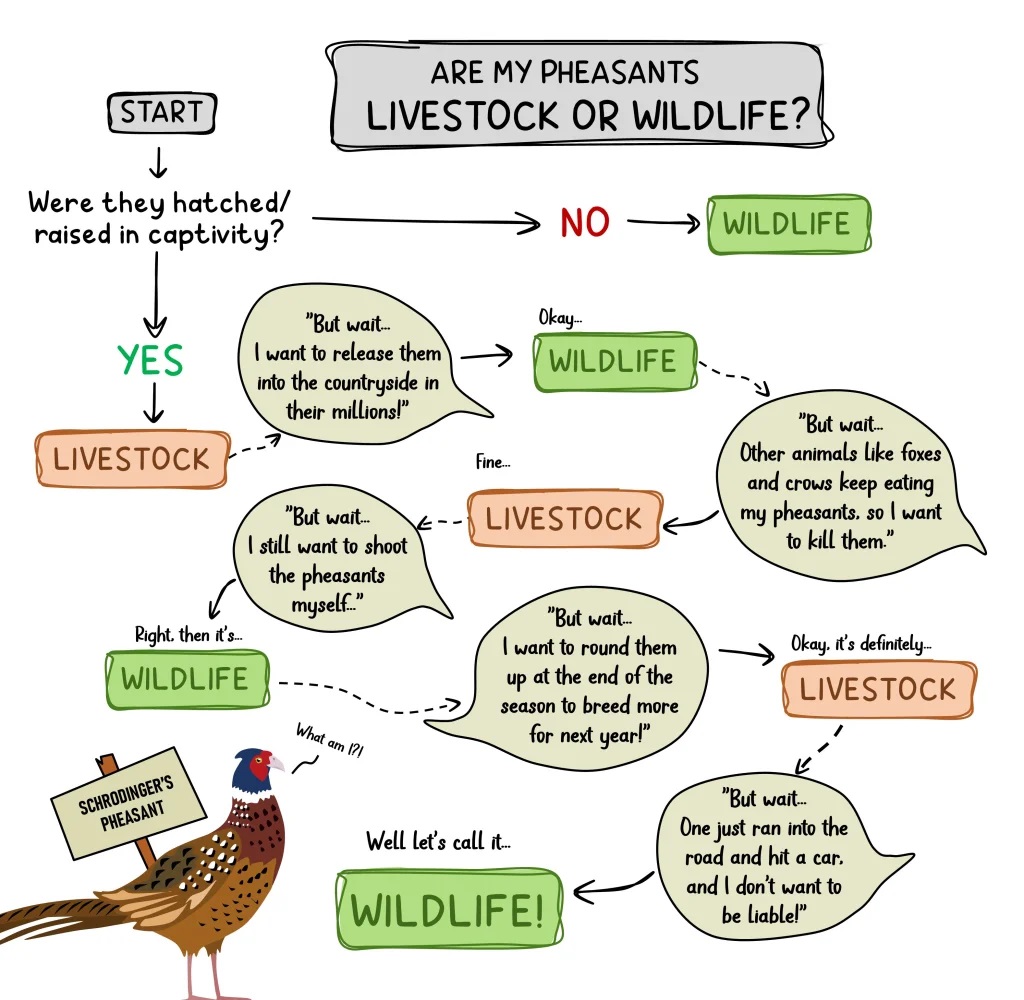
    Unless someone was seen dumping these shot gamebirds there’s no way of knowing who did it or from which gamebird shoot they originated. There’s no requirement for shoot managers to fit identifying markers to their livestock, which would make them traceable, because gamebird ‘livestock’ absurdly changes legal status to ‘wildlife’ as soon as the birds are released from the rearing pens for shooting (see Wild Justice’s blog on Schrodinger’s Pheasant for details).

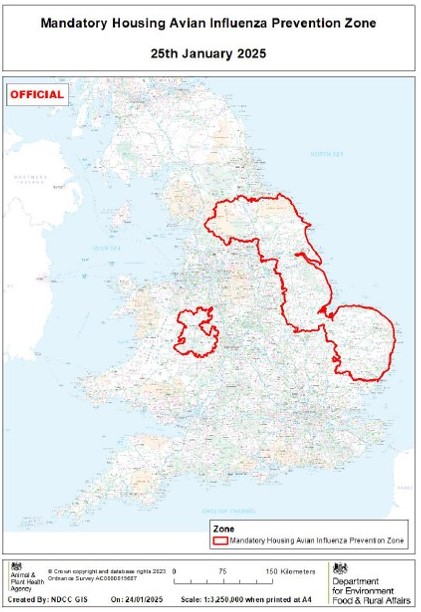
    What’s particularly concerning about this latest dumping incident is the location. Prior to the nationwide Avian Influenza Prevention Zone (AIPZ) being declared across the whole of England (and Scotland) on 25 January 2025 in an attempt to mitigate the risk of further outbreaks of a highly contagious disease (see here), Lincolnshire was already subject to a regional AIPZ, declared on 21 December 2024, mandating enhanced biosecurity measures and housing requirements for all captive birds (this mandatory housing order was extended to some other counties on 25 January 2025).

    Here’s DEFRA’s map showing the mandatory housing AIPZ covering Lincolnshire and other areas:

    And here’s the location of the shot & dumped pheasants, right in the middle of the mandatory housing AIPZ:

    This casual disregard for maintaining biosecurity during a time when the risk of an outbreak of highly pathogenic bird flu is so high should be shocking.

    Unfortunately, it isn’t shocking at all. It’s just yet another example of the selfish entitlement displayed by the so-called ‘custodians of the countryside’, time and time again. An industry that routinely breaks the law and rarely suffers the consequences, whether that be illegally killing protected species by poisoning, trapping or shooting, or using lead ammunition in habitats where its use is banned, or dumping shot gamebirds in rivers, woodlands, fields or roadside laybys because the birds are surplus to what they can sell or eat.

    This is what happens when you release 60 million+ non-native gamebirds (pheasants and red-legged partridge) into the British countryside every year.

    National Avian Influenza Prevention Zones (AIPZ) declared across England & Scotland

    Following an increase in the number of detections of highly pathogenic Avian Influenza (Bird Flu) in wild birds and other captive birds, the Deputy Chief Veterinary Officer from Scotland and Chief Veterinary Officer from England have declared a national Avian Influenza Prevention Zone (AIPZ) to mitigate the risk of the disease spreading amongst poultry and other captive birds.

    This means that from 12:00 noon on Saturday 25 January, it became a legal requirement for all bird keepers in Scotland and England to follow strict and enhanced biosecurity measures to help protect their flocks from the threat of Avian Influenza.

    Mandatory housing measures are not (yet) in place nationwide, but they are in the East Riding of Yorkshire, City of Kingston Upon Hull, Lincolnshire, Norfolk, Suffolk, Shropshire, York and North Yorkshire.

    A national AIPZ has not yet been declared for Wales.

    The declaration for England can be read here.

    The declaration for Scotland can be read here.

    Non-native red-legged partridge. Photo by Pete Walkden

    As we’re now at the very end of the gamebird shooting season (ends on Saturday 1st Feb 2025), these new AIPZs won’t affect the release of gamebirds for shooting because although the AIPZ does not permit the release of gamebirds in these areas, nobody will be releasing birds at this time of year – instead they’ll be trying to kill as many as they can.

    However, some shooting estates will also be ‘catching up’ gamebirds and ducks (this is permitted until 1 Feb in England and up until 28 February in Scotland) to use and/or sell the birds for breeding projects. There are now conditions imposed on the keepers of those birds, including a legal requirement not to move them on to other premises until 21 days after catching them. Details can be found here:

    If you’re wondering how they’re allowed to catch up wild birds and keep them in captivity, you need to learn about Schrodinger’s Pheasant, where the status of non-native gamebirds such as pheasants and red-legged partridges changes from ‘livestock’ to ‘wildlife’ and back to ‘livestock’, to suit the interests of the game-shooting industry. This absurdity has been examined by Wild Justice here and here and with this infographic:

    The declaration of the nationwide Avian Influenza Prevention Zones does not restrict gamebird shooting so we can expect more end-of-season shoots to take place this week, with a high likelihood that already-infected pheasants and red-legged partridges will be forcibly flying around the countryside as they’re chased towards the waiting guns, spreading a highly contagious disease to other wildlife. Then there’s the widespread distribution of potentially-infected gamebird carcasses finding their way in to the food chain.

    But who cares about the national threat, eh? As long as the gamebird shooters can have their fun, right?

    NatureScot capitulated on grouse moor licensing after legal threats by game-shooting industry

    Regular blog readers will know that I’ve been trying to uncover the reasoning and process behind NatureScot’s sudden decision last autumn to change its approach and amend the brand new grouse moor licences that had been issued to sporting estates in Scotland under the new Wildlife Management & Muirburn (Scotland) Act 2024.

    The changes made by NatureScot significantly weakened the licence by changing the extent of the licensable area from covering an entire estate to just the parts of the estate where red grouse are ‘taken or killed’, which on a driven grouse moor could effectively just mean a small area around a line of grouse butts.

    Photo of a line of grouse-shooting butts by Richard Cross, annotated by RPUK

    NatureScot also added a new licence condition that it claimed would allow a licence revocation if raptor persecution crimes took place outside of the licensable area, but many of us believe this to be virtually unenforceable.

    This new condition also means that all the other offences listed in the Wildlife Management & Muirburn Act that are supposed to trigger a licence revocation (i.e. offences on the Protection of Badgers Act 1992, Wild Mammals (Protection) Act 1996, Conservation (Natural Habitats etc) Regulations 1994, Animal Health & Welfare (Scotland) Act 2006, Hunting with Dogs (Scotland) Act 2023) are NOT covered by the new licence condition. The new condition ONLY applies to raptor persecution offences (see previous blogs here, here, here, here, and here for background details).

    As I blogged on 18 December 2024, NatureScot was clearly playing for time by stalling on releasing overdue FoI documents that I had asked for to try to find out what was behind the complete mess grouse shoot licensing has become.

    Finally, on 19 December 2024, by sheer coincidence, I’m sure, NatureScot provided a response, amounting to 162 pages of internal and external email correspondence between July and October 2024, relating specifically to the changes made to grouse licence conditions.

    Here is the cover letter sent to me by NatureScot, explaining what information was being released and what was being withheld

    And here is the substantial correspondence that NatureScot had with representatives of the grouse shooting industry prior to NatureScot making changes to the licence:

    It’s a lot to take in, and as you can imagine, it’s taken a while for me and my colleagues to digest the contents. To be frank, there’s nothing in the material released that we didn’t know or suspect had probably gone on, but the detail is very enlightening.

    It’s very clear that the level of engagement between NatureScot and Scottish Land and Estates (SLE, the lobby organisation for grouse moor owners in Scotland) was truly staggering. SLE (and latterly, BASC) were granted at least eight exclusive meetings with NatureScot staff between 15 July and early October to discuss the grouse licensing issue, without a word to any other stakeholders that this issue was being discussed.

    No notes of these meetings, or any of the many phone calls between SLE and BASC and NatureScot staff, has been provided in the FoI response.

    Also missing from the FoI response is the legal advice that NatureScot received about making changes to the grouse licence, despite it being clearly critical to NatureScot’s decision making.

    However, on the back of that legal advice, it is clear that SLE and BASC were given exclusive previews by NatureScot of proposed changes to the licence to agree before they were implemented.

    From the perspective of those of us who campaigned long and hard for a robust system of grouse moor licensing, and engaged diligently with the process of the Wildlife Management Bill as it progressed through Parliament and the subsequent meetings to determine the accompanying codes of practice, I’m not sure how this fits into NatureScot’s oft-repeated claim to seek “openness and transparency”.

    The policy intent of the legislation, part of the Wildlife Management and Muirburn Act, which was overwhelmingly passed by the Scottish Parliament, was crystal clear – “to address the on-going issue of wildlife crime, and in particular the persecution of raptors, on managed grouse moors. It will do this by enabling a licence to be modified, suspended or revoked, where there is robust evidence of raptor persecution or another relevant wildlife crime related to grouse moor management such as the unlicenced killing of a wild mammal, or the unlawful use of a trap”.

    Given the amount of evidence that SLE was invited to give during the Committee stages of the Bill’s progression, including representations by their legal representative, one wonders why SLE didn’t question the interpretation of the draft legislation defining land to be covered by a licence at that stage?

    SLE certainly raised questions and objections about many other aspects of the legislation during that process but maybe didn’t want the kind of public debate in front of MSPs that raising this issue at that time would have led to?

    Instead, the land management sector, and in particular SLE, pursued an extraordinary level of behind-the-scenes access to NatureScot staff after the legislation had been agreed through the democratic process, who in turn bent over backwards to accommodate all their demands, simply to head off the threat of legal action over interpretation of the new grouse licensing legislation, specifically how much of an estate should be covered by a licence.

    At this point, it’s legitimate to question SLE’s motives for trying to limit the amount of an estate that is licensed. Surely, if an estate’s employees aren’t committing wildlife crime, the extent of the licence shouldn’t actually matter?

    Anyway, it’s clear that discussions with SLE about a “legal issue” began in early July 2024, shortly after the period for grouse shooting applications had opened. It’s also apparent that shooting representative organisations were already advising their members via social media to delay submitting applications until the issue that “relates to the area of land to which the licence relates” was resolved.

    The FoI documents show that RSPB picked up on this and emailed NatureScot on 18 July 2024 asking for details. The response from NatureScot, sent the following day, appears to be reassuring, stating:

    We are clear that licences we issue should relate to the full landholding and not just land over which grouse are taken and killed, because as you well know, raptor persecution undertaken in connection with grouse moor management could take place anywhere on a property, not just on the grouse moor itself”.

    I, and I’m sure most readers of this blog, completely agree with this sentiment. We all know of many, many cases of raptors killed by gamekeepers on grouse shooting estates in places well away from where actual grouse shooting occurs – in woodlands, at nests on crags, in adjoining farmland. I don’t doubt that the majority of MSPs who passed the legislation would also have shared this view. Indeed, why would anyone who genuinely wishes to see raptor persecution addressed not agree?

    However, we now know that NatureScot went from saying they were comfortable that the process in place was robust (on 16 July) to bending over backwards to accommodate every suggestion SLE made about new conditions, despite recognising early on that the “policy intent” of the Wildlife Management and Muirburn Act might not be realised if areas covered by licences were too small.

    Interestingly, the document also shows that NatureScot’s internally-agreed line of communications (from 19 July 2024) would be that they were “working closely with stakeholders to develop a workable licensing scheme for grouse shooting that supports those who manage their grouse moors within the law and acts as a strong deterrent to raptor persecution”.

    Really? This has proven to be completely misleading and disingenuous at best. In reality it’s clear that the only organisations NatureScot was working closely with were SLE and BASC, even giving them advance notice of proposed new licence conditions for their comments and approval.

    In contrast, there is no correspondence with the police or NWCU to ask their opinion on the proposed new conditions and their enforceability, or any hint of wider discussion or consultation with any other organisation, despite other’s involvement in giving evidence to Parliament or contributing to the Grouse Code of Practice.

    Instead, there has been a concerted effort to placate representatives from the industry responsible for the illegal slaughter of huge numbers of raptors and other protected species, resulting in a significant number of investigations and prosecutions, just to head off legal threats. The rest of the world only became aware of these changes to the licences when it was all cut and dried, a done deal, published on NatureSot’s website.

    As I have written before, not only is the area to be covered by a licence down to the whims of the licence applicant, whatever the non-legally binding expectations of the licensing authority that it would include the whole grouse moor, but a new condition that I and many others believe to be unenforceable has been added.

    A stinging, but apparently unanswered, email sent from the RSPB to NatureScot on 10 October 2024 sums it up:

    This new ‘wildlife crime licensing condition’ will apply outside of the licensed area of a landholding but only where offences committed are related to management of the grouse moor. In a scenario where a buzzard is found dying in an illegally-set pole trap on a sporting estate, 2km away from the licensed grouse moor, we question what evidence will be required, and how it will be obtained, to allow an assessment if that crime was linked to grouse moor management, particularly if it was an estate that also had pheasant shooting?

    In summary, we believe that this new condition means that establishing a link between raptor persecution offences and grouse moor management, and to act as a meaningful deterrent to wildlife crimes, will now require a burden of proof that will be virtually impossible to achieve”.

    So much for these licences being a deterrent to raptor persecution! We also now know that NatureScot didn’t undertake a single measure of compliance monitoring or checks on the use of the 250 licences it issued for the 2024 grouse shooting season (see here).

    It’s becoming increasingly apparent that a culture of appeasement to the land management sector has become embedded in NatureScot. I’ll have a lot more to say about this over the coming weeks, (there is an ongoing related issue that has so many similarities but I can’t write about it yet, pending legal advice) but there is a growing sense of unease amongst conservationists with regard to decisions being taken by an organisation that should be leading on protecting Scotland’s wildlife.

    In the meantime, concerned blog readers may feel moved to write (politely) to the Scottish Government’s Minister for Agriculture & Connectivity, Jim Fairlie MSP, (email: MinisterforAC@gov.scot) to ask him what he intends to do to fix the huge loophole that NatureScot has created in the first Bill he led on in Government.

    I’ll be very interested in the responses you get.

    You might also increasingly be thinking that licensing grouse shooting just isn’t going to work, and the whole thing should just be banned. If so, please sign this petition.

    Two dead birds of prey ‘found in suspicious circumstances’ – Gwent Police investigating

    The following statement and photo was posted on social media on 19 January 2025:

    GWENT POLICE: Another busy weekend for the rural crime team that included responding to a report of 2 dead birds of prey. Found in suspicious circumstances, they have been recovered for autopsy via the Wildlife Investigation Team (WIIS).

    No further details available at the moment.

    NatureScot fails to make any compliance checks on use of new grouse moor licences

    As many of you will be aware, the 2024 grouse shooting season in Scotland (12 Aug – 10 Dec 2024) saw the use of grouse moor licences for the first time ever, introduced by the Wildlife Management & Muirburn (Scotland) Act 2024 passed by the Scottish Parliament in March 2024.

    For new readers, this Act was introduced as the Scottish Government’s response to the continued widespread illegal killing of birds of prey on grouse moors. It works on the basis that all red grouse shooting must now be licensed in Scotland under a section 16AA licence and if, on the civil burden of proof (i.e. on the balance of probability) sufficient evidence is found that the licence has been breached (including evidence of illegal raptor persecution), the licence can be withdrawn as a sanction, preventing the shooting of red grouse on a particular estate for a period of up to five years.

    The licences have already been weakened significantly by NatureScot after a legal threat from the game-shooting industry (see here) and I’ll be writing more about that, probably later this week.

    Red grouse photo by Pete Walkden

    As part of the new grouse moor licensing scheme, NatureScot published a Code of Practice for Grouse Moor Management (also known as the Grouse Code) which sets out the legal requirements associated with managing land for killing and/or taking red grouse.

    The Wildlife Management & Muirburn (Scotland) Act 2024 requires that a licence holder comply with the Grouse Code. Non-adherence to the Grouse Code could result in a licensing sanction and/or suspension or revocation. Here is the Grouse Code:

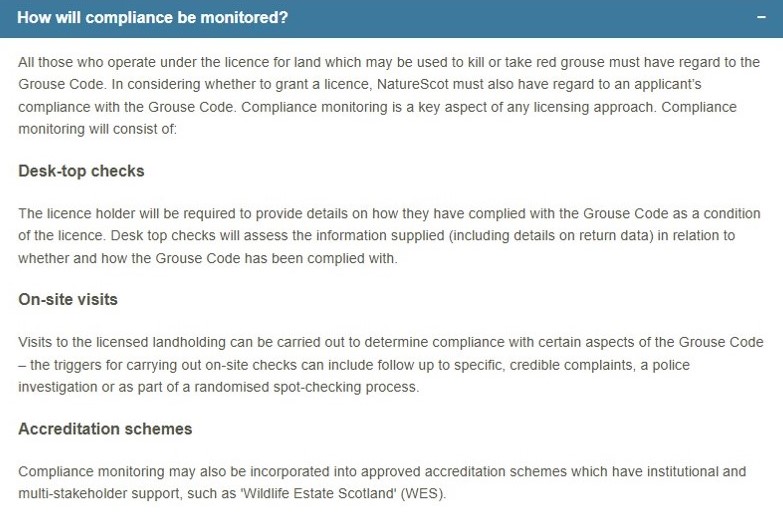
    You’ll note on pages 2-3 of the Grouse Code that it includes a section on compliance monitoring.

    Stating the obvious, NatureScot says, ‘Compliance monitoring is a key aspect of any licensing approach‘ and then outlines the types of compliance monitoring checks it says it will conduct:

    Sounds reassuringly comprehensive, doesn’t it?

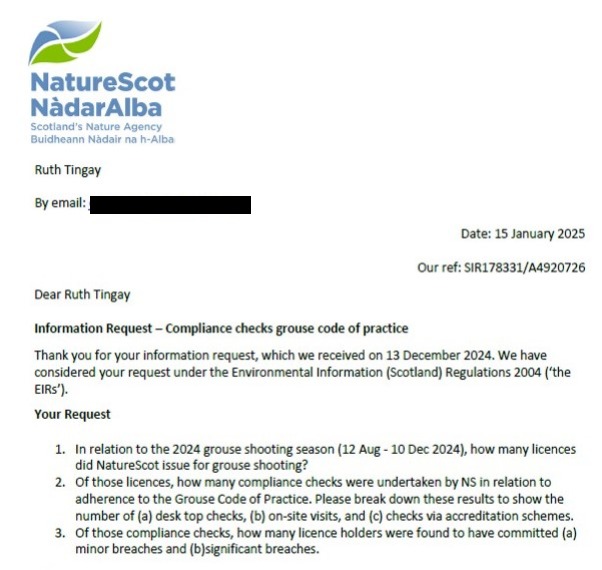
    However, in recent months I’ve learned that NatureScot can’t be trusted (more on that soon!) so rather than rely on what NatureScot says it will do with regard to Grouse Code compliance checks, I decided to find it what it actually did by submitting an FoI request as follows:

    1. In relation to the 2024 grouse shooting season (12 Aug – 10 Dec 2024), how many licences did NatureScot issue for grouse shooting?
    2. Of those licences, how many compliance checks were undertaken by NatureScot in relation to adherence to the Grouse Code of Practice? Please break down these results to show the number of (a) desk top checks, (b) on-site visits, and (c) checks via accreditation schemes.
    3. Of those compliance checks, how many licence holders were found to have committed (a) minor breaches and (b) significant breaches?

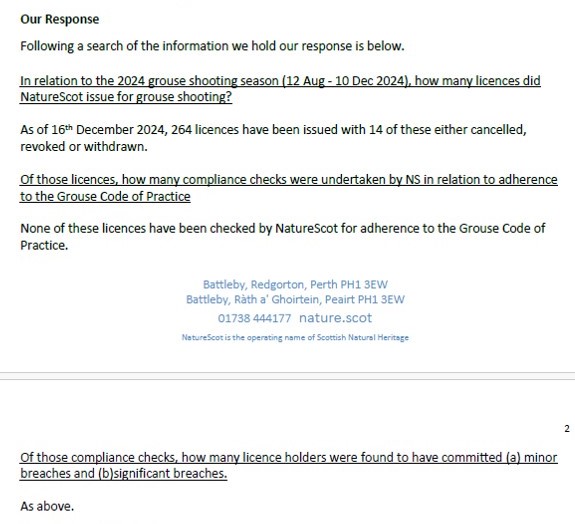
    Here is NatureScot’s response:

    So, NatureScot issued 264 grouse shooting licences for the 2024 season and says that 14 ‘were either cancelled, revoked or withdrawn‘. I’m guessing that none of them were ‘cancelled’ or ‘revoked’, but rather all 14 were ‘withdrawn’ by the licence applicant, probably as a result of the threatened legal challenge against NatureScot by the grouse-shooting industry that resulted in a narrowing of the licensable area, so perhaps some licence holders withdrew their original licence applications and submitted revised applications showing the more limited boundary.

    Whatever the reason, I’m quite confident that no licences have been ‘cancelled’ or ‘revoked’ by NatureScot because if they had, NatureScot would have publicised it on its website in the same way it does for General Licence restrictions. I suspect in this case, NatureScot has deliberately included the words ‘cancelled’ and ‘revoked’ in its FoI response in an attempt to infer enforcement action when actually it hasn’t done any enforcement whatsoever.

    That leaves 250 grouse shooting licences that NatureScot issued for the 2024 grouse shooting season. Of those, NatureScot didn’t undertake one single compliance check.

    That’s astonishing, given that the Scottish Parliament introduced grouse shoot licensing on the basis that many grouse moor owners and managers couldn’t be trusted to abide by the law, despite years of warnings that if they didn’t stop illegally killing birds of prey they’d face imposed regulations. Given this long history of criminality, you’d think that compliance monitoring would be fundamental.

    Regulation, in this case licensing, is only as strong as the associated compliance monitoring efforts and subsequent enforcement action. We’ve already seen the illegal shooting of an osprey (here) and a peregrine (here) since the licensing scheme began, and no sign of any subsequent enforcement action, which suggests that the licensing scheme simply isn’t an effective mechanism for stopping The Untouchables. NatureScot’s failure to undertake a single licence compliance check is playing right into their hands.

    Gamekeeper pleads guilty to snaring fox – press release from SSPCA

    Further to this afternoon’s blog about the conviction today of Scottish gamekeeper Thomas Ebner for a snaring offence in April 2023 (here), the Scottish SPCA has issued the following press release:

    GAMEKEEPER PLEADS GUILTY TO SNARING FOX

    A man has been fined £1,250 and ordered to pay a £75 surcharge for cruelly snaring a fox.

    Thomas Ebner, 74, from Reston in the Scottish Borders, pled guilty to setting a snare that could cause unnecessary suffering to any animal that came into contact with it. The snare was located on land belonging to Old Castles Farm in Chirnside.

    The snared fox at the centre of this case. Photo SSPCA

    The fox was caught by the neck and partially suspended on a broken fence line.

    Ebner was sentenced at Selkirk Sheriff Court on Monday, January 20 2025.

    Sheriff Paterson remarked, “This is a breach of the act. You knew what you were doing, and the fox suffered. But, I must consider that you have no previous convictions and pleaded guilty.”

    The sheriff then fined Ebner £1,250, plus a £75 surcharge.

    A Scottish SPCA Inspector from the Special Investigations Unit (SIU) said, “The fox was found caught in a snare along a broken fence line by members of the public. It was seen jumping through the fence in considerable distress and foaming at the mouth. The snare was wrapped around a fence post and was blood-stained. The public was able to free the fox from the snare.

    This snare was set in a way that caused suffering to the fox. There was a significant risk of it becoming entangled in the fence, which could have led to strangulation. It was clear that the fox was experiencing both mental and physical distress. The animal was at further risk of injury from surrounding barbed wire and broken wood.

    The snare was set by an individual who had attended an official snare training course, where they were taught the correct way to set snares.

    This is yet another example of the cruel impact snares can have on animal welfare and the unnecessary suffering they cause. We welcome the ban on snares implemented by the Scottish Government.”

    A ban on the use of snares came into effect in March 2024 as part of the Wildlife Management and Muirburn (Scotland) Act.

    We have also been given additional investigative powers to tackle wildlife crime. These powers allow our inspectors, who are already investigating animal welfare offences, to search, examine, and seize evidence.

    The Bill includes various measures to protect wildlife, such as a ban on all forms of snares and glue traps.

    We have long called for an outright ban on snares due to the suffering they inflict on animals, whether used legally or illegally. Animals caught in snares can endure unimaginable physical and mental anguish. Snares are non-selective and can harm both domestic animals and non-target wildlife.”

    ENDS

    Scottish gamekeeper convicted of snaring offence

    A Scottish gamekeeper has pleaded guilty to a snaring offence and has been fined £1,250.

    Thomas Ebner, 74, of Lakeside, Reston, Berwickshire, had previously pleaded not guilty to four charges relating to an incident that took place on land believed to be used by a small shooting syndicate at Old Castles Farm, Chirnside, in the Scottish Borders on April 25th 2023, which resulted in a fox being suspended by its neck in a snare on a broken fence line where it was found foaming at the mouth and thrashing around trying to escape (see here for previous blog on this case).

    At the time of the offence, snares were still lawful in Scotland but were not permitted to be set in a position where a trapped animal could be suspended, and users had to first attend a snare training course and then apply for an identification tag that would identify the snare operator and the target species.

    A snared fox on a fence line. NB: File photo, not associated with this case. Photo by SSPCA

    Ebner’s previous not guilty plea had led to a trial date being set for 4th February 2025. However, in a pre-trial hearing this morning at Selkirk Sheriff Court, Ebner changed his plea to guilty of one charge and the other three charges were dropped.

    I’d argue that Ebner got off lightly. A fine of £1,250 + £75 surcharge is well below the maximum sentence available, which is a custodial sentence of six months and/or a fine of £5,000. So much for those so-called ‘tougher penalties‘ for wildlife crime.

    Thankfully, the use of snares in Scotland has now been banned (since 25th November 2024) under the new Wildlife Management & Muirburn (Scotland) Act, thanks to a long-running campaign by animal welfare campaigners who spent decades putting forward evidence that these devices, recently and cynically named ‘humane cable restraints’ by the game-shooting industry, are actually cruel, indiscriminate and inhumane and have no place in modern society.

    UPDATE 16.30hrs: Gamekeeper pleads guilty to snaring fox – press release from SSPCA (here)

    Licence fees for firearms & shotguns set to increase for ‘full-cost recovery’ – no more public subsidy!

    The UK Government has announced that licence fees for firearms and shotguns are set to increase next month to allow for ‘full-cost recovery’, which means that taxpayers will no longer be subsidising the use of these weapons.

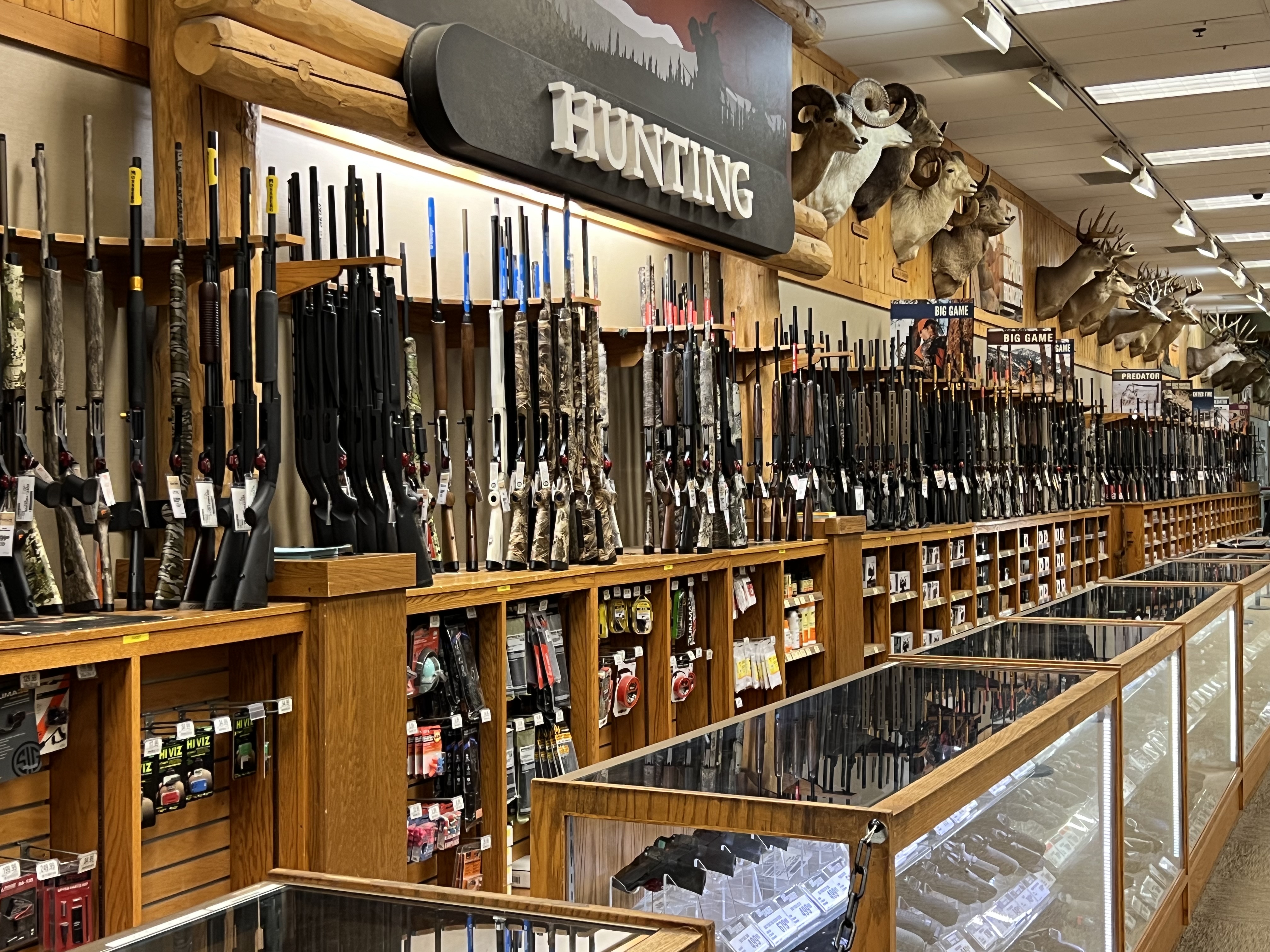
    Photo by Ruth Tingay

    Those wishing to possess, buy or acquire a firearm or shotgun and ammunition in the UK are required to have a certificate, issued by the user’s local police force who act as the licensing authority. These certificates are valid for five years, unless revoked.

    Before a certificate is granted, the police undertake a vetting procedure which includes medical checks and a range of suitability checks including referee interviews and a home visit to ensure the applicant has a secure facility to store a weapon and ammunition. All of this costs money from the force’s budget and until now, this cost has been significantly subsidised by the tax payer, costing the national police budget an estimated £17 – £20 million pounds a year.

    Last week the Home Office announced an increase in licensing fees, the first since 2015, that will, for the first time, achieve full-cost recovery for police forces.

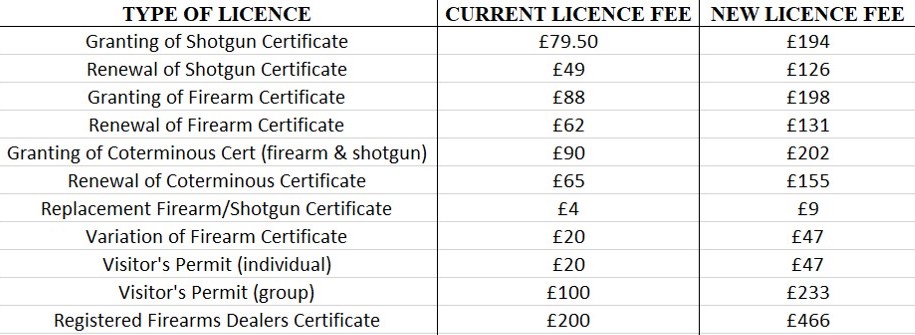
    Here are the current licence fees and the new fees that begin on 5th February 2025:

    This has been a long time coming. It was in Labour’s election manifesto and I’m pleased to see the speed with which it’s being rolled out.

    Some game-shooting organisations, such as BASC, are dramatically claiming that the fee increase ‘poses a threat to rural livelihoods‘. Having to pay the equivalent of £25.20 per year for a shotgun certificate renewal isn’t exactly going to ruin the rural economy, is it?

    Let’s hope the £17-£20 million pounds saved from the annual police budget can be put to good use to chase down all those certificate-holding gamekeepers who continue to use their firearms and shotguns to illegally kill birds of prey.