You may remember back in July when the Moorland Association published an incendiary blog accusing the police-led Hen Harrier Taskforce of ‘by-passing regulation‘ on surveillance after the police asked grouse moor owners to sign a letter giving permission for the police to enter land at any time and use equipment for the prevention and detection of crime, including the installation of cameras, proximity alarms and other equipment on and around hen harrier nest and roost sites (see here).
It was that blog that led to the Moorland Association’s CEO, Andrew Gilruth, being booted off the Raptor Persecution Priority Delivery Group (here) – I’ll write more on that shortly.
At the time we only had the Moorland Association’s warped view of the police letters given to grouse moor owners in known hen harrier persecution hotspots, because the letters hadn’t been made public.
It’s taken a while but those police letters have now been released after several rounds of FoI requests to the National Police Chiefs’ Council.
Here’s a template of the first letter, given to grouse moor owners at the end of the first police visit. It’s pretty self-explanatory:
The grouse moor owners visited by the police in those hotspot areas were also handed an information sheet outlining the relevant legislation that officers in the Hen Harrier Taskforce could apply when investigating the illegal killing or sudden ‘disappearance’ of satellite-tagged hen harriers:
And here’s a template copy of the letter the grouse moor owners were invited to sign at the end of the visit, giving permission to the police to enter the land and use equipment for the purposes of crime prevention and detection. This is the letter the Moorland Association really objected to (although I daresay they were also pretty unhappy about everything else as well – they haven’t previously been held to account at this level and their sense of entitlement would have been severely damaged):
If I was a grouse moor owner, who professed to love hen harriers and abhor wildlife crime, and who claimed had no idea who was killing hen harriers on my land and argued that it must be armed trespassers because none of my upstanding and law-abiding staff would ever commit such atrocities, I’d be pretty pleased with this police activity and determination to catch the criminals.
A fraud charge appears to have been dropped against serving police officer Suzanne Hall, the wife and mother of convicted peregrine launderers Timothy and Lewis Hall.
A quick recap.
WPC Hall, 46, initially faced multiple charges in 2022 in relation to the illegal laundering of Scottish peregrines that were stolen from nest sites across the south of Scotland and then sold on for profit to falconers in the Middle East.
The charges were the result of a joint Police Scotland /SSPCA raid at Hall’s property at Lamberton Holdings, Berwickshire, in May 2021 and a subsequent lengthy investigation codenamed Operation Tantallon.
Hall’s husband, Timothy Hall, and son Lewis both pleaded guilty (and received staggeringly inadequate sentences) but WPC Suzanne Hall’s not guilty pleas were accepted by the court in 2023. It was reported that the Crown Office deserted a fraud charge against WPC Hall but reserved the right to re-raise the case at a future date (see here).
Young peregrines at a nest site in Scotland. Photo (taken under licence) by Ruth Tingay
News then emerged in the Border Telegraph in July 2024 that WPC Hall was facing a fraud charge relating to almost £10,000 worth of council tax (here). It wasn’t clear whether this was the fraud charge that the Crown Office had previously deserted or another one. Hall denied the allegation and a trial date was set at Jedburgh Sheriff Court for 19 November 2024.
Then in October 2024, after I’d referred in a blog to this forthcoming trial, I started to receive emails from WPC Hall’s convicted husband Timothy Hall, who claimed there were no pending charges against his wife and he accused me of slander, threatening to sue me if I didn’t remove the blog post.
I didn’t bother trying to explain that what I’d written was accurate and fair reporting (based on the information available in the public domain at the time) and nor did I remove the blog post, for the same reason. This seemed to infuriate him and he did his best to write what he probably thought were hard-hitting threats but just sounded like somebody who’d watched too many episodes of Jeremy Kyle:
“My solicitor will be in touch” and “No doubt we will be seeing each other in court, I will be taking this all the way“.
I was curious though, so I contacted the Crown Office for an update on the status of the case against WPC Hall.
COPFS replied by giving me the contact details of Jedburgh Sheriff Court accompanied by a one liner: “They may be able to assist you further with your enquiry“.
So I called Jedburgh Sheriff Court. I was told that the information I sought was covered by the Data Protection Act and I was passed on to the Scottish Courts’ media team.
The response I received was this:
“I have searched our court rolls with the information you have provided and I am unable to locate a case with those details“.
Hmm.
My last attempt at trying to verify the status of the case against WPC Hall was today, when I viewed the online court roll for Jedburgh Sheriff Court which provides details of all the criminal cases being heard over the next five days (given that WPC Hall’s trial was scheduled to begin this coming Tuesday).
There is no listing for a case against WPC Hall.
It seems then, that the fraud charge against WPC Hall has either been moved or has been dropped. It’s impossible to determine the outcome, and impossible to know, if the case has been dropped, the reason behind that decision.
UPDATE 23 November 2024: Suzanne Hall, wife & mother of convicted peregrine launderers ‘no longer a serving police officer’ (here).
A new BBC Radio 4 series called ‘Rare Earth’ featured the issue of raptor persecution this week, in an hour-long episode that focused on birds of prey.
Raptor persecution was discussed during the latter part of the show and had contributions from Mark Thomas, Head of Investigations at the RSPB and Robert Benson, former Chair of the Moorland Association and its current Director of the North Pennines.
The discussion was entirely predictable, with Mark setting out the facts and Robert dismissing them, aided by ridiculous questions to Mark from presenter Tom Heap, such as:
“I’m just wondering, though, if this is really as big a problem as you’re suggesting or if you’re just inflating it for reasons of getting membership and getting attention because you want an enemy?“.
Biting insight there, Tom, totally ignoring the evidence (science, statistics, national police operations, Government statements etc).
It’s a tedious listen and regular blog readers won’t learn anything new.
There was also a fair bit of judicious editing at the end, cutting out the bit where Mark pointed out that the Moorland Association had been recently booted off the national partnership for tackling raptor persecution because of its inability to cooperate.
The controversy surrounding changes to Scotland’s new grouse moor licences continues (see here, here and here for background) and is now being picked up by mainstream media.
TheGuardian‘s Scotland editor, Sev Carrell, wrote about it yesterday and he included quotes from two wildlife charity directors who refer to the situation as a “shambles“.
Anne McCall, Director of RSPB Scotland, is quoted:
“We believe that these changes completely undermine the primary intention of this legislation to tackle raptor persecution and will only give comfort to those who intend to keep killing our birds of prey.
Leaders across the rest of the UK are looking to Scotland and this legislation to show them the art of the possible, with an example that they might soon follow. But the promise of a real deterrent to criminality on Scotland’s grouse moors has been allowed to descend into a shambles“.
Robbie Marsland, Director of the League Against Cruel Sports (Scotland & Northern Ireland) is quoted:
“Deliberately killing a protected bird of prey was a wildlife crime before the new legislation was enacted, and remains so, despite this shambles.
But any suggestion that ‘grouse moor management’ only applies to a small area around the shooting butts is clearly ludicrous. For example, when the league conducted an 18-month survey of six shooting estates we found traps and snares littered across the entire estates“.
An unnamed spokesperson for NatureScot says the revised licences “wererobust“. They’re clearly not!
The article also states that, ‘The Scottish government and NatureScot said they were considering amendments to the act, but refused to specify what would be done’.
Further to previous blogs about NatureScot’s utterly shambolic and unenforceable changes made to the grouse moor licensing scheme in Scotland following a legal threat from the grouse shooting industry (see here and here), this afternoon Scottish Greens MSP Mark Ruskell began the parliamentary process of challenging what he describes as the “vast loophole“.
Grouse shooting butts in Scotland. Photo by Ruth Tingay
Speaking during Portfolio Questions (Justice & Home Affairs) in the Chamber, Mark asked the following question:
“It’s becoming clear that the way land is defined though the Wildlife Management & Muirburn Act has severely compromised the most important legal deterrent to wildlife crime that we have.
So will the Cabinet Secretary discuss with other Cabinet colleagues with a view to bringing in an amendment to the Land Reform Bill to close the vast loophole that now exists?
The illegal persecution of birds of prey clearly must end“.
The Cabinet Secretary for Justice & Home Affairs, Angela Constance, responded:
“Presiding Officer, I will ask Ministers and the Cabinet Secretary responsible for issues in and around land reform to engage directly with the Minister“.
Bravo, Mark! Well done and thank you for picking this up so quickly.
If an amendment is feasible to close the “vast loophole” in the grouse moor licence then the Land Reform (Scotland) Bill seems the obvious vehicle. This Bill is currently at Stage 1 and that stage has to be completed by 28 March 2025. The lead committee scrutinising this Bill is the Net Zero, Energy & Transport Committee of which Mark is a member.
UPDATE 24 January 2025: NatureScot capitulated on grouse moor licensing after legal threats by game-shooting industry (here)
UPDATE 10 February 2025: Parliamentary questions lodged on grouse moor licensing shambles in Scotland (here)
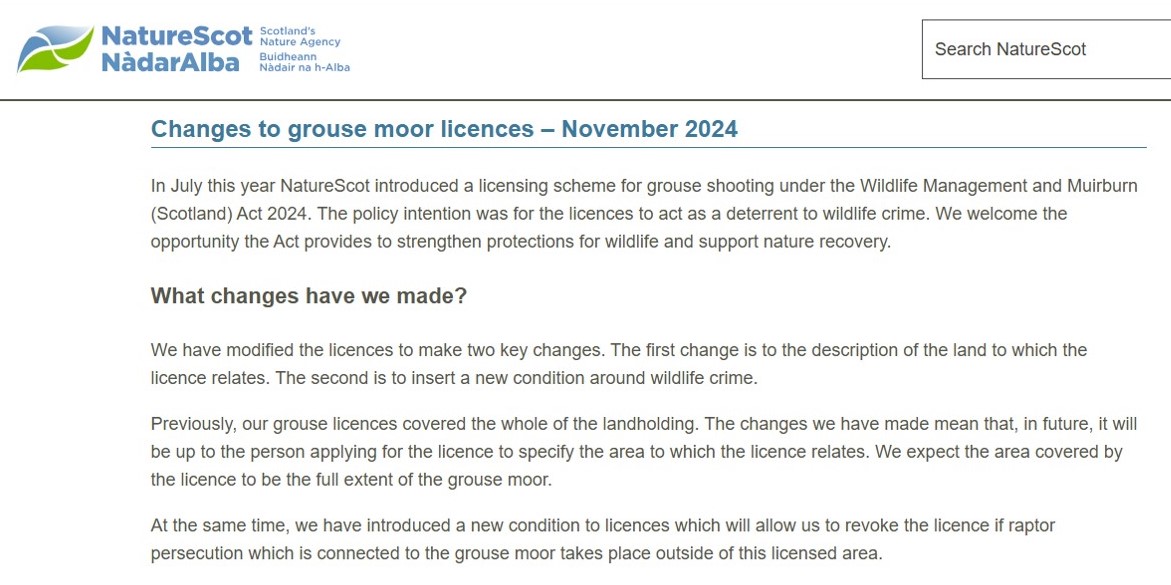
Further to my blog on Monday (here) outlining how Scotland’s grouse moor licensing scheme had already been sabotaged by the grouse shooting industry, today NatureScot has announced the commencement of its utterly shambolic and unenforceable changes made to the licence:
NatureScot is still stating, “We expect the area covered by the licence to be the full extent of the grouse moor“. This ‘expectation’ has no legal weight whatsoever.
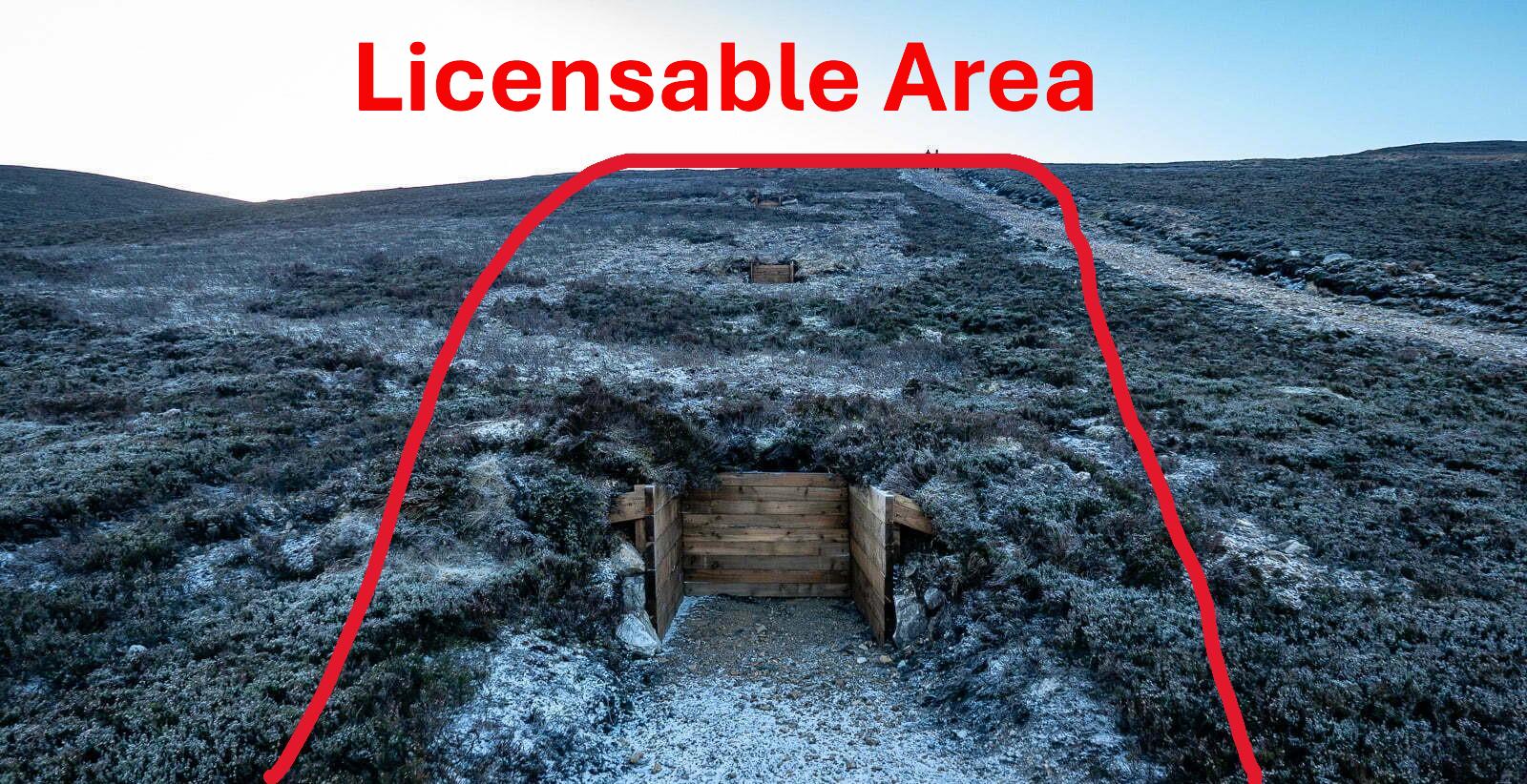
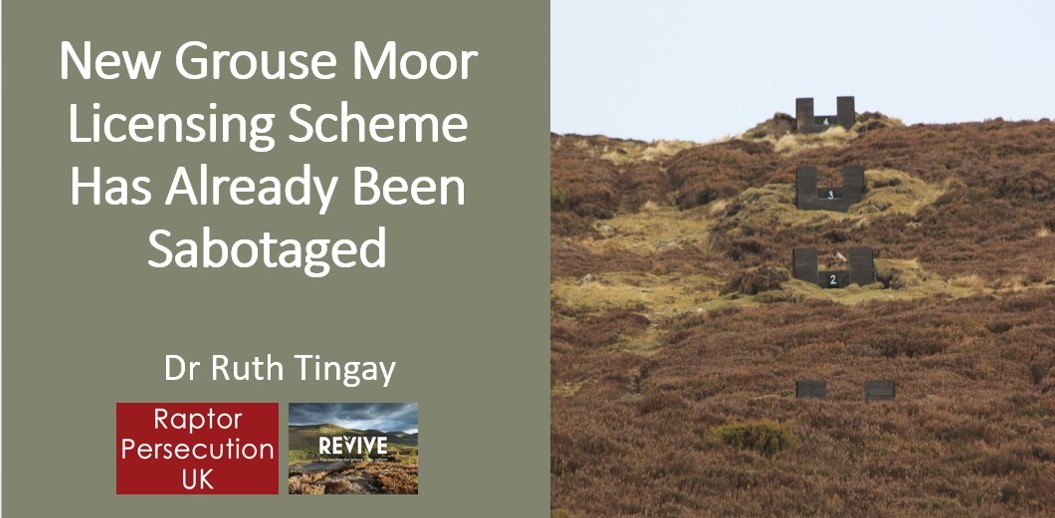
As I discussed previously, the grouse moor owners can simply draw an arbitrary line around their grouse butts, denoting the reach of a shotgun pellet, and argue that THAT is the area where they take/kill grouse and thus that should be the extent of the licensable area:
Grouse moor photo by Richard Cross. Annotation by RPUK
What this means in practice is that if any raptor persecution offences take place outside of that licensable area, the grouse moor/licence holder will not lose his licence because there won’t have been a breach of the new licensing condition.
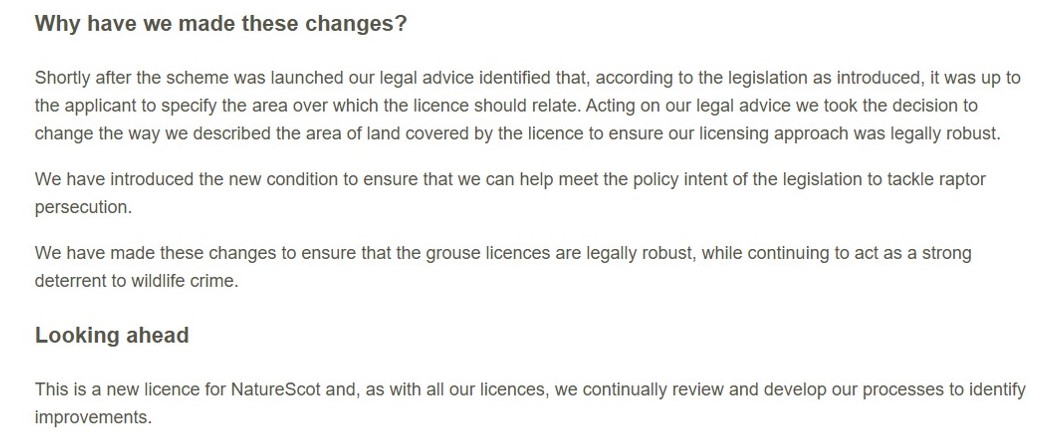
NatureScot has tried to address this loophole by introducing a second change, which, according to NatureScot, “Will allow us to revoke the licence if raptor persecution which is connected to the grouse moor takes place outside of this licensed area“.
Actually, it won’t, because how on earth will the authorities demonstrate that the raptor persecution crime was “connected to the grouse moor“? On a mixed shooting estate (i.e. the estate hosts grouse, pheasant and red-legged partridge shoots), how will NatureScot determine whether a poisoned golden eagle, found on a different part of the estate away from the grouse moor, was killed in connection to the grouse moor as opposed to ‘in connection with’ the pheasant or red-legged partridge shoot? How will NatureScot determine who laid the poisoned bait?
All the licence holder has to prove in their defence is that they’ve taken “reasonable steps” to prevent raptor persecution on their estate (e.g. their employees all sign contracts swearing to uphold the law), the gamekeepers will all give ‘no comment’ police interviews, and it will be virtually impossible to identify the perpetrator. Any half-decent defence lawyer will shred any attempt made by NatureScot to revoke a licence based on such uncertainty.
It’s exactly the same situation we had before the licencing scheme became enacted, and, incidentally, is exactly WHY the licensing scheme was introduced, to get around these issues!
The other big shocker within these new changes is that all the other offences listed in the Wildlife Management & Muirburn Act that are supposed to trigger a licence revocation (i.e. offences on the Protection of Badgers Act 1992, Wild Mammals (Protection) Act 1996, Conservation (Natural Habitats etc) Regulations 1994, Animal Health & Welfare (Scotland) Act 2006, Hunting with Dogs (Scotland) Act 2023) are NOT covered by this second change to the licence. That second change ONLY applies to raptor persecution offences.
Honestly, these new changes are so, so poorly thought through, and so, so far away from the Scottish Parliament’s intention when passing the Bill, it’s astonishing.
Stand by for more news about this later today…
UPDATE 13 November 2024: Mark Ruskell MSP starts parliamentary process of challenging the “vast loophole” in new grouse moor licence (here)
UPDATE 24 January 2025: NatureScot capitulated on grouse moor licensing after legal threats by game-shooting industry (here)
UPDATE 10 February 2025: Parliamentary questions lodged on grouse moor licensing shambles in Scotland (here)
UPDATE 14 November 2025: Scottish Minister Jim Fairlie provides rationale behind proposed amendment to close loophole on grouse shoot licence (here)
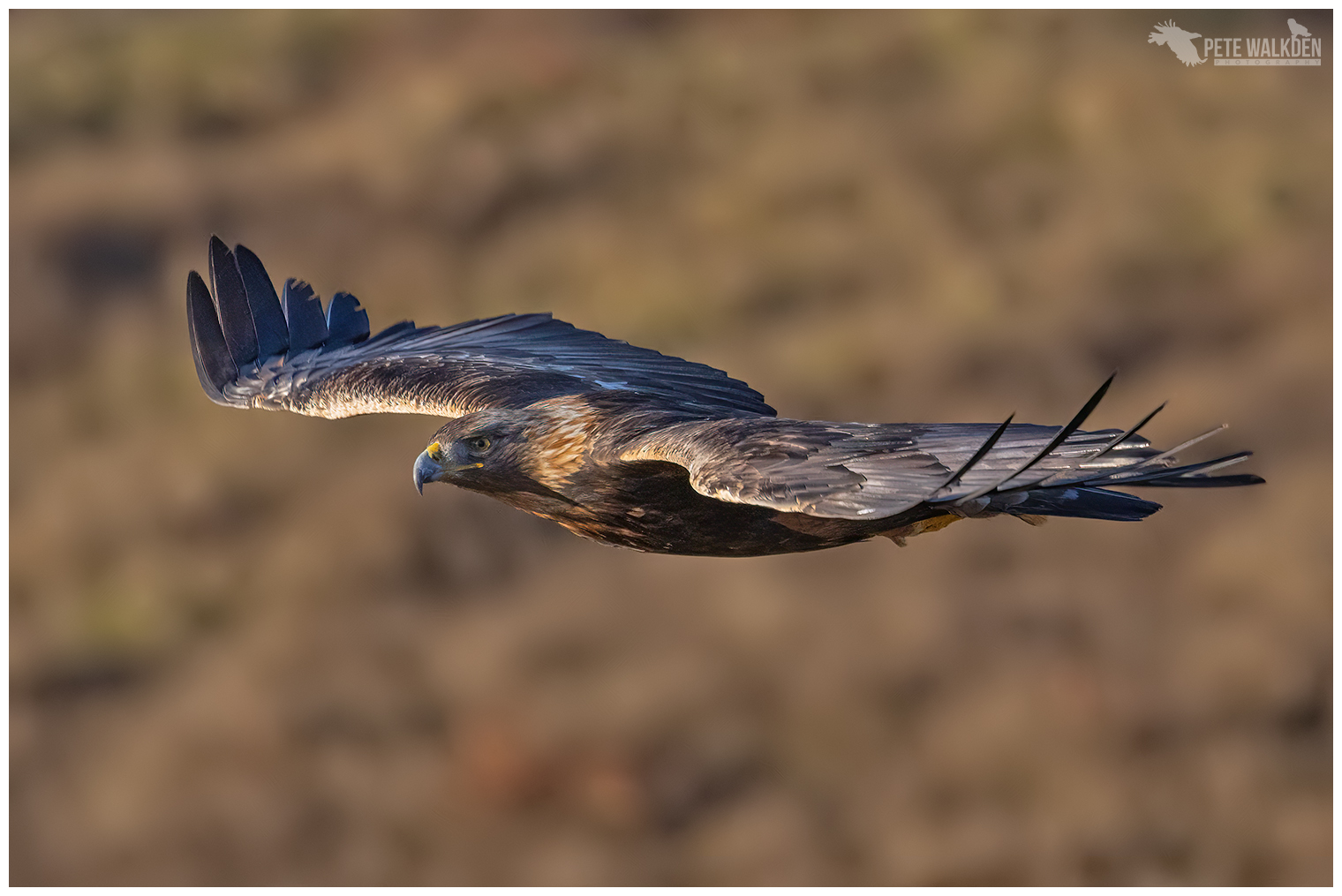
The young Golden Eagle, fitted with a satellite-tag, was being monitored by researchers in Scotland until it suddenly disappeared in the Angus Glens – an area dominated by grouse moors and with a history of raptor persecution.
Scotland’s national bird, Golden Eagles are still heavily – and criminally – persecuted.
The sudden disappearance of a satellite-tagged Golden Eagle has sparked concerns of criminal activity in the Angus Glens.
The young bird, which hatched in Tayside in 2022, was fitted with a satellite tag while in its nest. This work was supported by Forestry and Land Scotland for research purposes.
The tag was transmitting as expected until May 2024 when it suddenly went offline. Its last known location was an area of moorland in the Angus Glens – an area with a long history of illegal bird of prey persecution.
The data from the bird’s tag was swiftly provided to the police for independent scrutiny. Police Scotland, the National Wildlife Crime Unit and RSPB Scotland then conducted a search of the area but found no trace of the bird or its tag.
It is a crime to kill a bird of prey, and anyone caught doing so faces a fine or even jail. Furthermore, legislation introduced in March 2024 means that, if illegal activity takes place on a grouse moor, that grouse moor could lose its license to operate.
Will Hayward, RSPB Scotland Senior Investigations Officer, said: “The sudden cessation of transmissions from this tag strongly suggests human interference, and reflects a pattern of tagged birds ‘disappearing’ almost exclusively on or near grouse moors that has become all too evident in recent years. Had this bird died of natural causes or if the tag had become detached, we would be able to locate and retrieve it. Given the well-proven reliability of this technology, when no body or tag is found, this is highly suspicious. We believe this bird has been killed and the tag destroyed.”
Unfortunately, this young bird is the latest of many to disappear without explanation on or near a grouse moor.
Angus was one of the raptor crime hotspots identified in a Government-commissioned report on the fates of satellite tracked golden eagles in Scotland, published in 2017. Sadly there has been no let-up in confirmed incidents and suspicious disappearances since then. Most recently, an Osprey was found shot in the Glen Doll area on 12 August – the opening day of the grouse shooting season. [Ed: And a Peregrine was found shot in the Angus Glens on 3 September 2024, here]. And earlier this year sat-tagged Hen Harrier ‘Shalimar’ disappeared in circumstances similar to this Golden Eagle.
If you notice a dead or injured bird of prey in suspicious circumstances, call Police Scotland on 101 and fill in the RSPB’s online reporting form here.
If you have information about anyone killing birds of prey which you wish to report anonymously, call the RSPB’s confidential Raptor Crime Hotline on 0300 999 0101.
Another Silent Spring? A UK Government scheme to prevent the widespread poisoning of wildlife by rodenticides is failing.
Increasingly high levels of rodenticides (Rat poisons) have been found in Buzzards and Red Kites, and the Government is ignoring the evidence.
A report by Wild Justice highlights that the exposure of birds of prey to rodenticides in England has increased since a government scheme was introduced in 2015 to try and combat the problem.
Data from Red Kites and Buzzards, from both before and after the Rodenticide Stewardship Scheme (RSS) was introduced, show that anticoagulant rodenticides are now found in the livers of most dead birds that are tested, often at high levels.
Between 2020 and 2022, almost three quarters of tested Buzzards had been poisoned by rodenticides that are supposed to be restricted for use in and around buildings, including highly toxic Brodifacoum. This shows rodenticides aren’t being used correctly and that the use of these products requires stricter regulation, monitoring and enforcement.
Rodenticides are now being found in the livers of most dead Buzzards and Red Kites tested, according to a new report by conservation campaign group Wild Justice.
Using data obtained through Freedom of Information Requests, Wild Justice’s ‘Collateral Damage’ report presents the results of Government laboratory tests for 366 Buzzards and 173 Red Kites that had been submitted to the Wildlife Incident Investigation Scheme (WIIS) in England during the period 2005 to 2022. The report shows that in recent years nearly all these raptors had tested positive for Rat poison, often in high amounts.
A poisoned red kite. Photo by Dr Marc Ruddock
Rat poisons are toxins (Second Generation Anticoagulant Rodenticides, or SGARs) and are used extensively in game-keepering, farming and for pest control. It has been known for many years that these poisons don’t just kill targeted Rats. Poisoned Rats store the toxin in their liver and typically die several days after exposure. However, any animal eating the dying or dead Rat will also receive a dose of the toxin, resulting in the death of many species up the food chain, especially scavenging species such as Buzzards and Red Kites.
In 2012 the UK Health and Safety Executive carried out an environmental risk assessment on the use of SGARs and concluded that, due to the risk of secondary poisoning to wildlife, the poisons should not be used outdoors. However, the UK Government rejected this risk assessment and permitted the continued outdoor use of SGARs outdoors, even relaxing the regime to allow the external use of more toxic poisons such as Brodifacoum. Previously Brodifacoum was only allowed for use indoors.
The continued outdoor use of SGARs was on the condition that professional users complied with guidance known as the Rodenticide Stewardship Scheme (RSS) which was established in 2015. The aim of the RSS was to reduce SGAR exposure in wildlife resulting from improved Rat control working practices. The effectiveness of the RSS would be assessed by monitoring poison levels in wildlife, with a commitment to reduce SGAR exposure by 30% by 2020.
On the contrary, Wild Justice’s results demonstrate that rodenticide poisoning has actually increased during this period, not decreased.
Wild Justice compared data from birds tested before the introduction of the RSS in 2015, to those afterwards. Between 2005 and 2010 over 50% of dead Buzzards tested did not have any rodenticides in their livers. But in those tested between 2020 and 2022, over 90% of dead Buzzards had some level of rodenticide in their livers.
The data also show that in addition to the increasing number of Buzzards testing positive for rodenticide, there’s also been an increase in the number of birds containing very high levels of the poison. In Buzzards tested between 2005 and 2010, less than 2% contained over 0.3mg/kg (milligrams per kilogram) of SGAR poison in their livers, an amount considered to be very high. Yet in those tested between 2020 and 2022, nearly a quarter had over that amount.
An even starker picture was painted when looking at data for Red Kites. 15% of Red Kites tested between 2005 and 2010 contained these very high levels, whereas in those tested between 2020 and 2022, two thirds (66%) of birds had over 0.3mg/kg of SGAR rodenticide in their livers. In 2020-2022, none of the Red Kites tested were rodenticide free, and almost 90% had very high levels of poison.
Rodenticides are readily available, both for use by industry and for domestic purposes. There are different types of poisons available on the market, and many birds had been exposed to more than one type, with twelve of the Buzzards tested exposed to four different poisons. In Buzzards testing positive for rodenticide between 2020 and 2022, almost three quarters involved poisons that are supposed to be restricted for use in and around buildings, including highly toxic Brodifacoum.
Wild Justice believe this is partly the result of poisons being used illegally away from buildings. At the start of the survey period (2005 to 2012) these toxins were restricted to use within buildings only, and were generally marketed to professional pest controllers, rather than to gamekeepers and farmers. Now they appear to be in regular use by these groups, including illegally in open field situations away from buildings. This is the only explanation for such widespread levels of rodenticide found in Buzzards and Red Kites and shows that the use of these products requires stricter regulation, monitoring and enforcement.
Brodifacoum bait station illegally set on the edge of a grouse moor in the Yorkshire Dales National Park. Photo by Ruth Tingay
Brodifacoum. Photo by Ruth Tingay
Buzzards and Red Kites serve as indicators of a wider problem that will affect other predators and scavengers, including scarce and declining species. There are lots of species that eat rodents (not just Rats), meaning other birds like Kestrels and Barn Owls are also at risk. Wild Justice is calling for urgent regulatory changes to limit the availability and use of these products for the benefit of wildlife.
A spokesperson for Wild Justice said:
‘The Rodenticide Stewardship Scheme is a failed scheme, which the government should recognise. It is ridiculous that such dangerous, hazardous substances are escaping stricter regulation, especially when the evidence shows they are poisoning wildlife on a widespread scale, and even being used deliberately and illegally to do so. Our report reveals just the tip of the iceberg – such high levels of these poisons being found in birds of prey should be ringing alarm bells’.
ENDS
Wild Justice’s new report can be read/downloaded here:
The grouse moor licensing scheme in Scotland, brought in under the Wildlife Management & Muirburn (Scotland) Act 2024 in spring, has already been sabotaged by the grouse shooting industry.
This is breaking news that I presented at the REVIVE conference at Perth Concert Hall yesterday.
Some of the details of this sabotage are still a bit murky – it has all happened behind the scenes and it is proving difficult to get hold of the documents but it is apparent that the grouse shooting industry threatened a legal challenge against NatureScot’s interpretation of the new legislation, relating to the area of land that would be covered by the grouse shoot licence.
As a result of that threat, NatureScot appears to have caved in and has introduced modifications to the licence conditions which significantly narrow the intended purpose and reach of the original licence. However, scrutiny of those new conditions reveal they are utterly unenforceable.
These secret ‘negotiations’ between NatureScot and the grouse shooting industry appear to have been taking place over a number of months, without any consultation with other stakeholders and nor, it seems, with the police, who I understand have advised NatureScot of their concerns about their ability to enforce the new conditions.
I submitted an FoI to NatureScot a few weeks ago when I first became aware of these issues and I asked for the following documents:
A copy of the legal advice NatureScot received in relation to these changes.
A copy of all correspondence between NatureScot and Ministers in relation to these changes.
A copy of all external correspondence in relation to these changes.
A copy of all internal correspondence in relation to these changes.
The deadline for NatureScot’s response was last week. It came as no surprise whatsoever to receive an email from NS last week telling me they needed a further 20 working days to respond.
The lack of transparency around these changes is deeply concerning, especially given the efforts made by Government and its agencies to include the views of all stakeholders as the Wildlife Management & Muirburn Bill made its way through Parliament over the last year or so. These new modifications to the licence conditions look like a stitch-up that’s been concocted between the grouse shooting industry and NatureScot.
What it also shows, in my view, is the grouse shooting industry’s insincerity about tackling raptor persecution on grouse moors. The intent of the Scottish Parliament was clear when it passed the Wildlife Management & Muirburn (Scotland) Act and I have no doubt about its sincerity. What these new licence conditions do is undermine the will of Parliament and effectively negate the effectiveness of the grouse moor licensing scheme.
Work is now underway to address this in Parliament with the RSPB leading the charge. I expect we’ll hear a lot more about this over the coming days and weeks.
For those interested in the details of the licence changes and their implications (as far as I understand them at this stage), you can watch my presentation at yesterday’s REVIVE conference here (starts at 19.42 mins).
UPDATE 13 November 2024: NatureScot announces the commencement of its utterly shambolic & unenforceable changes to grouse moor licensing (here)
UPDATE 13 November 2024: Mark Ruskell MSP starts parliamentary process of challenging the “vast loophole” in new grouse moor licence (here)
UPDATE 15 November 2024: Scotland’s grouse moor licences “allowed to descend into a shambles” (here)
UPDATE 5 December 2024: Scottish Government ‘aware’ of issues with new grouse moor licences (here)
UPDATE 18 December 2024: NatureScot is stalling on releasing overdue FoI documents relating to its grouse moor licensing shambles (here)
UPDATE 24 January 2025: NatureScot capitulated on grouse moor licensing after legal threats by game-shooting industry (here)
UPDATE 10 February 2025: Parliamentary questions lodged on grouse moor licensing shambles in Scotland (here)
UPDATE 3 November 2025: Breaking news – Scottish Government commits to closing loophole on sabotaged grouse moor licences (here)
UPDATE 4 November 2025: Statement from RSPB Scotland Director on proposed amendment to close grouse moor licence loophole (here)
UPDATE 14 November 2025: Scottish Minister Jim Fairlie provides rationale behind proposed amendment to close loophole on grouse shoot licence (here)
Six months on from the introduction of new legislation intended to tackle raptor persecution, wildlife campaigners have expressed concern about the continued shooting of protected birds of prey near Scotland’s grouse moors.
The League Against Cruel Sports and Raptor Persecution UK have both commented on the shooting of a protected buzzard found near to the boundary of land belonging to Glenturret Estate in Perthshire in mid-May, just a few weeks after the Wildlife Management and Muirburn Act 2024 received Royal assent.
The comments came after police notified the League Against Cruel Sports that they had concluded investigations into the shooting of the buzzard with no charges being brought.
The dead bird was found on its back with its wings spread out by a Field Officer of the League Against Cruel Sports, who was carrying out field research on grouse moor management in the area.
A post-mortem conducted by the SRCU revealed that the buzzard had been injured by a ‘shot gun wound that caused fracture of the lower leg bone’, concluding that ‘the bird died slowly as a result of the leg wound and secondary infection, experiencing significant unnecessary suffering.’
Robbie Marsland Director of Scotland and Northern Ireland for League Against Cruel Sports said:
“Why would anyone shoot at a buzzard – unless it was someone who was trying to make sure there would be more grouse to shoot for so-called sport?
“The new laws were supposed to stop this kind of wanton cruelty but this case just goes to show that the killing goes on. Our worry is that this cruelty will continue as long as buzzards, hen harriers and golden eagles are seen as a threat to the shooting industry, rather than the magnificent creatures that they are.”
Dr Ruth Tingay of Raptor Persecution UK added:
“It was the persistent illegal killing of golden eagles and other raptors that led the Scottish Parliament to introduce a grouse moor licensing scheme earlier this year, a ground-breaking piece of legislation designed to impose sanctions on those who continue to kill our special birds of prey.
“The news that yet another raptor has been shot and killed is appalling. This case, along with other ongoing police investigations such as the recent shooting of an osprey and a peregrine, as well as the poisoning of a red kite and the discovery of a dismembered golden eagle found dumped inside a plastic bag, will test the effectiveness of the new legislation.
“If the killings continue, it’s likely there will be a push to ban gamebird shooting outright. If businesses can’t operate without killing protected species then they shouldn’t be in business.”
The Wildlife Management and Muirburn Act introduced a range of measures including a new licensing framework for grouse moors, banning the practice of snaring and giving greater powers to Scottish SPCA inspectors to tackle wildlife crime.
In a background briefing note about the new legislation, the Scottish Government stated, ‘The Wildlife Management and Muirburn (Scotland) Bill was introduced primarily to address raptor persecution and ensure that the management of grouse moors and related activities are undertaken in an environmentally sustainable and welfare conscious manner.’
The need for land reform to help tackle wildlife crime will be one of the discussion points at the REVIVE Conference in Perth on Sunday 10 November. REVIVE is a coalition of the League Against Cruel Sports, Common Weal, OneKind, Friends of the Earth Scotland and Raptor Persecution UK, and both Robbie Marsland and Dr Ruth Tingay will speak at the event.
The conference will launch the Big Land Question campaign, a year-long programme of independent research with the aim of enhancing and informing policy development and to ascertain public perceptions around land reform.
ENDS
This news was published by the Daily Record this morning (here).
Strathbraan is a large area dominated by grouse moors and is a notorious raptor persecution hotspot.









 Raptor Persecution UK