
The South Scotland Golden Eagle Project (SSGEP) has today announced the death of a young golden eagle after it collided with a wind turbine in Galloway in August this year.
The bird was a three-year old male called ‘Sparky’. He wasn’t one of the eagles translocated to south Scotland from the north by the SSGEP, but rather he fledged from one of the few remaining nests in south Scotland prior to the translocation project, but was carrying a satellite tag provided by that project, which helped in the swift recovery of his corpse.
Of course, Sparky’s death from collision with a turbine blade is a tragedy, but it’s important to view it from a broad perspective.
Golden eagle mortality from wind turbine collisions in Scotland is, thankfully, a rare occurrence. That’s not down to luck, or chance. It’s largely to do with detailed wind farm planning and choosing areas for turbines that are not located in habitats preferred by golden eagles.
A group of expert golden eagle ecologists, collaborating under an umbrella organisation called the Golden Eagle Satellite Tag Group (GESTG) has developed several models to predict significant areas of topographical use by golden eagles based on thousands of satellite tag records. The most recent model, called the GET (Golden Eagle Topographical) model, is now commonly used in Environmental Impact Assessments for judging the potential impact on golden eagles by proposed new wind farm sites across Scotland, and it works pretty well.
As an illustrative example, here is an image showing the movements of a satellite-tagged golden eagle that Chris Packham and I are tracking in the Monadhliath Mountains, on the western edge of the Cairngorms National Park. The red lines show the eagle’s movements around the footprint of three large windfarms and you can see that avoidance behaviour by the eagle is quite clear. (Thanks to Dr Alan Fielding for the data analysis and map).
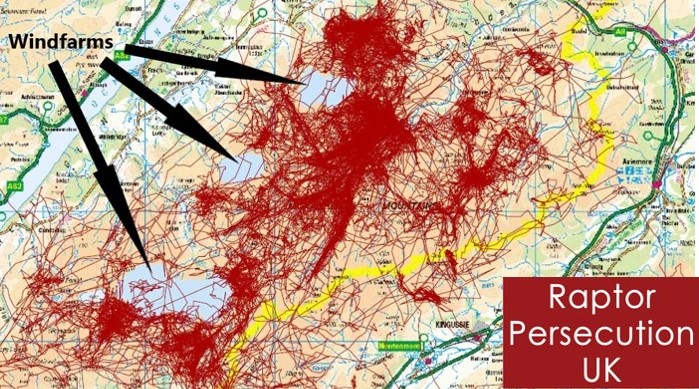
This eagle’s avoidance strategy is not uncommon. Peer-reviewed scientific research papers by the GESTG have demonstrated that both young, dispersing non-territorial satellite-tagged golden eagles (here), as well as older territorial satellite-tagged eagles (here) will generally avoid wind farms if they have not been sited in prime golden eagle habitat.
I don’t know much about the Environmental Impact Assessment undertaken for the Windy Rig Wind Farm in Galloway where Sparky was killed but it’s probably worth noting that it was consented in 2017 (and became operational in 2022) at a time when there were very few golden eagles in south Scotland so perhaps golden eagle collision risk wasn’t assessed to be high.
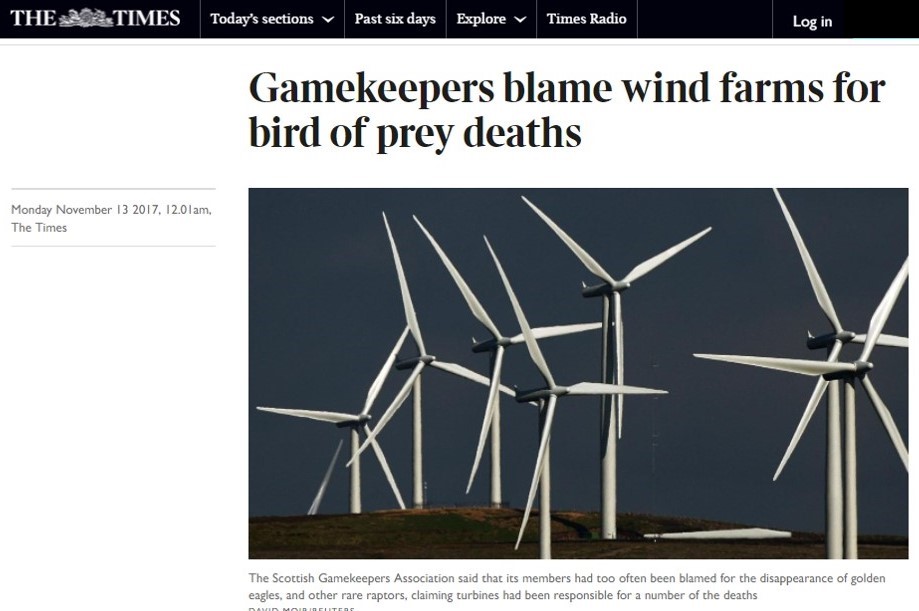
I fully expect the death of Sparky to be pounced upon by the raptor persecution deniers within the game-shooting industry, who will no doubt be jumping up and down, pointing fingers and announcing, ‘There! See? We told you that wind farms are killing golden eagles, it’s not us gamekeepers“, as they’ve been doing for years, for example this headline from 2017:
Alas, for them, the scientific evidence simply doesn’t support their claims (read the two linked papers above and also see Chapter 8 of the authoritative 2017 report by Drs Fielding & Whitfield: Analysis of the Fates of Satellite Tracked Golden Eagles in Scotland, where the authors examined whether any of the 41 tagged eagles that had ‘disappeared’ in suspicious circumstances were within the vicinity of a wind farm (spoiler alert – no, they weren’t, but illegal killing on a number of grouse moors was indicated).
Raptor collisions at wind farms has been a huge problem in some countries, notably in the USA at Altamont Pass in California where a long network of turbines was installed along the very ridgeline that migrating golden eagles use to take advantage of wind updrafts as they fly south. Anti-wind farm campaigners often point to these sites and assume that just because many golden eagles were killed at sites such as Altamont, it must mean that golden eagles are being killed at other wind farm sites. That’s simplistic nonsense, but some from the grouse-shooting industry have jumped on this to try and deflect attention away from the illegal shooting, trapping and poisoning of golden eagles that goes on in Scotland.
But it doesn’t wash anymore, and thank goodness the Scottish Government saw through the propaganda when it made the decision to introduce a grouse moor licensing scheme a couple of years ago.
That’s not to say that we should be unconcerned about golden eagles colliding with turbines – of course it needs to be monitored and the imminent construction of even more on-shore turbines needs to be carefully curated to ensure they’re built in the most appropriate locations, but thanks to ongoing satellite tag data analysis by experts in the GESTG, those potential impacts can be minimised.
 Raptor Persecution UK
That’s a very interesting piece, Ruth. There are anti-windfarm campaigners round here in mid-Wales claiming that raptors, owls, etc are going to be slaughtered wholesale if proposed windfarms are built. So it’s good to see a bit of balance for a change.
Very Interesting.
The very red (well frequented) area at the very top of your map of the eagle tracking in the Monadliath has a windfarm under construction and another proposed which will nearly exactly cover that solid red area.
If both wind farms are built will the eagles learn to avoid the area or does avoiding collisions require us to not put turbines there?
If eagles do avoid the area will cutting off that area from their use have a disproportionately large impact on them as it is (or appears to be) their best access to the north slopes of the Monadliath?
Young golden eagles actively avoid wind turbines in Scotland: new scientific research paper
https://raptorpersecutionuk.org/2021/07/27/young-golden-eagles-actively-avoid-wind-turbines-in-scotland-new-scientific-research-paper/
That’s a bit of an issue for golden eagles in an area saturated with turbines.
I wonder if we would ever have known about this bird if it wasn’t tagged.
Thank you Ruth and Dr Alan Fielding for this interesting insight. Was just wondering if Golden Eagles have a flight path around or near Clashindarroch, the home of the Scottish WildCat, as The WildCat Haven Folks are knee deep in protest with the Vattenfall Swedish Company who want to build inland wind farms in this forest of WildCats home!. Just a thought, a long shot. If so, may be a suggestion that we could add this fact to protect nature and wild life around the Clashindarroch Forest for Golden Eagles to, to add strength to this argument.? Thank you for this post.
Thanks for your comment but the ‘Wildcat Haven folks’ are not a group I have any interest in supporting, for a large number of reasons, but not least this:
https://andywightman.scot/2024/03/public-information-for-lairds-of-wildernesse/
I’m not sure that it is appropriate for Ruth to have used this sad incident as a springboard for further bashing of gamekeepers (however much some might deserve it).
Before this particular windfarm was built, the Windy Rig area was known to be a habitat not just for golden eagles which, according to the local raptor study group, were seen “fairly regularly” but also for red kites, peregrines and merlins.
One can only hope that more eagles and other raptors have not fallen victim to collision with the turbines and their blades.
However, it is worth noting that RSPB Scotland, which was a consultee, seemed fairly relaxed about the development at the consultation stage. The society did not oppose it.
It seems the RSPB was more worried about out potential impact on the local black grouse though their concerns were satisfactorily addressed when the application was amended.
I would like to think that turbine blade collisions are rare, but I’m not entirely convinced whatever the renewables industry and their flagbearers might claim.
I should state that I have a vested interest in the welfare of golden eagles. I have never seen one in the wild. To do so will be one of my resolutions for 2025. But sadly, it won’t be Sparky.
Hello James
Your wrote: “I’m not sure that it is appropriate for Ruth to have used this sad incident as a springboard for further bashing of gamekeepers (however much some might deserve it)“.
Not that I need your approval for what I choose to write about, but it’s entirely appropriate for me to comment on this incident. You may choose to describe it as ‘gamekeeper bashing’ but I see it as providing important context and perspective that you won’t find in other media coverage.
Perhaps you’re unaware of the gamekeeping industry’s long history of trying to discredit and undermine the use of satellite tags on Scotland’s golden eagles, as well as personal and libellous attacks on those of us involved in this research. They do it as a distraction technique to shift focus and attention away from the biggest threat to golden eagles in Scotland – the criminal activities of gamekeepers on some driven grouse moors, which our satellite tags have so clearly exposed, despite the extreme lengths those gamekeepers go to to hide their atrocities (e.g. cutting tag harnesses off the eagle they’ve just killed, wrapping it in lead sheeting to block the signal and dumping the tag in a river).
You only have to have a look around social media today to see this strategy still in play – I read this afternoon that apparently my colleagues and I are picking up dead eagles at windfarms, removing their tags and then declaring that the eagles have disappeared in suspicious circumstances on grouse moors! They forgot to mention that when a tagged eagle does vanish, we share the tag data with the police who conduct their own analyses to determine whether the circumstances are suspicious or not. And before anyone suggests that we could have ‘fabricated’ the tag data, the police have access, if they want it, to the original tag data directly from the tag manufacturer, who keeps its own records. If we were perverting the course of justice, as has been repeatedly suggested, we’d be in prison.
So forgive me if I take your accusation of ‘gamekeeper bashing’ as puerile gibberish. I’m interested in the conservation of golden eagles and if that means calling out the criminal behaviour of those gamekeepers intent on killing them then that’s what I’ll continue to do, regardless of the abuse it attracts.
Yes thankyou Ruth and Dr Alan Fielding for your input also interesting about wildcats habitat may be disrupted like you said ShatonbyTories would we have known about this incident if the eagle had not had it’s satellite tag on Still very sad poor Sparky.
‘Puerile gibberish’. Gosh, that’s a bit strong isn’t it? I thought I was just making my own modest contribution to the debate.
Indeed. Most uncalled for and very disappointing.
Whether birds are rarely struck by turbine blades or not, the findings that they will actively avoid flying through those areas says enough – their foraging area is being reduced. Where I live in north Sutherland, there is an onslaught of windfarm construction that will result is a huge area of ‘no-fly’ zones. It seems that no amount of opposition will stop the spread. The RSPB and NatureScot opposed the Strathy South and Strathy Wood applications to no avail. Look at the location of them. Not on, but slap in the middle of SAC, SPA, SSSI and RAMSAR, and now World Heritage Site! The flow country landscape is being destroyed too. The gently rolling blanket bog cannot hide 200m high turbines.
Can anyone tell me if any research is being carried out to try and find ways to deter raptors and other birds from flying into wind turbines?
As the world transitions to green energy, wind turbines will become a growing feature of our landscape.
Wildlife is already in a perilous state, so it would seem that it would be in everyone’s benefit to fund proper scientific research to find ways to minimise the impact of wind turbines have on wildlife.
I understand that the use of certain coloured lights can help rays from swimming into and being caught in fishing nets.
So I wonder if there is a workable solution to help birds avoid wind turbines?
It’s a massive area of research, John, and whilst I don’t intend for this discussion on the pros and cons of windfarms to continue on this blog, here is a recent summary paper for those interested in further reading:
Effects of wind farms on raptors: A systematic review of the current knowledge and the potential solutions to mitigate negative impacts (published Oct 2024, Journal of Animal Conservation) –
https://zslpublications.onlinelibrary.wiley.com/doi/full/10.1111/acv.12988#:~:text=Shutdowns%20on%20demand%2C%20the%20installation,are%20contradictory%20and%20case%2Dspecific.
Ruth, Thank you. Your link is greatly appreciated. Kind regards J.
Having now read the paper. It just highlights the importance of ending raptor persecution, and why any Govt which promotes onshore wind farms as part of its green energy policy, should also be robustly tackling raptor persecution. Thank you for all the work you do in championing this issue.
“That’s not to say that we should be unconcerned about golden eagles colliding with turbines – of course it needs to be monitored and the imminent construction of even more on-shore turbines needs to be carefully curated to ensure they’re built in the most appropriate locations …”
I presume you are aware, Ruth, of a proposed wind farm application (Scoop Hill, 60 turbines) currently at Public Inquiry Stage. Can the hills around Moffat, as the very location of the SSGEP, be considered “appropriate”? Not necessarily on the basis of collision risk, but on the basis that if eagles avoid wind farms, are the 50 or so repopulated eagles likely to be displaced.
Ruth it’s quite right to highlight how the raptor persecution deniers will pounce on this tragic accidental death. I remember when we were translocating golden eagles to Ireland, the same deniers were quick to exploit the fact some were poisoned over there, yet at the time deliberate poisoning of eagle was high in Scotland.
Regarding the 3 wind farms on the map, I believe the surveying for these was carried out when the golden eagle was very suppressed by illegal persecution. If the surveying had been carried out since the species substantial recovery the surveying results might have be quite different.
I wonder how many wind farms in the Southern Uplands were approved when the EA population was on the brink of extinction there, which otherwise might have been occupied by pairs.
There are a number of wind farms proposed for the red areas on the map. I wonder how much difference that will make to the planning decision.
There’s some interesting work going on in being able to detect when large birds fly close to turbines and shut them down https://www.youtube.com/watch?v=rmLnklzjpLQ There’s also the point that fossil fuel interests have been known to hype up wildlife deaths from turbines, or at least attribute them to turbines. The latest thing in the USA is claiming the sonic pollution from constructing off shore wind farms is killing whales!!! Of course these same bodies and their friendly (predominantly right wing) media sources never seem to take umbrage when raptor persecution, habitat loss due to the development of open cast mining and tar sands or ships colliding with whales (a large proportion of the world’s shipping carries oil and natural gas) is responsible. All you get is deafening silence when it suits them of course.