
Last month I raised concerns about NatureScot’s proposed framework that it will use when making decisions about whether to modify, suspend or revoke the new grouse shoot licences that form part of the Wildlife Management and Muirburn (Scotland) Act 2024 (that blog can be read here).
For new readers, this Act was introduced as the Scottish Government’s response to the continued widespread illegal killing of birds of prey on grouse moors. It will work on the basis that all red grouse shooting must now be licensed in Scotland under a section 16AA licence and if, on the civil burden of proof (i.e. the balance of probability) sufficient evidence is found that the licence has been breached (including evidence of illegal raptor persecution), the licence can be withdrawn as a sanction, preventing the shooting of red grouse on a particular estate for a period of up to five years.
NatureScot published its proposed decision-making framework in July 2024, as follows:
My biggest concern about the framework was that NatureScot was proposing that a licence might not be suspended / revoked if “corrective action could effectively be taken to bring the licence holder in line with relevant licensing conditions, within a timeframe usually not exceeding 12 months“:
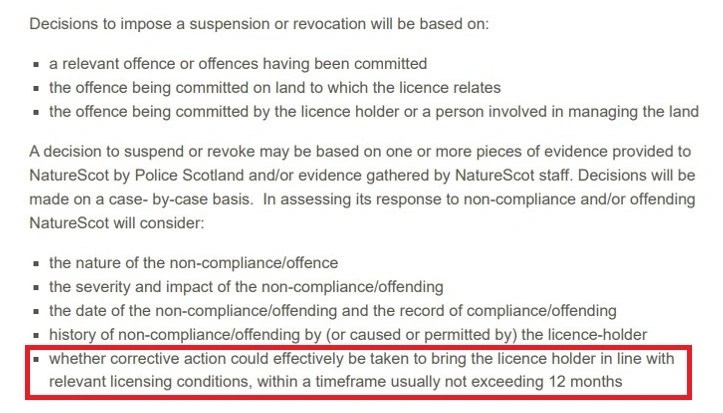
NatureScot didn’t define “corrective action” and I argued that the removal and replacement of a gamekeeper could be considered to be “corrective action”, in which case NatureScot would effectively be providing estates with a massive loophole to be be exploited because the estate could simply perpetually replace ‘dodgy’ gamekeepers that fell under suspicion and thus never suffer the consequences of a licence suspension/revocation for wildlife offences.
I’ve since written to NatureScot to ask for clarification on that issue and a few other concerns about the proposed framework. I’m grateful to Robbie Kernahan from NatureScot’s senior leadership team for his responses, as follows:
- Please can you explain whether evidence provided by the Scottish SPCA will be accepted in NatureScot’s decision making? And if it won’t be accepted, what the rationale is for that?
NatureScot can consider evidence gathered through SSPCA in line with the arrangements they are developing with Police Scotland.
2. How will NatureSot define ‘minor’ and ‘of a serious nature’ when considering the level of non-compliance?
We recognise there will be a spectrum of potential issues which may arise associated from non-compliance of conditions of licence, through to offences under the relevant legislation. For instance, returns not being made within the defined period – would be a compliance issue, but one which could be rectified without necessarily recourse to suspension or revocation, and may therefore be considered to be ‘minor’. NatureScot being satisfied that a relevant offence has been committed on the land by the licence holder or a person involved in managing the land to which the licence relates, is likely to be considered to be ‘of a serious nature’.
3. How will NatureScot determine whether a relevant offence has been committed by ‘the licence holder or a person managing the land’? It seems to me that this difficulty is precisely why the licensing scheme has been introduced, because it’s often not possible to identify the individual responsible for an offence.
NatureScot will consider such evidence as is made available to us. We anticipate that the primary source of evidence will be provided by Police Scotland, supplemented by any additional intelligence available to us. This will be on a similar basis to the evidence provided to us in considering the restriction on use of General licences. There may be cases in which NS will be satisfied, based on the evidence available, that a relevant offence has been committed on the land by the licence holder or a person involved in managing the land to which the licence relates, and as you note, where that evidence would not necessarily satisfy the standard of proof required for a criminal conviction of the relevant offence.
4. How will NatureScot define ‘corrective action’ when considering a decision to suspend/revoke a licence? Will that include the removal (by the estate) of an individual gamekeeper? If so, what are the implications for a prosecution (of that gamekeeper) or for vicarious liability (of the licence holder)? And why would the removal of one gamekeeper, presumably to be replaced by another one, solve the problem? How many times can an estate remove and replace a gamekeeper, without the estate being sanctioned?
The corrective action we envisage in this is likely to be around administrative issues (supply of returns) or other minor breaches which could be rectified quickly – not for wildlife crime.
These responses provide some reassurance but not all are as convincing as they might have been.
For example, on question 1, the arrangements between the SSPCA and Police Scotland for investigating and reporting suspected offences has not yet been made public (and may not become public) so the question of whether NatureScot will accept evidence provided by the SSPCA is still not clear. Remember, this arrangement between Police Scotland and the SSPCA relates only to the SSPCA’s increased investigatory powers for incidents where a live animal is not involved. The SSPCA is already a statutory reporting agency in its own right for offences under section 19 of the Animal Health and Welfare (Scotland) Act 2006, which is included in the ‘relevant list of offences’ [for which a licence may be suspended/revoked] under Naturescot’s proposed framework so it’s not clear to me why there’s so much opaqueness about whether evidence provided by the SSPCA will be accepted by NatureScot, especially in relation to offences under the Animal Health & Welfare Act.
On question 2, I think NatureScot’s explanation is clear and its rationale for distinguishing between ‘minor‘ non-compliance breaches and those ‘of a serious nature‘ seems sensible and fair.
On question 3, I think this is a reasonable response in as much as NatureScot can’t predict the type of evidence that will be available as each case (and thus available evidence) will be different. NatureScot has done a fairly good job so far of assessing evidence in relation to the General Licence restrictions it has imposed so we’ll have to wait and see whether that standard will be applicable for the suspension/revocation of section 16AA licences, which ultimately can be (and undoubtedly will be) challenged by the licence holder in a Sheriff Court.
On question 4, the definition of “corrective action“, I’m pleased to see the clarification from NatureScot that corrective action “is likely” to be associated with administrative breaches and not for wildlife crime, although I would have preferred to have seen this written as “will be” rather than “is likely” to be.
However, I’m still concerned that this “corrective action” loophole is included in the framework under the section headed ‘suspending or revoking a licence’. If NatureScot’s intention is to apply this measure for minor admin breaches only, why wasn’t it included in the section headed ‘modifying a licence’, which specifically deals with minor breaches, instead of the section headed ‘suspending and revoking a licence’, which deals with more serious breaches (i.e. criminal offences)?
Hmm. One to watch, I think.
 Raptor Persecution UK
Well done Ruth,yes that looks an obvious loophole to be exploited dosnt it !!
Thanks again for your diligence. One to watch, indeed.
Fuck off ! With your emails
patrickcosgrove44 – if you wish to unsubscribe from this blog you’ll need to follow the instructions that appear at the foot of the email notification, where it says ‘Manage your email settings or unsubscribe’. It’s simple, I’m sure you’ll manage.
“It’s simple, I’m sure you’ll manage.”
I dunno… Sounds intellectually challenged?
Brilliant critique of Nature Scot’s response Ruth…as you see, we will wait and see…
Perhaps you could go through an old case and ask NatureScot what they would do now with the new rules.
“go through an old case and ask NatureScot what they would do now with the new rules.”
Why would NatureScot approve expenditure on such a pointless, speculative, exercise?
I did notice the use of the word “can” in a number of their responses, rather than “will”. I would have preferred rather more definite commitment.
I wonder what Mr Cosgrove thought that this blog was about when he signed up to receive it? Last time I looked you have to opt in, it isn’t spam.
[Ed: I’m not going to publish that!]