What did Minister Jim Fairlie say to SLE’s Moorland Conference in June 2024?

Following the Scottish Parliament’s approval of the Wildlife Management & Muirburn (Scotland) Act 2024, which introduces a licensing scheme for the shooting of red grouse in Scotland in another attempt to bring an end to the ongoing illegal killing of birds of prey on many Scottish grouse moors, the landowners’ lobby group, Scottish Land & Estates (SLE) hosted a Moorland Conference on 11 June 2024 and invited Minister Jim Fairlie to speak.
I was interested in what the Minister would say so I asked the Scottish Government for a copy of his notes/speech.

This is what the Scottish Government sent to me:

There was a caveat at the end of the letter from the Scottish Government that went like this:

I would like to advise you that the actual speech by Minister Jim Fairlie, when he addressed the Moorland Conference on 11 June 2024, is likely to differ to the copy of the speech and/or prompt notes provided to him“.

I don’t think there’s anything particularly surprising in the copy of the speech that’s been provided – there’s nothing here that Fairlie didn’t say during his time on the parliamentary committee that scrutinised the Bill at stages one and two, nor during his time as Minister as he steered it through the Stage 3 debate before the Parliament voted to approve the Bill.

Nevertheless, it’s always a good idea to keep track of what Ministers are saying at private meetings, not least to be able to hold them to account if they renege on their previous commitments but also to be able to side-step any hyped-up claims of what’s been said by anyone wishing to present a distorted narrative.

For example, I read a review of the conference that focused heavily on Fairlie’s favourable comments about the grouse shooting industry but was predictably light on his comments linking illegal raptor persecution to grouse shooting.

Fairlie has always been clear about that undeniable link, especially during his time on the Rural Affairs Committee when it was scrutinising the Bill (here) so it’s good to see him reiterate that again to the grouse shooting industry, even though it was sandwiched between some top level fawning.
Your help needed – ‘Save Stobo Hope from commercial forestry project’

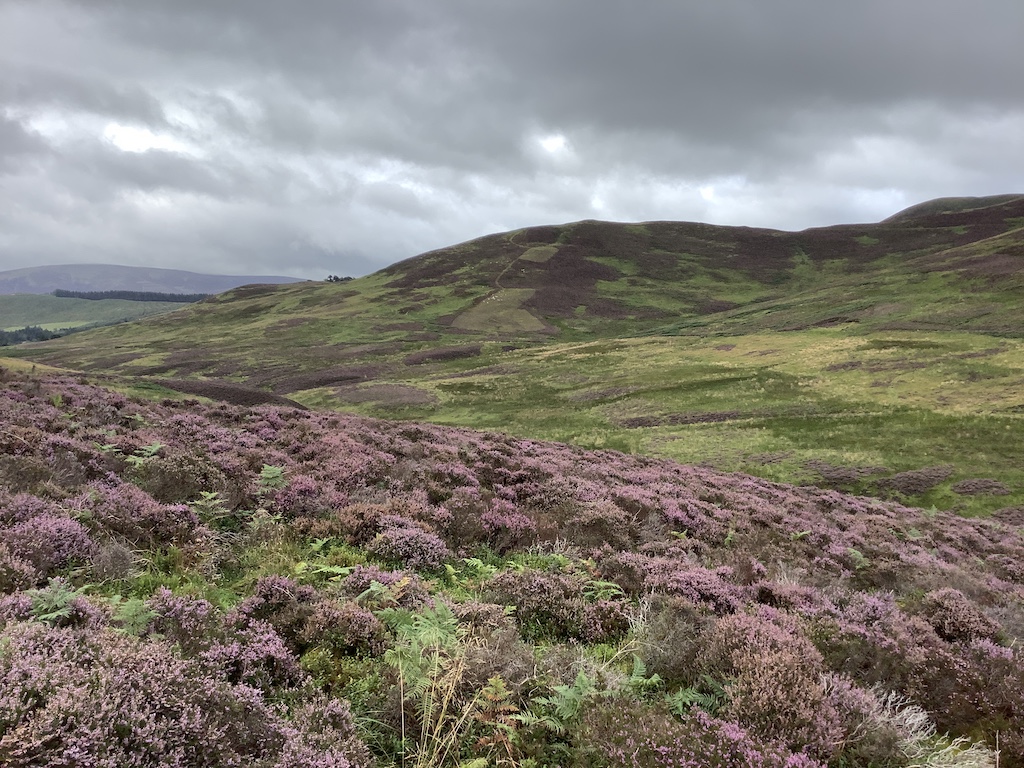
Stobo Hope is a valuable moorland habitat near Peebles in the Scottish Borders, part of a landscape designated as a National Scenic Area. It’s an important site for a number of species, not least Black Grouse and Golden Eagles.

Part of the site was formerly a grouse moor but that stopped quite a while ago and the heather ‘strips’ you can see in the distance in this photo is where the heather has been cut (as opposed to muirburn) for grazing management.

However, approximately ten square kilometres of this land has been bought by a company and approximately seven square kilometres is being planted with non-native Sitka Spruce, apparently in support of tackling climate change (but see here for a cautionary tale on tree-planting schemes in other areas of Scotland published on the always-interesting ParkWatchScotland blog).

This massive conifer plantation at Stobo has apparently been given the go-ahead by the Scottish Government (via its agency Scottish Forestry) and has awarded a grant in excess of £2 million (tax payers’ money) to support the development.

Local campaigners (Stobo Residents Action Group Ltd) claim that Scottish Forestry failed to follow the required legal protocols when assessing this development because they determined that an Environmental Impact Assessment (EIA) wasn’t required. The campaigners argue that NatureScot advised that an EIA was necessary because the conifer plantation was likely to have ‘significant and adverse affects’ but it appears that Scottish Forestry has ignored this advice, and similar advice from others.

In April this year the Stobo Residents Action Group lodged a request at court to seek judicial review of Scottish Forestry’s decision to allow the development without an EIA. The Scottish court has just given the campaigners approval to proceed (which means the court agrees that the group has an arguable case) and the group is now preparing for the case to be heard, probably in the autumn.

Meanwhile, back on site, preparation of the ground for the Sitka plantation is well underway with ploughing of the carbon-rich soil, the construction of large roads and the widespread application of a herbicide that campaigners say ‘has wiped out important plant communities including heather, blaeberry and many species of wildflowers, grasses, ferns, lichens and mosses. This will also have had a devastating effect on faunal populations, destroying the habitat, cover and food supply for mammals, birds, reptiles and invertebrates including the red-listed black grouse‘.

Here are some photos of the recent work on site (all photos by Stobo Residents Action Group):

Herbicide application
New road built in National Scenic Area
Ploughing on carbon-rich peatland for planting of non-native Sitka Spruce

As many of you will know, judicial reviews cost money and these local residents are now crowdfunding to try and raise the estimated £35,000 needed to take the case to court. As always with these things, there’s no guarantee of success but the fact the court has now approved the application for judicial review is encouraging and gives these campaigners a fighting chance.

The campaigners have raised £15,500 so far of their £35,000 target. If you’d like to support them, please visit their crowdfunder page here.

In fact I’d recommend you visit it anyway and click on the ‘updates’ tab to read in more detail what they’re fighting against. If you’re able to contribute a few quid I know they’d really appreciate your help. Thank you.

UPDATE 11 September 2024: Legal success for Stobo Residents Action Group fighting against commercial forestry project (here)

NatureScot publishes draft Code of Practice for Grouse Moor Management

Further to last week’s blog about the commencement legislation being published for the Wildlife Management & Muirburn (Scotland) Act 2024 (see here), NatureScot has now published its draft Code of Practice for Grouse Moor Management, which provides the legal framework for how grouse moors have to be managed.

Grouse-shooting butt. Photo by Ruth Tingay

The final version of the Grouse Moor Code of Practice is set to be published on 12th July 2024 and licence applications will open online on 15th July 2024, allowing grouse moor managers time to apply and have their licences in place for the start of the grouse-shooting season on the Inglorious 12th August.

Here is a copy of the draft Code of Practice:

A few of us have been invited to comment on the draft version of the Code, although this appears to be NatureScot just paying lip-service to a consultation, given the closing date for comments is 10th July and the final version is expected to be published two days later on the 12th July. Nevertheless, I have submitted some comments as follows:

  1. There doesn’t seem to be a requirement for grouse moor licence holders to produce evidence of a formal veterinary prescription for the use of medicated grit. This is both surprising and disappointing given that NatureScot told campaigners earlier this year that the use of medicated grit will be subject to greater regulation under the new Code of Practice (see here). Rest assured that campaigners from the League Against Cruel Sports (Scotland) and Wild Justice are planning to monitor the use (and mis-use) of medicated grit on grouse moors using a newly-developed lab technique they recently co-funded, and another technique currently undergoing testing. Watch this space.
  2. There doesn’t seem to be a requirement for licence holders to provide ‘returns’ (data) on the type and number of species that are (lawfully) killed as part of routine grouse moor management. There is a requirement for ‘bag returns’ on the number of red grouse shot, which is definitely an improvement, but what about the thousands (estimates of up to a quarter of a million) of other native animals that are trapped, shot and killed (e.g. corvids, stoats, weasels) each year just to enable an artificially high population of red grouse to be shot? How can NatureScot and the Scottish Government possibly evaluate the sustainability of grouse moor management if they don’t have access to these figures?
  3. There doesn’t seem to be a requirement for the use of non-lead ammunition. Why is that? How can grouse shooting be considered sustainable when thousands of tonnes of toxic poison are being fired and then left to accumulate in the environment, contaminating soils, plants and waterbodies, not to mention poisoning wildlife?
  4. It’s possible that some of the above are addressed in the associated ‘Best Practice Guidelines’ being drafted to support the Code of Practice, but currently the latest edition of the Best Practice Guidelines hasn’t yet been published and isn’t expected to be until ‘summer 2024’, whenever that is. How is it possible to provide an opinion on something that isn’t available for scrutiny?

Apart from these specific detailed concerns, the overall content of the Code seems reasonable and the general information that NatureScot has published so far about the Code of Practice and how it will work seems to be fairly comprehensive. It’s clear that an effort has been made to make the process as easy to understand as possible, both for the benefit of those having to work to the conditions of the licence and for those who will be watching closely and reporting suspected compliance breaches.

I’ll check back on the Code of Practice when the final version is published on 12th July, just to see if anything has actually been amended as a result of the mini-consultation, but I’m not holding my breath.