BASC throws a wobbler as Minister Jim Fairlie stands firm on Wildlife Management & Muirburn Bill

At the weekend I blogged about a claim made by BASC that Agriculture Minister Jim Fairlie might be considering a U-turn on the proposed snare ban, one of several measures being brought in by the Wildlife Management & Muirburn Bill (see here).
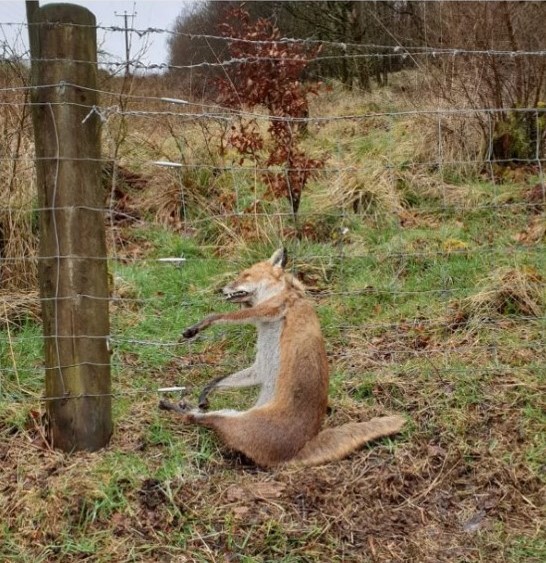
A dead fox killed in an illegally-set snare. Photo: Scottish SPCA

Many thanks to those of you who wrote to the Minister (and your local MSPs) calling for the proposed snare ban to remain in place.

Today, STV is reporting (here) that BASC has written to the Minister calling for the snare ban to be abandoned. BASC is apparently also asking for the scrapping of proposals that will allow other gamebird species to be added to the list that will require a licence to be shot, and also doesn’t want the Scottish SPCA to have increased investigatory powers. Quelle surprise.

STV states that the letter, which hasn’t been published, ‘raises the spectre of a potential legal challenge to the Bill’.

Jim Fairlie has responded robustly and is quoted as follows:

It is vital that Scotland’s grouse moors are managed in a way that is both sustainable and environmentally conscious.

Our Wildlife Management and Muirburn Bill will ensure that land managers adhere to responsible land management practices.

It is clear to me that our countryside continues to suffer from the damaging effects of wildlife crime, including raptor persecution on grouse moors.

The Bill contains a range of measures that will strengthen protections for our wildlife and will combat the blight of raptor persecution throughout Scotland.

I recognise the depth of feeling associated with these issues.

That’s why we have consulted extensively with groups from across the debate, and they have been involved in every step of the Bill’s process.

I am confident that this Bill strikes the right balance between further safeguarding our environment and supporting our rural economy“.

That’ll be a no then, BASC.

I see that BASC has now removed the claim that the Minister had suggested in discussions with BASC that he might be considering a U-turn on the snare ban. I hope BASC hasn’t been making false claims designed to appeal to its members.

Here’s the wording in the original blog:

And here’s how it looks today:

As for a legal challenge, this just seems like an empty threat. A judicial review can only be granted on the basis that a decision was made unlawfully (i.e. without due process). It cannot be made on the basis that someone (i.e. BASC) doesn’t like the decision.

Given the extensive level of consultations and evidence sessions relating to the Wildlife Management & Muirburn Bill, in all of which BASC has been engaged, I’d be utterly gobsmacked if a court decided the process of this Bill has been unlawful in any way, shape or form.

The Bill is currently at Stage 3 and will be debated by the entire Scottish Parliament on Tuesday 19th March, followed by a final vote to pass it onto statute.

UPDATE 15.00hrs:

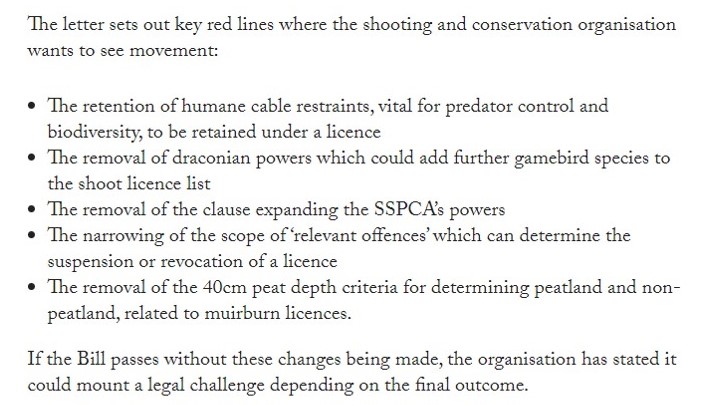
Other media sites are also covering this story and a piece on the politics.co.uk website includes a bit more detail about BASC’s foot-stamping tantrum. It’s not just the snare ban, addition of more gamebirds for licensing, or SSPCA powers that they’re objecting to- it’s also the extent of the relevant offences that may trigger a licence suspension/revocation, and the definition of peatland being 40cm depth:
The National has also run a piece, including a quote from Max Wiszniewski, Campaign Manager at REVIVE, the coalition for grouse moor reform:

It’s unsurprising to see the shooting fraternity making a last ditch attempt to water down this legislation, to avoid necessary scrutiny of their woefully unregulated and destructive industry.

Grouse moors are responsible for the deaths of hundreds of thousands of animals, the burning of huge swathes of Scotland and the pollution of the land from lead shot and toxic medicated medicated grit that’s spread throughout the countryside – all so more grouse can be shot by a few wealthy people for sport.

While the grouse moor bill could go further to tackle this circle of destruction, it marks an important and necessary intervention into land management activities and a full ban on snaring would be an important gain for animal welfare, something that seems is of little concern to the industry.

The Government would do well, to continue to reject these cynical attempts to rebrand snaring which up until now, has fooled no-one.”

Chief Executive of Moorland Association donates £10,000 to Tory Minister Guy Opperman

Whilst the political news is dominated by the story of a £10m donation to the Tory party by a donor accused of racism, it seems timely to look at another donation made earlier this year to Tory MP Guy Opperman, Minister for Roads and Local Transport, although there is no suggestion that the donor in this case is a racist.

As well as being a Government Minister, Opperman is the Conservative MP for Hexham in Northumberland, a constituency that includes a number of grouse moors in the North Pennines AONB (now re-named a National Landscape) and Northumberland National Park.

Unlike some of his Conservative colleagues, Opperman is not especially known as being an outspoken, hardcore supporter of the blood sports industry, although he has popped up occasionally, being seen to participate in a few PR stunts led by the Moorland Association.

Here he is in 2017 attending a Parliamentary reception for the Moorland Association:

And here he is in 2019 visiting gamekeepers on the Knarsdale grouse moor, featuring in a Moorland Association propaganda piece about how great grouse moors are for merlins (unfortunately this moor isn’t quite so good for hen harriers – this is where the shot corpse of hen harrier ‘Dagda‘ was found last year – nobody has been prosecuted, natch, but I’ll be writing more about that case in due course):

Hansard shows Opperman also spoke in Parliament in 2014 supporting the Moorland Association and describing gamekeepers as ‘custodians of the countryside’, although he also said he was supportive of the RSPB and its campaign to ban lead ammunition:

And just this morning there’s a local article (here) about Opperman visiting local stores that have been nominated for a Countryside Alliance award, although his visit does seem to be more about his particular support for a local business as opposed to blindly supporting the nasty brigade at the Countryside Alliance.

So I think it’s fair to say that Opperman isn’t a dyed-in-the-wool grouse shooting supporter, and his current Ministerial responsibilities seem to bear no significance for the grouse shooting industry.

How curious then, that in January this year his register of interests showed up this £10,000 donation from an unassuming-sounding company called GMS Partnership Ltd:

Who they?

Well according to Companies House, GMS Partnership Ltd is a ‘management consultancy’ whose sole director is none other than Andrew Gilruth, the recently-appointed Chief Executive of the Moorland Association:

I’ve previously written about Gilruth’s ‘interesting’ Directorship of another company, Moorland Communities Tradition, here, although Companies House is showing that he resigned as a Director of that outfit on 18 December 2023, leaving it in the capable hands of William van Cutsem and Jonathan Kennedy.

There’s no suggestion that the £10,000 donation made in January 2024 to Opperman from GMS Partnership Ltd is underhand (unlike allegations made about some of the donations Opperman has previously accepted (see here but also here where a Government probe cleared Opperman) but the donation from GMS Partnership Ltd is certainly interesting given Gilruth’s new role as Chief Exec of the Moorland Association.

One to watch.

Final debate on Scotland’s grouse moor licensing bill set for 19th March: your help needed

The final debate and vote on the Wildlife Management & Muirburn (Scotland) Bill is due to take place in the Scottish Parliament on Tuesday 19th March 2024.

For new readers, this is proposed new legislation to regulate grouse shooting and its associated management practices by way of licensing schemes, introduced because of the continued illegal persecution of birds of prey on many Scottish grouse moors.

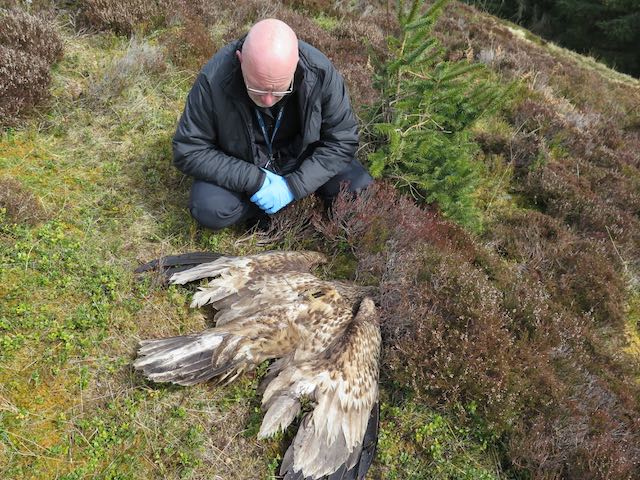
A police officer examines the corpse of a young White-tailed eagle, found illegally poisoned on a grouse moor in the Cairngorms National Park. Photo: Police Scotland

The Wildlife Management & Muirburn Bill, introduced in March 2023, has been examined and critiqued by the Rural Affairs & Islands Committee over the last year and after a number of amendments has now reached the final stage (Stage 3) of its progression through the Parliament.

Conservationists are generally satisfied with the Bill as it currently stands. It’s not perfect by any means, but it represents a significant shift away from the previous situation of driven grouse shooting being a largely unregulated hotbed of wildlife crime, animal suffering and environmental damage, where those committing offences were rarely held to account and the few who were only suffered minimal consequences.

The new legislation will introduce a licensing scheme for all grouse shooting in Scotland and where there’s sufficient evidence of unlawful activity (e.g. the poisoning, shooting or trapping of birds of prey) the licence can be revoked to prevent any further grouse shooting on that area of land. Crucially, the evidence will be assessed on the civil burden of proof (i.e. the balance of probability) rather than the criminal burden of proof (i.e. beyond reasonable doubt).

Muirburn will only be permitted under licence and not on peatlands where the peat depth is greater than 40cm. The muirburn season will end on 31st March instead of running through April as it currently does.

Grouse shooting and muirburn will both be covered by two new statutory codes of practice. Breaches of the code may result in the revocation of the relevant licence.

The SSPCA will be given increased investigatory powers to allow them to help with enforcement measures against wildlife crime alongside their current powers for enforcing animal welfare legislation.

Wildlife trap users will be licensed and all must first complete training for each trap type they intend to use. All snares (including so-called ‘humane cable restraints’) will be banned.

This is all looking very good. However, it’s not over the line yet. Further amendments to the Bill at Stage 3 may be lodged up until Tues 12th March and then some of those amendments will be selected for debate by the whole Parliament on Tues 19th, followed by a final vote on the Bill before it’s sent for royal assent.

Those further potential amendments have yet to be published but we expect to see them later next week. Of particular concern is a suggestion by BASC (British Association for Shooting & Conservation) that the Minister (Jim Fairlie MSP) may be considering a U-turn on the snare ban. This is what appeared on a recent BASC blog that was updating its members on the progression of the Bill after Stage 2:

A U-turn on the proposed snaring ban at Stage 3 would seem unlikely given the Government’s strong position shown at Stage 2 on implementing the ban, but BASC clearly seem to think that it’s a possibility.

With this in mind, I’d encourage all blog readers in Scotland to write to your respective MSPs to encourage them to support the Wildlife Management & Muirburn Bill as it currently stands and let them know how important it is that no U-turns are undertaken on the snaring ban.

Tell them how long you’ve been waiting for these new measures to be introduced and that you welcome and support the Government’s plans to finally bring some meaningful regulation to the grouse-shooting industry.

You can find the names of your MSPs by entering your postcode here.

Thank you.

UPDATE 14th March 2024: BASC throws a wobbler as Minister Jim Fairlie stands firm on Wildlife Management & Muirburn Bill (here)

FoIs reveal National Gamekeepers Organisation still trying to disrupt investigations into raptor persecution crimes

Some of you may remember a joint statement issued by five pro-shooting organisations in January 2020 professing ‘zero tolerance’ for raptor persecution crimes.

I wrote at the time why I didn’t find their claim convincing and that the five signatory organisations (BASC, Moorland Association, National Gamekeepers Organisation, Countryside Alliance, Country Land & Business Association) needed to do much more to persuade anyone to take them seriously. Just being so-called partners on the sham Raptor Persecution Priority Delivery Group (RPPDG) is nothing more than a greenwashing exercise, in my opinion.

More evidence has now surfaced about the National Gamekeepers Organisation (the membership body for gamekeepers in England & Wales) and what I would call its underhand tactics to try and disrupt investigations into alleged raptor persecution crimes.

In December 2023 I submitted an FoI request to Northumbria Police asking for, amongst other things, copies of 2023 correspondence between the National Gamekeepers Organisation (NGO) and Deputy Chief Constable Debbie Ford, who at the time was the National Police Chiefs Council (NPCC) Lead for Rural & Wildlife Crime.

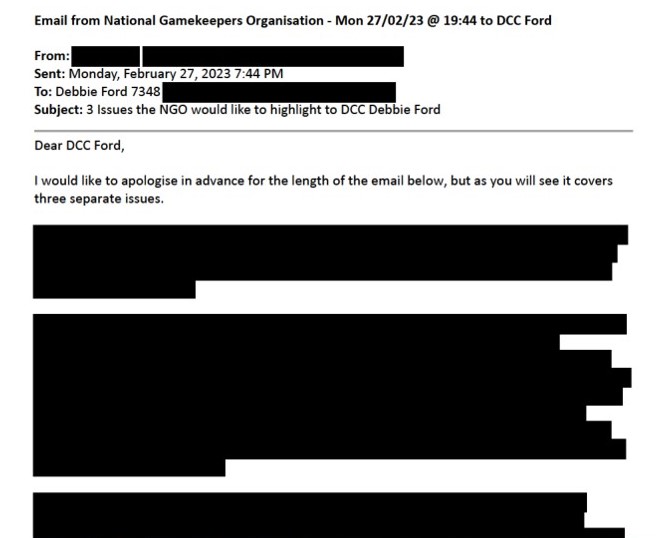
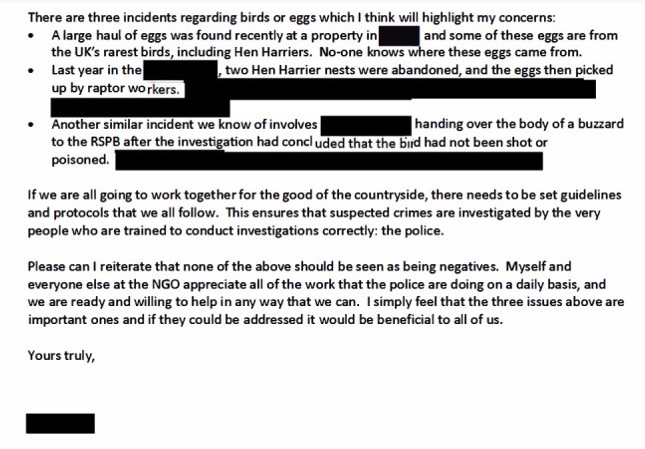
It turns out that the NGO had written to DCC Ford in February 2023 to highlight its three concerns in relation to bird crime.

The NGO’s first complaint was redacted by the FoI officer at Northumbria Police (see below). I’ve since submitted a separate FoI request for this detail and await a response.

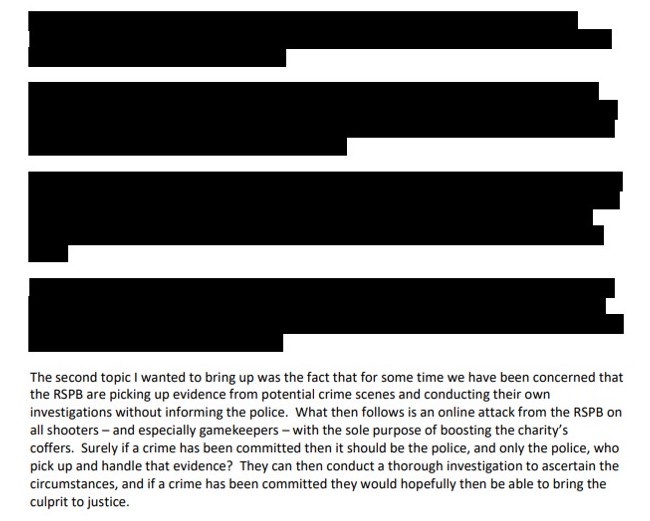
The second complaint related to, surprise surprise, the NGO’s objection to the involvement of the RSPB in raptor persecution investigations. I’ll come to that below.

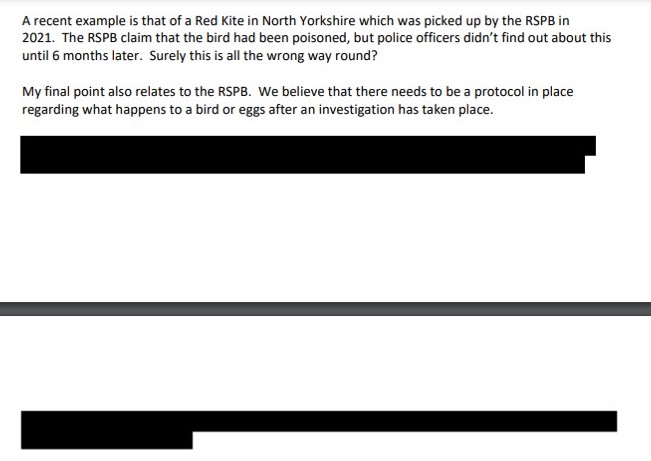
The third complaint related to the RSPB and members of the North of England Raptor Forum (NERF) and about what happens to birds and eggs once an investigation had concluded. It isn’t clear to me what the basis of this complaint is.

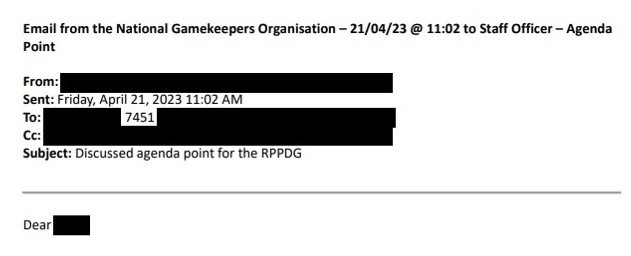
Here’s a copy of the FoI response I received from Northumbria Police:

Let’s focus on the NGO’s second complaint about the RSPB’s involvement in raptor persecution investigations.

This is a tired old trope that gets regurgitated every now and then by those who seek to marginalise the expertise and experience of the RSPB. Expertise and experience that has been utilised by police forces across the UK, time and time and time again, resulting in criminal gamekeepers being hauled before the courts and being convicted of raptor persecution crimes. This partnership working has been particularly effective in recent years, with the police leading many multi-agency raids (with partners including the RSPB, Natural England, NWCU and Natural England), resulting in the high profile conviction of a number of criminal gamekeepers (e.g. here, here, here, here, here, here, here, here).

Perhaps it’s these successful convictions of gamekeepers that have triggered the NGO’s complaint? But in this case, the NGO has provided wholly misleading ‘evidence’ to DCC Ford to justify their complaint. They reference a poisoned red kite found in Yorkshire in 2021 by the RSPB’s Investigations Team and argue that ‘police officers didn’t find out about this until 6 months later‘.

That’s not a factual account of what happened at all, and I daresay the NGO probably knows this because I wrote about that case 12 days before the NGO sent its email to DCC Ford. It relates to a poisoned red kite found on Swinton Estate that North Yorkshire Police failed to investigate, despite being told by the RSPB about the discovery of the kite on the day it was found (see here for case details).

So not only is the NGO going crying to the National Police Lead on Wildlife Crime with a baseless complaint about the RSPB, it’s also attacking an organisation that it’s supposedly in ‘partnership’ with on the RPPDG – you know, that ‘partnership’ that is supposedly focused on tackling raptor persecution crimes.

There’s more.

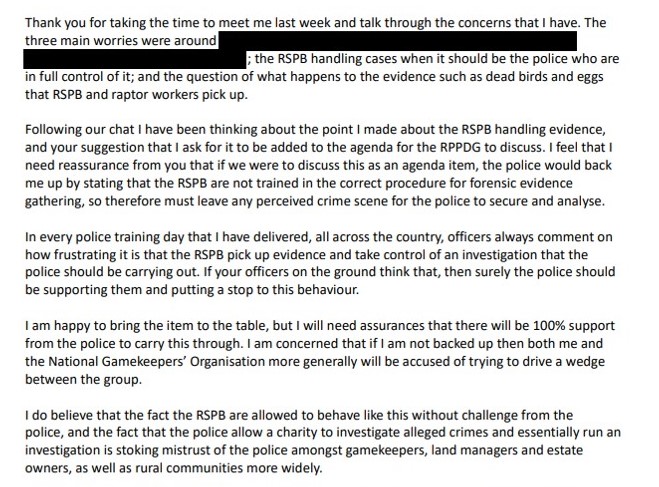
According to the FoI response I received from Northumbria Police, DCC Ford didn’t reply in writing to address the NGO’s complaints, but someone from DCC Ford’s office had a conversation with the NGO and suggested that the NGO raise the issue at the next RPPDG meeting.

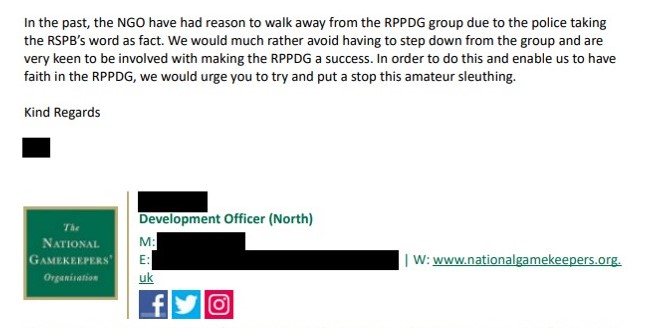
In response to that suggestion, the NGO’s Development Officer (North), who I presume is John Clarke, wrote back to DCC Ford’s staff officer wanting “assurances that there will be 100% support from the police to carry this through” and he included a veiled threat about the NGO leaving the RPPDG (having already resigned once before) if the police didn’t support the NGO’s attack on the RSPB:

Interestingly, the NGO’s complaint has not been raised at any subsequent RPPDG meetings, presumably because the police refused to support it.

Why is the National Gamekeepers Organisation still serving on the RPPDG? It’s absurd to think that this so-called ‘partnership’ for tackling raptor persecution crimes will achieve anything of significance whilst the NGO is attempting to disrupt police investigations via the back door.

Gamekeeper charged with attempting to trap goshawks in North Wales

Press release from North Wales Police (7th March 2024):

Wrexham man charged with wildlife offences

A man has been charged with attempting to take Goshawks in a cage trap on land on the outskirts of Wrexham.

Young goshawk in a cage trap. Photo by RSPB (file photo, not linked to this case)

Birds of prey such as Goshawk are protected under the Wildlife and Countryside Act 1981.

The 47 year old man from the Wrexham area was postal charged with using a trap for the purpose of killing or taking a wild bird and possessing an article capable of being used to kill or take a wild bird.

He is due to appear before Wrexham Magistrates Court on Thursday, March 28th.

North Wales Police rural crime team will pursue anyone targeting wildlife and continue to work with our partners the RSPB and National Wildlife Crime Unit.

ENDS

This press release is quite vague, and I believe deliberately so. Definitely one to watch. Comments are closed until criminal proceedings have concluded.

UPDATE 9th March 2024: This blog article has been picked up by Nation Cymru, the Welsh news service, here.

UPDATE 27th March 2024: Gamekeeper Stuart Hart due in court tomorrow to face charges of alleged wildlife crime (here)

Scottish gamekeeper convicted for causing unnecessary suffering to trapped magpies

Press release from Scottish SPCA (7th March 2023):

Penicuik man receives ban from keeping animals for five years after trapping and killing magpies

Alexander Hamilton was sentenced to a five-year ban from owning and keeping animals and 100 hours of community service at Edinburgh Sheriff Court on Tuesday, 5 March.

64-year-old Hamilton of Windsor Drive, Penicuik pled guilty to trapping magpies in illegal traps in his garden causing them distress. The birds were also deprived of adequate food water and shelter.

Scottish SPCA Chief Inspector Mark Rafferty, Special Investigation Unit, said:

On 29 July 2022 our animal helpline received a call from a resident in Windsor Drive, Penicuik reporting two magpies caught in cages in the back garden of a neighbour.

We attended that same day but found no one at home. On looking over the fence into the back garden, we observed a Larsen Mate trap and two other cages. The two cages had no suitable shelter, food or water and no visible tag attached to them.

We attended later that day at the address and the occupier, Hamilton, let us into his garden. We found a dead magpie lying on the paving slabs in the back garden, just inside the gate.

In the bottom corner of the garden, screened off from the rest of the garden by a large unsecured fencing panel, was an area where there were three traps.

Three of the magpie traps in Hamilton’s garden. Photo: SSPCA

The first trap was a Larsen Mate trap containing one Magpie. The bird was in a distressed state due to being confined within the trap and was in poor condition. This trap was of a manufactured type, and was specifically designed for the purpose of catching targeted species.

Crow cage traps and Larsen traps are bird traps used to catch various territorial members of the crow family most commonly used by gamekeepers or sheep farmers.

Trap operators are responsible for traps carrying their Trap Registration Number and all traps used must only display a single tag or sign showing one NatureScot Trap Registration Number. These conditions were not being adhered to rendering this trap illegal.

The second trap contained one magpie and there was also a cage containing a magpie in poor body condition.

The magpie within this cage was distressed and managed to squeeze through the mesh on the floor of the cage and enter a space underneath the adjacent shed. The bird could be heard scraping and pecking at the wooden floor of the shed and was clearly distressed.

The birds were released from the cages and the traps and were released back into the wild.

We’re pleased with the five-year ban at the sentencing result. All animals should be protected from suffering and this includes magpies. Our team treat these cases seriously and it is good to see that the courts share this view. We will continue to investigate this type of offending, to ensure people like Hamilton are caught and stopped from further cruelty acts. I would like to thank the Procurator Fiscal Karon Rollo and the Wildlife and Environmental Crime Unit.

If anyone is concerned about an animal, they can contact our confidential animal helpline on 03000 999 999.”

ENDS

This is a good conviction for the Scottish SPCA, who reported Hamilton to the Crown Office using their powers under the Animal Health & Welfare (Scotland) Act 2006 and without needing support from Police Scotland (contrary to MSP Edward Mountain’s ludicrous claims that the SSPCA lacks the qualifications and training to implement the law).

There looks to have been some plea bargaining on the sentencing. According to this article in Edinburgh Evening News, Hamilton’s defence lawyer told the court that Hamilton owned two gundogs and asked for any animal ban imposed by the court to exclude those animals.

Sheriff Gillian Sharp obliged by sentencing Hamilton to carry out 100 hours of unpaid work in the community and disqualified him from owning or keeping animals, with the exemption of his two dogs, for five years. 

Hamilton is reportedly no longer a gamekeeper and is now employed as a labourer. His conviction means he can no longer operate under the terms of a General Licence until the conviction is considered spent.

Gamekeeper in Scotland charged with killing goshawk on a Perthshire estate in February

Press release from Police Scotland (4th March 2024):

Photo: Ruth Tingay

47-year-old man arrested and charged following death of goshawk near Blairgowrie

On Thursday, 29 February, wildlife crime officers acting under warrant searched an estate near Blairgowrie with the assistance of our partners the RSPB and the SSPCA.

This resulted in a 47-year-old man being arrested and charged with killing a goshawk, which is a protected bird, contrary to section 1 of the Wildlife and Countryside Act 1981.

A report will be submitted to the Procurator Fiscal.

The incident took place on Monday, 12 February.

Police Scotland Wildlife Crime Coordinator Detective Sergeant David Lynn said:

Police Scotland will pursue anyone deliberately targeting Scotland wildlife. This multi-agency day of action shows our collective commitment to safeguarding Scotland’s wild animals.”

ENDS

This is an efficiently-handled case by Police Scotland and agency partners SSPCA & RSPB. The time from the alleged offence and the subsequent arrest and charge is unusually short. It’s also good to see an early press statement – well done.

NB: As an individual has been charged this case is considered live so comments have been turned off until criminal proceedings end. Thanks for your understanding.

UPDATE 23 July 2025: Trial date for Scottish gamekeeper accused of killing a Goshawk on a Perthshire shooting estate (here)

UPDATE 17 September 2025: Change of trial date for Scottish gamekeeper accused of killing a goshawk on a Perthshire shooting estate (here)

UPDATE 12 November 2025: Trial of Scottish gamekeeper accused of killing Goshawk now delayed until March 2026 (here)

Raptor Persecution UK blog is 14 years old

Today this blog reaches its 14th birthday!

It feels like I’ve been writing it forever, although in the grand scheme of things it’s just a mere eye blink.

It continues to attract public and political interest, with blog views now approaching 11 million, with over two million of those in the last year alone.

Awareness about raptor persecution and its link to gamebird shooting has changed significantly since I began writing in 2010. Obviously not all of that is attributable to this blog – there have been many, many people who’ve helped push the issue up the political agenda, not least the fine work of the RSPB’s Investigations Team and the grassroots movement started by Mark Avery with the publication of his 2015 book, Inglorious: Conflict in the Uplands and his subsequent work with Chris Packham bringing Hen Harrier Days to the fore, which has since led to many other individuals, groups and charities joining the campaign and pushing it forwards.

Social media has helped enormously – no longer can the game-shooting industry control the narrative in the main stream press and present themselves as law-abiding ‘custodians of the countryside’ without being challenged and called out on the widespread criminality that runs deep within its ranks.

The long-term work of the raptor study groups has contributed massively in helping to expose the impact of persecution on various raptor populations, and the satellite-tracking of golden eagles and hen harriers has been a game-changer, leading to the publication of seminal scientific research papers (e.g. here, here and here) which has helped demonstrate to politicians the clear link between raptor persecution and driven grouse shooting.

All this work has directly influenced Government policy in Scotland, where the introduction of a grouse shooting licensing scheme is imminent under the Wildlife Management & Muirburn (Scotland) Bill, which is expected to be passed by the Scottish Parliament later this month. It’s not perfect by any means and it remains to be seen how effective it will be, but its clear intention is to crack down on those who persist in illegally poisoning, shooting and trapping protected birds of prey and it’s a monumental step forward from where we were in 2010 when the only thing politicians had to offer was empty promises about not tolerating these crimes.

But even as I write, raptor persecution continues across the UK – there are a number of current police investigations in Scotland, England and Wales which I expect to see publicised in the coming weeks. It is clear that there is still a long way to go to rid the UK of this pervasive savagery.

As ever, I’m indebted to those who help fund my time to write this blog, to those who work with me behind the scenes (you know who you are), to those who send me information, to those who take the time to comment here, and especially to those who share blog posts on social media channels – raising awareness of the illegal killing of birds of prey was the main driver behind setting up this blog and it continues to be one of its main objectives.

Thanks for your continued support.