
Press release from Wildlife & Countryside LINK’s Wildlife Crime Group (5th December 2023):
Low convictions allowing wildlife crime to go unpunished, say nature groups
Some of the country’s leading nature voices are today releasing analysis showing that our cherished wildlife is being failed in the courts, with people who commit crimes (including persecution of birds of prey, badgers and bats) rarely being convicted. Such a lack of convictions removes a key deterrent for would-be criminals and makes it more likely for people to become repeat offenders. Wildlife crime can also be linked to other serious crimes like firearms offences and organised crime.
The Wildlife Crime Report for 2022, compiled by Wildlife and Countryside Link, with information from groups including RSPB, WWF UK, and the League Against Cruel Sports, has shown that convictions for crime against wildlife in 2022 decreased substantially. This is despite a record number of reports of wildlife crime over 2021. Other wildlife crimes include the disturbance of seals and dolphins, and the illegal trade of wildlife across international boundaries.

In 2022, Link estimates that there were around 4,457 reported wildlife crime incidents in England and Wales, compared to 4,885 in 2021 (a record level sustained from a surge in incidents in 2020 during the pandemic). Despite record levels of wildlife crime in 2021, there was a notable 42% fall in subsequent convictions for wildlife crime, from 900 in 2021 to 526 in 2022.
Dominic Dyer, Wildlife and Countryside Link’s Wildlife Crime Chair, said: “To put it simply, people who hurt wildlife are getting away with it, with a lack of convictions leaving them free to cause further suffering. Despite shockingly high levels of wildlife crime in recent years we’re not seeing higher levels of convictions to give nature the justice it deserves.
“With the Government’s deadline to halt the decline of nature by 2030 getting ever closer, it’s time for ministers to take the issue of wildlife crime seriously. This means the Home Office making it a notifiable offence to help police forces identify crime hotspots and plan accordingly.”
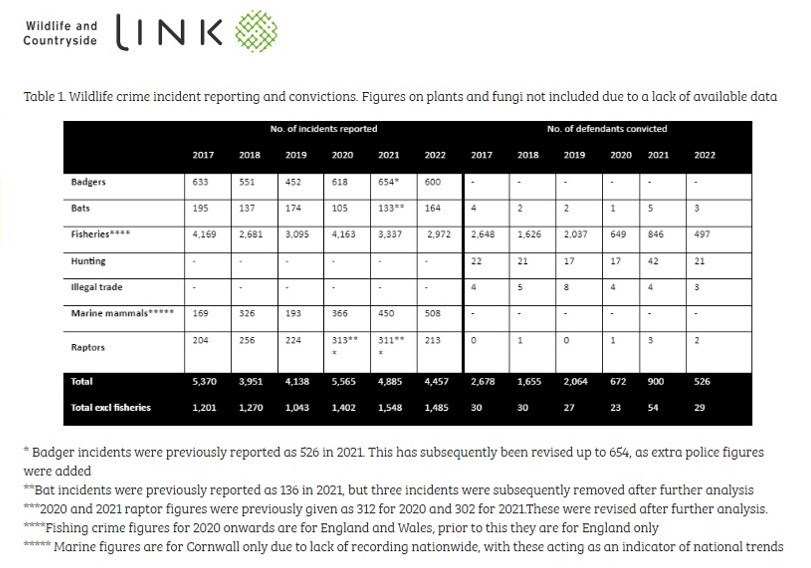
Despite a slight fall in the overall number of reports of wildlife crime, the report shows that reports of disturbances on marine mammals (including seals and dolphins) rose from 450 in 2021 to 508 in 2022. This is likely due to the rise in the number of people participating in outdoor activities on or near the coast including walking, paddle boarding, kayaking and jet skiing, as well as wildlife tours and wild swimming. Marine experts and water sports governing bodies are working to educate the public on how to enjoy our beaches and ocean without putting the welfare of marine wildlife at risk.
Sue Sayer MBE of Seal Research Trust, said: “More people enjoying our ocean is great news for health and wellbeing, but we must be more mindful of how this can impact marine wildlife including seals. If a seal gets scared by people getting too close it will use huge amounts of energy to scamper away and could also risk serious injury when getting back into the water. Fortunately, it’s very easy to enjoy our beaches and ocean without putting seals at risk of harm. Just follow the Defra Marine and Coastal Wildlife Code, Give Seals Space (100m+), and slowly move further away from seals if they start to look at you.”
Bat crime figures for 2022 increased by 23% compared to 2021. A survey issued by the National Wildlife Crime Unit to the 43 police forces across England and Wales (19 responded meaning these numbers are likely far less than the true extent of crime), coupled with reports to Bat Conservation Trust revealed 164 cases of bat crime. The most common form of bat crime is disturbance or destruction of roosts, often due to property development. The report points to a case in Monmouthshire of a developer being fined more than £7,000 after renovating an old school building where bats were known to be present.
Kit Stoner, chief executive of Bat Conservation Trust, said: “Bats are long lived, roost faithful, and slow to recover from population losses. Unfortunately, many species of bat in the UK are under threat from loss of roosting sites. With the most common form of bat crime being disturbance or destruction of roosts, it is vital that we maintain and enforce protections. Without this action, we will not meet targets to halt the decline of species.”
Due to a lack of official data, these figures on crime (most of the data relies on direct reports from members of the public to nature groups) are likely to be a significant under-estimate of wildlife offences. Wildlife and Countryside Link is therefore calling on the Home Office to make wildlife crime notifiable, to help target resources and action to deal with hotspots of criminality.
To properly tackle the issue of wildlife crime, nature experts are calling for the following actions (most of which were also recommended by a UN report in 2021):
- Making wildlife crimes notifiable to the Home Office, so such crimes are officially recorded in national statistics. This would better enable police forces to gauge the true extent of wildlife crime and to plan strategically to address it.
- Increasing resources & training for wildlife crime teams in police forces. Significant investment in expanding wildlife and rural crime teams across police forces in England & Wales, would enable further investigations, and lead to further successful prosecutions. Funding for the National Wildlife Crime Unit should be increased in line with inflation, to allow the Unit to continue its excellent work.
- Reforming wildlife crime legislation. Wildlife crime legislation in the UK is antiquated and disparate. A 2015 Law Commission report concluded these laws are ‘‘overly complicated, frequently contradictory and unduly prescriptive’’. Much of this stems from the need to prove ‘intention and recklessness’, which has stunted the potential for prosecution in even clear cases of harm being done to protected and endangered species.
ENDS
The report can be read/downloaded here:
 Raptor Persecution UK
UNTIL THE PEA BRAINED LAW AND ORDER CREW realize the sentence should out-way the crime, this so called country is a joke, From car crime,to knife crime, to murder, Animal cruelty, Animal crime, THE WHOLE SYSTEM NEEDS A KICK UP THE ARSE, Even those in power abuse the system, a total disgrace, be all, end all.
This has been apparent for years to anybody who takes an interest and exactly how the government can continue to complain about wrong doing in the Amazon rainforests and poaching in Africa China or anywhere else whilst claiming the U.K. is a nation of animal lovers is completely perverse especially when so many of them have an interest in shooting and encouraging law breaking such as fox hunting because it is done by the wealthy is absolutely disgusting and against the law this country is a total mess when it comes to conservation. Sent from Yahoo Mail on Android
The UK IS a Nation of animaql lovers ,,, however, landowners, proiperty developers and those affluent enough to benefit financially from these crimes not so much so — and it is the latter demographic that have access to the levers that influence power.
It’s amazing how a few donations to those seeking elections can lead to apathy, if not collusion, can weaken the stance, or even the position, of the aforersaid individuals.
This, of course, is not confined to wildlife crime but it appears to feature high on the list. The law is only ineffective in a few areas — it is the APPLICATION of wildlife and how parts of it are interpretted that bends to the weight of wealth.
Well said a lot of these wealthy people hunting shooting give donations of money back handers to politicians and other people in positions of authority so it’s a complete farcical waste of time trying to prosecute one of the country’s 100th [Ed: rest of comment deleted as libellous]
The majority of land belongs to wealthy Tories who have a direct link to the judiciary and parliament.
They or their employees commit wildlife crime and pull strings to either get off or organise a paltry fine.
The feudal society is alive and well, rich landowners always get their way.
It is curious that the Wildlife and Countryside Link do not call for wildlife crimes involving firearms to be included in the official firearms offences statistics.
Well said Pete not as libellous as my comment but meaning the same corruption and money is king unfortunately.
Enforcement is the major issue. This is not helped by police being possessive and having a ‘ if we can’t do no one can attitude’ this serves only to benefit wildlife criminals…
Starving our public infrastructure and services of proper levels of funding doesn’t help. 13 years of Tory austerity hasn’t only affected our police forces and criminal justice system but also every public service in the country and it affects every part of our daily lives.
“Starving our public infrastructure and services of proper levels of funding doesn’t help.”
I think that is a lame excuse. Where’s your data?
https://www.statista.com/statistics/298637/united-kingdom-uk-public-sector-expenditure-police-services/
Show police funding at £19.3 billion (2009/10) and £25.29 (2022/23)
“Public spending on the police service in the United Kingdom rose to 25.3 billion British pounds in 2022/23, the highest amount spent during the provided time period. Between 2009/10 and 2013/14 the amount of public money spent on the police fell from 19.3 billion pounds to just 16.35 billion pounds, due to the austerity policies followed by the UK government at the time.”