Is DEFRA can-kicking the decision to phase out use of toxic lead ammunition by gamebird shooters?

Earlier this week I wrote (here) about how the DEFRA Secretary of State, Therese Coffey, is preparing to make a decision about the phasing out of toxic lead ammunition; a welcome move after years and years of the Westminster Government ignoring the scientific evidence about the poisonous effects of toxic lead ammunition on wildlife, the environment and human health.

Her decision will be based on a dossier of options currently being prepared by the Health & Safety Executive (HSE), which was commissioned by DEFRA to undertake this work in Spring 2021.

HSE published its proposals in May 2022 and opened a six-month public consultation. However, in January 2023, HSE announced a six-month extension to its review of the consultation responses, pleading that it needed more time as it had been ‘overwhelmed’ by the number of responses, which I understand included a large volume of objections from those within the game-shooting industry.

As DEFRA Minister and gamebird shooter Richard Benyon told Green peer Natalie Bennett earlier this year in response to a Parliamentary question about the continued use of toxic lead ammunition (here), ‘the HSE’s final opinions are now due by 6th November 2023 and the DEFRA Secretary of State is required to make a decision within three months of receipt of the opinions’.

However, rumour has it that the HSE and DEFRA will not be able to fulfil their legal obligations to deliver this on time.

As I understand it from a well-informed blog reader, HSE is legally obliged to deliver its options by 6th November 2023. HSE is also legally obliged to have published the draft of the opinions and held a 60-day consultation on it before formulating the opinion. They have already  done the public consultation on the risk assessment, but were due to publish the draft socio-economic assessment and other parts of the opinion on 6th August 2023. HSE said that this document would be published on 6th August. It hasn’t been published yet. HSE told key stakeholders (i.e. shooters and conservation organisations) in confidence in August that publication had been delayed by unforeseen ‘clearance’ issues. The public consultation cannot begin until the draft is published.

I don’t know what those unforeseen ‘clearance’ issues are, but given that there are only 54 days to go until 6th November, it looks like what DEFRA Minister Richard Benyon told Natalie Bennett is no longer deliverable. Perhaps Natalie will ask him what those ‘unforeseen clearance’ issues are.

It’s anticipated that DEFRA will authorise yet further delay to the process to enable HSE to formulate its final opinions after 6th November 2023. How much of a delay remains to be seen – it depends on what those ‘clearance’ issues are, I guess, but this can-kicking looks likely to extend well into 2024 and perhaps will coincide with a General Election.

That could be interesting.

UPDATE 11.10hrs: Natalie Bennett has now lodged a written Parliamentary question about this.

UPDATE 4th Oct 2023: Minister confirms further delay on making decision whether to phase out use of toxic lead ammunition by gamebird shooters (here).

‘Licensing is the least the brutal grouse shooting industry should expect’ – statement from REVIVE, the coalition for grouse moor reform

There’s been some media coverage today about how ‘nearly 400 rural businesses’ have written a letter to Environment Minister Gillian Martin about their ‘opposition’ to the Wildlife Management & Muirburn (Scotland) Bill currently making its way through Parliament – this is the Bill that intends to regulate grouse moor management and provide penalties for those who continue to break the law, e.g. by killing birds of prey and deliberately setting fire to heather on areas of deep peat.

The media coverage stems from a press release put out by Scottish Land & Estates (SLE), the grouse moor owners’ lobby group in Scotland. There’s a copy of that press release at the foot of this blog, although interestingly, I haven’t found a copy of the actual letter or the names of its nearly 400 signatories.

I’d really like to see it because the last time SLE pulled a publicity stunt like this (in 2010, under their former name of SRPBA), 200 landowners/shooting estate owners wrote to the then Environment Minister Roseanna Cunningham, expressing their condemnation of illegal raptor poisoning (here), in response to public concern about ongoing illegal raptor persecution. However, when the list of signatories was scrutinised, it turned out that raptor persecution incidents had been recorded on some of those signatories’ estates and some of their employees even had criminal convictions for raptor persecution crimes (here).

Indeed, 13 years later, one of the signatories of the 2010 letter (Invercauld Estate in the Cairngorms National Park) is currently serving a three-year sanction imposed by NatureScot following the discovery in 2021 of a poisoned golden eagle and poisoned baits on the estate (see here).

I think it’s important, for the sake of transparency, that the current list of signatories is scrutinised and that’s why I’ve lodged an FoI request today with the Scottish Government asking to see a copy of the letter and the signatories.

Meanwhile, REVIVE, the coalition for grouse moor reform, has responded to SLE’s latest PR stunt with the following statement, sent out to news editors this afternoon:

In the recent publicity about calls from ‘rural businesses’ (fewer than 400) for licencing of grouse moors to be watered down, the economic contribution of grouse shooting appears to be intentionally blown out of proportion. This letter organised by Scottish Land and Estates, the lobbying group for Scotland’s largest shooting estate owners, completely misjudges the mood of Scotland’s people towards their archaic activity – the harming of animals for sport shooting and the practices that sustain it.

The very fact that such a destructive land use which depends on the killing of hundreds of thousands of animals, the mass chemical medication of grouse and the burning of huge swathes of Scotland hasn’t even required a licence until now is almost beyond comprehension.

That Scottish Land and Estates and their contacts are trying to thwart a pragmatic and decades overdue Bill highlights their true intention: to halt any change at their expense that can make our country better. What’s more, their letter signatories don’t even register as half a percent of rural Scotland’s business base and, although we haven’t seen the list of signatures, will have a strong proportion of large landed interests signed up.

The economic contribution of grouse shooting is actually small, considering all the land it uses up, and is regularly conflated by the industry with all field sports activities in Scotland. Grouse shooting is estimated to add £23 Million (GVA) to the economy. If Scotland’s economy was the height of Ben Nevis, grouse shooting’s contribution would be the size of a bottle of Irn Bru. Outdoor tourism, excluding field sports, contributed over 50 times more to the economy than grouse shooting (over £1.2 Billion), the jobs in grouse shooting are dwarfed by forestry (commercial and otherwise) and wildlife tourism (shooting animals with cameras instead of guns).

Licencing is the least that this brutal industry should expect and the Scottish Government is wholly correct for pursuing it. Those who do not depend on its most unsustainable, and in some cases illegal, practices should have little to fear from it. Many believe of course that the most intensive driven grouse shooting estates depend on unsustainable practices. Perhaps this is why they are fighting so hard to stop any much needed progress.

Max Wiszniewski, Campaign Manager for REVIVE

ENDS

Here’s a copy of SLE’s press release:

11 September 2023

400 Rural Businesses Voice Opposition to Grouse Shooting Licensing Plans

Nearly 400 businesses have joined together to urge the Scottish Government to avoid a ‘disastrous and irreversible’ outcome for rural Scotland from its plans to licence grouse shooting.

Butchers, hotels, tradespeople, farms and upland estates are amongst those to have written to Environment Minister, Gillan Martin MSP, seeking changes to be made to the Wildlife Management and Muirburn (Scotland) Bill, currently at stage 1 in the Scottish Parliament.

The game and country sports sector is worth over £350m per year to the Scottish economy. Over 11,000 full time jobs are supported by sporting shooting, often in rural areas where alternative sources of employment are scarce.

The letter urges the government to amend punitive and flawed provisions within the draft Bill that would render any licensing scheme disproportionate and unworkable, ultimately disincentivising investment in nature conservation as well as local businesses and jobs.

The main areas of concern, which are described in the letter as “fatal flaws” that will create “a climate of business uncertainty, exacerbated by a total lack of procedural safeguards for licence holders”, are:

  • The proposed licence duration of only one year, which would provide no long-term business certainty while also creating an administrative burden for estates and the government’s nature body, NatureScot, who will be tasked with operating the licensing scheme;
  • The broad discretionary power of NatureScot to decide whether or not it is “appropriate” to grant a licence, again providing a complete deficit of certainty for business;
  • The power NatureScot would have to suspend licences – even when it is not satisfied that a relevant offence has been committed – which is described in the letter as being “wide open to exploitation” and something that “would inevitably be subject to legal challenge”;
  • The wide range of offences – not just raptor persecution – that could lead to a licence being modified, suspended or revoked, which is described in the letter as being “disproportionate, unreasonable, completely unsupported by empirical evidence and would inevitably be subject to legal challenge”.

Ross Ewing, Director of Moorland at Scottish Land & Estates, said: “If the proposed licensing scheme is introduced without amendments, then it would be disastrous – not only for moorland estates; but also for the broad range of businesses and communities that rely on them across rural Scotland.

“Scottish Government commissioned research has shown that, compared to other upland land uses, grouse shooting provides: the greatest number of jobs per hectare; the highest levels of local and regional spending; and the greatest levels of investment per hectare without public subsidy. The Scottish Government will jeopardise this if it does not bring forward amendments that will provide certainty to businesses and legal safeguards for licence holders. 

“We believe that – by working with us on the suggestions set out in this letter – the Scottish Government will be able to achieve its policy objective, without running the risk of fatally damaging a vital rural sector. We very much hope they will be willing to constructively engage.”

Mike Smith, owner of the Tay House which provides sporting accommodation in Dunkeld, said: “As the owner of a business with a significant reliance on visitors who come to Scotland to shoot grouse, I am alarmed by contents of the Wildlife Management and Muirburn Bill and the obvious adverse impact it will have on investment in moorland management for grouse shooting.

“Country sports are an integral part of the rural economy, and provide businesses like mine with a much needed boost beyond the conventional summer tourism season. To see the Scottish Government playing Russian roulette with rural businesses and livelihoods in this way is frankly unconscionable. It is not difficult to see why grouse moor owners are looking at licensing scheme with trepidation, especially when licences can be suspended without satisfying any burden of proof whatsoever. The scheme is ripe for vexatious influence.

“Government ministers must listen to the widespread concern of businesses that are the backbone of Scotland’s rural economy, and take urgent action to bring forward amendments that will make the scheme workable. Should they fail to do so, the consequences for businesses like mine would be disastrous.”

Graeme McNeil, owner of Graeme McNeil Decorating based in Brechin, said: “As a business owner who benefits from a significant amount of trade from estates in the Angus Glens, I cannot overstate how worried I am about the potential implications of this Bill.

“If the government introduce measures that will ultimately disincentivise investment in grouse shooting, the knock-on implications for businesses like mine could be huge. Many local businesses are reliant on estates that shoot grouse, and we all stand to be adversely impacted if the investment is in any way compromised.”

Mark Tyndall, owner of the Horseupcleugh Farm in the Lammermuirs, said: “There is deep-seated concern among rural farms and estates about the total lack of procedural safeguards within the Wildlife Management and Muirburn Bill, as well as the disproportionate nature of several provisions outlined in our letter.

“The Scottish Government must see that the Bill, in its present form, goes way further than is required to address the policy aim of reducing raptor persecution. Furthermore there are significant questions over whether the bill is compliant with the European Convention on Human Rights.

“We sincerely hope that the Scottish Government is willing to address the problems with this Bill and avoid protracted litigation, so that moorland management can continue to deliver biodiversity gains as well as a sustainable rural economy with unparalleled levels of employment and investment, all at virtually no cost to the public purse.”

ENDS

Some media reports today have included a statement of response from the Scottish Government, as follows:

A Scottish Government spokesperson said: “We recognise the valuable contribution that grouse shooting makes to our rural economy and the Wildlife Management and Muirburn Bill is not about preventing this activity.

“But it is clear that grouse moors must be managed in a sustainable and responsible way that minimises environmental impacts and helps to protect nature and wildlife.

“The provisions in the bill provide for a practical, proportionate and targeted licensing regime which will support those carrying out activities appropriately and in line with the law, and will have consequences for those that don’t.”

Nice try, grouse shooters, but it looks your days of unregulated, unsustainable, and in some cases, unlawful activity are numbered. Nobody believes the rhetoric anymore.

UPDATE 5th October 2023: Rural businesses’ letter to Environment Minister opposing grouse moor licensing plans – some ‘interesting’ signatories (here)

New study shows significant unlawful behaviour by shotgun users in Scotland, illegally using toxic lead ammunition over wetlands 18 years after its use was banned

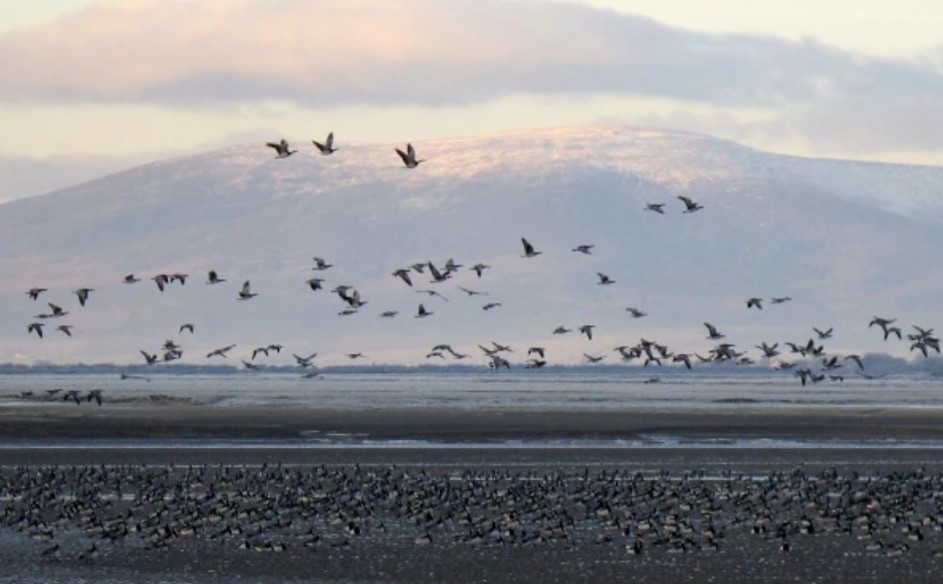
In news that will come as no surprise whatsoever, a new study has revealed that toxic lead ammunition is still being used widely to shoot birds in coastal intertidal and riparian habitats across Scotland, even though its use was banned in these habitats 18 years ago.

Photo: Brian Morrell, WWT

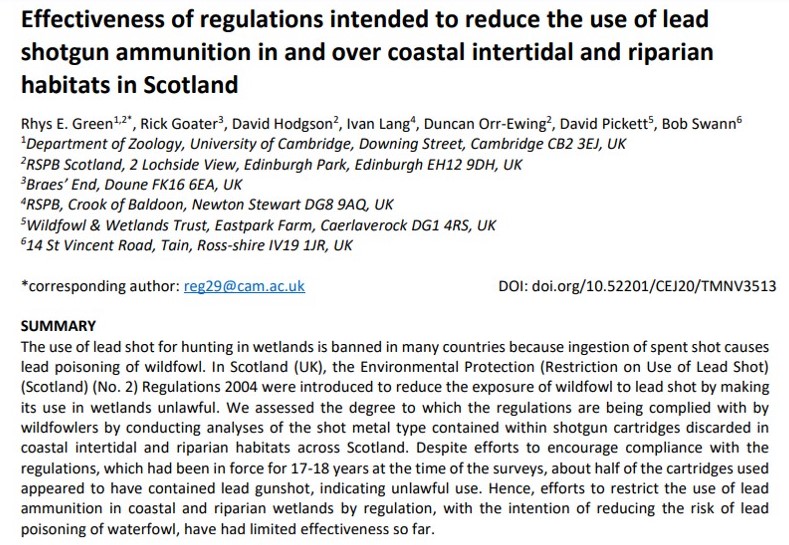
The new study, which has just been published in the journal Conservation Evidence, analysed discarded shotgun cartridges at various wetland locations and found that approximately half appeared to contain lead shot, which hasn’t been permitted for use over Scottish wetlands since 2005.

The ban on using lead shotgun ammunition over wetlands was introduced to try and reduce the amount of lead poisoning in wetland birds and the subsequent poisoning of predators that might scavenge the shot birds, particularly certain raptor species (e.g. see here and here).

Here’s the summary of the study (full paper available at the foot of this blog):

Similar legislation (with slight variations) was introduced in England in 1999 after a voluntary ban on the use of lead shotgun ammunition over wetlands failed.

However, a number of studies since that new legislation was introduced (see here) have shown high levels of non-compliance with the law, for example 68% non-compliance in 2001-2002; 70% non-compliance with the law in 2008-2009 & 2009-2010; and 77-82% non-compliance with the law in 2013-2014.

Another study published in 2021 concluded that since the regulations were introduced in England in 1999, an estimated 13 million ducks have been shot illegally using lead shotgun ammunition, with an annual average of approximately 586,000 ducks, representing approximately 70% of the total ducks shot (see here).

Tellingly, this 2015 paper that included the findings of a questionnaire survey of shooters’ behaviour and attitudes revealed that one of the main reasons for non-compliance with the law was the shooters believed they “were not going to get caught” i.e. shooters knew that using lead ammunition would not involve penalties as the law is not enforced. This is a really common feature of wildlife crime in general, but particularly raptor persecution crimes, which I’ve written about before (e.g. here). It doesn’t matter how stiff the penalty is, if the offender thinks there’s little to no chance of being caught then it’s worth the risk of committing the crime.

The 13 million illegally shot ducks also provide an excellent example of why it’s idiotic to calculate the extent of a crime based on the number of convictions (as Professor Simon Denny tried to do in his recent ‘truly objective‘ claim that raptor persecution isn’t a widespread issue on grouse moors – see here). If we classify every one of those shot ducks as a separate crime, there has only ever been one successful prosecution out of a potential 13 million crimes (and that prosecution only happened because the offender shot a swan in front of witnesses, mistaking it for a goose whilst on a pheasant shoot in North Yorkshire). One conviction from 13 million crimes demonstrates quite clearly that a lack of prosecutions / convictions does not equate to a lack of crime!

It’s an important lesson for the Scottish Parliament as it considers the Wildlife Management and Muirburn (Scotland) Bill – if there is insufficient monitoring and enforcement accompanying the new legislation on grouse moor management practices, the offenders will continue to commit their crimes (i.e. killing birds of prey and lighting fires on deep peat) because they’ll know the chances of being caught are pretty slim.

The Westminster Government is currently considering a range of options for phasing out the use of lead ammunition (see here), after ignoring the overwhelming scientific evidence for years and instead choosing to support the shooting industry’s (then) refusal to get rid of toxic lead ammunition (e.g. see here and here).

Three years ago some (but not all) in the game-shooting industry realised the game was up and proclaimed a five-year voluntary phase-out of toxic lead ammunition (largely, I believe, because they didn’t want to have a ban enforced upon them). However, three years into that five-year phase out, things aren’t going too well (see here) and many UK supermarkets are still selling poisonous game meat to unsuspecting customers for both human consumption (here) and for pet food (here).

The HSE is due to report its recommendations about the use of toxic lead ammunition to Government by 6th November 2023. DEFRA Minister Richard Benyon told Green peer Natalie Bennett recently that the DEFRA Secretary of State ‘will be required to make a decision within three months of receipt of the opinions, with the consent of Welsh & Scottish Ministers‘ (see here).

Anything less than an immediate ban on the use of toxic lead ammunition for killing any species in any habitat (not just some species in some wetland habitats), will be challenged.

Here’s the full paper on the significant non-compliance of the law by shooters in Scotland, who are still using toxic lead shotgun ammunition to kill birds over wetlands, 18 years after it was banned. Well worth a read:

UPDATE 13th September 2023: Is DEFRA can-kicking the decision to phase out use of toxic lead ammunition by gamebird shooters? (here)

Police in Derbyshire charge man for alleged disturbance of Peregrine nest & theft of eggs

Derbyshire Constabulary posted the following statement on social media yesterday:

A suspect from Matlock has been charged with taking eggs of a Schedule 1 wild bird and disturbing the nesting site of a Schedule 1 wild bird following an incident at a Peregrine falcon nesting site at Bolsover, Derbyshire in April 2023. The suspect will appear at North East Derbyshire and Dales Magistrates Court in October“.

Peregrine falcon. Photo: Ben Hall, RSPB Images

There is further commentary on Derbyshire Constabulary social media where the individual is named as Christopher Wheeldon of Lime Grove, Darley Dale, Matlock. The 34-year-old has apparently been released on bail and is due to appear at Chesterfield Justice Centre on 16th October 2023.

PLEASE NOTE: As this is a live court case comments won’t be accepted until criminal proceedings have concluded. Thanks for your understanding.

UPDATE 16th October 2023: Man fails to attend court to face charges of alleged peregrine egg theft in Derbyshire (here)

UPDATE 22nd November 2023: Case adjourned for Christopher Wheeldon accused of alleged peregrine egg theft in Derbyshire (here)

UPDATE 16 January 2024: Derbyshire ‘drug addict’ jailed for stealing peregrine eggs (here)

Man in court accused of shooting & killing a goshawk at pheasant-rearing farm

A court hearing was adjourned this week in the case of a man accused of shooting and killing a goshawk at his pheasant-rearing farm in Wales.

Photo: Mike Warburton

Thomas Edward Jones, 38, is alleged to have shot and killed a goshawk at Pentre Farm in northern Powys in July 2022 where tens of thousands of pheasants are reportedly reared for the game shooting industry.

Appearing at Welshpool Magistrates Court on Tuesday 5th September, Jones confirmed his name, age and address but did not enter a plea.

The case will continue on 19th September 2023.

PLEASE NOTE: As this is a live court case comments won’t be accepted until criminal proceedings have concluded. Thanks for your understanding.

UPDATE 21 September 2023: Trial date set for man charged with killing goshawk at pheasant-rearing farm (here)

UPDATE 23 November 2023: New trial date for man accused of shooting & killing goshawk at pheasant-rearing farm (here)

UPDATE 7 December 2023: Trial discontinued for man accused of killing goshawk at pheasant-rearing farm in Wales (here)

Minister admits DEFRA is clueless about over-stocked duck ponds for shooting

In July I published a photo of a vegetation-free mud pit, ridiculously over-stocked with semi-tame reared ducks that were being fed with sack loads of barley to keep them at the pond so that paying clients can turn up from 1st September and blast them to smithereens for a bit of a laugh (here).

An over-stocked duck pond in the Scottish Borders. Photo supplied by a blog reader

I argued that the shooting of semi-tame ducks for ‘fun’ in the UK hasn’t attracted as much attention as pheasant and partridge shooting, probably due to the numbers (and thus environmental impact) involved (i.e. an estimated 60+ million non-native pheasants & partridges released annually in the UK compared with a vaguely estimated 3 million native mallards) but that it definitely deserves more scrutiny, especially in this avian-flu era.

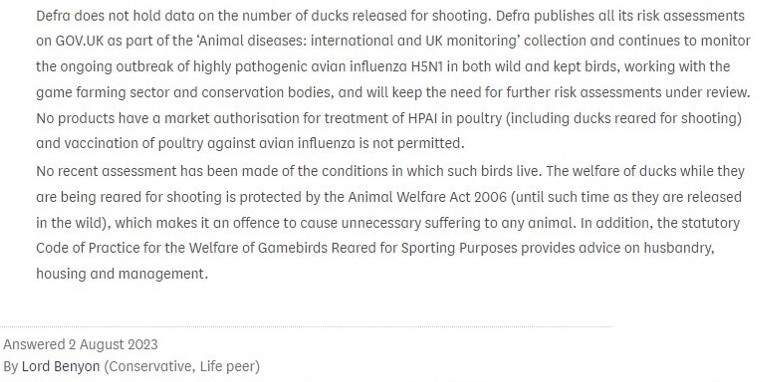
Many thanks to Green Peer Natalie Bennett who read the blog and submitted a Parliamentary Question on this issue:

It was answered by DEFRA Minister (and gamebird shooter) Richard Benyon as follows:

What a surprise (not) to learn that DEFRA doesn’t have a clue how many ducks are reared and released for shooting, nor the conditions in which they live before being shot to pieces.

It doesn’t look like he has any plans to recommend a review, either.

Marvellous. There’s nothing quite like having a Minister with vested interests, is there?

The Future Landscapes Forum & its links to driven grouse shooting

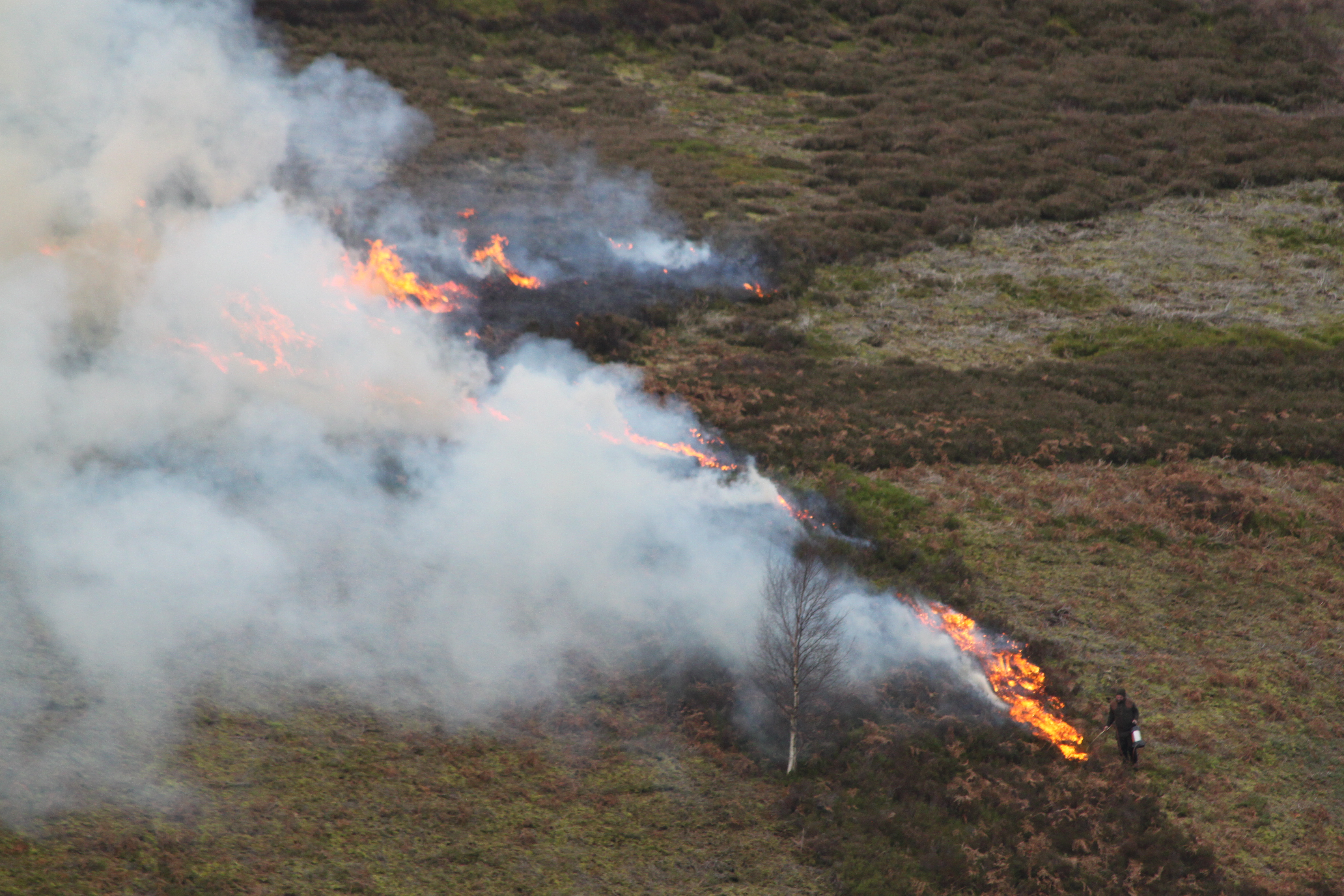
A couple of weeks ago I received an invitation to attend the launch of a new report on ‘controlled burning’ in the uplands, by a group I’d never heard of – the Future Landscapes Forum. By ‘controlled burning’ I assumed they meant muirburn, the deliberate setting fire to heather moorland to boost the number of red grouse available for shooting.

Gamekeepers setting fire to a grouse moor to increase red grouse stocks for shooting. Photo: Ruth Tingay

I didn’t attend the launch (and I’ll explain why below) but I was curious about this newly-formed group – who are they, what are they doing, who funds them, and what links, if any, do they have to driven grouse shooting?

The name of the new group, the Future Landscapes Forum (FLF), is pretty benign and pretty vague; it doesn’t provide much of a clue about who might be involved. So I googled it and found the FLF website, which helpfully names the five individuals involved, all of whom have played a role, of varying degrees, in defending various elements of grouse moor management but particularly muirburn:

Professor Andreas Heinemeyer (Associate Professor, York University)

Dr Mark Ashby (Ecology & Conservation Teaching Fellow, Keele University)

Professor James Crabbe (Professor of Biochemistry, University of Bedfordshire; Supernumerary Fellow of Wolfson College, Oxford University; Visiting Professor at the University of Reading and at Beijing Normal University at Zhuhai in China)

Professor Simon Denny (formerly Director of Enterprise, Development and Social Impact, University of Northampton [retired])

Professor Rob Marrs (Emeritus Professor of Applied Plant Biology, University of Liverpool & Past President of the Heather Trust)

The FLF website states that ‘many‘ of the five have ‘conducted key research and published a considerable body of recent peer-reviewed science and assessments pertaining to this important habitat‘ [heather dominated landscapes]. Some of them have, for sure, and some of that has been funded by the grouse shooting industry.

The FLF website goes on to include a section called, ‘Why are we speaking out?‘ which states the following:

As a group of leading scientists and practitioners in upland management and socio-ecological impacts, we have growing concerns that the public and policy debate about managing heather moorland is neither properly informed nor evidence-based.

Indeed, there seems to be a concerted effort to derail an evidence-based approach and sound future policy by certain influential organisations and individuals who ignore or distort evidence, often present unevidenced arguments, or deploy arguments based on selective elements of scientific papers and reports that support their position.

Such arguments are often reductive, lack context and are presented wrongly as the scientific consensus.

We believe that debate and, increasingly, decisions about upland management have become polarised and overly focused on a single issue: driven grouse shooting. Our view is that this focus is wrong and dangerous.

Our concerns are not related to habitat management for grouse; indeed, we would be making this position statement if grouse, and grouse shooting, did not exist“.

It’s interesting that the FLF criticises some of the debate about upland management because it ‘lacks context‘ as some of the FLF team’s own work has received similar criticism (e.g. see here, here, here, here, here, here) but has often been used by the grouse shooting lobbyists as showing ‘scientific consensus‘. The scientists can’t be held responsible for how the grouse shooting lobby interprets their scientific research, but it seems unlikely that they’d be unaware of how it was being presented.

Even Natural England describes a recent piece of work by Heinemeyer comparing heather burning with mowing or uncut management approaches (published in early 2023) as being “widely reported as justifying the ongoing use of burning management” but that it is “best seen as an outlier in the range of scientific studies relevant to management of blanket bog“. (I’ll write a separate blog about that because it’s too much to include here).

It’s also worth noting that two of the FLF team (Prof Heinemeyer and Prof Marrs) have both featured in videos pushed out by the various Regional Moorland Groups as part of their propaganda campaigns to promote grouse moor management. They’re entitled to contribute to such output, of course, but visitors to the FLF website may not be aware of this, given FLF’s efforts to distance itself from driven grouse shooting interests.

It’s also worth noting that two other members of the FLF team (grouse-shooter Prof Denny & Prof Crabbe) only recently published a report (a hopelessly biased one, in my view) on so-called sustainable driven grouse shooting, a report described as ‘truly objective’ and timed to make the headlines during the Inglorious 12th. The report was commissioned (and presumably funded?) by the Regional Moorland Groups. Say no more.

Incidentally, that Denny & Crabbe report was reportedly ‘peer reviewed by three academics from UK universities‘ but strangely, they weren’t named. It wasn’t Heinemeyer, Ashby & Marrs, by any chance?

I think it’s disingenuous of the FLF to distance itself from the driven grouse shooting debate, for all the reasons I’ve provided above but also because upland management for driven grouse shooting (specifically, muirburn) lies at the very heart of the climate emergency and the UK’s response to it. We’re not talking about the odd little fire here and there – we’re talking about the widespread, deliberate burning of heather on the UK’s carbon-storing peatlands across vast areas of the British uplands -let’s not pretend that there’s nothing to see here.

The focus is very much on driven grouse shooting and for very good reason. Indeed, it’s why the Scottish Government is about to licence muirburn as part of its Wildlife Management & Muirburn (Scotland) Bill, designed to regulate grouse moor management after years of inertia. I see the FLF’s position statement on controlled burning has featured in The Scotsman today, no doubt timed to coincide with the Scottish Parliament’s ongoing scrutiny of the Bill.

I couldn’t find any information on the FLF website about who is funding this group. The five members may be funding it themselves of course, but I do wonder about the Moorland Communities Tradition Ltd, who incidentally appear to have a new Director, one Andrew Gilruth, formerly of GWCT (and ironically, given FLF’s statement, well known for cherry picking and distorting evidence) and now working as the Chair of the Regional Moorland Groups.

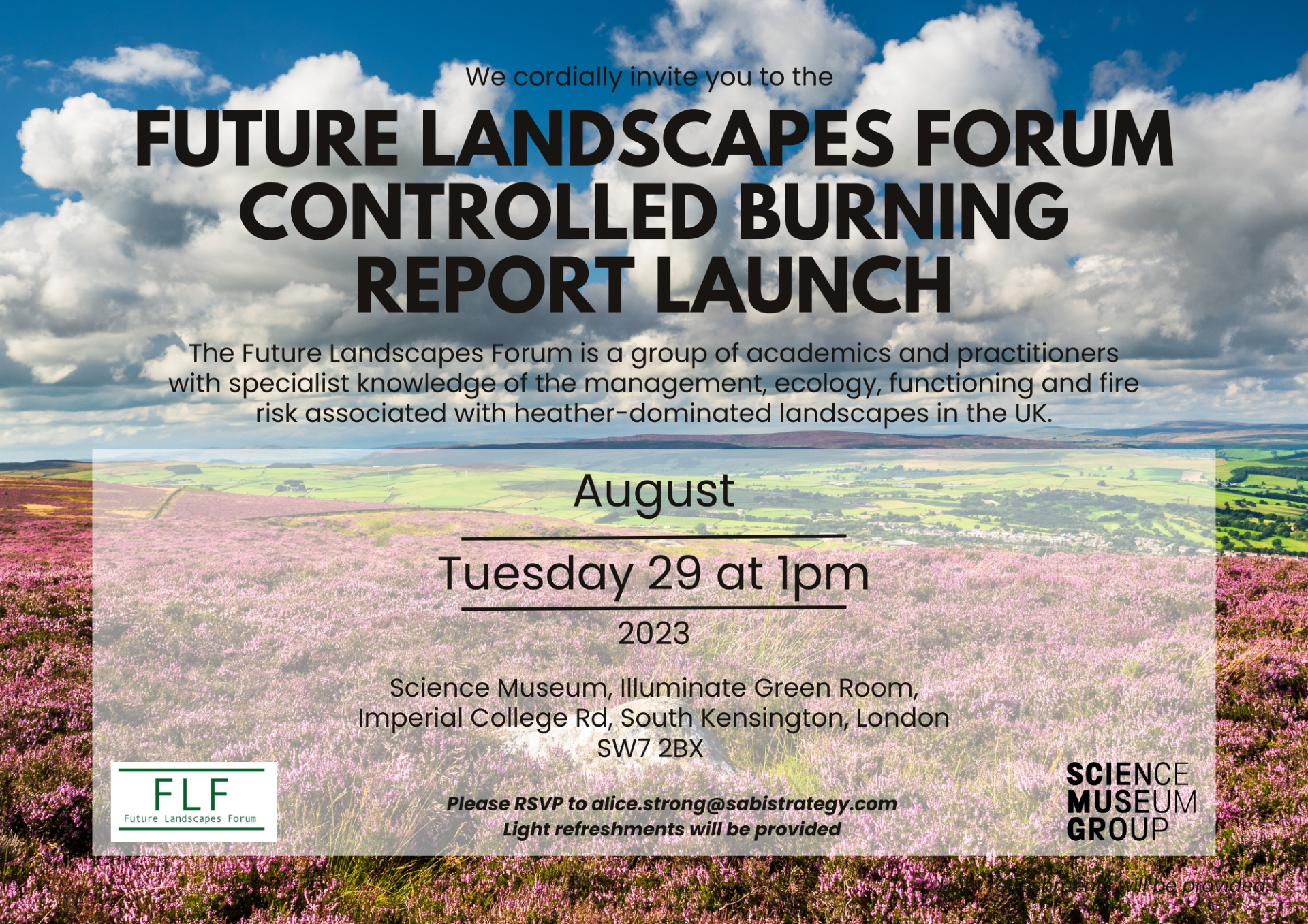
I said at the beginning of this piece that I decided not to accept the invitation from FLF to their launch event last week. And here’s why. Take a look at the invitation they sent out and pay attention to the RSVP address:

Sabi Strategy. Hmm. Where have we heard that name before? Ah yes, the slick London PR agency that’s been linked to promoting the foul and aggressive output of the pro-grouse shooting astroturfing group, C4PMC (here).

Is it a coincidence that this PR agency is also working for FLF? Perhaps, but of all the PR agencies available that FLF could have hired, it strikes me as being an unlikely coincidence.

In writing this piece I’m not advocating that the upland research undertaken by the FLF team be simply dismissed – some (but not all) members of this group are indeed experts in this field and their findings are of interest to the ongoing debate on upland management – but let’s not pretend that there aren’t also links to the driven grouse shooting industry.