Three more satellite-tagged hen harriers ‘vanish’ on driven grouse moors, all within 6 days of the start of the grouse-shooting season

Press release from RSPB (18th August 2023)

THREE MORE SATELLITE-TAGGED HEN HARRIERS VANISH ON DRIVEN GROUSE MOORS, ALL WITHIN DAYS OF THE ‘GLORIOUS 12TH’

  • Three satellite tagged Hen Harriers have disappeared on private driven grouse moors in Northern England between August 9th and August 15th.
  • All three birds were fitted with a satellite tag, which regularly transmit data, allowing their movements to be monitored.
  • Two birds had fledged recently on the United Utilities Bowland Estate, and the third was a one-year-old female from the National Trust for Scotland Estate at Mar Lodge.

Three satellite-tracked Hen Harriers have suddenly disappeared over land managed for driven grouse shooting. All three disappearances have happened within days of the Glorious Twelfth, the official start of the shooting season for Red Grouse, and a time where grouse numbers are managed to be at their peak level to ensure a successful shooting season.

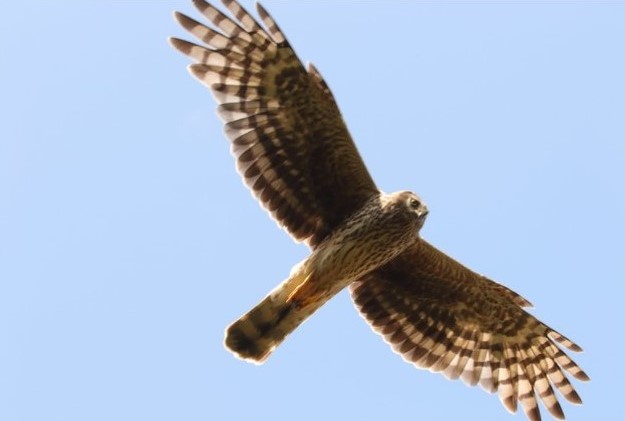
Hen Harriers are a rare, protected species, known for their acrobatic ‘skydancing’ courtship display over the uplands. The Hen Harrier is categorised as a red listed species in the UK, due to its low population levels.

Hen harrier. Photo: Ian Poxton

Martha was a one-year-old female Hen Harrier. She was tagged as a chick at Mar Lodge, a National Trust for Scotland estate in Aberdeenshire in the spring of 2022. The satellite tracking data shows that Martha moved into Northumberland in early August 2023 and gave her last transmission from Westburnhope Moor near Hexham, in the North Pennines on 9 August 2023.

Selena was a juvenile female tagged on United Utilities land in Bowland in the spring of this year. Her satellite tag showed that she had just moved to the Yorkshire Dales before her last transmission from Mossdale Moor near Hawes, in the Yorkshire Dales on 11August 2023.

Hepit was another young female Hen Harrier. She had also been tagged as a chick on United Utilities land in Bowland this year, before moving to the Yorkshire Dales last month. Hepit’s last transmission came from moorland at Birkdale Common near Kirkby Stephen, on 15 August 2023 – an area where 9 other satellite-tagged Hen Harriers have vanished or been found dead with injuries consistent with persecution since September 2020.

Despite being legally protected, multiple studies and reports confirm that illegal killing is the main factor limiting the recovery of Hen Harrier in the UK, causing a reduction in nesting success, annual productivity and survival of breeding females. A recent RSPB Centre for Conservation Science study which investigated the illegal killing of satelite-tagged Hen Harriers in association with gamebird management (Ewing, et al 2023) has shown that the survival rates of Hen Harriers in the UK is “unusually low” with birds surviving for just 121 days after fledging. Human persecution accounted for 27-41% of deaths on Hen Harriers aged under one year and 75% of deaths in birds aged between one and two years.  It also highlighted a strong overlap between Hen Harrier mortality and the extent of grouse moors.

Sadly, although this pattern of satellite tagged birds disappearing around the start of the Red Grouse shooting season has been seen before, the RSPB have never had a case of three satellite-tagged Hen Harriers going missing within six days.

Beccy Speight, RSPB Chief Executive said – “This is the first time so many hen harriers have gone missing in such a short space of time, all on driven grouse moors. This is on top of the 21 birds that we reported on in April, as having gone missing in the last twelve months. If these magnificent birds are ever going to have a sustainable population in England this has to stop, productivity from nests simply means nothing if the birds don’t survive.

We call on the UK Government to introduce a licencing system for grouse shooting in England similar to measures now being taken forward in Scotland, to act as a meaningful deterrent to raptor crime whilst also protecting the legitimate interests of those landowners who operate legally.”

All three incidents have been reported to the police and the NWCU (National Wildlife Crime Unit). Sadly, there are several other Hen Harrier persecution incidents that we cannot report on at this time.

If you notice a dead or injured bird of prey in suspicious circumstances, call the police on 101 and fill in the RSPB’s online reporting form: https://www.rspb.org.uk/birds-and-wildlife/advice/wild-bird-crime-report-form/

If you have information about anyone killing birds of prey which you wish to report anonymously, call the RSPB’s confidential Raptor Crime Hotline on 0300 999 0101.

ENDS

These latest three victims mean that at least 101 hen harriers have gone ‘missing’ / been killed illegally in the UK since 2018, most of them on or close to driven grouse moors. I’ll update the list shortly.

It’s clear from the statement in the RSPB press release, ‘Sadly, there are several other Hen Harrier persecution incidents that we cannot report on at this time‘, that there are multiple other cases of missing/killed hen harriers still to be publicised, no doubt delayed by certain police forces not doing their jobs.

It’s interesting to see the RSPB take the decision not to wait before publicising these latest three incidents. All three have been reported to the police, quite rightly, but given the appalling track record of both North Yorkshire Police and Northumbria Police in dealing with investigations into suspected raptor persecution crimes, there seems little point in waiting anymore. In fact I’d go as far to say that there should be independent inquiries into the mishandling of investigations into raptor persecution crimes by these two police forces. Some of their latest failures are yet to be reported but some are already in the public domain (e.g. here, here, here).

UPDATE 11.40hrs: 101 hen harriers confirmed ‘missing’ or illegally killed in UK since 2018, most of them on or close to grouse moors (here).
Killing the Skydancer: episode three of the Guardian podcast investigating the illegal killing of raptors on grouse moors

The third and final episode of the Guardian’s mini podcast series investigating the illegal killing of birds of prey on grouse moors has been released this morning.

For those who missed episode one click here, and episode two click here.

Hen harrier. Photo: Ian Poxton

In episode three, journalist Phoebe has a conversation with a cagey-sounding Sgt Mark Earnshaw of North Yorkshire Police’s Rural Crime Team, who reveals that the police investigation into the stamping to death of those hen harrier chicks in a nest on a Whernside estate last year did not include interviewing local gamekeepers or the land owner. WTF?!

Phoebe also says she finally tracked down the name of the estate where the crime had taken place and an estate spokesperson told her, ‘At no point had the estate been informed that the nest was located on their land, or that this incident had taken place’.

I find this hard to believe given what we learned from episode two – that Natural England couldn’t/wouldn’t go on to estates without the landowner’s permission, let alone set up a video camera on site to monitor the nest.

It’s all very bizarre and unsatisfactory, and as usual reeks of cover-ups and collusion.

Episode three of the podcast can be heard here.

Hunt saboteurs out for a third day on Yorkshire grouse moors

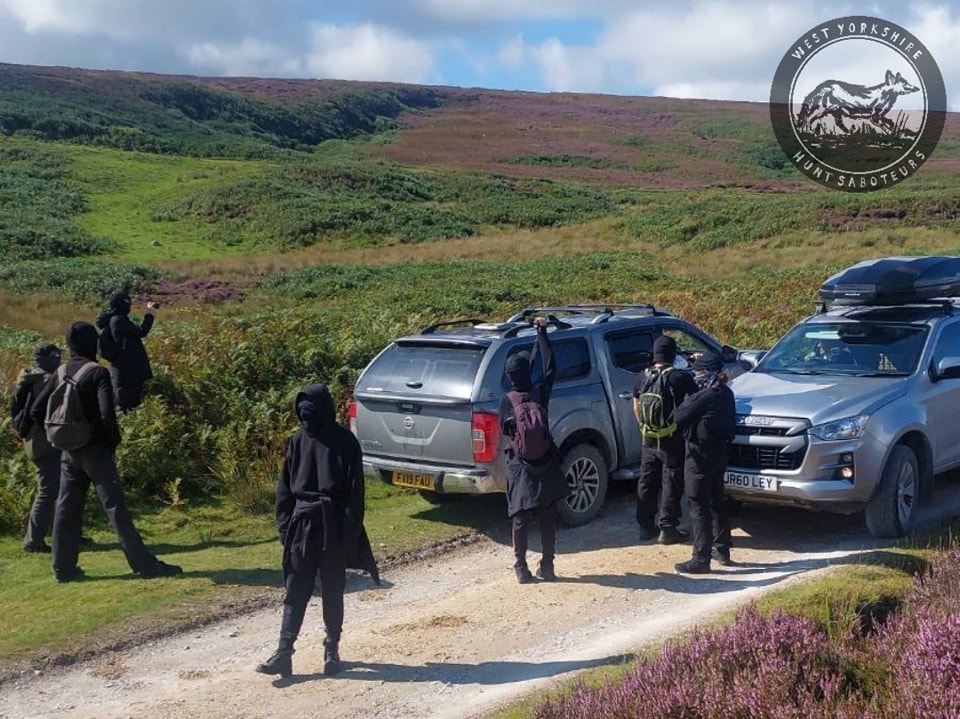
The Hunt Saboteurs were out for a third day yesterday and stopped a grouse shoot on Barden Moor on the Bolton Abbey Estate.

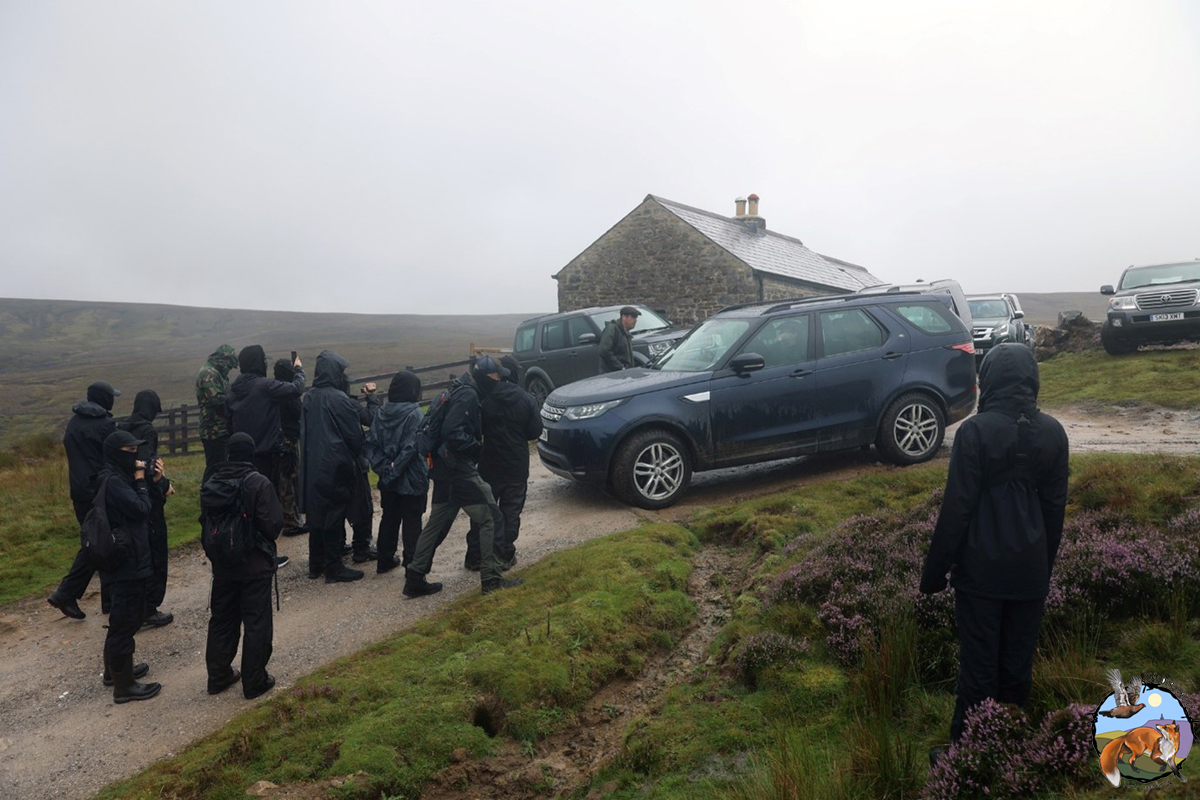
Hunt Saboteurs block shoot vehicles on Bolton Abbey Estate. Photo: West Yorkshire Hunt Saboteurs

This follows their work stopping grouse shoots on Saturday 12th Aug (here) and Monday 13th (here), all in Yorkshire.

BASC ‘forgets’ to mention evidence showing no difference between penetration level of lead vs steel shot in ‘game meat’

Well this is interesting, and I’d say pretty embarrassing for BASC (British Association for Shooting & Conservation).

Cast your mind back to April 2023 when I blogged (here) about how BASC’s CEO Ian Bell had written to the lead author of a scientific paper that had just been published by Cambridge University researchers, that had found that 94% of pheasants on sale in the UK for human consumption were killed using toxic lead ammunition.

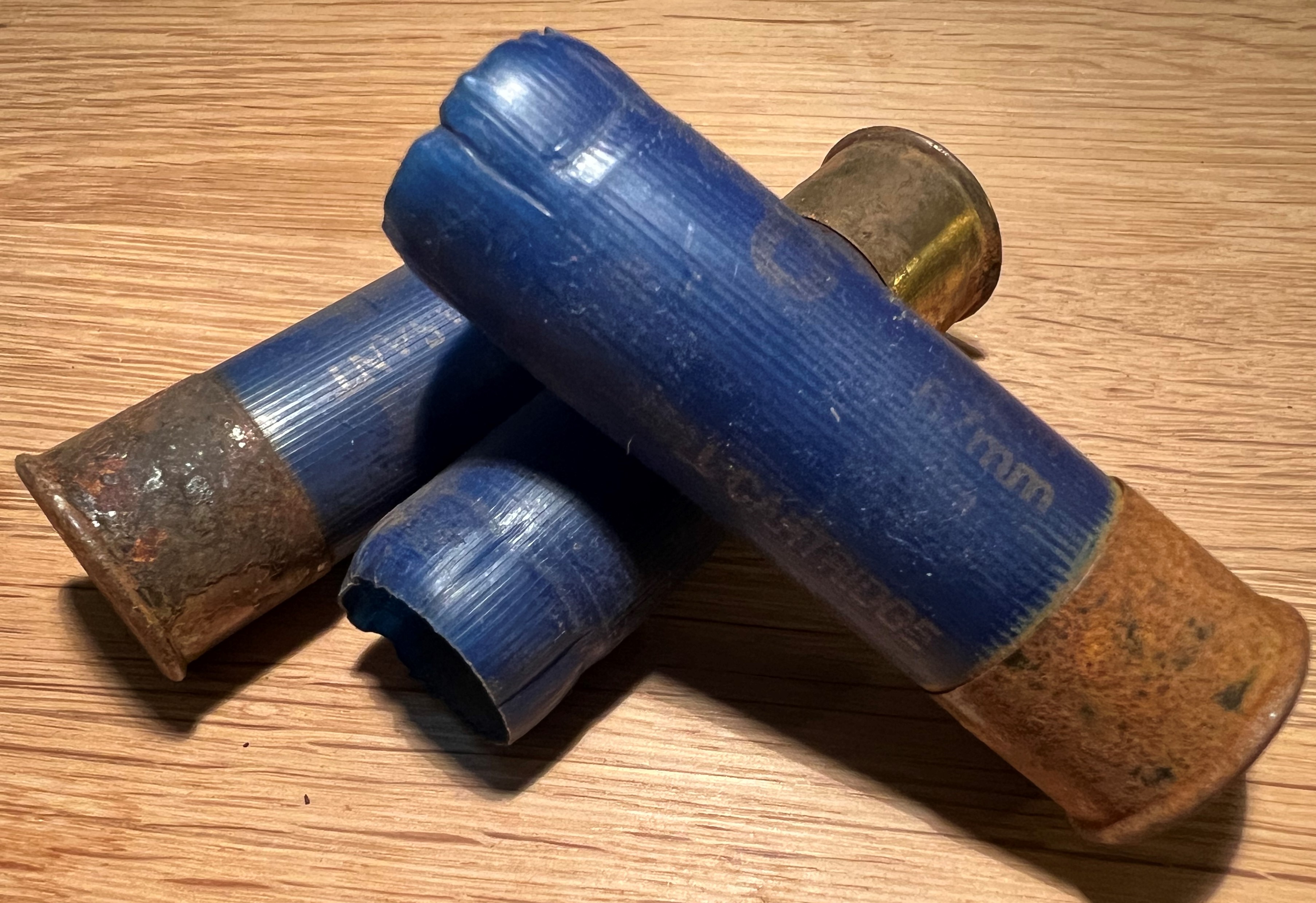
Spent shotgun cartridges. Photo: Ruth Tingay

The paper in question was the third scientific paper published by the ‘SHOT-SWITCH‘ group, which was established in 2020 to monitor the shooting industry’s professed voluntary five-year transition from toxic lead to non-lead ammunition in the UK. The paper exposed the shooting industry’s appalling lack of progress on its much-heralded ‘voluntary transition’.

Mr Ian Bell wrote to Professor Rhys Green (Cambridge University) in March 2023 to express his “significant concerns” about the accuracy of the paper’s conclusions.

In addition, another BASC employee, Dr Conor O’Gorman, went further and wrote an unpleasant article published on BASC’s website where he slurred the SHOT-SWITCH research as “pseudoscience“.

You may recall that Professor Green wrote back to Ian Bell in April 2023 and responded, point by point, to BASC’s “significant concerns” and basically blew them all out of the water (no pun intended).

However, there’s since been a further response from Professor Green that’s been published on the SHOT-SWITCH project website (here). It turns out that after responding to Ian Bell, the SHOT-SWITCH team came across some additional research that they hadn’t included in their scientific paper because they’d previously been unaware of its existence.

Guess what that additional research was?

It was a study of what happens when you fire lead shot and steel shot into ballistic gel. The properties of ballistic gel mimic those of game tissue. This study was done by ballistics experts at Cranfield University and it showed that there was no difference between lead and steel in the extent to which they penetrate the gel, even when the gel block was covered by a pheasant skin to assess the effect of feathers/skin in reducing the depth of penetration.

This finding runs counter to the assertion by Ian Bell in his letter to Professor Green about his “significant concerns” that knowledgeable experts thought that steel shot were more likely to pass through pheasants than lead shot, which (he thought) would make the SHOT-SWITCH results wrong.

And guess who commissioned the Cranfield University study?

Yep, it was BASC.

And guess when that BASC-funded study was completed?

3rd August 2021.

That’s 20 months BEFORE Ian Bell wrote to Professor Green in March 2023, contesting the findings of the SHOT-SWITCH study.

Was Ian Bell ignorant of the findings of the BASC-funded study when he wrote to criticise the findings of the SHOT-SWITCH study? That would seem unlikely, given he’s the BASC CEO who presumably knows what studies BASC has commissioned/funded. Had he simply forgotten about the findings of the study that BASC funded? Or, was he well aware of the findings but just hopeful that the results would never see the light of day? Who knows. It may have been a genuine oversight but surely one of his team has since explained the BASC-funded findings to him, and how they actually support the findings of the SHOT-SWITCH study, and that BASC now owes the SHOT-SWITCH team an apology for slurring their work as “pseudoscience“?

You can read the latest response from the SHOT-SWITCH researchers to Ian Bell’s “significant concerns“, which provides more detail about how this recently-uncovered, BASC-funded research, further demonstrates that BASC’s criticisms are unfounded, and that’s being kind (see pages 3-5 below).

Many thanks to the blog reader who pointed out this latest update to me.

JOB OPPORTUNITY: Assistant ecologist, white-tailed eagle reintroduction project

FORESTRY ENGLAND : WHITE-TAILED EAGLE REINTRODUCTION PROJECT

SALARY: £26,534

SIX MONTH CONTRACT

CLOSING DATE: 3rd September 2023

JOB SUMMARY:

South England Forest District manages some 46,000 hectares of the public forest estate across West Sussex, Surrey, Berkshire, Hampshire, Isle of Wight, Dorset & South Wiltshire.  Much of the land is of high importance for nature conservation, supporting some 29,000 hectares (ha) deemed to be of national importance for wildlife of which approximately 28,000 ha are also designated as being of international importance for biodiversity as Special Areas of Conservation (SACs), Special Protection Areas (SPAs) and Ramsar sites. The majority of the land managed by the District is also within areas designated for their landscape value, including 4,000 ha within AONBs and 31,500 ha across two National Parks.

The White-tailed Eagle project is a partnership with the Roy Dennis Wildlife Foundation, to reintroduce this species back to the south coast of England. The project has a Natural England licence to release birds over a 5-year programme, which started in 2019.

The Assistant Ecologist will be assisting the Project Officer in all areas of their work, from engagement with groups and stakeholders about the project to management and care for the birds prior to release. They will also have a role to play in monitoring the birds that are already released. This is an exciting 6 month role to gain valuable experience in reintroductions.

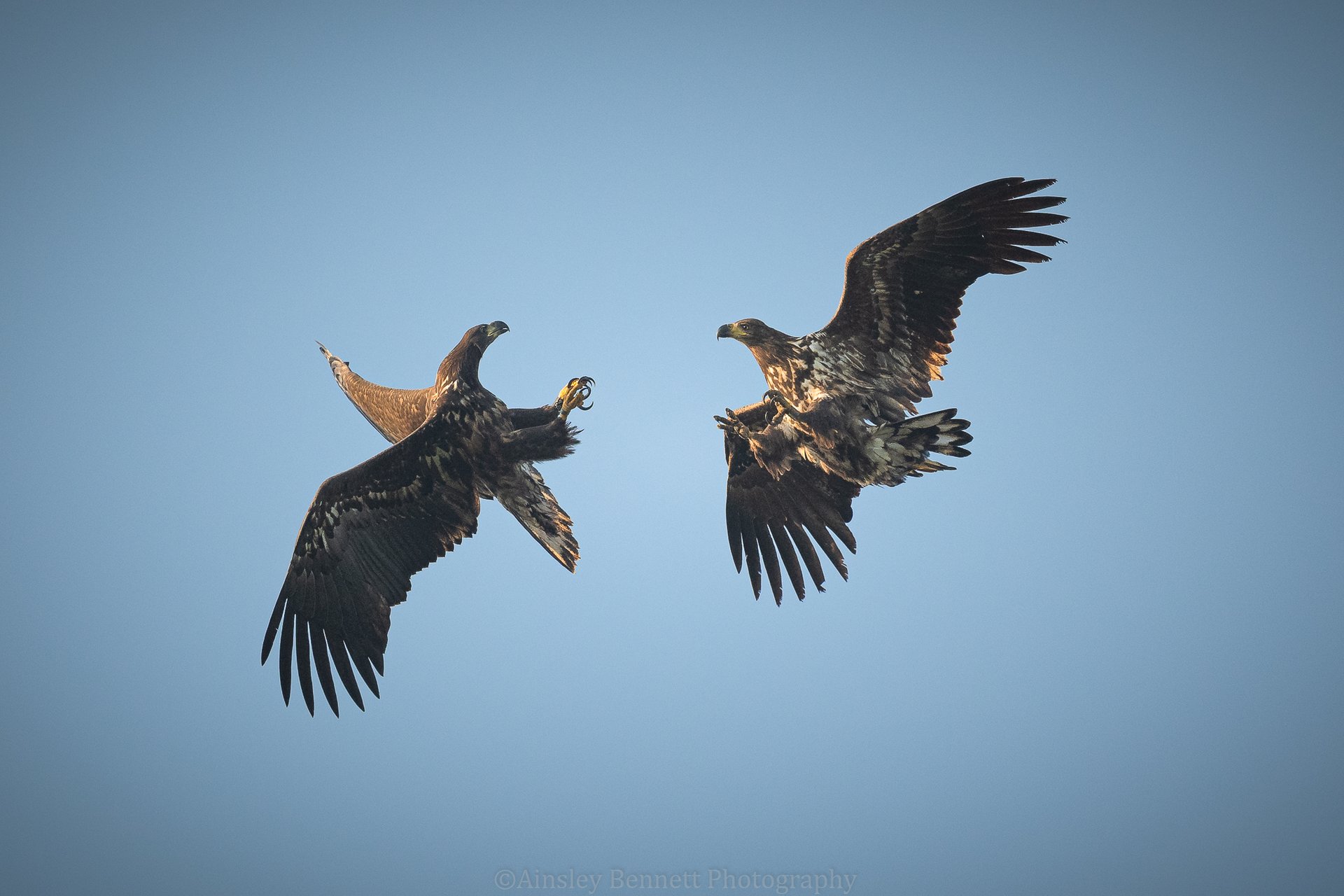
Two of the young reintroduced white-tailed eagles. Photo: Ainsley Bennett

JOB DESCRIPTION:

Key Work Areas

  • The post holder will help to deliver the reintroduction process, including feeding of the birds and monitoring pre and post release.
  • They will support the Project Officer with information dissemination via a project website, social media and a programme of guided walks and talks.
  • Liaise with stakeholders both on the Isle of Wight and on the mainland to ensure the success of the project.
  • The post holder will be local to the Isle of Wight so that they can be on hand during the period when the birds are in cages at the release location and during post-release feeding.

PERSON SPECIFICATION:

Essential

  • A good understanding of raptor ecology with on the ground practical experience.
  • Experience or knowledge of monitoring birds in the field.

Desirable

  • Preferably experience of working on a similar reintroduction project.
  • Experience of working with landowners.
  • Ability to demonstrate engagement with the public and local groups.

As part of the application process we will assess you on the following behaviours:

Making Effective Decisions

  • Speak with the relevant people in order to obtain the most accurate information and get advice when unsure of how to proceed.

Communicating and influencing

  • Actively listens, allowing others to fully express their opinion.
  • Be an effective representative of the team.

Working Together

  • Build, maintain and improve relationships with different stakeholders at the relevant level to understand differing views and issues.

Seeing the Big Picture

  • Focus on the overall goal and intent of what you are trying to achieve, not just the task.
  • Ability to communicate the wider context of the project to others.

For further details and information on how to apply, please click here.

Killing the Skydancer: episode two of the Guardian podcast investigating the illegal killing of raptors on grouse moors

Episode two of the Guardian’s mini podcast series investigating the illegal killing of birds of prey on grouse moors has been released this morning.

For those who missed episode one, please click here.

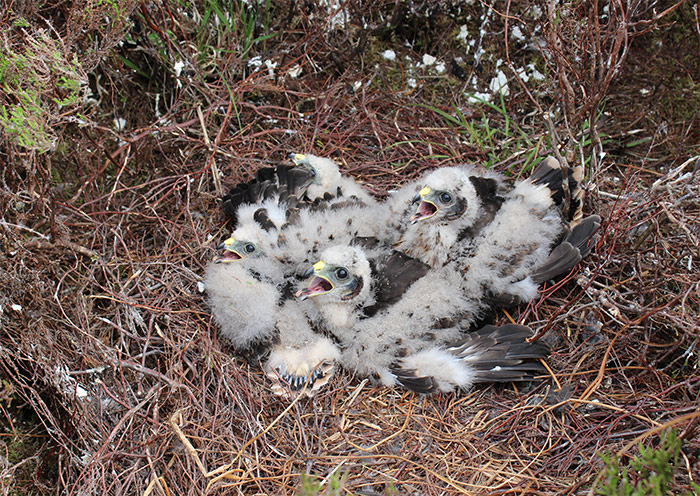
Hen harrier chicks. Photo: Ian Newton

In episode two, journalist Phoebe travels to the Yorkshire Dales National Park in an effort to try and see the location of the nest where an entire brood of hen harrier chicks had been stamped to death the previous year.

She talks a lot about the great big wall of silence about the case, especially from Natural England – many of you will recognise the frustrating lack of accountability and transparency.

She interviews a couple of RSPB investigators and then finally gets an interview with Stephen Murphy from Natural England, who apparently had to be accompanied by a minder from DEFRA. Stephen apparently believes that there’s been “a reduction in the intensity of persecution and the hen harriers are prospering from that…”. Really, Stephen? Jesus Christ. 98 missing/dead hen harriers since 2018 suggests otherwise (here).

There’s also a report of a discussion Phoebe had with John Holmes, NE’s Director of Strategy, who apparently doesn’t see any conflict of interest in Natural England receiving an £85K ‘donation‘ from BASC, with an attached clause that prevents NE from saying anything untoward about BASC and hen harriers.

The episode ends with Phoebe chatting to a cafe owner named Alan, who happens to be a grouse shooter and seems unable to be able to contain his hatred of Chris Packham.

Listen to Episode two here.

UPDATE 17th August 2023: Link to third & final episode here.

REVIVE: the coalition for grouse moor reform – tickets for national conference now on sale

REVIVE, the coalition for grouse moor reform is hosting its biggest ever national conference at the Perth Concert Hall on Sunday 12th November 2023.

The conference will be hosted once again by REVIVE supporter Chris Packham and there’ll be speakers from REVIVE’s member organisations (Common Weal, Friends of the Earth Scotland, League Against Cruel Sports, OneKind and Raptor Persecution UK) as well as significant guest speakers from across the political, conservation and land reform sector.

The full programme will be published shortly but booking is now open – please click here to secure your place!

To find out more about REVIVE, please visit the website here.

Hunt Saboteurs stop another grouse shoot in Yorkshire

Further to the news on Saturday when Hunt Saboteurs from across the country gathered in Yorkshire to stop three grouse shoots on the Inglorious 12th (here), they’ve been back out again.

Photo: Calder Valley Hunt Sabs

In atrocious weather conditions they went back to Nidderdale yesterday and disrupted one of the same shoots they’d visited on Saturday.

Further details available on the Hunt Sabs website here.

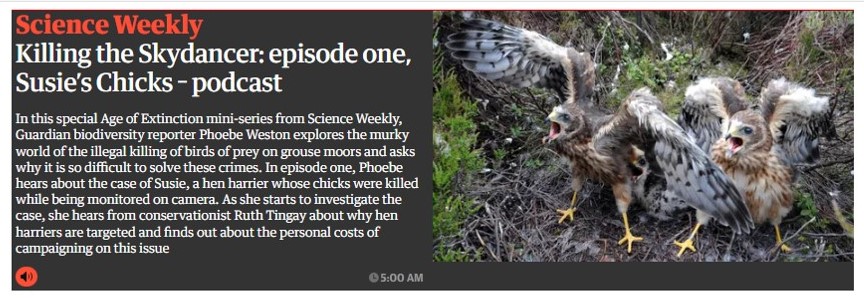
Killing the Skydancer – new podcast from the Guardian about raptor persecution on grouse moors

The Guardian has just released the first episode in a mini-series podcast it has produced called ‘Killing the Skydancer‘, which centres on the illegal killing of birds of prey on driven grouse moors.

Episode one introduces Phoebe Weston (Guardian journalist) who read an article on this blog about how a brood of hen harrier chicks were stamped to death in their nest on a Whernside grouse moor in the Yorkshire Dales National Park last year (see here).

Phoebe was so horrified by the story she says she couldn’t stop thinking about it and it led her to want to find out more. This podcast series is the result of her investigation as she travelled to the Peak District and the Yorkshire Dales to look for hen harriers and to interview some people from both the conservation sector and the grouse shooting industry.

Episodes two and three will be out tomorrow and Thursday.

The link to listen to episode one (21 mins) is HERE

UPDATE 16th Aug 2023: Episode two is here.

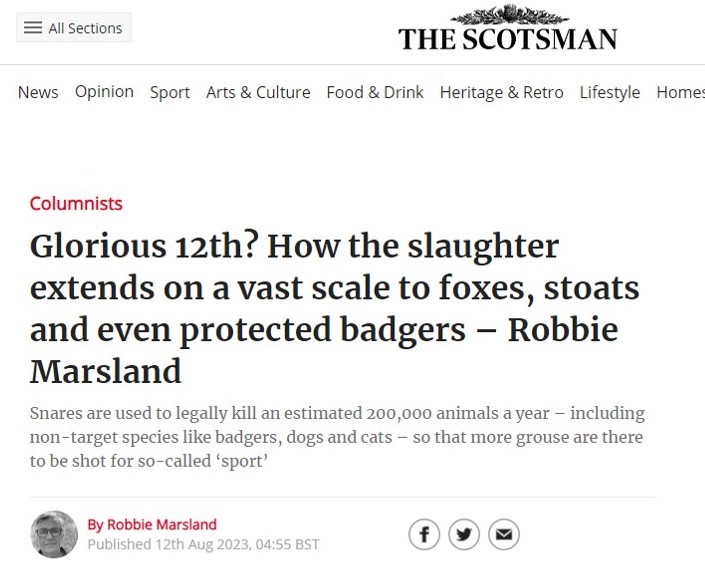
Glorious 12th? How the slaughter extends on a vast scale to foxes, stoats and even protected badgers: opinion piece by Robbie Marsland

Another opinion piece by a member of REVIVE, the coalition for grouse moor reform, was published over the weekend, this time in the Scotsman and written by Robbie Marsland, Director of League Against Cruel Sports Scotland.

It’s reproduced here:

Snares are used to legally kill an estimated 200,000 animals a year – including non-target species like badgers, dogs and cats – so that more grouse are there to be shot for so-called ‘sport’.

A thin loop of steel wire sits in an entrance to a mound of rotting animals. It’s a snare set to capture foxes drawn to the smell of what is known as a “stink pit”. Despite being cruel, primitive and indiscriminate, snares are currently legal in Scotland.

In theory, foxes are simply detained by the snares and wait peacefully for up to 24 hours for a gamekeeper to arrive and shoot them with a shotgun. In theory. In practice, foxes struggle and mutilate themselves as the wire cuts into their flesh.

Snares are laid on animal pathways as well as around stink pits. This means that any animal using the pathways or attracted by the smell of carrion can get caught by these indiscriminate devices. Badgers, which are protected species, are trapped in snares so often that there’s a name for the distinctive area of flattened ground around a snare made by their death throes. It’s called a “doughnut”. Cats and dogs are also common victims of these pernicious implements.

So why are snares still legal? For years, the League Against Cruel Sports and our friends at animal welfare charity OneKind have been calling for them to be consigned to history. Scotland has to some extent led the way in that it was the first part of the UK to regulate their use. But that lead has now gone with the Welsh Government recently announcing an outright ban on snares – the first UK nation to take this step.

The Scottish Government has the opportunity to catch up with the Welsh example. The Wildlife Management and Muirburn Bill currently approaching the end of its first stage in parliament provides the government with a vehicle to ban the use of snares. The government has acknowledged this and says that it will announce whether they intend to ban snares or not in the next couple of months.

One of the main reasons that foxes are targeted by these horrific devices is to make sure there are more grouse to be shot for sport. The ‘glorious’ 12th of August is the beginning of the grouse shooting season that goes on until December. But the killing of any animal that is thought to reduce the number of grouse goes on all year round.

A 14-month League Against Cruel Sports study of seven shooting estates in Scotland revealed the use of a massive array of traps and snares aimed at foxes, stoats, weasels and crows. Judging by what was found, we estimate more than 200,000 animals are killed on all Scottish shooting estates each year. The survey also revealed that just under 40 per cent of the dead animals found in traps were “non-target” species like badgers, cats and dogs, or even hedgehogs, that do no harm to grouse.

As the Wildlife Management and Muirburn Bill is debated in the Scottish Parliament over the coming months, the League Against Cruel Sports looks forward to snares being banned and questions being asked about the ethics of killing hundreds of thousands of animals killed each year to ensure there are more grouse to be shot for so-called “sport”.

Robbie Marsland is director of the League Against Cruel Sports Scotland

ENDS