
Here are some more parliamentary questions relating to the Westminster Government’s failure to effectively tackle raptor persecution, this time submitted by Ruth Jones MP (Labour, Shadow Minister at DEFRA).
The following four questions were lodged on 1st March 2023:
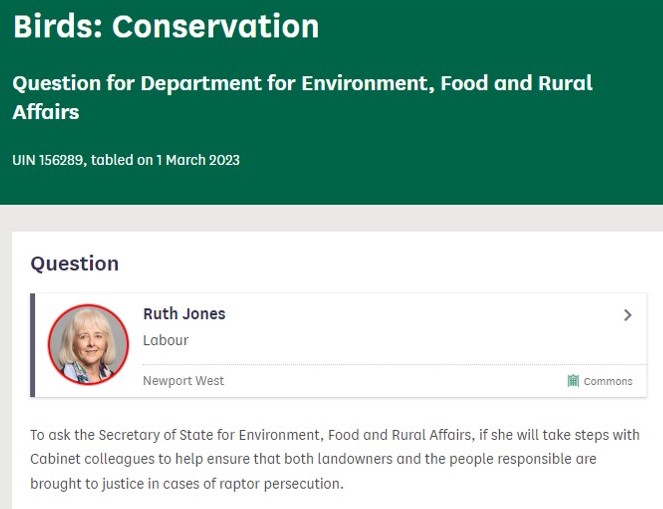
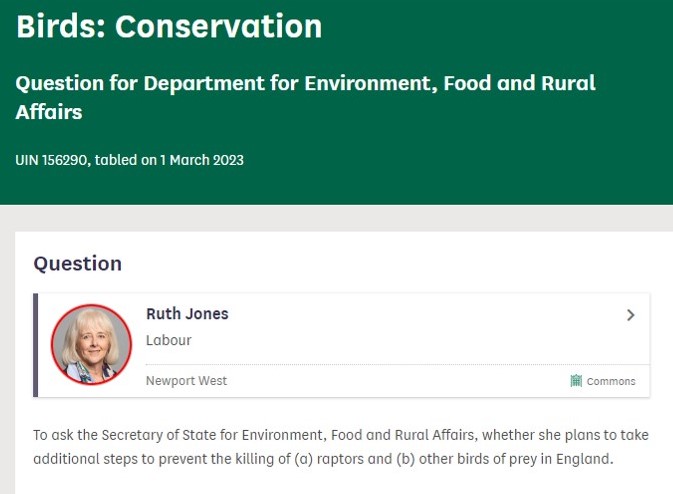
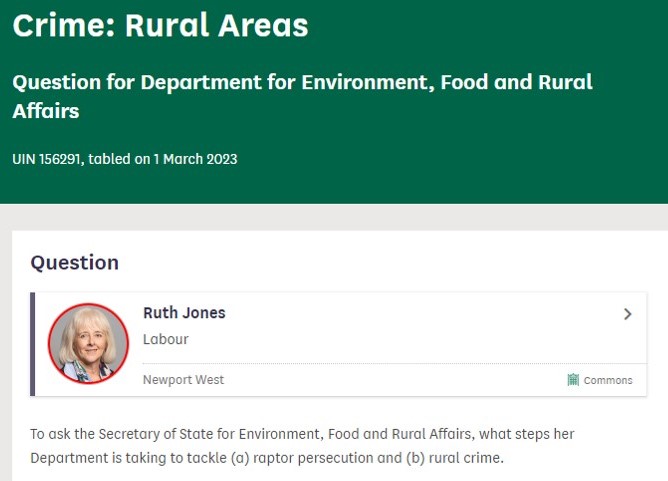

There’s a fair bit of overlap with these four questions but I’m not going to criticise Ruth Jones for tabling them in this format. On the contrary, I’m delighted to see a Shadow Minister making an effort on this subject and applying pressure on DEFRA.
Is it significant that there’s been a recent flurry of parliamentary questions about raptor persecution? I like to think so.
Ruth Jones’s written questions were answered on 9th March 2023 by Trudy Harrison, the Parliamentary Under Secretary of State in DEFRA, as follows:
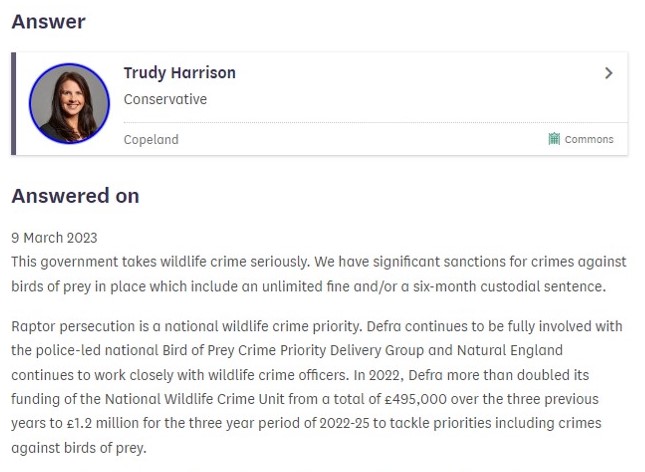
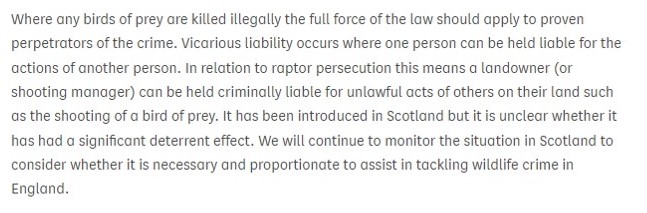
This response is predictably lame and amounts to nothing more than paper-shuffling by DEFRA. In fact, I reckon DEFRA has a folder where stock phrases are kept and hauled out each and every time there’s a question about why the Westminster Government is failing so badly when it comes to tackling raptor persecution.
Many of the sentences in Trudy Harrison’s response are pretty much carbon-copies of those given by Environment Minister Rebecca Pow in September 2021 (here), those given by DEFRA Minister Richard Benyon in February 2022 (here), those given by Rebecca Pow in February 2022 (here), those given by Richard Benyon in April 2022 (here), and those given by Trudy Harrison earlier this month (here).
Once more, for the record:
Harrison/DEFRA says: “This government takes wildlife crime seriously“.
Does it? The evidence suggests not.
Harrison/DEFRA says: “We have significant sanctions for crimes against birds of prey in place which include an unlimited fine and/or a six-month custodial sentence“.
Indeed, these sanctions are in place but there has only ever been one custodial sentence handed down to a raptor-killer – and that was in Scotland in 2015 when gamekeeper George Mutch was given a four-month custodial sentence for crimes he committed in 2012 (here). There haven’t been any others since then, and a custodial sentence has never been handed down in England, Wales or Northern Ireland for raptor persecution crime.
Harrison/DEFRA says: “Raptor persecution is a national wildlife crime priority“.
On paper, yes. In reality, no. Raptor persecution was identified as a national wildlife crime priority in 2009. That’s 14 years ago, and hundreds of birds of prey have been illegally killed in the UK since then.
Harrison/DEFRA says: “Defra continues to be fully involved with the police-led national Bird of Prey Crime Priority Delivery Group“.
This so-called Priority Delivery Group has been in place since 2011 and has delivered absolutely nothing of meaningful effect since then, largely due to the fact it is dominated by pro-shooting organisations who have a stranglehold on any progress that could have /should have been made. In my view, it’s a partnership sham, designed to look as though efforts are being made to effectively tackle illegal raptor persecution in England and Wales (see here).
Harrison/DEFRA says: “Natural England continues to work closely with wildlife crime officers“.
Yes, and in recent years NE has been involved with a number of multi-agency raids. Good. However, NE also ‘partners’ with the grouse-shooting industry, facilitating DEFRA’s ludicrous hen harrier brood meddling scheme, designed to placate the very industry responsible for this species’ persecution and subsequent catastrophic decline.
Harrison/DEFRA says: “[Vicarious liability] has been introduced in Scotland but it is unclear whether it has had a significant deterrent effect. We will continue to monitor the situation in Scotland to consider whether it is necessary and proportionate to assist in tackling wildlife crime in England“.
Vicarious liability has been in place in Scotland for 11 years. The recent UN report on UK wildlife crime made a recommendation that vicarious liability be introduced without delay in England and Wales. What does DEFRA have to lose by introducing it south of the Border?
 Raptor Persecution UK
“Is it significant that there’s been a recent flurry of parliamentary questions about raptor persecution? I like to think so.”
It is rather extraordinary. The art of asking awkward questions is to avoid generalisations, but to be specific about the lack of progress over the years. For that, the sort of stats provide by Raptor Persecution UK are required.
And then to keep asking the same awkward question after every death, or infraction…
It doesnt appear that DEFFRA finds these questions awkward.
As the industry proves time and time again, there are no deterrents.
Licencing and tough custodial sentences or we will continue to have these conversations into the next century.
“It doesnt appear that DEFFRA finds these questions awkward.”
Quite. They were generalisations… (Perhaps just laying the ground for later, more damning and more specific interventions…? Time will tell…)
The introduction and rigorous application of vicarious liability is the key. Scotland has it but seems disinclined to enforce it. Other countries in the UK fail on all counts. A good parallel is the fine handed out to a company that fails in its duty of care in any area. If the business offends and that includes employees then a fine must be imposed on them corporately. This embarrasses and dissuades. Shoots are businesses and thus liable. I do not understand why this is not universally applied, but then I am no legal eagle! However, the presence of a dead raptor does not constitute a crime committed by the landowner, and is very hard to prove. But as this blog ably demonstrates there are plenty of other areas where crimes can be proven. I believe vicarious is central to finding a solution. If Wild Justice et al launch a petition I would certainly support it, and if it results in a Westminster debate we have a start.
“I do not understand why this is not universally applied, but then I am no legal eagle!”
Vicarious liability implies that an employer is responsible for, and has control over, an employee in their work, and is negligent in carrying out that responsibility or exercising that control.
Proving that in court is difficult without the employee’s damning testimony. And would such an employee find another such job very easily?
“This government takes wildlife crime seriously“.
Really? I don’t think so. It is the same old, same old lame excuses put out by this government who has done nothing to help stop these terrible crimes against our raptors.
They will do, and continue doing, nothing. They really aren’t interested or bothered one iota.
Their interests seem to lie more with the moors owners and protecting them it would seem.
Well done to Ruth Jones. I hope she continues to ask these very same questions until positive answers are given with actual proof of the government and DEFRA actually doing something with their significant sanctions actually put in place on a regular basis against offenders.
We certainly can’t rely on Thérèse Coffey MP, Secretary of State for Environment, Food and Rural Affairs, doing anything to help in any way
“Well done to Ruth Jones”
Why didn’t Ruth Jones suggest what should be done – besides just asking for the introduction of vicarious liability (which has not worked in Scotland)?
Is Ruth Jones aware that vicarious liability has not worked in Scotland? If she is, why ask for that, alone? If she is not aware, why not?
Just asking the Government what steps they are taking regarding raptor persecution (and rural crime) is simply asking for the Minister to merely repeat the enacted list of non-working legislation (which she duly did:-(
Why didn’t she, instead, ask the Minister why instances of raptor persecution and successful convictions is running at considerably more than ten to one? Does that not get to the nub of the problem? Surely she would want to know what the Government thought about how that statistic relates to their policies?
Or, she could have been even more dramatic and concentrated on Hen Harriers and asked why the instances of persecution and successful convictions are running at more than one hundred to one?
But she choose to let Defra off lightly, in my opinion.