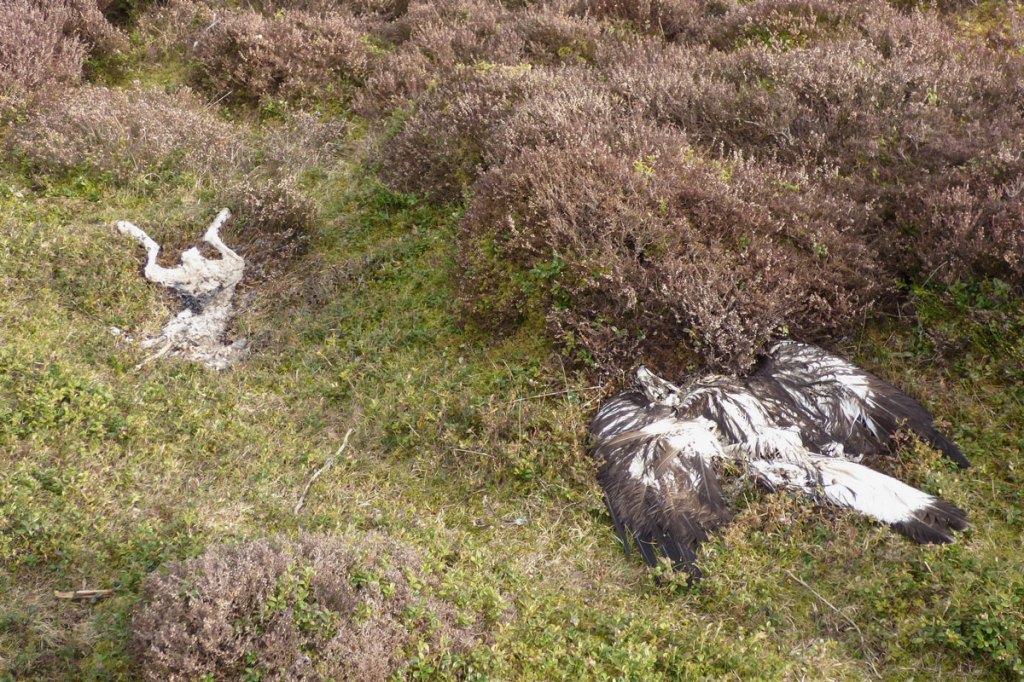
In March last year a dead golden eagle was found face-down on a grouse moor on Invercauld Estate in the Cairngorms National Park. It had been ‘deliberately’ poisoned with a banned substance, according to Police Scotland, and two poisoned baits were found close-by (see here).
[The poisoned golden eagle, next to a poisoned hare bait. Photo by RSPB Scotland]
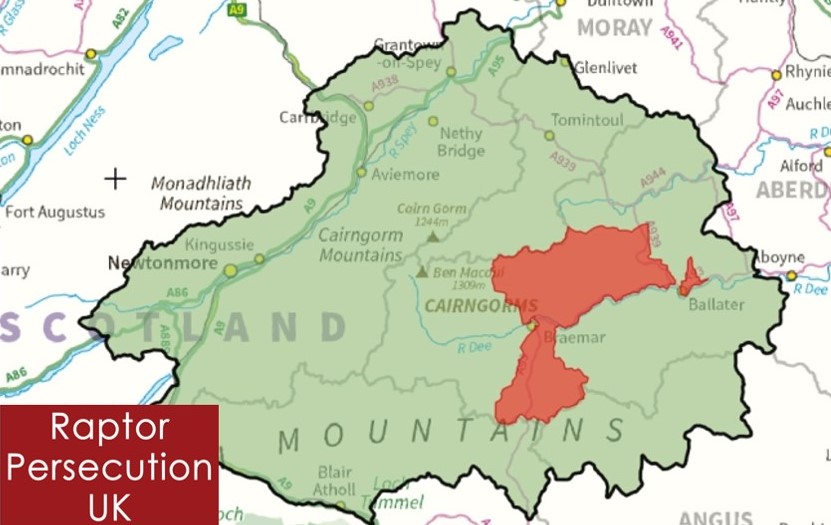
[Invercauld Estate inside the Cairngorms National Park. Boundary data from Andy Wightman’s Who Owns Scotland website]
Today, 11 months after the grim discovery, the Scottish Government’s statutory nature conservation agency NatureScot has imposed a three-year General Licence restriction on part of Invercauld Estate. Here’s the press release:
General Licence restricted on Cairngorms Estate
NatureScot has restricted the use of general licences on part of the Invercauld Estate in the Cairngorms National Park.
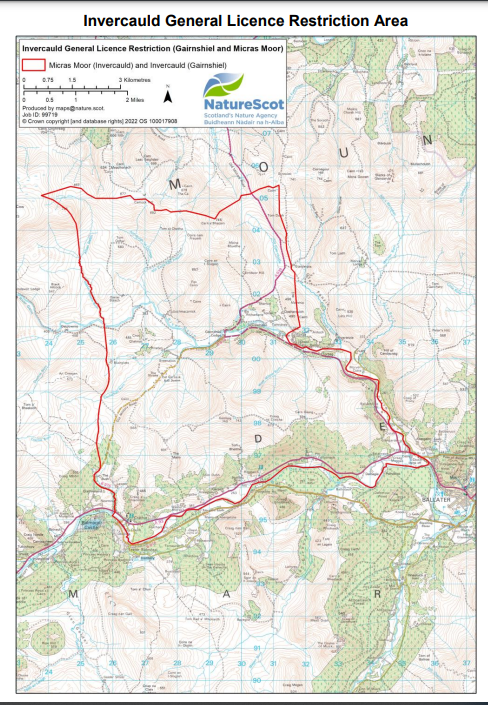
The decision was made on the basis of evidence provided by Police Scotland of wildlife crime against birds. This evidence included a poisoned golden eagle found on the estate in March 2021, along with a rabbit and a hare carcass, both baited with poison. The restriction will apply to the Gairnshiel and Micras moor on the estate, where the evidence of poisoning was found.
Donald Fraser, NatureScot’s Head of Wildlife Management, said: ““These poisoning incidents are appalling and an act of animal cruelty. The indiscriminate use of poisons is not only lethal to our iconic Scottish wildlife, but can also pose a serious health risk to people and domestic animals that come into contact with it.
“We are committed to using all the tools we have available to tackle wildlife crime. In this case, there is clear evidence of criminal behaviour. Because of this, and the risk of more wildlife crimes taking place, we have suspended the use of general licences on this property for three years. They may still apply for individual licences, but these will be closely monitored.
“This measure will help to protect wild birds in the area, while still allowing necessary land management activities to take place, although under tighter supervision. We believe this is a proportionate response to protect wild birds in the area and prevent further wildlife crime.
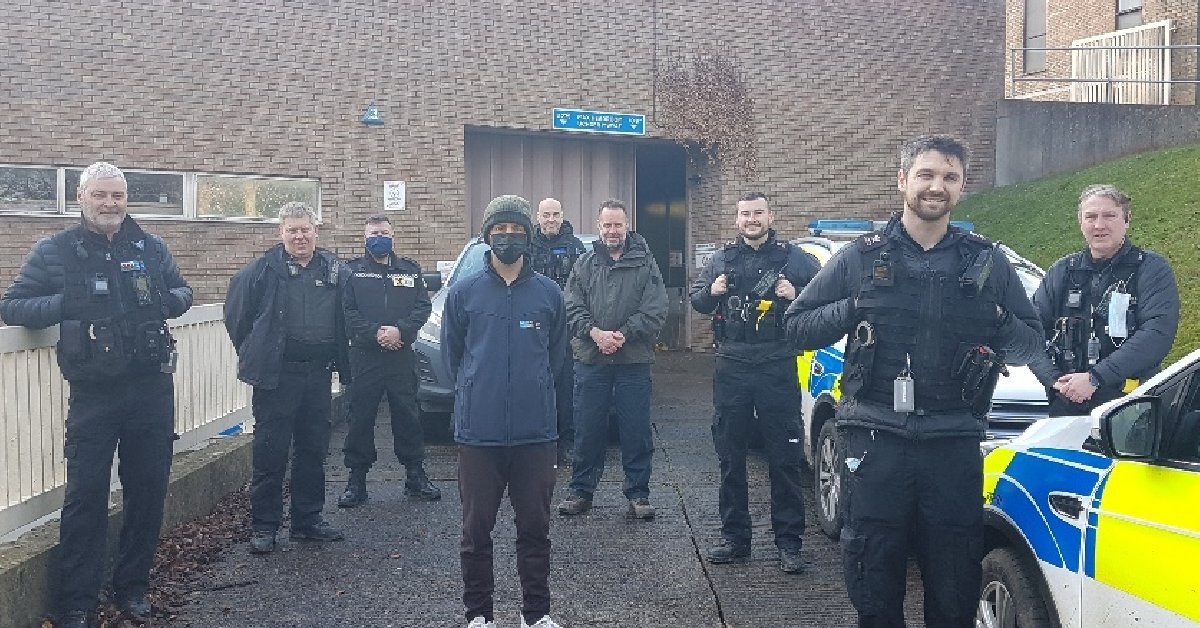
“We work closely with Police Scotland and will continue to consider information they provide on cases which may warrant restricting general licences. The detection of wildlife crime can be difficult, but this is the third time in recent months when we have restricted use of general licences on the basis of evidence of crime taking place. New and emerging technologies, along with a commitment from a range of partners to take a collective approach to these issues, will help us stop wildlife crime.”
General licences allow landowners or land managers to carry out control of common species of wild birds, such as crows and magpies, to protect crops or livestock, without the need to apply for an individual licence.
ENDS
Here is the map showing the restricted areas on Invercauld Estate. The restriction applies from 9th February 2022 to 9th February 2025.
This has been a long time coming for this estate. I wrote about it in May 2021 (here) and I’ll repeat it here.
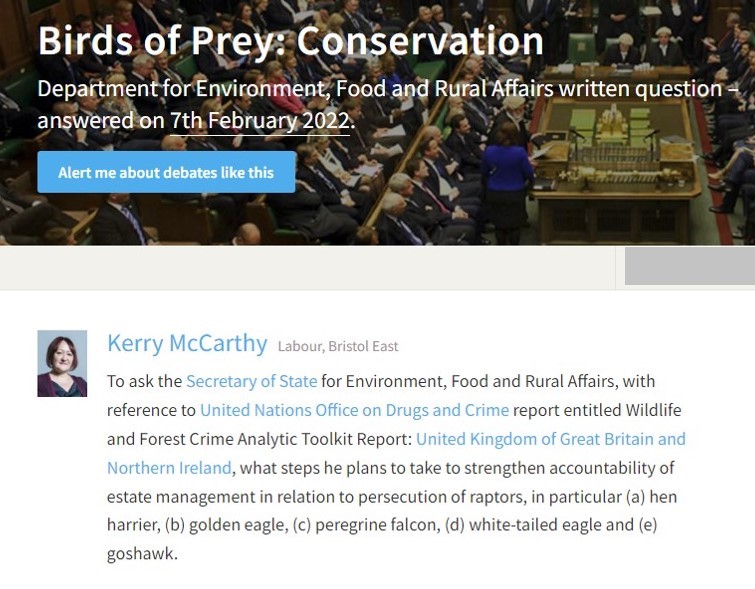
Invercauld Estate and the surrounding area has been at the centre of many alleged wildlife crimes over the years, including the discovery of three poisoned buzzards on the estate in 2005 (here), the discovery of a poisoned red kite at the Spittal of Glenshee on Invercauld Estate in January 2007 according to former police wildlife crime officer Alan Stewart (in litt. 9 Feb 2022), the discovery of an illegally shot peregrine at the Pass of Ballater in 2011, the reported coordinated hunt and subsequent shooting of an adult hen harrier at Glen Gairn on the border of Invercauld and Dinnet Estates in 2013, the illegally-set traps that were found near Geallaig Hill on Invercauld Estate in 2016, the suspicious disappearance of satellite-tagged hen harrier Calluna ‘on a grouse moor a few miles north of Ballater’ on 12 August 2017, the opening day of the grouse shooting season (here) although it’s not clear whether this was on Invercauld Estate or neighbouring Dinnet Estate, the suspicious disappearance of satellite-tagged white-tailed eagle ‘Blue T’ on Invercauld Estate in May 2018 (see here), the suspicious disappearance of satellite-tagged hen harrier Stelmaria ‘last recorded on grouse moor a few miles north west of Ballater, Aberdeenshire on 3rd September 2018 (see here), the discovery of a golden eagle flying around the area with a spring trap attached to its foot in August 2019 (here), the suspicious disappearance of satellite-tagged hen harrier (Wildland 2) on Invercauld Estate on 24 September 2019 (here) and the discovery of a deliberately poisoned golden eagle and poisonous baits on a grouse moor on Invercauld Estate in March 2021 (see here).
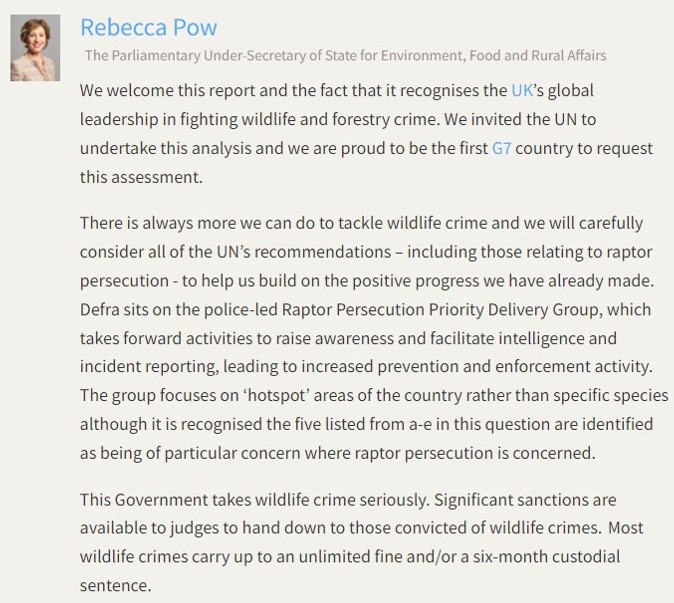
I’m pleased to see this restriction finally imposed on Invercauld, although I’d much rather have seen a series of criminal prosecutions. The restriction will have very little material affect on the game-shooting activities on Invercauld because the estate can simply apply for an individual licence allowing it to continue its activities as if no ‘clear evidence of criminal behaviour’ has been uncovered (more on that ridiculous situation shortly) but it does mean the estate’s reputation is damaged and it also means this can be used to apply pressure on organisations such as Scottish Land & Estates and the Scottish Gamekeepers Association, who both claim to have a zero tolerance of raptor persecution.
Will Invercauld Estate and its gamekeepers remain members of these two organisations?
UPDATE 7th April 2022: Invercauld Estate in Cairngorms National Park loses appeal against General Licence restriction imposed for wildlife crime (here)







 Raptor Persecution UK