
Police investigating Swinton Estate for alleged hen harrier disturbance

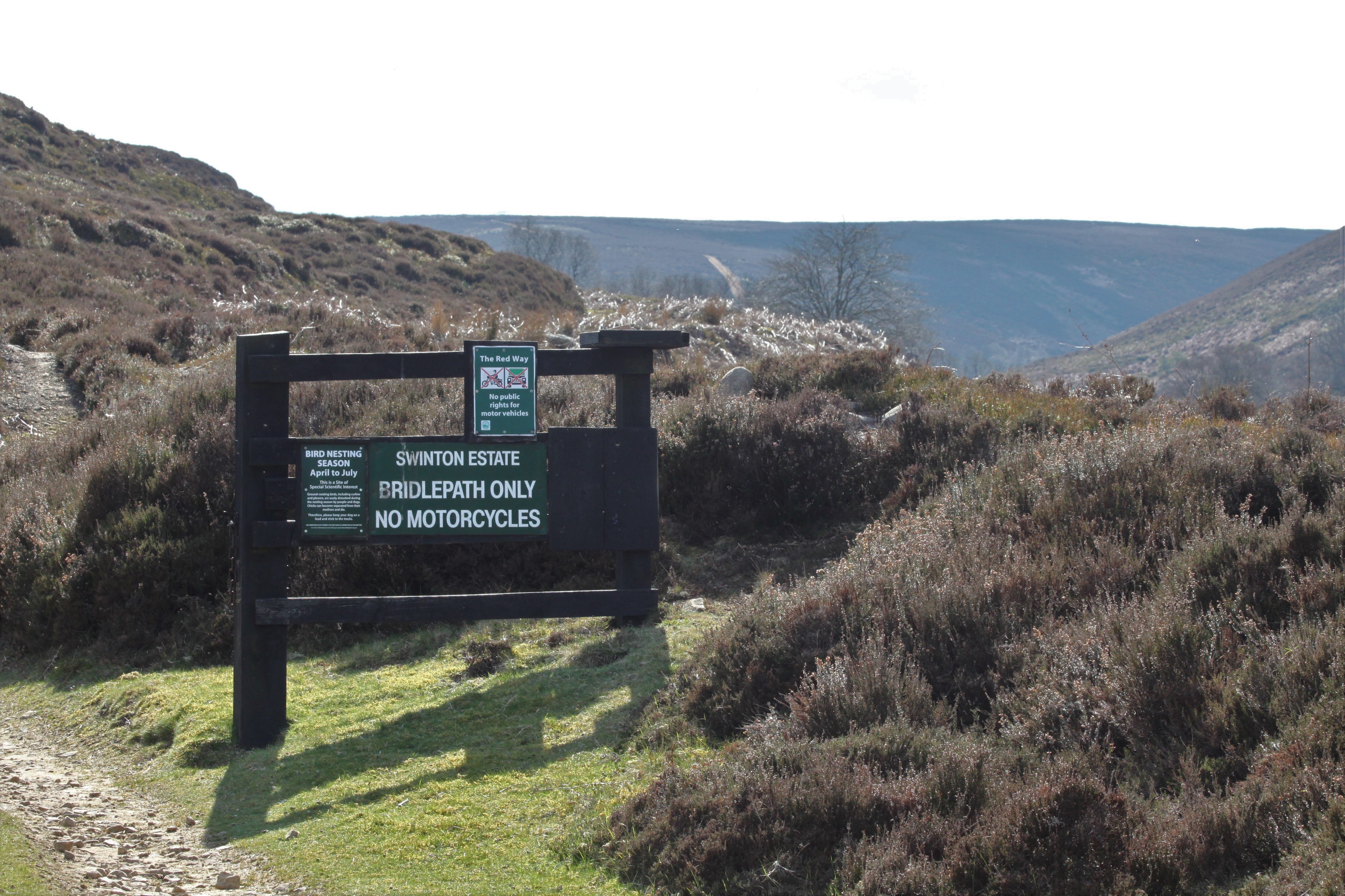
The Swinton Estate in North Yorkshire is once again the focus of a police investigation in to alleged wildlife crime.

This time the investigation hasn’t been triggered by the discovery of a shot hen harrier corpse or two on the Swinton grouse moors (see here and here), nor on the use of illegally-set traps (see here) and nor by reports of an armed man walking through a known hen harrier roost at dusk (see here).

No, this time it’s been triggered after a recent Freedom of Information request revealed the estate did not have a licence when one of its employees was filmed allegedly disturbing an active hen harrier nest earlier this spring.

[Photo by Ruth Tingay]
You might recall I first blogged about this incident in April 2021, after footage was sent to me of two individuals who had been observed visiting an active hen harrier nest on the estate, and just prior to that had been observed placing out food nearby for the breeding adults as part of a diversionary feeding scheme (see here). It was claimed that one individual was a Swinton Estate employee and the other one was a Natural England employee.

There were questions to be answered about why the estate was apparently providing diversionary food so early on in the breeding cycle (incubation stage) when the licence permitting diversionary feeding is very clear that this is only permissible once the chicks have hatched (see info here).

So I submitted a series of Freedom of Information requests to Natural England, which were met with NE’s standard unhelpfulness and obfuscation, e.g. telling me, after 20 working days had passed, that they needed an additional 20 working days to provide a copy of one licence return because apparently asking for this was unduly ‘complex’ (see here)!! I’ll come back to that particular aspect of this story in a separate blog because I now have a copy of the licence return and it’s quite interesting in itself.

At the same time as lodging the FoI requests, I also asked Natural England whether they were taking any enforcement action against the estate for allegedly breaching the terms of the diversionary feeding licence (known as a CL25 licence) – see here and here for previous correspondence.

To be fair, the Enforcement section of Natural England has been much more helpful and open than the FoI department. It’s been quite refreshing. Anyway, to cut a long story short, after chasing them for a while I received an email from the Enforcement team the other evening and to my surprise, this is what it said:

So, to clarify, Swinton Estate did not have a diversionary feeding licence in 2021 when one of its employees was observed allegedly providing diversionary food for hen harriers on the estate.

This means that technically there has not been a breach of the CL25 licence, because a licence hadn’t been issued. Therefore, Natural England are not in a position to take enforcement action and the case has instead been passed to North Yorkshire Police for investigation in to alleged offences under the Wildlife & Countryside Act.

I have spoken briefly with a spokesperson at North Yorkshire Police who has confirmed an investigation has opened.

This is going to be really very interesting on all sorts of levels and for all sorts of reasons.

Not least because Swinton Estate is owned by Lord Masham, Mark Cunliffe Lister, who also happens to be the latest Chairman of the Moorland Association, the grouse moor owners’ lobby group in England.

But perhaps of most interest, I’m told that Natural England’s insane hen harrier brood meddling scheme has been undertaken on Swinton Estate in previous years and is apparently set/approved to have chicks removed again this year. How does that work, then, if the estate is under police investigation for alleged wildlife crime?

Ah, that’s right, it makes no difference whatsoever to Natural England’s sham conservation project – as we’ve seen previously on another estate, a police investigation in to alleged wildlife crime doesn’t stop NE from issuing a brood meddling licence and partnering with said estate (e.g. see here).

I’m pretty sure that Mark Avery, and perhaps even the RSPB, may have something to say about these latest revelations in relation to their respective legal challenges against hen harrier brood meddling. I’m pretty sure that the evidence uncovered so far suggests that NE’s so-called ‘rigorous scientific trial’ is not so rigorous after all – and that surely invalidates the so-called ‘research’? Let’s see.

More on this case, and on Swinton’s diversionary feeding licences from previous years, shortly….

UPDATE 14th June 2021: Natural England quietly alters terms of diversionary feeding licence (and hopes we won’t notice) (here)

Wild Justice launches two new legal challenges: gamebird releases (again) & the burning regulations

Campaign group Wild Justice (Mark Avery, Chris Packham, Ruth Tingay) has begun the process of launching two new legal challenges in England.

Pre-action protocol letters have been sent to DEFRA laying out the legal arguments for both cases. DEFRA has to respond within a short timescale and depending on the content of those responses, Wild Justice will consider whether to proceed with the cases and seek permission from the High Court to take judicial reviews.

Case 1: Gamebird releases

This case is a natural follow-on from Wild Justice’s successful legal challenge last year on the legality of large-scale gamebird releases on or near sites of high conservation importance (see here and here).

In that case, DEFRA was forced to agree to conduct a review of the harmful ecological impacts of released gamebirds on and near protected sites and to establish a licensing scheme to regulate such releases.

DEFRA has recently (May 2021) issued a new general licence (GL43) in an attempt to meet its obligations but Wild Justice submits that the licence is unlawful in that DEFRA is ‘permitting and licensing the release of gamebirds within European sites and within 500m of European sites, without having properly ruled out the risk of harm of the release of gamebirds in the numbers, densities, and locations permitted under GL43, and has failed to take the necessary steps to prevent the deterioration of European sites.

Case 2: Burning regulations

This new case builds on the e-action that was supported by 123,000+ people after it was launched on Hen Harrier Day 2020 (see here) where Wild Justice asked, among other things, for regulation of burning of vegetation on peatlands. 

DEFRA has recently brought in measures which limit, to some extent, burning of upland vegetation but the measures cover, at best, only 40% of the resource (see here for details of the faults). 

The DEFRA proposals have been roundly criticised by non-governmental organisations, by a parliamentary committee and in a special debate in the House of Lords (see here). 

Wild Justice submits that the new Burning Regulations are unlawful on a number of counts:

  • Ground 1: Unlawfulness arising from the Burning Regulations frustrating their own purpose
  • Ground 2: Demonstrable flaw in the reasoning or serious logical error in the reasoning leading to the making of the Burning Regulations
  • Ground 3: Breaches of the Habitats Regulations 2017
  • Ground 4: Failure to take into account Material Considerations, in particular the requirements to act swiftly to limit the emission of greenhouse gases.

Wild Justice has asked DEFRA to make urgent amendments to the Burning Regs. 

[Photo: muirburn on a North Yorkshire grouse moor. Photo by Ruth Tingay]

If you’d like to be amongst the first to know about what Wild Justice is up to, including progress on these two cases and a number of others in the pipeline, you might want to consider joining 40,000+ others by subscribing to the free Wild Justice newsletter (here), delivered directly to your email inbox.

Many thanks to the readers of the RPUK blog who have shown such enthusiastic support for Wild Justice’s work. There’s more on the way….

Legal challenge against Scottish beaver cull gets underway today

Press release from Trees for Life

Legal challenge to Scottish Government’s beaver killing policy to be heard at Court of Session

A legal challenge by Trees for Life to the Scottish Government’s beaver killing policy will be heard by the Court of Session in Edinburgh on Thursday 3 June and Friday 4 June.

Trees for Life says the Government’s nature agency NatureScot is breaking the law by failing to make the killing of the protected species a last resort when management is required. 

The rewilding charity says NatureScot must consider moving beavers to areas of Scotland where they would be welcome and can help boost biodiversity, rather than issuing licences for them to be killed when they cause local damage to farming interests. 

[Photo by Scotland: The Big Picture]

The case aims to ensure a safer future for beavers, which can help tackle the nature and climate crises because their dams create nature-rich and flood-reducing wetlands. Trees for Life also says any management changes must be practical and effective in protecting farmers’ interests.

A ruling in our favour could transform the fortunes of Scotland’s wild beavers. But whatever the legal outcome, this case is spotlighting glaring inconsistencies in the Government’s approach to protecting this still-fragile native species – and why a more nature-friendly, climate-friendly and farmer-friendly approach is needed,” said Steve Micklewright, Trees for Life’s Chief Executive.

The Government declared beavers to be legally protected in 2019. But NatureScot has since issued dozens of killing licences when beavers are said to be damaging farmland – even though laws on protected species require management to have the least possible impact on their conservation status.

Given the legal protection afforded to beavers and the logic of taking a precautionary approach to their management, Trees for Life is making a strong case that all viable non-lethal alternatives to killing should be explored so that killing of beavers is genuinely a last resort.

Trees for Life agrees with NatureScot that beaver impacts sometimes need to be managed, but believes NatureScot is legally obliged to consider trapping and relocating beavers as an alternative to lethal control of beavers when it issues licenses – something NatureScot contends. 

The court’s view of these arguments will be one of the key points of the judicial review. It is expected that it may be the end of the summer before the court’s verdict is announced.

Lawyer Adam Eagle, Chief Executive Officer of legal specialist rewilding charity The Lifescape Project, which is spearheading the litigation with Trees for Life, said: “We’ve studied hundreds of pages of material obtained from NatureScot through Freedom of Information requests, and we’ve compiled strong arguments that current beaver licensing practices breach the Scottish Habitats Regulations on several fronts.”

A judicial review ruling that lethal control should only be a genuine last resort could allow conservationists and others to identify, with proper community engagement, suitable sites across Scotland to which beavers can be moved and be welcome – boosting biodiversity, creating wildlife tourism opportunities, and preventing potential damage to farmland elsewhere.

Currently the Scottish Government is blocking such relocations, even though NatureScot has identified over 100,000 hectares of suitable habitat. This is limiting the options for Tayside farmers whose land or crops are damaged by beavers, often putting them in the position of having to shoot the much-loved animals.

Trees for Life’s public crowdfunder to cover the legal costs of the judicial review raised over £60,000.

A judicial review – a court review of official decision-makers’ decisions and actions to ensure they are lawful – can only proceed when there is a recognised legal ground and if the applicant has the legal right, known as ‘standing’, to bring a challenge.

Trees for Life is dedicated to rewilding the Scottish Highlands. See treesforlife.org.uk.

ENDS

This subject is off-topic for this blog but is of interest on a number of fronts, not least the tactic of a conservation organisation taking the Government to court to challenge alleged unlawful wildlife policy, but also because blog readers contributed to the crowdfunder to support this legal challenge (here).

Perhaps most significantly though, because in this case Scottish farmers and landowners have joined forces with statutory agency NatureScot to defend this judicial review because they believe the outcome could have impacts on the lawfulness of killing sea eagles, ravens and other protected species (see here).

Good luck in court today and tomorrow to the legal team from Trees for Life.

Trial begins for Millden Estate gamekeeper accused of animal cruelty offences

The trial is due to begin today of a Scottish gamekeeper from Millden Estate in the Angus Glens, who is accused of a number of animal welfare offences related to animal fighting.

Police Scotland and the Scottish SPCA raided a property on Millden Estate and another property in Aberdeenshire in October 2019 after intelligence suggested animal fighting was taking place. A number of dogs were seized (see here).

Alleged offences relating to the Animal Health & Welfare (Scotland) Act 2006 resulted in charges being brought against a gamekeeper in December 2020 (see here).

The charges relate to:

Section 19 concerning offences related to unnecessary suffering.

Section 23 concerning offences related to animal fights.

Section 24 concerning offences related to ensuring the welfare of animals.

This is an interesting case for a number of reasons and there’ll be much to say but for now, comments on this blog post will not be accepted until criminal proceedings have concluded.

UPDATE 2 November 2021: New trial date for Millden Estate gamekeeper accused of animal fighting offences (here)

Parliamentary question: when will Scottish Government consult on grouse moor licensing?

In November 2020, the Scottish Government announced it’s long-awaited, and some would argue long-overdue, decision to introduce a licensing scheme for driven grouse shooting, in response to the Werritty Review and in response to the grouse-shooting industry’s utter failure to self-regulate and stop the illegal persecution of birds of prey on driven grouse moors (see here).

Mairi Gougeon, who was the Environment Minister at that time, said in her statement:

If re-elected, this Government will bring forward the necessary legislation in the next Parliament to license grouse moor management and to strengthen the existing legislation on muirburn, including a range of appropriate penalties that could be applied in cases of non-compliance. Any new legislation will of course be preceded by full consultation in the normal way

and

I look forward to discussing these measures with members of this parliament and key stakeholders over the coming months“. 

Six months on from making that commitment, Mark Ruskell MSP (Environment spokesperson for Scottish Greens) is not wasting any time in getting down to business in this new Parliament and is already applying the pressure.

He lodged the following Parliamentary Question on 14th May 2021:

S6W-00039To ask the Scottish Government when it will consult on the licensing of grouse moors.

This question was answered on 26th May 2021 by Graeme Dey:

ANSWER: The Scottish Government remains committed to implementing the licensing of driven grouse shooting and is currently developing proposals for a full public and stakeholder consultation with the aim of bringing forward legislation during this parliamentary term.

The timing of the consultation will depend on the legislative programme for the Parliament, which will be set out in due course.

Hmm. The first thing that struck me about this response was who it was from. Graeme Dey is the Transport Minister – his portfolio does not cover grouse shooting as far as I can tell. How very odd that it wasn’t answered by either the Environment Minister (Mairi McAllan) or either of the two Cabinet Secretaries with responsibilities in this area (Mairi Gougeon and Michael Matheson).

The second thing that struck me was the Government’s continued use of language that aims to demonstrate action but actually delivers nothing more than a holding statement. Yes, it’s a standard tactic but it’s oh so bloody tedious. I guess it’s just all part of the pantomime.

Well done Mark Ruskell MSP. Please keep pushing on this – there’s absolutely no reason why the public and stakeholder consultation on grouse moor licensing can’t be started now. Sure, the drafting and processing of new legislation will have to fit into the Government’s programme but there’s an awful lot of work to do before we get to that stage and there’s no legitimate excuse to delay that.

What the Government can be sure about, is that we won’t let it get away with the shambolic lack of urgency it has demonstrated on the parallel subject of increased powers for the SSPCA – a topic it has dragged its feet on since 2011 under a succession of now eight (yes, eight!) Environment Ministers (see here).