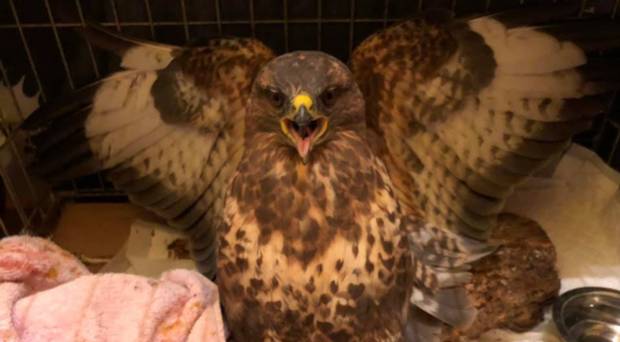
Buzzard shot & wounded in Co Tyrone

From the Belfast Telegraph (14/11/19):

BIRD OF PREY FOUND SHOT THREE TIMES ON MEND, SAY OMAGH VETS

A bird of prey is recovering after being shot three times in Co Tyrone.

X-rays performed by Omagh practice Corry & O’Hare Vets revealed that the buzzard had received a fractured bone following the attack in Newtownstewart.

Three round pellets were also found lodged in various parts of the female bird’s body.

It is unclear whether or not the buzzard – a species afforded the highest level of wildlife protection – was shot deliberately.

As it is illegal to hunt protected birds, the incident has been reported to the PSNI.

The penalty for committing a wildlife crime in Northern Ireland – including shooting, poisoning, trapping and nest destruction of a bird of prey – is a fine of up to £5,000 and a six-month custodial sentence.

Louise O’Hare from Corry & O’Hare Vets said the injured bird was brought to them last week after being found unable to fly by a member of the public.

ENDS

It’s good that this shooting has been reported in the media but the quality of reporting is pretty poor. If those ‘three round pellets’ found in the buzzard’s body were shotgun pellets it’s likely the bird was hit once and sprayed with shot, not ‘shot three times’. And does it matter whether the buzzard was targeted deliberately or not? If it wasn’t, then shooting it was reckless and is still an offence.

Last week the Partnership for Action Against Wildlife Crime in Northern Ireland published a ten-year review of raptor persecution (2009-2018) which highlighted buzzards as the most frequently reported victims (followed by red kite then peregrine). Technology such as satellite tags and nest cameras are now being deployed in an attempt to crack down on the criminals. You can follow this project on the Hawk Eyes website (here) and read our commentary on it here.

Werritty Review submitted to Scottish Government?

Rumour has it, Professor Alan Werritty has submitted his long-awaited review on grouse moor management to the Scottish Government, two and a half years after it was first announced by Environment Cabinet Secretary Roseanna Cunningham following the devastating findings of the golden eagle satellite tag review, which showed the extent and scale of ongoing golden eagle persecution on some driven grouse moors.

To be fair, Professor Werritty wasn’t actually commissioned until two years ago in November 2017. Nevertheless, the report is still six months overdue, partly due to ill-health (fair enough) but partly due to….well, we don’t know.

There hasn’t been any official announcement about the submission of Professor Werritty’s Review, and thus no indication of when the Scottish Government might publish it, nor when it might respond to the report’s recommendations.

Video evidence loopholes to be closed with proposed new Scottish legislation on wildlife crime

Proposed new legislation in Scotland will have significant ramifications for those who continue to kill birds of prey.

The Animals and Wildlife (Penalties, Protections & Powers) (Scotland) Bill was introduced by Environment Cabinet Secretary Roseanna Cunningham on 30th September 2019 (see here for associated docs) and will, amongst other things, increase the maximum available penalties for the most serious animal welfare and wildlife offences.

For example, under the Wildlife & Countryside Act, the current maximum penalty available for intentionally or recklessly killing, taking or injuring a wild bird is six months imprisonment and/or a £5,000 fine with the case being heard in the Sheriff Court.

Under the proposed new Bill, the case could still be heard in the Sheriff Court where the maximum penalty would be 12 months imprisonment and/or a £40,000 fine, but the case could also be heard on indictment in a higher court where the maximum sentence would be five years imprisonment an/or an unlimited fine.

This policy document from the Scottish Government is worth reading for a clear explanation of what else is proposed under the new legislation.

These proposed changes are significant and very welcome – especially in light of the monumentally inadequate sentencing of convicted Scottish gamekeeper Alan Wilson recently (see here) although the new proposals still pale in to insignificance when compared with the zero tolerance penalties imposed in Spain (e.g. see herehere and here).

This Bill has been a long time coming – six years in fact – from 2013 when the then Environment Minister Paul Wheelhouse commissioned a review on whether penalties for wildlife crime should be increased, as a direct response to ongoing illegal raptor persecution. Professor Mark Poustie submitted his report and a series of recommendations, including a penalty increase, in 2015. The then Environment Minister Dr Aileen McLeod broadly accepted those recommendations in 2016 and the Scottish Government committed to progressing them in its 2017/2018 Programme for Government.

Importantly, the five-year custodial penalty is big news because effectively it would mean that Police Scotland would now have the authority to apply for permission, under the Regulation of Investigatory Powers (Scotland) Act 2000 (RIPSA), to install covert cameras on private sporting estates for the purpose of detecting wildlife crime.

Currently, Police Scotland do not have the authority to seek permission to install covert cameras as part of an investigation simply because raptor persecution crimes do not merit a custodial sentence of three years or more. Authority can only be given if the activity is considered ‘proportionate’ and when the crime being detected is considered ‘serious’ (i.e. where the penalty would constitute a term of imprisonment for three years or more).

As we’ve seen in recent years, the RSPB has installed covert cameras at the remote nest sites of specially protected birds of prey and has recorded what is obviously a wildlife crime, but because the RSPB is a charity and not a statutory agency it is ineligible for RIPA/RIPSA authorisation so clever defence lawyers have been able to get cases thrown out of court on technicalities, and more recently some of these cases haven’t even reached court because the Crown prosecutors have decided the footage is inadmissible (e.g. see here and here).

It’s ironic that a law (RIPA/RIPSA) intended to protect the innocent has actually been exploited to protect the guilty and has undermined justice time and time again.

The Bill is currently at Stage 1 and is open to Parliamentary scrutiny. On 29th October the Environment, Climate Change and Land Reform (ECCLR) Committee took evidence from a number of Scottish Government policy officials and there was an interesting discussion about the implications of the Bill for police-led video evidence, and also questions about why the Bill didn’t include proposals to extend vicarious liability and increased powers for the Scottish SPCA. You can read the transcript here: ECCLR Animals and Wildlife Bill stage1_29Oct2019

In early December RPUK will be participating in a round-table discussion on this Bill at the Scottish Parliament.

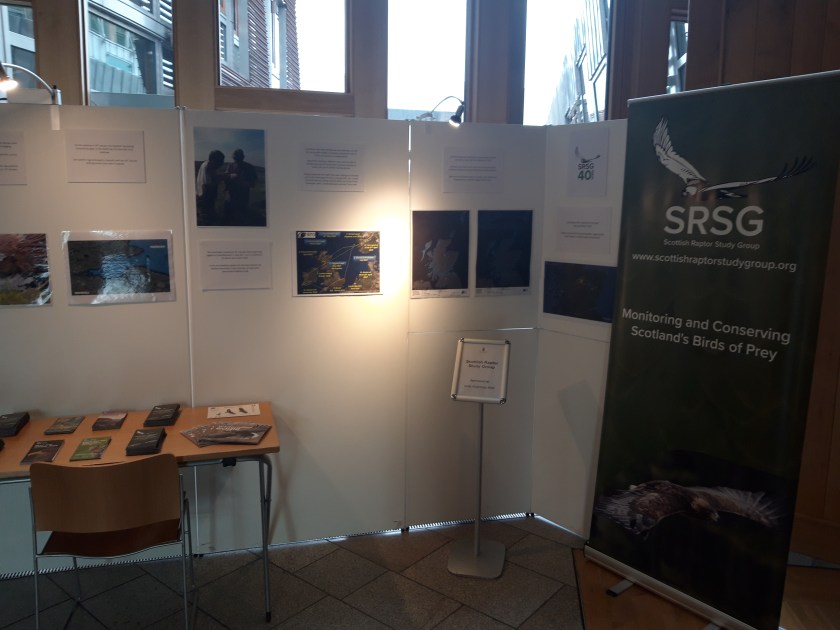
Scottish Raptor Study Group holds three day exhibition at Scottish Parliament this week

The Scottish Raptor Study Group (SRSG) is holding a three-day exhibition in the Scottish Parliament this week to showcase the group’s immense contribution to the Scottish Raptor Monitoring Scheme as well as to highlight the ongoing issue of illegal raptor persecution on and around some driven grouse moors.

This is a follow-on event from the SRSG’s Parliamentary reception held in May (see here).

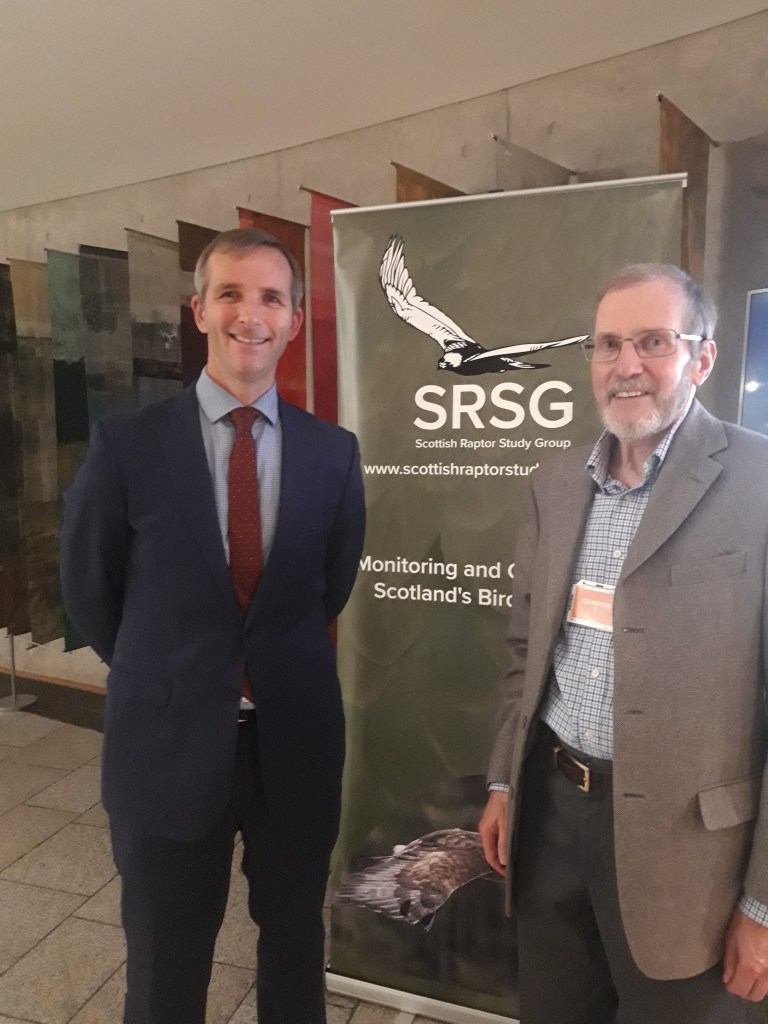
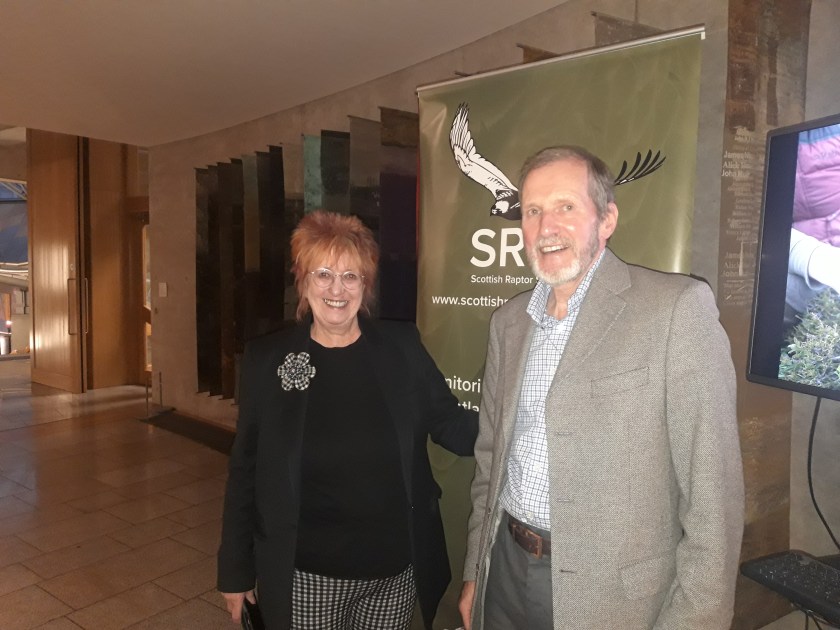
[All photos by SRSG]

Sponsored by Andy Wightman MSP (Golden Eagle Species Champion), the event provides an opportunity for SRSG members to engage with MSPs and discuss the ecological and economic importance of birds of prey as well as explaining the science behind satellite-tagging and the incredible behavioural insights resulting from this conservation research.

There has been a stream of cross-party visitors so far including Environment Minister and Hen Harrier Species Champion Mairi Gougeon, John Mason MSP (Kestrel Species Champion), Bill Kidd (Red Kite Species Champion), Graeme Dey MSP, Christine Graham MSP, Liam McArthur MSP, Andy Wightman MSP, Mark Ruskell MSP (White-tailed Eagle Species Champion), Alison Johnstone MSP, Bob Davis MSP (Peregrine Species Champion).

The exhibition concludes on Thursday afternoon so if you’re in Holyrood don’t miss the opportunity to come and speak to these experts.

Raptor persecution in Northern Ireland: ten year review and new strategies to tackle these crimes

Press release from the Partnership for Action Against Wildlife Crime Northern Ireland (PAW NI):

Birds of prey to be safeguarded by new technology

Satellite tracking devices are to be fitted onto birds of prey and nesting site surveillance installed, in the latest fight against wildlife crime.

‘Hawk-Eyes’, an advanced technology project, is being launched by the Partnership for Action Against Wildlife Crime Northern Ireland (PAW NI), alongside their ‘10 Years of Persecution’ Report.

The report reveals that from 2009-18, there were a total of 72 incidents of confirmed raptor persecution in Northern Ireland, resulting in the death or injury of 66 birds of prey and the destruction of two nesting sites.

Department of Agriculture, Environment and Rural Affairs (DAERA) Wildlife Officer Dr Jon Lees said buzzards and red kites are amongst the most common victims of persecution: “Sadly, a small proportion of our population still seem to think it’s ok to destroy these magnificent birds at the expense of the environment and the rest of the community.

“Raptors such as buzzards, red kites, peregrine falcons and Sparrowhawks, have been illegally targeted right across Northern Ireland to such an extent some areas are at risk of losing their natural top predators,” explained Dr Lees.

The methods these criminals use, such as poisoned bait, are often highly dangerous, putting livestock, pets and people at risk. These offenders care little for people’s safety. We rely heavily on the vigilance of the public to report these crimes and any evidence to the police or Crimestoppers,” Dr Lees added.

The “Hawk-Eyes” project, is funded and supported by the Department of Justice, – Assets Recovery Community Scheme (ARCS) and run through PAW NI, which brings together government Departments, PSNI and other enforcement agencies, environmental organisations, animal welfare groups and country sports associations with the common goal of combating wildlife crime through publicity, education and campaigning.

Some of the birds’ tracking information will be publicly available on the project website at http://wildlifecrimeni-hawkeyes.com, which will allow people to help protect these special birds by reporting such crimes.

PAW NI encourages people across Northern Ireland to be vigilant. If anyone sees or knows of any wildlife crime, report it to the PSNI by calling 101 or, in an emergency, 999. Crime can be reported anonymously to Crimestoppers on 0800 555 111.

ENDS

The ten year review report (2009-2018) can be downloaded here: PAW NI Raptor Persecution Report 2009 – 2018

The use of technology (nest cameras and satellite tags) in the Hawk Eyes project is very interesting, especially as it’s being funded by the Department of Justice’s Assets Recovery Community Scheme, where proceeds of crimes are distributed to help community projects. It would be great to see this approach repeated in England, Scotland and Wales.

Of most interest to us is that these tags are being deployed primarily to aid the detection of wildlife crime. Typically, up until now the main reason for deploying satellite tags has been as part of an ecological research project – the subsequent detection of wildlife crime hotspots (through the discovery of poisoned/shot/trapped sat tagged birds or the suspicious disappearance of tagged birds) has been a by-product of that research and not its primary aim. This is a very clear change of approach from the PAW NI and its also very pleasing to see that the police are key partners in it. Good stuff.

Will the use of satellite tag technology help to identify the criminals as well as the hotspots? Quite possibly. It doesn’t work in England, Scotland or Wales where there are large game shooting estates and where evidence can be quickly destroyed with relative ease (no witnesses around and thousands of acres in which to hide corpses/tags) and where multiple gamekeepers can hide in the crowd (a prosecution isn’t possible unless an individual suspect is identified) but the situation in Northern Ireland is quite different.

Raptor killing in Northern Ireland isn’t such an ‘organised crime’ as it is in the rest of the UK because there are very few large game shooting estates. It seems to be more localised and opportunistic in Northern Ireland, so the perpetrators aren’t so clued up on how to avoid detection. The deterrent effect of simply knowing that these birds might be tagged may also be significant in Northern Ireland because the raptor killers there won’t have wealthy employers prepared to fork out thousands of pounds for legal defence as they do on the game shooting estates in England and Scotland. The risk of getting caught and being afraid of the consequences might just do the trick in Northern Ireland.

Well done and good luck to the PAW NI team – a lot of people will be watching this project with interest.

RSPB corrects misleading commentary from shooting industry

A couple of weeks ago the RSPB announced it was going to conduct a review of its policy on game bird shooting (see here). That’s all it was – a statement of intent to review a policy, nothing more, nothing less.

However, this statement elicited a surprisingly strong reaction from the game shooting organisations who mostly appeared to be terrified at the prospect of such a review and responded by hurling characteristic abuse at the RSPB. For example, Tim Bonner of the Countryside Alliance was quoted in the press as follows:

Disappointingly this seems to be the final step in the RSPB’s long journey to becoming an anti-shooting organisation. 

It displays the organisation’s bizarrely warped priorities in the face of so many other pressing concerns that face the countryside we know and love“.

This morning the RSPB’s Martin Harper has responded to the media frenzy with a measured blog setting out the facts and dismissing the hysteria – well worth a read (here).

There’s another example of the RSPB hitting back this week….

In the Oct 9th edition of Shooting Times there was a spectacularly crap article based on a claimed conversation between an unknown gamekeeper and the article’s author, Jamie Blackett, claiming that two people who said they were from the RSPB were ‘inspecting‘ the property of the unnamed keeper and in doing so, according to Blackett, were ‘likely to be acting unlawfully‘, acting ‘contrary to the European Convention on Human Rights‘, ‘were probably trespassing‘, and ‘acting as if they were the police force’.

There was also some very strange and embarrassing drivel about allegations that another [unnamed] organisation had been removing eagles from nests without licences to fit trackers which “would probably be a criminal activity“. Er, yes it would be ‘a criminal activity‘ if the people removing eagles from nests to fit trackers weren’t licensed to do so – if Mr Blackett has any evidence of this we’d urge him to report it to Police Scotland without delay.
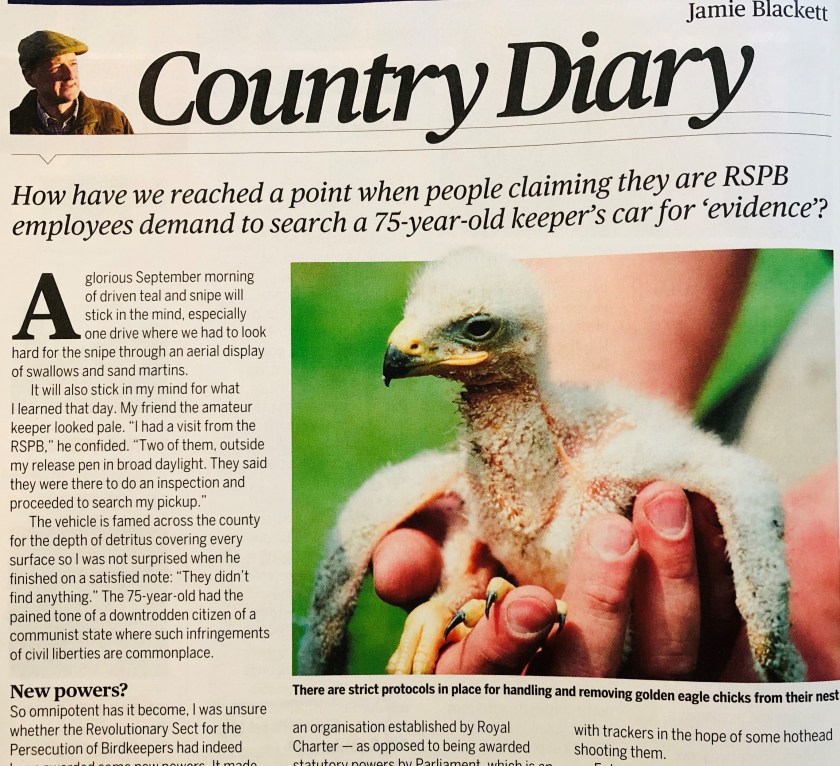
The text of this article appears to be based entirely on unsubstantiated claims and innuendo but also looks to have been carefully ‘lawyered up’, peppered with language that would prevent any accusations of libel from sticking. It says a lot about Shooting Times that it would publish this dross.

The RSPB wrote a letter of complaint to Shooting Times the following week and the letter has finally been published this week, as follows:

We note, with considerable disappointment, the recent article by Jamie Blackett (Country Diary, 9 October), which contains many false and totally unsubstantiated allegations about the RSPB.

It appears that this article seeks solely to damage the RSPB’s reputation and create suspicion and distrust in the minds of your readers. Its publication does nothing to encourage constructive discussion between the shooting industry and nature conservation NGOs, and is all the more disappointing in the light of recent discussions and meetings between RSPB staff and Shooting Times, where we are trying to build bridges between our sectors.

There is no evidence whatsoever to support the apparent source of this story’s assertion that the two individuals he claimed to encounter were from the RSPB, other than his claim that they told him this. The falsities are compounded by the fact that no attempt was made either by the author or your editorial team to put them to us for comment.

RSPB staff have no powers or right to ‘inspect vehicles’ – the only time we would be involved in carrying out any search would be when we are specifically requested by the police to assist them under their instruction and immediate close supervision. Similarly, the further accusations that RSPB staff were ‘trespassing’ or are vigilantes do not stand up to scrutiny.

The final paragraph of the article suggests that the RSPB may have brought the law into disrepute by acting dishonestly. Again, we repudiate this baseless accusation.

This article is constructed entirely on false accusation and allegation and on unevidenced opinion. For clarity, we refute the allegations completely and request that you publish this letter and provide us with an apology‘.

Allie McGregor, Communications Officer, RSPB

ENDS

The Shooting Times editor chose not to publish an apology.

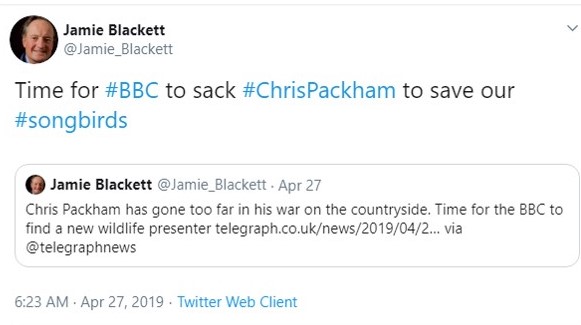
The article’s author, landowner Jamie Blackett, is not new to this game. George Monbiot called him out earlier this year (see here), arguing that an article in the Telegraph that had been written by Blackett was likely to encourage further harassment of Chris Packham at a time when Chris had been receiving death threats.

And according to Blackett, sacking Chris Packham would ‘save our songbirds’. Ahem.
 

Calling for an end to wildlife abuse on Scottish grouse moors

Last month the Scottish animal welfare charity OneKind lodged a petition at the Scottish Parliament calling for ‘an end to the killing of wildlife on grouse moors and elsewhere in Scotland’.

Below is some background information from OneKind on why they’re calling for the Scottish Parliament to conduct a full review of the animal welfare impacts of the use of traps and snares on grouse moors and elsewhere in Scotland.

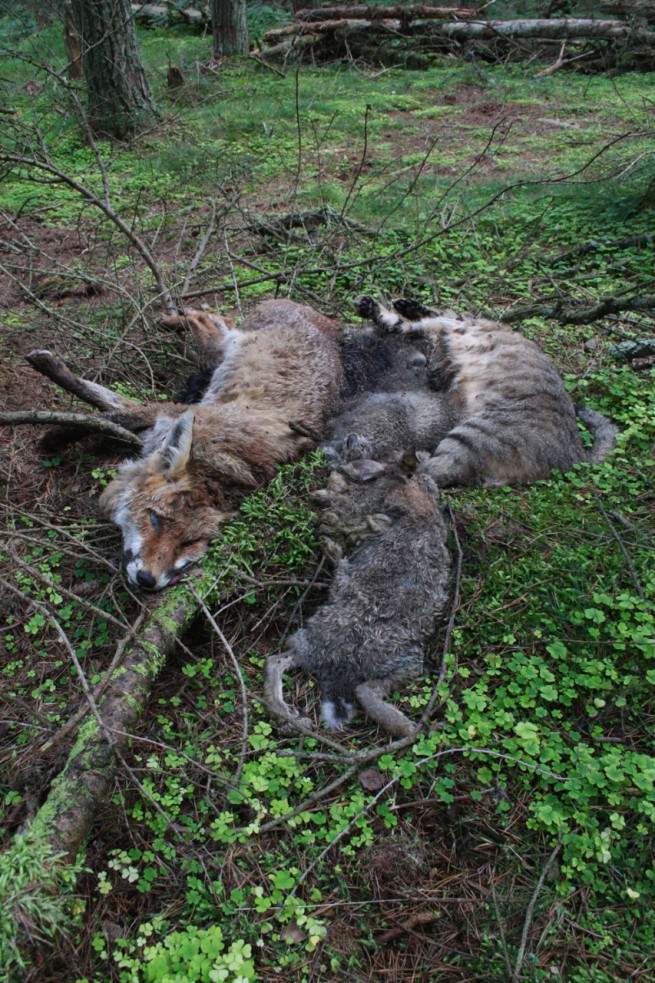
[A gruesome stink pit photographed on a grouse moor in the Angus Glens. This fox, some rabbits and a cat had been killed and then dumped in a heap so their putrefying corpses would attract the attention of passing scavengers who would then be caught in snares set close by, killed, and then added to the pile].

The focus of the review called for in this petition should be:

• The ethics and sustainability of the routine and repeated killing of the same species in the same location;
• The case for banning snares, Larsen traps and certain other types of live traps outright, on animal welfare grounds;
• The animal welfare issues surrounding lethal traps such as spring traps, both approved and non-approved categories;
• Mechanisms to ensure proper scrutiny of all practices undertaken by hunters, shooters and trappers and only to permit the use of traps under exceptional circumstances; and
• Whether activities closely associated with causing unnecessary suffering by means of trapping and snaring, such as driven grouse shooting, should be banned.

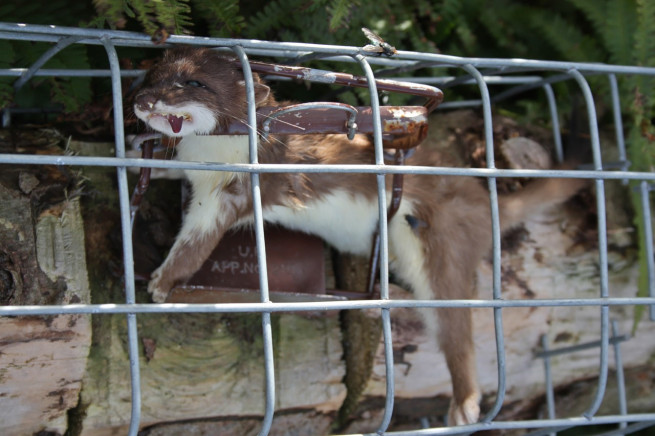
[A stoat killed in what is currently a lawful trap, set on another grouse moor in the Angus Glens. This sort of wildlife abuse is routine, with some estates hosting thousands of traps like this].

Petitions at the Scottish Parliament are different to those at Westminster – they are generally active for about six weeks, anybody from anywhere in the world can sign them and there is no minimum number of signatures required before the petition will be considered by the cross-party Petitions Committee.

OneKind’s current petition is doing moderately well with 5,542 signatures and one more week to go before it closes on Weds 13th November. It would be good to send a strong message to the Scottish Government that the systematic abuse of wildlife on Scottish grouse moors is no longer tolerable.

If you agree, please consider signing the petition HERE

Thank you

No confidence in new satellite tags fitted to brood meddled hen harriers

Last week we blogged about how the brood meddling project management team had agreed to fit a new, untested type of satellite tag to at least three of the five brood meddled hen harriers (see here).

This new tag was also fitted to other hen harrier chicks by Natural England this year. One of those chicks was called Rosie, who was reported as ‘missing’ on 17 September 2019 (here) only for her tag to re-start transmitting data three days later (here).

We blogged about the scientific and political stupidity of testing a new type of tag in the brood meddling trial, where understanding the fate of the brood meddled chicks is fundamental to assessing the trial’s ‘success’ or failure. It makes no sense whatsoever to do this – why not stick with the tags that you know, from several years worth of experience, have a 94% reliability rate on harriers? It’s been reported that three of the five brood meddled hen harriers ‘disappeared’ in September but because there is so little confidence in the reliability of the new tags nobody knows whether those birds have been illegally killed (like so many before them) or whether they’re actually fine and just carrying dodgy tags.

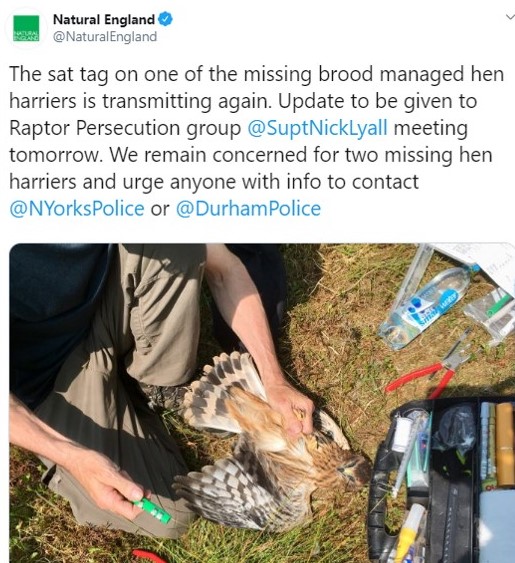
This afternoon we learned that at least one of those brood meddled hen harriers is actually ok and yes, it is clearly carrying a dodgy tag. This from Natural England on twitter:

So now we have no confidence whatsoever in these particular tags.

For the avoidance of doubt, that doesn’t mean that all satellite tags are unreliable, as undoubtedly the persecution deniers will try to claim. As we’ve blogged previously, there are many different tag models and the quality of both the tag and the data it produces can vary massively. There is constant communication between many researchers who deploy these tags as nobody in their right mind would want to buy a tag, let alone deploy it, if there was any hint of that particular model under-performing.

Which begs the question, again, why were these tags selected for the brood meddling trial?

Dead partridges dumped in lay-by

In its desperation to appear ethical and sustainable, the game shooting industry has often pretended that shot game birds all end up in the human food chain.

For example, in a letter to the Daily Telegraph in November 2005 headed ‘Game birds for eating not dumping’, Tim Bonner of the Countryside Alliance said this:

Every bird shot in Britain goes into the food chain, whether into participants’ freezers, or through game dealers into an increasing number of supermarkets, butchers, pubs and restaurants“.

Regular blog readers will know this claim has been debunked time and time and time again. We’ve previously blogged about how dead game birds have been dumped in the Scottish borders (here), Norfolk (here), Perthshire (here), Berkshire (here), North York Moors National Park (here) and some more (here), Co. Derry (here), Cheshire (here), West Yorkshire (here), N Wales (here), mid-Wales (here), Leicestershire (here) and Lincolnshire (here).

As we’ve written before, it seems to be a widespread problem, doesn’t it? That’s hardly a surprise when the game shooting industry is permitted to release as many non-native pheasants and red-legged partridge as it likes (estimated to be almost 60 million EVERY YEAR), with minimal regulation, and no requirement to report on what happens to those birds once they’ve been shot for a bit of a laugh.

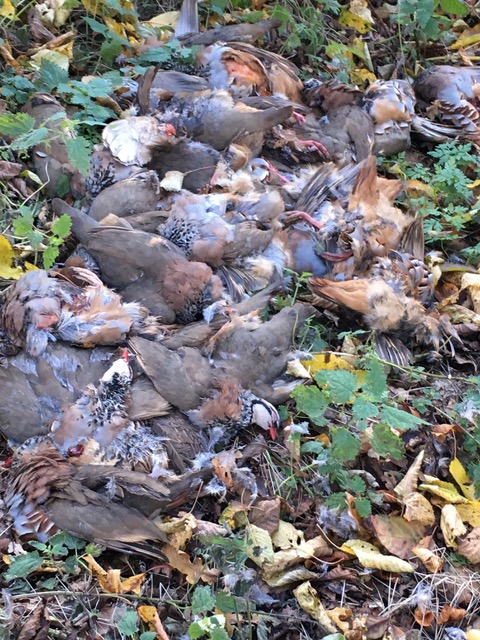
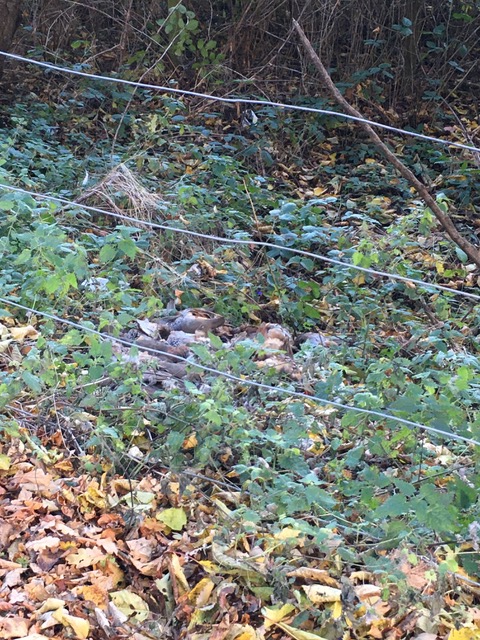
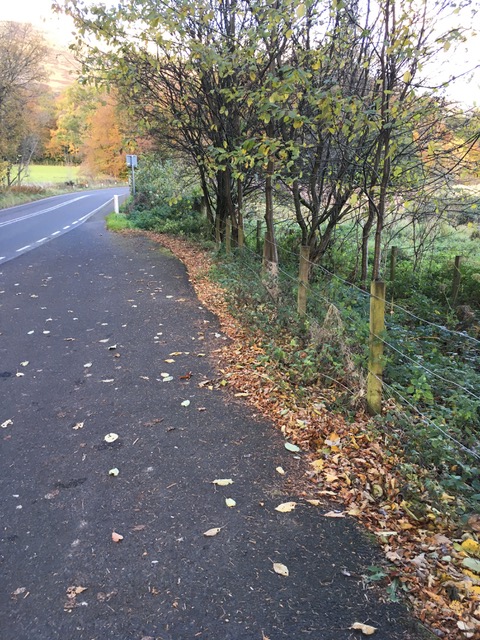
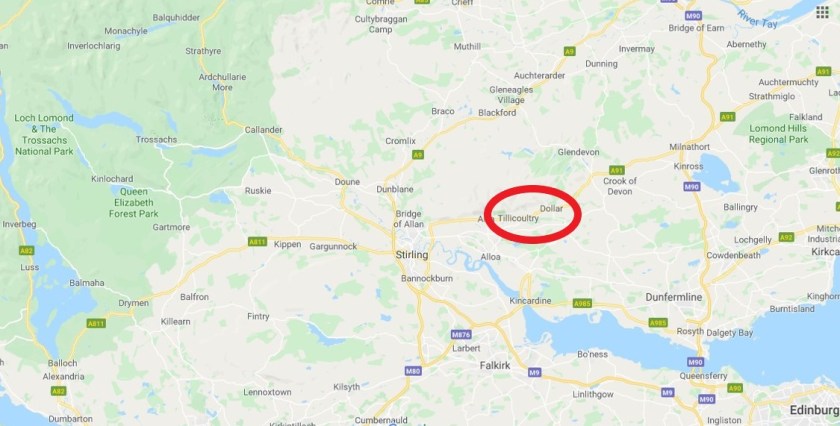
Well guess what? Here’s another example, this time from Clackmannanshire in Scotland. Thanks to the blog reader who sent us these images, photographed on Tues 29 October 2019 in a lay-by on the A91 between Tillicoultry and Dollar.

In defence of this vile behaviour, it’s often argued that the dead birds have been ‘de-breasted’ (i.e. the breast meat has been removed) before the carcasses are dumped. Oh well that’s alright then, nothing to be concerned about, eh? Apart from showing zero respect for the quarry and zero consideration for the local residents who’ll have to foot the bill to have the carcasses removed.

This particular case has been reported to the local authority as a fly-tipping offence.

Two more satellite-tagged eagles disappear on Scottish grouse moors

Press release from RSPB Scotland (4 Nov 2019):

Two satellite-tagged eagles disappear on the same day

Both last recorded on grouse moors

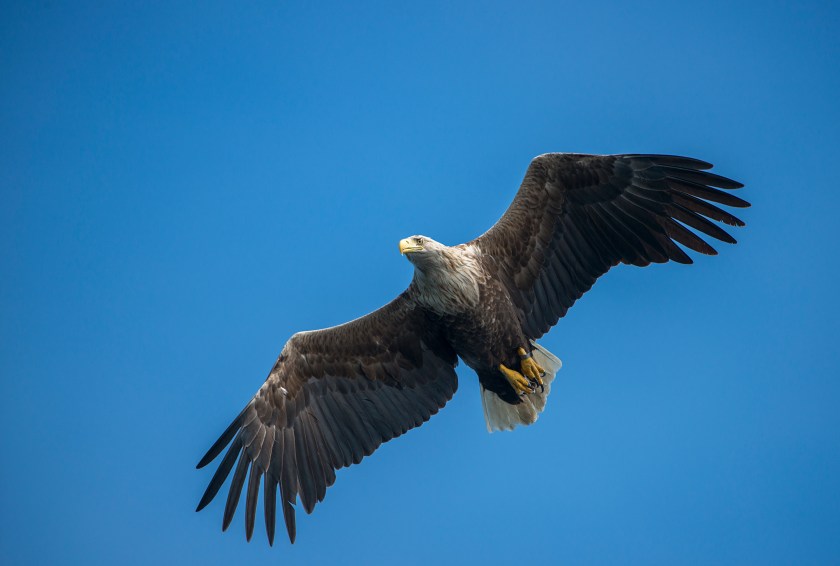
RSPB Scotland is appealing for information after two young satellite-tagged white-tailed eagles disappeared in highly suspicious circumstances. Transmissions from the tags of both birds ceased on 22nd July this summer, one last recorded over a grouse moor in Inverness-shire, and the other over an Aberdeenshire grouse moor.

[White-tailed eagle, photo by Ben Andrew]

The Inverness-shire grouse moor is in an area with a history of bird of prey persecution, including numerous suspicious disappearances of tagged golden eagles over several years. These incidents led the Scottish Government to commission an independent review in 2016 into the fates of satellite-tagged golden eagles in Scotland, with the subsequent report finding that a third of these birds had most likely been illegally killed.

The birds that disappeared in July were both from the first generation of chicks from breeding pairs in the tiny white-tailed eagle population in east Scotland. Illegal persecution lead to white-tailed eagles becoming extinct in Scotland in 1918. The birds have returned to this eastern part of the country through a reintroduction project run by RSPB Scotland, Forestry Commission Scotland and Scottish Natural Heritage between 2007 and 2012.

Ian Thomson, RSPB Scotland’s Head of Investigations, said: “Yet again, rare, protected birds of prey have disappeared in highly suspicious circumstances, with their last known locations on grouse moors. And yet again, we can be almost certain that these birds have been killed, with those responsible destroying all the evidence. The disappearance of these two eagles is more than a loss of two birds; it means any future breeding success they might have had, helping to boost the numbers of these rare birds, has also been destroyed. Illegal persecution is seriously undermining the re-establishment of a white-tailed eagle population in this part of Scotland.”

Satellite tagging technology allows conservationists to monitor the eagles as they establish and develop a breeding population following the reintroduction, as well as providing insight into the threats they face and how best to help them. The tags, designed to transmit regularly, even after a bird has died, are fitted by licensed, trained fieldworkers.  RSPB Scotland was monitoring the eagles’ tag data and, in both cases, they suddenly ceased transmitting, with no prior evidence of any technical issues.

The National Wildlife Crime Unit and Police Scotland were immediately notified and, under routine procedure, were provided with the tags’ data to allow them to make a separate independent assessment of the birds’ likely fates. Follow-up investigations by the police, including searches of the final known locations of the birds, have yielded no further information as to their likely demise. Neither bird, nor their transmitters, have been seen or heard from subsequently, strongly suggesting that they have been illegally killed.

Ian Thomson continued: “In 1999, Donald Dewar, Scotland’s first First Minister, described raptor persecution as a “national disgrace”, but twenty years on, it continues unabated. It’s clear that current legal deterrents aren’t working and is long overdue that the stain of raptor persecution was removed from our nation’s reputation by the introduction of robust regulation of a driven grouse shooting industry that is blighting our country’s incredible wildlife and contributing to its biodiversity crisis.”

White L was a male eagle tagged as a chick at a nest in in Fife in 2016. His tag last transmitted on a grouse moor a few miles from the famous Banchory to Fettercairn Road, in Aberdeenshire. The other chick fledged from a nest in Inverness-shire in 2018 and disappeared on managed moorland near Tomatin in the northern Monadliaths. As well as repeated disappearances of satellite tagged eagles, this area of Inverness-shire has seen numerous incidents of shooting, poisoning and illegal trapping of eagles, red kites and hen harriers.

The independent peer-reviewed report which followed the Scottish Government commissioned review of the fates of satellite tagged eagles provided unequivocal evidence of the link between the highly suspicious disappearance of satellite-tagged raptors and criminal activity associated with grouse moor management.

Anyone with information about either of these birds or any other wildlife crime is urged to contact Police Scotland on 101 or call the RSPB’s raptor crime hotline on 0300 999 0101.

ENDS