Interview with RPPDG Chair, Supt Nick Lyall in Shooting Times

A couple of weeks ago Shooting Times published an interview with Police Supt Nick Lyall, Chair of the Raptor Persecution Priority Delivery Group (RPPDG).

The interview took place in February 2019, shortly after the Moorland Association, BASC, Countryside Alliance, National Gamekeepers’ Organisation and Country Land & Business Association chose to boycott Nick’s first RPPDG meeting in a desperate attempt to block progress (see here, here, here, here).

It also took place before the publication of the damning scientific paper showing the link between English grouse moors and extensive hen harrier persecution.

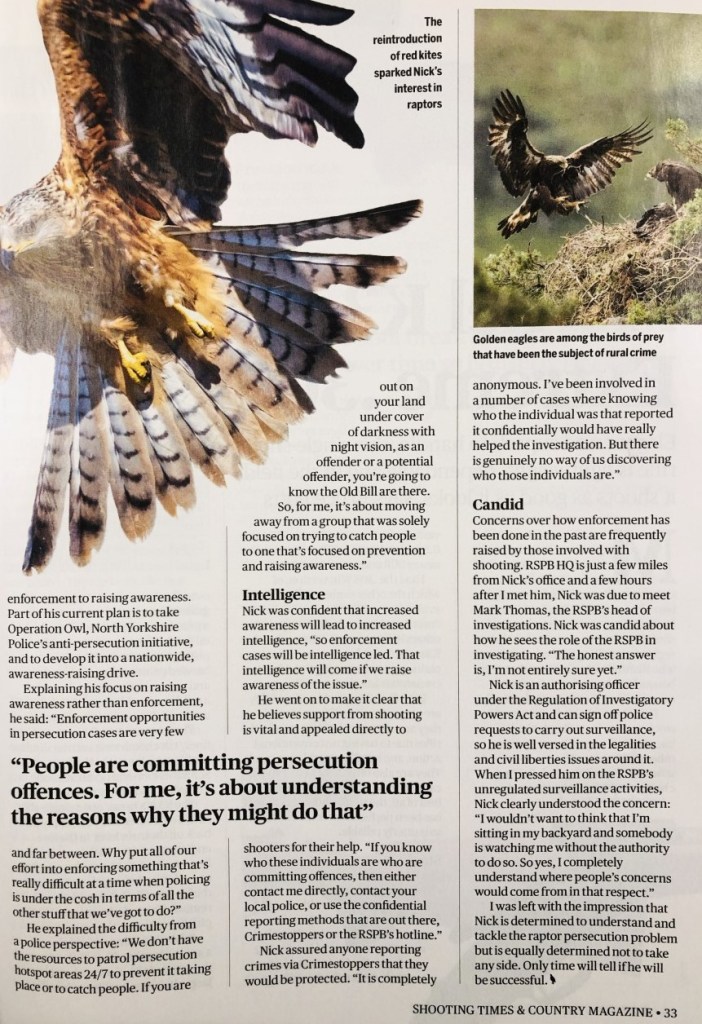
Here’s the interview:

Let’s congratulate the editor of Shooting Times for commissioning and then publishing this, especially at a time when prominent organisations from the game shooting industry were giving Nick Lyall a metaphorical two-fingered salute by challenging his integrity and refusing to attend a so-called ‘partnership’ meeting.

The congratulations would have been more hearty had Shooting Times taken the opportunity to publish the RSPB’s Raptor Crime Hotline number (0300 999 0101) one year after it was launched, but that still seems too difficult. Why is that? Even after the Raptor Crime Hotline was mentioned by Nick in the interview!

The interview itself wasn’t very enlightening, but that’s probably more to do with the style of presentation than anything else. We’re so used to listening to interviews on radio or podcasts, or watching them on TV, where both the question and answer can be heard, allowing us to place the answers in context. But for this interview, we have to rely upon someone else’s interpretation and that’s unsatisfactory for an issue as contentious as illegal raptor persecution because inevitably some answers will be given out of context.

For example, there is this floating paragraph:

Later in the interview, he [Nick Lyall] compared shooters involved with raptor offences to the smaller number of corrupt police officers‘.

Really? For such a significant (alleged) statement, it would have been good to have seen the context of that part of the conversation. As a stand alone statement it seems even more unlikely when you read what Nick had said about his understanding of who was committing raptor persecution crimes:

“…….there is clearly organised criminality in terms of multi-million pound industries that are committing persecution offences……..”

Gosh. Which “multi-million pound industry” is he thinking of?

There was also an odd bit at the end of the article where Nick is quoted during a discussion on the use of covert cameras:

I wouldn’t want to think that I’m sitting in my backyard and somebody is watching me without the authority to do so. So yes, I completely understand where people’s concerns would come from that respect“.

Again, this appears to have been taken out of context. We know, having had conversations with Nick about covert surveillance and the RIPA legislation, that he fully understands that covert cameras aren’t placed anywhere near anyone’s dwelling, let alone pointing at someone’s backyard, as this quote suggests. Rather, cameras are placed on remote moorland, miles from anyone’s house and any chance of intruding on their private lives. Typically they are pointed at the nests of Schedule 1 birds, which nobody should be visiting without a Schedule 1 Disturbance Licence anyway, or at illegally-set pole traps to find out who is operating the trap. To us, it looks like this quote has been included, out of context, simply to play to the shooting industry’s hatred of RSPB covert surveillance which, time and time again, has revealed what really goes on when the criminals think no-one is watching. E.g. here, here, here, here, here, here, here, here, here, here, here, here, here

Fortunately Nick Lyall is savvy and proactive enough to be able to present his own views, via his twitter account (@SuptNickLyall) and via his RPPDG blog (here). We know that he continues to work hard behind the scenes and we’re looking forward to seeing the launch of his Operation Owl website in the very near future, which aims to educate, inform and inspire people to get involved with tackling illegal raptor persecution.
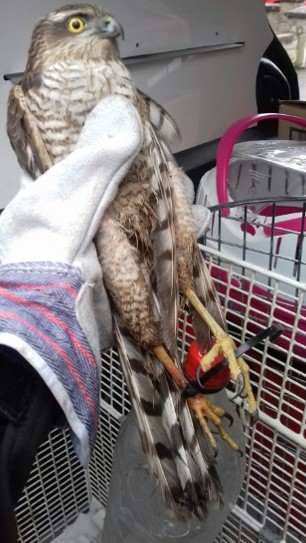
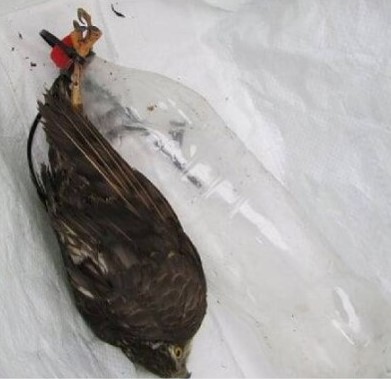
Sparrowhawk found tied to plastic bottle in Angus

The SSPCA is appealing for information after a sparrowhawk was found cable-tied to a plastic bottle in Carnoustie, Angus.

A member of the public found the bird on Sunday 7 April in a field at the top end of Lochend Road. The SSPCA attended and released the bird after checking it for injuries.

[Photos by SSPCA]

SSPCA rescue officer Dionne Boyack said, “We were notified by a concerned member of the public who came across the sparrowhawk. It was found to be tethered in an unusual way, so we don’t suspect this to be a falconer.  The bird was restrained with cable ties and attached to a bottle which was hindering its ability to fly. It is possible the bird got caught up in this unfortunate way by accident. After assessing the sparrowhawk for injury and being satisfied that he had none, I freed him and he flew away.

If anyone in the area has any information about how the bird came to be trapped in this way, please contact our confidential animal helpline on 03000 999 999.”

Fundraising fell runners to visit last known locations of missing hen harriers on northern grouse moors

Four ultra-marathon fell runners are taking on an extraordinary three day challenge in July, running 200km across grouse moors in Lancashire and Yorkshire.

The idea is to visit the last known locations of ‘missing’ satellite-tagged hen harriers on grouse moors in the Bowland AONB, Yorkshire Dales National Park and the Nidderdale AONB.

They’re doing this to raise awareness of hen harrier persecution and to raise £10k to support Wild Justice hen harrier projects. They also hope to raise funds that can be put towards rewards to secure prosecutions against those who kill hen harriers.

Their ultra-marathon will start at 8am on Weds 3rd July and end at 12 noon on Saturday 6th July.

If you’re a fell runner and would like to run with them, please contact Henry Morris (see website link below).

If you’d like to donate towards this fundraiser, please visit their crowdfunder page here

If you’d like to find out more about the four runners (a personal trainer, a nurse, an analyst and a music promoter, who’ll no doubt be labelled ‘animal rights extremists’ for their efforts) their route and their motivation for taking on this challenge, please visit their website here


Peregrine nest on Peak District grouse moor fails in suspicious circumstances

The Peak District Raptor Monitoring Group (PDRMG) has already reported the failure of a peregrine nest in the Peak District National Park, and the breeding season’s only just got underway!

You can read the group’s report here.

[Three abandoned peregrine eggs on the nest ledge, photo by Peak District Raptor Monitoring Group]

Of course, an abandoned nest is not a clear indicator that a wildlife crime has occurred and if viewed as an isolated incident, it could easily be argued that reporting this incident to the police is an over-reaction. Indeed, that’s exactly what we’d expect grouse shooting organisations to say. It’s what they do: play it down, make out that everything’s fine, that the persecution issue is “tiny and that there’s really nothing to worry about. And that’s a convincing argument, when viewing an incident like this in isolation.

However, incidents like this that happen on grouse moors in known wildlife crime hotspots (like the Peak District National Park) should never be viewed in isolation. Instead, they should be viewed as being part of a well-established pattern of failed peregrine breeding attempts in this region, and in every other region in northern England where grouse moors dominate the landscape.

We see it happen over and over and over again. In the Peak District, a so-called ‘partnership’ has consistently failed to address peregrine persecution (e.g. see here) and there have been several scientific papers making a direct link between grouse moor management and peregrine persecution here and across the UK, e.g. here, here, here, here.

It was only last month that we watched covert footage of a load of armed gamekeepers hiding close to a plastic peregrine decoy, on a grouse moor, er, in the Peak District (here).

[This peregrine was found shot next to a grouse moor in the Peak District National Park in 2016. It didn’t survive. Photo by RSPB]

And yet still it continues.

The police are investigating the latest suspicious loss of two breeding adults but to be honest there’s not much they can do unless they happen to stumble across a couple of shot peregrine corpses stashed under someone’s driving seat or chucked in the back of a Landrover, but even then it would be virtually impossible to prove who’d killed them and the charge would be for the lesser crime of ‘possession’.

In the meantime, this case will be hotly disputed at so-called ‘partnership’ meetings, the grouse shooting reps will come up with 101 reasons why the breeding attempt might have failed and not one of those reasons will be the probability that someone linked to the grouse moor has killed the breeding adults.

When you hear the inevitable denials and protestations, its worth remembering what happened to the poor Bleasdale peregrines and the grouse shooting industry’s response (here & here) when the RSPB’s video evidence was ruled inadmissible and the trial collapsed.

Hats off to the peregrine fieldworkers in the uplands who volunteer to monitor these breeding attempts, year after year, knowing full well what is likely to happen. Fortunately for us they’re willing to document these failures so everybody can see the pattern for themselves.

Prosecution continues against Scottish gamekeeper Alan Wilson for alleged wildlife crimes

The case against Scottish gamekeeper Alan Wilson continued with a procedural hearing at Jedburgh Sheriff Court on Monday 1st April.

Mr Wilson faces multiple charges of alleged wildlife crimes following a police raid on a shooting estate at Longformacus in the Scottish Borders in June 2017 (see here here and here).

Mr Wilson has not yet entered a plea but will have a chance to do so at another intermediate hearing, and depending on his plea, a potential trial date has been set to begin on 13 June 2019.

Please note: we will not be accepting comments on this news item until legal proceedings have concluded. Thanks.

Former Edradynate Estate head gamekeeper cleared of crop poisoning charges

David Campbell, the former head gamekeeper of Edradynate Estate in Perthshire, has been cleared of all charges relating to the poisoning of game crops on the estate in April 2017.

It had been alleged that David Campbell had maliciously damaged game crops by spraying them with an unknown substance which caused them to rot and perish. At the time of the alleged offences, Campbell was no longer an employee of the estate, having worked there since 1983 but after falling out with the landowner, millionaire city financier Michael Campbell (no relation), his employment was terminated in February 2017.

[Edradynate Estate, photo by Ruth Tingay]

Michael Campbell had told the court that he believed his former employee had caused the damage ‘in revenge’ and said he could identify David Campbell on CCTV by his distinctive “mutton chop” facial hair. Various witnesses had told the court that David Campbell had been “upset” at having to leave his long-term employment at Edradynate Estate.

Last week, David Campbell’s defence solicitor had argued that the case against his client should be dropped because there was a lack of evidence to show his client was the person caught on the covertly-filmed CCTV. Sheriff Gillian Wade had rejected the argument and said the court had been presented with sufficient evidence for the case to proceed.

However, at Tuesday’s court hearing Sheriff Wade cleared David Campbell after ruling the case against him had not been proved beyond reasonable doubt.

This latest failed prosecution is one of several linked to the Edradynate Estate, although the majority of the previous allegations have related to the alleged illegal poisoning of birds of prey, rather than alleged crop poisoning. Despite at least 22 police investigations over several decades (according to former Tayside wildlife crime officer Alan Stewart), nobody from Edradynate Estate has ever been successfully prosecuted for any of these alleged wildlife crimes.

[A poisoned buzzard at Edradynate in 2015, photo RPUK]

We’ve blogged about this estate a lot over the years (see links here), and most recently in relation to the alleged poisoning of two buzzards in 2015 and the Crown Office’s decision in 2017 not to prosecute one of the Edradynate gamekeepers (un-named), despite Police Scotland urging otherwise (see here).

Edradynate Estate is currently serving a three year General Licence restriction, imposed in Sept 2017 and which we believe relates to the alleged buzzard poisonings in March 2015.

Last year three dogs and two more buzzards were reported to have been “deliberately poisoned” in the area but nobody has been charged (see here) and we are not aware of any suggested link between these poisonings and any current employee of Edradynate Estate.

BASC still in denial about extent of illegal raptor persecution

There was a feature on illegal raptor persecution in the Peak District National Park on the BBC’s Sunday Politics (East Midlands) programme a couple of days ago.

You can watch it on BBC iPlayer here (starts at 21:02; ends at 25:05; available for 27 days).

The film began with an interview with Tim Birch from Derbyshire Wildlife Trust, who explained that illegal raptor persecution in the Dark Peak area of the National Park is particularly bad, affecting hen harriers, goshawks and peregrines. The Derbyshire Wildlife Trust is calling for stronger enforcement action on the criminals responsible and for the introduction of vicarious liability, to hold the landowners to account.

The presenter then spoke about the recent scientific paper on hen harrier satellite data, published a couple of weeks ago. She said:

When it comes to hen harriers a recent study by Natural England found they were ten times more likely to die if they were near or on land used for shooting. Now this study concluded that illegal persecution is having a major impact on the conservation of these birds. But not everyone agrees with the data. Duncan Thomas represents the shooting community and believes questions need to be raised“.

The camera then cut to Duncan Thomas, ex-police wildlife crime cop in the Forest of Bowland and currently the British Association for Shooting & Conservation’s (BASC) northern director. Here’s how the interview went:

Duncan Thomas:You know, what we have to be really careful of is the data that’s coming from these tagging programmes and who controls that data. I’d like to see much more transparency in the whole tagging process for the benefit of everybody“.

Interviewer:These wildlife charities say that there is a direct connection when it comes to the decline in birds of prey populations here in the Peak District and illegal persecution“.

Duncan Thomas:There is a tiny amount of persecution occurring and what we have to do is to work closely with our conservation partners to eradicate that. BASC and the other shooting organisations have a zero tolerance for wildlife crime. Any body committing any crime will be expelled from the organisations, the police will remove their firearms and shotgun certificates and they won’t be able to work, you know. There is a zero tolerance for it. You know, let’s work together and take this issue forward“.

[Duncan Thomas, struggling to understand the definition of “tiny”]

Given the extensive catalogue of evidence that demonstrates the appalling level of wildlife crime in the Peak District National Park, Duncan Thomas’ refusal to acknowledge it just makes him, and BASC, look ridiculous.

That evidence dates back at least 20 years and resulted in two damning summary reports published by the RSPB: Peak Malpractice (here) and then Peak Malpractice update (here).

Then came the Peak District National Park Bird of Prey Initiative in 2011, a so-called ‘partnership’ aimed at restoring raptor populations in the Dark Peak part of the Park. This Initiative has failed to deliver on every single target since then (see here and here) and is barely hanging by a thread (here).

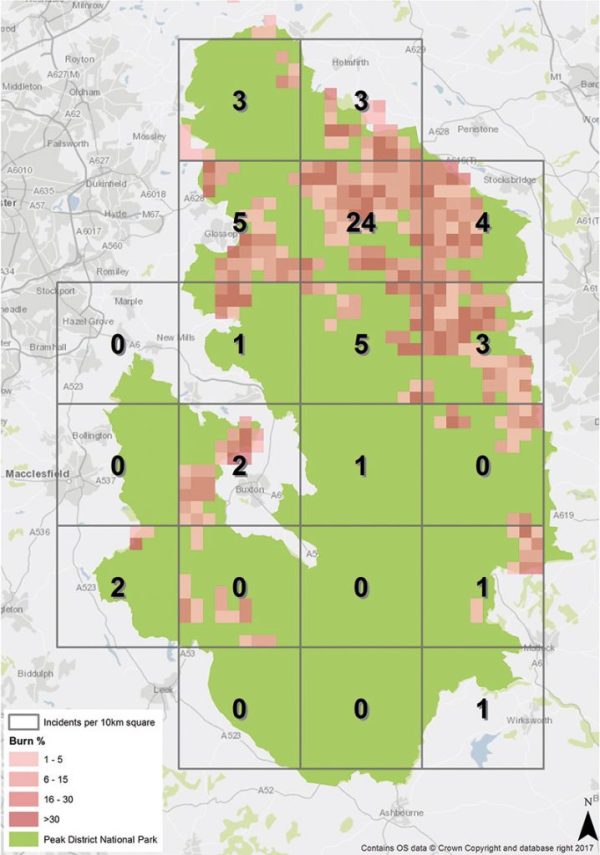
Then last year a scientific paper published in the journal British Birds comprehensively linked the illegal killing of raptors with areas of land managed for driven grouse shooting in the National Park (see here). Here is a map from that paper showing the number of raptor persecution incidents against the backdrop of grouse moors (burned heather).

To suggest that the scale of raptor persecution in the Peak District is a “tiny amount“, even though it’s been shown repeatedly, for many years, to be having population-level effects on hen harriers, goshawks and peregrines, is either fatuously ignorant or wilfully blind.

Instead of acknowledging these widespread crimes, Duncan Thomas instead focused on trying to undermine the hen harrier satellite tag data which were collected by a Government agency, analysed by international scientists and published in an exceptionally high quality journal!

And it’s simply not true that the shooting organisations operate a zero tolerance policy for wildlife crime. If only they did, this issue would be resolved very quickly! For example, not one of them published a statement to condemn the shooting of Marsh harriers at a nest on Denton Moor nor issue an appeal for information to identify the armed men dressed as gamekeepers (here).

Instead, what we see repeatedly are shooting organisation representatives sneering and ridiculing the RSPB when covert video evidence has been ruled inadmissible in prosecutions for alleged raptor crime (Duncan Thomas has a track record of this – e.g. here), we see high-end barristers (often of QC status) brought in to defend the accused (who pays the legal fees, because they’ll be beyond the gamekeeper’s pocket?), and instead of expulsions from shooting organisations following a successful conviction we see statements of support (e.g. here).

On top of all that, we understand that BASC is accepting funds from several people who are also involved in the management of a number of estates notorious for both confirmed and alleged wildlife crimes. We’ll be exploring that relationship, also shared with GWCT, in another blog.

Does any of that look like zero tolerance to you?

Oh, and Duncan, about your idea of “working together“. That won’t happen when BASC and its fellow raptor persecution apologists boycott a meeting designed to, er, work together to tackle illegal raptor persecution.

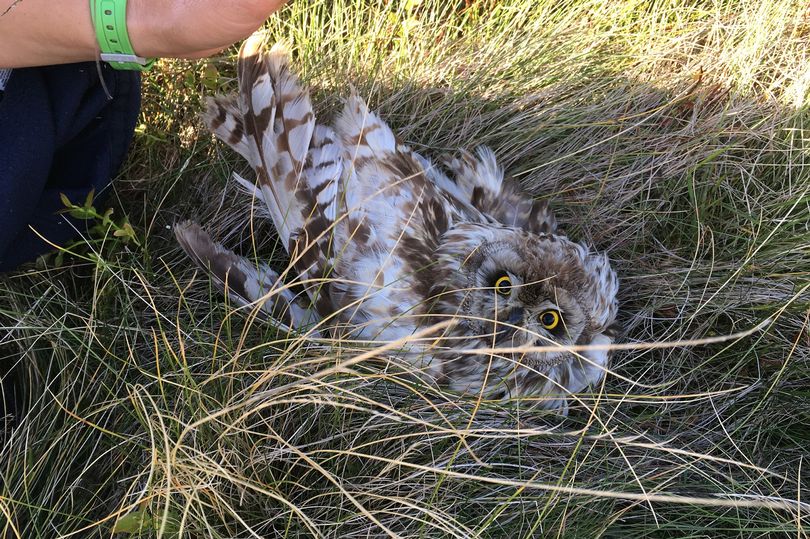
[Photo of a short-eared owl that was found shot in the Peak District National Park last year. A shot tawny owl was found stuffed in a drystone wall not far away. Photo via RSPB]


Natural England approves reintroduction of white-tailed eagles to Isle of Wight

Natural England press release (2 April 2019)

Natural England issues licence to release white-tailed eagles

Natural England has issued a licence to allow the release of white-tailed eagles on the Isle of Wight.

The release is part of a project, led by the Roy Dennis Wildlife Foundation and Forestry England, to establish a breeding population of white-tailed eagles in southern England.

White-tailed eagles became extinct as a breeding species in England in the eighteenth century.  Releases over the past 40 years have successfully re-established breeding populations in Scotland and Ireland.

Natural England has very carefully considered all aspects of the licence application.  I would like to personally thank the expert working group of local staff and national specialists who have carefully tested the application against our licensing criteria and the IUCN: International Union for Conservation of Nature’s Guidelines for Reintroductions and Other Conservation Translocations.

We have paid particular attention to:

  • the impacts on other wildlife and socio-economic interests, including livestock
  • the risk of disease transmission
  • the feasibility of the proposal and likely success
  • any risk to the donor population
  • the contribution to the conservation of white-tailed eagles
  • the adequacy of the applicant’s consultation, the evidence of support and how issues raised will be addressed
  • the applicant’s experience
  • the applicant’s monitoring plan
  • evidence of sufficient finances to support the project
  • the applicant’s communications plan and exit strategy

We have very thoroughly assessed the potential impacts on protected site features and existing wildlife.  We have discounted any adverse impacts through direct predation and disturbance by the eagles or indirectly through increased visitor pressure from ‘eagle tourists’.

We have carefully examined the potential risk of lamb predation.  There is no evidence of this becoming a problem where the eagles live alongside lowland sheep farming in Europe.  However, we will ensure that the applicant puts in place clear routes to identify and manage any unexpected issues that might arise.

The licence permits the release of up to 60 eagles (12 per year) over the next five years.  Young eagles will be sourced under licence from nests in Scotland and raised through to release on the Isle of Wight.   The first release is planned for summer 2019.

In response to queries raised through public consultation and our assessment, conditions attached to the licence ensure that no releases can occur until the applicants have:

  1. established a project steering group and a monitoring and management group with representation from key stakeholders and sectors
  2. developed a detailed monitoring strategy with clear evaluation and research objectives
  3. produced a communications strategy that clearly outlines mechanisms for escalating concerns and accessing advice and support to resolve them

Natural England is pleased to be able to license this application.  As described in the Government’s 25 Year Environment Plan, bringing back lost species in a well-planned and supported way not only helps wildlife populations recover, but can also help more people connect with nature and open up new business opportunities.

ENDS

Excellent news!

For more detail about the project, see the Roy Dennis Wildlife Foundation website here

Northern England hen harrier hotline re-opens

The RSPB has re-opened its hen harrier hotline for members of the public to report sightings of this highly persecuted bird of prey: Tel 0845-4600121 (calls charged at local rate).

[Photo by Tim Melling]

RSPB press release:

The RSPB is calling on people who spend time in the remote hills and moorlands of northern England to look out for hen harriers, England’s most threatened bird of prey.

The nature conservation charity has relaunched the Hen Harrier Hotline with the aim of finding out where these birds might be nesting.

In spring, the male hen harrier performs his courtship display known as skydancing, involving a spectacular series of swoops and somersaults. If he attracts a female, he attempts to further impress her by passing food offerings in mid-air.

Experts estimate there is enough suitable habitat in England for around 300 pairs of breeding hen harriers. But last year there were only nine successful nests in the whole country.

Hen harriers are teetering on the verge of extinction in England because of ongoing illegal killing. As they sometimes eat red grouse, they are often unwelcome on moors managed for driven grouse shooting. This form of field sport requires huge numbers of red grouse and some game managers resort to illegally killing or disturbing harriers to protect their business.

A recent scientific study found that hen harriers are 10 times more likely to die or disappear in areas with grouse moors than elsewhere.

The RSPB is calling for the introduction of vicarious liability (making game managers legally responsible for the actions of their staff) and a licensing system for driven grouse shooting, which would help stamp out illegal persecution and improve standards in the industry.

Amanda Miller, conservation manager for the RSPB in Northern England, said: “Last year’s breeding season was the best for a decade with nine successful nests, seven of which we played a key role in protecting. However, this is just a fraction of the number there should be and birds are continuing be illegally killed.

We are asking farmers, wildlife watchers, walkers, fell runners, mountain bikers and anyone else who spends a lot of time in the hills in the North to keep an eye out for hen harriers and let us know if they see one. It’s vital that we find out where they are breeding so we can protect the nests and give their chicks the best chance of survival.”

Male hen harriers are an ash-grey colour with black wing tips and a wingspan of just less than a metre. They are also known as ghostbirds because of the paleness of their plumage. Female hen harriers are slightly larger, are owl-like in appearance, and have a mottled brown plumage, which camouflages them when they nest on the ground. They have horizontal stripes on their tails, giving them the nickname ringtail and a patch of white just above, on the rump.

The Harrier Hotline number is 0845 4600121 (calls charged at local rate). Reports can also be e-mailed to henharriers@rspb.org.uk Reports of sightings should include the date and location of sighting, with a six-figure grid reference where possible. A description of the bird’s behaviour would also be useful.

ENDS

“Why I have suspicions of birds of prey persecution in Yorkshire Dales”

This letter was published in the Yorkshire Post on Saturday:

From: Trevor Brockway, Upper Fant Road, Maidstone, Kent.

I HAVE just returned from a few days walking in the Yorkshire Dales National Park. While walking between Aysgarth and Hawes, I noticed many dead rabbits beside the track.

These were found 100-200 metres apart and did not look diseased. I then realised that I had not seen a single bird of prey on these grouse moors. I had seen many red kite, buzzard and kestrels on my journey from Kent. This aroused my suspicion that the rabbits were being used for bait to lure the birds down to be shot or perhaps the rabbits were poisoned. This would be a criminal act under the Wildlife and Countryside Act 1982.

The following days were the same. While walking between Aysgarth and Askrigg and between West Burton and Horsehouse, there was not a single bird of prey.

I have since read two reports which say that the park is a hotspot for bird of prey persecution.

I am aware that grouse shooting brings in valuable income to the area, but so does tourism, such as recreational walking, etc. There should be a way to rear grouse but still protecting our beautiful birds. Also, talking to local people, it would appear that it is common knowledge that birds of prey are shot. Although this is only anecdotal, it is another indication that the law is being breached and the problem does exist. I will certainly not return to this area of the Dales until the persecution of birds is stopped, and would hope others would not visit.

I am sorry to be writing this letter but I feel so strongly about the issue and hope that it may go some way to stopping the illegal practice.

ENDS