Wild Justice wins its first legal challenge

In February this year, not-for-profit company Wild Justice launched its first legal challenge which was a challenge against the casual killing of birds permitted under Natural England’s General Licences.

This legal challenge was supported by over 1,000 people who pledged £36,000 to cover the legal costs.

That legal challenge has been successful and late this afternoon Natural England posted the following statement on the gov.uk website:

GENERAL LICENCES FOR BIRD CONTROL: MAJOR CHALLENGES TO LICENSING REQUIREMENTS

Natural England announces changes to three general licences for controlling specific wild bird species.

Natural England is revoking three general licences for controlling certain wild birds as of Thursday 25 April 2019.

These licences (GL 04/05/06) cover 16 species of birds including several members of the crow family, Canada goose, some gulls and pigeons.

The change follows a legal challenge to the way the licences have been issued, which could mean users who rely on them are not acting lawfully.

Natural England is working at pace to put in place over the next few weeks alternative measures to allow lawful control of these bird species to continue where necessary. In the meantime, once the licences have been revoked and until new licences are issued, anyone needing to control one of these 16 bird species where there is no reasonable non-lethal alternative will need to apply for an individual licence.

The action is the first stage of a planned review of general and class licences, which will be completed this year.

Natural England’s interim chief executive Marian Spain said: “We recognise this change will cause disruption for some people, but we are working hard to ensure it is kept to a minimum. We will bring forward interim measures as quickly as possible as the first stage of our planned review of the licences. We want to make sure our licensing system is robust and proportionate, taking into account the needs of wildlife and people“.

What to do if you use a general licence

It is expected that, over time, many situations currently covered by the three general licences will be covered by new licences.

Natural England is undertaking new licensing assessments to support lethal control of certain birds in defined situations, such as to prevent serious damage to livestock from carrion crow and to preserve public health and safety from the impacts of feral pigeons. It intends to start issuing these licences on gov.uk from the week commencing 29 April when more details will be available.

If people need to take action in the meantime they will need to apply for an individual licence, using a simplified process which will be available on gov.uk from 25 April.

In limited circumstances, people may be allowed to undertake urgent action in accordance with the existing requirements of section 4 of the Wildlife and Countryside Act 1981.

Anyone exercising lethal control of birds after Thursday 25 April 2019 without taking the above steps will not be covered by a general licence and could be committing an offence.

If you are unsure what you should do on your land, visit the Natural England licensing webpage for more information and advice.

Background on the general licence

General licences were introduced in the 1990s to allow the legal control of bird species of low conservation concern to protect public health and safety, prevent serious damage and disease, and protect plants and wildlife.

Further details of the wider review into the operation and provision of general licences will be shared shortly. We will seek feedback from those using them and from wildlife protection and other groups. We expect to complete this review by the end of the year.

Part of Natural England’s role is to ensure relevant provisions of the Wildlife and Countryside Act 1981 are upheld to protect wildlife, as well as recognising the needs of people.

Background

Currently the three licences subject to the legal challenge cover 16 bird species, including several members of the crow family (crows, magpies, rooks, jackdaws and jays), feral and wood pigeon and number of invasive non-native species (such as Canada goose).

The specific licences:

  • General licence GL04: To kill or take certain species of wild birds to prevent serious damage or disease
  • General licence GL05: To kill or take certain species of wild birds to preserve public health or public safety
  • General licence GL06: To kill or take certain species of wild birds to conserve wild birds or flora or fauna

ENDS

Obviously there is a lot to discuss about this case and Wild Justice will be issuing a detailed statement tomorrow after taking further legal advice.

Wild Justice explores more projects with top wildlife cops

In February Wild Justice launched a legal challenge against the casual killing of birds permitted under Natural England’s General Licences (see here).

Natural England has yet to respond, although the deadline is looming (25 April 2019 to respond to the court and a further seven days to respond to Wild Justice, so by 2 May 2019 at the latest).

Meanwhile, Wild Justice Directors have been busy exploring other potential projects with a number of senior police officers who specialise in tackling wildlife crime. Earlier in April they met with Chief Inspector Lou Hubble (Head of National Wildlife Crime Unit, NWCU) and Deputy Chief Constable Craig Naylor (National Police Chiefs Council, NPCC). This was an extremely productive meeting and a number of themes have since developed as a direct result.

On Thursday Wild Justice Directors met with Superintendent Nick Lyall, Head of the Raptor Persecution Priority Delivery Group (RPPDG) to continue to build a strong working relationship and share some information. Given that Nick was supposed to be on annual leave but still chose to come along is a measure of his commitment to this issue. He has some excellent ideas for moving things forward on a few fronts and the determination to deliver. Watch this space.

Also on Thursday, Wild Justice Directors met with Chief Inspector Phil Vickers in what was an enlightening discussion about illegal hare coursing and how Wild Justice might contribute most effectively to Operation Galileo, the national police response to tackling this wildlife crime. Ideas are currently in development and discussions with other interested organisations have been arranged.

West Yorkshire Police appeal for info after buzzard found shot dead

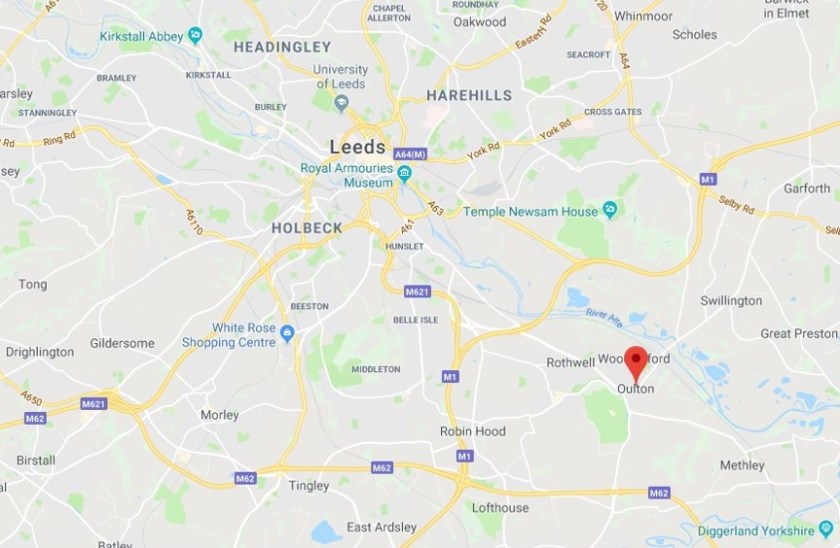
West Yorkshire Police are appealing for information after the discovery of a shot buzzard in the Oulton area of Leeds.

The buzzard was found dead.

No further details have been publicised.

If you have any information please contact the police on 101 (ref# 13190200712) or Crimestoppers on 0800 555 111 or the RSPB’s Raptor Crime Hotline on 0300 999 0101.

Job opportunity: White-tailed eagle project officer, Isle of Wight

Following the news that Natural England has approved the reintroduction of white-tailed eagles to the Isle of Wight as part of a conservation effort to re-establish a breeding population in southern England (here), the project team is now recruiting for a White-tailed eagle Project Officer.

Strangely, the post is only offered as a ‘Fixed Term Appointment for 2 years with the possibility of extension or permanency but no guarantee’ whereas the proposed reintroduction is planned to cover a five-year period. Nevertheless, it’s a fantastic opportunity to be part of an exciting conservation initiative and to work with a great team of conservationists and of course an incredible species.

JOB SPECIFICATION

Location: Isle of Wight

Salary: £25,673 – £28,428

Hours: 37hr/week, full time, flexible working

Job background: South England Forest District manages some 46,000 hectares of the public forest estate across West Sussex, Surrey, Berkshire, Hampshire, Isle of Wight, Dorset & South Wiltshire. Much of the land is of high importance for nature conservation, supporting some 29,000 hectares (ha) deemed to be of national importance for wildlife of which approximately 28,000 ha are also designated as being of international importance for biodiversity as Special Areas of Conservation (SACs), Special Protection Areas (SPAs) and Ramsar sites. The majority of the land managed by the District is also within areas designated for their landscape value, including 4,000 ha within AONBs and 31,500 ha across two National Parks.

The White-tailed Eagle project is a partnership with the Roy Dennis Wildlife Foundation, to reintroduce this species back to the south coast of England. The project has a Natural England licence to release birds over a 5 year programme, starting June 2019.

Job description: To deliver the reintroduction project on the Isle of Wight. The Project Officer will work closely with Forestry England’s ecology team and the Roy Dennis Wildlife Foundation to carry out a successful reintroduction programme with good monitoring and close liaison with our stakeholders and the wider public.

Key work areas: The post holder will develop a volunteer network to help deliver the reintroduction process, including feeding of the birds and monitoring post release.

  • Oversee information dissemination via a project website, social media and a programme of guided walks and talks.
  • Develop information around how and where to see the birds, including developing interpretation material for the project.
  • The monitoring and feeding of juvenile birds after their arrival on the Isle of Wight.
  • Post release monitoring will involve close observation of the birds in the field and the use of both radio and satellite tracking.
  • The key person liaising with stakeholders both on the Isle of Wight and on the mainland to ensure the success of the project.
  • The first point of contact for any concerns raised by the local landowners and organisations, with support from Forestry England ecology team and the Roy Dennis Wildlife Foundation.
  • Be local to the Isle of Wight so that they can be on hand during the period when the birds are in cages at the release location and during post-release feeding.
  • Work with local enterprises looking to add value to the project.
  • Support the Bird Aware project in the Solent.

Essential experience:

  • Sound knowledge and understanding of birds and wider ecology.
  • Experience working with local stakeholder groups, including: farmers; landowners; non-governmental organisations; charities; local government.
  • Experience working with the public.
  • An effective communicator, both written and verbally.
  • Fieldwork experience of monitoring birds, particularly raptors
  • Experience engaging with volunteers, volunteer recruitment and management.
  • Competent in IT – Microsoft Office, website content and social media.
  • Current resident of the Isle of Wight or prepared to relocate.

Desirable experience:

  • Practical experience of species reintroduction projects.
  • Sound knowledge of the application of environmental legislation to project planning and delivery in the context of species reintroductions.
  • Experience developing a suite of interpretation for a project.
  • Experience in monitoring using satellite tagging.

Closing date: 1 May 2019

Interview date: 14 May 2019

For further details and how to apply, please see here

Northants police appeal for information after buzzard found shot

Police are appealing for information following the discovery of an illegally shot buzzard in east Northamptonshire.

The injured buzzard was found off Shelton Road, near Hargrave, on 25 March 2019.

The bird was caught and taken to a vet, where an x-ray confirmed it had been shot. The buzzard is now recovering in the care of a local wildlife charity.

It is a criminal offence to shoot birds of prey, including buzzards.

Witnesses to the shooting or anyone with information about the incident are asked to contact rural crime team officer PC Chloe Gillies by calling 101, or Crimestoppers in confidence on 0800 555111.

ENDS

BASC’s mask slips again as Director dismisses sat tag evidence as “hysterics”

Have a look at this tweet from Duncan Thomas, a regional director of the British Association for Shooting & Conservation (BASC):

Dear oh dear. And BASC had been trying soooooo hard to convince everyone it accepted the findings of the recently published hen harrier satellite tag paper that showed at least 72% of sat tagged hen harriers were presumed illegally killed on grouse moors.

In response to that scientific peer-reviewed paper BASC’s Executive Director of Conservation had even stated:

We are grateful that this research has been carried out. Satellite tags are a tool in the fight against persecution. We have to make sure there is no place left for criminals to hide“.

This is the second time in recent weeks that Duncan Thomas has caused what should be considerable embarrassment to those at BASC’s head office – last time was when he went on the telly to claim that “there’s a tiny amount of persecution occurring” [in the Peak District National Park] despite overwhelming evidence that’s stacked up over the last two decades that shows otherwise –  see here.

Does this look like an organisation committed to tackling the illegal killing of birds of prey?

Why is BASC still a member of the Raptor Persecution Priority Delivery Group (RPPDG)? It boycotted the last RPPDG meeting and then shortly afterwards claimed it was still “committed to constructive dialogue“.

Does referring to the scientific findings of the hen harrier and golden eagle sat tag papers as “#raptorhysterics” look like constructive dialogue to you?

How will this appalling attitude help progress the work of the RPPDG?

Police target bird egg thieves in Operation Easter 2019

Press release from National Wildlife Crime Unit

OPERATION EASTER 2019 – STOPPING EGG THIEVES AND EGG COLLECTORS

Wild birds are nesting and the national campaign to protect them across the UK is underway. Egg thieves will go to any lengths to raid the nests of rare species but Operation EASTER is determined to stop them in their tracks.

Operation EASTER was developed in Scotland 22 years ago.  The operation is now facilitated by the National Wildlife Crime Unit (NWCU) in conjunction with UK police forces and partner agencies.  The operation targets egg thieves by sharing intelligence across the UK to support enforcement action.

In recent years the operation has also been expanded to look at those who might take raptor eggs or chicks to launder into falconry, those who are suspected of disturbing nests for photography and those who trade eggs online.

The taking of wild bird eggs is a serious crime yet it remains the pastime of some determined individuals.  Whole clutches of eggs can be taken from some of the UK’s rarest birds with potentially devastating impacts. The eggs are stored in secret collections.

Chief Inspector Lou Hubble, head of the NWCU, said: “As populations of many birds decline, the NWCU are committed to Operation EASTER.  We will be working alongside partners and police forces to help to protect nesting sites and would encourage anyone who witnesses suspicious activity to report it to their local police force”.

If you have any information on egg thieves, or those who disturb rare nesting birds without a licence, you should contact your local or nearest police station by dialing 101 and ask to speak to a wildlife crime officer if possible. Nesting will be in full swing by April so please contact the police if you see anyone acting suspiciously around nesting birds.

Information can also be passed in confidence to Crimestoppers via 0800 555 111.

ENDS

‘Almost a fifth of Scotland is managed for grouse shooting’

‘Almost a fifth of Scotland is managed for grouse shooting’.

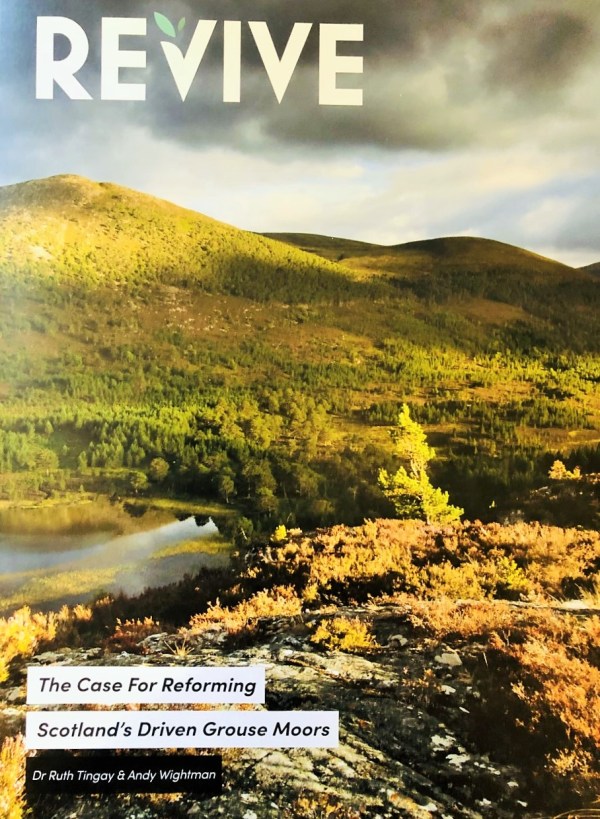
This claim was made in a 2018 report, The Case for Reforming Scotland’s Grouse Moors, authored by Ruth Tingay & Andy Wightman and published by Revive: The coalition for grouse moor reform.

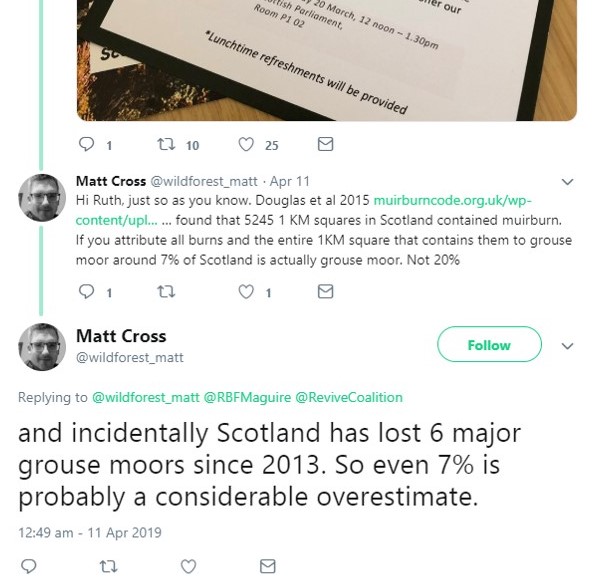
The ‘almost a fifth’ claim is an attention-grabber and often shocks people, which is why it is regularly used by Revive as part of its campaign material. For example, here in a flyer advertising a fringe event hosted by Revive at the forthcoming SNP spring conference:

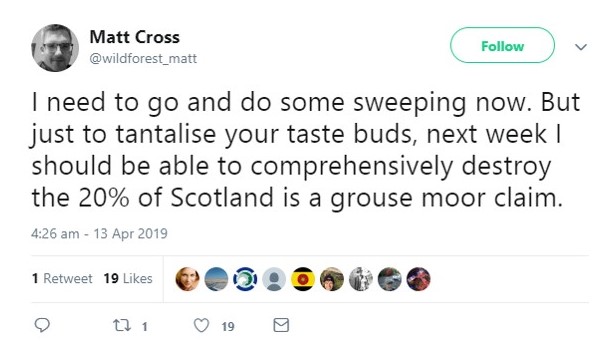
Unsurprisingly, there are some supporters of grouse shooting who appear to be intensely irritated by the ‘almost a fifth’ quote and have been trying to discredit it in recent weeks. Actually, not just discredit it, but apparently to “comprehensively destroy” it.

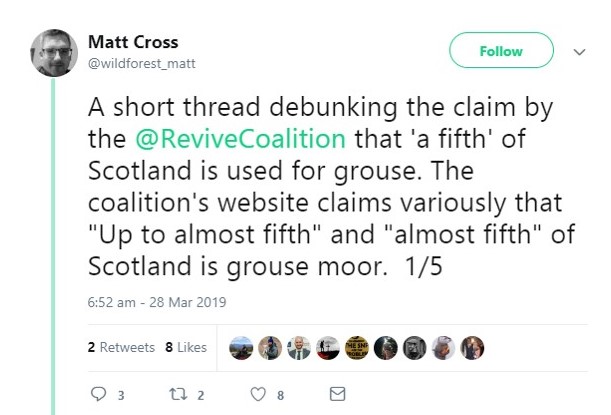
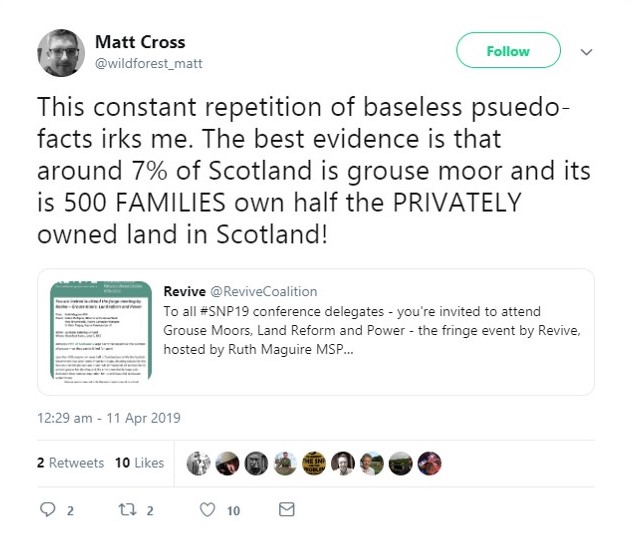
A bold claim indeed. Unfortunately not one that the claimant could live up to. The following screen grabs are from Matt Cross’s twitter account (he’s a ‘journalist’ who writes stuff for Shooting Times – not always accurately, see here & here). Thanks to the blog reader who sent them in:

Oh dear. It appears Mr Cross isn’t quite the brilliant researcher he thinks he is. First he claims that Revive “didn’t provide a source for the [one fifth] claim” and then he decides the source was a 28 year old publication.

He’s wrong. On both counts.

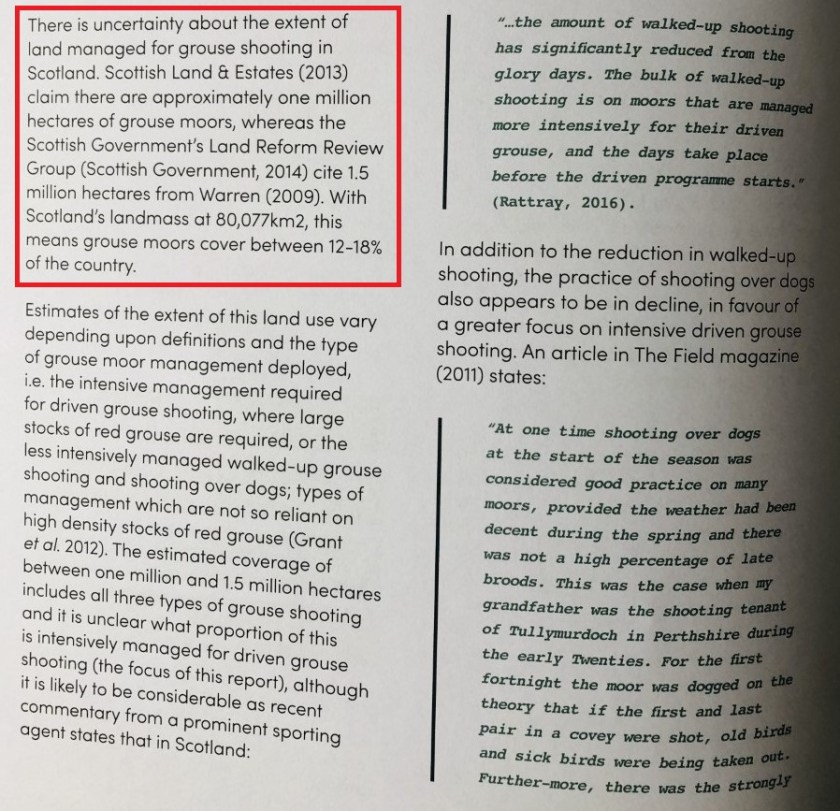
Had he read Revive’s report, which is readily available on the Revive website, he would have found this, on page 10:

So, to clarify. The ‘almost a fifth’ claim was based on two sources – one from the grouse moor owners’ lobby group Scottish Land & Estates and one from the Scottish Government’s Land Reform Review Group. Neither of these sources are 28 years old.

The Revive report makes no comment on the validity of those two sources (as that would have been beyond the scope of the report) but used them in good faith as the best available evidence. The report also included the caveat that ‘Estimates of the extent of this land use vary depending upon definitions and the type of grouse moor management deployed’.

The report further explained (on page 11) ‘Further complications arise in estimating the extent of land used for grouse shooting when one particular aspect of grouse moor management (predator control) is taken in to account. Predator control occurs on the grouse moor itself but also beyond the boundary of the moor (e.g. in forestry blocks or on in-bye ground) so the mapping of moorland habitat alone is insufficient to calculate the full extent of grouse moor management as a land-use ‘type”.

For all these reasons, it is perfectly legitimate for Revive to state that ‘Almost a fifth of Scotland is managed for grouse shooting’.

Scottish gamekeeper Alan Wilson accused of 12 wildlife crimes

Further to previous blogs on the prosecution of Scottish gamekeeper Alan Wilson for alleged wildlife crimes in the Scottish Borders (see here, here here and here) further details have emerged about the charges he faces.

From the Peebleshire News (12/4/19) (and with thanks to the blog reader who sent us a copy):

WILDLIFE CHARGES

A gamekeeper has been accused of 12 wildlife offences at Jedburgh Sheriff Court. Alan Wilson, 60, is charged with shooting two goshawks, four buzzards, a peregrine falcon, three badgers and an otter at Henlaw Wood, Longformacus, between March 2016 and May 2017.

He also faces charges of using a snare likely to cause partial suspension of animal or drowning, failing to produce snaring records within 21 days when requested to do so by police and no certificate for an air weapon.

Wilson, of xxxxx xxxxx xxxxx pleaded not guilty to all 12 charges and a trial date was set for June 13 with an intermediate hearing on May 27.

ENDS

Please note: we will not be accepting comments on this news item until legal proceedings have concluded. Thanks.

Illegal trap user escapes trial after prosecution shambles

Here’s another example of another raptor persecution case collapsing.

This was published in the latest edition of Legal Eagle (#87), the RSPB Investigation Team’s newsletter:

It’s so frustrating. Yes, the CPS is massively under-resourced and struggling to cope with far more serious crimes than this, so even more justification, then, for the need for a specialist wildlife crime unit to investigate and then prosecute alleged offenders.

Who’d pay for that? Licence the entire game shooting industry, which is the industry responsible for the vast majority of raptor persecution crimes, and it’d raise millions. Sorted.