
In yesterday’s blog (here) we discussed how the raptor-killing criminals have changed tactics to avoid detection and are going to greater lengths to remove/hide the evidence of their crimes.
This latest case is a good example of how this may be happening and how this can lead to raptor persecution crimes remaining undetected.
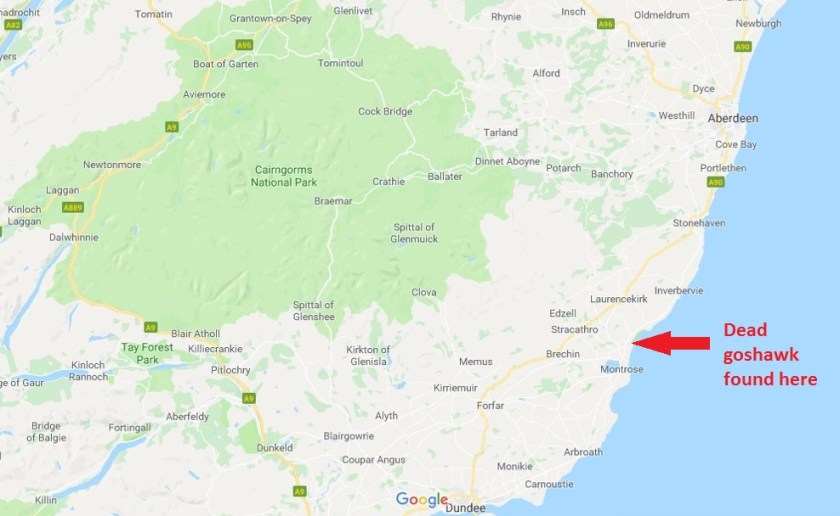
In March 2018 a member of the public found a dead goshawk washed up at the mouth of the River North Esk near St Cyrus in Aberdeenshire. The bird had an identifying leg ring and the finder reported this ring number to the British Trust for Ornithology (BTO). The BTO quickly notified the ringer, Dr Chris McGuigan, and provided him with the grid reference of where the bird had been found. Chris contacted a colleague in the area (Simon Ritchie) who was able to attend the scene and collect the fresh corpse.
[Photos of the dead goshawk by Simon Ritchie]
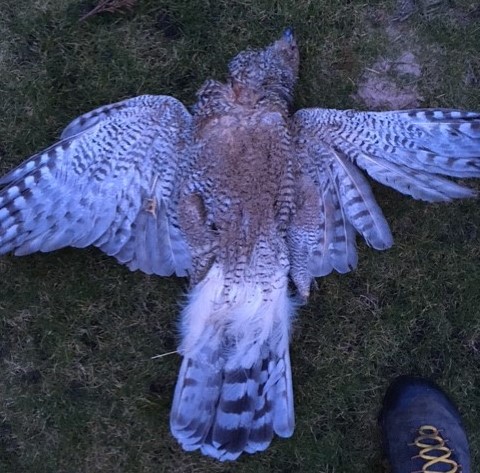
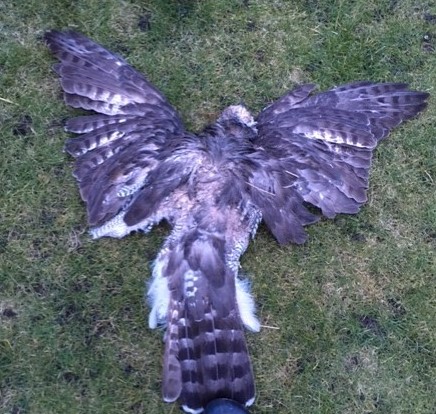
Chris was able to identify the bird as one of three females that were ringed as chicks in Angus in 2014:
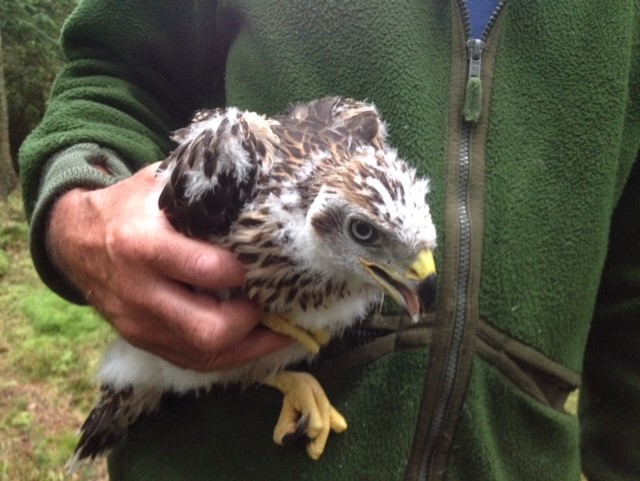
Having experience of finding dead raptors in Angus which upon closer examination turned out to have been illegally shot, and given the location of where the corpse had been found (not prime goshawk habitat), in addition to the known level of hatred directed towards goshawks by many in the game-shooting industry, Chris took the decision to submit the dead goshawk for testing. It was a very good decision.
The goshawk was sent to the Royal School of Veterinary Studies at Edinburgh University where an x-ray revealed the goshawk’s body was peppered with lead shot, suggesting it had been shot at close range.
So how did the dead goshawk end up washed up on the shoreline at the mouth of the River North Esk? Given the large amount of lead shot in its body it would have died immediately, so it’s possible it was killed on the shoreline and left to rot, although this seems unlikely given the habitat and the stupidity of leaving an illegally-killed raptor in full view of any passing members of the public.
Another explanation is that the goshawk had been shot and killed further inland and then tossed in the river for the water to carry away the corpse (and thus the evidence of the crime).
[Map showing the River North Esk running down through the Angus Glens grouse moors and out along the plain to the North Sea]
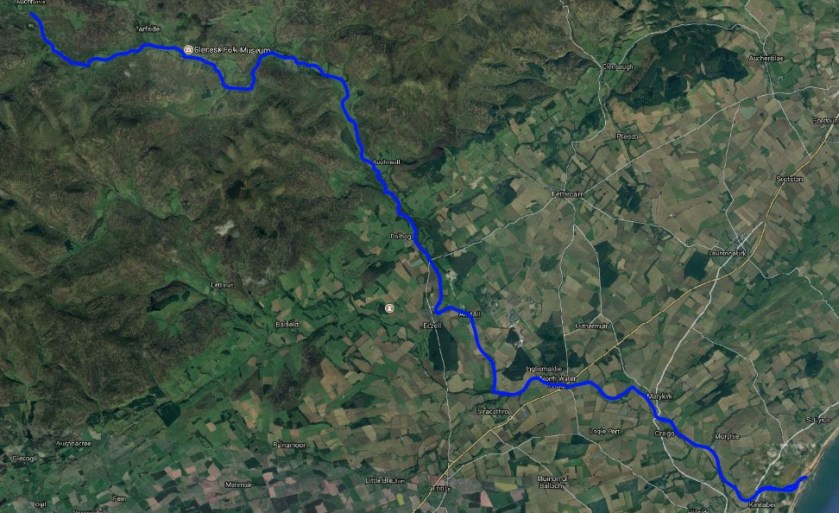
Undoubtedly there will be some who consider this explanation far-fetched, but throwing dead goshawks in to rivers isn’t unheard of in Scotland – we’ll shortly be reporting on another case that includes some amazing supportive evidence……we’re just waiting for a bit more detail on that one.
Meanwhile, back to the investigation in to the illegal shooting of this goshawk in Angus….
When Chris submitted the goshawk carcass to the Edi Vet School he hadn’t notified the police as there was nothing to report at that stage – just the discovery of a dead goshawk. However, when the x-ray revealed the lead shot in the goshawk’s body, he asked the staff member to report the incident to Police Scotland.
We understand that the staff member sent the corpse to Scotland’s Rural College (SRUC) for a post-mortem (standard practice) and that the SRUC would then notify the police.
However, when we contacted Police Scotland last week to ask about the status of the investigation and why they hadn’t made a public appeal for information (this goshawk was found in March, remember, that’s seven months ago!), we were told that the police had only been informed about the incident ‘in the last couple of weeks’ and so the investigation was ‘at the very early stages’.
We asked Police Scotland for a crime reference number that we could include in this blog but we were told that a crime number ‘had not yet been issued’.
Hmm.
There are several lessons to learn from this case, not least the importance of submitting carcasses for further examination to help detect criminal activity – if Chris & Simon hadn’t acted, this crime would not be recorded in the official statistics.
But this case also highlights the importance of sending reports of suspected raptor crime to RSPB Scotland at the earliest possible time, so if there is a subsequent breakdown in communication between the authorities, which appears to have happened in this case, the RSPB can follow-up and make sure that at least these crimes are properly recorded and investigated, even though the chances of catching the culprit are precisely zero.
UPDATE 20 Oct 2018: This blog has been picked up by an article in The Express (here)
UPDATE 20 Oct 2018: This blog has also been picked up by an article in The Press & Journal (here)
 Raptor Persecution UK
Seems to be a pattern of raptors turning up in the North Sea (Like Fred)
One could suspect collusion and corruption everywhere outside of the conservation movement if one were so inclined.
Id have to say that looking at the photos of the dead bird it hasnt spent ant time in water?
You may be right – the bird does not look particularly water-logged in the photos as far as one can judge. This may call into question the plausibility of the specific suggestion that it may have been thrown into the river as a means of disposal of the evidence but in no way alters the fact that a crime has clearly been committed somewhere. Equally, the comments in the post about the importance informing RSPB as soon as possible of any suspected bird crime are valid irrespective of where the bird was shot and how it came to be on the shore at St Cyrus.
Did you see how much rain came down in some parts of Scotland last week, it was torrential? If it was raining hard in February or March it could have taken a very short time to travel that distance.
Do not trust police or Government figures relating to wildlife crime.
And so the killing goes on……….Rosanna Cunningham could always release more special constables to deal with serious and organised wildlife crime which is happening on an industrial scale across Scotland and threatening our rarest of species.
Independence at all costs !!!!!
One might suggest that the bird was caught in a Larden Trap, shot at close range and intentially dumped at St. Cyrus as it is a Nature Reserve popular with many birding enthusiasts some of whose comments regularly appear on various online wildlife sites. Nasty stuff, anyhow, and has the distinct aroma of tweed hanging around it.
Think you’re right, definitely looks like another example of rubbing their noses in it.lesl
Main lesson here to note is that in the main the police do not care or are not interested, and if it gets to court the accused will only get a slap on the wrist. Such is the sad state of life in 21st century England.
In an effort to deflect blame, retired gamey Mr Fruit Punnet said ” where the bird was found indicates that it was feeding on the Corophium volutator in the fine sediments at low tide… it accidentality ingested ancient spent shot and was too heavy to fly off when the tide came in.” ………”oh dear”….
Its worth reading their guff….just shows how low their credibility has sunk.
This is a good one….. https://www.gwct.org.uk/blogs/news/2018/october/the-ecologist-%E2%80%93-what-they-don%E2%80%99t-what-their-readers-to-know/?fbclid=IwAR1bO_g14J1EcTeXCZaJc7TQ-0YvOWl795oJAElhq0OZ7fHr1ns_VoxdA0c#.W8b1DlBr7es.facebook
Talk about misrepresentation!
I can’t avoid commenting that the police seem to be dragging their feet on this incident and I wonder why?.
It’s hard to say for sure, John.
When Dr Chris McGuigan was informed by the Edi Vet School that the x-ray had revealed a large amount of lead shot, he specifically asked (and thus expected) that the Vet School would alert the police.
However, in recent correspondence the Vet School staff member stated the corpse was sent to SRUC for a post mortem and that they expected SRUC to report it to the police. Chris McGuigan knew none of this for months, and had assumed the Vet School had reported it to the police who were then investigating. Had he been aware that this wasn’t the case we’re pretty sure he would have reported the case himself.
We emailed the police about this case a few weeks ago and it took a number of emails and nudges to get a response, and then we had a phone call to say the case had only been officially reported to them in the last few weeks.
If the police claim is accurate, then it looks like a complete breakdown in communication between the Vet School, SRUC and the police.
Although we were somewhat surprised to learn that the police still hadn’t got a case reference number several weeks after the case being reported to them.
It may just be a sad reflection of “the state we’re in,” but I sometimes worry that we overstep the mark in our range of conspiracy theories. There is little doubt that a crime has taken place in regard to this incident, but without any further evidence (so far), is it really worthy speculating so vividly in some cases? There is a (small?) danger this could lead to lack of credibility, and it could certainly provide an opportunity for mockery from the enemies of predatory birds. In my experience over half a century, the shooting community doesn’t just consist of middle class gentlemen (sic) and gamekeepers, there is also an element of common working men (notably very few women) who roam the urban fringe with their dogs, shotguns and .22 air rifles determined to kill as many wild animals as possible. They are really just a less wealthy element of society with similar moral values to fox hunters and grouse shooters. There is a degree of overlap, some of whom have “stepped up” to become gamekeepers or associates thereof. One thing most of them, with a few exceptions, have in common is a hatred of raptors, crows and a range of other animals which are perceived to be affecting their target species. Or even just mindlessly regarded as “pests.” A phenomenon which makes me particularly angry is their tendency to shoot at virtually any bird which comes within range, no matter what species or its protection status. At one time I had neighbours who claimed to specialise in shooting Jack Snipe on a nearby estuary. One day I met them out in the field and they produced a bag of shot Dunlin, boasting they had just had a very successful day shooting these “Jack Snipe”! I have also frequently observed hunters from a distance, blasting away at anything which flew past even remotely within range. I can well imagine where one of these casual hunters, with poor ID skills (or even not), shooting a flypast Goshawk. There are many scenarios where the corpse could end up in a river.
The Express has carried an article on this case:
https://www.express.co.uk/news/uk/1033651/goshawk-rare-bird-shot-police-hunt-rspb
The Press & Journal has also picked up on it:
https://www.pressandjournal.co.uk/fp/news/aberdeenshire/1588839/police-investigate-bird-of-prey-death-near-st-cyrus-following-post-mortem-discovery/