Red kite shot near Corby, Northants

The following article appeared in the Northamptonshire Telegraph on Tuesday 31 July 2018:

POLICE ARE APPEALING FOR WITNESSES AFTER A RED KITE WAS SHOT AND INJURED

The bird of prey is being seen to by a local vet after being shot and injured yesterday (Monday).

The shooting took place in the area of Deene park and Fineshade.

A neighbourhood alert posted by Northants Police about the incident said: “Please be aware it is an offence to injure or kill these birds.”

Anyone who witnessed the shooting, saw anyone that looked suspicious or saw any suspicious vehicles in the area at the time is asked to call Northamptonshire Police on 101.

ENDS

We’ve been unable to find any further detail about this case – there’s no official appeal for information on the Northamptonshire Police website.

UPDATE 13.50hrs: We’ve now been informed this kite was handed in to the Forestry Commission office at Fineshade Wood on THURSDAY 19th JULY (not Mon 30th July as previously thought). It was rescued by a member of the public.

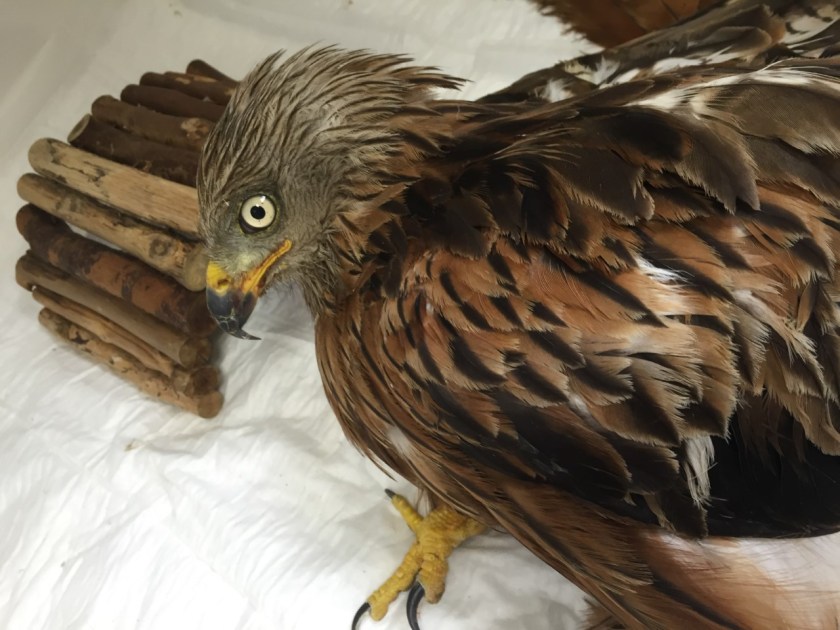
Quote from the Raptor Foundation: “I have taken charge of a red kite that has been shot, with three shotgun pellets, in the leg, shoulder and ear. The leg and shoulder pellets are not really an issue governing the birds potential release as they are below joints. The pellet in the ear is lodged in the bony part of the skull and is causing the bird problems with balance. The vet and I both agree the bird could not be released back with the pellet still inside. We have been treating for infection and pain relief and the bird is making steady improvements. It was unable to stand on admission, but is now mobile along the floor to some degree. The vet is looking to operate later this week“.

[Photo of the shot red kite, by Raptor Foundation]

RSPB satellite tags a shedload of hen harriers

RSPB press release (3 August 2018):

RECORD NUMBER OF HEN HARRIER CHICKS TAGGED THIS YEAR

Over 30 chicks tagged by RSPB Project

An unprecedented number of hen harrier chicks have been fitted with satellite tags this year by the RSPB as part of its EU funded Hen Harrier LIFE project to secure the future of these threatened birds.

So far more than 30 of the young birds have been tagged, the majority of them in Scotland. This is the fourth year in a row that the project has fitted satellite tags on hen harrier chicks. A number of those tagged this year are the offspring of birds tagged in previous years by the project including DeeCee who hatched in Perthshire in 2016.

Hen harriers are one of the UK’s rarest birds and the satellite tags allow the project to follow their movements as they leave the nest, gaining invaluable information on where the birds spend their time. The odds are stacked against hen harrier chicks from the start with survival rates of around 22 per cent in their first two years of life. The tags can reveal information about the cause of death for many of these young birds.

Of the birds tagged in 2017 almost 40 per cent are known to have died from natural causes, in line with these low survival rates. As the tags continue to transmit after a bird has died the remains of many of them were able to be recovered allowing post mortems to be carried out. These showed some to have been predated, while others died of starvation. One bird, Eric who was tagged in Orkney in July 2017, apparently drowned in January.

However, the tags also reveal that over a quarter of last year’s chicks have disappeared in suspicious circumstances. In these cases, transmissions from tags that have been functioning perfectly suddenly stop. The tag of one bird, Calluna, ended transmissions abruptly over a grouse moor a few miles north of Ballater on 12th August last year. Manu and Marc, from the same Borders nest, both disappeared over grouse moors in northern England.

The latest national survey of hen harriers, carried out in 2016, shows that the UK population has declined by 24 per cent since 2004. In Scotland there has been a 57 per cent decline on grouse moors since 2010. The continued illegal persecution of these birds is having a huge detrimental impact on their numbers.

RSPB Scotland is currently awaiting the recommendations of an independent enquiry panel commissioned by the Cabinet Secretary for the Environment Climate Change and Land Reform, Roseanna Cunningham MSP in May 2017, to look into how grouse moors can be managed within the law and explore options for its regulation. The panel was created following the review of satellite tagged golden eagles in Scotland and is expected to report back in Spring 2019.

Dr Cathleen Thomas, Project Manager for the RSPB’s Hen Harrier LIFE project said: “Satellite tagging technology has taught us so much about the movements of hen harriers. We can follow individual stories; from the birds that make huge journeys crossing over seas to those that stay closer to home and only move short distances from where they were hatched. We’ve discovered new nesting places and winter roosting sites, which help us protect the birds when they are at their most vulnerable.

The tags also allow us to investigate where and in what circumstances these hen harrier chicks are lost so we can better understand how to protect them and advocate for licensing of driven grouse shooting. This species is only just holding on in the UK; it’s both heart-breaking and infuriating that year after year many of these chicks disappear in suspicious circumstances. The loss of birds in this way is both needless and senseless and cannot go on. We hope that the recommendations of the enquiry panel here in Scotland will give hen harriers, and other birds of prey, a fair and fighting chance at survival and help stamp out these outdated illegal persecution practices.

The project is grateful for the fantastic support given from members of the Scottish Raptor Study Group and to the many landowners and their staff for their interest and help in assisting to tag so many birds.

From September a selection of this year’s tagged birds will be added to the project website where their travels can be followed along with some of the surviving birds from previous years: www.rspb.org.uk/henharrierlife

ENDS

Poisoning suspected after discovery of dead peregrine & tethered pigeon ‘bait’

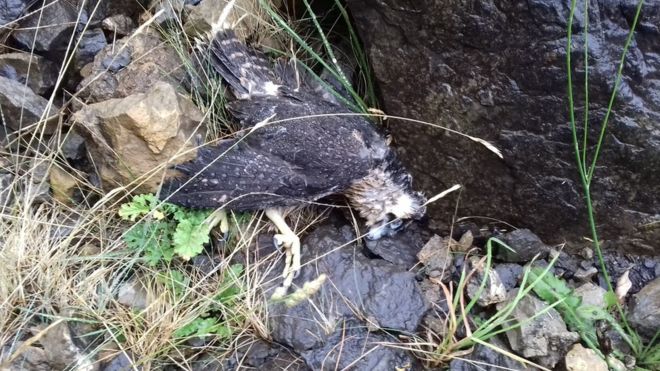
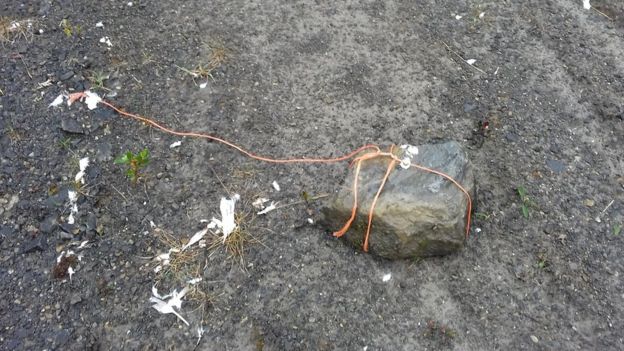
The Police Service of Northern Ireland (PSNI) is investigating a suspected poisoning incident after raptor workers found the body of a dead young peregrine and the remains of what had probably been a live tethered pigeon close to the peregrine’s nest site. An adult peregrine is reported as ‘missing’ from the site.

The gruesome discovery was made by members of the Northern Ireland Raptor Study Group (NIRSG) in the Scraghey area of Castleberg, Co Tyrone, on 10 July 2018. Toxicology results are awaited.

[Photo of the dead young peregrine, by NIRSG]

[Photo of the rock, baler twine & remains of a pigeon leg found at the site, by NIRSG]

Smearing a live pigeon with poison and then tethering it close to a peregrine breeding site to act as a flapping ‘bait’ is a barbaric yet all too common crime. We only blogged about a similar case a few weeks ago (see here).

Jim Wells from the NIRSG said: “The vigilance of several members of the Raptor Study Group and the very quick response by the PSNI have revealed what is likely to be one of the most serious incidents of peregrine persecution in Northern Ireland for several years.

This is nasty, very cruel and callous. We don’t know what the suspected poison is, but if someone had come along and tried to help the pigeon it could have hurt them too.

This has happened on several occasions in areas of Co Tyrone. There are around 15 sites in Tyrone, it’s an important breeding ground. But in some areas there is still a culture of poisoning birds, which is very damaging to the overall population.

All of the peregrine sites in Co Tyrone are monitored on a regular basis every year. This research has revealed that illegal persecution remains a problem in some parts of the county“.

Dr Eimear Rooney of the NIRSG and a representative on the Partnership for Action against Wildlife Crime NI said there are between 80 and 90 breeding pairs of peregrines across the whole of Northern Ireland, of which around 55 pairs are successful in producing young. She said:

The population of peregrines in Northern Ireland is limited by available nest sites and thus has remained fairly stable for several yearsHowever, illegal killing could result in serious implication for the viability of the species here. Peregrine falcons are primary predators and removal of such predators from our ecosystems can have serious consequences on a wide range of species.

It’s deeply frustrating to think that someone went out of their way to target these birds in such a heinous manner“.

Anyone with information about this suspected crime is encouraged to contact the PSNI (Tel: 101) quoting incident number 1550.10/7/18.

Further calls to end mountain hare culling as slaughter season opens today

Press release from OneKind and League Against Cruel Sports Scotland (1st August 2018):

Charities have today intensified their calls for urgent action from the Scottish Government to prevent the further mass killing of Scotland’s mountain hares.

The open season on mountain hares begins today (1st August) and runs until 28 February. During this period, tens of thousands of mountain hares will be killed. The majority will be killed by gamekeepers to manage their land for red grouse shooting, while the rest are shot freely for fun.

[A pile of shot mountain hares left to rot on a grouse shooting estate in the Angus Glens]

Figures released earlier this year under Freedom of Information show that large-scale mountain hare killing has been routine in Scotland for many years, with an average of 25,961 mountain hare killed a year. However, numbers reached an all-time high in 2014 when 37,681 were killed.

83% of the Scottish public think culling should be regulated or made illegal, according to polling commission by OneKind and the League Against Cruel Sports in May 2018.

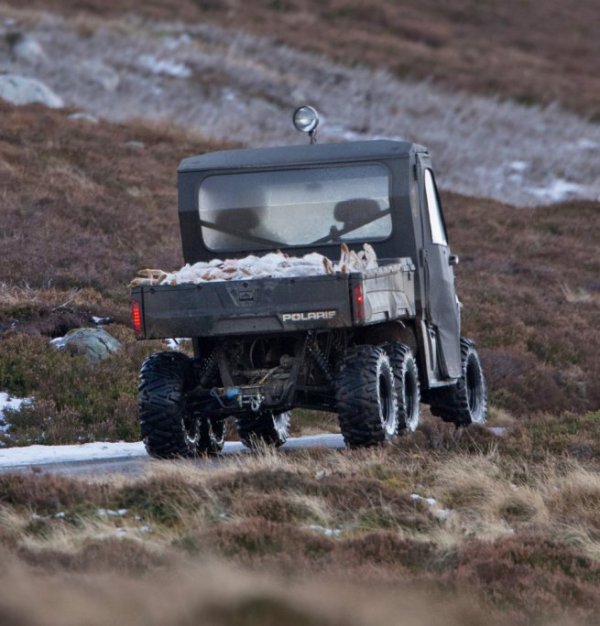
[An ATV full of shot mountain hares photographed on a grouse moor in the Monadhliaths, by Pete Walkden]

Harry Huyton, Director of OneKind said:

The First Minister and The Cabinet Secretary have both been clear that the large-scale culling of mountain hares is unacceptable, yet once again the killing season has begun, and Scotland’s mountain hares are left unprotected. It’s time to say enough is enough. We’re calling on the Scottish Government to move from rhetoric to action by introducing protections for mountain hares before the killing reaches its peak in the winter months”.

Robbie Marsland, Director of the League Against Cruel Sports Scotland said:

Scottish estates kill thousands and thousands of mountain hares in the hope that this will increase the population of red grouse shot for entertainment later in the year. Their equation is: more dead mountain hares equals more dead red grouse.

This circle of death is just one part of the out of control intensification of grouse moor management. The Government should both protect the mountain hare and seriously consider the wider impact that grouse moors have on Scotland’s wildlife and environment.”

ENDS

OneKind has written an open letter to Environment Secretary Roseanna Cunningham and Scottish Natural Heritage CEO Francesca Osowska, asking for urgent action. Please consider signing in support HERE

A short one-minute video summarising campaigners’ concerns about ongoing mountain hare culls in Scotland:

Paul Haworth: obituary

It was with enormous shock and sadness that we learned of the passing of Dr Paul Haworth at the weekend.

Paul was a long-standing member of the Scottish Raptor Study Group and even if you hadn’t enjoyed the pleasure of knowing him, if you’re a regular reader of this blog you’ll be familiar with his work as he co-authored many of the seminal research papers on golden eagles and hen harriers that we regularly cite here.

Some of his close friends and colleagues have written the following two obituaries:

Paul Haworth passed away on 28th July 2018 with his family close by.

Paul was based on Mull and was a foremost expert on raptors there, in the Western Isles, and in many other places further afield in northern England, Scotland and Ireland.

His experience allowed unique comparative insights into many raptor species’ biology and the threats they face, especially merlin, hen harrier and golden eagle, through diligent field records ranging from the English Pennines, the west of Ireland, and most recently in his devotion to the Scottish Hebrides and the western mainland. Paul saw, for example, that despite the substantial research attention being paid to the hen harrier on moors for driven grouse shooting, where their fate and conservation status was far less than certain, that for many years which he had documented they were doing far better in the west and islands, where there was little burnt heather, no grouse shooting, but rather more in the way of woodland and scrub habitats.

He was a key guiding influence in the management of a small estate on Mull, where removal of sheep and deer have seen many species flourish and biodiversity expand, from native trees and the passerines which rely on them, to hen harriers and golden eagles using the naturally open ground.

As well as having numerous such practical on-the-ground influences, he made many important contributions to raptor conservation science in the UK and Ireland, in particular the golden eagle and hen harrier conservation frameworks, which have been instrumental in identifying the key influences on these species’ conservation status.

He was immense fun to be with, always helpful, kind and supportive of raptor field workers and any others with a shared passion for raptors and the uplands who had the good fortune to cross his path. Paul was the best company in the field, the pub, or in meetings on the numerous research and conservation projects he contributed to. He endeared the highest respect and affection amongst friends and colleagues through his immense knowledge, charm, and often, piercingly observant sense of humour. He will be greatly missed by the many who loved him, not least by his wife Trish and his daughters Erica and Kathryn.

Alan Fielding and Phil Whitfield

___________________________________________________________________________________________________________________

The Irish Raptor Study Group (IRSG) and Golden Eagle Trust learnt with great sadness of the passing of Dr Paul Haworth, on Saturday, the 28th July 2018.

Paul was a very strong supporter of Irish birds of prey, in his own unassuming way. Paul was from Lancashire and his wife’s Tricia’s parents were originally from Connemara, where he spent several seasons monitoring the local Merlin population in the 1980s.

He shared the maps of his detailed fieldwork there, which allowed IRSG members Aonghus O Domhnaill and Dermot Breen, (as part of their National Parks and Wildlife Service Conservation Ranger roles), to build upon his underlaying dataset. The ongoing Connemara Merlin studies are now an important part of this species’ national conservation effort.

Paul also played a key role in supporting the tenuous efforts to secure the Irish Golden Eagle Reintroduction programme, by helping secure Scottish Golden Eagle donor stock. Always at hand to advise and assist a strained Golden Eagle Trust project manager, trying to make the proposal reach fruition. Whether by actually facilitating the collection of donor stock from his home on Mull or in identifying potential donor nests, through his staff and contacts, elsewhere on the Hebridean Islands – he was a key component of a crucial source of Ireland’s founding donor stock.

Paul, in collaboration with Dr Alan Fielding, his close friend and associate, also produced the detailed reintroduction population modelling programmes for the three Irish raptor reintroduction programmes; namely the Golden Eagle, the White-tailed Eagle and Red Kite projects.

Over the last two decades, the IRSG repeatedly sought advice and guidance from Paul, regarding Hen Harrier conservation and a broad range of other land management issues.

Paul died from complications arising from his dignified and private battle with melanoma cancer. He will be dearly missed by his wife Tricia and their two daughters, Kathryn and Erica.

Obviously, Paul committed himself to the task of nature conservation in Britain from an early age and especially the enhancement of Upland bird species, including Golden Eagle, Merlin and Hen Harrier. The sudden loss of such a wildlife advocate is offset to some degree by his own words – confiding with his family before he died, that he was “Totally at peace and had a privileged life doing what he loved”.

As the sadness of his passing gradually settles upon those who knew him, maybe in time we will recognise the ongoing fruits of his passion, across Ireland and Scotland. We can take solace from the fact that Paul felt grateful to have enjoyed so much mountain wilderness activity, since his youth, across a long, influential and varied ‘Field Trip’, of his own choosing.

As they would say in Connemara, “Go dtuga Dia grásta dó” – ‘May God give him Peace.’ It was a privilege to know Paul – what a lovely man.

Lorcan O’Toole