
The Moorland Association’s long-term ability to deny and undermine the proven link between illegal raptor persecution and driven grouse moor management is legendary (see here for just one of many examples).

Never far from the headlines, they’ve been churning out the propaganda again, this time during an interview on BBC Radio 4’s Today programme, broadcast 2 May 2018, in response to the recently published scientific paper linking illegal raptor persecution in the Dark Peak area of Derbyshire’s Peak District National Park with driven grouse moor management.
The interview is available on iPlayer for the next 21 days here (starts at 53:15 mins).
Here’s the transcript:
John Humpries: There’s new research seems to show a clear link between grouse shooting and the decline in the number of birds of prey, specifically the goshawk and the magnificent peregrine falcon, the fastest bird in the world. Mark Thomas of the RSPB has done the work, Amanda Anderson is the Director of the Moorland Association. They are both on the line.
Mr Thomas, haven’t we heard this before?
Mark Thomas: We have, John, lots of times. The difference here is you’ve got a National Park, a place where the public can go, 10m visitors a year.
John Humphries: The National Park being ?
Mark Thomas: The Peak District National Park. It is highly protected yet half of the park, the northern bit with the grouse moors, are a no go zone for the very birds that you’ve just discussed.
John Humphries: Because?
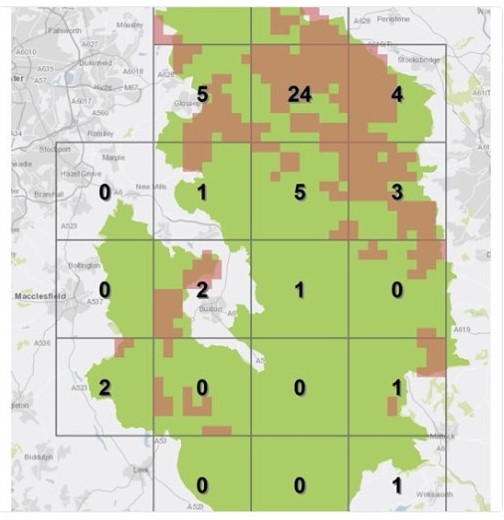
Mark Thomas: Because we’ve done some research and what we’ve done is we’ve looked at all the crimes against birds of prey. So this is shot peregrines, poisoned buzzards, shot buzzards, pole trapped ospreys, it goes on and on, and all those crimes, we’ve matched them statistically with the area used for driven grouse shooting in the Dark Peak, the northern area.
John Humphries: But I’m not quite sure how you link the crimes, as you put it, to legitimate grouse shooting.
Mark Thomas: Because what we’ve basically done is we’ve matched the places where the crimes occur and then we’ve put a layer on showing where the grouse moors are and statistically that is significant. It overlays each other and we’ve proven a correlation between the two. If you are a bird of prey, you do not want to be in the Dark Peak.
[RSPB map from the new scientific paper showing the number of confirmed raptor persecution incidents in the Peak District National Park 2000-2016 overlaid with areas managed for grouse shooting]:
John Humphries: Amanda Anderson, do you accept that?
Amanda Anderson: Good morning John, good morning Mark. I have to refute that Mark thinks the northern area is a no go zone for birds of prey. The National Park is a massive area, the size of London, and in the north of the park this year we have 8 pairs of peregrines and 7 or 8 pairs of goshawk. Now it’s early in the season, it’s a very cold late spring, I’m sure you’ll agree, so we can’t guarantee that these pairs will turn into nests and eggs turn into chicks.
John Humphries: But it’s this correlation between the crime and the areas where grouse shooting happen.
Amanda Anderson: One incident of a bird of prey being persecuted is too many but we must look at the instances of this, the amount of crimes reported. I don’t know the definition of a confirmed crime but it is over a 16-year period so there are 3-4 incidents per year and there have been 2 prosecutions in the area that Mark refers to and bird of prey numbers are now increasing.
John Humphries: That presents a slightly different picture, Mark.
Mark Thomas: That’s not exactly right. When you look nationally, 69% of all people convicted for killing birds of prey, gamekeepers, let’s get to it, they are the people killing birds of prey in this park. And, as I’ve said, we have a whole catalogue of incidents. The confirmed ones is when we’ve got a body, we’ve physically got a body where nobody can refute that that bird has not been poisoned, hasn’t been trapped. In terms of the birds that are there at the moment, we’ve had this situation year on year. At the beginning of the season it looks good. Ask Amanda. Last year not one single peregrine falcon was successful in the northern Dark Peak where the grouse moors are.
Amanda Anderson: That’s absolutely true. Last year peregrine were very disappointing. As I say, this year it’s looking very exciting with about 8 pairs on the go at the moment.
John Humphries: So there we are, that’s it, it does fluctuate, doesn’t it Mark?
Mark Thomas: It does but what our data is looking at is over a long period of time. Amanda’s reflecting on one year. We must acknowledge Amanda has tried very hard with her moorland managers to self regulate but that is not working.
John Humphries: So what would you do? Would you ban grouse shooting?
Mark Thomas: No, the RSPB is not saying that and we are not going as far as that. We are saying we want licencing. If a shoot has committed a crime then the licence to shoot on that moor is removed for a period of time. That would focus and we think that would solve this problem.
John Humphries: And would you accept that, Amanda?
Amanda Anderson: If a shoot has committed a crime then somebody should be in court and prosecuted and that is a fair system and is working. The conclusion the RSPB draw to legislate to help birds of prey is flawed when the population is increasing.
ENDS
Wow. Amanda’s final comment deserves a whole blog to itself but that’s for another time.
For now, we want to concentrate on Amanda’s claim that this year is “looking very exciting with about 8 pairs [of peregrines] on the go at the moment” and “7 or 8 pairs of goshawk“.
That sounds promising, doesn’t it? But just how accurate are these figures?
Not very, according to local raptor group fieldworker Mike Price from the Peak District Raptor Monitoring Group.
We asked Mike to comment and here’s his response:
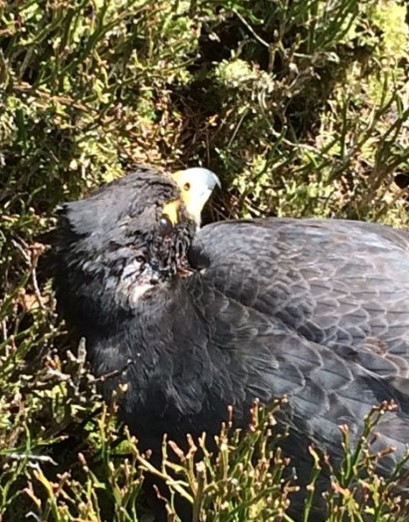
We know that there has been an incident near to one site that led to an injured bird being photographed by a member of the public. It was described as immobile, on the ground and covered in blood. Unfortunately, despite extensive searching the bird has not been recovered and we do not know what caused the bird’s injuries.
[Photos of the injured peregrine, found 14 April 2018, published on Twitter by @RSPBBirders]

Occupied Goshawk sites appear to be lower than in 2017, although known breeding pairs remain in line with 2016 and 2017. Several sightings of pairs exhibiting breeding behaviour at historic breeding sites appear to have fizzled out and at a number of sites this appears to be happening annually and without any reasonable explanation.
With all of that in mind the figures quoted by Amanda Anderson for the north of the Peak District National Park, are in our opinion, inaccurate. We would welcome a recovery for both Peregrine and Goshawk in the area mentioned but after seven years of failed collaborative working we are understandably cautious”.
Hmm, this report paints quite a different picture to the one Amanda was suggesting, doesn’t it?
To be fair though, Amanda did say it was still early in the season and it’d been a cold, late spring so there was a chance that not all the peregrine and goshawk breeding attempts would be successful. That’s true, and the weather may well have played a role in some of these early failures (we’ll find out when the 2018 report is published). But take a look again at that bloodied, injured peregrine laying in the heather. Was that a victim of the cold, late spring?
It’s a critical time for breeding birds, and especially for breeding raptors in the Peak District National Park. According to a statement made by the Peak District National Park Authority in January this year, it is “looking for an increase in birds in the breeding season before committing to working with the other organisations in the Peak District Bird of Prey Initiative beyond 2018″.
It’s no wonder the Moorland Association is keen to pretend things are on the up.
 Raptor Persecution UK
I’m not sure that I would believe Amanda Anderson if she told me her members thought the sky was blue. Amanda may be trying( sometimes very!) but her membership, which, is free under their ” constitution” to more or less do as they please still seems to be in the Victorian era when it comes to attitudes and then actions towards protected predators. Their attitude seems to be persecution is OK as long as it cannot be pinned on one of us in court.
Then again I could be wrong and that photographed Peregrine shot itself on finding out it was in the Dark Peak. On a slightly different issue an organisation with no credibility like the MA should have no voice on the BBC!
The simple solution is to act on vicarious liability and fine or preferably jail the culprits and their employers. Once estate owners are threatened with or get jail time I think things would improve especially on grouse moors.
That’s not going to happen, you can’t even jail the keepers never mind the land owners, until someone grows some balls and stands up to these bastards nothing will change, and as for Anderson don’t get me going on that subject
I do worry that the only people who will understand or react to this kind of thing are interested parties like us, i.e. those that read blogs such as this. Is there a chance of more publicity – perhaps someone from RPUK offering to be opposite the gamekeepers next time?
I feel that with so much knowledge, so much experience in dealing with the lies of such people and the fact that you’re not answerable to a membership, more could be said in letting Joe Bloggs know what is going on under his very nose. It’s frustrating when lies are told in the national press with little in the way of comeback.
12 August… date of the Strathbraan mass Raven census? Covering every hill simultaneously we should get a good count.
A small observation, centre spread of Yorkshire Post’s Country Week ran a piece about Melling et. al. paper in British Birds so widening audiences. Detail of same posted on twitter, 67 RTs (sorry not calculated the reach) and some great feedback, so slowly the momentum of critical mass raising awareness is growing & long may it continue & yes I appreciate it’s enshrined in their ‘traditions’ & has been ever thus but change is a coming, be in no doubt. This R4 exposure can only be good, will listeners believe someone who prevaricates? The spin bowlers are failing, there’s too much evidence being circulated so we just carry on pushing water uphill in a colander, n’owt worth having was ever easy ….
Talking of bowlers – has everybody noted that “Sir” Ian Botham’s charity allegedly gave out no grants in 2016 but re-imbursed his daughter’s company handsomely? Reported in Times, Daily Mail et al. Seems charity begins at home! What a hypocrisy “You forgot about the Birds” is, under the circumstances. Also most people don’t know his son runs a game shoot in North Yorkshire, the country’s wildlife crime capital.
I thought that John Humphrey’s was far from impartial. Take this so called question, which is far more of an assertion “But I’m not quite sure how you link the crimes, as you put it, to legitimate grouse shooting.” diverted attention from the main issue. The fact that grouse shooting is “legitimate” is not relevant to the point. We are talking about criminal persecution, which certainly is not legitimate. It shouldn’t have been necessary for Mark Thomas to point out to Humphrey’s that most of those prosecuted for the illegal persecution of birds of prey are employed by the shooting industry, it is common knowledge.
Essentially Mark Thomas’ time was wasted with answering Humphrey’s red herring assertions, posing as questions, such as implying that the RSPB wanted to ban driven grouse shooting, when it is common knowledge that the RSPB’s positioning is the licensing of grouse moors. If Humphrey’s or BBC researchers had actually bothered to read the paper on which this interview was based the time would not have been wasted answering points which were irrelevant, took up the time of the interview, and which in my opinion were deliberate red herrings to divert attention from the real problem.
Look at another red herring question from Humphreys “So there we are, that’s it, it does fluctuate, doesn’t it Mark?”. Again an entirely false point. This is not natural fluctuation, that is disinformation put out by the likes of the Moorland Association. We are talking about the persistent failure of the breeding Peregrines, Goshawks, and of course Hen Harriers on grouse moors, even those these species thrive elsewhere.
Overall Mark Thomas was asked challenging questions, in which the tacit premise was that the RSPB were making false claims, and further implying that they had an agenda to ban driven grouse shooting. All these insinuations were false, and this is based on a scientific paper. Amanda Anderson was not put on the spot or challenged about her blatantly false arguments.
Amanda Anderson was allowed to get away with the false argument, that only convictions indicate criminal activity. Where dead raptors, illegally killed, illegal traps, poisoned baits, is clear evidence that the incidence of crime is far higher than convictions. If people have their houses broken into, robberies are committed, people are murdered, these are not only treated as a crime when someone is convicted. There are many types of crime where convictions are low compared to the likely amount of crimes committed. The use, dealing and importation of illegal drugs is a good example. The authorities do not estimate the amount of drug dealing, importation, and drug use, purely on the basis of convictions.
The 2009 Natural England report A Future for the Hen Harrier in England, put the blame for the lack of breeding Hen Harriers firmly on shooting interests. Why has there been an Orwellian re-invention of history, which allows John Humphreys to pretend that this had never been established, and to accept the mealy mouthed false arguments of Amanda Anderson without properly challenging them. Why was the party being most challenged, the party using sound argument based on peer reviewed scientific research?