RSPB Scotland blog in response to mass raven cull licence

Further to the news that Scottish Natural Heritage has issued a multi-year licence to allow the mass culling of ravens in Highland Perthshire just ‘to see what happens’ (see here), RSPB Scotland has just published a blog in response.

Here’s a short excerpt:

Now – to this research licence. In the first instance, we doubt very much that the proposal in this case has anything to do with the given reason for the research licence request – ostensibly to ‘improve understanding of factors affecting key wader species’. In light of previous loud complaints by estates in this and other grouse shooting areas about raven predation of red grouse, we and many others see this raven research proposal as simply a rather transparent mechanism whereby a perceived pest species can be removed to benefit red grouse, with the conservation of wading birds as a by-product.

We would have hoped that, on receipt of such an application, the location for the study would have set some alarm bells ringing amongst SNH staff, since this area has been clearly identified by the Scottish Government, the police and other authoritative commentators for many years as a raptor persecution “black hole”, where golden eagles and other protected raptors suspiciously disappear without trace or explanation”.

To read the RSPB Scotland blog in full, please see here.

For those who oppose the raven cull licence, please consider sending an email to SNH Chair Mike Cantlay: chair@snh.gov.uk

Please also consider signing this petition HERE

UPDATE 27 April 2018: ‘No justification’ for raven cull licence, says RSPB Scotland Director (here)

Raven cull update & what you can do to help

There has been a phenomenal public reaction to the shocking news that Scottish Natural Heritage has issued a multi-year licence to allow the mass culling of ravens in Highland Perthshire just ‘to see what happens’ (see here).

A few updates for those who might have missed them:

Statement from Robbie Kernahan, Head of Wildlife at SNH:

“We understand the concerns over wildlife crime in Strathbraan, but we are also clear that the granting of this licence is wholly unconnected to the issues concerned.

This licence is about a pressing and complex conservation issue. It  is a large-scale collaborative trial which will help improve our understanding of factors affecting key wader species, populations of which are declining at an alarming rate. We are satisfied this licence will not affect the population of ravens overall, and is over a five year period.

The licence places significant responsibility and expectations on all those involved – to be able to show that this approach can work and will help deliver what are essentially shared objectives.

Trust is a key element of this and this presents a great opportunity to develop that trust and relationships with all involved. If it becomes apparent that actions are not being carried out in accordance with the terms of any licence then we will have no hesitation in removing the licence”.

UPDATE 23 April 2018: RSPB Scotland responds in full to raven cull licence (here)

Statement from Duncan Orr-Ewing, Head of Species & Land Management at RSPB Scotland:

“We are extremely concerned about the likely scale on impact of this research licence on the local raven population in the Strathbraan area of Perthshire. We are also very surprised that SNH have issued such a research licence  in the vicinity of Strathbraan, which has an appalling and well documented track record of illegal persecution of raptors, noting also the very recent “suspicious” disappearance of a satellite tagged white-tailed eagle in this very same area.

We, together with local raptor workers who have been monitoring ravens in the area for decades, could have helped SNH with this background detail to the licence application if we had been consulted.

We will be seeking a high level meeting with SNH shortly to discuss. We will be pressing for the research licence to be revoked on the back of the white-tailed eagle incident, and instead consideration given by SNH to removing the use of the Open General Licence in this area, as is within their powers”.

Both RSPB Scotland and the Scottish Raptor Study Group are working hard behind the scenes to stop this licence in its tracks. We hope to have more news on that in due course.

It’s also worth noting here that, as we understand it, many SNH staff members are opposed to this licence on scientific and ethical grounds, but it seems their advice was ignored by the decision-makers.

In the meantime, please continue to send emails to the Chair of SNH, Mike Cantlay. It’s crucial that he/SNH understands the strength of public anger and opposition to this licence. Emails to: chair@snh.gov.uk 

A number of well-intentioned people have started a variety of petitions opposing the cull licence. Some are more accurate than others but all are helpful in raising awareness. We’d recommend signing this one: SIGN PETITION HERE

Thank you

SNH issues licence for mass raven cull in 5-year ‘experiment’

To the utter disbelief of conservationists, statutory conservation agency Scottish Natural Heritage (SNH) has issued a licence authorising the mass killing of ravens in a large area of Perthshire (an area identified as a wildlife crime hotspot where six satellite-tagged eagles have suspiciously disappeared in recent years), as part of a proposed five-year experiment, on the basis of ‘seeing what happens’ to wader populations when ravens are removed.

The licence has been issued to a consortium calling itself the Strathbraan Community Collaboration for Waders (SCCW) which, according to the licence application, ‘represents some of the local land management (farmers, gamekeepers) and private interests in the area who value wading birds for their biodiversity, social and economic value to the area and to Scotland more widely. The application is supported by the Scottish Gamekeepers Association and technical advice and support, notably data gathering and interpretation, is being provided by the Game & Wildlife Conservation Trust (GWCT)‘.

The following has been written by a group of Scottish Raptor Study Group (SRSG) members as a guest blog:

STRATHBRAAN RAVEN LICENCE

The news about the missing white tailed sea eagle disappearing in Glen Quaich on Tuesday 17th April could sadly not have been more timely as Scottish Natural Heritage, (SNH), have issued a licence to several estates in the Strathbraan area in Perthshire, including Glen Quaich Estate, for the killing of 300 ravens in a large scale trial over five years to see if wader productivity and populations can be improved by removing raven predation.

The manner in which the government’s statutory nature conservation agency have conducted themselves has come as a shock and there is grave concern about the mis-application of science, the lack of consultation with key stakeholders, such as the RSPB and SRSG, their choice of estate partners and the lack of transparency, trust and honesty, and even seasoned SNH watchers are aghast.

We have raised our concerns and are unhappy with the response so far and have resorted to writing this blog to make the matters public. Following the “suspicious” disappearance of the white tailed sea eagle and the fact the police are describing this as ‘an illegal act’ we call upon SNH to conduct a review and if the circumstances fulfil what we consider to be the established criteria set out in SNH’s own report then we expect the licence to be withdrawn.

Our concerns focus on three areas, firstly the choice of partners:-

Firstly when selecting a trial area why would you choose an area dominated by driven grouse shooting with a history of illegal raptor persecution? What message does this send out to the many law-abiding estates? Is it that persecution will enable you to ‘cut a deal’ with the statutory nature conservation body? Cynics might suggest this is more about an opportunity to kill ravens in an attempt to protect red grouse stocks and it could also be argued that a licence has been issued to kill one species of bird to enable another bird to be shot for fun.

[Map of proposed cull area in north Perthshire, from the licence application, running from Loch Tay in the west to the A9 in the east]:

Raptor workers over the years have been monitoring the area and can speak with authority on raptor persecution. The Scottish Government’s review of satellite-tagged golden eagles showed that four of these birds have disappeared suspiciously in this area, with a satellite-tagged red kite also disappearing in 2010. In all cases, the tags can be classed as “stopped – no malfunction” as used in the review – ie. highly suspicious.

[Map of north Perthshire showing the last known fixes of five satellite-tagged golden eagles that disappeared in suspicious circumstances. Sea Eagle Blue X also disappeared in Glen Quaich last month]:

In addition, a radio-tagged white-tailed eagle was tracked to this area, but disappeared in January 2012, while a further satellite-tagged white-tailed eagle recently similarly disappeared in Glen Quaich. An illegal clam trap was found in November 2012, while a buzzard was spring-trapped in January 2012. A red kite was found poisoned in January 2015. A raven was poisoned in 2017. In addition, licenced raptor study group members have noted a number of cases of suspicious failure of nesting attempts by hen harrier, red kite and buzzard across the area. They have also recorded a higher than usual turnover of red kites and a loss of breeding pairs at nearby sites. All of which indicates on-going illegal persecution.

Even bearing in mind these detected incidents represent an unknown proportion of actual persecution taking place, this is an area where land management practices have displayed a proven criminal intolerance to protected species, stretching back for many years. All this has been in the public domain so why did SNH press on knowing that their partners in this initiative have such a dubious record, and what level of confidence can we have in their honesty and integrity?

Secondly, science and key questions that remain unanswered:-

  • What monitoring is in place to assess that this cull will not affect the raven population status?
  • How will SNH be able to differentiate from other factors affecting the decline of waders such as other predatory pressures, the loss of suitable habitat and changes in agricultural practices?
  • What criteria will be used to differentiate between breeding and non-breeding birds? This year we have noticed that the breeding season is later than usual.
  • What allowance has been made for the immigration of immature flocks into the proposed licence area?
  • Why has the licensing decision been taken in the absence of the raven population modelling report, as it was commissioned with the sole, or at least the main, purpose of underpinning raven licensing decisions with sounder background information?
  • What is the nature and extent of the independent scrutiny that has been carried out?
  • If any raven roosts are located during the period of the licence, can we be assured that any Schedule 1 non-breeding species and other protected species (possibly also using the same roosts) will not be disturbed?
  • What safe guards are in place to ensure the numbers killed will remain within that permitted?

Thirdly, the lack of engagement

SNH are always keen to trumpet words such as ‘trust’, ‘building relationships’, ‘shared objectives’ ‘working collaboratively’ but we have seen none of this.

  • There has been no communication with SRSG workers who have been active in the proposed licence area and have many years of breeding data on ravens and raptors.
  • We understand that not all landowners/managers within the area of licence have been contacted about this licence, contrary to reassurances provided.
  • This proposed application was developed outside the much lauded ‘Working for Waders’ initiative and we only became aware of this by accident; hardly working together or building trust!
  • Under the Scottish Raptor Monitoring Scheme raven data are submitted to SNH (who is a key partner), yet it seems this information was not included in the licence considerations, (we know this as under the permission sharing protocols raptors workers who collected the information in the first place would have had to have been consulted).

We are deeply suspicious that the lack of engagement was deliberate as SNH knew their proposal was weak and would not stand up to the rigour of an independent scientific review.

We again call upon SNH to withdraw the licence.

ENDS

It’s well known that SNH issues a number of licences every year to cull ravens where they are considered a ‘serious threat’ to livestock (e.g. see here, here) but these are apparently for a limited cull, not related to game management and supposedly based on sound scientific evidence of a perceived local problem.

It’s also well known that gamekeepers have long wanted ravens to be added to the General Licence (e.g. see here, here) because they are seen as a perceived threat to grouse stocks.

It’s also well known that ravens are routinely demonised in the press, including this outrageous piece published by the BBC (see here, and well worth a read to understand the hysteria whipped up around this protected species).

However, this latest licence authorising a multi-year mass culling of ravens over a large area for spurious reasons (and apparently very little, if any, scientific justification) is unprecedented. That it also happens to be a well-known raptor persecution hotspot just adds to the lunancy of this situation.

If you share the concerns of the SRSG members, please consider sending an email to Mike Cantlay, SNH Chair, calling on him to withdraw the licence with immediate effect. Emails to: chair@snh.gov.uk

UPDATE 14.20hrs: Thanks to the blog reader who brought this article to our attention, reporting on the results of a scientific study that dispels many of the myths associated with ravens and wader population declines. And here is the scientific peer-reviewed paper by Amar et al that specifically warns against making predator control licensing decisions without a thorough evaluation of the evidence.

UPDATE 21 April 2018: A quote from SNH Head of Wildlife, Robbie Kernahan:

We understand the concerns over wildlife crime in Strathbraan, but we are also clear that the granting of this licence is wholly unconnected to the issues concerned.

This licence is about a pressing and complex conservation issue. It  is a large-scale collaborative trial which will help improve our understanding of factors affecting key wader species, populations of which are declining at an alarming rate. We are satisfied this licence will not affect the population of ravens overall, and is over a five year period.

The licence places significant responsibility and expectations on all those involved – to be able to show that this approach can work and will help deliver what are essentially shared objectives.

Trust is a key element of this and this presents a great opportunity to develop that trust and relationships with all involved. If it becomes apparent that actions are not being carried out in accordance with the terms of any licence then we will have no hesitation in removing the licence“.

UPDATE 21 April 2018: A quote from RSPB Scotland Head of Species & Land Managament, Duncan Orr-Ewing:

We are extremely concerned about the likely scale on impact of this research licence on the local raven population in the Strathbraan area of Perthshire. We are also very surprised that SNH have issued such a research licence  in the vicinity of Strathbraan, which has an appalling  and well documented track record of illegal persecution of raptors, noting also the very recent “suspicious” disappearance of a satellite tagged white-tailed eagle in this very same area.

We, together with local raptor workers who have been monitoring ravens in the area for decades, could have helped SNH with this background detail to the licence application if we had been consulted.

We will be seeking a high level meeting with SNH shortly to discuss. We will be pressing for the research licence to be revoked on the back of the white-tailed eagle incident, and instead consideration given by SNH to removing the use of the Open General Licence in this area, as is within their powers“.

UPDATE 22 April 2018: Raven cull update and what you can do to help (here)

UPDATE 23 April 2018: Article published in The National (here)

UPDATE 23 April 2018: Article published in The Herald (here)

UPDATE 23 April 2018: RSPB Scotland blog in response to raven cull licence (here)

UPDATE 25 April 2018: OneKind blog in response to raven cull licence (here)

UPDATE 25 April 2018: Chris Packham’s response to raven cull licence (here)

UPDATE 26 April 2018: Is the raven cull licence still active whilst SNH review takes place? (here)

UPDATE 26 April 2018: SNH refuses to say whether raven cull licence has been suspended (here)

UPDATE 27 April 2018: Green MSPs seek urgent meeting with SNH re: raven cull licence (here)

UPDATE 27 April 2018: ‘No justification’ for raven cull licence, says RSPB Scotland Director (here)

UDATE 28 April 2018: Raven cull licence: SGA evasive on benefits to grouse moors (here)

UPDATE 1 May 2018: Strathbraan Community Collaboration for Waders: who’s involved? (here)

UPDATE 4 May 2018: Raven cull: next steps to take as SNH blunders on (here)

UPDATE 7 May 2018: “Let’s have more trials [culls] whether it’s about ravens or other things” says SNH (here)

UPDATE 8 May 2018: Parliamentary questions lodged on raven cull licence (here)

UPDATE 9 May 2018: Alison Johnstone MSP lodges Parliamentary motion on raven cull licence (here)

UPDATE 12 May 2018: Raven cull: please ask your MSP to support this Parliamentary motion (here)

UPDATE 23 May 2018: Raven cull update: scientific advisory committee not being asked to repeal licence (here)

UPDATE 23 May 2018: Raven cull: Parliamentary questions and answers (here)

UPDATE 20 May 2018: Raven cull: latest update (here)

UPDATE 5 June 2018: Legal challenge to raven cull licence: your help needed! (here)

UPDATE 6 June 2018: Raven cull: legal challenge crowdfunder smashes £10k target on day one! (here)

UPDATE 19 June 2018: Raven cull: a few updates (here)

UPDATE 20 June 2018: #Justice4Ravens fundraising merchandise now available (here)

UPDATE 22 June 2018: Preston man receives warning for raven cull death threat (here)

UPDATE 1 July 2018: Last push on #Justice4Ravens crowdfunder (here)

UPDATE 1 July 2018: #Justice4Ravens crowdfunder target smashed! (here)

UPDATE 5 July 2018: #Justice4Ravens: application lodged for judicial review (here)

UPDATE 23 July 2018: Surprise! Gamekeeper in raven cull area declares cull a success (here)

UPDATE 30 July 2018: Raven cull licence: scientific rigour ‘completely inadequate’ says SNH’s scientific advisory committee (here)

UPDATE 30 July 2018: Voluntary suspension of raven cull is meaningless greenwash (here)

UPDATE 7 August 2018: #Justice4Ravens: judicial review update (here)

UPDATE 20 August 2018: Raven cull: application for judicial review withdrawn, for now (here)

UPDATE 30 April 2019: SNH reluctant to discuss licensed raven cull in Strathbraan this year (here)

UPDATE 2 May 2019: SNH rejects 2019 licence application for Strathbraan raven cull (here)

UPDATE 30 May 2019: Scottish Gamekeepers Association’s pity party in response to failed Strathbraan raven cull bid (here)

UPDATE 10 November 2022: Ravens illegally shot on two Strathbraan grouse moors (here)

“It can’t go on” – Mark Ruskell MSP speaks out against illegal raptor persecution

Press release from white-tailed eagle species champion Mark Ruskell MSP (19/4/18), following the recent suspicious disappearance of sea eagle Blue X in grouse moor dominated Glen Quaich, Perthshire:

WILDLIFE CRIME IS HIGHLAND PERTHSHIRE’S SHAME

Green MSP for Mid-Scotland and Fife Mark Ruskell has branded Highland Perthshire a wildlife crime hotspot after a further disappearance of a White Tailed Eagle around the Glen Quaich area and called on the Scottish Government to finally act by bringing in a licensing regime for driven grouse shooting estates.

Raptor Persecution UK highlighted Perthshire North, as a hotspot for raptor disappearance. Six satellite-tagged eagles have disappeared in suspicious circumstances in what is a relatively small area. Green MSP Mark Ruskell called on the Scottish Government to face up to Perthshire’s shame and ensure those responsible for eagle disappearances face justice.

The individual eagle who recently vanished was named Blue X and was fledged in NE Fife. In his role as the Parliament’s White Tailed Eagle champion Mr. Ruskell last year visited the nest site where the bird fledged and spoke to volunteers who had spent hundreds of hours guarding the site from wildlife criminals. Mr. Ruskell also sits on the Scottish Parliament’s Environment Committee which last year agreed that a licensing regime for driven grouse moor estates should be put in place.

Mark Ruskell said: “Highland Perthshire is renowned for the beauty of the landscape and phenomenal wildlife, but this latest incident brings shame to the area. It’s quite clear from the satellite tags that these birds are disappearing around driven grouse moors. Some disreputable estates and gamekeepers have a bizarre Victorian attitude that wildlife should be exterminated, despite wildlife tourism bringing millions into the Scottish economy. Driven grouse estates in particular are attempting to deliver unsustainable levels of grouse populations which lead them to cull mountain hares for example.

It can’t go on; the Scottish Government is prevaricating over the setting up of a licensing scheme for driven grouse moor estates that would separate the good from the bad. Wildlife crime is notoriously difficult for the Police to track down and there is a wall of silence in communities, no-one wants to call out the illegal actions.

I’m particularly gutted to see this bird disappear, volunteers had spent months on end guarding its nest site in Fife and I even saw the bird myself from afar last year.

ENDS

Well done, Mark, and thank you.

UPDATE 21 April 2018: Green MSP angers gamekeepers over missing bird of prey (article in The National, here)

Why shooting estates should fear eagle disappearances

An interesting and insightful Leader Comment in today’s Scotsman: (whoever wrote this, well done!) –

As the RSPB Scotland points out, the disappearance of a fourth satellite-tracked eagle in a part of Perthshire that’s home to several shooting estates over four years is “highly suspicious”.

The Scottish Gamekeepers Association complains its members are the “first to be accused when any bird of prey goes missing”, but the illegal killing of raptors undoubtedly happens, as a 2016 report on red kites by Scottish Natural Heritage found, and few others have a motivation. Each case is a further challenge to the rule of law that will eventually force parliament to react.

And that could lead to the licensing of shooting estates – with the threat of licences being revoked over killings of birds of prey – or a strict liability offence so that a landowner would be found responsible for the unnatural death of any raptor on their land.

Both are measures that estates would – and should – fear.

The sooner the shooting community realises that the death of a sea eagle represents a greater threat to their business than a live bird, the better the chances will be of protecting these magnificent creatures.

Andy Wightman MSP becomes Golden Eagle Species Champion

Some brilliant news, for a change!

Press release from Scottish Greens (19/4/18):

WIGHTMAN TO CHAMPION UNDER PERSECUTION GOLDEN EAGLES

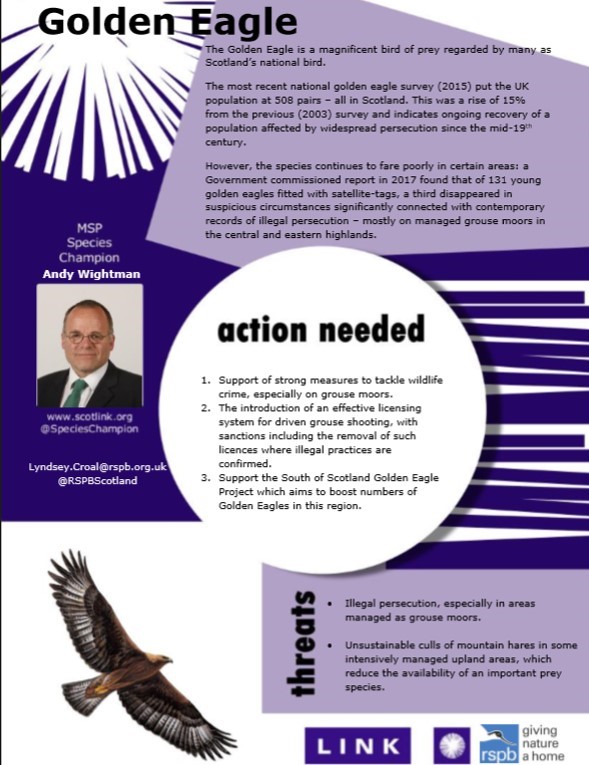
Scottish Green MSP Andy Wightman is the new Scottish Environment Link species champion for the Golden Eagle.

The Golden Eagle is Scotland’s most iconic bird of prey but, despite decades of legal protection in Scotland, continues to be the victim of illegal persecution.

In a recent review commissioned by the Scottish Government and published by Scottish Natural Heritage, it was found that almost a third of young satellite-tagged golden eagles had disappeared in “suspicious circumstances” in the Highlands over a 12 year period. These incidents largely occurred in areas dominated by intensive driven grouse-shooting management.

Moreover, in the last few months, there have been further suspicious disappearances of “Fred” in the Pentland Hills and of another young male eagle in the wildlife crime blackspot of the northern Monadhliath mountains in Inverness-shire.

Reports published by both Scottish Natural Heritage and RSPB Scotland have repeatedly shown that while incidents of illegal poisoning have declined in recent years, other forms of persecution continue to have a proven and significant impact on not just golden eagles, but also species such as hen harrier and red kite. While wildlife criminals may go to considerable efforts to hide the evidence of their crimes, the absence of these species from significant areas of our uplands, particularly in eastern and southern Scotland, gives a clear indication that levels of illegal killing of our birds of prey have not declined.

On the back of the Scottish Government review’s findings, Environment Cabinet Secretary Roseanna Cunningham set up a review of grouse moor management practices, a clear indication of the increasing concern that this issue is impacting on Scotland’s reputation.

Andy Wightman MSP commented:

I am delighted to be the species champion for Golden Eagle. It is clear that much work still needs to be done to ensure that this iconic species continues to thrive across Scotland and that the species returns to parts of the country that it has for too long been absent.

I look forward to meeting those involved in conservation and monitoring of Golden Eagle populations over the coming years and to work with them to tackle the ongoing challenges facing this magnificent bird.”

Duncan Orr-Ewing, Head of Species and Land Management at RSPB Scotland said:

It is great to have Andy on board as a passionate species champion for this special bird, which is arguably Scotland’s national bird. The golden eagle is an indicator species for the health of our uplands, however sadly it still faces many conservation challenges, most significantly the continuing threat of illegal persecution in moorland areas managed for driven grouse-shooting.

This appointment comes at a time when the important South of Scotland Golden Eagle Project, designed to reinforce the population of golden eagles in this area, and to bring wide ranging rural development opportunities to local communities is also about to begin. I am sure that partners in this project will look forward to involving Andy as part of his role in due course”.

ENDS

This is fantastic news. Species Champions are members of the Scottish Parliament who have agreed to lend their political support to the protection of Scottish wildlife.

Andy is already species champion for the Mountain Everlasting wildflower and we’re delighted that he has agreed to lend his considerable influence to help highlight the on-going illegal persecution of golden eagles on some driven grouse moors and champion the conservation of this magnificent species.

We’ve known and admired Andy for several years and he’s been a long-time and vocal supporter of this blog. His skills as a fearless advocate will be much welcomed by those of us working to protect golden eagles.

He joins several other MSPs who work as species champions for raptors in Scotland:

Mark Ruskell MSP (Scottish Greens) – White-tailed eagle

Mairi Gougeoun MSP (SNP) – Hen harrier

John Mason MSP (SNP) – Kestrel

Donald Cameron MSP (Conservative) – Merlin

Bill Kidd MSP (SNP) – Red kite

Iain Gray MSP (Labour) – Short-eared owl

Deputy First Minister’s constituency a hotspot for ‘disappearing’ sat-tagged eagles

Following the recent news that satellite-tagged white-tailed eagle ‘Blue X’ has ‘disappeared’ in suspicious circumstances in the grouse moor dominated Glen Quaich, Perthshire, we’ve taken a closer look at this area.

It was one of the areas identified as a hotspot for ‘disappearing’ satellite-tagged golden eagles in last year’s expert review of Golden Eagle Satellite Tag Data, with a cluster of five golden eagles vanishing without trace in recent years:

It turns out that this area sits within the constituency boundary of North Perthshire, held by John Swinney MSP, Deputy First Minister and Cabinet Secretary for Education:

Another star now needs to be added to this map, representing the last known position of white-tailed eagle ‘Blue X’, although unlike the missing golden eagles we don’t know the precise location of her last known fix, other than it being in Glen Quaich.

That’s six satellite-tagged eagles that have vanished in suspicious circumstances in a small area of John Swinney’s Perthshire North constituency.

We have no idea of John Swinney’s views on illegal raptor persecution and its undisputed link to driven grouse moor management but as a respectable, law-abiding member of society we’d expect him to be as outraged as the rest of us.

What’s different about John Swinney is that he’s a senior member of the Scottish Government and so he’s in a much stronger position than the rest of us to push the Government in to action.

We haven’t seen any commentary from John about the suspicious disappearance of sea eagle ‘Blue X’ in his constituency and it may be that as a busy senior politician it has escaped his attention.

If you are one of John Swinney’s local constituents and you want to know what he thinks, and more importantly what he intends to do about these missing eagles, please drop him an email: john.swinney.msp@parliament.scot

If you are not a constituent but would still like to bring this issue to his attention, and register your disgust that such blatant lawlessness is apparently allowed to continue without sanction, please use this email address and mark it for the attention of John Swinney: Scottish.Ministers@gov.scot

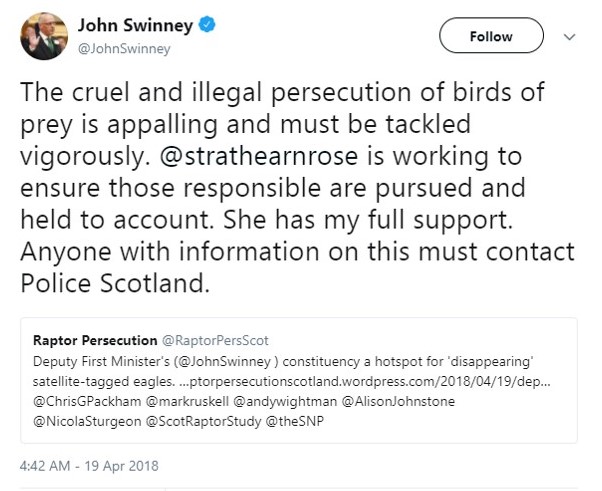
UPDATE 4pm: John Swinney has responded on Twitter as follows:

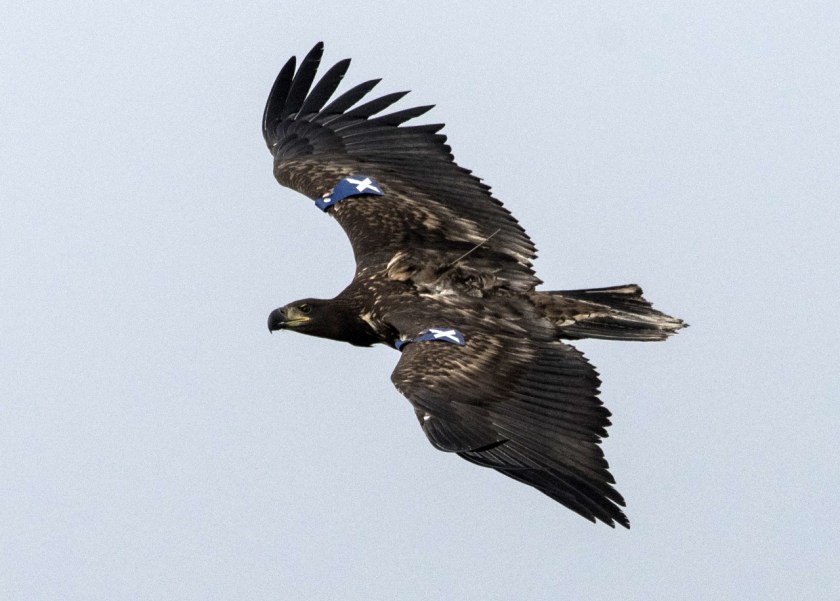
Photo of missing sea eagle ‘Blue X’, by RSPB Scotland.

UPDATE 20 April 2018: “It can’t go on” – Mark Ruskell MSP speaks out against illegal raptor persecution (here)

Pointless search for missing sea eagle ‘Blue X’

Yesterday’s police search for missing satellite-tagged sea eagle ‘Blue X’ was a complete waste of time.

Why? Because Police Scotland invited some gamekeepers (also known as potential suspects) to join the search. Since when has inviting potential suspects to help search for potential evidence of a potential crime been a good idea?

[Photo of white-tailed eagle Blue X, by RSPB Scotland]

Some might think that calling gamekeepers ‘potential suspects’ is a bit harsh, but we’d disagree, and here’s why:

Blue X’s satellite tag had been working perfectly since it was deployed last summer. Suddenly, and inexplicably, it stopped working last month when Blue X was visiting the grouse moor-dominated Glen Quaich, in Perthshire. Had this been the first tagged eagle to ‘disappear’ on a grouse moor in Scotland, then sure, it might be reasonable to assume it was just a rare faulty tag and that nothing untoward had happened to this eagle. But Blue X wasn’t the first sat-tagged eagle to disappear in such circumstances – she is one of over 40 tagged eagles to have mysteriously vanished in recent years, the majority of them on or close to a driven grouse moor. Oh, and Blue X  just happened to vanish in an area where three other sat-tagged eagles had also disappeared. Clearly, Blue X’s disappearance was highly suspicious.

[Red stars indicate last known fixes of sat-tagged golden eagles, orange circle denotes area where Blue X vanished; data from Golden Eagle Satellite Tag Review]:

The government-commissioned analysis of where these eagles have been disappearing (mostly on or near to driven grouse moors) was so unequivocally damning that in response to the report, the Scottish Government urgently convened a special panel to review grouse moor management practices with a view to introducing sanctions for those who continue to defy the law. It was the Government’s view (and the view of every other intelligent observer) that some grouse moor gamekeepers were under reasonable suspicion of involvement with the disappearance of these eagles, and thus its reasonable to refer to them collectively as ‘potential suspects’. [NB: this does not imply any level of guilt on any individual; for that, we’d need to see a criminal conviction and as yet there hasn’t been a single successful prosecution for the illegal killing of an eagle in Scotland. Ever.]

You’d think, then, given this bigger picture of eagles routinely disappearing in suspicious circumstances on or near grouse moors, that Police Scotland, on learning of Blue X’s disappearance, would follow the protocol as devised by the Partnership for Action against Wildlife Crime (PAW) to treat this disappearance as suspicious and NOT alert the landowner(s) or their employees prior to any search:

So what did Police Scotland do? Ignored the PAW protocol, notified the potential suspects several weeks ago that a tagged eagle had ‘disappeared’ in the area (thus allowing any potential suspect to hide any potential evidence of a crime) and then invited the potential suspects to ‘help’ on the search several weeks later when the snow had melted. Genius.

If that wasn’t bad enough, the Scottish Gamekeeepers Association issued a press release yesterday, while the search was underway (so against PAW protocol), telling the world that a search was taking place. This information was leaked on Twitter by some half wit, thus allowing any other potential suspect in the area the chance to remove any potentially incriminating evidence.

Is there any wonder there has never been a successful prosecution for the illegal killing of an eagle in Scotland?

Politicians need to be asking some serious questions about this farcical and pointless investigation.

UPDATE 19 April 2018: Deputy First Minister’s constituency a hotspot for ‘disappearing’ sat-tagged eagles (here)

Satellite-tagged white-tailed eagle ‘disappears’ in grouse moor blackspot in Perthshire

Press release from RSPB Scotland (17/4/18):

RSPB SCOTLAND ASSISTS IN SEARCH FOR ‘MISSING’ EAGLE

Another satellite tagged eagle has disappeared in highly suspicious circumstances. RSPB Scotland has today (17th April 2018) been assisting Police Scotland in the search for the white tailed eagle in the Glen Quaich area of Perthshire.

Photo of White-tailed eagle ‘Blue X’, by RSPB Scotland

[RPUK map. Red stars indicate last known fixes of satellite-tagged golden eagles that have ‘disappeared’ in suspicious circumstances. Orange circle indicates area of interest. Data from the Golden Eagle Satellite Tag Review, published last year]:

Duncan Orr-Ewing, Head of Species and Land Management at RSPB Scotland said: “This is the fourth satellite tagged eagle (three golden eagles and now one white-tailed eagle) to disappear in highly suspicious circumstances in this very area since 2014. This location around Glen Quaich is dominated by driven grouse moor estates, and has been highlighted previously as a ‘black hole’ for wildlife crime against raptors”.

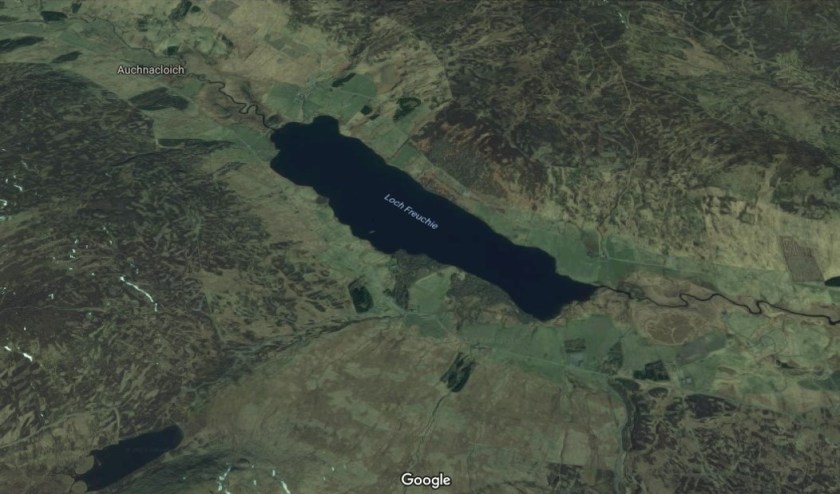
[Google map of Glen Quaich, surrounded by driven grouse moors]

Duncan continues: “A report published by the Scottish Government last May, prompted by the regular disappearance of satellite-tagged eagles, provided unequivocal evidence that the sudden disappearance of these birds when reliable tags suddenly stop transmitting is highly suspicious.

This is the third of five white-tailed eagle chicks to have fledged from the first successful nest in East Scotland –  the product of a Scottish Government-sponsored reintroduction project – to have disappeared in such circumstances, suggesting it has also been illegally killed.

We call on the Scottish Government to introduce a robust licencing system for driven grouse shooting with sanctions for removal of licences where criminal patterns of behaviour are established to the satisfaction of the authorities. Those that obey the law and conduct their operations within it have nothing to fear from such a regulatory framework.

ENDS

Eagle Blue X was the 5th chick to fledge from the well known Fife pair. Only one is still alive: one died after landing on power lines (and was recovered for post mortem) and two others disappeared under suspicious circumstances. This is a very high attrition rate for the most important generation in the reintroduction project.

In 2017, 21 volunteers gave up a total of 815 hours to watch the Fife nest and make sure the breeding attempt was successful. They stopped a photographer from continuing to disturb the incubating female and undoubtedly saved the eggs from chilling.

Blue X hatched in 2017 and she was ‘gone’ by March 2018.

Here she is in the nest as a chick (photo RSPB Scotland). All that effort, for nothing.

For how long do you think the Scottish Government will tolerate this blatant criminality that brings shame and embarrassment to the decent, law-abiding citizens of Scotland?

They’ll tolerate it for as long as we allow them to.

Please, consider writing to Environment Cabinet Secretary Roseanna Cunningham, who undoubtedly will be as appalled as we all are about this ongoing, out of control lawlessness, and ask her to act. Emails to: CabSecECCLR@gov.scot 

UPDATE 18 April 2018: Pointless search for missing sea eagle ‘Blue X’ (here)

UPDATE 19 April 2018: Deputy First Minister’s constituency a hotspot for ‘disappearing’ sat-tagged eagles (here)

UPDATE 20 April 2018: “It can’t go on – Mark Ruskell MSP speaks out against illegal raptor persecution (here)

Legal challenge against hen harrier brood meddling continues, x2

Two separate High Court applications have been submitted this week, seeking a judicial review of Natural England’s highly controversial decision to issue a hen harrier brood meddling licence.

As a quick re-cap for new blog readers, in January this year, Natural England issued a licence to Jemima Parry-Jones (International Centre for Birds of Prey [ICBP], Newent, Glos) permitting the removal of hen harrier eggs and chicks from some nests on grouse moors in Northern England, to protect artificially-high stocks of red grouse being farmed for shooting. The licence permits the ICBP to rear the young hen harriers in captivity and then release them in August back to the same grouse moor areas from where they were removed, where they will once again be put at risk of being illegally killed.

This licence is fundamental to DEFRA’s hen harrier brood meddling plan, which forms part of its ludicrous Hen Harrier Action Plan. For background reading on hen harrier brood meddling, please see here.

The ICBP is being paid by the Moorland Association to undertake the brood meddling work, and the licence is supported by the members of the Hen Harrier Brood Meddling Project Board, which includes Rob Cooke (Natural England), Adrian Jowitt (Natural England), Steve Redpath (Aberdeen University), Jemima Parry-Jones (ICBP), Adrian Smith (GWCT), Philip Merricks (Hawk & Owl Trust), Amanda Anderson (Moorland Association), Robert Benson (Moorland Association).

In early February, lawyers acting on behalf of Mark Avery decided to challenge the lawfulness of Natural England’s decision to issue this licence by way of a judicial review. The lawyers agreed to work at reduced rates and Mark successfully raised over £26,000 via crowdfunding to support the legal action.

In late February Mark’s lawyers sent a ‘pre-action protocol letter’ to Natural England, outlining the perceived legal inadequacies of the decision to issue the licence. The letter also invited Natural England to revoke the licence and undertake a proper public consultation on the issue of hen harrier brood meddling.

In March the RSPB also sent a pre-action protocol letter to Natural England on the same issue.

Natural England’s response letters have been seen as unsatisfactory by Mark and by the RSPB and so yesterday Mark submitted an application to the High Court seeking permission for a judicial review, because, as Mark’s lawyer says,  “My client believes that the decision to grant this licence is unlawful as it is in breach of EU law – it takes criminal activity as its starting point and looks to ease the path for those who break the law, often for profit, for the purpose of shooting red grouse“.

Today the RSPB has also announced it, too, has submitted an application seeking a judicial review.

Good stuff.

There was an article in The Guardian yesterday about Mark’s application.