National golden eagle survey 2015: low occupancy on Eastern Highland grouse moors remains a concern

Every year a proportion of the Scottsh golden eagle population is surveyed by licensed experts from the Scottish Raptor Study Group. This phenomenal voluntary effort (currently 373 home ranges [approx 53% of known ranges] monitored by 150 eagle experts) provides invaluable data that are submitted to the Scottish Raptor Monitoring Scheme and are used to inform conservation policy at local, regional and national level.

In addition to this annual monitoring, a national survey is periodically undertaken with both paid and voluntary experts in an effort to visit every known home range throughout Scotland.
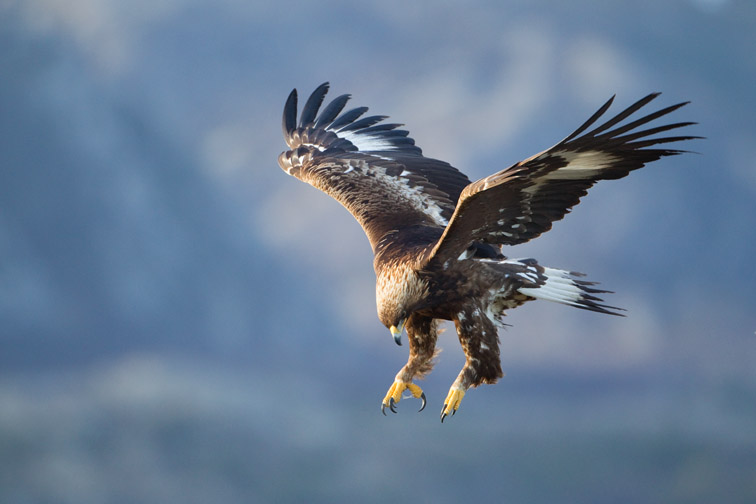
Photo by Mark Hamblin

The latest national golden eagle survey took place in 2015 and the interim results were announced in November 2016. The main headline was that overall, the national population had increased by 15%, rising from 442 pairs recorded during the last national survey in 2003, to 508 territorial pairs in 2015, and the species was now considered to be in favourable conservation status.

This was excellent and welcome news, but as we pointed out at the time, the headline masked a more sinister situation. Although the national population had surpassed 500 territorial pairs, the magic number needed to upgrade the species’ national conservation status from ‘unfavourable’ to ‘favouable’, it was still well below the estimated capacity of 700 pairs. This meant that approx 200 pairs of golden eagles were still ‘missing’.

Unsurprisingly, the national survey revealed that golden eagle populations in the driven grouse moor areas of eastern and southern Scotland were still being suppressed and had not shown any significant sign of recovery since the previous national survey in 2003. Illegal persecution has been identified time and time again as the main constraint on population growth in these regions.

The formal scientific peer-reviewed results of the 2015 national survey were published last week in the journal Bird Study [Hayhow, D., Benn, S., Stevenson, A., Stirling-Aird, P. and Eaton, M. (2017). Status of golden eagle Aquila chrysaetos in Britain in 2015. Bird Study].

Unfortunately publishing restrictions do not permit us to upload the full paper (you’ll have to subscribe to Bird Study for full access) but here is the abstract:

[UPDATE: This paper is now fully available online, free access, thanks to the BTO. Click here]
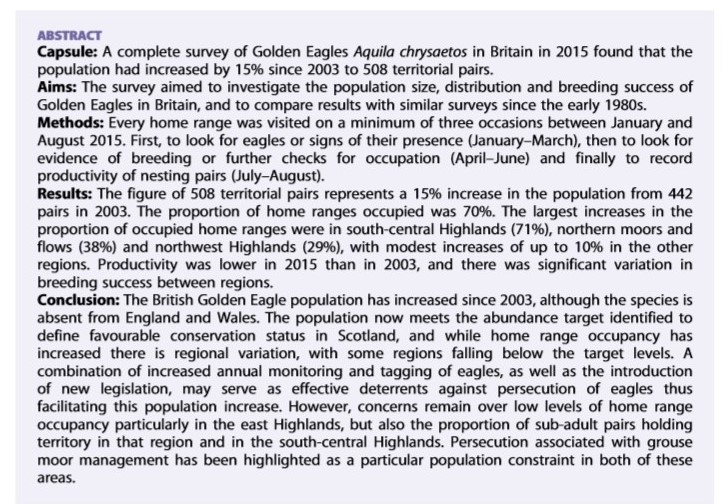
In additon to details about the continued low occupancy on grouse moors in the eastern Highlands, the paper also provides information that dispels a couple of myths that are frequently claimed as ‘facts’ by the SGA and co.

You might remember the SGA giving evidence to a parliamentary committee earlier this year where they claimed that “the Cairngorms National Park held the highest density of eagles in the world“. They might want to have a look at this map. This is the distribution of pairs of golden eagles in 2015 and shows the densities of occupied home ranges by 10 x 10 km squares. As you can see, the highest densities of golden eagles were recorded in the Outer Hebrides and on Mull (no grouse moors in these areas):

Another commonly-heard myth, usually trotted out to support calls for the ‘control’ of white-tailed eagles, is that re-introduced white-tailed eagles are displacing golden eagles and taking over their territories/nest sites, even though recent research has demonstrated that these two species partition their habitat and prey preferences in western Scotland. In this latest paper, the authors comment:

Although we have not assessed this in the current study, we report increases in golden eagles numbers in regions such as the Hebridean Islands in which there has been a rapid increase in white-tailed eagles (Holling 2016), which suggests that, at least at current population levels, there has been no major impact“.

The authors do acknowledge that the white-tailed eagle population is predicted to continue its expansion and this may, potentially, create competition between the two species in the future but right now, based on the currently available data, there is no evidence to suggest this is a population-level concern.

The main current threat to Scottish golden eagles is the same as it was following the previous national survey, fourteen years ago. And that is illegal persecution on some driven grouse moors in the eastern Highlands and south Scotland. The grouse-shooting representatives can continue to deny it, but this latest paper is yet another nail in the coffin of this filthy industry.

Northern England Raptor Forum (NERF) annual conference 2017

Booking is now open for this year’s Northern England Raptor Forum (NERF) annual conference, which takes place at Northumbria University in Newcastle on Saturday 18th November 2017.

For further details and to book your place, please visit the NERF website here.

Two parliaments, two politicians, two questions, two very different attitudes to raptors

Dim-witted DUP dinosaur Jim Shannon MP (Strangford, Northern Ireland), a member of the Countryside Alliance and not known for having a sharp intellect, posed the following written parliamentary question on 5 September 2017:

Question 8483: To ask the Secretary of State for Environment, Food, and Rural Affairs, if he will consider controls on the number of raptor birds in the countryside.

Answered by DEFRA Under Secretary of State Dr Therese Coffey, 13 September 2017:

Nature conservation is a devolved matter. In England all wild birds are protected under the Wildlife and Countryside Act 1981, making it an offence to kill, injure or take wild birds or to take or damage their eggs and nests. There are provisions under Section 16 of the 1981 Act that allow for the control of raptors for specific reasons, for example, to conserve other wild birds. Licence applications are dealt with on a case by case basis and priority must be given to non-lethal methods. The Government is not considering any further controls on the number of raptors.

Meanwhile, back in the 21st Century, yesterday in the Scottish Parliament Hen Harrier Species Champion Mairi Gougeon MSP (SNP, Angus North & Mearns) asked the following question:
Question # S50-01250: To ask the Scottish Government what role the police and the Crown Office have in dealing with wildlife crime.

Answered by Cabinet Secretary Roseanna Cunningham, 14 September 2017:

Wildlife crime is crime. Perpetrators will be investigated and, if there is sufficient evidence, prosecuted, as with any other crime. However, we are aware that there are characteristics of wildlife crime that mean that a specialised approach is required. For example, wildlife crime often takes place in remote areas where there are no witnesses, and of course there are usually no victims able to report what has happened to them. For those reasons, we are working with Police Scotland to expand the resources that are available to the police to tackle wildlife crime, with a pilot project to provide additional special constables in Cairngorms national park. The Crown Office also has a specialist wildlife and environmental crime unit to tackle such crime.

Mairi Gougeon followed up with a supplementary question:

The cabinet secretary will be aware of the recent shooting of a hen harrier on the Cabrach estate and the recent disappearance of Calluna, a satellite-tagged hen harrier, near Ballater. In the light of those incidents, what action is the Scottish Government taking to implement the recommendations of the satellite tagging review?

Roseanna Cunningham answered:

I am aware of those appalling incidents. In the light of the satellite tagging review, which was announced on 31 May, we will bring forward a number of measures, which include setting up an independently led group to look at grouse moor management practices and increasing Police Scotland resources, as I mentioned.

In accordance with that, good progress is being made on those areas; I will announce further details shortly. In the meantime, other work goes on—the police respond to and investigate reports that are received, and there are actions such as the further use of restrictions on general licences by Scottish Natural Heritage when wildlife crime is suspected to have taken place. We are determined to put an end to wildlife crime.

Three raptor workers short-listed for national conservation awards

Huge congratulations to Brian Etheridge, Andrea Hudspeth and Logan Steele, three Scottish Raptor Study Group members who have been shortlisted in this year’s Nature of Scotland Awards.
Brian Etheridge is on the shortlist for the RSPB Species Champion Award. To be shortlisted for this award ‘the entrant will have achieved something extraordinary to conserve a vulnerable or threatened species‘. Brian is indeed extraordinary, as are his achievements in the field of raptor monitoring and conservation. Through many decades of fieldwork he has accrued a vast knowledge on the ecology and conservation of a number of species, notably red kite and hen harrier but also merlin, common buzzard, honey buzzard, goshawk and golden eagle, but perhaps of greater significance is his ability and willingness to share that knowledge and experience with others. Brian’s expertise is always in high demand and he’s always, always generous with his time, encouragement and support. This has been beneficial not only to the species he studies, but also to an army of young, up-and-coming researchers, both amateur and professional, who’ve been fortunate to spend any time with him.

Andrea Hudspeth and Logan Steele have been shortlisted for the Political Advocate of the Year Award. This award is ‘to recognise a politician, campaigner or individual who has made a difference or significant impact on public policy for nature and wildlife‘. Andrea and Logan helped prepare the public petition, on behalf of the SRSG, calling for the licensing of gamebird shooting in Scotland. They gave measured, thoughtful and compelling evidence at two parliamentary committees last year, pushing the issue of raptor persecution higher up the political agenda. As a direct result of their efforts, the Scottish Government is undertaking a review of grouse moor management practices and, significantly, is considering the introduction of a licensing scheme. Also as a direct result of their efforts, they have both been subjected to a vile campaign of harrassment and intimidation from some disgraceful individuals within the game-shooting sector. Andrea and Logan have dealt with this appalling abuse with dignity and fortitude.

It’s fantastic to see these three people receive some well-earned recognition – well done, thank you, and good luck at the awards ceremony in November!

Natural England must release hen harrier satellite tag data

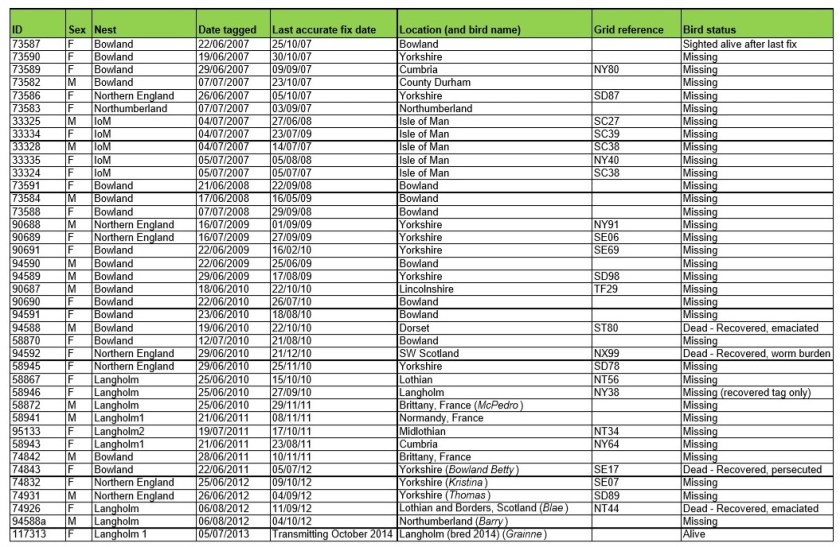
Natural England has been fitting tags to English hen harriers since 2002. First it was radio tags and then, since 2007, it’s been satellite tags.

So far, Natural England has refused to release detailed information about the fate of these tagged hen harriers because the data were being collected as part of a PhD study. Last month we learned that the PhD has been abandoned (see here).

NE did release some initial information in 2014 (see here), that showed 47 hen harrier sat tags had been fitted between 2007-2014 and of those, an astonishing 37 harriers (78.7%) had gone ‘missing’. However, NE did not provide details about the circumstances of these disappearances, and notably excluded the locations of the last transmitted signals; even a description of the associated land-use of those final locations was kept secret.

Since 2014, we know that NE has fitted more hen harrier satellite tags (5 x tags in 2015, all of which were ‘missing’ by July 2016, according to an FoI response; and at least 2 x tags in 2016 and perhaps 1 x tag in 2017 – the details are sketchy because NE has remained tight-lipped about how it has spent our money).

In sharp contrast, detailed information on the fate of satellite-tagged raptors in Scotland has been made available to the public, even though some of the tagging effort has been privately funded. The recent report on the fate of satellite-tagged golden eagles (see here), and the RSPB’s consistent public updates on the fate of satellite-tagged hen harriers (see here), has helped to progress the issue of illegal raptor persecution high up the Scottish political agenda and we are now on the cusp of seeing genuine attempts at progressive reform.

We want to see the same progress being made in England but we need access to scientific information to help frame the case. That scientific information is available (15 years worth of hen harrier tag data) and what’s more, it’s been paid for with public funding. Our money!

Last month we encouraged blog readers to contact Natural England and ask for the release of some of that publicly-funded information. So far, NE hasn’t responded but we are quite certain that NE doesn’t have a leg to stand on if it insists on withholding the information and if it tries to do so, we’ll be submitting a formal complaint to the Information Commissioner.

At the very least, the very, very least, NE should be producing a map to show where all those ‘missing’ sat-tagged hen harriers have vanished. This can be done at a scale that doesn’t compromise sensitive locational data and doesn’t compromise the value of the data for peer-reviewed scientific publication (see the golden eagle satellite tag review to see how it can be done).

We would encourage as many of you as possible to email Natural England and ask for the release of this information, even if you did this last month and are still waiting for a response. Email: enquiries@naturalengland.org.uk 

Thank you.

Driven grouse shooting & mountain hare culling under more political scrutiny this Thursday

More angst for the dark side this week as yet more political attention is given to driven grouse shooting and mountain hare culling.

The Scottish Parliament’s Public Petitions Committee will convene on Thursday 14 September to discuss a number of new petitions lodged by members of the public.

We’re interested in two of these petitions:

Petition # PE01663 – Driven Grouse Shooting Study, lodged by Les Wallace.

Petition summary: Calling on the Scottish Parliament to urge the Scottish Government to sponsor a comprehensive and independent study into the full economic impacts of driven grouse shooting.

Petition # PE01664 – Greater Protection for Mountain Hares, lodged by Harry Huyton (of OneKind).

Petition summary: Calling upon the Scottish Parliament to urge the Scottish Government to introduce greater protection for mountain hares on both animal welfare and conservation grounds, which may include: introducing a three-year moratorium on all mountain hare killing, permitting culls and driven hunts only under licence, and ending all culling and driven hunting of mountain hares within Scotland’s National Parks using a Nature Conservation Order.

We have no idea how the Petitions Committee will choose to proceed with these two petitions as they are mostly superceded by Environment Secretary Roseanna Cunningham’s surprise announcement in May that she is setting up a review of grouse moor management (which will include mountain hare culling), as well as ‘commissioning research into the costs and benefits of large shooting estates to Scotland’s economy and biodiversity’.

Nevertheless, it is good too see these issues still firmly on the political agenda. Well done, Les & Harry.

We expect this session to be broadcast live on Scottish Parliament TV on Thursday morning and we’ll post the official transcripts as soon as they’re available.

Conservation status of mountain hares: parliamentary questions lodged

As many of you will know, the mountain hare is listed on Annexe V of the EU Habitats Directive (1992), which requires member states to maintain this species in favourable conservation status.

As you’ll also know, the mountain hare is a legal quarry species in Scotland (during the open season of Aug-Feb) and is routinely culled on many grouse moors without any regulatory oversight. There have long been concerns about the sustainabilty of these large-scale culls and the grouse-shooting industry has been urged to undertake ‘voluntary restraint‘ – a pointless plea that so far seems to have been roundly ignored.

Dead mountain hares being transported on Farr Estate Feb 2017 (photo by Pete Walkden)

Earlier this year the charity OneKind published a summary report outlining many of the conservation and welfare concerns relating to the continued killing of this species (see here).

In May, Environment Secretary Roseanna Cunningham announced that the issue of mountain hare culling would be addressed as part of her proposed review of grouse moor management (see here). We’ve yet to hear any more details about when this review might begin.

The Scottish Government has a legal obligation (under the Habitats Directive) to report to the EU on the health of the mountain hare population. Given that the Government has absolutely no idea what impact the mass culls have on the mountain hare population (because, unbelievably, there is no legal requirement for estates to provide cull return data to SNH outside the close season, and, there isn’t yet an agreed survey method for monitoring mountain hares), it would be interesting to know what SNH has been telling the EU.

Well, we’re about to find out thanks to a pertinent Parliamentary Question lodged by Alison Johnstone MSP:

Question S5W-11180: Alison Johnstone, Lothian, Scotish Green Party. Date lodged: 8/9/2017.

To ask the Scottish Government what reports it has made to the EU Commission in the last 10 years regarding the population status of mountain hares, and what summary conclusions these included regarding the species’ health.

Expected answer date: 26/9/2017.

We’ve previously blogged about this issue and have argued that we consider the current unregulated mass culling of mountain hares to be in breach of EU regulations (see here), mainly because in the absence of decent population data, it is impossible for SNH to assess whether the species is in favourable or unfavourable conservation status. So we’re very much looking forward to finding out if SNH has been telling the EU that Scotland’s mountain hare population is in favourable conservation status, and if so, on what evidence this claim has been made.

Alison has lodged two more related questions, also due to be answered on 26 Sept 2017:

S5W-11181:

To ask the Scottish Government, when it will publish its standardised counting method for mountain hare populations.

S5W-11182:

To ask the Scottish Government when Scotland’s Moorland Forum will publish its best practice guidance on the sustainable management of mountain hares, as part of the Principles of Moorland Management project.

Well done, and thanks, Alison.

Imagine that! Satellite tags continue to function after non-suspicious deaths of two hen harriers

This morning the RSPB announced that two of this year’s satellite-tagged hen harriers, Mannin & Grayse, had died in non-suspicious circumstances.

Both had been tagged at a nest on the Isle of Man in July 2017. Grayse was discovered dead on the island on 9th August. Her brother Mannin left the island on 14th August and made a failed attempt to cross the sea to the Galloway coast in SW Scotland. After ten days at sea, his body was found washed up on the Scottish shoreline on 24th August 2017.

Photo of Mannin & Grayse before they fledged (photo by James Leonard).

The bodies of both birds were submitted for post mortems, neither of which indicated their deaths were suspicious.

Although the deaths of these two harriers is disappointing, natural mortality is, well, natural and not unexpected.

What’s unusual about these two harriers is that their satellite tags continued to transmit data after the birds had died. That shouldn’t be a surprise, because that’s how these tags are designed to work and in most countries, that is how they work. Researchers are routinely able to use the data from the still-transmitting tags to locate the dead body and work out what happened to cause the animal’s death.

It seems it’s only in the UK, and particularly on grouse moors, where satellite tags on dead raptors routinely and abruptly stop transmitting, and vanish off the radar, along with the raptor’s corpse.

Funny, that.

The recent Golden Eagle Satellite Tag Review found that this happened much more often in Scotland than in any other countries where the same tags are deployed (England was not included in the analysis because Natural England is still sitting on the tag data – probably because NE knows just how devastatingly embarrassing a data analysis of tagged hen harriers will be).

Raptor persecution highlighted as key concern in Yorkshire Dales National Park

Earlier this year the Yorkshire Dales National Park Authority opened a public consultation to inform its next five-year Management Plan (2018-2023).

Residents and visitors were invited to submit comments on three open-ended questions:

  1. What do you love about the National Park?
  2. How do you think the National Park can be improved?
  3. What do you think are the three most important issues for the National Park Management Plan to tackle over the next five years?

Yesterday, the initial consultation results were published. Download the report:

 YDNPA_ManagementPlan_Report-of-consultation-8Sep2017

Grouse moor in Yorkshire Dales National Park (photo by Ruth Tingay)

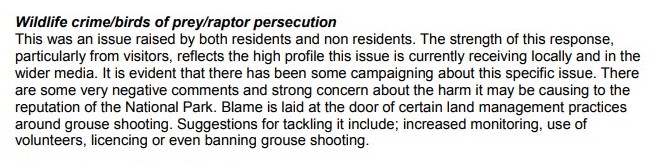
As you’d expect, a variety of concerns were raised relating to access, public transport, planning, farming, affordable housing and community services/sustainability. Two other concerns featured high on the agenda of residents and visitors alike – illegal raptor persecution and land management (with a particular focus on grouse moor management).

It’s no surprise. North Yorkshire (which includes the raptor persecution hotspots of the Yorkshire Dales National Park & the neighbouring Nidderdale Area of Outstanding Natural Beauty) is consistently rated as one of the worst counties in the UK for reported raptor persecution crimes (e.g. see here).

Separate to this consultation, we were recently provided with an interesting bit of news from a local resident. Following the 2016 case of the Mossdale pole traps, where a gamekeeper employed on the Mossdale Estate in the National Park was filmed by the RSPB setting three illegal pole traps on a grouse moor (here) and who was erroneously let off with a police caution (here), the Yorkshire Dales National Park Authority apparently received around 2,000 emails of complaint/concern. Not only that, but many local traders also contacted the Park Authority to express their concern about how the Park’s persistent reputation for illegal raptor persecution may damage their businesses.

It’s clear that people have had enough and are looking to the Park Authority to lead on this issue.

Is the Yorkshire Dales National Park Authority up for the challenge? Well, we’ll see. The results of the public consultation will be used by the Park’s Management Plan Steering Committee to draft specific objectives for the new Management Plan, which should be published early next year.

GWCT twisting the truth about hen harrier persecution, again

A few days ago we blogged about a series of letters published in The Times (Scotland) relating to the disappearance of a young satellite-tagged hen harrier Calluna, who recently vanished after visiting a Deeside grouse moor.

Scottish Land & Estates used the incident as an opportunity to falsely accuse the RSPB of not following agreed protocols, presumably in a pathetic attempt to detract attention from the ongoing criminality associated with the driven grouse shooting industry. We’ve come to expect no better from this organisation.

As a follow on from those letters, another industry figure, Andrew Gilruth from the Game & Wildlife Conservation Trust (GWCT), decided to join in and spew out some more fakery, this time in The Times (London edition). Here’s what he wrote, published 7 Sept 2017:

HEN HARRIER HABITAT

Sir,

The RSPB are right to say an organisation must not “ignore facts to suit its narrow agenda” (letter, Sep 5). The most productive location for hen harrier nests, 47 fledged young from 12 nests, was achieved by gamekeepers on Langholm Moor just three years ago. However, their improvement of the moorland habitat and protection of these ground nesting birds from foxes has now ended, because conservationists could not agree on how to also recover grouse numbers. Should hen harrier numbers drop to the two pairs there were before these gamekeepers arrived in 2008, the birds might ask who has the narrowest agenda.

Andrew Gilruth
Director of Communications
Game & Wildlife Conservation Trust

You’ll notice how Andrew’s distraction technique has cleverly moved the story away from the news of Calluna’s suspicious disappearance from a grouse moor and has instead tried to re-focus the story on to how great grouse moors are for hen harriers. Unfortunately for Andrew, choosing the Langholm Moor study as an example to support this theory was not the brightest idea.

Here’s why, succinctly explained in a letter published in The Times (London) today:

ABSENCE OF HARRIERS

Sir,

Andrew Gilruth’s letter (September 7) brings to mind Kipling’s poem ‘If’ for the manner in which it twists the truth to make a trap for fools.

The single and only reason Langholm Moor supported 12 harrier nests that fledged 47 young was that the gamekeepers working on this collaborative demonstration project were under strict instructions not to kill them and operate within the law. It is very telling that no other driven grouse moors in Scotland (or the rest of the UK) can equal this hen harrier population or productivity. What this statistic actually suggests, therefore, is the rampant scale of illegal killing of this majestic bird, given its landscape-wide absence and the lack of breeding success on all other driven grouse moors and which our members, (who are licenced by Scottish Natural Heritage), monitor across Scotland every year.

Logan Steele

Scottish Raptor Study Group (SRSG)

Logan hits the nail on the head. If driven grouse moors are so great for breeding hen harriers, why are we seeing an almost total absence of breeding hen harriers on these moors, year after year after year? Of course, the disgusting truth is already well known.

Andrew Gilruth’s letter has been widely shared on social media by the criminal apologists and has been followed up with other examples of supposedly typical driven grouse moors that have good hen harrier breeding figures this year. Unfortunately, these people are as scientifically illiterate as Andrew Gilruth and have used wholly inappropriate examples to illustrate their (fake) claims, e.g. Leadhills Estate, which had nine hen harrier nests this year, but this estate hasn’t seen any driven grouse shooting for a number of years (see here). There are other claims of “an estate in Perthshire” with 12-15 hen harrier nests this year – the estate hasn’t been named (natch) but they might be referring to Atholl Estate, which these days is a pretty good estate with a sympathetic management approach to breeding raptors, but only offers walked-up grouse shooting, not driven grouse shooting, so any successfull hen harrier nests there this year cannot be attributed to driven grouse moor management. Sorry, trolls, you must try harder.

Anyway, getting back to the actual news, that hen harrier Calluna is the latest in a long, long, long, long line of satellite-tagged raptors that ‘disappear’ after visiting certain driven grouse moors, it’s been a week since the RSPB appealed for information.

We’ve been looking at the social media accounts of various shooting industry organisations to see how much effort these ‘leaders’ have put in to encouraging their members to pass on information to the police. You can probably guess what we found (or didn’t find). That tells its own story about the sincerity and commitment of the industry to rid itself of its dirty criminals. Mark Avery has a pretty good explanation about the industry’s refusal to reform (see here) and Andrew Gilruth’s chronic propaganda patter gives Mark’s theory much credence.