W Yorks Police Firearms Licensing Dept: in breach of policing code of ethics?

A couple of days ago, the following extraordinary tweet appeared on the West Yorkshire Police Firearms Licensing Department’s official twitter account:

This is a shocking abuse of position. According to the national Policing Code of Ethics, police officers and staff are supposed to be impartial and non-political. For an official police account to use the hashtag #NoMoorMyths, which is the basis of a BASC propaganda campaign against those who oppose driven grouse shooting, is neither impartial or non-political.

Our objection isn’t based on whether or not we support grouse shooting, because we’d be equally appalled if we saw an official police account promoting the hashtag #BanDrivenGrouseShooting. This is about having confidence in the police’s ability to be professional and objective.

The police are also not supposed to abuse or harass members of the public (in this case, re-tweeting an offensive comment about Chris Packham).

The West Yorkshire Police Firearms Licensing Department’s twitter account is relatively new (the account opened on 18 July 2017) but a quick scan through some of its other tweets (e.g. promoting the Glorious 12th) is an alarming demonstration that whoever is operating the account needs to receive some advice on professional standards, and pronto!

Perhaps West Yorkshire Police Chief Constable Dee Collins might want to have a word. Emails of encouragement to: dee.collins@westyorkshire.pnn.police.uk

Record number of hen harriers fitted with satellite tags


RSPB press release:

The RSPB has fitted a record number of hen harrier chicks with satellite tags in the UK this year, more than doubling the number from any other year.

More than 24 birds have been fitted with transmitters so far, the majority of them in Scotland, as part of the conservation organisation’s EU-funded Hen Harrier LIFE Project. Harriers were also tagged in Wales and the Isle of Man.

By tracking the movements of these threatened birds of prey, the RSPB will be able to build up an even clearer picture of where hen harriers go and where they are most at risk, for example from illegal persecution.

This is the third consecutive year that hen harriers have been tagged as part of the project [6 tagged in 2015; 12 tagged in 2016]. The increase in the number of tags deployed in 2017 was made possible by cosmetic company LUSH, which raised funds through the sales of a specially created “Skydancer” bath bomb.

Conservationists hope the ‘Hen Harrier Class of 2017’ will fare better than last year’s cohort. Out of the 12 young harriers fitted with tags by the RSPB in 2016, only five are still alive. [See here for fates of RSPB and Natural England tagged 2016 hen harriers].

One of the birds, Carroll, was found dead having suffered from an infectious disease. Disturbingly, a post mortem later revealed lead pellets, indicating she had survived being shot at some earlier point in her life. Two of the other birds disappeared in suspicious circumstances when their tags suddenly stopped transmitting, while a further three were lost to unknown causes. All are presumed to have died, as it is very rare for tags to fail for technical reasons.

It is not only RSPB-tagged hen harriers that have met with untimely demises over the past 12 months. In May this year a police investigation was launched after a hen harrier was allegedly shot on Leadhills Estate in South Lanarkshire, while in October Rowan, a bird tagged by Natural England, was discovered shot dead in Cumbria.

The RSPB sincerely hopes that Natural England will publish the publicly funded satellite tracking data which the statutory agency has collected over the past decade, as this will add significantly to the weight of evidence being gathered through the RSPB’s work. [We have an FoI back from NE about this and will blog shortly].

The need for this sort of data has never been greater. Hen harriers are in serious trouble across the UK. The results of the recently published National Hen Harrier Survey revealed that in the last 12 years, the number of breeding pairs has declined by more than a quarter (27%) in Scotland and by over a third (39%) in the UK as a whole.

While the final numbers are still being collated, anecdotal reports suggest the situation in Scotland does not appear to have improved this breeding season with hen harriers notably absent or in very low numbers in areas of suitable habitat, particularly in the south and east. In England, the final figures for 2017 show only three successful nests across habitat suitable for over 300.

The main reason hen harriers are continuing to decline is illegal killing and disturbance associated with the increasingly intensive management of driven grouse moors. The Scottish Government recently set up an independent enquiry into gamebird shoot licensing after an independent scientific review of golden eagle satellite tracking data revealed that approximately a third of them are being illegally killed.

Blánaid Denman, Project Manager for the RSPB’s Hen Harrier LIFE+ Project, said: By satellite tracking more hen harriers than ever before, we’ll gain a clearer picture of where these birds are spending their time and what exactly is happening to them. We’ve already discovered previously unknown nesting and winter roosting sites, as well as been able to pinpoint where natural deaths and illegal killings have occurred.

“It’s both infuriating and utterly heartbreaking to see these beautiful birds, year after year, disappear off the radar. Something needs to change. A system of grouse moor licensing would not only protect hen harriers but also tackle wider damaging grouse moor management practices, such as heather burning on deep peat and inappropriate drainage. For now though, I’ll be watching our newly fledged hen harriers, praying for their safety, and waiting to see what incredible journeys are about to unfold.”

Paul Morton from LUSH said: “We’re thrilled to hear that the money raised by our customers has allowed the RSPB to sat tag more hen harrier chicks than ever before. Monitoring as many youngsters as possible as they take their first flights across the length and breadth of the country is vital for their long-term protection. The message is loud and clear; a nation is watching and will have the welfare of each of these birds close to our hearts. The illegal persecution of hen harriers or any bird of prey will not be tolerated“.

From September, it will be possible to follow the travels of a selection of this year’s tagged hen harriers, together with last year’s surviving birds at: www.rspb.org.uk/henharrierlife.

ENDS

A fantastic partnership effort (real, actual partnership-working rather than the charade of pretence we’re so used to seeing from the PAW Raptor Group). Well done to all involved at RSPB and LUSH, and well done to everyone who purchased a Skydancer bathbomb because you helped this project happen.

Grouse shooting industry in desperate attempt to greenwash its rampant criminality

While hundreds of extremist armchair conservationists (an oxymoron, surely?) turned out in force to support Hen Harrier Day events up and down the country last weekend, the grouse shooting industry was preparing to unleash a barrel of propagandist articles and ‘new research’ in a desperate attempt to greenwash the rampant criminality that threatens to take the shine off the opening of the grouse shooting season this coming weekend.

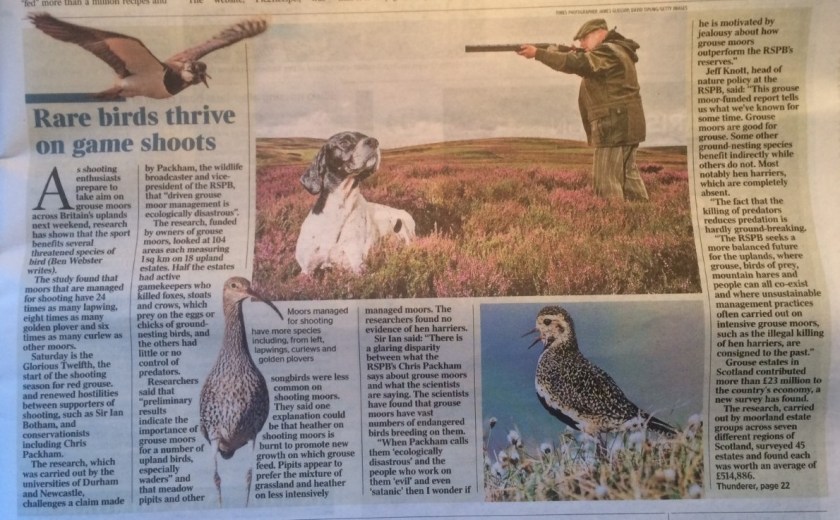
Much of the spin has focused on the ‘preliminary results of a new study’ that, according to the grouse shooting industry, shows that ‘rare birds thrive on game shoots’ and that grouse moors in North East Scotland and North Yorkshire are ‘the country’s best bird sanctuaries’ (e.g. see here and here).

Hmm. An interesting conclusion. Would these be the same grouse moor regions that consistently appear at the top of the national league table for illegal raptor killing, year after year after year? Surely not.

Unfortunately no actual details of the new study have been made available so it’s difficult to assess the validity of the ‘preliminary’ findings, and given the grouse shooting industry’s track record on falsely interpreting grouse moor bird survey data (see here) and falsely attributing grouse moor bird research to credible research organisations (funnily enough, published around this time last year, see here), we’d prefer to wait to see the actual peer-reviewed scientific paper before commenting further.

Jeff Knott (RSPB) has provided an excellent interim response to an article about this study. In The Times yesterday, he said:

This grouse-moor-funded report tells us what we’ve known for some time. Grouse moors are good for grouse. Some other ground-nesting species benefit indirectly while others do not. Most notably, hen harriers, which are completely absent. The fact that the killing of predators reduces predation is hardly ground-breaking“.

Well known academic Ian Botham, Professor Emeritus of the University of Rural Mythology, has taken a break from his glittering scientific career to offer a few quotes in several papers in support of the ‘new research findings’ and, predictably, then moves on to slag off the RSPB and Chris Packham. Some might argue that he’s desperately trying to deflect attention from his car crash radio interview last week (still very funny, still worth a listen if you haven’t yet done so).

Meanwhile, another new research study has found that the best way to preserve wildlife is to shoot it in the face (see here).

Thanks to blog reader Mr Carbo for sending in this cartoon.

Cabinet Secretary at Moy Game Fair: what message for the raptor killers?

The Moy (Highland) Game Fair kicks off today, where the great & good of the game shooting world gather to celebrate their activities.

Fergus Ewing MSP, Cabinet Secretary for the Rural Economy and Connectivity, will be there again this year, especially as this is bang slap in the middle of his constituency and he’s a big supporter of the game shooting industry.

We’ve often puzzled over the choice of venue for this event. The area has quite a history. In fact this region of the Monadhliaths, to the north west of the Cairngorms National Park, is one of the well known raptor persecution hotspots in Scotland.

Last year, Fergus Ewing rocked up to the Fair as usual, but his first time as a Cabinet Secretary. Have a watch of this video and listen to the strong message he gave to any raptor killing criminals that might have been listening. Not quite the message we might have hoped for from a senior representative of a Government that’s supposed to be big on stamping out raptor persecution, and in sharp contrast to the message given by another Cabinet Secretary earlier this year:

Botham in tantrum over car crash radio interview

Hopefully by now you’ve all had a chance to listen to Ian Botham’s masterclass in how not to do a radio interview – the best car crash radio for some time (see here).

Now Botham’s having a tantrum, claiming he was “ambushed by an anti-shooting agenda” and has threatened to boycott the BBC “unless something significant comes of this complaint“. Here’s the article in today’s Times:
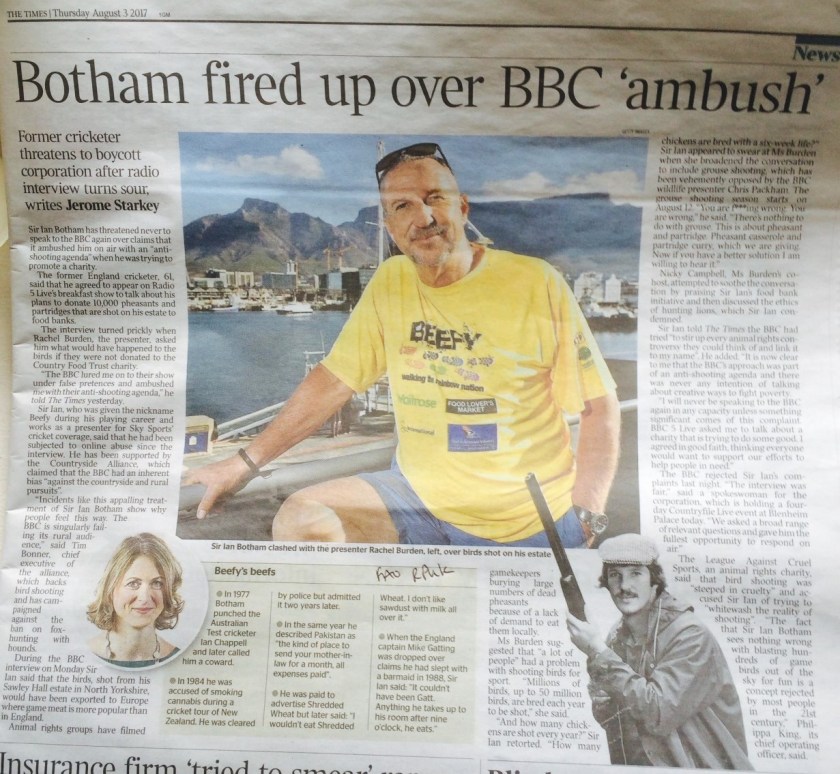
Here’s the text:

Sir Ian Botham has threatened never to speak to the BBC again over claims that it ambushed him on air with an “anti-shooting agenda” when he was trying to promote a charity.

The former England cricketer, 61, said he agreed to appear on Radio 5 Live’s breakfast show to talk about his plans to donate 10,000 pheasants and partridges that are shot on his estate to food banks.

The interview turned prickly when Rachel Burden, the presenter, asked him what would have happened to the birds if they were not donated to the Country Food Trust charity.

“The BBC lured me on to their show under false pretences and ambushed me with their anti-shooting agenda”, he told The Times yesterday.

Sir Ian, who was given the nickname Beefy during his playing career and works as a presenter for Sky Sports’ cricket coverage, said that he had been subjected to online abuse since the interview. He has been supported by the Countryside Alliance, which claimed that the BBC had an inherent bias “against the countryside and rural pursuits”.

“Incidents like this appalling treatment of Sir Ian Botham show why people feel this way. The BBC is singularly failing its rural audience”, said Tim Bonner, chief executive of the alliance, which backs bird shooting and has campaigned against the ban on fox hunting with hounds.

During the BBC interview on Monday Sir Ian said that the birds shot from his Sawley Hall estate in North Yorkshire, would have been exported to Europe where game meat is more popular than in England.

Animal rights groups have filmed gamekeepers burying large numbers of dead pheasants because of a lack of demand to eat them locally.

Ms Burden suggested that “a lot of people” had a problem with shooting birds for sport. “Millions of birds, up to 50 million birds, are bred each year to be shot”, she said.

“And how many chickens are shot every year?” Sir Ian retorted. “How many chickens are bred with a six-week life?”

Sir Ian appeared to swear at Ms Burden when she broadened the conversation to include grouse shooting, which has been vehemently opposed by the BBC wildlife presenter Chris Packham. The grouse shooting season starts on August 12. “You are f***ing wrong. You are wrong”, he said. “There’s nothing to do with grouse. This is about pheasant and partridge. Pheasant casserole and partridge curry, which we are giving. Now if you have a better solution I am willing to hear it”.

Nicky Campbell, Ms Burden’s co-host, attempted to soothe the conversation by praising Sir Ian’s food bank initiative and then discussed the ethics of hunting lions, which Sir Ian condemned.

Sir Ian told The Times the BBC had tried “to stir up every animal rights controversy they could think of and link it to my name”. He added: “It is now clear to me that the BBC’s approach was part of an anti-shooting agenda and there was never any intention of talking about creative ways to fight poverty.

“I will never be speaking to the BBC again in any capacity unless something significant comes out of this complaint. BBC 5 Live asked me to talk about a charity that is trying to do some good. I agreed in good faith, thinking everyone would want to support our efforts to help people in need”.

The BBC rejected Sir Ian’s complaints last night. “The interview was fair”, said a spokeswoman for the corporation, which is holding a four-day Countryfile Live event at Blenheim Palace today. “We asked a broad range of relevant questions and gave him the fullest opportunity to respond on air”.

The League Against Cruel Sports, an animal rights charity, said that bird shooting was “steeped in cruelty” and accused Sir Ian of trying to “whitewash the reality of shooting”. “The fact that Sir Ian Botham sees nothing wrong with blasting hundreds of game birds out of the sky for fun is a concept rejected by most people in the 21st century”, Philippa King, its chief operating officer, said.

ENDS

 

Police interview man re: shot red kite in Nidderdale

North Yorkshire Police have issued a further appeal for information about the shooting of a red kite in Nidderdale.

The kite was found near Greenhow in Nidderdale on Saturday 11th March 2017 (see here). Since then, a number of rewards have been offered for information leading to the arrest and conviction of those involved. One of these rewards has been offered by local businesses in nearby Pateley Bridge (see here).

Last month North Yorkshire Police interviewed a local man in connection with the incident and now they are appealing again for more information.

PC David Mackay, a Wildlife Crime Officer from the North Yorkshire Police Rural Task Force said: “We have had a good response so far from the public to our appeal for information, and I am urging anyone who has not yet come forward to do so now. This lengthy investigation shows that we take bird of prey persecution extremely seriously“.

North Yorkshire Police is being supported in the investigation by the Yorkshire Red Kites group. Doug Simpson, the Yorkshire Red Kite Co-ordinator, said: “I am pleased to hear of the progress made in this case. I would encourage anyone with any information not yet reported to contact the police as soon as possible.”

Anyone with information is asked to contact Police Wildlife Crime Officer David Mackay:  david.mackay@northyorkshire.pnn.police.uk and quote reference number 12170047155. Alternatively, you can contact Crimestoppers anonymously on 0800 555 111.

The grouse moor areas of Nidderdale and the neighbouring Yorkshire Dales National Park are well known raptor persecution hotspots. In the last ten years (2007-2017), twenty six red kites have been confirmed as victims of illegal persecution in North Yorkshire (18 poisoned, 8 shot). Twenty two of those red kites were killed in Nidderdale or the National Park. Earlier this year the RSPB wrote a blog about red kite persecution in this region and produced this shocking map:

Well done North Yorkshire Police for persistence with this latest investigation (see press release here).

Red kite photo by Richard Stonier

Peregrine shot in Ipswich – police investigation launched

Suffolk Police are investigating the shooting of a young male peregrine in Ipswich.

The bird, one of four to have fledged this year from the Mill Tower at Ipswich Waterfront, was found alive but in an emaciated condition at the weekend. He was taken to Riversbrook Veterinary Practice where an x-ray revealed he had been shot in the leg. Unfortunately he didn’t survive.

Further details in the Ipswich Star here

Photos by Riversbrook Veterinary Practice

Three successful hen harrier nests in England (none on driven grouse moors)

The RSPB has just announced the results of the 2017 hen harrier breeding season in England. There was a pathetic total of three successful nests (England has the capacity for ~330 pairs).

The three successful nests (with ten fledglings) were on land managed by the Forestry Commission in Northumberland.

Read the full, sorry details on the RSPB’s Skydancer blog here.

Well done to the Northumberland Hen Harrier Protection Partnership (Northumberland National Park Authority, Forestry Commission, RSPB, Natural England, Northumberland Wildlife Trust, Ministry of Defence, Northumbria Police, and the Northern England Raptor Forum).

There’s an interesting quote from Andrew Miller of the National Park who says, “We will continue to monitor our birds throughout the year….” This implies that the young birds have been satellite tagged, but according to our sources, only one fledgling was fitted with a tag because Natural England left it too late this year. This seems hard to believe, given NE’s experience of sat tagging hen harriers, but no doubt we’ll hear more about this in due course.

The real story, and what should be our focus of attention, is that for a second year in a row, there wasn’t a single successful breeding attempt on any driven grouse moor in England. This is despite the grouse shooting industry supposedly being signed up to DEFRA’s Hen Harrier InAction Plan.

[Drawing by Gerard Hobley]

If this year’s shameful breeding results don’t inspire you to attend a Hen Harrier Day event this coming weekend, nothing will.

Well done to the RSPB for publishing the details of this year’s breeding season in good time (presumably Natural England is still fiddling with its super computer, trying to count up to three and ‘analysing’ the data).