Is a grouse shooting apologist making up stuff to attack the RSPB? Surely not!

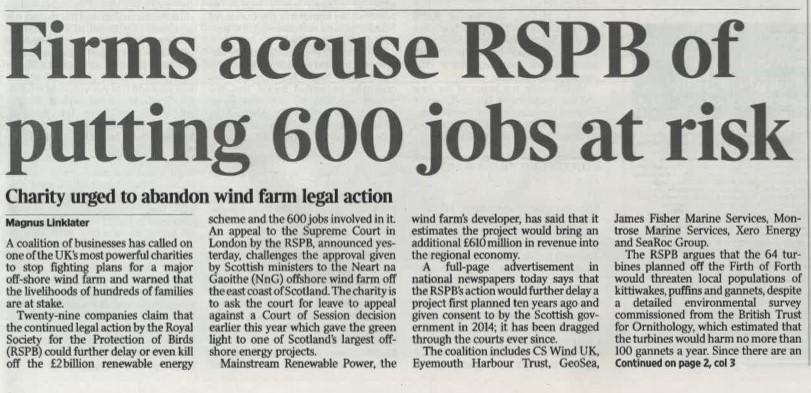
Slightly away from our usual blog topics, some of you may have seen a full page advert in some national newspapers today, placed in the form of an open letter to RSPB Scotland (see: Times Coalition advert) by a consortium of companies hoping to be involved in the construction and/or operation of a massive offshore windfarm. This follows news yesterday that RSPB Scotland has lodged papers at the Supreme Court, seeking leave to appeal a previous Court of Session decision that reinstated Scottish Government consents for the development.

While we’re not qualified to comment on the rights or wrongs of the proposed development, some of the media commentary on the back of the advert is particularly interesting.

In a front page article in the Scottish edition of The Times, as usual protected by a paywall, journalist Magnus Linklater says that the RSPB’s suggestion that the 64-turbine development off the Firth of Forth would threaten local populations of seabirds, was made despite a “detailed environmental survey commissioned from the British Trust for Ornithology, which estimated that the turbines would harm no more than 100 gannets a year”. The article goes on to suggest that the companies behind the proposed development say that the impact of the scheme would be “marginal”.
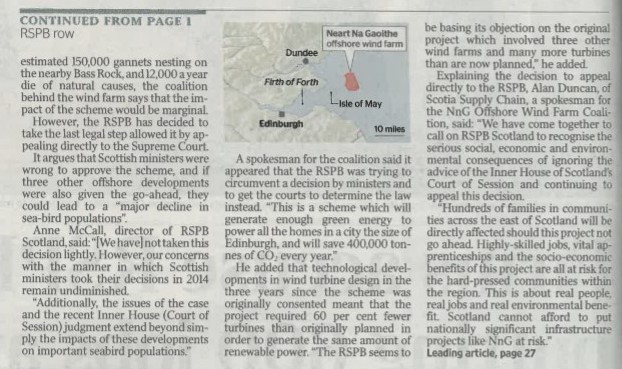
Linklater suggests a significant role played by the BTO in undertaking survey work to inform the developers’ case. Interestingly, the figures in the Scottish Ministers’ own assessment seems to markedly contradict the “100 gannets a year” figure attributed to the BTO by Mr Linklater. According to the official assessment, the cumulative impact of this development is to harm 1169 gannets a year, considerably higher than the “no more than 100 gannets a year” quoted by Linklater, and it appears that a good few other seabirds are predicted to die every year as well. Check out the ‘Cummulative’ column in this table from the Scottish Ministers’ official assessment report:
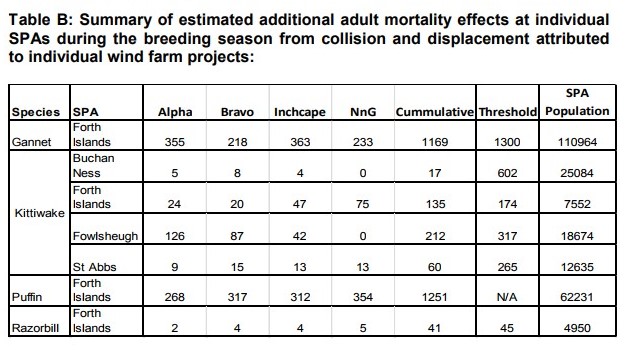
Perhaps the BTO will clarify this huge discrepancy in the number of birds predicted to be harmed?

However, it is perhaps the editorial piece in the same paper that is of considerably more concern. It suggests that the RSPB is “stepping outside its charitable brief in mounting a legal challenge to Scottish minsters” and goes on to say that “nothing in the charitable guidelines within which it operates sanctions this kind of campaigning”.
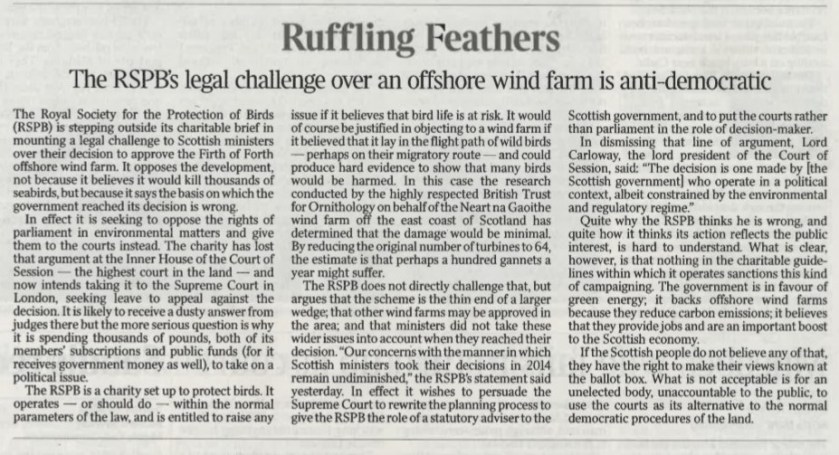
We beg to differ, as does an excellent article here (well worth a read). This Times leader has got a sinister stench not dissimilar to the Nasty Brigade’s ongoing campaign against the RSPCA in an attempt to prevent prosecutions under the Hunting Act. It’s pretty clear to us that campaigning to stop the predicted deaths of thousands of seabirds is exactly what the RSPB should be doing (alongside all their other stuff, of course).

Given this, why on earth would a journalist want to portray the RSPB in a bad light, suggesting that it’s threatening jobs and opposing the rights of parliament? Why would a journalist quote erroneous data to support their assertions? Could it be that this was seen as an opportunity to mount an attack on the RSPB by a regular apologist from another sector that frequently tries and fails in this very tactic?

Mr Linklater has a long history of voicing negative opinions about the RSPB or writing pro-gamebird shooting/anti-RSPB articles in the media (see here), and its not the first time he’s come out with some fake facts (see here for a summary). Interestingly, George Monbiot wrote about this anti-RSPB bias five years ago, and also drew attention to the fact that Mr Linklater is one of three trustees of a sporting estate in Scotland. Surely a grouse shooting apologist wouldn’t misrepresent the BTO? Oh, wait a minute – remember this?

Incidentally, in another depressingly one-sided, non fact-checked piece of ‘journalism’, anti-BBC, ex cricketer and You Forgot the Birds mouthpiece Ian Botham went off on one about RSPB in the Daily Mail on the Inglorious Twelfth. We haven’t bothered to read it all (because we’re still laughing at his recent car crash interview on BBC 5 Live) but we’re told that he claims that ‘the RSPB are like Venezuela’. We’ve heard that Venezuela is rather good for birds, so we’re sure that will please the RSPB.

Given that this upcoming court challenge is very clearly the RSPB standing up for birds that aren’t even raptors, we’re sure they’ll be waiting for Beefy’s ringing endorsement.

UPDATE 17 August 2017: Magnus Linklater and his fake facts, caught out again (here)
Species Champion Mairi Gougeon MSP speaks up for hen harriers

‘Species Champions’ are members of the Scottish Parliament who have agreed to provide political support and awareness for Scotland’s threatened wildlife, under a scheme organised by Scottish Environment LINK.

Mairi Gougeon (nee Evans) MSP is the Species Champion for the hen harrier, and it was fantastic to see her attend Hen Harrier Day at Loch Leven a couple of weeks ago. She wasn’t the only MSP present – also in attendance was Alexander Stewart MSP (Scottish Conservatives) and Andy Wightman MSP (Scottish Greens) – Andy had cycled from Edinburgh and broke his pedal 5 miles away but still managed to make it on time – impressive!

It was gratifying to see all three of these politicians giving up their Saturday to come along. And they didn’t just turn up for the photo call and then clear off; they spent a considerable amount of time talking with the public, asking pertinent questions (and listening to the responses!) and they all stayed to hear the presentations throughout the afternoon. Mairi even gave a short but very encouraging presentation – you can watch it here (it’s only 4 mins long – well worth a listen, thanks to Guy Shorrock for recording it):

Perhaps of all three politicians in attendance, Mairi had the most cause to be there. Not just as the Hen Harrier Species Champion, but also because her SNP constituency is Angus North & Mearns, which includes the Angus Glens grouse moors, a notorious raptor persecution hotspot.

The history of illegal raptor persecution in this area is well known (see here for a long list of incidents), and it’s also known for its lack of breeding hen harriers – not a single recorded breeding attempt on these grouse moors for 11 years, although there was one breeding attempt in the area this year, but it wasn’t on a driven grouse moor. It’s clear from Mairi’s speech that she is well informed about the situation there.

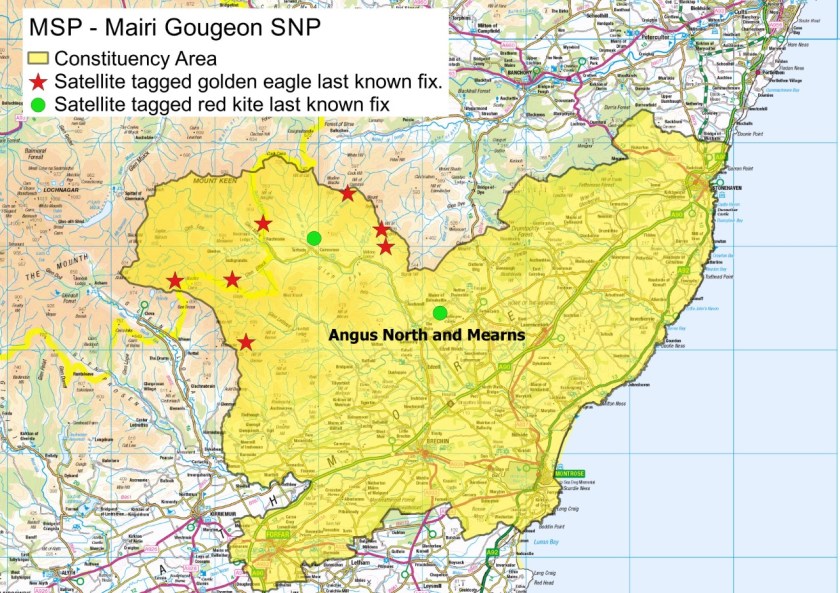
Here’s a map we’ve created for Mairi to study. It’s a map of her constituency and includes data from the recent expert review of golden eagle satellite tag data and also from the RSPB’s recent map showing the locations of ‘disappeared’ or illegally killed satellite-tagged hen harriers and red kites. It’s quite clear that it’s the grouse moor areas of the Angus Glens that are bringing her constituency in to such disrepute.

Thanks to all three MSPs for their genuine interest in protecting the hen harrier and particular thanks and good luck to Mairi – we hope blog readers will support her endeavours to draw political attention to this species’ plight.

Satellite-tagged Montagu’s harrier Sally ‘disappears’ in Norfolk

If it’s not news of a hen harrier being persecuted, or a marsh harrier being persecuted, then it’ll be a Montagu’s harrier.

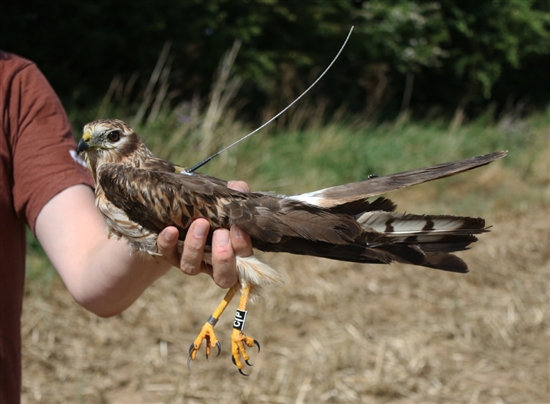
The RSPB has just published a blog detailing the ‘disappearance’ in Norfolk of satellite-tagged Montagu’s harrier ‘Sally’ on 6th August 2017.

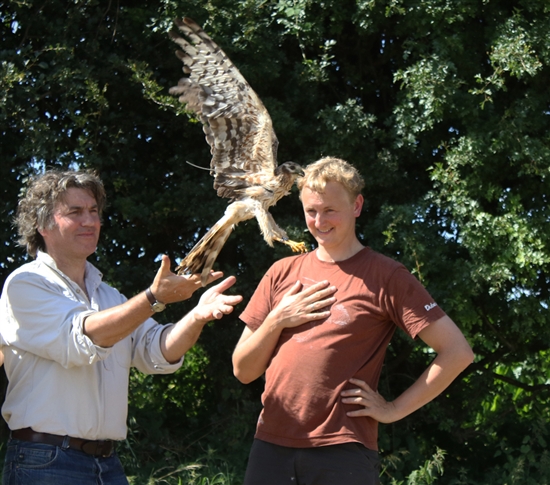
Sally was an adult female who had featured on the BBC’s Autumnwatch programme when presenter Martin Hughes-Games was given the privilege of releasing her post tag-fitting in July 2016.

Photos from RSPB

Sally had bred successfully in Norfolk for two years, including raising a brood of three this year. She (along with partner Roger) was one of only four breeding pairs in the UK and the only breeding pair in eastern England.

Her last tag signal came from near Bircham Tofts in Norfolk on the evening of Saturday 5th August 2017. She was reliably seen near her nest site at midday on Sunday 6th August 2017 but the scheduled tag signals from Sunday evening onwards never materialised. Since then, silence.

Sally’s ‘disappearance’ comes almost 3 years to the day when another tagged Montagu’s harrier (called Mo) ‘disappeared‘ in the same area, reported at the time to be on land bordering the Sandringham Estate.

If anyone has any information, please contact Norfolk Police (Tel: 101) and quote ref #12815082017.

UPDATE 17th August 2017: Good coverage in The Sun newspaper here

Natural England Board making up justification for Hen Harrier southern reintroduction?

Last month we blogged about the minutes of a Natural England Board meeting (held 22 March 2017) in relation to the proposed reintroduction of hen harriers to southern England. The published minutes stated:

The NE Board has considered the overall objective of the southern reintroduction [of hen harriers] and agreed this was to help relic upland populations in respect of the genetic diversity and the overall favourable conservation status of the species”. 

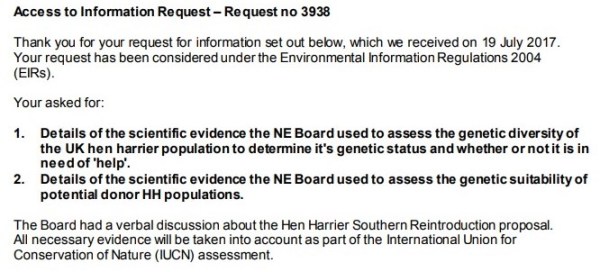
We were curious about the scientific evidence used by Natural England’s Board to assess the genetic diversity of the UK hen harrier population and determine that its genetic diversity is in need of “help”. We were also curious about whether potential donor hen harrier populations had been screened to assess their genetic suitability.

The reason we were so curious is because we were unaware of any genetic assessment ever having been undertaken for the UK hen harrier population, but, considering the scientific credentials of many NE Board members, we assumed they would have insisted on seeing such evidence before making such a claim. So we submitted an FoI to Natural England to ask for these details.

Natural England has responded as follows:

So basically, Natural England is unable to point to any scientific evidence to indicate that the genetic diversity of the UK hen harrier population is in need of ‘help’, and yet the NE Board has claimed that ‘helping’ the species’ genetic diversity is suitable justification for the southern reintroduction project to go ahead.

As Mark Avery said on his blog this morning, ‘Is NE fit for purpose? Quite honestly I don’t think it is. I no longer trust NE to do the right things for nature, and I no longer trust NE to tell the truth about what it is doing‘. We’re in full agreement with that, and based on this latest FoI response, we’d extend that to the NE Board.

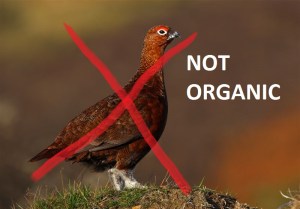
Fact check for Angus Glens Moorland Group – red grouse are NOT organic

Dear oh dear. It’s only been six weeks since Michelin-starred chef Andrew Fairlie was told by Perthshire Council’s Food Standards Officer to stop referring to red grouse as being organic (see here), and yet now the Angus Glens Moorland Group Coordinator is claiming that red grouse are “100% organic“.
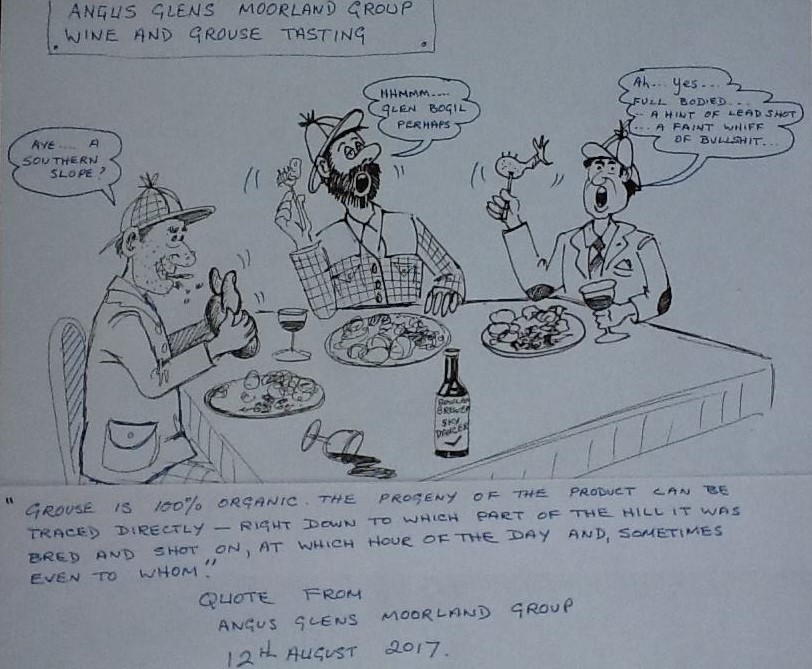
Lianne MacLennan was quoted in the Dundee Courier (Food & drink section, 12th August 2017) – see here. She also made an astonishing claim that “The progeny of the product can be traced directly – right down to which part of the hill it was bred and shot on, at which hour of the day and, sometimes even, by whom“.

Really? That might be true if the grouse is immediately cooked at a shooting hut on the day, but for the hundreds of thousands of grouse that are sold on to game dealers, that is patently untrue. We know, because we’ve previously bought red grouse from several game dealers (to test it for lead shot) and in each case, the game dealer was unable to tell us even from which county the bird originated, let alone which estate, which moor, which hill slope, what month, what day, what time and by whom it was shot.

Here’s a quick recap for Lianne about the organic status of red grouse, because either she missed it first time around or has chosen to ignore the facts and just lie:

According to DEFRA’s guidance on organic farming,

  • You must register with an organic control body if you’re going to produce, prepare, store, import or sell organic products;
  • You’re breaking the law if you call a food product ‘organic’ if it hasn’t been inspected and certified by one of the UK’s nine organic control bodies.

We know from our earlier research that there isn’t a single grouse moor in the Angus Glens (or anywhere else in the UK for that matter) that is registered/certified as an organic producer. Therefore, red grouse cannot be described as being organic, nor “100% organic”.

We also know that red grouse may contain any or all of the following:

  • Excessive quantities of toxic poisonous lead (sometimes over 100 times the lead levels that would be legal for other meat – see here)
  • Unknown quantities of the veterinary drug Flubendazole (see here)
  • Unknown quantities of the veterinary drug Levamisole hydrochloride (also used in chemotherapy treatment for humans with colon cancer – see here)
  • Unknown quantities of the pesticide Permethrin (used topically to treat scabies and pubic lice; probably not that great to ingest) – see here
  • Red grouse may also be diseased with Cryptosporidiosis (see here).

Does that sound “100% organic” or does it sound hazardously toxic and potentially unsafe?

We also know that red grouse are not routinely Government-tested for any of these toxic ingredients. For some strange reason, all gamebirds are exempt from testing for poisonous lead. Gamebirds are not exempt from testing for illegal residues of veterinary medicines, although in 2015 we discovered that red grouse had never been tested because Government officials “didn’t know where to find them“. Last year, for the first time ever and only after considerable pressure from us, DEFRA’s Veterinary Medicines Directorate agreed to test shot red grouse for illegal residues of veterinary medicines. They managed to test a total of six birds (2 from Scotland, 4 from England) out of an estimated 700,000 shot birds, and they couldn’t even tell us from which estates these six birds originated.

Lianne is further quoted: “In recent years, supermarkets have taken to stocking grouse during the season“. That’s true, but she missed an important bit off the end – ‘but have since withdrawn the product due to concerns about meeting the requirements of their Responsible Sourcing Codes’.

Thanks to Mr Carbo for this cartoon:

Grouse shooting industry silent on marsh harrier persecution

Last Thursday (10th August 2017) North Yorkshire Police issued an appeal for information about several armed men, dressed as gamekeepers, who had been filmed trying to shoot a nesting Marsh harrier on a Yorkshire grouse moor in May. Some more armed men, still dressed as gamekeepers, were also filmed removing eggs from the Marsh harrier’s nest.

The Police appeal for information about the crimes, and an RSPB blog about the crimes, can be found here. The RSPB’s video footage of the crimes can be viewed here:

Four days on, we were interested to find out what the leading representatives of the grouse shooting industry have had to say about these crimes so we checked the following website news sections:

Moorland Association – nothing

National Gamekeepers Organisation – nothing

Countryside Alliance – nothing

British Association for Shooting & Conservation – nothing

Game & Wildlife Conservation Trust – nothing

No condemnation of these crimes. No appeals for information about these crimes from within their industry. Just a complete wall of silence. We even asked the Moorland Association whether this grouse moor was a member, and we asked the National Gamekeepers Organisation whether they had any members employed on this grouse moor. The responses? Nothing. Zero. Zilch. Nada.

It’s the same deafening silence that followed the discovery of a poisons cache buried on another North Yorkshire grouse moor (see here).

Isn’t it great to see these ‘partners’ in the Partnership for Action against Wildlife Crime (PAW) speaking out and doing their utmost to fight against illegal raptor persecution? It’s yet more evidence that the whole ethos of ‘partnership working’ against raptor persecution is nothing more than a sham.

Actually, how does this collective silence meet with the requirements of being a PAW member?

Let’s look at the PAW mission statement first:

Working in partnership to reduce wildlife crime through prevention and awareness-raising, better regulation, and effective and targeted enforcement‘.

Now let’s look at the PAW objectives:

  • PAW will raise awareness of wildlife legislation and the impacts of wildlife crime
  • PAW will help and advise on wildlife crime and regulatory issues
  • PAW will ensure all wildlife crime is tackled effectively.
  • All PAW members of PAW UK should take action in support of these overarching objectives

How does refusing to comment about raptor persecution crimes meet with any of the PAW objectives?

Some of these PAW members (all of them except the GWCT) are also members of the England & Wales PAW subgroup, the Raptor Persecution Priority Delivery Group (RPPDG). This is the group that DEFRA has identified as being integral to their highly controversial Hen Harrier Recovery Plan. Part of the RPPDG’s role is to provide publicity about raptor persecution, in order ‘to build trust and transparency’. Strange then, that we haven’t found any statement from the RPPDG about the persecution of Marsh harriers on this North Yorkshire grouse moor.

We were interested to read about a few hundred Hunt Saboteurs ‘sabbing’ (disrupting) a couple of grouse shoots this last weekend. As the shooting industry members of the PAW Partnership continue to deliver nothing at all, don’t be surprised to see more of this direct action approach in the months and years ahead.

Ian Thomson (RSPB Scotland) resolute against illegal raptor persecution

For those who couldn’t make it to Hen Harrier Day in the Highlands, here’s a short video of the presentation given by Ian Thomson, Head of Investigations RSPB Scotland. Well worth 11 minutes of your time.

Scottish Raptor Study Group publishes Moorland Mythbuster guide

Last month the Scottish Mail on Sunday published some right old tosh about how game shoot licensing would threaten the livelihood of gamekeepers and their families (see here).

In one of the articles, a comment piece by gamekeeper’s wife Carrieanne Conaghan (who, we’ve since been told, works as a sales rep in a publishing house in Grantown-on-Spey – if that’s true it was a bit disingenuous to claim that her family’s livelihood is reliant on game shooting), various unsubstantiated claims were made about the motivation of the estate licence petitioners (Logan Steele & the Scottish Raptor Study Group) as well as the usual denials about the unbridled criminality associated with the grouse shooting industry.

Logan Steele asked the Scottish Mail on Sunday if he could write a comment piece in reply. His request was denied (see here).

No problem. The Scottish Raptor Study Group has published its own response. Here, in their own words and without editorial censorship, are six moorland mythbusters, in response to the most commonly cited myths from the game shooting industry:

1. ‘Game bird licensing is unnecessary’
The failure of the intensive end of the game shooting industry to operate within the law over 60 years has led the Scottish Government to propose that game bird shooting licensing should be considered, along with other measures in an effort to eradicate the illegal, endemic and widespread killing of raptors. Licensing would set out clear standards required for this land use in the public interest, as applies also in other areas of natural resource management such as for water, wild fisheries and deer management in Scotland. No industry should rely on law-breaking to exist. Self-regulation has been given more than a chance to succeed and has not delivered and in the circumstances it is right that the Scottish Government should act in the public interest. . The concept is simple, if shooting estates abide by the law then no one has anything to fear, break the law and you stand to lose your licence to shoot. The only threat to livelihoods is from those individuals who are willing to take a chance and break the law. Any suggestion that a dead raptor or illegal trap could be ‘planted’ by a third party to make an estate lose a licence is simply scaremongering – there would have to be a clear evidential link to estate employees being responsible for any offences before a licence withdrawal could be considered.

2. ‘Incidents of illegal killing are declining’
The number of confirmed cases of persecution fluctuates markedly from year to year so comparing results between years is statistically invalid, particularly when the number of cases found will represent only a small but variable proportion of the actual number of crimes being carried out – the ‘tip of the iceberg’. A more robust means of identifying trends in persecution is to look at regional or national population studies of birds of prey, where a significant weight of peer-reviewed science reveals a more accurate picture. For example, recently published scientific reports on red kite, peregrine, hen harrier and golden eagle all provide clear evidence of populations constrained well below natural levels in areas where red grouse shooting is the predominant land use. The recently-published study on satellite-tagged golden eagles, commissioned by the Scottish Government, showed a similar pattern to recent raptor persecution cases, with a third of young tagged golden eagles disappearing on, or close to, land managed for intensive grouse shooting. Few of these birds were found, so they will not appear in any published statistics.

3. ‘Grouse moor management is good for a wide range of bird species’
In much of eastern and southern Scotland, heather moorland is intensively managed to maintain a patchwork of a variety of ages of heather to help create the ideal habitat for red grouse. However, most driven grouse moors are managed with the sole purpose of producing an unnaturally high abundance of grouse to be shot, and on many of them any species which is perceived to pose a threat to this is removed. Potential predators are killed, either legally (e.g. stoats, weasels, foxes, crows and magpies), or illegally, protected birds of prey. While legal predator control can
undoubtedly protect a variety of ground-nesting bird species, such as curlew and golden plover, the overall bird and mammal fauna present is often impoverished. However, with some estates now employing methods, such as the use of gas guns, to deter ground nesting birds of prey, it is likely that wader species will equally be deterred from nesting.

4. ‘Raptor populations are increasing’
In the last 30 years or so, several raptor species have enjoyed a recovery in their fortunes following decades of persecution. These include buzzards, now common in the lowlands, and ospreys that have seen significant investments in nest protection schemes. Other species have been aided by reintroduction programmes, such as red kite and white-tailed eagle. On driven grouse moor areas, however, hen harrier, peregrine and golden eagle remain well below optimum numbers, and in some areas are now regionally extinct, with persecution being the main cause. The Scottish hen harrier population declined by 22% between 2004 & 2010, and by a further 9% between 2010 & 2016.

5. ‘Conservationists want to bring an end to bird shooting’
So long as game bird shooting remains a legitimate activity i.e. it is conducted within the law and sustainable environmental management practices are employed, there is no conservation reason to stop it. What clearly needs to end is the illegal activity and environmental destruction apparently deemed necessary to maintain the intensive driven grouse shooting industry, and this is at the heart of the so-called ‘grouse/raptor’ controversy. Environmental damage includes the bulldozing of hill tracks; the burning of heather on active blanket bog and deep peat deposits which releases carbon into the atmosphere; the drainage of blanket bog habitats to promote heather growth which dries out peat and increases run-off after periods of heavy rain, risking flooding elsewhere in the river catchment area; and the unregulated slaughter of the mountain hare. An aspect rarely mentioned is the ‘accidental’ by-catch in traps of song birds and mammals such as wildcat and pine marten. Similarly, the widespread use of lead, long since banned in petrol, and paint, but still widely utilised in shotgun ammunition, creates environmental pollution and detrimental sub-lethal effects in scavenging birds and mammals.

6. ‘Jobs are at threat’
There is no reason why legally undertaken jobs should be threatened by licensing grouse moors and if shooting estates really believe that livelihoods are at risk because of adherence to the law then the question arises: ‘is the business sustainable’ either legally, financially or morally? In a speech to the Scottish Raptor Study Group’s conference in February 2017 the Cabinet Secretary for the Environment, Climate Change and Land Reform made the point that predation of grouse is a business risk that must be accepted and managed within the law. The strongest foundation for a secure and thriving rural economy in the future is a broad-based approach to land use, which optimises all of its natural assets, including birds of prey. The illegal killing of birds of prey and other unsustainable management practices prevents other rural development opportunities from being explored and realised, including wildlife based tourism, and selfishly denies local communities and visitors alike the right to enjoy seeing birds of prey in the Scottish countryside. Licensing grouse moors is an important step towards eradicating illegal persecution of birds of prey and creating a more balanced and healthy natural environment, with all the recreational and economic opportunities for Scotland that could arise from this.

ENDS

More illegal raptor persecution hotspots revealed in new map

Ian Thomson, Head of RSPB Investigations Scotland has written an interesting blog examining the ‘disappearance’ and/or illegal killing of satellite tagged red kites and hen harriers – see here.

It’s well worth a read. And take a close look at this map, illustrating the locations of suspicious disappearances as well as where the corpses have been found:

Here’s a direct quote from Ian:

It is clear from this map that, like golden eagles, the distribution of illegally killed or suspiciously disappeared satellite-tagged red kites and hen harriers is far from random, and shows clear clusters in some upland areas. As with the “hotspots” for eagles, these clusters are almost entirely coincident with land dominated by driven grouse shooting management, again including areas like the northern Monadhliaths and the Angus Glens. But, harriers and kites have clearly being targeted in other regions – notably, but not exclusively, upper Strathspey, Strathnairn and the Lowther Hills of S Lanarkshire‘.

Following the recent news that the RSPB, in partnership with LUSH, has satellite-tagged a record number of hen harriers this year, we can expect many more dots to appear on this map, most of them will be added before Xmas.

We’ll be undertaking some finer analyses of this map, probably next week, and we’ll be asking blog readers to get involved. More on that soon.

There’s one other point in Ian’s blog that is worth highlighting here, in response to the unsubstantiated yet repeated claims by some that raptors do better on driven grouse moors than they do on RSPB reserves:

More pairs of hen harriers bred successfully on one RSPB reserve on Islay in 2017, than on the grouse moors of Aberdeenshire, Kincardineshire, Angus and the Scottish Borders put together. In fact, RSPB nature reserves hold 10% of Scotland’s breeding population of hen harriers, with 46 pairs in 2016‘.

How many hen harriers do you think bred successfully on Scottish grouse moors in 2016 (where driven shooting took place – not on moors which are currently not being shot)?

Photo of hen harrier Annie, who was found shot on a grouse moor in South Lanarkshire in 2015. (Image: RSPB Scotland).

Video of marsh harrier persecution on North Yorkshire grouse moor

If anybody has been foolish enough to believe any of the grouse shooting industry’s recent propaganda onslaught in the run up to the Inglorious 12th, here’s a shocking reminder of what really goes on.

Press release published today by North Yorkshire Police:

POLICE INVESTIGATE PERSECUTION OF BREEDING MARSH HARRIERS

North Yorkshire Police are investigating an incident in which men disturbed a pair of marsh harriers nesting on moorland north of Denton, near Ilkley, in Wharfedale.

In May 2017 a pair of marsh harriers was discovered nesting on moorland forming part of Middleton and Denton moors near the village of Denton in North Yorkshire.

The site was monitored by RSPB investigators who photographed the nest containing five eggs. The adult birds were observed at the nest.

A camera was set up to record activity at the nest site. Video images recorded by the camera show that on 17 May at least two individuals, who appeared to be men, wearing dull, brownish green coloured jackets, traditional country caps, and carrying what looked like shotguns and a brown game bag approached the nest site on six occasions between 12.40pm and 9.30pm. The sound of several shots fired in the vicinity of the nest  were recorded, as was the noise of an engine, believed to be a quad bike. One of the men stood over the nest, bent down, and appeared to pick up something from the nest before walking away.

The following day, 18 May, a further visit by a man, similarly attired, along with a green rucksack, was recorded at around 9.40am. This individual stood over the nest, bent down, and appeared to remove something from the nest.

An RSPB investigator checked the site on 19 May and discovered the nest had no eggs in it, with no sign of any debris from damaged eggs.

The people shown on the video at the nest site have not been identified. A number of men have been spoken to by police as part of the investigation.

The Wildlife and Countryside Act 1981 (WCA) makes it an offence to take, damage, or destroy the nest of any wild bird. Marsh harriers are a scarce species, listed on schedule 1 of the WCA, and have additional protection. It is an offence to intentionally or recklessly disturb birds listed on schedule 1 while they are at, or near, a nest with eggs or young. Marsh harriers are birds of prey and they normally breed in marshes and reed beds. It is unusual to find them breeding in heather on a moor.

PC Bill Hickson, who is investigating the incident, said: “The video evidence provided by the RSPB shows illegal activity around a marsh harrier nest, and the activity shown speaks for itself. The pictures on the video are, unfortunately, too small to produce an image from which any of the individuals shown could be identified.”

Anyone who has any information about the incident or can help identify who was responsible is asked to contact North Yorkshire Police. Telephone 101, choose option 2 and ask for PC 820 Bill Hickson or email bill.hickson@northyorkshire.pnn.police.uk.

ENDS

The RSPB has released a copy of the video footage: (make sure the volume is turned up)

The RSPB’s investigations unit has also published a blog about this case, here.

Gosh, who do you think those armed gunmen were? It’s a tricky one.

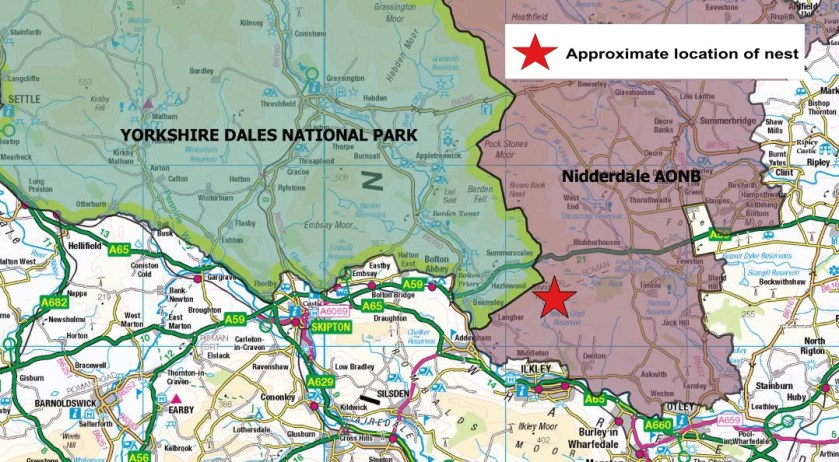
Here’s a map we’ve created to show the approximate location in Nidderdale Area of Outstanding Natural Beauty (which also just happens to be a notorious raptor persecution hotspot):

Well done to the RSPB Investigations Team for securing this footage (note: NOT inadmissible evidence) and very well done to North Yorkshire Police for a timely public appeal for information.

If, like us, you’re sick to the back teeth of the illegal persecution of raptors on grouse moors, and you want 10 million people to hear about it, please consider using your social media accounts (twitter & facebook) to sign up to Findlay Wilde’s thunderclap, due to go out at 9.30am on the morning of the Inglorious 12th. At the moment, the social reach of this thunderclap is over 9.5 million people. Let’s get it to ten million. Please sign here.