Eight Scottish osprey chicks translocated to Poole Harbour, Dorset

Some welcome conservation news for a change:

Press release from charity Birds of Poole Harbour:

Eight Osprey chicks from Scotland have safely arrived in Poole Harbour as part of a five-year translocation project, aimed at re-establishing this species on its former breeding grounds on the south coast of England.

The project which is being run by Birds of Poole HarbourThe Roy Dennis Wildlife Foundationand local wildlife technology company Wildlife Windows, was given the go-ahead this spring and it is hoped that over the next 4-5 years Ospreys will adopt Poole Harbour as their new home and recolonise the south coast. Osprey pass through Poole Harbour every year on migration, attracted by the abundance of fish such as Mullet and flatfish. In late August, the harbour can host up to six Ospreys as birds fatten up before their long migration down to west Africa.

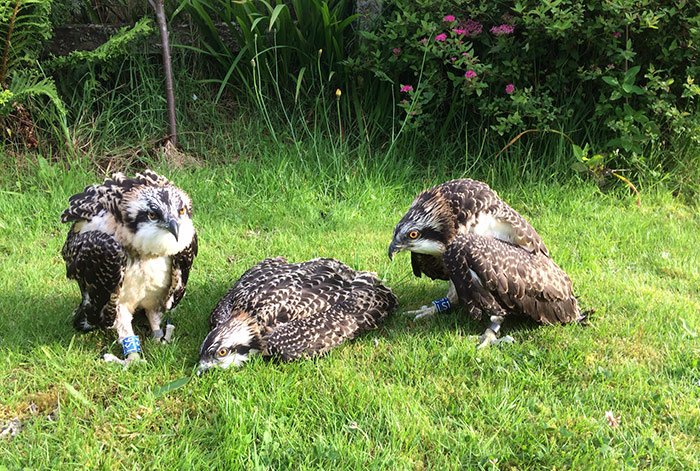
Photo: three of the eight osprey chicks (photo by Roy Dennis)
Paul Morton from Birds of Poole Harbour said, We’re so pleased to see the chicks finally arrive in Poole Harbour. It’s been a long few months waiting for this moment, so to see them in the pens has made the whole project very real now. The public support we’ve received has been over-whelming and the offer of help from Storm restaurant has been key to making this part of the process run smoothly and efficiently“.

Pete Miles, owner of Storm restaurant and local fisherman added,  “It’s a real privilege to be involved in the project and to help the Osprey team out. Anything that helps promote and educate local environmental stories is always good news. We’ve already got all the facilities to prep fresh fish so it made sense to offer help, plus I’m really looking forward to seeing these birds out flying around the harbour in years to come whilst I’m out on my fishing boat”.

Roy Dennis said, “We are delighted that this exciting and important project is underway. Establishing a population of Ospreys on the south coast will restore the species to an area where it was once common and also help to link expanding populations in central England, Wales and northern France. We are moving the birds to the best possible location given the abundance of fish found in Poole Harbour and the plethora of potential nest sites in the surrounding area. I’m particularly excited about this project because I was born in the New Forest”.

Once the chicks look ready and strong enough to fly, the Osprey monitoring team will open the pens, allowing the chicks to take to the wing for the first time and explore their new area. It is expected that the young Ospreys will remain in the harbour for a further 3-5 weeks after release before they begin their long migration to West Africa. The released Osprey will then remain in Africa during the summer and winter of 2018 and won’t think about flying north to the UK until late spring 2019. It is hoped that the first breeding will take place around 2021.

ENDS

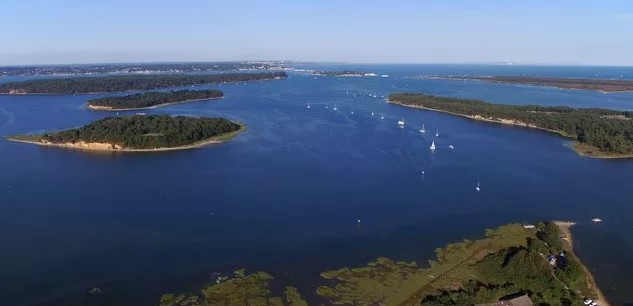
Photo of Poole Harbour by Michael Harpur
Police investigating footage of ‘gamekeepers’ shooting & snaring wildlife in Peak District National Park

The Mirror has just published an article entitled “Barbaric”: Wild animals trapped and shot in UK National Park to protect birds for shooting season and a by-line stating “Film taken in Peak District National Park shows gamekeepers shooting and trapping wild animals in a bid to stop them killing grouse as bird hunting season nears” (see here).

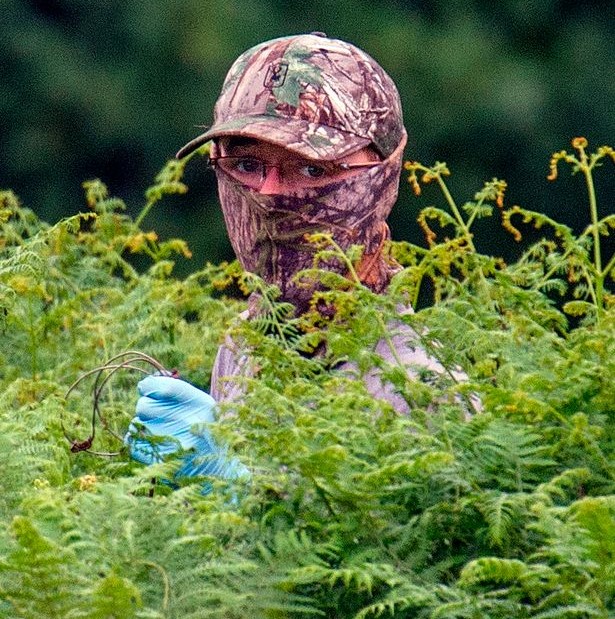
The article includes video footage and a number of photographs taken by a group called the Hunt Investigation Team. The video shows a masked man shooting off a snare around a badger’s neck (and the badger subsequently running off) and another masked man shooting dead a snared fox.

The video is graphic and makes for unpleasant viewing, but from what we can see, none of the filmed activity shows obvious illegal activity. Interesting, though, that the armed men are masked. That’d be quite a shock for any member of the public who happened to be walking in this National Park.

It is legal to snare foxes (as long as certain snaring conditions are met, and these conditions vary between England & Scotland) and then to shoot the snared fox. The snared fox in the video, which is obviously distressed, is dispatched quickly.

It is illegal to deliberately snare badgers, however, as snares are indiscriminate, badgers and other non-target species can often be caught by accident. When this happens, the badger must either be immediately released when found by the snare operator, or, if it is badly injured, it can be humanely killed. The masked man in the video uses his firearm to shoot through the snare and the badger is able to run free. The masked man makes no attempt to kill the badger, even though he had ample opportunity.

There are obvious welfare concerns about the badger being released with wire still around its neck, and by law, snares should not be set in areas where badgers are known to inhabit. The snare operator should be skilled at detecting badger signs and where seen, snares should not be set. Perhaps this is what the police are investigating? *see update at foot of blog

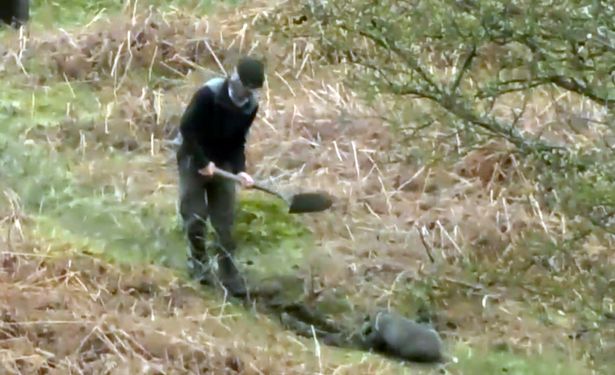
It’s also possible that there is further video evidence that has not been released to the media. One ominous photograph, that looks like it’s a screen grab from a video, shows a masked man approaching an apparently snared badger with a half-raised shovel. It’s impossible to judge from this photograph whether the masked man is about to use the shovel to protect himself as he frees the badger, or whether he is about to use the shovel to cave in the badger’s skull. Perhaps the full video sequence is more enlightening.

The Mirror article claims the two masked men are gamekeepers, working to protect grouse stocks. The ground that can be seen in the video doesn’t look like a grouse moor but of course this footage could have been filmed on land adjacent to a grouse moor. The name of the location has not been published. It’s highly likely that the two masked, armed men are gamekeepers, and perhaps the Hunt Investigation Team has further intelligence to support this. If they’re not gamekeepers, then the police will be investigating whether these two armed, masked men had landowner permission to be snaring and shooting wildlife here.

So although there may be more to this story than has been presented by the Mirror article, based on what’s been published this appears to show gamekeepers undertaking lawful gamekeeping activity. Nevertheless, it will be abhorrent to many, and probably an eye-opener to the average Mirror reader who perhaps is unaware that snaring is even legal in 21st Century Britain, and probably also unaware of the routine killing of wildlife that is allowed in this country all so a minority sector of society can shoot gamebirds for fun. That this is permitted within a National Park will also probably be shocking news to many. Good, this is exactly the sort of information that needs to be widely publicised.

UPDATE: Thanks to one of our Twitter followers for providing the following link to the Hunt Investigation Team website, which names the estate as the Moscar Estate (a known grouse-shooting estate within the Peak District National Park) and provides much more detail and further gruesome video evidence and commentary on what was filmed there earlier this spring. See HERE.

Natural England still refusing to release details of Hen Harrier brood meddling plans

Regular blog readers will know that we’ve taken a keen interest in DEFRA’s Hen Harrier Action Plan, which was published in January 2016.
We’ve been particularly interested in two of the six action points of this plan: brood meddling and the southern reintroduction.

On brood meddling, through a series of FoIs last year, we were able to find out what was being planned (here), a bit more about what was being planned (here), who was likely to be involved in the practicalities of brood meddling (here), and a bit about an even more bonkers social science survey that was to run parallel with the bonkers brood meddling scheme (here).

However, since November 2016, it all went a bit quiet so on 23 February 2017 we submitted another FoI asking for copies of all recent correspondence on brood meddling and the southern reintroduction. Natural England responded on 21 March 2017 telling us that information was being withheld “as it would prejudice the process of determining the licence application and potentially the quality of that licence”. They also told us, “The discussions are confidential up until the point the licence application has been determined. Once this has happened then details of the licence are available to the public”. 

We knew that this licence application was being submitted (by Natural England, to Natural England!) in either February or March 2017, so we left it a while before we submitted another FoI.

Our second FoI asking for information was submitted on 29 May 2017. Natural England responded on 31 May 2017 with this:

The application you refer to is still being determined. I’m afraid that we do not have an estimate of when it will be”.

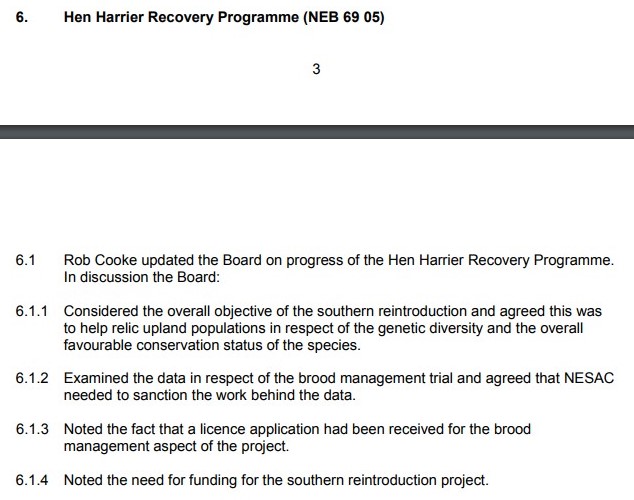
We then learned, from reading the minutes of the Natural England Board meeting held on 22 March 2017 that the brood meddling licence application had been submitted (by Natural England, to Natural England!). We also learned that the Natural England Science Advisory Committee “needed to sanction the work behind the data” but that’s about all we’ve been able to find out.

So on 2 July 2017 we put in a third FoI to Natural England, again asking for copies of all correspondence relating to the brood meddling scheme. Last Thursday (6 July 2017) Natural England responded:

I can confirm that the licence application is still being determined and we do not have an estimate of when it will be“.

We’re finding this all quite hard to believe and suspect that Natural England is just using this as an excuse not to release any more information about their plans for brood meddling because they don’t like the criticism those plans have attracted. How would releasing notes from the brood meddling team meetings ‘prejudice the process of determining the licence application and potentially the quality of that licence‘? All this secrecy, over a highly controversial project, doesn’t inspire confidence.

On the southern reintroduction action point (although it’s not really a ‘reintroduction’ because harriers are still present in southern England), last year, again through a series of FoIs, we were able to find out about the feasibility/scoping report (here), the project group and its planned work timetable (here), potential funding options (here), Exmoor National Park as a proposed release site (here), Wiltshire as a proposed release site (here), and potential donor countries from where NE will source hen harriers (here).

Since the end of 2016, Natural England has refused to release any further information on the southern reintroduction, again, using the brood meddling licensing application to hide behind. We’ve now submitted another FoI (2 July 2017) asking for this information to be released, as this information has nothing to do with the brood meddling licence application and should therefore be available for scrutiny.

We do know, from the minutes of that NE Board meeting on 22 March 2017, that the NE Board has “considered the overall objective of the southern reintroduction and agreed this was to help relic upland populations in respect of the genetic diversity and the overall favourable conservation status of the species“.

So has the NE Board seen any scientific evidence that has assessed the genetic diversity of the UK hen harrier population and determined that its genetic diversity is in need of “help”? Have the potential donor populations been screened to assess their genetic diversity? And how will releasing hen harriers, that are likely to disperse to the uplands where this species is still routinely shot on sight, help the species achieve favourable conservation status?


Protest march to Downing Street, 12th August 2017

A coalition of wildlife campaigners will be marching to Downing Street on the Inglorious 12th August 2017 to protest about the on-going cruelty and criminality against badgers, foxes and hen harriers in the UK countryside.

Key issues of this protest include the Government’s ineffective and costly badger cull policy, strengthening rather than appealing the Hunting Act, raising awareness of barbaric fox-cub hunting, and calling for a ban on driven grouse shooting.

Supported by all the major wildlife protection charities (including Badger Trust, LACS, IFAW, Born Free), the march will begin at Cavendish Square at 1.30pm before heading down Regents St, Pall Mall, around Trafalgar Square and down Whitehall, ending at Richmond Terrace opposite Downing Street.

Speakers will include Chris Packham, Dominic Dyer, Mark Avery and others.

Mass shooting of protected gulls on Lancashire grouse moor

RSPB press release: (as read on Mark Avery’s blog)

The RSPB has learned that large numbers of protected birds are being killed on a grouse moor in Lancashire.

A RSPB staff member working in the Bowland area discovered two estate workers shooting nesting lesser black-backed gulls – on a grouse moor managed by the Abbeystead Estate – leaving their chicks to be either killed by dogs or left to starve.

Lesser black-backed gulls have been nesting on the moors of Lancashire for more than 80 years. The recovering colony in Bowland is one of the most important in the UK and is protected under British and European law, having once been in excess of 20,000 pairs. Lesser black-backed gulls are declining across the UK and the RSPB is becoming increasingly worried about their future in the UK.

This species can only be legally culled if they pose a threat to human health, risk spreading disease or are having a negative effect on other species of conservation concern. The RSPB understands Natural England – the government agency for responsible for protecting the countryside – granted consent for the cull. But while the nature conservation organisation has repeatedly asked Natural England for scientific evidence which would justify a cull, none has been forthcoming.

Although the RSPB has yet to see the full details of the consent, it has reason to believe that the landowner may have breached both the letter and the spirit of the agreement, and is calling on Natural England to investigate the matter urgently.

Graham Jones, RSPB Conservation Area Manager for North West England, said: ‘We are devastated that this cull of a protected species has been taking place, apparently without any justification. Although it may occasionally be necessary to cull a small number of large gulls for conservation and health reasons, there is absolutely no evidence to support it in this case. 

We want Natural England to tell us why they think the gulls at Bowland met the legal criteria for a cull and also want them look into whether the terms of an already flawed agreement have been broken. Bowland should be a safe place for this declining species and Natural England should be focussing on helping the colony’s recovery.

We believe the only reason these protected birds are being killed is simply to satisfy the requirements resulting from the ongoing unsustainable approach to grouse moor management”.

ENDS

This isn’t the first time the culling of Lesser black-backed gulls on the Abbeystead Estate has been in the news. Four years ago Leo Hickman of the Guardian wrote an article on how Natural England had been licensing a cull of this species on the Abbeystead Estate for decades, officially “to stop water pollution” although some believed it was partly done to protect grouse shooting interests.

At the time, the Lesser black-backed gull had been identified as a qualifying species (along with hen harrier and merlin) for the Bowland Fells Special Protection Area, but the official documentation hadn’t been updated to include the gull on the citation, which led to confusion about the legality of the cull.

We’ve just looked at the latest version of the Bowland Fells SPA citation (here) and Lesser black-backed gull is now included, supposedly affording it special protection during the breeding season.

So what gives, Natural England? Have you licensed this cull and if so, what is the scientific justification? If you haven’t licensed it, is this latest cull a wildlife crime? Emails to: enquiries@naturalengland.org.uk

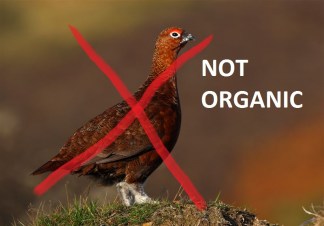
Gift of Grouse chef told to refrain from calling red grouse “organic”

Following earlier blogs where we challenged Gift of Grouse chef Andrew Fairlie’s claim that red grouse are “organic” (see here and here), the Foods Standards Officer at Perth & Kinross Council has completed an investigation. Here are the findings:

You are alleging that Mr Fairlie makes a fraudulent claim about organic status of red grouse being sold at the Mitchelin-starred Andrew Fairlie Restaurant based at Gleneagles Restaurant, Auchterarder.

The provided link to the ‘Gift of Grouse’ web based article contains a quote from Mr Fairlie, which includes the following wording: “In the summer our customers come from all over the world and they want to eat the finest local food. Customers like it because it’s organic, sustainable and its provenance is exact.”

Having checked the restaurant’s available advertising materials, including menus and compliance history I am satisfied that Mr Andrew Fairlie doesn’t make any direct claim that the red grouse or any other food he serves in his restaurant is organic or made from organic ingredients.

I have brought the matter to Mr Fairlie’s attention and received assurance that using ‘organic’ for the purposes of the quoted article was merely reflecting the drive to use natural and locally sourced foods.

I advised Mr Fairlie to refrain from using ‘organic’ as a descriptor of food unless the food complies with the prescribed legal requirements. I intend to monitor the situation in future to ensure that no unauthorised claims are made“.

Glad that’s cleared up then. When Gift of Grouse chef Andrew Fairlie of the Michelin-starred Andrew Fairlie Restaurant at Gleneagles Hotel claims that a food product is organic, when it obviously isn’t, you can be sure he’s not trying to mislead customers, abuse public trust or make a false representation – he’s ‘merely reflecting the drive to use natural and locally sourced foods’.

Genuinely certified organic producers will be thrilled!

Interestingly, the false statement that red grouse are “organic” has not been removed from the Gift of Grouse website. Hardly a surprise – it sits well amongst all the other “risible, make-believe tosh” generated by the grouse-shooting industry’s inept propaganda machine.

Original photo of red grouse by Jim Wood

Trading standards investigating claim red grouse are “organic”

A few days ago we blogged about an extraordinary claim that red grouse are “organic” (see here).
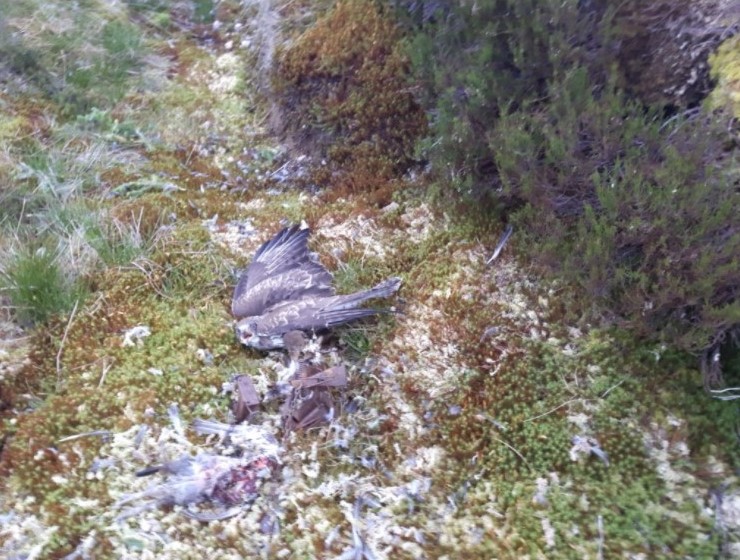
The claim was made by chef Andrew Fairlie, who runs the Michelin-starred Andrew Fairlie Restaurant at Gleneagles Hotel. His claim was widely published in Scottish newspapers and also promoted on the Gift of Grouse website.

We did a quick bit of research and couldn’t find any evidence of any grouse moors in Angus, East Lothian or Deeside being registered / certified as “organic” (these are the geographic areas from where Mr Fairlie’s grouse are sourced).

Indeed, given the associated environmental damage of intensive grouse moor management, its strong link to wildlife crime (especially raptor persecution) and the high level of poisonous lead shot, worming drugs and pesticides that may be inside the bird, we’d argue that red grouse are about as far away from being organic as it’s possible to be.

It is an offence to call a food product “organic” if it hasn’t been inspected and certified by one of the UK’s nine control authorities. We would expect a Michelin-starred chef, in whom the public place great trust, to understand the implications of describing a food product as “organic”.

Many blog readers contacted Andrew Fairlie, the Gift of Grouse, and Ochil Foods (Mr Fairlie’s game supplier) to ask for evidence of the organic certification of the red grouse being served at the Andrew Fairlie Restaurant. As far as we’re aware, no responses have been received.

A report has now been submitted to Trading Standards Scotland, who have confirmed that an investigation has been launched.

UPDATE 7 July 2017: Gift of Grouse chef told to refrain from calling red grouse “organic” (see here)

Buzzard caught in illegally-set trap on Monadhliaths grouse moor

Police Scotland have this afternoon published the following statement:

Investigation into illegal setting of traps, Strathdearn

Police Scotland can confirm that an investigation into the alleged illegal setting of traps to deliberately target birds of prey near Auchintoul, Strathdearn has been launched.

Police were informed of an incident that occurred on 7 June 2017 where a buzzard was found after having been illegally trapped on the south slopes of Beinn Bhreac. The bird was found by a member of the public and was released.

Inspector Mike Middlehurst said: “It is very disappointing to have an incident like this reported, especially when there is a great deal of positive work going on in the Highlands to tackle wildlife crime. Unfortunately, there are some who continue to deliberately target birds of prey; there is nothing accidental in the setup of these traps.

“I am grateful to the member of the public who came across the bird and for their assistance in trying to free it. They were slightly injured in the process of releasing the bird and had the knowledge to photograph it. We are keen to speak to anybody who was walking or mountain biking in this area over the weekend of 3 and 4 June 2017. If anyone saw people or vehicles on these tracks that they thought out of place or acting suspiciously I would encourage them to contact us.

“Anyone with information is asked to contact Police Scotland on 101 quoting reference NN13977/17 or Crimestoppers on 0800 555 111 if you wish to remain anonymous.”

ENDS

Well done to the member of the public who saw the trapped buzzard, photographed it, and reported it to the Police. And well done Police Scotland for getting this news out within a month of it happening. By the looks of the photograph, that’s a baited spring trap, illegally-set out in the open instead of being placed inside an artificial or natural cover as the law demands. Police Scotland are clear:

Unfortunately there are some who continue to deliberately target birds of prey; there is nothing accidental in the setup of these traps“.

It’s also interesting to note the date this incident occurred – 7th June 2017. This is one week after the Cabinet Secretary’s announcement that she was bringing in new measures to tackle the on-going illegal persecution of raptors on grouse moors. It seems there are some out there who are determined to keep sticking up two fingers to the law, to the Government, and to the will of society. More fool them, because ultimately it is this arrogance and belief of being untouchable that will be the grouse-shooing industry’s downfall. We’re already beginning to see it crumbling in Scotland and cases like this will just increase resolve to demolish it once and for all.

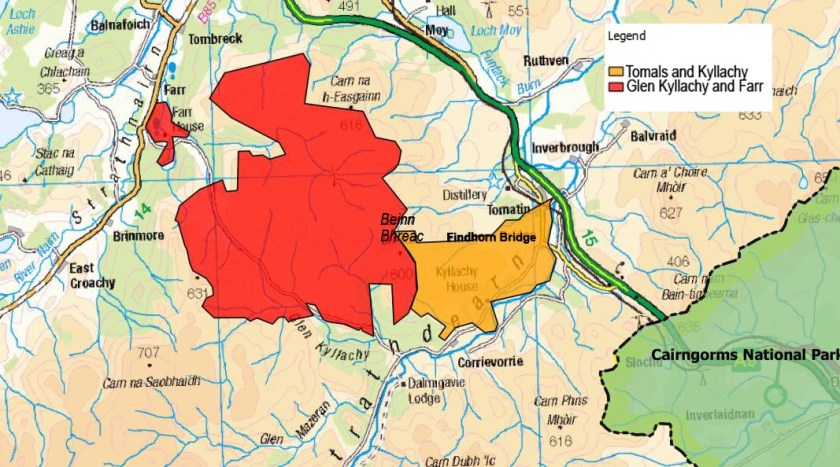
The name of the estate where the trapped buzzard was found has not been publicised. However, Police Scotland say it was found on the south slopes of Beinn Bhreac. Using Andy Wightman’s ever-useful Who Owns Scotland website, the boundaries of two estates meet on the south slopes of Beinn Bhreac: Glen Kyllachy & Farr Estate on the west side, and Tomals & Kyllachy on the east side. Without a grid reference, we’re unable to determine on which estate this trap had been illegally set. Regular blog readers will be familiar with the name of one of these estates.

Here is a map showing Beinn Bhreac and the boundaries of the two estates meeting on its southern slopes (boundary information from Who Owns Scotland website).

Unsurprisingly, this area is driven grouse moor country and just happens to also be where a number of satellite-tagged golden eagles have ‘disappeared’ in recent years. Indeed, this area of the Monadhliaths to the north west of the Cairngorms National Park was identified in the recent Golden Eagle Satellite Tag Review as being one of the main areas where multiple tagged eagles have ‘disappeared’ in a suspicious cluster.

UPDATE 6PM:

We’ve sent a tweet to Conservative MSP Ed Mountain, as this is his constituency, asking him if he’s ready to be the “fiercest critic” yet? (E.g. see here).

We’ve also sent a tweet to Fergus Ewing MSP, Cabinet Secretary for Rural Economy, as this is also his constituency. We’ve asked him if he thinks this ongoing criminality is good for the rural economy?

We’ll post their responses here.

UPDATE 6 July 2017: Edward Mountain MSP responded with this: “Illegally trapping birds of prey is unacceptable. Police Scotland must carry out a full investigation. I will await and act on results”.

Fergus Ewing MSP (Cabinet Secretary) has not responded.

Gift of Grouse chef claims red grouse are “organic”

The Scottish grouse shooting industry’s propaganda machine, The Gift of Grouse, is definitely a gift that just keeps giving. It stumbles from one gaffe to the next with extraordinary frequency.

This week, the Gift of Grouse has joined forces with “Scotland’s leading chefs” to promote the use of red grouse in more restaurants and hotels. This latest campaign has been timed to coincide with this weekend’s Scottish Game Fair, and a press statement has appeared in various papers across the country. Said press statement also appears on the Gift of Grouse website (here).

We were fascinated to read a quote in this press statement from ‘top chef’ Andrew Fairlie of the Michelin-starred Andrew Fairlie Restaurant at Gleneagles. Mr Fairlie says “Customers like it [red grouse] because it’s organic, sustainable and it’s provenance is exact“:

Let’s leave his claim of red grouse being “sustainable” (they’re not) and having “exact provenance” (they don’t) to one side and concentrate on his claim that red grouse are “organic”.

Organic? Really? We thought red grouse could contain:

  • Excessive quantities of toxic poisonous lead (sometimes over 100 times the lead levels that would be legal for other meat – see here)
  • Unknown quantities of the veterinary drug Flubendazole (see here)
  • Unknown quantities of the veterinary drug Levamisole hydrochloride (also used in chemotherapy treatment for humans with colon cancer – see here)
  • Unknown quantities of the pesticide Permethrin (used topically to treat scabies and pubic lice; probably not that great to ingest) – see here
  • Red grouse may also be diseased with Cryptosporidiosis (see here).

It’s hard to see how a product that could contain so much hazardous toxicity could ever be certified as being organic. But, taking Mr Fairlie at his word, we thought we’d do a bit of checking:

We looked at DEFRA’s guidance on organic farming, which says:

  • You must register with an organic control body if you’re going to produce, prepare, store, import or sell organic products;
  • You’re breaking the law if you call a food product ‘organic’ if it hasn’t been inspected and certified by one of the UK’s nine organic control bodies.

Then we looked at the Scottish Organic Producers Association (SOPA) website to find out which businesses are registered and certified as organic producers or processors. The SOPA website pointed us to the IFOAM (Organics International) registered verification facility (here), which allows the public to search a database for registered / certified organic producers in many different countries, including Scotland.

We noticed that Mr Fairlie said his grouse supplier is a company called Ochil Foods in Perthshire. We checked Ochil Foods’ status as an organic producer/processor on the IFOAM database but it wasn’t listed. Hmm.

So then we looked at the Ochil Foods website to see if they mentioned from which estates they sourced their red grouse. No estate names are listed (so much for Andrew Fairlie’s claim of “exact provenance” then) but it does say: “Our grouse come from Deeside, Angus and East Lothian“.

So we thought we’d search the IFOAM database for details of all registered / certified organic producers in East Lothian, Angus and Aberdeenshire to see how many red grouse producers are listed. To do this we searched the IFOAM database by postcode, and chose postcodes that we knew corresponded with areas that includes land managed as a grouse moor.

We found a total of 22 businesses in these areas that were either registered and/or certified as organic producers or processors (East Lothian: 4; Angus: 9; Aberdeenshire: 9). The IFOAM database also allows you to look at the actual details of each certification, which shows the produce each business is certified to sell as organic. Guess what? Of the 22 registered organic businesses we found, NOT A SINGLE ONE WAS LISTED AS PRODUCING RED GROUSE.

You can download our search results here:

Registered organic businesses EastLothian_Angus_Aberdeenshire

So where does that leave us? It leaves us in a position of being unable to verify the organic status of red grouse, which leads to questions about the integrity of Mr Fairlie’s claim, and the integrity of the Gift of Grouse for promoting this claim. If a product is described as being “organic”, the public needs to have confidence that that’s what it is. And let’s just remind ourselves, again, that according to DEFRA, it is an offence to call a product “organic” if it hasn’t been inspected and certified by one of the nine UK control bodies.

Now it may be that the source estate of Mr Fairlie’s red grouse IS registered / certified as being organic, but for some reason it’s not been included on the IFOAM database. Mistakes can happen. So before we suggest submitting a formal complaint to the authorities, we should allow Mr Fairlie, Ochil Foods and the Gift of Grouse an opportunity to either verify this claim or publish a statement to clarify that red grouse are NOT organic.

Here are the questions to ask:

  • Please provide the name and address of the estate(s) from where the red grouse sold at Gleneagles are sourced.
  • Please provide the name, address and code number of the UK control body/authority that certified the estate(s) as organic.
  • Please provide the estate’s date of organic certification and the period of validity of that certificate.

Emails to:

Andrew Fairlie: reservations@andrewfairlie.co.uk

Gift of Grouse: tim.baynes@scottishlandandestates.co.uk

Ochil Foods: jeremy@ochilfoods.co.uk 

UPDATE 6 July 2017: Trading Standards investigate claim red grouse are “organic” (see here)

UPDATE 7 July 2017: Gift of Grouse chef told to refrain from calling red grouse “organic” (see here)