BAWC’s crowdfunding appeal for raptor satellite tagging project nears target

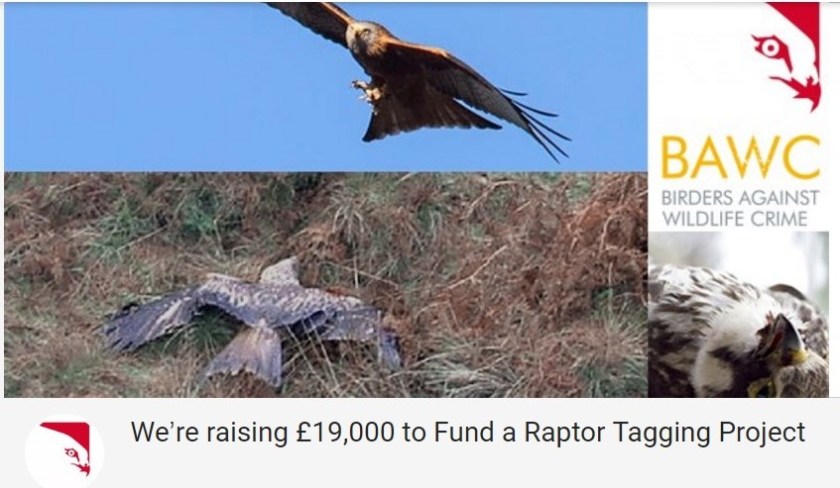
In January, campaign group Birders Against Wildlife Crime (BAWC) launched a crowdfunding appeal to help support a new raptor satellite tagging project in northern England.

The initial fundraising target was £10,000 and this was smashed within a week or so of launching. £10k was the minimum amount required for the project to be viable, but such was the support, BAWC increased the target to £19,000 to allow even more tags to be purchased.

At the time of writing, 699 incredible supporters have raised £18,124. Contributors have included high profile individuals like Chris Packham, Mark Avery, Nick Miles (Jimmy King from Emmerdale!) as well as some less well known people such as the children and teachers from St Mary’s RC Primary School in Northumberland who recently held a cake sale and donated the proceeds to this project.

The crowdfunding appeal closes in three days time so this is the final push to reach the £19,000 target. If you’d like to donate, please click here.

Thank you!

Incidentally, over the last few days various allegations have been made on social media about raptor tagging projects. This is, of course, coming from people within the game shooting industry who are keen to discredit raptor workers at every opportunity and they are also particularly keen to discredit the practice of raptor tagging in general, probably because they are worried about what the forthcoming raptor satellite tag review will show (and they are right to be worried – we expect the report to be damning).

Some of the allegations that have been made are clearly libellous and there has also been targeted harassment of some individual raptor workers, and their children, so we won’t be blogging about those as legal action is being considered. However, we will shortly be blogging in a wider context about some of the unsubstantiated claims being made about the effects of tagging on various raptor species.

Two more buzzards shot dead in North Yorkshire

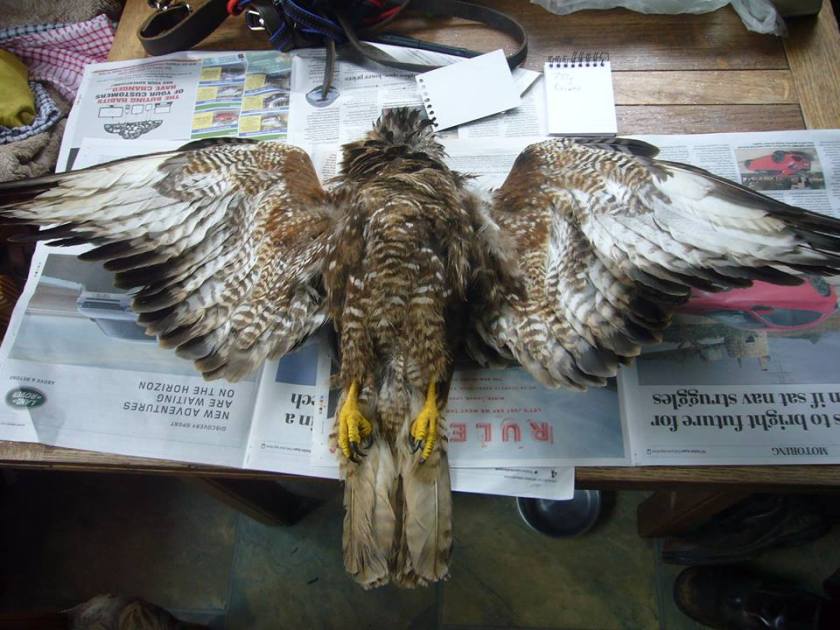
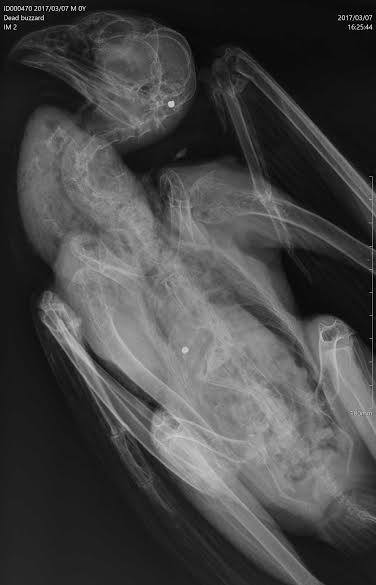
Two buzzards have been found shot dead in separate incidents in North Yorkshire.

One was found with shot gun injuries near East Lutton and the other one was found with shot gun injuries at Sutton Bank top near Helmsley in the North York Moors National Park.

Information and photos from Jean Thorpe (Ryedale Wildlife Rehabilitation Centre).

No further details available but hopefully North Yorkshire Police will issue a press release soon.

If you have any info please contact Police Wildlife Crime Officer Jez Walmsley: jeremy.walmsley@northyorkshire.pnn.police.uk 

1,000 birds killed despite General Licence Restriction at Raeshaw Estate / Corsehope Farm

Regular blog readers will know that in November 2015, SNH issued two General Licence restriction orders on the Raeshaw Estate and neighbouring Corsehope Farm in the Scottish Borders (see here). This was in response to alleged raptor persecution crimes (see here), although there was insufficient evidence to proceed with a prosecution and the estates have denied any responsibility.

The General Licence restriction orders were supposed to last for three years, starting 13 November 2015 and ending 12 November 2018. However, since being implemented, these restriction orders have been on and off as Raeshaw Estate mounted a legal challenge against their use. This legal challenge resulted in a judicial review, which was heard in January 2017, and we await the court’s findings.

Meanwhile, unbelievably, SNH issued two so-called ‘individual licences’ (see here) – one to Raeshaw Estate and one to Corsehope Farm, allowing the gamekeepers to continue the activities they would have undertaken had the General Licence restriction orders not been imposed (i.e. killing so-called ‘pest’ bird species). In our view (here) this was a ludicrous move because it totally undermined the supposed ‘sanction’ of the General Licence restriction. RSPB Scotland shared our view (see here).

SNH responded by saying the individual licences represented “robust regulation” (see here) and argued that the use of the individual licences would be “closely monitored” and that the gamekeepers would be “under tighter supervision” than they would have been if using a General Licence (see here).

As a reminder, here are copies of the two individual licences:

Raeshaw Estate individual licence here (valid 10 June 2016 – 31 December 2016)

Corsehope Farm individual licence here (valid 1 July 2016 – 31 December 2016)

As a condition of each individual licence, the estates had to submit to SNH, within one month of the licence expiry date, a log of all activities undertaken under each licence.

Last month we submitted an FoI to SNH asking for copies of these logs, as well as asking for details of the number of visits SNH staff  had made to the two estates to check for licence compliance (you know, that ‘close monitoring’ and ‘tight supervision’ SNH had been promising). What we discovered validates all our earlier concerns about this so-called ‘sanction’.

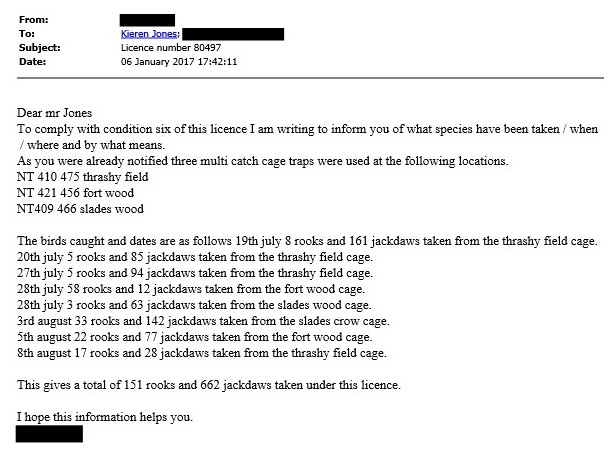
Here are the two logs submitted to SNH by the gamekeepers, detailing what species they’d killed, where, and when. The first log is for three crow cage traps placed on Raeshaw Estate and the second log relates to a single crow cage trap situated on Corsehope Farm (believed to be operated by Raeshaw Estate gamekeepers):

In total 294 rooks and 706 jackdaws were killed between 19 July and 25 August 2016. This amounts to 1,000 birds.

SNH staff undertook one compliance check visit for each estate. Both visits took place on 25 August 2016. The visit to Raeshaw Estate took 2.5 hours and the visit to Corsehope Farm lasted for one hour.

We’ve mapped the position of the four crow cage traps (note that the grouse moor at Raeshaw Estate lies directly to the west of these traps (the dark brown area).

These findings raise a number of questions and further concerns:

  1. The licence returns only refer to two species of birds that were caught and killed using four crow cage traps. Are we to believe that no other form of avian ‘pest control’ took place on either land holding between 10 June and 31 December 2016 (the duration of the individual licences)?
  2. For what ‘purpose’ were 294 rooks and 706 jackdaws killed? According to the individual licences (see above), the purpose was to “Prevent serious damage to livestock, foodstuff for livestock, crops, vegetables, fruit, growing timber, fisheries or inland water” and in the case of the Corsehope Farm individual licence, also to “prevent the spread of disease“. Can SNH explain the specific purpose of allowing these birds to be lawfully killed (i.e. if it was to protect livestock, what was the livestock and what threats do rooks and jackdaws pose? If it was to protect crops, what sort of crop and what threats do rooks and jackdaws pose? etc etc).
  3. What steps did SNH take to ensure that these 1,000 birds were not killed in order for the estates to produce artificially high densities of gamebirds for shooting? (This would be illegal).
  4. Why were 294 rooks allowed to be killed when this species has suffered a 37% decline in Scotland between 1995-2014, which would trigger a formal Amber listing if the listing criteria were applied at a Scottish level instead of a UK level (as pointed out to SNH by RSPB Scotland here)?
  5. Does SNH believe that one visit (per estate) for the duration of these six-month long individual licences equates to “close monitoring“, “tighter supervision” and “robust regulation“. If so, how?
  6. What did SNH staff do on their 2.5 hour visit to Raeshaw Estate? Did they just visit the three known crow cage traps or did they search the rest of this 9,000 acre estate to search for unlicensed (and thus illegal) traps?
  7. What did SNH staff do on their one hour visit to Corsehope Farm? Did they just visit the one known crow cage trap or did they search the rest of this farm for unlicensed (and thus illegal) traps?
  8. Are we still expected to believe that a General Licence restriction order is an effective sanction for alleged raptor persecution crimes, and if so, how?

We’ll be asking these questions to the SNH licensing team. If you want to join in, here’s their email address: licensing@snh.gov.uk

Convicted shooting agent no longer listed on tourism website

Some of you may remember back in December 2016 and January 2017 we were blogging about an organisation called the Scottish Country Sports Tourism Group (SCSTG).

The SCSTG had been awarded funding from Scotland’s national tourism agency, VisitScotland, to help develop an initiative called ‘Game for Growth’, aimed at boosting the value of shooting, stalking and fishing to the Scottish rural economy.

This raised eyebrows, and even a parliamentary question, when we pointed out that a convicted wildlife criminal’s business (Dunmhor Sporting) was being promoted on the SCSTG website and yet this Game for Growth initiative had been launched at a parliamentary reception at Holyrood (see here, here, here).

We also noted that two sporting estates (Invercauld Estate & Glendye grouse moor) were being promoted on this website (here), despite the recent discovery of illegally-set traps on both landholdings, although nobody has been charged in relation to the Invercauld incident (here) and we understand the Glen Dye incident is still under police investigation. (Well done to the local police wildlife crime officer, by the way, who reacted quickly when he was alerted to the traps at Glen Dye and has been fast to respond to subsequent correspondence on this matter).

Some of our readers, and us, contacted Fiona Hyslop, Cabinet Secretary for Culture, Tourism & External Affairs, and Malcolm Roughead, Chief Exec of VisitScotland, to ask whether they were aware that tax payers’ money (via VisitScotland) was being used to promote the business of a convicted wildlife criminal and whether they thought this was an appropriate use of public funds.

So far, the responses from both have been unsatisfactory (e.g. see here) and further correspondence via a number of local MSPs is currently being undertaken.

However, after a quick look at the SCSTG website this morning, it would appear that Dunmhor Sporting is no longer listed. Whether the Minister and/or VisitScotland has had this listing removed, or whether Dunmhor Sporting has removed itself, remains to be seen.

However, Invercauld Estate and Glen Dye are both still listed.

We’ll be returning to this when we find out whether SNH intends to invoke General Licence restrictions on either of these two estates, assuming GL restrictions are still possible after the findings of the recent judicial review are made public – any day now.

Case against gamekeeper Stanley Gordon re: shot hen harrier, part 9

As many of you will be aware, criminal proceedings are underway against Scottish gamekeeper Stanley Gordon.

Mr Gordon, 60, of Cabrach, Moray, is facing a charge in connection with the alleged shooting of a hen harrier in June 2013. He has denied the charge.

We need to amend some information about this case, written in an earlier post on 10 Feb 2017 (here).

We had previously been told that the new trial date was 21 March 2017. This was incorrect. There will be another hearing on 21 March 2017 but it will be an intermediate diet. The new trial date has been set for 15 May 2017.

Here is the revised timeline of this case:

Hearing #1 (19 May 2016): Case continued without plea until 16 June 2016.

Hearing #2 (16 June 2016): Case continued without plea until 14 July 2016.

Hearing #3 (14 July 2016): Case continued without plea until 11 August 2016.

Hearing #4 (11 August 2016): Case continued without plea until 1 September 2016.

Hearing #5 (1 September 2016): Mr Gordon enters a not guilty plea. A provisional trial date is set for 19 December 2016, with an intermediate diet set for 18 November 2016.

Hearing #6 (18 November 2016): Case adjourned for another intermediate diet on 2 December 2016.

Hearing #7 (2 December 2016). Provisional trial date of 19 December is dumped. Case adjourned for another intermediate diet on 10 February 2017.

Hearing #8 (10 February 2017). Case adjourned for another intermediate diet on 21 March 2017. New provisional trial date set for 15 May 2017.

Merlin population in decline on Lammermuir grouse moors

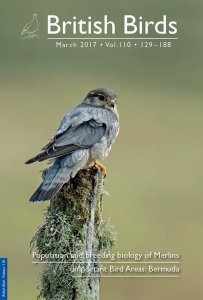
british-birds-march-2017-coverA new paper has just been published in the latest edition of British Birds (March 2017) detailing a 30-year study of breeding merlins on four grouse shooting estates in the Lammermuir Hills in south east Scotland:

Heavisides, A., Barker, A. and Poxton, I. (2017). Population and breeding biology of merlins in the Lammermuir Hills. British Birds 110: 138-154.

The authors are long time members of Lothian & Borders Raptor Study Group and this paper is the latest in a series of peer-reviewed scientific papers written by Scottish Raptor Study Group members reporting on the detrimental effects of intensive grouse moor management on several raptor populations. Other recent publications have included the catastrophic decline of hen harriers on NE Scotland grouse moors, here and the long-term decline of peregrines in the uplands of NE Scotland, here.

The results of the Lammermuir merlin study suggest that illegal persecution is NOT thought to be a contributing factor in this population’s decline. Merlins are generally tolerated on UK grouse moors (presumably as they’re not a big threat to red grouse) and the grouse shooting industry will often use the merlin’s breeding success on grouse moors to counter any accusation that raptors (in general) are illegally killed there. Obviously, that argument doesn’t stand up to scrutiny.

What is suggested in this paper is that an intensification of grouse moor management in the Lammermuirs over the last ten years has probably had an impact on this merlin population, particularly an increase in the heather burning regime.

It’s also interesting to note the authors’ records of other breeding raptor species in the Lammermuirs:

Only three hen harrier broods were found throughout the study period, the last in 1994.

There were at least three sites where peregrines attempted to breed in the early years of the study, the last successful one being in 1994.

Buzzards are commonly seen in the Lammermuirs but only nest on the periphery of the study area, “probably because all of the suitable trees that were used previously have now been removed”.

Short-eared owl sightings were “quite frequent” in the early study years and nests were “occasionally found”, but “these casual observations declined as the years went by and became unusual during the later years”.

Unfortunately we’re not allowed to publish the full paper here (you’ll either have to subscribe to the British Birds journal or contact one of the authors and ask for a copy for personal use). We can, though, publish the abstract. Here it is:
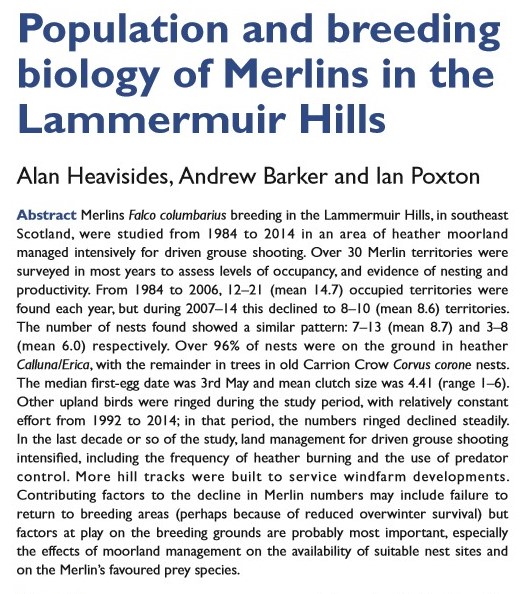
merlin-abstract

This long-term study was brought to an abrupt end after the 2014 breeding season. This is touched on in the paper but has been more elaborately described during recent conference presentations by one of the authors. The authors mention they enjoyed good cooperation from landowners and gamekeepers during the early study years, and were granted permission to drive their vehicles on estate roads to help access some of the more remote nest sites. However, in 2015, when the researchers contacted the estates to let them know that fieldwork was about to begin, two of the four estates told them they were no longer welcome and withdrew permission for vehicular access.

The authors believe this was a reaction to criticism made directly by the study team of various aspects of the estates’ grouse moor management techniques, particularly the increased use of bridge (rail) traps that were catching / killing non-target species such as dippers, merlin and ring ouzels. The authors also speculated that it may have been a more ‘general backlash’ following recent widespread criticism of driven grouse moor management across the UK.

Whatever the reason was, it flies in the face of the Scottish Moorland Group’s recent claim to the Scottish Parliament’s Environment Committee that grouse moor owners, “Would very much like to see greater cooperation between ourselves, the Raptor Study Groups, and the RSPB” (see here).

Really? Funny way of showing it.

The two estates in question are reported to be the Roxburghe Estate and the Hopes Estate. It’s fascinating to see the Hopes Estate involved in all this.

The Hopes Estate is owned by Robbie Douglas Miller, who also happens to run the Wildlife Estates Scotland (WES) scheme, administered by Scottish Land & Estates, as a way of showcasing the, ahem, fabulous work that estates undertake to protect wildlife. We’ve recently blogged about one of these accredited WES estates – the Newlands Estate where gamekeeper Billy Dick was convicted of throwing rocks at, and stamping on, a buzzard (see here).

In 2014 the Hopes Estate gained accreditation to the WES scheme – independently verified, of course. Estates that are awarded accreditation have to meet certain criteria, including:

  • Commitment to best practice
  • Adoption of game and wildlife management plans that underpin best practice
  • Maintaining species and habitats records
  • Conservation and collaborative work
  • Integration with other land management activities (such as farming, forestry and tourism)
  • Social, economic and cultural aspects (such as employment, community engagement and communications)

Hmm.

Environment Secretary’s message to Scottish gamekeepers re: raptor persecution

roseanna-cunninghamLast week, Environment Cabinet Secretary Roseanna Cunningham gave a speech at the Scottish Raptor Study Group’s annual conference, where she described, with feeling, her ‘contempt‘ for the continued illegal persecution of birds of prey (see here).
Her speech was warmly welcomed by those in the audience and many were hoping she would deliver the same message when she spoke at the Scottish Gamekeepers’ Association AGM, six days later on 3 March.

It seems as though she did. According to this article in the Courier, her speech to the SGA was similarly-worded and hopefully it was delivered with the same strength of feeling she gave at the SRSG conference.

Here are some quotes from her SGA speech:

Not only are you valuable eyes and ears in the Scottish countryside, but you are stakeholders in the Partnership for Action Against Wildlife Crime, with a vital role to play.”

We also need to continue to work together to change attitudes and every person in this room can help“.

The successful reintroductions of red kite and white-tailed eagle, and the recent 15% increase – which is in real terms a recovery – in golden eagle numbers, from the results of the last national survey – is welcome progress“.

For many people seeing these magnificent birds is a rare event. Many of you here today are in the fortunate position of seeing them regularly and I envy you that“.

Unhappily however the illegal killing of raptors is still with us“.

I have no patience at all with old fashioned attitudes towards these birds that linger on in this day and age. We all have to abide by the law, and must do so every day“.

I have no truck with any excuse that raptors damage driven grouse shooting interests – such damage is a business risk that grouse moor owners have to live with, and manage for – and this has to be done within the law“.

I note and welcome your chairman Alex Hogg’s reiteration of the pledge to ensure SGA members only consider legal routes to conflict resolution and he has made it clear that those committing wildlife crime will be removed from the SGA.

Although it looks like she didn’t go as far as directly pointing the finger at the SGA, it is to be hoped that the sub-text was clear enough to have some people squirming in their seats.

As several commentators have mentioned on this blog, although the Environment Secretary’s words were welcome, we have heard them all before, not only from her but also from three previous Environment Ministers, and yet raptor persecution continues. For now though, we’re cautiously giving Roseanna Cunningham the benefit of the doubt.

Yes, her words to the SGA are a big improvement on the words her predecessor gave to the SGA (see here) and yes, she’s bought herself and the Scottish Government a bit more time with these two speeches, but society’s patience is not limitless. We expect to see further measures enacted, and soon. There will be a lot of attention placed on the Cabinet Secretary’s response to the recently-published game bird licensing review, the forthcoming review of satellite tagged raptors, and the decision on whether to give increased investigatory powers to the SSPCA.

There’ll also be a great deal of attention paid this year to whether SNH grants licences to gamekeepers allowing them to kill protected raptors and if so, on what grounds? Roseanna has been clear that any perceived damage by raptors to grouse moor management should be a ‘business risk’ that has to be ‘managed within the law’. The SGA will no doubt argue that applying for licences to kill raptors would be ‘managing the business risk within the law’ and technically, they’d be correct, in as much as the provision is there to apply for such licences but whether protecting artificially high numbers of game birds is justification for legally killing protected raptors, especially when illegal raptor persecution continues, is an argument that will dominate MSPs’ inboxes if licences are given this year.

Interesting times ahead.

Are red grouse safe to eat? Don’t rely on Government testing to tell you

grit-box-rpuk2-copyAbout eighteen months ago in October 2015 we wrote a blog about the use of medicated grit to dose red grouse with a parasitic wormer drug called Flubendazole.
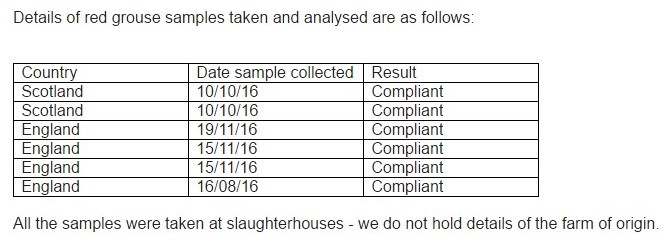
We’d learned that this practice was largely unregulated (surprise!), that some grouse moor managers were using a super-strength drug that was 10 times, and sometimes 20 times, the strength permitted for use in the UK, and, most incredibly, that the Government’s statutory agency (Veterinary Medicines Directorate (VMD)) responsible for monitoring meat to ensure harmful drugs are not entering the human food chain, had not ever tested a single red grouse for residues of Flubendazole because, they said, they didn’t know where to find dead red grouse (see here).

It was shocking stuff. When we pointed out to the so-called specialists at the VMD that dead red grouse could be found at the same processing facilities where the VMD was already testing other gamebirds for veterinary residues (duh), the VMD promised to start testing red grouse in 2016.

So, we waited until the end of the 2016 grouse shooting season and submitted an FoI to the VMD to ask them how many individual red grouse they’d tested in 2016 in England & Scotland, and from how many geographically separate grouse moors the birds had originated, and a few other things too.

The VMD’s response is staggering. Here it is:

vmd_redgrouse2016

So in 2016, the VMD managed to test four red grouse from England and two from Scotland. That’s it. And they apparently don’t have a record of where those six samples originated, which is very hard to believe. What would happen if the samples were found to contain illegal residues of this veterinary drug? Would the VMD just shrug their shoulders and say, ‘Sorry, can’t take any action ‘cos we’re too incompetent to have recorded the site of origin’?

We wondered what proportion of the 2016 red grouse bag this ludicrously small sample size represented. Unfortunately we’ve been unable to find out how many red grouse were shot during the 2016 shooting season because there is no statutory requirement for the grouse shooting industry to record these data, let alone publish them. The GWCT apparently maintains a record of the national bag but who’s going to believe their figures, especially when their Director of Research is on record as saying information about grouse moor management should be “kept under the radar” in case the regulators start sniffing around?

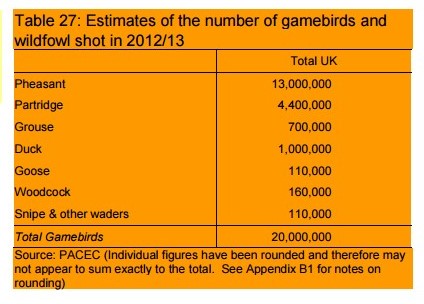
What we did find, though, was an estimate of the number of red grouse shot in the UK in 2012/2013 (source: PACEC report 2014).

grouse-shot-20123_pacec2014

So let’s assume this estimate of 700,000 shot red grouse was applicable to the 2016 shooting season. Does the VMD believe that sampling six out of 700,000 is a good indicator of compliance?

So if you choose to eat red grouse, that so-called “natural” and “healthy” product (see hereherehere and here), bear in mind that not only has that meat probably not been tested for veterinary medicine residues and pesticides, but it also won’t have been tested for toxic lead either (because for some strange reason, gamebird meat is exempt from lead testing).

Bon appetit!

Ps. For anyone interested in the VMD’s wider sampling regime in 2016 (e.g. cattle, sheep etc), this spreadsheet is helpful: national-statutory-surveillance-scheme-for-veterinary-residues-in-animals-and-animal-products_2016

Our 7th birthday

Sometimes it feels like we only started this blog yesterday, and sometimes it feels like we’ve been writing it for years. It turns out we have – seven of them.

The number of blog hits received in the last year almost doubled from the previous year and we’re now heading towards three million views. That’s very satisfying and is undoubtedly a result of an increased social reach on twitter and facebook. Thank you to everyone who reacts and spreads the word either by re-tweeting or sharing. Thanks also to those who comment on the blog, and on social media – it makes it all the more interesting, for us and for other readers.

rpukbdaystats

Our top ten most read blogs from the last year are as follows:

  1. Natural England issues licence to kill buzzards to protect pheasants (here)
  2. National Trust pulls grouse shooting lease in Peak District National Park (here)
  3. Queen’s Balmoral Estate accused of mountain hare massacre (here)
  4. Faking it (here)
  5. More mountain hares slaughtered in the Angus Glens (here)
  6. More mountain hares massacred in the Cairngorms National Park (here)
  7. The illegal killing of birds of prey in the Cairngorms National Park (here)
  8. Chris Packham has a message for Marks & Spencer (here)
  9. Mass raptor poisoning in Wales: location revealed (here)
  10. Catastrophic decline of breeding hen harriers on grouse moors in NE Scotland (here)

This year, an incredibly generous sponsor has stepped forward to help pay for the time it takes to research and then write this blog. We’re massively grateful for this support, not just as a vote of confidence in what we’ve been doing, but because it will allow us to do so much more.

And there’s plenty more to do.

Here’s to another year of it.

Andy Wightman MSP tables parliamentary motion for increased powers for SSPCA

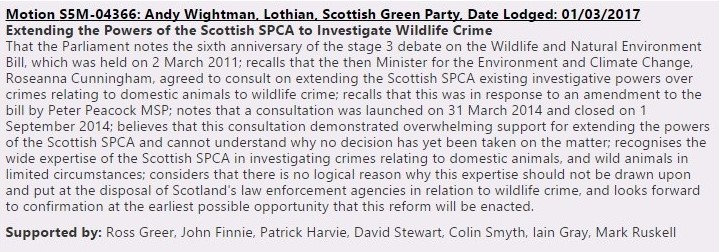
andyw2Scottish Greens MSP Andy Wightman has tabled a parliamentary motion calling on the Scottish Government to increase the investigatory powers of the SSPCA.
Regular blog readers will know that a succession of Environment Ministers (five!) in the Scottish Government have dragged out this fiasco for an embarrassingly long number of years (six years today, in fact).

For new blog readers, here’s a summary timeline.

In January this year, in response to a parliamentary question from Scottish Greens MSP Mark Ruskell, the Environment Cabinet Secretary Roseanna Cunningham said she would announce a decision “in the first half of 2017“. That gives her until the end of June.

She was also asked about this decision during her visit last weekend to the Scottish Raptor Study Group’s conference. She responded with caution and told the audience it was a “complex issue” and much more complex than people thought.

It isn’t complex at all. It’s quite straightforward. Here is a brief overview of the issue:

Currently, the SSPCA has the statutory power to investigate wildlife crimes that involve an animal in distress. So for example, if they are called out to an incident of a golden eagle that had been caught in an illegally-set spring trap and the eagle was still alive, the SSPCA has the power to collect evidence as part of a criminal investigation. This is because they have powers under the animal welfare legislation and this incident would certainly fall into a welfare category where the animal was ‘under the control of man’.

However, if they are called out to an incident where a golden eagle had eaten a poisoned bait and had died two minutes before the SSPCA arrived on scene, the SSPCA does not currently have the power to investigate because the welfare legislation doesn’t apply (the bird is already dead) and the dead bird is not ‘under the control of man’. In this scenario, all the SSPCA can do is to call the police and hope that the police attend the scene in a timely manner. How stupid is that?

Another example – if the SSPCA was called out to an incident of an illegally-snared badger, and that badger was already dead, and the SSPCA found 100 illegally-set snares at the same location, the SSPCA would not be able to investigate; they would have to rely upon the police to attend. If the badger was still alive (suffering), the SSPCA could investigate.

The proposal laid out in the consultation is to widen the investigatory powers of the SSPCA so that they’re not just limited to operating under welfare legislation; the increased powers, if granted, would also allow them to operate under certain parts of the Wildlife & Countryside Act in addition to the welfare legislation.

Importantly, the increased powers would  allow them to continue their investigations into animal welfare incidents where an animal is in distress, but also to investigate wildlife crimes where the animal is already dead, and even wildlife crimes that haven’t yet involved an animal – for example an illegally-set trap.

Here is MSP Andy Wightman’s parliamentary motion:

pm

If you live in Scotland, please contact your MSP and encourage them to support this parliamentary motion. Environment Cabinet Secretary Roseanna Cunningham needs to see the strength of feeling on this before she makes her decision in June. If you’re not sure who your MSP is, you can find them here.