Review of gamebird licensing systems due to be published ‘shortly’

Earlier this month we blogged about the long-overdue commissioned review of gamebird licensing systems (see here). This review was first commissioned by former Environment Minister Paul Wheelhouse, way back in May 2014.

In January last year, in response to a Parliamentary Question from Claudia Beamish MSP (Scottish Labour), the then Environment Minister Dr Aileen McLeod said it would be published in Autumn 2016.

In August 2016, in response to another Parliamentary Question from Claudia Beamish MSP, Environment Cabinet Secretary Roseanna Cunningham said it would be published in Autumn 2016.

In November 2016, in response to a Parliamentary Question from Mark Ruskell MSP (Scottish Greens), Environment Cabinet Secretary Roseanna Cunningham said, “We anticipate that it will be published shortly“.

In January 2017, Mark Ruskell MSP asked again in a further Parliamentary Question when this review would be published.

Environment Cabinet Secretary Roseanna Cunningham has now responded (on 17 Jan 2017):

Scottish Natural Heritage will publish the commissioned research on gamebird licensing systems in selected other countries shortly“.

This stretching of the definition of ‘shortly’ is not uncommon in politics. In December 2016, John Finnie MSP (Scottish Greens), exasperated at the use of this term in relation to another Parliamentary Question, asked the Scottish Government: ‘…..what its definition is of the term ‘shortly’ and whether it will confirm by what date the announcement will be made‘ (Question S5W-05839).

Humza Yousef, Minister for Transport and the Islands responded almost one month later:

I shall reply to the member as soon as possible‘.

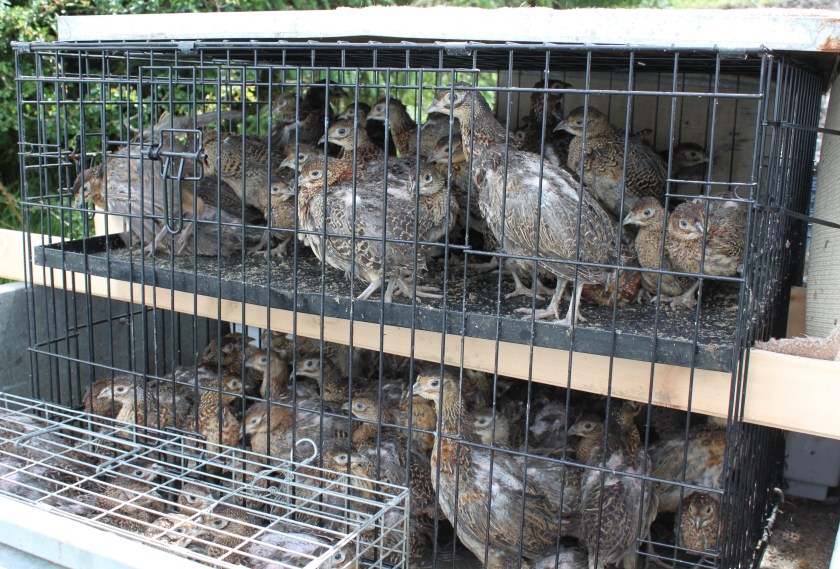
Photo of gamebirds being transported to a release pen, by RPUK

Another question on withheld raptor persecution data

mark-ruskellWe’ve talked quite a bit on the issue of withheld raptor crime data from the Scottish Government’s 2015 annual Wildlife Crime report. We blogged about it when the report was published in November 2016 (here) and again earlier this month when Mark Ruskell MSP asked for an explanation from Police Scotland during the recent ECCLR Committee hearing on wildlife crime (see here).

This issue was raised again on Thursday during a general question session at Holyrood. The topic of ‘crime recording’ was being discussed and Mark Ruskell took the opportunity to ask a supplementary question:

“The cabinet secretary might be aware that “Wildlife Crime in Scotland—2015 Annual Report” came under scrutiny recently in the Environment, Climate Change and Land Reform Committee. It was revealed that a number of bird of prey persecution incidents from two years ago were withheld from the report despite details from other sources being in the public domain. Will the cabinet secretary undertake to investigate why that information was withheld, and will he say what Police Scotland can do to ensure that wildlife crime reporting is transparent, accurate and has the confidence of the public?”

The Cabinet Secretary for Justice, Michael Matheson, responded as follows:

“Classification and the way issues are recorded in the statistics are developed by statisticians, and the approach must comply with the code of practice that is applied to recording of crime statistics. I have no doubt that if the Scottish crime recording board believes that there is a need for any alterations, it can consider that issue, as we move forward with any changes that could take place. However, I will ensure that Mark Ruskell receives a full and detailed response on the specific nature of wildlife crimes”.

The withholding of the raptor persecution data probably wasn’t due to a faulty classification system developed by statisticians. The missing data included incidents that were very clearly crimes – there’s no ambiguity about whether 4 shot buzzards, a trap containing a live pigeon decoy, and spring traps set in the open, were crimes. They obviously were crimes, even though the police-led investigation didn’t identify the person(s) responsible for those crimes.

We await Police Scotland’s explanation for why these crimes were withheld from the Government’s annual report.

Thanks to Mark Ruskell MSP (Scottish Greens, Mid Scotland & Fife) for his persistence on this issue.

Satellite-tagged hen harrier ‘Bonny’ is missing, presumed dead

Another one of the preciously small group of hen harriers that managed to fledge in England last year has been reported as missing, presumed dead.

Read the news on the RSPB’s Skydancer blog here.

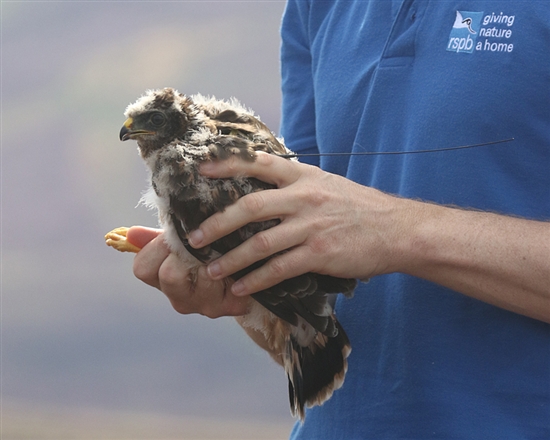
This time it’s Bonny. Bonny was particularly special. He was the first hen harrier to successfully fledge on the RSPB’s Geltsdale Reserve in ten years. He was mischievously named after Tim Bonner, head of the Countryside Alliance (watch the video here) by Chris Packham, as part of the Lush Skydancer Bathbomb campaign. Bonny was featured on the BBC’s Autumnwatch programme, which was a major coup because usually the BBC shies away from the ‘controversy’ of hen harrier persecution but by filming Bonny being fitted with his satellite tag, this allowed a ‘non-controversial’ way of introducing a massive BBC audience to the plight of hen harriers – hopefully his story will be covered in the BBC’s forthcoming Winterwatch, which airs next week, thus providing an opportunity to discuss what might have happened to this young harrier.

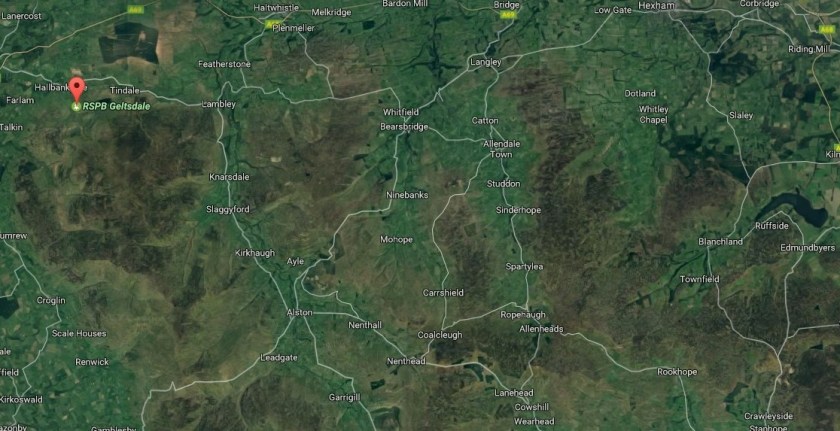
As the RSPB’s Skydancer project manager Blanaid Denman says on the Skydancer blog, we don’t know what happened to Bonny. His signal went dead on 14 December 2016 on a moor a few kilometres to the east of Geltsdale. It’s possible it’s a tag failure, but the probability of something more sinister is far greater, especially when you consider the history of raptor persecution in the Geltsdale area.

Over the years, the bodies of five shot hen harriers have been found (the killing of one of these was witnessed by RSPB investigators – see pages 38-40 in Mark Avery’s book Inglorious for a detailed description), there have been at least four attempted shootings of hen harriers, and another hen harrier was found poisoned. In addition, there have been poisoned ravens, poisoned buzzards and some shot peregrines.

Some of these crimes happened on the Geltsdale Reserve (safe to assume this wasn’t the handiwork of the RSPB wardens) and some of the crimes happened on nearby grouse moors. Take a look at the map and note those big brown smudges. When you look at the extent of the driven grouse moors here, and the long, long history of raptor persecution, it’s a miracle that Bonny even fledged in the first place.

The class of 2016 are not doing very well. In addition to Bonny, here are some of the others that didn’t make it to Xmas:

Hen harrier Elwood – ‘disappeared’ in the Monadhliaths just a few weeks after fledging.

Hen harrier Brian – ‘disappeared’ in the Cairngorms National Park just a few weeks after fledging.

Hen harrier Donald – missing in northern France, presumed dead.

Hen harrier Hermione – found dead on Mull, believed to have died from natural causes.

Hen harrier Rowan – found dead in Yorkshire Dales National Park. Cumbria Police said ‘likely to have been shot’. There is no ambiguity – this bird was shot (more on this soon).

Hen harrier Tarras – ‘disappeared’ in the Peak District National Park.

Hen harrier Beater – missing in Scottish Borders, presumed dead.

Eight down, seven to go (Aalin, Carroll, DeeCee, Finn, Harriet, Wendy, Sorrel).

Photograph of hen harrier Bonny by Mark Thomas

Kestrel found shot dead in Worcestershire

A kestrel has been found shot dead in the village of Broadwas in Worcestershire. It was discovered on 10 January 2017.

This information was sent to us by a blog reader (thank you). The kestrel had been ringed in Warwickshire in June 2016 and whoever found the body in Worcestershire reported the ring number to the British Trust for Ornithology (BTO), who then sent a ‘ringing return’ note to the bird ringer, to inform him / her of the bird’s death.

According to this ringing return, the bird had been categorised as being ‘dead for more than a week, not fresh, found shot’.

What’s interesting about this, apart from the utter stupidity of the person who shot this bird (it’s a kestrel for god’s sake, what possible reason would there be for shooting it?), is what happens to the data after being reported to the BTO.

It’s our understanding that the BTO does not, as a matter of routine, forward data about suspected persecution incidents to the Police or the RSPB.

If our understanding is correct, this situation is quite astonishing. Surely there’s an ethical responsibility for the BTO to report suspected persecution incidents, to allow the Police or RSPB to undertake follow up investigations? Even if nothing comes of any investigation, these cases would still provide useful background intelligence and, importantly, would contribute to a better understanding of the extent of illegal raptor persecution in a given area. Reporting suspected crimes to the Police / RSPB would not affect the usefulness of the data to the BTO – the BTO could still use the data for trend analyses etc, it’s not as though the data point would be ‘lost’ if it was reported to the authorities.

How many of these suspected persecution incidents go unreported by the BTO every year? Is it the BTO’s responsibility to report suspect crimes, or is it the responsibility of the ringer (once notified of the circumstances of a bird’s death via the ringing return from the BTO), or is it nobody’s responsibility?

It’s all very strange.

Photo of a kestrel by Graham Catley

UPDATE 3.30pm: The BTO has responded to this post on Twitter as follows: ‘The finder has responsibility to report any suspicious deaths but we will review to see if there is more we can do’. Good for them.

Edward Mountain MSP – the fiercest critic of those committing wildlife crime?

Edward Mountain MSP is a new member of the Scottish Parliament (Scottish Conservative & Unionist Party, Highlands & Islands).

Edward recently wrote a guest article for the Scottish Gamekeepers’ Association’s quarterly rag, Scottish Gamekeeper (Issue 71, winter 2017, page 20). We’re going to reproduce part of that article:

I believe that challenging the ‘spectre’ [of land management reform] is vital, if the very countryside we all value and love is to be maintained. The way to do this is by standing tall and laying out a stall, for all to see the benefits positive management has to offer. The problem is that every time it looks like the right story is being delivered another case of wildlife crime comes to light. If there is any chance of moving forward we must stop these idiots, who believe illegally killing raptors is acceptable.

I therefore would urge all organisations that represent country folk to stand up and let people know all the good work that is being done for conservation. At the same time, they also need to vilify those that break the law.

Over the next 4.5 years I look forward to working with the SGA and I will do all I can to defend the values you and your members believe in. However, I must also say that I will be the fiercest critic of those that jeopardise these values by breaking the law‘.

Good strong words, but will he put them in to action?

His article for the SGA was probably written before he hosted a parliamentary reception at Holyrood for the Scottish Country Sports Tourism Group in mid December 2016 (see here). The reception was to launch the ‘Game for Growth’ initiative that is using public funds to promote country sports providers in Scotland.

We now know that these public funds are being used to promote a sporting agent with a conviction for raptor persecution (see here) and two estates where illegally-set traps have been discovered (see here).

Now’s your chance, Edward – it’s been put on a plate for you. As you’re so publicly supportive of this Game for Growth scandal, are you going to stand up and be “the fiercest critic” of the associated wildlife crimes?

We’ll see.

Public funds being used to promote Glendye grouse moor

Yesterday we blogged about the illegally-set traps that had been photographed on a grouse moor at Glendye Estate in Aberdeenshire (here). We await the result of a police investigation to determine who was responsible for setting those traps (but we’re not holding our breath).

Meanwhile, as taxpayers, you’ll all be thrilled to learn that your money is being used to promote grouse shooting on Glendye Estate. This estate is listed on the Scottish Country Sports Tourism Group’s website, which is part-funded with a grant from VisitScotland.

We already knew that the Scottish Country Sports Tourism Group is promoting a sporting agent with a criminal conviction for raptor persecution (see here), so it shouldn’t really come as a surprise to find them also promoting a grouse moor where illegally-set traps have been discovered. In fact the SCSTG was already doing this because Invercauld Estate is also being promoted as a ‘sporting provider’ on the SCSTG website – you’ll recall that illegally-set traps were discovered on an Invercauld Estate grouse moor last summer and this resulted in what we believe to be a ‘cover-up’ by the authorities (see here).

Why is public funding being used to promote a ‘sport’ that is mired in illegal activity? It’s bad enough that public funds are being used to promote such an environmentally damaging ‘sport’ but to promote estates where criminal activities have been uncovered is scandalous. Why is the Scottish Government still turning a blind eye to what’s going on on some of these estates, despite incident after incident after incident after incident after incident after incident being uncovered? Scottish Ministers are being made to look like fools.

Illegally set traps on Glendye Estate grouse moor, Aberdeenshire

Have a look at this blog. You’ll see a series of photographs, taken yesterday (17 January 2017) on a grouse moor at Glendye, just beyond the famous Clachnaben hill, which is part of the Fasque & Glendye Estate according to Andy Wightman’s always useful website Who Owns Scotland. This area looks like it’s the area covered by the Glendye Grouse Syndicate who apparently took on a 20-year lease of this moor in 1997.

We’re not allowed to reproduce the photographs here so you’ll have to click the link if you want to see them. And you really should see them.

Three of these photographs depict illegally-set traps. They are all ‘bridge traps’ – comprising a Fenn spring trap fixed to a log across a burn or gully and designed to catch so-called ‘vermin’ such as stoats or weasels. This type of trap is legal if the trap is covered either in a natural or artificial tunnel, but the three traps photographed yesterday are definitely illegal.

One is covered with wire mesh but the entry and exit holes are wide open. This is illegal. These entry/exit holes are supposed to be partially closed to minimise the risk of catching non-target species. This trap in the photograph could easily catch a non-target species, including protected Scottish wildcats, otters and pine martens.

The other two spring traps are totally uncovered except for a single wire loop above each trap. A wire loop is not going to protect any species from standing on these traps and thus both traps are illegal. These two traps are effectively pole traps – if a bird or mammal stands on the trap, the trap will fall from the log, with the animal attached (probably by the leg), and the animal will dangle, suspended below the log, until it dies a slow, miserable death.

We don’t know whether the photographer has reported these crimes to the local police. We would hope he has – he understands that the traps are illegally-set (the safety catch is not on – we’ve looked) so we’d expect him to have provided grid references and photographs to the local Police Wildlife Crime Officer. In case he hasn’t reported them, we’ll do it for him, although by now the individual who set these traps has probably been alerted and is probably out on the moor removing all the evidence as we speak.

The local Police Wildlife Crime Officer is Doug Darling. Here’s his email address: douglas.darling@scotland.pnn.police.uk

Ask him for a crime reference number so we can follow up what action he has taken to identify the individual(s) responsible. This is important because after his investigation, we expect him to alert SNH to these illegal traps. Why? Well, because these illegal traps should result in the withdrawal of the General Licence on this grouse moor. According to SNH guidelines, evidence which may be considered by SNH in any decision to impose a General Licence restriction includes:

Illegal placement, design or use of traps or methods that are not in compliance with the requirements of the General Licence‘.

However, the evidence must be provided by the Police. So, just in case the Police ‘forget’ to tell SNH, we’ll notify SNH as well so they can’t then argue they haven’t been informed. Emails should be sent to Nick Halfhide, Director of Operations: nick.halfhide@snh.gov.uk 

To be fair to SNH, they are probably awaiting the findings of the Raeshaw Estate judicial review before they impose any more General Licence restrictions. That’s fine, they can just add this case to the others they’re currently sitting on and hopefully they’ll be in a position to take action in due course.

And, if you’re in the mood for writing emails, you might also want to alert the Environment Cabinet Secretary, Roseanna Cunningham, to these illegally-set traps. The information will be very helpful as she ponders the issue of introducing state-regulated licensing. These photographs confirm that law-breaking continues, despite the grouse shooting industry’s fervent claims to the contrary. Emails to: scottish.ministers@gov.scot and mark it FAO Roseanna Cunningham.

We wonder what the grouse shooting industry’s Gift of Grouse project has to say about these illegal traps? We wonder if Glendye is part of the Grampian Moorland Group, which in turn is part of the Gift of Grouse propaganda campaign? That’d be interesting…..

UPDATE 17 March 2017: Update on illegally-set traps on Glendye grouse moor (here)

ECCLR review of wildlife crime report: session 1

Last week the Scottish Parliament’s Environment, Climate Change & Land Reform (ECCLR) Committee held an evidence session in which to review the Scottish Government’s 2015 Annual Wildlife Crime Report.

The archived video can be watched here

The official transcript can be read here: ecclr-transcript-wildlife-crime-10-jan-2017

The evidence session took place in two parts: the first session involved witnesses from Police Scotland and the Crown Office, and the second session heard evidence from RSPB Scotland, Scottish Badgers, Scottish Gamekeepers’ Association and the Bat Conservation Trust.

This blog focuses on session 1 (we’ll blog about session 2 in another blog).

ecclr1

The witnesses in session 1 were Gary Aitken (Crown Office), ACC Steve Johnson and DCS Sean Scott (Police Scotland). DCS Scott has appeared in front of this committee in previous years (when it was the RACCE committee) but this was a first time appearance for ACC Johnson and Gary Aitken.

Session 1 lasted for about two hours and it’s fair to say these witnesses were given quite a grilling. The ECCLR Committee was extremely well informed and in some cases there was some pretty persistent (but respectful) questioning, notably by Mark Ruskell MSP and Claudia Beamish MSP.

We’ve already blogged about part of this session (see here) in relation to Police Scotland’s inability to answer Mark Ruskell’s question about why some confirmed raptor crimes had been withheld from the Government’s 2015 report. We await Police Scotland’s written explanation to the Committee in due course. A similar problem was raised in this session re: the huge discrepancy between the number of crimes against badgers recorded by Scottish Badgers ( n = 42) and those recorded by Police Scotland (n = 5). Again, Police Scotland has been asked to provide a written explanation to the Committee, which will be important because this appears to be a recurring issue. It was good to hear  though, that Police Scotland has recently set up some new reporting mechanisms with Scottish Badgers, as well as training days for officers. Hopefully this will improve communication and understanding between them.

There was good discussion about increased powers for the SSPCA (Police Scotland appears to have softened its stance on this a bit, although we’re all STILL waiting for the Environment Cabinet Secretary to announce the Government’s position on these increased powers), agreement that increased penalties for wildlife crime would be very welcome, and also agreement on the importance of being able to identify accountable individuals for potential vicarious liability prosecutions. All good.

On the whole, Police Scotland and the Crown Office were far more circumspect at this hearing than in previous appearances. We were very pleased to hear ACC Johnson acknowledge that the full extent of wildlife crime in Scotland is an ‘unknown’, in complete contrast to his predecessor’s (ACC Malcolm Graham) ludicrous claims that Police Scotland ‘wasn’t missing much of it’ (see here).

We were also very pleased to hear ACC Johnson’s acknowledgement that the scientific / academic evidence [of the effect of persecution on the distribution and abundance of raptor populations] was a “strong part” of the evidence of wildlife crime.  However, none of this scientific evidence had appeared in the Government’s 2015 annual report and Mark Ruskell MSP asked what progress had been made in assessing this evidence; something ACC Graham had committed to doing last year. The responses from ACC Johnson and DCS Scott were utterly astounding. They both said they’d be happy to look at the scientific evidence ‘if it was brought to their attention’.

What? Are they for real? Are they seriously suggesting they’re unaware of the massive body of scientific evidence? They’re having a laugh, aren’t they?

How many peer-reviewed scientific reports and papers have been published on this issue in the last 20 years? Bloody loads of them! Here’s a list of some of them and hereherehere are some more that have been published in the last year alone and here, here are some preliminary scientific results, all widely reported in the media, that are due to be written up as scientific papers in the immediate future.

Sorry, ACC Johnson and DCS Scott, your claimed ignorance of the scientific evidence just doesn’t wash. Especially DCS Scott, who chairs the PAW Raptor Group, where some of these scientific results have been frequently discussed.

So why claim ignorance? Was it to cover up Police Scotland’s inaction on this issue? If so, that’s not nearly good enough. For two years in a row now Police Scotland has committed to assessing the scientific evidence and incorporating it in to its ‘intelligence-led’ investigations. We, and no doubt the ECCLR Committee, will expect to see progress on this when the Government’s 2016 annual report is published later this year.

Crowdfunding appeal to help support Hen Harrier Day 2017 in Scotland

Hen Harrier Day, now in its fourth year, has quickly become established as THE day to raise awareness about the illegal persecution of hen harriers in the UK.
The idea was first mooted by Mark Avery, who suggested using the anniversary of the shot hen harriers at Sandringham to ‘stir things up’ each October  with a ‘Harrier Day’ (see page 203 in his book Fighting for Birds).

The idea was later developed by Alan Tilmouth who was working with Birders Against Wildlife Crime (BAWC), and he suggested having a Hen Harrier Day in August, just prior to the start of the grouse shooting season. This made perfect sense given that hen harrier persecution is so closely associated with driven grouse shooting.

From humble beginnings in 2014, Hen Harrier Day has grown and draws wide media attention across the country, much to the consternation of the grouse shooting industry. Last year, BAWC helped coordinate 12 events in England, Scotland and Northern Ireland (see here for an overview) and preparations are now underway for 2017.

In Scotland, Tayside and Central Raptor Study Groups are planning another Hen Harrier Day event and they need your help. They would like to be able to hire a marquee to provide a more robust venue and offer a bit of protection from inclement weather. A crowdfunding page has been set up to raise £500 to cover this cost.

If you’d like to donate, please visit the donations page HERE

If you’re unable to donate but would still like to offer support, please spread the word amongst your friends, family and colleagues.

Thanks!

UPDATE 16 January 2017: The target of £500 has been met! Many thanks to all who helped with this.

Public funds to promote wildlife criminals in Scotland?

In December 2016 we blogged about the ‘Game for Growth’ strategy, which is a plan to promote Scottish country sports and boost its value to the economy. The strategy, which was launched at a parliamentary reception on 20th December 2016 (here) is being led by the Scottish Country Sports Tourism Group (SCSTG) and is being part-funded by VisitScotland using tax payers’ money (see here).

You may recall that Scottish Greens MSP Andy Wightman lodged a parliamentary question about the use of these public funds, as follows:

Question S5W-05930: Andy Wightman (Lothian, Scottish Green Party). Date lodged: 22/12/2016

To ask the Scottish Government whether it will provide a breakdown of the recipients of financial contributions from VisitScotland to the strategy, Game for Growth Strategy – Country Sports Tourism in Scotland 2016; what information it has regarding how each recipient will use this; what action it has taken to ensure that no money was provided to the owners or managers of landholdings on which crimes against wildlife have been committed; whether it will publish the strategy on its website, and what aspects of this it is supporting or plans to support with public money.

This question has now been answered:

Answered by Fiona Hyslop MSP (Cabinet Secretary for Culture, Tourism & External Affairs) on 11/1/2017:

VisitScotland has approved a grant of £17,925 to the Scottish Country Sports Tourism Group to promote Scotland as the destination of choice for all country sports. The Group will use this to develop content and supporting digital activity to attract visitors from across the UK and Scandinavia. As this money is for a specific project, no funding will be provided to individual estates or land owners. There is no intention to publish the strategy on VisitScotland’s website and so there will be no funding support for this.

It’s an interesting response. It does clarify that public funds (at least these public funds) will not be given directly to individual estates or landowners, but it is also clear that individual estates will still benefit from this public funding, albeit indirectly, because the SCSTG will use the funds to promote these individual estates as part of an online PR campaign.

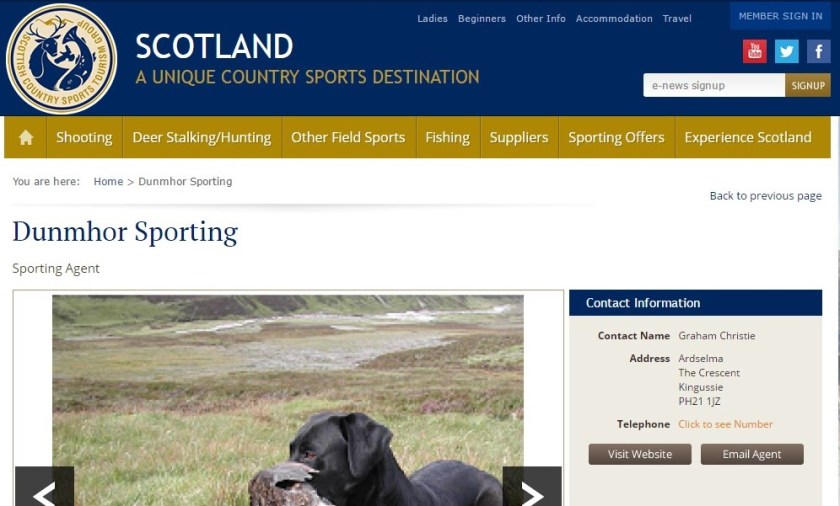
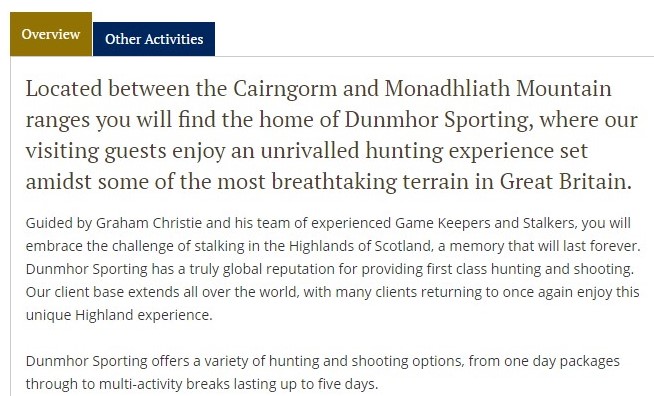
In our December blog, we noted that the SCSTG website was promoting the Dunmhor Sporting Agency as a provider of country sports activities in Scotland:

We were surprised to see Dunmhor Sporting being promoted on the SCSTG website because Graham Christie of Dunmhor Sporting was convicted in December 2015 of being vicariously liable for the criminal actions of his gamekeeper, who had used an illegal gin trap to catch and injure a buzzard on the Cardross Estate. We just looked at the SCSTG’s website again and Dunmhor Sporting is still being promoted as a country sports provider.

So much for the game shooting industry ousting its criminal members.

We wonder whether the Cabinet Secretary for Culture, Tourism & External Affairs, Fiona Hyslop, is aware that a now (part) publicly funded organisation (the Scottish Country Sports Tourism Group) is promoting a convicted wildlife criminal and if so, whether she thinks this is an appropriate use of public funds?

Emails to: scottish.ministers@gov.scot and mark it FAO Fiona Hyslop